







Abstract
There is an urgent need to address the nursing faculty shortage and evaluate current enrollment in nurse educator programs across the country. In this article, we describe a nationwide review of graduate nursing programs focusing on the nursing education shortage; program, faculty, and student demographics; methodological approaches; concentrations, content and practice areas; and future directions for graduate program development.
Keywords
The preparation of nurse educators at the graduate level has become increasingly important as our country continues to focus on health care reform, and integration of new technologies into patient-centered care continues (National Academy of Medicine, 2020). In 2018, 17.1% of the national nursing workforce was master's prepared, with 1.9% holding a doctoral degree (Smiley et al., 2018). This article reports a nationwide review assessing the status of graduate nursing education programs in the United States (US) related to the nursing education shortage and to program, faculty, and student demographics. The article also examines methodological approaches; concentrations, content, and practice areas; and future directions for graduate program development.
Graduate Nursing Education Programs
Nursing schools in the US are turning away qualified applicants for numerous reasons. Of these reasons, the nursing faculty shortage is most often cited, followed by insufficient clinical sites and classroom space, budget constraints, the aging demographics of faculty, and more competition for employment in clinical sites (American Association of Colleges of Nursing [AACN], 2019; National League for Nursing [NLN], n.d., 2020b). In the early 2000s, nursing schools began increasing the number of master's programs to prepare additional nurse educators (Ruland & Leuner, 2010). Enrollment in Master of Science in Nursing (MSN) education programs has increased in the last two decades (AACN, 1997,2010,2020b). In 1996,1,707 students were enrolled in MSN education programs in the US (AACN, 1997); by 2009, enrollment had grown to 13,883 students (AACN, 2010), and to 16,363 in 2013 (AACN, 2020b).
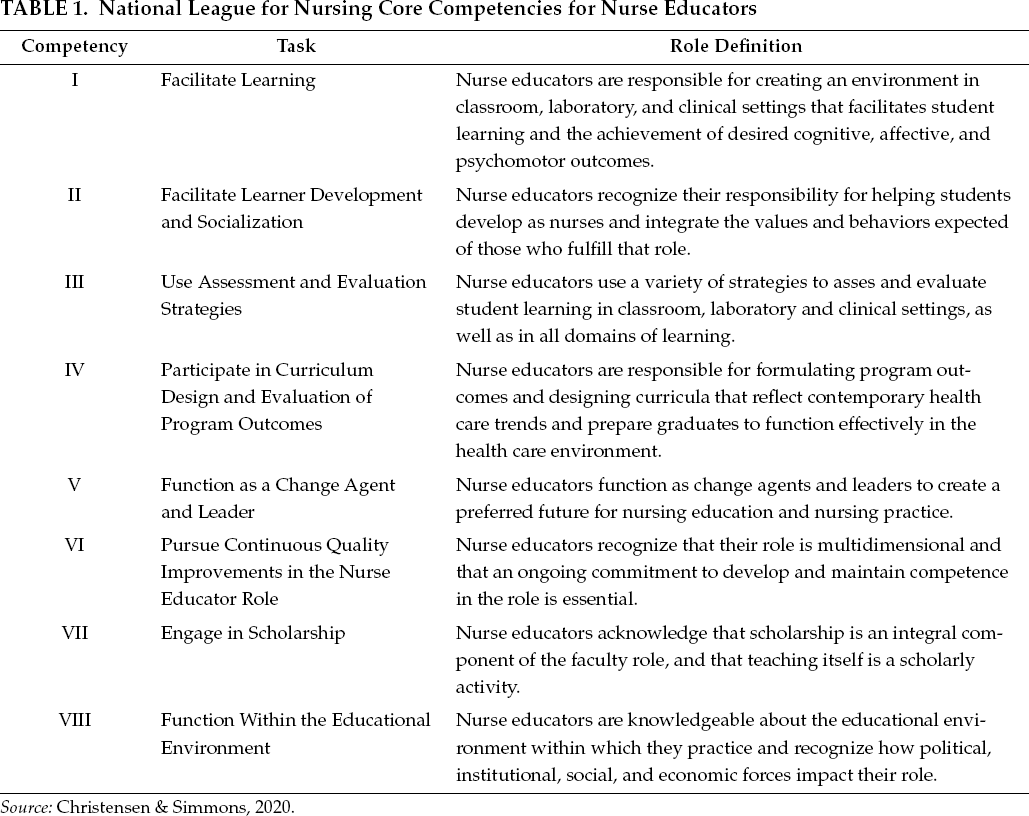
There is no consistent national requirement for nursing faculty to have formal training in educational methods, despite the demand for more nursing educators to fill the needs of expanding nursing programs nationwide (Summers, 2017; Supplee et al., 2014). Programs that prepare nursing educators are challenged to include content about pedagogy as well as opportunities to develop supplementary clinical practice and leadership expertise, in addition to the clinical expertise from their previous work settings (Supplee et al., 2014; Zungolo, 2004). Standards for the advanced practice educator role have been addressed by the NLN's Core Competencies (2020a) (Table 1). However, clear national standards have not been established for selecting curriculum models, what courses to include, and expectations for practicums and/or internships (Ruland & Leuner, 2010; Summers, 2017; Zungolo, 2004); each can vary depending on accrediting bodies. Additionally, most faculty in nursing academia are required to hold a PhD or the equivalent, which creates its own set of issues for preparing faculty for the advanced practice educator role (Bullin, 2018). An integrative review by Bullin (2018) found that conditions continue to perpetuate insufficient pedagogical preparation for nursing educators and a lack of consensus about the scholarship of teaching in nursing. Bullin suggests that society assumes that all nurses are good teachers. Current conditions such as the requirement for a research-focused PhD, lack of mentorship within doctoral programs and/or academic institutions, and evaluation and reward systems in academic environments that impact the focus on the practice of scholarship, teaching, and service, are barriers to effective preparation of nurse educators. Combining these conditions with the assumption that all nurses are good teachers makes clear that more clearly defined standards for nursing educator development are needed.
National League for Nursing Core Competencies for Nurse Educators
In a review of 198 U.S. nursing educator program websites, the average program consisted of 39 credit hours, with less than a third of programs requiring 40 credit hours or more (Ruland & Leuner, 2010). This same study reported that 96% of programs contained a course in research, 91% included a theory course, 67% contained a health-care policy course, 49% incorporated both ethics and professional role development courses, and 22% included a health promotion and disease prevention course. Professional role development courses often integrated social and diversity concepts and content (Ruland & Leuner, 2010). The majority (92%) of nursing educator programs included an educational practicum either at the conclusion of the program or multiple times during the program. Content for teaching preparation was relatively consistent, with 97% of programs including strategies for teaching and 89% of programs offering content about methods of evaluation. Courses in instructional technology (26%) and adult learning (19%) were not commonly found; possibly content in these areas was assimilated into the strategies for teaching or other courses (Ruland & Leuner, 2010). More recent reviews of nurse educator programs were not found in the literature, supporting the need for this review.
Programs with online education options offer a greater number of students in all disciplines the opportunity to participate in formal learning with fewer time and space constraints. Enrollment in distance learning has increased significantly over the last decade, from an estimated 1.6 million students in 2002 (Allen & Seaman, 2014) to 6.9 million in Fall 2018 (National Center for Education Statistics, 2020). Nursing programs have followed this trend. According to the AACN (2014), 82.5% of master's programs in nursing education provided some type of distance education, particularly online. Student retention is a concern in online programs, with lower rates of retention reported in programs with online formats compared to face-to-face classroom instruction (Allen & Seaman, 2014). Social presence, such as level of connectedness between instructors and students, quality of program or course(s), and assessment of individual learner characteristics (personal, academic, social, emotional, and/or cognitive) were identified as areas to consider to increase student retention in online graduate nursing education programs (Gazza & Hunker, 2014).
Society assumes that all nurses are good teachers.
Nurse educator programs should be constructed to prepare graduates for a variety of professional locations, including universities, hospitals, community colleges, and community health settings. Additionally, these locations must support nurse educators during the transition from student to teacher. Summers (2017) reported in an integrative review that orientation programs, mentor support, clarity about role expectations, and ongoing feedback on performance during the transition phase are essential for retaining nursing faulty and for the development of core competencies for nurse educators. Primary challenges to designing curricula involve assessing core program requirements while addressing the need to maintain overall total credit hour requirements that are attractive to students and competitive with other programs, and ensuring that requirements are met. In graduate nursing programs, research, theory, capstone projects, and health-care policy courses were most often retained in the core (Ruland & Leuner, 2010). Due to the ever-changing climate of nursing education, a current assessment of nurse education programs is needed.
Methodology
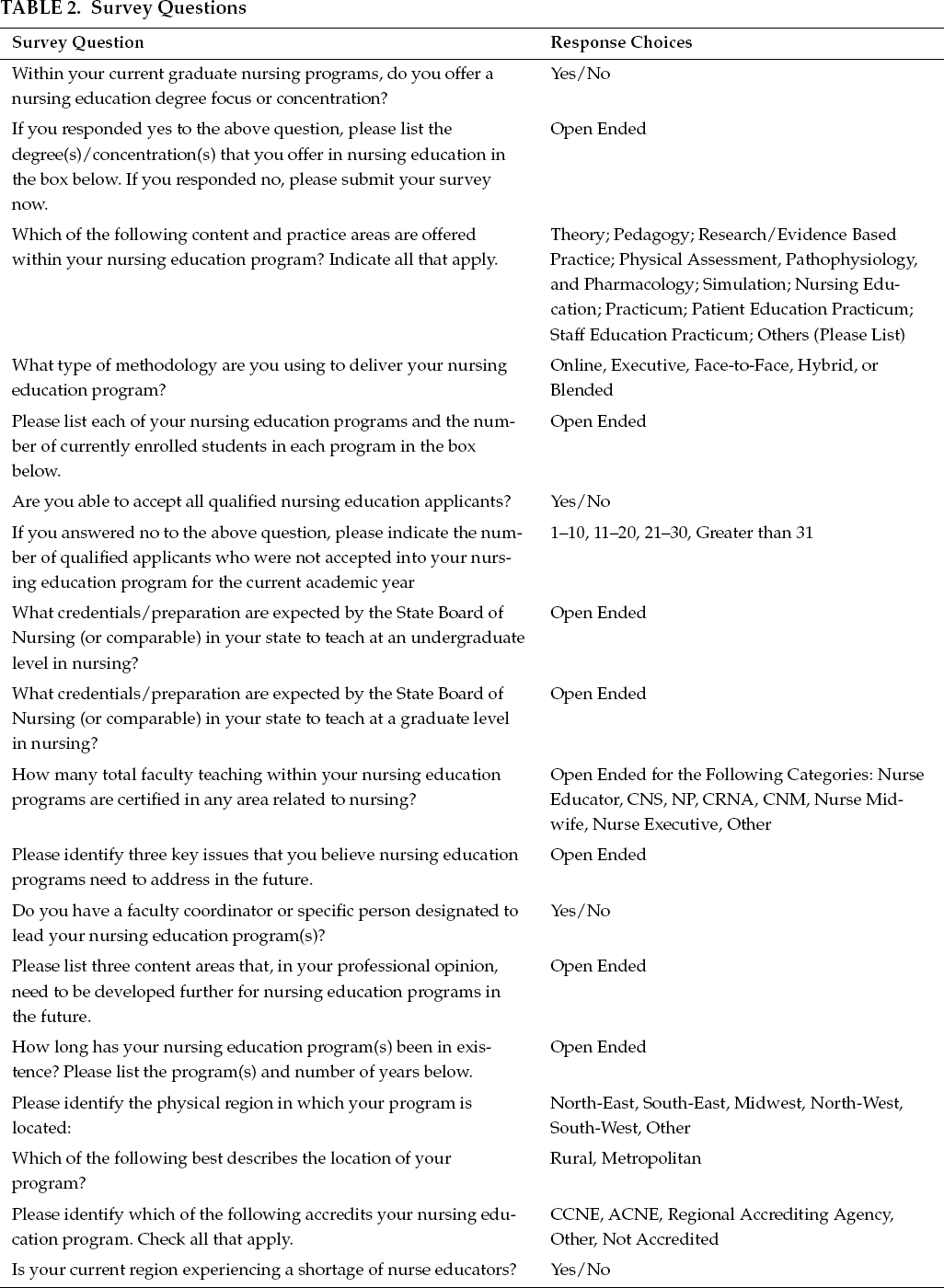
An online survey using Qualrrics was emailed to directors of 491 U.S. graduate nursing programs that offer nurse educator concentrations and were accredited by Accreditation Commission for Education in Nursing (ACEN) and/or the Commission on Collegiate Nursing Education (CCNE). A full list of accredited programs was obtained from the accrediting bodies ‘websites. We evaluated each program's online marketing materials and identified programs that offered a nursing education concentration or degree, to include in the survey. The survey was exempt from IRB review per Appalachian State University's IRB committee. Fourteen multiple-choice questions and eight open-ended short-answer questions (see Table 2) were included to assess the status of the graduate nursing education program. Descriptions of program demographics, students, faculty, program content, and delivery were included in the survey items.
Survey Questions
Results
Survey Responses
Fifty-three nursing education program directors of the 491 identified programs that offer a nursing education degree focus in their graduate nursing program responded to the survey, for a return rate of approximately 11%. Thirty-one percent of programs were located in rural areas; 69% were identified as being in metropolitan areas; 43% were located in the Midwest; 23% in the Southeast; 23% in the Northeast; 7% in the Southwest; and 4% in the Northwest. The nursing education programs had been in existence for a mean of 11 years; 83% of programs had a faculty coordinator for the nursing education focus. Seventy-seven percent of programs were accredited by CCNE; the remaining 23% were accredited by ACEN.
Demographics
Ninety percent of programs were able to enroll all qualified nursing education applicants in their programs. A mean of 24 students were enrolled in the programs ‘graduate nursing education focus. Of programs that turned away qualified applicants, 40% turned away 1–10 students; 60% turned away 11–20 students.
Qualifications
Minimum credentials required to teach in a graduate program as defined by the individual programs ‘state boards of nursing (or equivalent) included master's degree (48%), doctoral degree (42%), or Bachelor of Science in Nursing (10%). At the undergraduate level, credentials expected of faculty were master's degree (94%), BSN (4%), or other (2%). In addition to academic credentials, a mean of 10% of faculty were certified in a variety of nursing education, administration, and practice areas.
Curricular Content
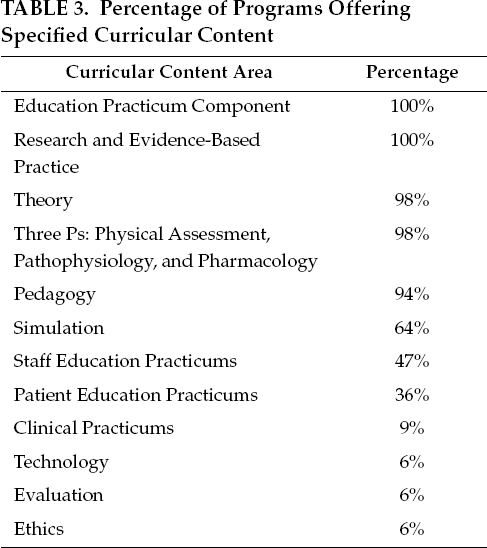
Of the programs that responded, curricular content areas in the graduate nursing education focus are described in Table 3.
Percentage of Programs Offering Specified Curricular Content
Findings for Future Planning
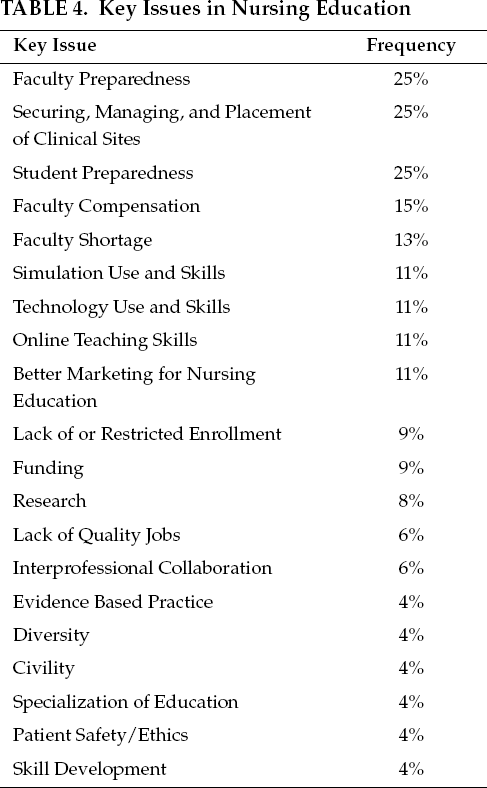
Key issues and areas for further development of curriculum related to graduate nursing education programs identified by the program directors who responded to the survey are described in Tables 4 and 5, respectively.
Key Issues in Nursing Education
Areas for Further Development in Nursing Education
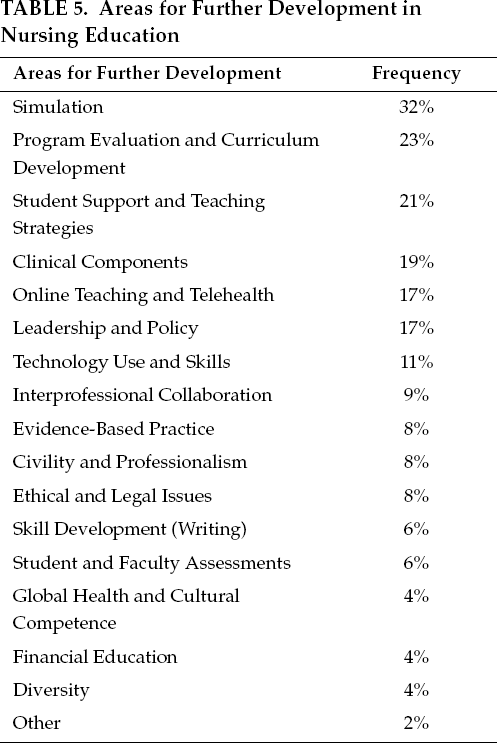
Other areas mentioned (<2%) included clinical nurse specialist roles, interprofessional education, advocacy, direct care, and psychomerrics.
Program Format
Over half (27) of the programs that responded to the survey were delivered online. Fifteen programs used hybrid delivery methods; the remainder used face-to-face (10) or an executive format (1). With a nurse educator shortage reported by 81% of the respondents, continued development and use of flexible program delivery options will be important to meet the increased need for nurse educators.
Limitations
An 11% response rate reflects a possible source of bias and limits generalizability. Programs that are more proud of themselves or are better organized and/or have more administrative resources may have been more likely to respond.
Conclusion
The AACN (2018) identified over 1,700 nurse faculty vacancies across the US across all nursing programs, with need for an additional 138 faculty positions to meet enrollment needs; this was consistent with our findings that 81% of respondents identified a faculty shortage for all nursing programs at their respective universities. Additionally, most faculty teach across multiple nursing programs and therefore faculty vacancies typically represent multiple levels of nursing programs. One positive finding in our study was that 90% of respondents could accept all qualified applicants to their programs. Other factors contributing to the faculty shortage include the demographic trends of aging nursing faculty and retirement of large numbers of nurses of the baby boomer generation; higher salaries for clinical and private sector positions than for academic positions; competition from clinical organizations for doctorally- or master's-prepared nurses; and an undersupply of nursing graduates who are prepared to serve in a nurse educator role (AACN, 2019,2020a; Bittner & Bechtel, 2017; Fang & Kesten, 2017; McDermid et al., 2012).
McDermid et al. (2012) identified that most academic nurse educators came from a clinical background, with little preparation for the complexity of an academic educator role. Our study showed that faculty preparedness, clinical site securement and placement, student preparedness, and faculty compensation were identified as the most significant issues facing nurse educators currently; almost 20% of respondents identified that a clinical component was needed for further development in nurse educator programs. Some accrediting bodies require additional clinical preparation for students in nurse educator programs (AACN, 2020a). Comparable to Ruland and Leuner (2010), our study found that theory courses remained one of the main focus areas for curricular content, but that pedagogical approaches, research and evidence-based practice, the three Ps, and education-based practicum experiences were common throughout nurse educator curricula.
Research is needed to determine why nurses are choosing other career paths than education, and what motivational factors are influencing nurses who do select nursing education.
Future work is urgently needed to address faculty shortages and the increasing enrollment in nurse educator programs. Based on our findings, the solution is not necessarily to increase capacity for enrollment of students in accredited nurse educator programs. However, our data and national data continue to show faculty shortages in almost all regions (AACN, 2020b). While we know that demographic trends for nurse faculty indicate aging and larger numbers of retirements from faculty roles, competition from clinical organizations, and an undersupply of nursing graduates (AACN, 2019, 2020b; Bittner & Bechtel, 2017; Fang & Kesten, 2017; McDermid et al., 2012), more research is needed to determine why nurses are choosing other career paths than education, and what motivational factors are influencing nurses who do select nursing education. Additionally, the nurse educator role is often overshadowed in marketing and public opinion by roles such as clinically based practitioner roles that are more appealing due to prestige and salary factors. As a profession and as a society, we need to focus on the value of the advanced practice nurse educator role and generate appeal for this role to high school students, students beginning nursing programs, and nurses early in their careers. Also, we cannot continue to expect that teaching skills are synonymous with nursing skills. We must prepare nurses at all levels for teaching. With the majority of undergraduate and graduate nursing programs requiring a master's or doctoral degree for their faculty, it is imperative to include basic teaching theory and pedagogy in all master's and doctoral programs in nursing, not just in specific educator concentrations, to prepare more nurses for this advanced role.
Footnotes
Disclosure. The authors have no relevant financial interest or affiliations with any commercial interests related to the subjects discussed within this article.
Funding. The author(s) received no specific grant or financial support for the research, authorship, and/or publication of this article.
Susan Hayes Lane, PhD, MSN, RN, (she/her) is a tenured Associate Professor in the Department of Nursing in the Beaver College of Health Sciences at Appalachian State University in Boone, North Carolina. Her research areas focus on active learning strategies, nursing education, evaluation and leadership.
Eileen Kohlenberg PhD, RN, NEA-BC, (she/her), is Professor Emeritus at The School of Nursing at The University of North Carolina at Greensboro. During her tenure, she served as Associate Dean for Graduate Programs.