







Abstract
University of California San Diego Health was set to launch its 13th annual Nursing and Inquiry Innovation Conference event in June 2020. However, the Coronavirus Disease 2019 (COVID-19) pandemic placed a barrier to large gatherings throughout the world. Because the World Health Organization designated 2020 as the Year of the Nurse and Midwife, the University committed to continuing the large-scale conference, converting to a virtual event. This article reviews the methodologies behind the delivery of the virtual event and implications for user engagement and learning on the blended electronic platform.
Traditionally, the Nursing Research and Evidence-Based Practice Council at University of California San Diego (UCSD) Health holds an annual full-day Nursing Inquiry and Innovation Conference in person. The program allows nurses to showcase their research, evidence-based practice, and quality improvement projects to colleagues within the healthcare system and to regional participants, via posters, podium presentations, and an art exhibit. Given the scale of planning and execution, this event usually requires 8 months of preparation by the planning committee.
Background
The Coronavirus Disease 2019 (COVID-19) pandemic placed a worldwide cessation on gatherings both intimate and large. Our organization's 13th annual Nursing and Inquiry Innovation Conference was set to launch in June 2020. In response to the World Health Organization's (WHO) pandemic declaration in March 2020, San Diego County instituted a health order effective March 13, 2020, prohibiting “gatherings” to prevent disease transmission (Chu et al., 2020; San Diego County, 2020).
The Council originally assumed that the June conference would have to be cancelled. However, two members of the Council with special technology skills offered to convert the live event to a synchronous online event. The Council members felt that the conference had to be preserved to recognize the innovative work of nurses, especially during the pandemic when nurses desperately needed positive reinforcement. As the WHO designated 2020 as the Year of the Nurse and Midwife, the conference planning team decided to use this opportunity to demonstrate resiliency and rise above the challenges (WHO, 2020).
This article reviews the methodology of converting from a live to a virtual conference, to highlight the work of nurses during a difficult time in health care. The conference was held on July 17, 2020. The entire conversion was planned and executed in less than 3 months.
Methodology
Conversion to an All-Virtual Format
The all-virtual mixed-method synchronous learning event was planned to combine pretaped presentations with live question and answer (Q&A) sessions, interactive activities, and a competitive awards process. The following tools were utilized:
Zoom
Microsoft Word
Microsoft PowerPoint
Adobe Acrobat DC
Mentimeter
Qualtrics
YouTube
Piktochart
Conference Preparation
The conference theme was “Healthy Nurse, Healthy San Diego.” A call for abstracts and selection of accepted podium and poster presentations had already been completed in January 2020.
The Council had already peer-reviewed all presentations and provided feedback about clarity of content or design; presenters revised their content as indicated. Then presenters were requested to convert content to taped presentations that were uploaded as unlisted videos on YouTube (see Table 1). The decision to use pretaped presentations was made to improve time efficiency on the day of the event, minimize technological difficulties, and mitigate presenters ‘online stage fright. The conference coordinator created a training video to teach presenters how to create taped sessions (https://youtu.be/MtDWAkK6EhY). Individual support was also provided. The Council Chairperson's opening remarks, the keynote speech, and the closing Nurse Scientist presentation were prerecorded.
Online Conference Essential Steps
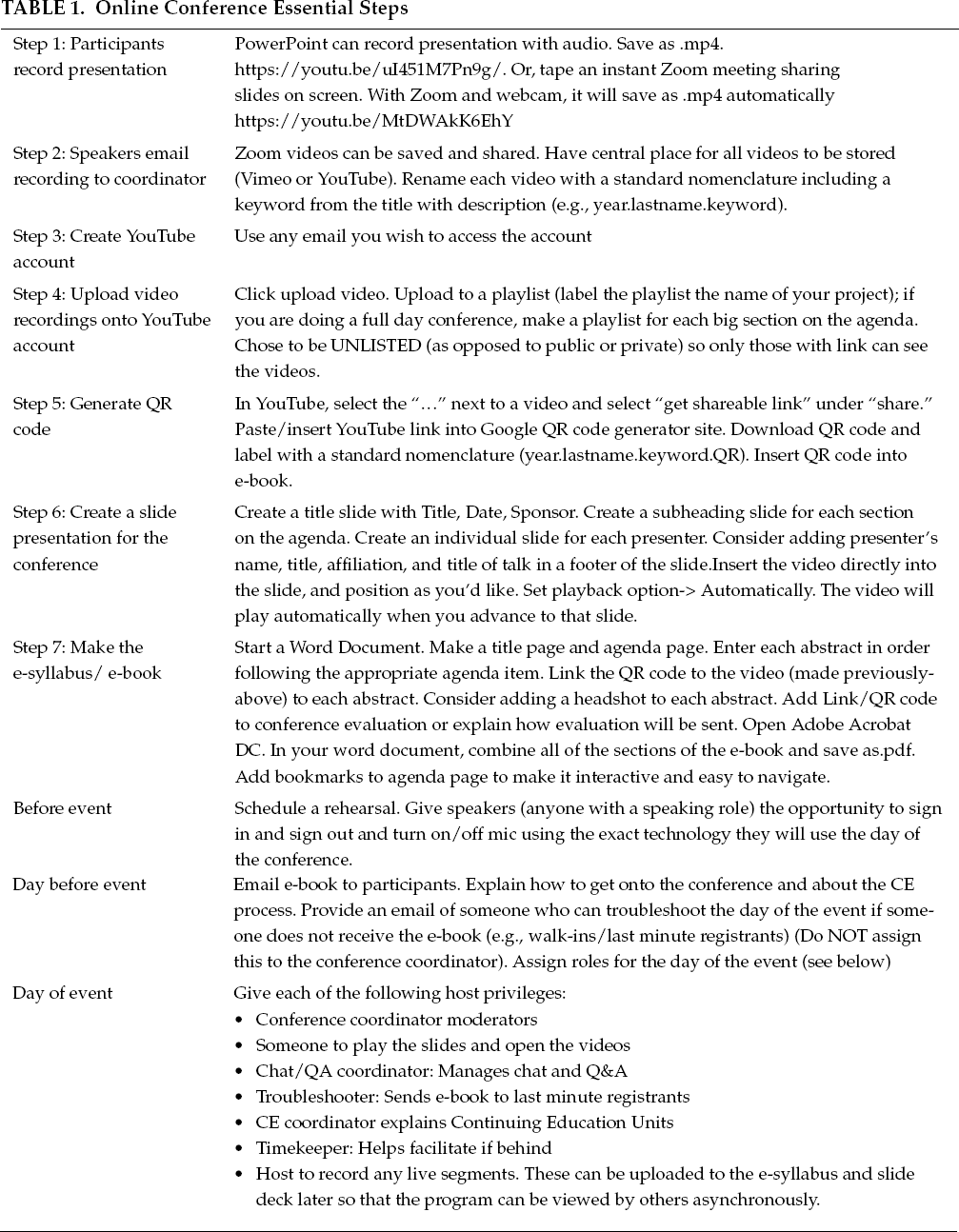
Presentation Process
Only those who received the conference booklet or attended the virtual event have access to the videos of the presentations. The URL for each video was embedded in a slide on the conference slide deck with the presenter's name and title of presentation.
After every podium presentation and the keynote speech, a live Q&A round was held. Podium presenters were requested to turn on their cameras and microphones to answer questions submitted in the chat box, which were read by the moderator.
Curating Nursing Artwork
The UCSD Health embraces art as a way to capture the intangible, unquantifiable parts of nursing. This draws from educational and therapeutic tradition using art as a way of knowing (Exploratorium, 2011; Johnson, 2019). During prepandemic conferences, attendees were greeted by a long hallway of artwork related to the conference theme and created by frontline nurses, including paintings on easels, live music, sculptures, poetry, photography, and immersive performance art displays.
However, the need for a virtual conference prevented live displays. Instead of physical artwork, 19 nurse-artists submitted high-resolution images or videos of their artwork and wrote an abstract citing current research and relating it to the conference theme “Healthy Nurse, Healthy San Diego” or to the COVID-19 pandemic. Media included poetry, drawing, photography, painting, music composition, cinematography, and even mask sewing. To personalize the virtual conference experience, the syllabus contained a biography and photo of each artist. The Council invited a selection of the nurse-artists to prerecord video presentations about their artwork. Like the research presenters, the artists were asked to respond to live questions typed in the chat box by the audience. These questions, exploring the artists ‘inspiration and methodology, were answered after each artist's presentation. During conference breaks, previous years ‘conference artwork was shown in a slide montage.
At the end of the conference, attendees were asked to vote for best-of-show artwork; the enthusiastic voting remarkably ended in a tie between an original piano composition entitled Awakening (https://youtu.be/R-LD8rVyglw) and a charcoal sketch, Portrait of a COVID Nurse (Davidson & Pasion, 2020). The composer-nurse practitioner wrote Awakening to express hope in difficult times and to honor transplant donors and recipients. The Portrait of a COVID Nurse drawing revealing the personal protective equipment marks and bruises on the nurse's face was drawn to express solidarity with a former coworker now working on a COVID-19 unit. An acrylic painting, Caring in Bloom, was painted expressly to show support for coworkers by painting their favorite flowers incorporated as part of cardiac anatomy (Figure 1). A poignant submission included a photo snapped on an iPhone in the COVID ICU with a nurse holding a sign saying “stay home” (Figure 2).
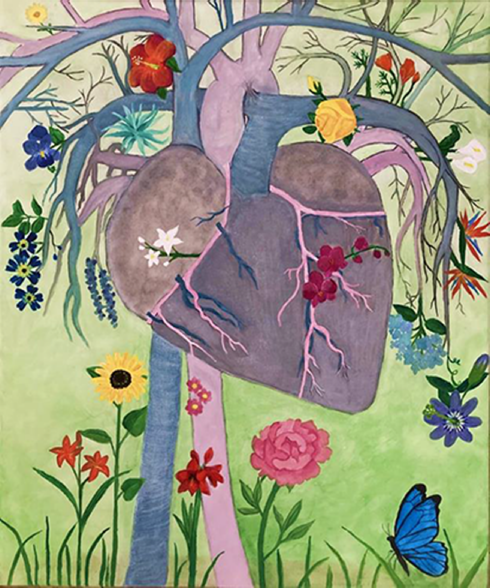
Caring in Bloom.
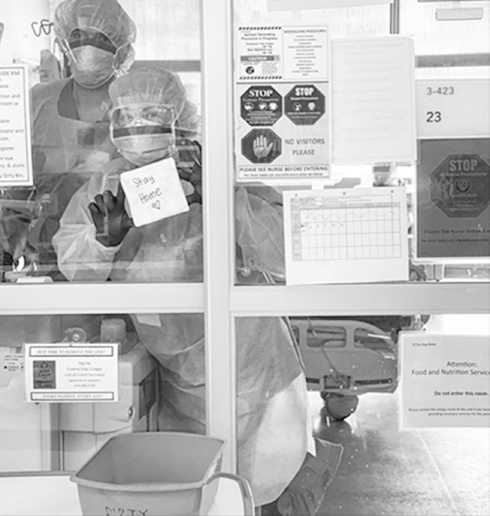
COVID-19 photography.
The conference had to be preserved to recognize the innovative work of nurses, especially during the pandemic when nurses desperately needed positive reinforcement.
While the art component of the research conference grows in popularity every year and is marvelous at capturing the intangible parts of nursing, the act of creating and sharing with fellow nurses became particularly therapeutic and cathartic during this difficult time in health care. After the conference, the nurse-artists ‘managers were encouraged to display the artwork on their units to enliven and personalize the units.
Special Section: Cancelled Presentations
We found ourselves in a position as the only conference not cancelled, from many local, regional, and national conferences where our nurses had been accepted to present. We compiled a list of these nurses and invited them to present at this conference, with their abstracts included in the syllabus.
Platform
The organization had a Zoom site license. Zoom Webinar was the chosen platform instead of Zoom Meeting in order to accommodate the over 200 registrants. One drawback was that breakout rooms were unavailable in Zoom Webinar.
The platform's interface was simplified to a limited number of options so that only presenters/moderators could use their camera, share screen, or use the microphone. Podium presenters were given presenter status and moderators were given cohost status. A virtual room enabled podium presenters to ask questions to moderators without making the questions visible to participants. Participants asked questions through the chat feature. Attendee log-in and activity were tracked through the Zoom platform.
Roles
Members of the Council were assigned moderator roles; responsibilities were made clear at least a month before the conference date. See Table 2.
Conference Moderator Roles with Associated Responsibilities
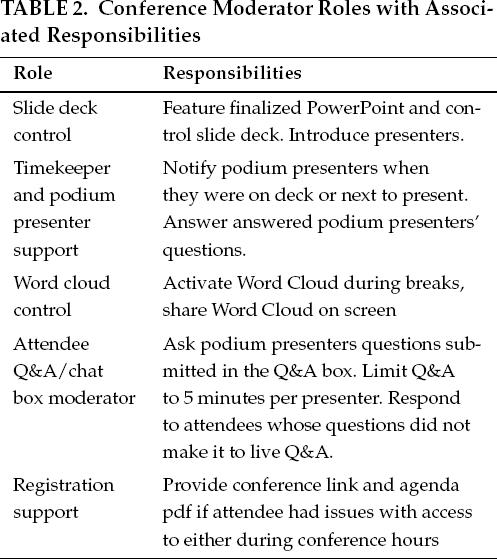
Conference Syllabus
A combination of Piktochart and Microsoft Word was used to build the aesthetics and design of the electronic syllabus; it was then converted to a pdf distributed to all registrants the day before the conference. The syllabus contained an interactive table of contents that could bring the reader to a specific portion of the content, and included all podium, poster, and artist abstracts. Clickable hyperlinked quick response (QR) codes allowed attendees to bring up the web addresses so that they could rewatch the presenters ‘videos. Photos of each piece of art were included in the syllabus with its associated abstract.
As 2020 is the Year of the Nurse and Midwife, the conference planning team used this opportunity to demonstrate resiliency and rise above the challenges.
Breaks were interactive, with activities such as building a word cloud and answering fun questions using Mentimeter (https://www.menrimeter.com/), such as, “What do you do to unwind?” Instructions on how to use the interactive syllabus, apps, and QR codes were included in both the conference slide deck and the electronic syllabus.
Maintaining Engagement
The conference schedule was intentionally constructed to alternate pretaped presentations, live Q&As, interactive exercises, and art, to maximize engagement (Lima et al., 2020). Results of interactive events such as a conference-themed collective word cloud and entertaining questions were posted during breaks. To further maintain interest, attendees were encouraged to vote for their favorite artwork and posters; results were only made available at the end of the conference once all presentations were complete.
Continuing education credits (CEs) were provided at the end of the conference. The conference evaluation used the scoring system within Qualtrics normally intended for scoring test questions, to tabulate partial credits for those who did not attend the entire program. The Qualtrics survey was built with an end-of-survey message that prepopulated a certificate with the attendee's name, nursing license, date and title of conference, and number of credits obtained.
Practice Run
The Council conference planning committee met iteratively during the planning stage to test the various technical aspects of the program. On the day before the program, they tested the slide deck, loading each taped presentation and checking for appropriate sound and visual quality.
A practice session was prescheduled and provided to all podium presenters to ensure that cameras and microphones were working appropriately. Each participant logged in for 5 minutes using the equipment they would use on the day of the event and practiced answering a question, turning their video camera on and off, and muting and unmuting their microphones.
Results
A total of 1786 CEs were provided to 267 participants. At least 240 people were in attendance during the whole event. Participants reported attending 1–7 credit hours of content (mean = 6.7), with 48 benefiting from the opportunity to obtain partial credits for attending a portion of the day (an option not previously offered). When asked what type of conference participants would want next year, 57% preferred another online conference (see Table 3). Since it was online, we were able to offer this event at no cost. Typical cost of a hotel conference for 200 participants in Southern California is $5,000 (hotel, food, awards) after contributions by vendors. The online cost was $80.00 (for awards) resulting in a cost savings of at least $4920.00 plus time spent soliciting vendors.
Conference Evaluation
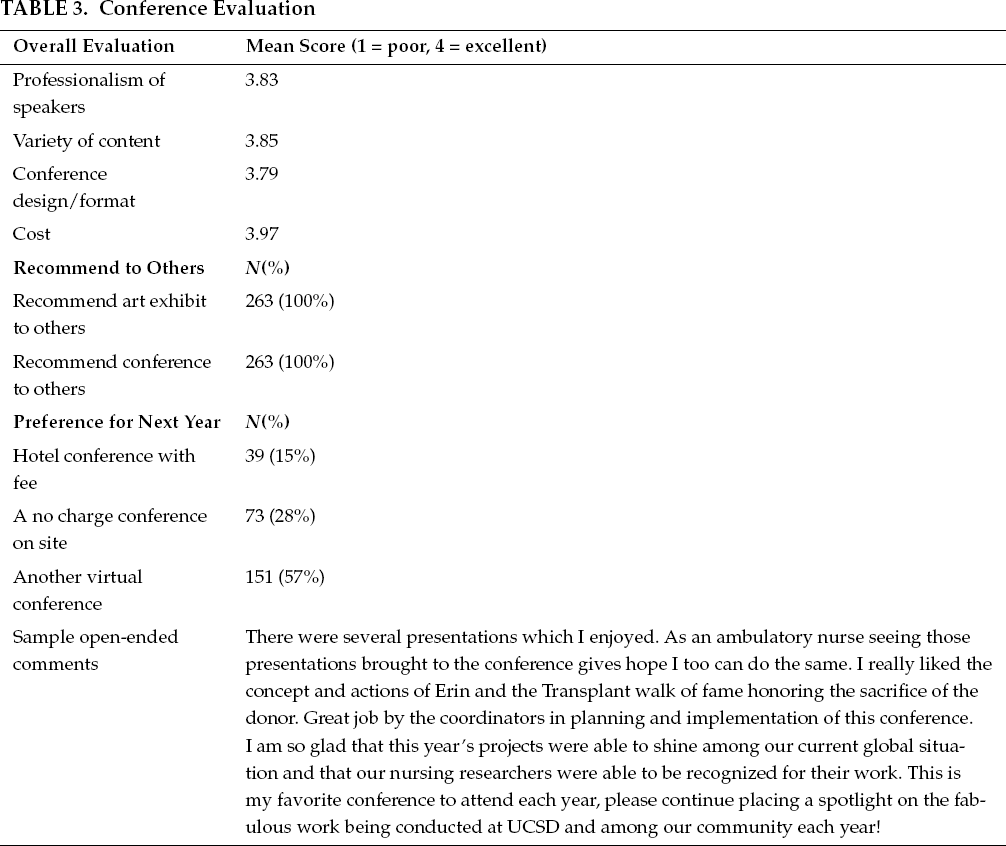
One hundred percent of participants recommended the art exhibit and research conference to others. Three constructive comments were provided: move lunch break to later, add audio for poster presentations, and add more breaks. Pages of positive feedback were received in the open-ended comments reflecting the participant's gratitude for having a day of learning despite the pandemic (Table 3).
Discussion
Some attendees were concerned that electronic learning (e-learning) would not be as effective as face-to-face education. However, the conference evaluation results and the active engagement of participants throughout the program indicate otherwise. The online version of the program had more registrants than any previous conference. Blended learning combining synchronous and asynchronous elements provided nurses the flexibility to learn from home. Despite our yearning to meet in person again as we once did, the learners clearly requested another online program in the future, given what they experienced in 2020. Our results are congruent with others who have found that e-learning can be more effective than nonblended education frameworks in facilitating knowledge acquisition for health-care professions (Liu et al., 2016; Tudor Car et al., 2019).
Dissemination of Results
The conference was attended by several educators from academia, nursing leaders from other local health-care systems, and faculty from a local consortium, the Evidence-Based Practice Institute (EBPI). These participants later asked for support from the conference planning team to replicate the strategy at their sites. The lead author met with EBPI faculty and taught them how to load videos to YouTube, create a slide deck with hyperlinked pretaped videos, use the planning spreadsheet, and create the electronic syllabus. The EBPI successfully replicated the process for an audience of 100 participants at their end of cohort graduation and conference in November 2020, with exemplary evaluations.
Implications
With proper preparation, a virtual platform can be a well-accepted accommodation to deliver education safely to a large audience. The cost savings of not using a hotel cannot be ignored; coupled with the fact that the majority of participants voted to use the online format for future events, this means that the virtual conference method may be a disruptive yet enduring change. Traditional conferences are beneficial in developing networking but do come at a large cost in resources and labor. In the future we hope to build enhanced networking activities into the virtual program to fill the gap. The conversion required learning new technologies, which augmented the skill sets of all those involved.
Conclusion
The 13th Annual Nursing Inquiry and Innovations Conference was made possible even during a global crisis that prevented traditional conference gatherings. The ability to provide a virtual conference exceeded expectations, showcasing the positive work of nurses during negative times. The ability to overcome the obstacle of physical distancing to continue with this time-honored tradition of yearly celebration was a testimony to the resiliency of nurses.
Nineteen nurse-artists submitted images or videos of their artwork related to the conference theme or to the pandemic-media included poetry, drawing, photography, painting, music composition, cinematography, and even mask sewing.
Footnotes
Disclosure. The authors have no relevant financial interest or affiliations with any commercial interests related to the subjects discussed within this article.
Funding. The author(s) received no specific grant or financial support for the research, authorship, and/or publication of this article.
Lilian J. Canamo, MSN, RN, PCCN, (she/her)), is currently a nurse informaticist at the University of California San Diego Health. She has been a nurse for 5 years primarily in trauma step-down care and is chair for the organization's Nursing Research and Evidence-Based Practice Council.
Judy E. Davidson, DNP, RN, MCCM, FAAN, (she/her), serves as a nurse scientist for the Division of Nursing at University of California San Diego Health and a research scientist in the Department of Psychiatry University of California, School of Medicine. In these roles, she supports nurses and others with project development, presentation skills, and publication.
Jessica P. Bejar, BSN, RN, PCCN, PHN, (she/her), is a Progressive Care Unit charge nurse at the University of California San Diego Health and served as art coordinator of the EBP/Research Council. She grew up in the San Francisco East Bay and has prior nursing experience at Johns Hopkins Hospital.