







Abstract
Background:
Naftifine is a topical allylamine that is effective and safe in the management of superficial dermatomycoses. Naftifine is fungicidal in vitro against a broad spectrum of dermatophyte fungi and provides good activity against Candida and Aspergillus species. It is also effective against gram-negative and gram-positive bacteria.
Objective:
To provide a review of the pharmacologic properties and clinical efficacy of topical naftifine preparations.
Methods:
A review of the medical literature was performed using PubMed (1965–2006) using the search term “naftifine.” All available English-language articles discussing the pharmacology and clinical use of naftifine were reviewed for the article.
Results:
Naftifine causes interruption of fungal ergosterol synthesis and accumulation of squalene in fungal organisms. Naftifine also has demonstrated anti-inflammatory properties such as a reduction in superoxide production and a reduction in polymorphonuclear leukocyte chemotaxis/endothelial adhesion. Naftifine has shown good efficacy and safety for a variety of conditions and is a useful treatment that provides both antifungal action and relief of inflammatory signs and symptoms. Few adverse events have been noted with naftifine use, the most frequent being mild and transient burning, stinging, or itching in the application area.
Conclusion:
Naftifine remains a reliable multifunctional agent for a variety of superficial infections.
TOPICAL PREPARATIONS remain a mainstay for treatment of superficial skin infections such as tinea corporis, tinea cruris, and tinea pedis as oral therapy for such infections may present unsuitable risk and costs, except in the most severe cases of infection. Topical allylamines may be preferred to topical azoles as they can have shorter durations of therapy with suitable fungicidal activity. Naftifine is a primary topical allylamine that is available in a wide variety of formulations in many countries and was the first topical antifungal agent in its class that held promise for the treatment of superficial fungal infections (Table 1).1–4 In addition to the antifungal properties, this synthetic allylamine also shows significant antibacterial and anti-inflammatory activity, which may be particularly useful where superficial dermatoses are accompanied by superimposed bacterial infection and inflammation. Furthermore, naftifine has been shown to be effective with once-daily use, and this may provide an advantage to patient compliance. Adverse events noted with naftifine tend to be local and mild to moderate in a small proportion of patients; systemic effects have not been noted. Use of 1% naftifine cream or gel in North America requires a prescription.
Approved Topical Formulations of Naftifine HCl
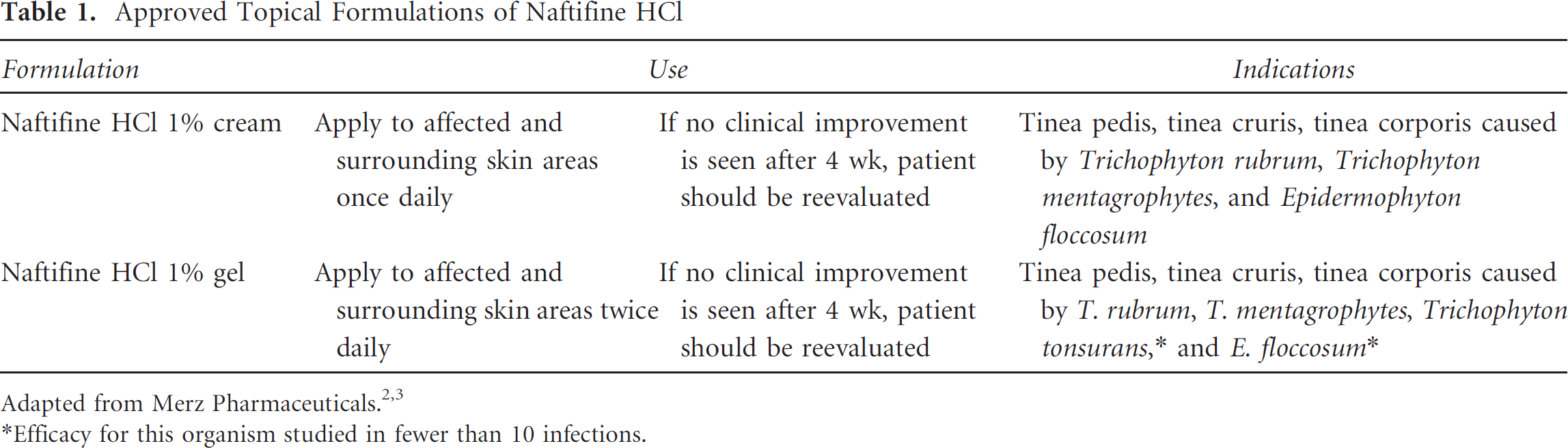
Efficacy for this organism studied in fewer than 10 infections.
The safety and efficacy of naftifine have been well established, yet no recent review articles exist to provide a summary of current clinical information and pharmacologic research. This article seeks to compile all such past literature to provide a summary of present naftifine knowledge.
Antimicrobial and Anti-Inflammatory Activity
Naftifine is fungicidal in vitro against dermatophyte organisms, including Trichophyton spp, Microsporum spp, and Epidermophyton floccosum, with a minimal inhibitory concentration (MIC) range of 0.1 to 0.2 μg/mL (Table 2).5,6 In vivo assays show that naftifine activity against Trichophyton rubrum and Trichophyton mentagrophytes is similar to that of econazole and clotrimazole. 4 Fungicidal activity is attributed to inhibition of squalene epoxidase (SE), which prevents production of ergosterol and leads to toxic accumulation of squalene. 1 Naftifine shows primarily fungicidal activity in vitro against Candida species, including C. parapsilosis, and C. albicans, with an MIC range of 1.5 to > 100 μg/mL (> 100 μg/mL: 8/77 isolates).6,7 Naftifine also shows good activity in limited testing against Aspergillus species (MIC range 0.1–12.5 μg/mL) and Sporothrix schenckii (MIC range 0.8–1.5 μg/mL) (see Table 2).6,8 Furthermore, naftifine is specific to microbial SE, rather than mammalian SE, and is unlikely to interfere with mammalian cholesterol synthesis.7,9,10
Summary of Naftifine Activity

MIC = minimal inhibitory concentration;
PMN = polymorphonuclear;
UV = ultraviolet.
Naftifine exhibits local antibacterial activity against both gram-positive and gram-negative bacteria at minimum bactericidal concentrations of 0.04 to 1.25% active naftifine (see Table 2). 11 Multiple anti-inflammatory actions noted with naftifine include targeting of the formation, release or effect of prostaglandins, the 5-lipoxygenase synthetic pathway, and the action of polymorphonuclear leukocytes.9,12–16 Both antihistamine and corticosteroid effects have been observed with naftifine use. 17
Pharmacokinetics and Dosing
Naftifine penetrates the stratum corneum and epidermis.2,4,11 Single doses of naftifine may persist in the skin for several days at levels exceeding the MIC of dermatophytes, suggesting that once-daily dosing is appropriate, although only the cream formulation is currently labeled for once-daily use.10,11 Current research indicates that naftifine solubility may be increased when complexed with cyclodextrins, 18 which are cyclic oligosaccharides that are used as drug carriers to control the rate of drug release. 19 However, the implications of this finding are currently unknown.
Efficacy of Naftifine
Naftifine cream 1% and naftifine gel 1% are approved for the topical treatment of tinea pedis, tinea cruris, and tinea corporis caused by T. rubrum, T. mentagrophytes, and E. floccosum.2,3 Use of both the cream and gel formulations shows good rates of mycologic and clinical cure after 2 to 8 weeks of use.20–32 Naftifine efficacy is comparable to that of the topical antifungals clotrimazole, econazole, miconazole, and terbinafine (Table 3). Naftifine showed superior efficacy to topical oxiconazole in one reported trial for tinea pedis. 28 Once-daily naftifine use shows results generally equivalent to those with twice-daily use (see Table 3).22,24
Efficacy of Naftifine in Clinical Trials for Dermatomycoses
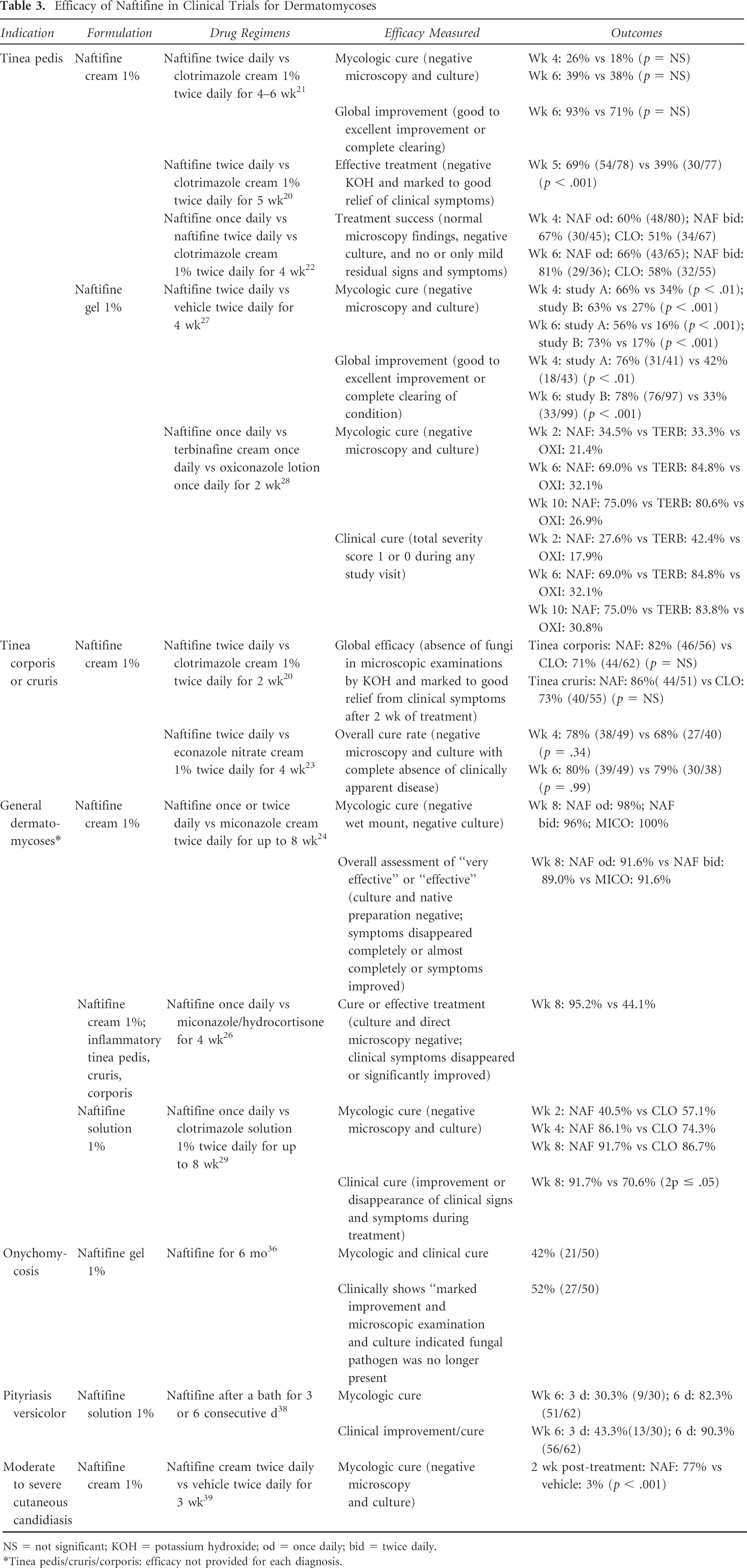
NS = not significant;
KOH = potassium hydroxide;
od = once daily;
bid = twice daily.
Tinea pedis/cruris/corporis: efficacy not provided for each diagnosis.
Naftifine provides early relief of symptoms of tinea pedis, tinea corporis, and tinea cruris that is comparable to that with imidazole-corticosteroid combination therapy, including resolution of symptoms relating to inflammation, such as erythema, fissuring, and pruritus.17,21,22,26,27,33,34 Naftifine cream 1% was also successfully used to treat three cases of recalcitrant tinea corporis and one case of recalcitrant tinea pedis in a patient with acquired immune deficiency syndrome (AIDS). 35
Regarding unlabeled uses, naftifine gel for up to 6 months in fingernail and/or toenail onychomycosis produced a mycologic cure along with clinical improvement or cure of a target nail in 47 of 50 patients observed at the end of the treatment period.36,37 Naftifine has also shown efficacy in pityriasis versicolor and moderate to severe cutaneous candidiasis caused by C. albicans (see Table 3).38,39 Antibacterial use of naftifine cream twice daily for 12 days for pyoderma showed good to excellent efficacy noted in most patients, with no significant differences between naftifine treatment and gentamicin treatment. 40 A case report on the treatment of trichomycosis pubis with naftifine cream twice daily for 2 weeks showed that the infection nodules totally resolved, with no recurrence 6 months after cessation of therapy. 41
Safety Profile of Naftifine
Naftifine cream 1% has an efficacy and safety profile that is comparable to that of imidazole antifungals, such as econazole, clotrimazole, and miconazole.23,29,38 Adverse events reported by patients using naftifine are generally mild to moderate in severity and do not cause discontinuation of therapy. Adverse reactions reported with naftifine 1% include burning or stinging, dryness, erythema, itching, and local irritation, typically in less than 5% of patients.2,3 Few cases of allergic contact dermatitis owing to naftifine have been presented in the English literature.42–45 Dermatotoxicology studies in humans showed no evidence of irritancy, phototoxicity, sensitization, or photosensitization with naftifine. 46 Cross-reactivity and cross-resistance of naftifine with other allylamines have rarely been a concern with naftifine use. 42 Systemic absorption after single doses of naftifine has ranged from 4.2 to 6% of the applied dose, and no adverse systemic events have been noted with naftifine use.2,3
Conclusion
Naftifine 1% is a safe and effective treatment of most superficial dermatomycoses. The systemic absorption of naftifine following topical application is slight, and adverse events experienced were generally local, mild to moderate, and transient. The once-daily dosing may be an advantage for patients compared with other topical products that require twice-daily application since daily application may improve patient compliance and reduce the cost of therapy. The wide spectrum of activity makes naftifine an ideal first-line therapy, particularly where a dermatophyte infection may show bacterial superinfection. The activity of naftifine against both gram-positive and gram-negative infections may provide an advantage over topical azoles, which typically are effective only for gram-positive organisms. 47 Furthermore, inflammatory dermatophytoses may be treated successfully with naftifine, thus avoiding the potential for adverse events presented by use of antifungal-steroid topical combination treatments. Although the results from clinical trials investigating the use of naftifine in the treatment on onychomycosis show promise, more research needs to be conducted before it can be recommended for use in nails. Naftifine remains a reliable multifunctional agent for a variety of superficial infections.