







Abstract
Background:
There is much information on the life and accomplishments of John Hinchman Stokes (1885–1961), the dermatologist and syphilologist. There is little detailed information on his 1944 classic text on syphilis, Modern Clinical Syphilology.
Objective:
To review and critique this book.
Methods:
A careful review of the book, his life, and the accomplishments that were undertaken in relation to the age in which he lived.
Results:
The book is indeed a goldmine of information of all aspects of syphilis from pre–World War I (1905) until the late (1944) World War II era.
Conclusion:
The factors that make it a classic are as follows: (1) the disease had a specific cause; (2) Stokes's 25-year obsession with the disease; (3) there was no effective simple cure for most of the time he was studying it; (4) Stokes was an obsessive, intelligent, well-trained physician; (5) he lived in a well-developed, reasonably stable country; and (6) he was able to see how the disease could be adequately treated with penicillin and compare these events with those in the prepenicillin era.
THERE IS MUCH INFORMATION in many publications on the life and accomplishments of John Hinchman Stokes (Figure 1), the American dermatologist and syphilologist who lived from 1885 until 1961.1–3 Interestingly, in all of these writings, there is little detailed information on his 1944 classic text on syphilis, Modern Clinical Syphilology (Figure 2). 4 Although Herman Beerman and Norman Ingraham are listed as coauthors, this text was, and still is, usually referred to as Stokes's textbook on syphilis. According to Chrissey and colleagues, the nickname, “The Green Monster,” was given to the text by the dermatology residents of the University of Pennsylvania. 5
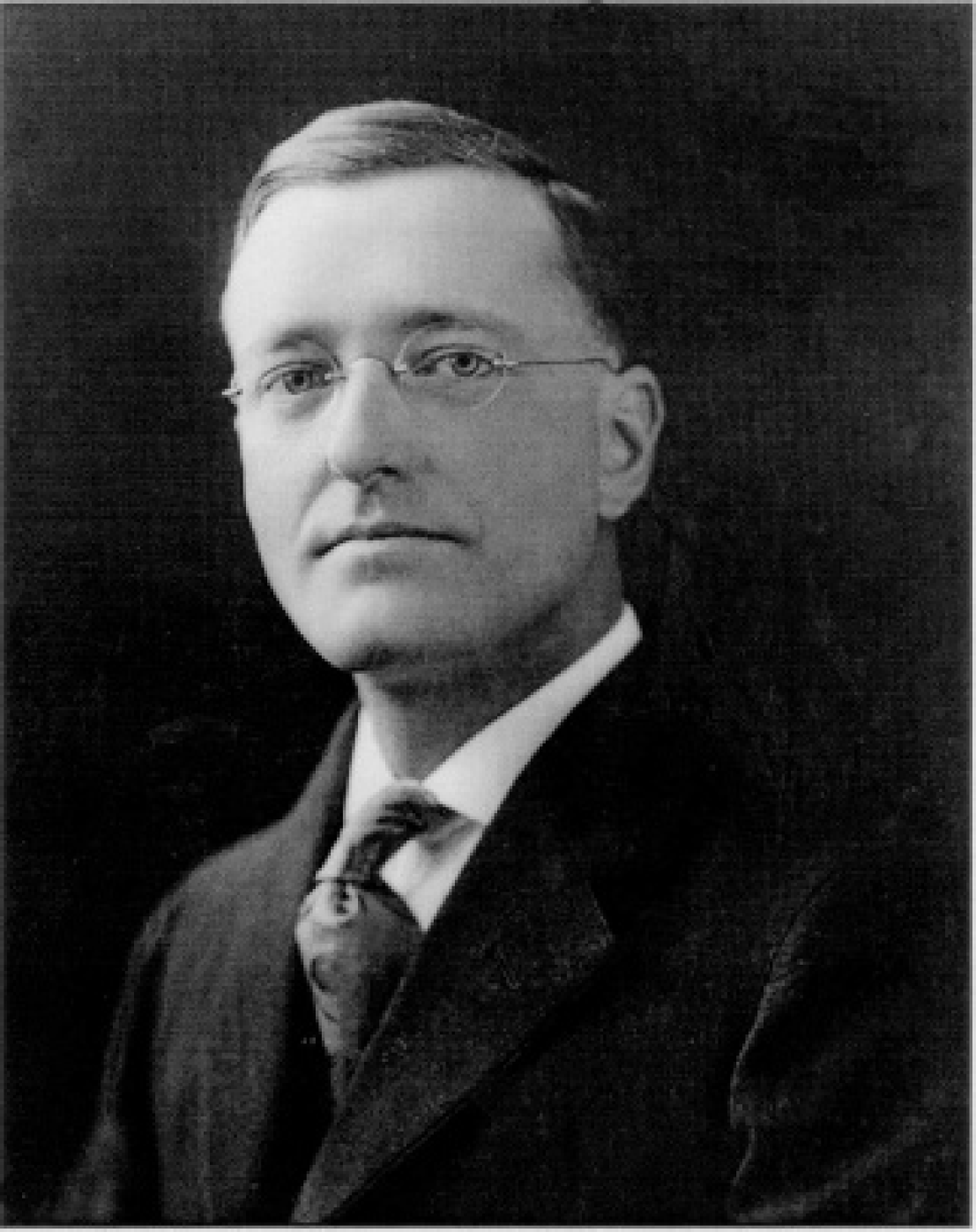
John Hinchman Stokes (1885–1961). Reproduced with permission from Mayo Historical Unit, Mayo Foundation, Rochester, MN.
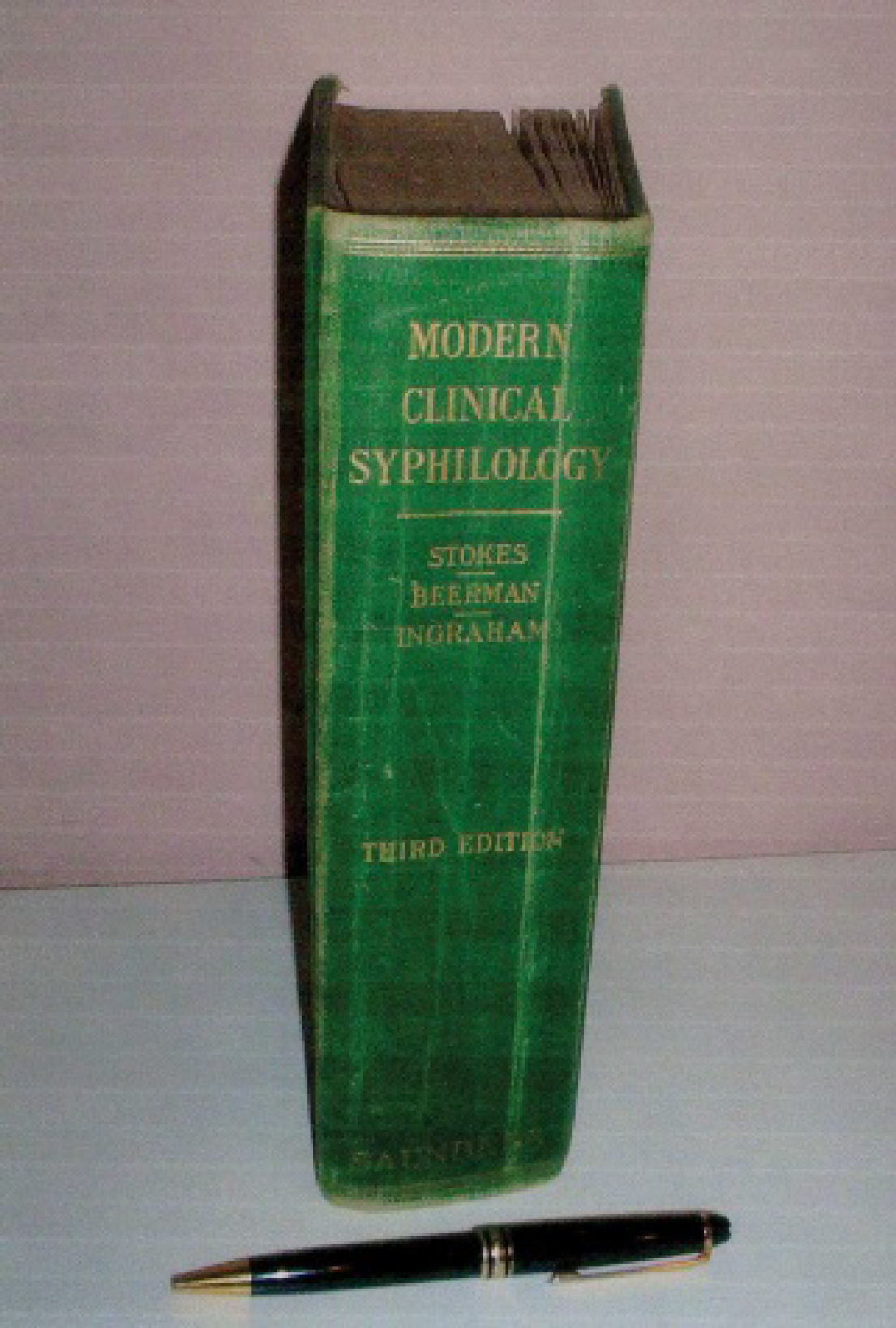
Photo of Modern Clinical Syphilology by John Hinchman Stokes, Herman Beerman, and Norman Ingraham. 5
The purpose of this article is to briefly review and provide a critique of this 1,332-page book. It has been described as a classic. (The Shorter Oxford English Dictionary defines classic as “Of the first rank or authority; standard, leading.” 6 ) Was it?
The table of contents indicates that 50 pages were on the chancre, 100 pages were on secondary cutaneous syphilis, and 100 pages were on tertiary cutaneous syphilis. As the author of a morphology text, I have written the following:
Not only the morphology of syphilis, but also much about the morphology of skin diseases that have been confused with syphilis can be learned. For example, in the 62 pages on the differential diagnosis of secondary syphilis, there are numerous excellent photographs and no less than 55 tables outlining the morphological differences between syphilis and conditions that may mimic it. Although there may be a variety of constitutional signs and symptoms of systemic organ involvement in secondary syphilis, in most cases the clinical diagnosis is made (or suspected) on the basis of skin and/or mucous membrane lesions. 7
The text contains examples of these many useful comparisons of differential diagnoses.
But this text is more than a dermatology text. The clinical systemic manifestations take up 40 pages on osseous lesions, 45 pages on liver and spleen lesions, 70 pages on the cardiovascular system, and 100 pages on central nervous system findings (including the eye). There are 100 pages of familial and prenatal problems. There is a huge detailed record of all prepenicillin heavy metal therapy, including its method of administration (frequency of dose, side effects) and effect on the natural course of the disease.
Stokes's final analysis of all heavy metal relative antispirochetal efficacy was arsenic 10, bismuth 5, and mercury 3, with antimony and iodides being less effective.
There is seemingly endless discussion and description of the 25 or so serologic tests for syphilis, including what they could and could not do, and four pages of lists of conditions producing biologically false–positive results. In the 69-page chapter on technical methods and considerations in diagnosis and treatment, everything from water for sterilization, to 6 pages on the care of needles, to the 18 steps of collecting and handling blood specimens for the Wassermann serologic tests was described.
When penicillin came on the scene, Stokes was elated and fascinated. Its efficacy was obvious and so much more superior to that of previous treatments.
You might wonder what possibly could have been omitted. Not much. But I did find three items. There was no mention of the Tuskegee Study of Untreated Syphilis in the Negro Male done under the aegis of the US Public Health Service from 1932 to 1972. 8 Stokes had the title of senior surgeon (ret'd) with this organization. A figure within the text displays the rates per 1,000 for syphilis in whites and blacks, discovered by testing for syphilis for military service. In his text, Stokes discusses in some detail the great problem: “the extraordinarily high prevalence of syphilis in the negro is a basic public health fact which permeates overwhelming by all other data.” 9 Did he not know of the Tuskegee survey?
The second omission is that he does not make mention of the then well-known sequelae of long-term administration of inorganic arsenic (AsO3, eg, Fowler solution) punctate keratoses on palms and soles with eventuation into squamous cell carcinoma, multiple superficial basal cell carcinomas on the torso, and raindrop pigmentation. 10 These are almost unknown from organic arsenic (C12H14As2N2O2 arsphenamine).
The third omission is that except for a few short notes on yaws and pinta, he makes no comments on the history of syphilis or of other treponematoses. He starts his book with the discovery of the spirochete of syphilis in March 1905.
A Classic or Not?
Books become classics for many reasons. Some of these reasons are completeness, new concepts, topical subject matter, and excellent writing or beautiful illustrations. Some have a wonderful organization, some are extremely readable, some use statistics superbly, and others have a tremendous clarity. Each classic is different, and there are different opinions as to what is a classic.
The details included in Stokes's text were outlined in the first part of this article. As I have implied, they told almost all of the medical (and, in places, the social) aspects of syphilis. With this as a background, what other background factors contributed to making this book a classic?
It helps if the disease can be clearly defined with a definite cause. Starting in March 1905, this was the case with syphilis.
Stokes's interest in syphilis started in the mid-1920s. The first edition of his book was in 1926. He investigated and studied all aspects of the disease, especially until the publication of his 1944 text.
During most of this time, there was no easy, effective cure for syphilis. The arsenicals and heavy metals had only an ameliorating effect. The treatments were long and tedious, and I wonder how many of the 1½- to 2- year treatment injection series of the organic arsenicals were ever completed? So the disease was not cured and made to disappear. This meant that the disease was still around to be studied, and it needed to be studied in all aspects as a multisystem disease.
Stokes was an obsessive, intelligent, well-trained physician in a dominant position to be supervising and accumulating the material to be published in the book. A partial list of his academic positions include (1) professor, Mayo Clinic medical school; (2) chairman of dermatology and syphilology at the University of Pennsylvania; (3) professor of dermatology, Graduate School of Medicine, University of Pennsylvania; (4) head, Institute for the Study of Venereal Diseases at the University of Pennsylvania; (5) senior surgeon, US Public Health Service (reserve); (6) Committee on Research in Syphilis; (7) consultant to the surgeon general of the army and secretary of war; (8) Subcommittee of Venereal Diseases in National Research Council; (9) American representative to the League of Nations; and (10) an important role in the US-wide Cooperative Clinical Group for the study of syphilis.
The United States was a well-developed, reasonably stable country with numerous well-funded medical institutions and with the financial and intellectual abilities to support medical studies. Stokes was able to get support from other syphilologists in this milieu.
Finally, the effects of a new curative drug could be measured on a background of 20 years of intensive study. Many of the difficult clinical problems were seen to melt away in a manner never seen before!
Many others have made significant contributions to our knowledge about syphilis—almost too numerous to mention. Think of Gaston August Milian (1871–1945), Jonathan Hutchinson (1828–1913), and Jean Alfred Fournier (1832–1915). However, few wrote complete texts. (Fournier had the first two volumes of his classic published in 1899 but nothing else. 11 ) Phillippe Ricard (1800–1889) wrote the classic Practical Treatise of Venereal Disease. 12 None that I know of cover in detail the medical story of syphilis from the discovery of the causative treponema to the introduction of the curative penicillin.
Footnotes
Acknowledgment
Financial disclosure of author and reviewers: None reported.