







Abstract

On March 8, 1965, Margaret G. Smith, MD and John M. Kissane, MD were among a group of men and women who gathered in room 547 in the Philadelphia Sheraton Hotel to discuss pediatric pathology in an organizational sense. Appropriately, Sidney Farber, MD sat at the table in the front of the room along with Jay Bernstein, Gene Perrin, and Daria Haust who conducted the meeting. Not surprisingly, several of the individuals in the room were Farber's former trainees.
Farber was the first full-time pathologist at Boston Children's Hospital in 1929 after the completion of his pathology residency at the then Peter Bent Brigham Hospital. There was no greater name in pediatric pathology at this time than his in the United States, even though he had his doubts about the uniqueness of pediatric pathology [1]. His presence at the meeting was a titular sign of his approval of the purpose for the meeting. Many of the attendees were already well-established names in pediatric pathology that held positions of leadership in children's hospitals throughout the United States and Canada (M. Finegold, personal communication).
The purpose of the meeting was to discuss the formation of a professional organization of pathologists whose practice and scholarly focus spanned the broad front of pediatric pathology. The outgrowth of that meeting came to be known as the Pediatric Pathology Club (PPC), which underwent a later name change to the Society for Pediatric Pathology (SPP) [2]. Daria Haust and others were to lead the later movement in behalf of a name change from PPC to SPP.
It certainly could be argued that the North American rendition of the PPC, which was inaugurated in 1965, had come to the party rather late since the organizers in the United Kingdom had established a Paediatric Pathology Club in 1955. John Emery, in his history of the Paediatric Pathology Club through 1997, noted that already in the mid-1950s “paediatric pathology was obviously rapidly expanding” and that there was a “need for the formation of such a group” [3]. In the discussions leading to the formation of the Paediatric Pathology Club, Emery took note of several pediatric pathologists in the United States and Canada, including Dorothy Anderson, Jim Arey, Bill Donohue, George Fetterman, Edith Potter, and Fred Wigglesworth, who offered enthusiastic encouragement and support for an organization of pediatric pathologists. Emery refers to these individuals and others as some of the “pioneers of paediatric pathology.”
Most of the pathologists who gathered together in March 1965 in Philadelphia during the meeting of the American Association of Pathologists and Bacteriologists were not the only members of that informal fraternity of pioneer pediatric pathologists. Several other names missing from the roster on that day in Philadelphia included Shirley Driscoll, Jim McAdams, Frank Sherman, John Craig, Ben Landing, Kurt Benirschke, Ellen Oppenheimer, and Dick Naeye.
MARGARET G. SMITH, MD
Smith and Kissane came to be identified as pediatric pathologists through the portal of general pathology rather than fellowship branded (Fig. 1). Both were excellent general pathologists whose diagnostic skills were honed in the autopsy suite. Smith, for many years, was the director of the autopsy service at Barnes and St Louis Children's Hospitals and was succeeded by Kissane upon her retirement from that position in 1967. Smith and Kissane were equally adept with the pathologic anatomy in an adult or neonate. The common refrain in the department by more than one of their colleagues while reviewing the organs or the microscopic sections from an autopsy was, “Why don't you [the resident] show this case to Dr Smith and/or Dr Kissane?”
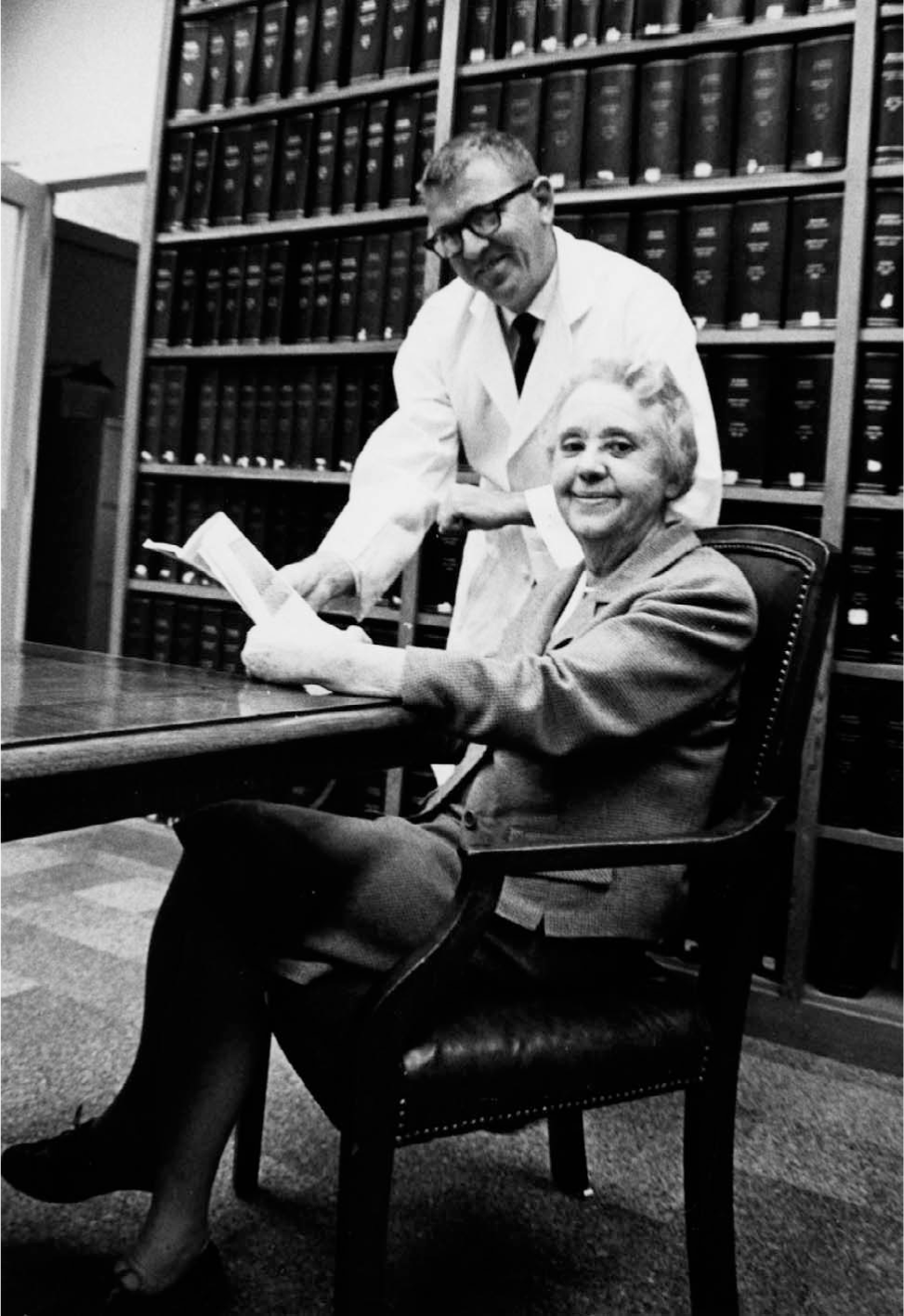
Margaret Smith and John Kissane pictured together circa 1967 in the departmental library on the 3rd floor of the West Building. Becker Medical Library, Washington University School of Medicine.
Smith and Kissane were not contemporaries; she was born in 1896 in Carnegie, PA and he in 1928 in Oxford, OH. She joined the faculty of the Department of Pathology of Washington University School of Medicine (WUSM) in 1929, whereas Kissane matriculated as a first-year medical student at WUSM in 1948. Their paths would have crossed in the second year pathology course, since Smith still was quite active in medical student education when I was a second year medical student in 1963 at WUSM.
Margaret Smith, known to most as “Dr Smith,” graduated from Johns Hopkins University School of Medicine (JHUSM) in 1922 [4]. She remained at Johns Hopkins until her move to St Louis at the invitation of Leo Loeb, MD, the chairman of the Department of Pathology. Loeb had succeeded Eugene Opie, MD, who was in the first class to graduate from JHUSM in 1897. Smith was in the line of several others who joined the faculty of WUSM in pathology and other departments with direct connections to JHUSM. Though not reflected in her early papers published while at Johns Hopkins, Smith had an evolving interest in infectious disease that can be traced in part to her colleague, Arnold Rich, MD. Though having graduated just three years before Smith, he already was ascending through the ranks with his work on tuberculosis and acute lung injury, known for many years as Hamman-Rich syndrome. It was Rich who told Smith that the two people that he would “consider working with if he were thinking of leaving Baltimore,” which he never did, were Leo Loeb and Eugene Opie [4]. It was Howard A. McCordock, MD, another JHUSM alumnus, colleague, and future chairman of the Department of Pathology at WUSM, who recommended Smith to Loeb. She was offered a position as assistant professor. She remained in that position from 1929 to 1943.
Soon after arriving in St Louis, Smith published a study on the presence of intranuclear inclusions in the lungs of children who died of pertussis [5]. Her studies throughout the 1930s were focused on the salivary gland inclusion virus in mice and St Louis encephalitis virus (SLEV) in the setting of the great encephalitis epidemic in the St Louis area in 1933 (910 cases in late summer, 1933 with 160 deaths) [6–12]. Though the virus was isolated by Leslie Webster, MD in 1933, another JHUSM alumnus known to Smith [13,14], she published a series of laboratory studies on the neutralization, propagation, and preservation of SLEV [15,16]. She also was one of the first to observe the similarities of SLEV and Japanese B encephalitis virus, both mosquito-borne flaviviruses [17–21]. Smith may have passed from the scene in 1970, but interest in SLEV continues to the present day in her department [22].
Her studies on SLEV continued throughout the decade of the 1940s, but during this period, she also turned her attention to the murine poliomyelitis virus [23,24]. Beginning in 1950, Smith returned in a more focused manner to salivary gland inclusion virus with a comprehensive review appearing in 1940 with Frank Vellios, MD, one of the many young pathologists who came to the department for residency or as young faculty and later whose names would become widely recognized in the community of general and academic pathologists [25]. She initiated a series of laboratory studies on the propagation and transmission of murine salivary gland virus in tissue culture [26]. In 1955, she isolated salivary gland virus for the first time from human tissue, known to us today as cytomegalovirus (CMV), but her study was rejected because of the suspected cross-contamination from her murine cultures of this virus [27]. She was to isolate the virus from a second human case and that study was accepted for publication in 1956 [28]. Thomas H. Weller, MD had been credited as the first to successfully culture human CMV, but Ho [28] corrected the record in the following account: “Earlier in 1955, Margaret Smith isolated from the salivary gland of a dead patient a virus which grew only in human but not in mouse cell culture. The paper describing this finding was rejected because she was also working with murine salivary gland virus.… It was only in 1956 when she re-isolated the virus and isolated the same virus from the kidney of another patient with CID (cytomegalic inclusion disease) that her paper was accepted.” We now know that the various strains of CMV are species specific so that murine CMV could not have infected human cells [29]. Of course, CMV is one of the most important of the congenital infections.
One can appreciate that Smith's scholarly contributions to pediatric pathology occurred through the pathway of infectious disease. In 1958, she was chosen as one of the 10 Women of Achievement in St Louis. Upon the sudden death of McCordock in 1938, who then was the chairman of Pathology at WUSM, Smith became the acting chairman and the first woman on the faculty to hold an administrative position in the School of Medicine [30]. Her life was devoted to the department and WUMS since she never married and had few immediate family members of her own.
JOHN M. KISSANE, MD
John Kissane graduated cum laude from WUSM in 1952. The following 2 years were spent as a resident in pathology at Barnes Hospital and as a research fellow. After the completion of a 2-year tour in the United States Army, he returned to St Louis and joined the pathology faculty as an assistant professor.
He became involved in basic research with the application of microchemical techniques, which he had learned in the laboratory of Oliver H. Lowry, MD, Ph.D. It was there that he came into contact with Eli Robins, MD (later chairman of the Department of Psychiatry). Kissane and Robins worked together on two publications using Lowry's techniques [31,32]. Soon thereafter, he began collaborative studies with Robert H. Heptinstall, MD, who was in the department at that time; their studies focused on experimental obstructive uropathy and chronic pyelonephritis which we know today as reflux nephropathy [33–35]. These same techniques were applied in studies on the developing kidney [36]. In the first edition of Pathology of the Kidney, Heptinstall acknowledged his gratitude to Kissane for his chapters on renal development and congenital malformations [37,38].
Kissane and Smith collaborated on the first edition of Pathology of Infancy and Childhood, which was published in 1967 [39]. Their reference appeared 1 year after the second edition of Stowens' Pediatric Pathology to serve as contrasting levels of scholarship [40]. McAdams' review of Pathology of Infancy and Childhood characterized it as “beautifully illustrated… and unquestionably superior to any other existing book on the subject” [41]. However, McAdams stated that he would not purchase the book since he found “texts of any kind to be of little use.” As a postscript to their book, Smith acknowledged that she had “done next to nothing with it. It is John's book and I am only the background” [4]. She went on to further say that “John had the scientific ability and knowledge, and an excellent command of the English language” [4]. It is apparent that she had enormous regard and affection for her former student and trainee who succeeded her as the full-time director of the autopsy service, but who never replaced her in a sense.
Kissane's interest in pediatric pathology began to emerge while he was a resident and was on exhibit in his first published paper on the topic of maturation of neuroblastic tumors, which he coauthored with Lauren V. Ackerman in 1955 [42]. A report on acute nonlipid reticuloendotheliosis in an infant appeared in the following year [43]; this disorder also was known as Letterer-Siwe disease and today as infantile multisystem Langerhans cell histiocytosis. Throughout his active years, Kissane continued his interest and developed his insights into various aspects of renal diseases in children with studies on cystic disease and hereditary nephropathies [44–51]. Kissane also was involved in a number of studies on various aspects of childhood neoplasia, including Ewing sarcoma, renal tumors, small cell osteosarcoma, pancreatic tumors, rhabdomyosarcoma, and histiocytic disorders [52–59].
In addition to his responsibilities as director of the autopsy service at a time when 600 to 700 autopsies per year were performed in the department, Kissane also was responsible for the pediatric and adult renal biopsies which came through surgical pathology. He was actively involved in the second-year pathology course as a lecturer in a number of organ systems, in addition to his supervisory role in the student laboratories at a time when we were expected to master microscopic pathology at a basic level; the latter is no longer a component in most contemporary medical school pathology courses to the detriment of their education.
Kissane was an active participant in one of the early goals of the newly organized PPC, which was the eventual acquisition of subspecialty status for pediatric pathology. No individual worked as tenaciously as William (Bill) Donnelly, MD in that regard. Kissane was involved in the early organizational activities of the PPC. He was a member of the constitutional and by-laws committee of the PPC. Once pediatric pathology had been recognized as a subspecialty by the American Board of Medical Specialties, Kissane was appointed by the American Board of Pathology to the first pediatric pathology test committee from 1984 to 1989. The culmination of those endeavors by Donnelly, Kissane, and many others in the PPC was the first subspecialty examination in pediatric pathology on November 20, 1990 in a room filled with most of the founders' generation and other less notables.
Smith and Kissane participated in clinicopathologic conferences at the St Louis Children's Hospital (STLCH) and were recognized formally as the pediatric pathologists even though there was no department, division or section of pediatric pathology. All of the pediatric surgical pathology specimens, except the renal biopsies, were examined by the staff surgical pathologists rather than Smith and Kissane. To this very day, STLCH does not have its own general pediatric pathology laboratory in contrast to most children's hospitals in the United States and Canada. The clinical laboratories are located in the STLCH and have been directed over the years by various pediatricians with one exception, Carl Smith, MD, a pathologist. When the original STLCH was dedicated in January, 1915, it was next door to the recently completed Barnes Hospital. There were several small operating rooms in STLCH, but their inadequacy soon became apparent. The solution to this problem was to rent several operating rooms from Barnes Hospital. At the end of the day, all surgical specimens found their way to the general surgical pathology laboratory. There were no autopsy facilities in STLCH either yesterday or today. The autopsy suite is located in one of the original buildings of the post-Flexner, reorganized WUSM, the West or Old Clinic Building. The new STLCH was opened on April 14, 1984 with its own operating rooms and radiology department, but only a single room on the 5th floor with the designation “pediatric pathology” on a small wall panel and a few shelves and counters were the total physical presence of anatomic pathology.
Though a formal pediatric pathology fellowship did not exist at STLCH until the mid-1990s, at least four individuals came through the pathology residency program at Barnes Hospital in the late 1960s through the 1980s who were influenced by Kissane and his commitment to pediatric pathology: Frederic B. Askin, MD, Stewart F. Cramer, MD (WUSM, 1973), David Witte, MD, and myself (WUSM, 1966). Each of us holds him in highest regard and would have likely pursued different paths without his example.
Only a few individuals from that founding group still are with us, but fortunately for us in St Louis, Dr Kissane remains active and attends the weekly autopsy conference to insure that we do not wander too far from the diagnostic path. He remains a blessing in our midst.
A final note is in order about Kissane's deep regard for Margaret Smith; these are but a few words from his memorial to her: “we who remain feel sorrow, but it is not the sorrow witnessing a decline of faculties or prolonged incapacity…but it is a loss from fullness rather than the loss from work undone… And so each of us must, in his own way, and husbanding his own memories, take leave of one who was variously our teacher, our preceptor, and our dear friend” [60].
Footnotes
ACKNOWLEDGMENTS
The meeting was chaired by Sidney Farber and included the following individuals: James Arey, Kurt Aterman, Jay Bernstein, William Blanc (Joaquim Wigger, guest), Joseph Boggs, Robert Bolande, Drummond Bowden, Joseph Brough, Jane Chatten, Pat Conen, Molly Dapena, Israel Diamond, Renata Dische, William Donahue, John Esterly (guest of Ella Oppenheimer), George Fetterman, Robert Goyer, Peter Gruenwald, M. Daria Haust, William Jacques, Shirley L. Kauffman, John Kissane, Samuel McCreadie, Harry Neustein, William Newton (K. Masugi and G. Glynn, guests), James Patrick, Eugene Perrin, Charles Reiner, Harvey Rosenberg, Douglas Shanklin, Margaret Smith, Lotte Strauss, Gordon Vawter (guest of Sidney Farber), Frederick W. Wigglesworth, Camillus Witzleben, and William Yakovac. It is reported that there were 35 individuals at this meeting, but there is some discrepancy in the names of those who were there in attendance.