







Abstract
The Accreditation Council on Graduate Medical Education (ACGME) requires documentation of the progress of residents and fellows in training, and the keeping of a portfolio is one method to comply with ACGME requirements. This article briefly describes Good-Fellow, an electronic portfolio database written in Microsoft Access ®. GoodFellow provides the fellow with electronic forms to track work hours, scene visits, court visits, court testimony, consults with families, police, and attorneys, and it also includes a place to document competence in required procedures (technical skills). Also included are forms to document experiences relevant to systems-based-practice, practice-based learning, required and optional reading, and evaluation of external rotations. If an office does not have an electronic database for tracking the fellow's case log and status of autopsy reports, GoodFellow offers those functions as well. In our office setting, a copy of GoodFellow is placed on an office network computer drive which is accessible by the fellow and the training program director and associate director. This allows the programs directors to continuously monitor the fellows progress, and data from GoodFellow are quite useful in preparing periodic status reports for, and required formal evaluations of the fellow. At year's end, a copy of GoodFellow can be placed in the fellows training file and a copy can be provided to the fellow as a keepsake and documentation of training.
Keywords
Introduction
The Accreditation Council on Graduate Medical Education (ACGME) requires documentation of the progress of residents and fellows in training, and the keeping of a portfolio is one method to comply with ACGME requirements. This article briefly describes GoodFellow, an electronic portfolio database written by the author using Microsoft Access®, in which the fellow can enter data relevant to fellowship goals and progress.
Methods
The author reviewed the common and specific program requirements but forth by the Accreditation Council on Graduate Medical Education (ACGME) for forensic pathology fellowship training programs (1, 2). Based on this information, in 2006, an electronic database (GoodFellow) was written using Microsoft Access® 2003 and the database has been used to track fellow progress and performance for seven fellows since that time. Principles for writing programs in Access® had been learned earlier when the author designed a case management system for use in his office, based on guidance provided in an available publication (3). Based on fellow feedback, the database has been modified several times since its original development, and this article describes the features of the current version.
Features of the System
A copy of GoodFellow is placed on a common network computer drive accessible to both the fellow(s) and the forensic pathology training program director and associate director. If a network drive is not available, a copy of GoodFellow can be placed on the fellow's personal computer. A copy of GoodFellow is made for each fellow in the program so each has his/her own database, and the name of each database can be renamed to include the name of the fellow such as GoodFellowSally, GoodFellowDavid, GoodFellowJohnson, etc.
The main page of GoodFellow contains 14 buttons, each of which performs a specific function which, for the most part, is to call up a custom form into which the fellow can enter relevant information (Figure 1) These buttons and the associated information are as follows:
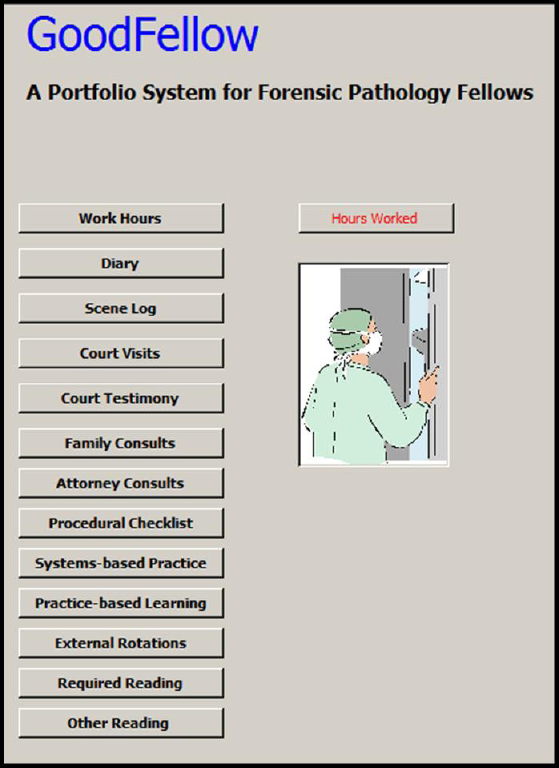
The main page of GoodFellow, showing the buttons which call up specific forms on which the fellow may document various types of learning and fellowship experiences (see text).
Work Hours
Each day, the fellow indicates the time he/she came to work and the time he/she left work. An associated “Hours Worked” button can be used at any time which calculates the hours worked each day. This function is useful to tabulate average and maximum work hours per day as well as a sequential history of consecutive days worked so that violations of ACGME work hour limitations can be avoided.
Diary
This form is used as needed by the fellow to briefly document interesting learning or other experiences related to the fellowship. It may be used to document experiences that do not fall within the other categories below.
Scene Log
The fellow enters brief information about scene investigations he/she attended such as case number, date, probable manner of death, and a brief description of circumstances.
Court Visits
This form is used to document observation of testimony by staff in court cases, depositions, or other legal proceedings.
Court Testimony
The fellow documents personal testimony in court or depositions using this form.
Family Consults
The fellow uses this form to document conversations or meetings with families with whom case findings or other issues have been discussed.
Attorney Consults
On this form, meetings with case-related attorneys are documented. The form may also be used to document similar meetings with law enforcement personnel.
Procedural Checklist
This form contains a list of 44 procedures which the fellow is expected to learn and perform during the year. A place exists to document the date that competence is demonstrated and which staff medical examiner “signed off on the procedure. The form may be modified by the program director, if needed.
Systems-based-Practice
The fellow uses this form to document experiences involving external systems such as interactions with laboratories, health departments, and other relevant agencies and organizations.
Practice-based-Learning
On this from, the fellow documents such things as the preparation and presentation of lectures based on case material, literature reviews, and case-based reading.
External Rotations
The fellow uses this form to document and evaluate external rotations at other labs or agencies such as the firearms lab, toxicology lab, DNA/ serology lab, as well as other specialty areas such as questioned documents, latent prints, and trace evidence.
Required Reading
On this form, the fellow documents the start date and completion date for a list of reading materials considered by the program director to be required reading. The program director may modify this form, if needed to meet specific program goals and objectives.
Other Reading
This is an open-ended form into which the fellow may document reading that is outside of the required reading list.
If the training center does not have a separate electronic database which tracks autopsies and other case exams done by the fellow, a list of unfinished cases, or a tabulation of case types, there are hidden buttons in GoodFellow which can be enabled to perform these functions.
Discussion
If the training center uses software other than Microsoft®, the principles described in this article may be used to develop a similar database using other database software, if desired. For those who do use Microsoft Access®, the author is willing to provide a copy free-of-charge to those who wish to try GoodFellow in their training program.
Experience with our past seven fellows has shown that the least-used portion of GoodFellow is the Diary. This seems to be due to most experiences having another form in GoodFellow on which the information can be documented. It also seems unclear to some fellows which type of experiences they should document as systems-based-practice or practice-based-learning. This obstacle can be overcome by explaining the desired types of entries at the beginning of the fellowship year.
At the end of the training year, a copy of Good-Fellow can be placed on a CD which can be filed in the fellow's training material records and a copy can be provided to the fellow as a keepsake and documentation of many aspects of the training year.
Although it is separate from GoodFellow, our office's main case management system contains a table in which all conferences can be documented, such as morning case preview, afternoon case review sessions, didactic lectures on forensic pathology subjects, weekly image review conferences, and other extemporaneous conferences. The table includes a place to indicate if the fellow was present, and it also contains checkboxes for each of the six-basic competency areas (knowledge, systems-based practice, practice-based-learning, interpersonal skills, technical skills, patient (client) care, and professionalism), and the applicable categories can be checked for each conference. At years end, this table allows for easy tabulation of learning encounters which fall outside of those captured by GoodFellow.
Along similar lines, our office holds a weekly image review conference in which all scene and autopsy digital images (photographs) are reviewed, typically for all cases that occur over a one week period. The case management database contains a form on which the review of each case can be documented, along with text entry to describe images that would be good for teaching or publication purposes. The list is searchable so that cases with images of specific findings may be easily located.
The author has found GoodFellow to be a useful tool to monitor forensic pathology fellow progress, and in preparing required formal evaluations of the fellow during the training year. Training directors in other forensic pathology programs may wish to use GoodFellow or a similar database to facilitate evaluation of fellow progress during the training year.