







Abstract
This article is intended to provide information to the forensic pathologist about proper collection and preservation of toolmark evidence from sharp force injury events. Other topics include case histories, research related to toolmarks in cartilage and bone and toolmark examiner procedures for preparing specimens for examination.
In cases where there is probative value in comparing a knife or other bladed implement to a toolmark left in bone or cartilage, it is essential that there is communication between the forensic pathologist and a toolmark examiner. With proper collection, preservation and examination of toolmarked objects by the forensic pathologist, a toolmark examiner may be able to identify or eliminate a suspect blade as having produced the defect, providing valuable information to the law enforcement and judicial community.
Introduction
In the course of a forensic pathologist's career, sharp force injury will undoubtedly be the cause of death in at least a handful of cases. During the investigation of such cases, the forensic pathologist has the opportunity to provide evidence that would otherwise be unavailable for examination by the toolmark examiner. Sharp force injuries produced in cartilage and bone by knives and other bladed implements will many times possess toolmarks that may be of value for comparison to tools recovered during the course of an investigation.
This article will provide the forensic pathologist with basic terminology used by the toolmark examiner, a brief review of the toolmark research and case history that has been produced/published with regard to this type of examination, and a procedure for the recovery of this type of evidence, and a method for preserving the evidence in a way that will insure the toolmark information is intact for eventual examination by a qualified toolmark examiner. Finally, the procedure that a toolmark examiner uses to prepare specimens for comparison will be presented.
Basic Terminology
In the most basic terms, a toolmark is simply the impression or mark left behind when two objects come into forceful contact with one another, resulting in the softer object being marked. The harder of the two objects, or the object leaving behind the mark or impression, is called the tool. In the context of this article, the tool is generally a cutting tool such as a knife or a saw. The toolmarks left behind by knife or saw blades may have measurable features that could indicate a specific type of blade. These features or class characteristics can provide clues as to the design and size of the tool, as well as give some indication to how the tool was used (e.g., stabbing versus slashing).
Identification of a tool to a toolmark occurs when a qualified examiner finds agreement between test marks and the toolmarks in question that is consistent with toolmarks made by the same tool and beyond agreement that might be found in toolmarks known to be produced by different tools. This level of agreement is determined by examination of repeated tests made with the tool in question. The examination of toolmarks is typically performed by side-by-side analysis under proper magnification and oblique lighting using a comparison microscope. Additionally, the use of casting materials may be necessary when the surface bearing the toolmarks lacks sufficient contrast or is too reflective for direct comparison. The most commonly used are a silicone based casting materials, such as Mikrosil or Forensil.
Research and Case Studies Involving Knives
Research into toolmarks produced by knives has been published over the last 39 years. Bonte noted as early as 1974 that cartilage and bone could accept toolmarks from knives and saws (1). He also noted that many times, class characteristic information as well as “accidental nicks”, and individual characteristics can be transferred to these media (1). Since that time, there have been numerous publications on the research of knives, their toolmarks, and the media they mark. Empirical and/or validation studies are one type of such work. In the toolmark discipline, it is common practice when designing an empirical and/or validation study to use consecutively manufactured tools. The reasoning behind this methodology is that the machining tools used to manufacture the final products will be in approximately the same state of wear. This means that the tools produced have the greatest chance of having characteristics so similar that the toolmarks they produce might not be distinguishable to a trained examiner. Over the years there have been several studies of this type (2–7). All of these studies have shown that the toolmarks made by knives, whether used in a slicing or stabbing motion, are specific to the knife that made them. One of these studies, a validation study by Thompson and Wyant, was able to provide an error rate for this type of exam (.776%) (4).
Other articles include those that focus strictly on class characteristic identification (1, 8, 9), and those that describe cases studies in which toolmarks from knives have been identified in cartilage or bone (10–16).
Procedure for Documenting and Removal of Toolmarked Bone or Cartilage
The photographic documentation of wounds is a familiar task for the forensic pathologist. Without it, one would have to rely solely on detailed notes and sketches to refresh one's memory. While this kind of information can be very useful indeed, it is nearly impossible to document everything that a photograph can relay with a simple release of a shutter. In this day and age when digital cameras are everywhere, regardless of budget, there can be almost no excuse for not documenting photographically.
It should be no surprise that detailed photographic documentation of wounds from autopsy can be very useful for the toolmark examiner. Information related to tool type, blade width, and other factors may be better understood, given the opportunity to view photographically. Whenever possible, a toolmark examiner should be present to take part in the examination, documentation, and removal of the toolmarked material. This may be mutually beneficial for both the pathologist and the toolmark examiner.
It is recommended that photographs be taken at three levels when documenting wounds of any type. Overall, mid-range, and close-up photographs should be taken with a scale in the same plane as the subject wound (
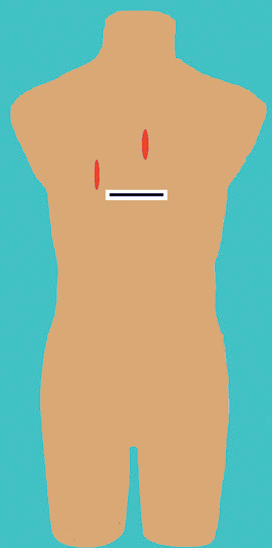
Representation of an overall photograph to be taken of body. Red ovals represent sharp force wounds. Black and white rectangle represents scale placed in the same plane as wounds.
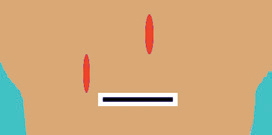
Representation of a mid-range photograph showing wound orientations.
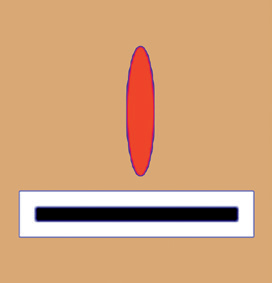
Representation of a close-up photograph showing wound detail.
Once the wound/defect has been incised, a photograph should be taken, showing the orientation of the wound with the body. This can be accomplished by placing the removed portion next to the incised area from which it was removed (
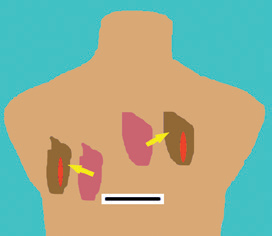
Representation of incised areas around wounds placed next to the hole from which they came. It is recommended that a photograph be taken similar to the representation for documentation and orienting purposes
Preservation of Toolmarked Evidence
Once the wounds/defects have been removed, they should be packaged for submission to the crime laboratory. Previous research (6) has shown 10% formalin to be suitable for preserving toolmarks in cartilage. The same has been noted for toolmarks in bone by Lançon (7). Other methods of preservation of cartilage and bone have been studied (18). Ten percent formalin is the method preferred by Clow and Lançon. Heat sealed plastic bags can work well for packaging (
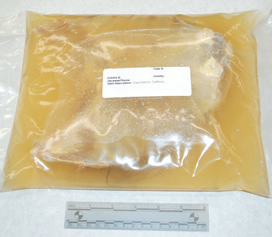
Heat sealed package containing a chest plate with sharp force wounds.
Procedure for Examination of Toolmarked Cartilage or Bone
Once the potentially toolmarked specimens have been packaged and submitted to the laboratory, the toolmark examiner can either store the material indefinitely or begin the task of determining if the specimens have toolmarks for comparison. An examination of the defect should reveal the class characteristics of the tool. For example, with a stabbing in cartilage, the length of the wound can be indicative of the width of the blade. So, if a wound's length is 1/2 inch and the questioned knife blade has a maximum width of 2frac12 inches, the toolmark examiner may be able to eliminate the knife based on class characteristics. It should also be noted that an examination of the photos of clothing and the skin of the deceased may prove useful in determining the type of knife used and how it was used.
The first step in the process is to photographically document and note how the specimen was received (
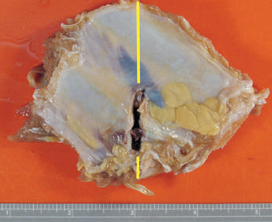
Portion of chest plate with sharp force injury. Yellow lines indicate area to be incised to expose inner surfaces with potential toolmarks.
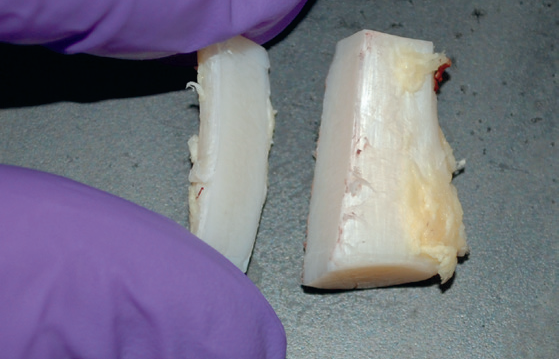
Separation of cartilage, exposing inner surfaces.
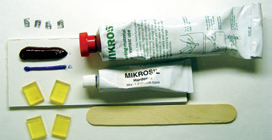
Mikrosil casting materials and rubber like material with knife produced toolmarks to be cast (6). Reprinted with permission from the AFTE Journal.
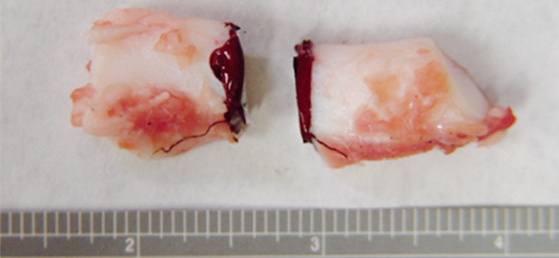
Mikrosil casting material applied to cartilage.
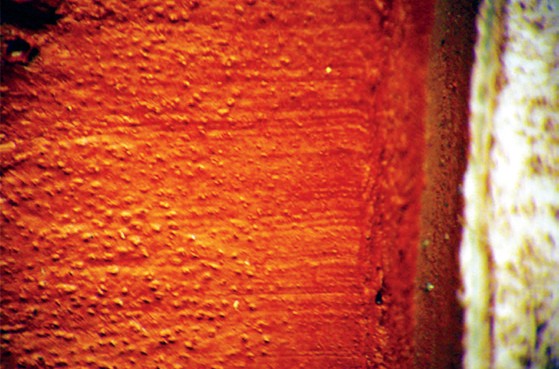
Photomicrograph of cast of cartilage showing visible toolmarks for examination (6). Reprinted with permission from the AFTE Journal.
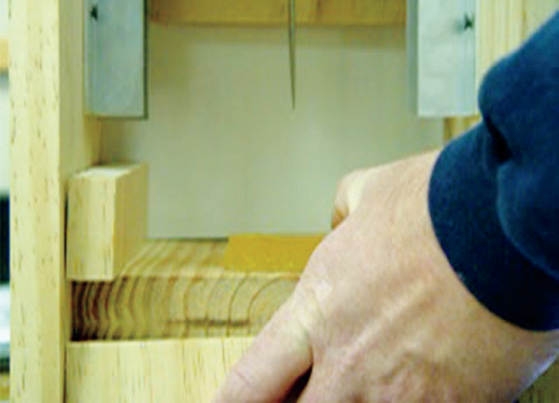
Jig used to hold knife blade for production of test toolmarks in rubber-like material.
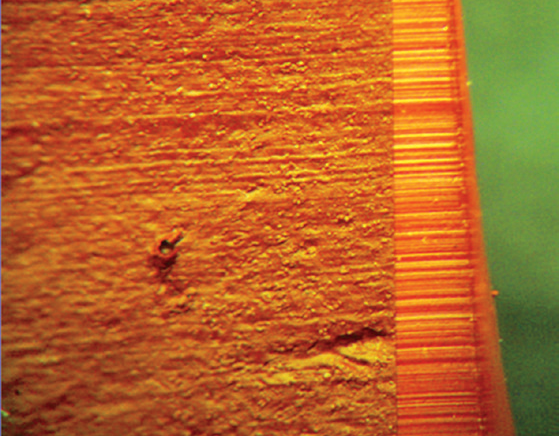
Comparison photomicrograph of an identification of toolmarks on a cartilage cast to a cast of knife produced test toolmark (6). Reprinted with permission from the AFTE Journal.
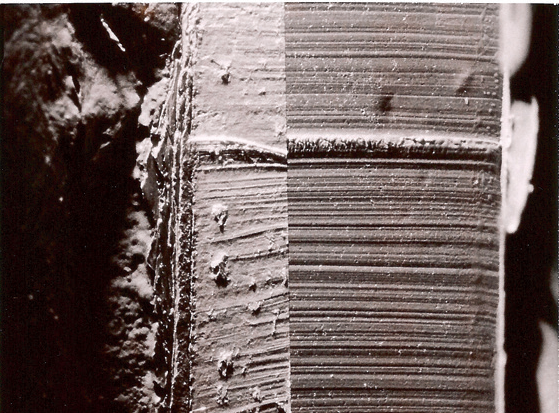
Comparison photomicrograph of an identification of toolmarks on a bone cast to a cast of a knife-produced test toolmark (7). Reprinted with permission from the AFTE Journal.
Conclusion
In the case of the investigation of a sharp force injury death, the identification of the suspected weapon may be crucial. While it is generally known that information about the class characteristics (e.g., size, blade style, and shape) may be determined from sharp force injuries, both cartilage and bone have been shown to be suitable substrates for toolmark identification using standard comparison practices. The forensic pathologist plays a critical role in the removal and preservation of this type of potentially toolmarked evidence. The thoughtful collaboration with a toolmark examiner in such cases may result in the successful identification of a suspect weapon, potentially aiding law enforcement and the judicial system.
Footnotes
The authors, reviewers, editors, and publication staff do not report any relevant conflicts of interest.