







Abstract
Throughout Florida history, death investigations were performed under a haphazard or nonexistent system of justices of the peace coroners. These investigations were restricted to certain types of criminal deaths and deaths in jail, ignoring the vast majority of unexpected or violent deaths. There had not been a provision for the investigation of the large number of sudden, natural and violent deaths that fall into the non-criminal, yet public interest, category.
Few states have an oversight and regulatory body such as Florida's Medical Examiners Commission. Its purpose is to advise medical examiners and to develop policies and procedures for how medicolegal death investigation is performed in the state. This article describes the formation and function of our Medical Examiners Commission and its membership, and also briefly describes other states that have a regulatory commission or similar governing body.
Introduction
It is fundamental for a society to know why it is being deprived of the talent and productivity of its citizens by premature death. Modern forensic science technology and investigative procedures have been developed, which - through the cooperation of the medical, law enforcement, and legal communities - can determine the cause, manner, and circumstances of almost all deaths on a case-by-case basis. To achieve efficiency, major metropolitan centers in developed countries have opted for a centralized, organized, specifically staffed and structured office charged with the responsibility to provide answers, not only about individual deaths, but also summaries on which to base countermeasure planning. A suspicious human death or body discovered in the most remote area of Florida deserves as meticulous an investigation as one discovered inside a high-rise condominium. It is the goal of the Florida Medical Examiners Commission (MEC) to provide such service to all the people of the Sunshine State.
The mission of medical examiners is to provide medicolegal documentary evidence and investigatory support to the courts, law enforcement agencies, prosecutors, defense attorneys, government, and to the public about the causes and circumstances of human deaths. They provide an alert response and statistical definition to situations involving communicable diseases and hazards to the public health, including public and worker safety. They provide professional channels for specific organ and tissue retrieval for therapeutic, medical, and scientific research and transplant purposes such as current law provides. They also provide independent investigative authority to persons in custody of an institution by threat of an in-depth investigation by an outside professional authority in the event of death. Another mission is to provide professional determinations of cause and circumstances of deaths for the comfort of survivors, estate settlements, criminal prosecutions, and exoneration of the innocent. They provide on-site expertise in identification of the dead and special expertise in techniques of handling emergencies and disasters involving multiple fatalities. Medical examiners serve as an independent check and balance with the traditional law enforcement community.
Discussion
In the late 1960's, with the implementation of Article V (Judiciary) to Florida's Constitution and the abolishment of the justice of peace-coroner system, there was an increasing and urgent need for the establishment of a uniform statewide medical examiner's system. It was a major contribution toward the dawn of a new era in criminal justice throughout Florida.
Florida was deemed too big and too varied for a single chief medical examiner in our state capital of Tallahassee to assume responsibility for individual case investigations. The political strengths of Florida have been, and continue to be, local and not state. If one were to get into an automobile in Key West and drive to Chicago, the halfway point is Pensacola, Florida, in another time zone! The closer the pathologist/medical examiner was to the investigation, the more efficient he/she could become (1).
The current chairman and the immediate past chairman of the Medical Examiners Commission reviewed historical documents, Florida Statutes, and Florida Administrative Code and describe the formation and workings of the Medical Examiners Commission. An online email survey of contact persons in each state was also conducted by the National Association of Medical Examiners’ ad hoc Data Committee to determine which other states have a medical examiner-related commission or similar body, along with basic details about those commissions.
Florida is one of 13 states that have a commission, council, or other advisory or regulatory bodies for medicolegal death investigation. The others include Oregon (2), Connecticut (3), Indiana (4), Iowa (5–7), Kentucky (8), Maryland (9), Massachusetts (10), Mississippi (11), Oklahoma (12), Rhode Island (13), South Carolina (14), and Washington State (15). Basic details about these various commissions are presented in
Basic Details for 13 States That Have a Medical Examiner Commission or Similar Body *
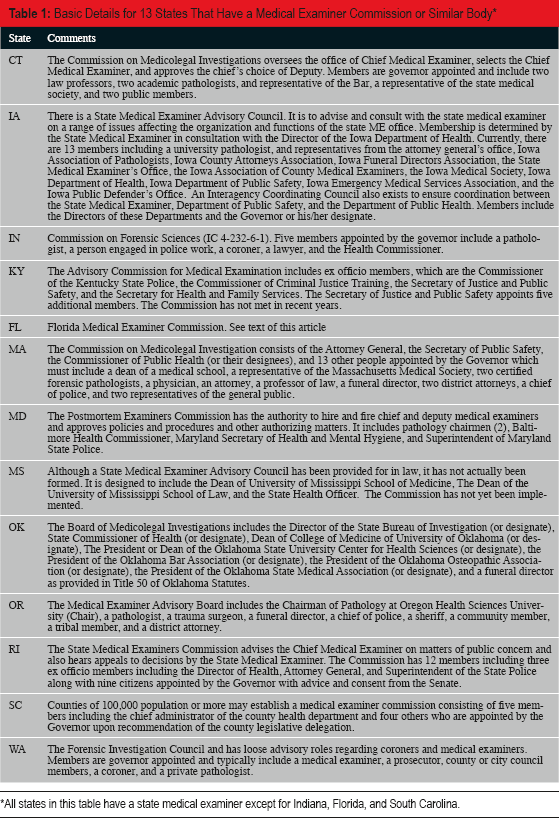
All states in this table have a state medical examiner except for Indiana, Florida, and South Carolina.
To establish a uniform medical examiner system in each of Florida's 67 counties, The Medical Examiners Act, Chapter 406, Florida Statutes, was passed by the 1970 Florida Legislature. Local autonomy was critical, despite operating in a uniform and regulated system with no state funding, but funding issues quickly developed. Without initial state funding, the burden of costs for implementation of the program was almost totally borne by the individual 67 Boards of County Commissioners. Rural counties were often reluctant or unable to provide funding. An initial statewide survey indicated county expenditures totaling $2.36 million; 60% for professional services including autopsy, toxicology, investigative costs, and transportation and the remaining 40% for facilities, salaries, and administrative costs.
Initially, the Act provided for a six-member Medical Examiners Commission appointed by the Secretary of the Department of Health & Rehabilitative Services (HRS) that included: two pathologists and end-users of the medical examiner services: one State Attorney, one representative of Florida's Attorney General, one representative from the Department of Criminal Law Enforcement, and one funeral director. The Bureau of Adult Health and Chronic Diseases was designated to provide the necessary staff and administrative assistance to implement the Medical Examiners Act.
The Act directed the Medical Examiners Commission to create medical examiner Districts and to promulgate such rules and regulations as may be deemed necessary. District medical examiners (similar in function and training to chief medical examiners), were appointed by the Governor of Florida from nominations submitted by the Board of County Commissioners of the counties within each District. District medical examiners must be “…practicing physicians in pathology” (17). A major diagnostic procedure is the autopsy. Physicians with training in pathology are the best qualified to utilize autopsy procedures and to properly interpret the complex interactions (the physiology, biochemistry, and anatomy) of both disease and injury.
District medical examiners were required by the Act to: 1) examine deceased persons, 2) establish cause of death, and 3) report to the State Attorney or County Solicitor, deaths that included the result of criminal violence, accident, suicide, sudden death unattended by a physician, deaths occurring while in police custody, in prison, or by criminal abortion, deaths by poison, or any other death constituting a threat to public health, and for a number of other reasons.
District medical examiners are entitled to compensation; such reasonable salary and fees as are established by the board of county commissioners in the respective district (18) and to expert witness fees as provided by law (19). District medical examiners and associate medical examiners are public officers (20) subject to the standards of conduct prescribed there. They may engage in the private practice of medicine or surgery, if licensed pursuant to chapter 458 (medical practice) or chapter 459 (osteopathic medicine), insofar as such private practice does not interfere with their medical examiner duties (21).
Though no funds were initially appropriated by the legislature to support the program, the first meeting of Florida's Medical Examiners Commission was held in Orlando on Monday, March 22, 1971. Nine additional meetings ensued until the January 19, 1972 meeting in which a districting proposal was adopted that closely follows Florida's 20 judicial circuits. As of that date, 14 medical examiners had been appointed by then-Governor Reubin O'Donovan Askew. Medical examiner districts have been subsequently modified (22).
In keeping with periodic sundown review, the 1981 Florida Legislature amended The Medical Examiners Act (Chapter 406 et seq.) to include the transfer of the program from the Department of Health and Rehabilitative Services (HRS) to the Florida Department of Law Enforcement (FDLE). The initiation of these changes generally centered around the perception that the HRS was not adequately supporting the medical examiners program and the opinion that the MEC would be more appropriately located within a law enforcement agency. Notable changes brought about by this revision included provisions for a governor-appointed MEC (rather than secretarial appointees by HRS), and the membership of the Medical Examiners Commission increased from six to nine members with the addition of additional end-users of medical examiner services: an elected public defender, an elected sheriff, and an elected county commissioner. A county commissioner represents the source of current medical examiner system funding (23), as it is local funding that best serves the local needs. Seven of the nine-member Commission are currently appointed by the Governor of Florida, while the representative of Florida's Attorney General and the Secretary of Health are standing appointments.
The Legislature also granted the MEC the authority to promulgate administrative rules by which they could remove or suspend district medical examiners and associate medical examiners, investigate alleged violations of The Medical Examiners Act, along with establishing oversight authority for the distribution of state funds for medical examiner services. The District Medical Examiner is given statutory authority to establish cause of death and the MEC has no authority in the appellate process when disagreements arise. The MEC also established specific terms of office for district medical examiners (staggered three-year terms), and established that each District Medical Examiner submit an annual budget to the Board of County Commissioners within the medical examiner district. As the MEC was by then administratively housed within FDLE, the FDLE representative on the MEC was then substituted for an appointee of the Secretary of the Department of Health and Rehabilitative Services where the MEC had been previously housed.
All MEC members are on full-time call for advice in their area of expertise by district medical examiners, staff, other governmental agencies, and the general public. There are particular and regular communications between the MEC members and its staff. MEC members are contacted before each meeting by MEC staff (to ensure a quorum), and are provided with a briefing packet of each meeting (also available to the public).
The MEC “…shall annually select a Chairman from among its own members and shall meet at least 4 times each year and on the call of the chairman” (24). Its meetings are open to the public with advanced notices published in the Florida Administrative Weekly (www.flrules.org). Members of the MEC “…shall not receive any compensation for their services, but shall be reimbursed for travel and expenses incurred in the performance of their duties…” (25). The MEC employs no staff directly and relies totally on staff support provided by FDLE.
There is no formal relationship between the Florida Association of Medical Examiners (FAME) and the MEC. They exist for completely separate and distinct purposes, though both of the physician-members of the MEC are also FAME members. But this is not required. FAME is a professional society of Florida-based medicolegal death professionals (including pathologists, investigators, and office and morgue personnel).
Florida's investigations into sudden infant deaths (26) are directly dependent upon medical examiner autopsy diagnosis. The MEC had direct input into the development of policy and manuals in such diverse areas as abortion clinics, hospital and nursing homes, driving under the influence of alcohol and drugs, anatomical gifts, child abuse, and disaster preparedness.
The National Highway Traffic Safety Administration promulgated standards that states must meet to receive Federal funds for highway construction and maintenance, mass transit, and other related projects. One such standard (No. 308) required data be collected and analyzed for certain prescribed levels of blood alcohol concentration present in highway fatalities. This blood ethanol testing data was readily available through our medical examiner system.
The sufficiency of cases amassed by prosecuting attorneys, reinforced by documented medical examiner evidence, is very often great enough to force the accused to plea bargain for a lesser penalty, thereby saving the public the expense of trials. The general public gains marked confidence in medicine, law enforcement, and the judicial system when it hears of cases adequately prosecuted based on medical examiner expert witness testimony.
Old English common law provided for coroners to investigate cause and circumstances of deaths, reporting directly to the Crown. Florida's death investigation system began when Florida became a territory with coroners and peace justices. After Florida's Statehood in 1847, this system continued. With a constitutional revision in the 1880's, the coroner function was combined with the peace justice and death investigations were conducted by county coroners using Chapter 936 (Florida Statutes), Inquests of the Dead. The financial responsibility for the coroner's activities was with the county in which the death occurred.
Florida is the second largest land mass state east of the Mississippi River. Prior to 1951, the words “medical examiner” did not appear in Florida Statutes except as it applied to the Board of Medical Examiners, the governmentally regulated function for physician licensure.
In 1951, “medical examiner” appeared in another guise. Broward County abolished peace justices and the Broward County Medical Examiner's Law (27) had been instituted in a special act of the Florida Legislature that applied only to Broward County and provided for the County Commission to designate a pathologist as medical examiner who would determine cause of death in certain cases submitted by police and prosecutor.
The following year (1952), the Dade County Sheriff, Dean of the newly created University of Miami School of Medicine, and other interested parties met to discuss the need for a medical examiner in Dade County (now known as Miami-Dade County). A local Miami civic activist, Mrs. Claire Weintraub, enlisted her attorney-son to draft a bill to create the Dade County Medical Examiner, Chapter 30228, Laws of Florida (1955). When the Home Rule Charter for Dade County was passed in 1957, the Dade County Medical Examiner's Office became a Department within County government, and remains so to this day. Subsequently, some of 67 more populous Florida counties created variations on that theme.
Clara B. Jackson, an 82-year-old woman was admitted on September 17, 1966 to Holy Cross Hospital in Fort Lauderdale (Broward County) for abdominal pain, dehydration and suspected abdominal cancer. While hospitalized there, she reportedly fell out of her hospital bed on September 30th and sustained a right intertrochanteric femoral fracture. The femoral fracture was surgically repaired via open reduction and internal fixation. She had a complicated postoperative course and died there on November 4th. Mrs. Jackson's next of kin was asked for autopsy consent by the admitting physician, but declined. The admitting physician then declined to sign Mrs. Jackson's Death Certificate. The hospital's nursing staff presented the case information to Joseph C. Rupp MD, the hospital's associate pathologist and a Broward County Medical Examiner. Dr. Rupp called the Jackson family, “… to ask that an autopsy be done with their permission, implying that it would be done, but that as a matter of courtesy I wanted them to change their minds, do away with their objection to the autopsy and that it be done with their permission“ (28). Despite the telephone call, the Jackson family did not acquiesce to allow Dr. Rupp to perform the autopsy. Regardless, about 31/2 hours after Mrs. Jackson's death, Dr. Rupp began her autopsy and when completed he concluded she had died from an, “…intestinal obstruction due to adenocarcinoma of the ascending colon with adenocarcinoma of the stomach and a fracture of the right femur as contributory conditions” (11).
Nine months later Dr. Rupp was sued, alleging a tort and damages for performing an autopsy on the body of Clara B. Jackson contrary to the express refusal of the next of kin to permit a hospital autopsy.
During the June 1968 trial, “At the end of the presentation of the plaintiff's case the defendant's council (sic) moved for a directed verdict which the court granted” (29, 30). The Jackson family appealed the directed verdict against them to Florida's 4th District Court of Appeal and on November 7, 1969 the appellate court reversed the lower court's decision and set the case for retrial. During the second trial, as in the first trial, at the conclusion of the plaintiff's case the defendant moved for a directed verdict and the trial court again granted the motion and entered final judgment. Prior to Jackson v Rupp (30), the cause for action for an unauthorized autopsy had not been dealt with by any Florida courts. As a result of the outcome of the 4th District Court of Appeal decision in 1969 (29), Dr. Rupp requested a hearing for a question, “involving great public interest.”
Chapter 27439, Laws of Florida, Special Acts of 1951, required as a necessary condition for the performance of an autopsy by the Broward County Medical Examiner that there be a request by the prosecuting attorney of any Court of Record, having jurisdiction of the felonies of Broward County, Florida, made to the County Medical Examiner to make an examination, investigation or autopsy.
On July 22, 1970, the Supreme Court of Florida issued its opinion: “We agree with the District Court's decision in all respects. An unauthorized autopsy will support such a tort action” (30). Dr. Rupp had admitted during trial that no authorization by a prosecuting attorney was applied for by anyone. Several weeks after the Florida Supreme Court's decision, the two physicians acting as Broward County Medical Examiners resigned.
Around the same time that Jackson v Rupp went to trial in Broward County, the Florida Medical Association (FMA) addressed the extremes in quality and availability of medical examiner services and other shortcomings at a Tallahassee meeting they convened in 1968.
The 1969 governmental reorganization resulting from the 1968 revision of the Florida Constitution abolished the Justice of the Peace court system. Later that year, a bill modeled after the Dade County Act, was presented in the Florida Legislature that year, but failed to pass. Legislative committee hearings were held. Dr. Joseph H. Davis, then the Dade County Medical Examiner, served as the Chairman of the ad hoc FMA committee to help re-write and tweak the bill's language. A companion committee with the Florida Society of Pathologists was chaired by Dr. Donald L. Howie, a Pinellas County pathologist. In 1970, as a result of their combined efforts, Chapter 406, Florida Statutes, was enacted to provide Florida with a modern medicolegal investigation system.
The first legislative appropriation of state funding was proposed in 1974 on the basis of the State reimbursing the counties for 60% of the costs of reported violent deaths (about $1.4 million). The counties were required to pay the remaining 40+% for facilities and administrative costs. Avoiding duplicate payments for all violent deaths reported by the 67 counties proved to be more record keeping than staff could manage. For 1975, the Commission voted to distribute $1.404 million in State funds on the basis of a population formula. The 1975 ratio resulted in the expenses averaging 56% (State) to 44% (county) monies.
Since implementation of the legislative amendments in 1981, the MEC has been more than pleased with the administrative and policy support provided by FDLE. Medical examiners are more closely allied with law enforcement than they are with a health department role or function. Utilizing FDLE legal support, the MEC rapidly promulgated new Administrative Rules necessary to ensure minimum and uniform standards of excellence, performance of duties, maintenance of records, and the compliance with statutory mandates, including the investigation of violations of the Medical Examiners Act (31). These violations may lead up to and include suspension or removal of a medical examiner. Florida Administrative Rule, Chapter 11-G provides for interpretive policies and procedures used throughout the Medical Examiners Act. Under statutory construction, Administrative Rules cannot promulgate any authority not granted by the Legislature. It provides for legal definitions of terms and phrases used, including the duties and standards of care of a medical examiner contained in the “Practice Guidelines for Florida Medical Examiners, sponsored by the Florida Association of Medical Examiners,” revised July 28, 2010, incorporated by reference (32).
The following year (1982) saw the Florida Legislature increase funding for the medical examiner system to $1.5 million, a 20% increase from the previous year and a 12.3% increase from its 1974 appropriation. Expenditures by the counties had increased 300% during that same time.
The Medical Examiners Commission initiated a comprehensive study in March 1983 that found that the total cost of Florida's medical examiner system was $8.28 million. Of that total amount, approximately 82% was provided by the counties and 18% by the State (including in-kind services). The total cost at that time was about 80¢ per capita.
The chief advantage of the Medical Examiners Act was to remove any artificial barriers to good service. Common to any highly successful medical examiner office is an aggressive pursuit by the medical examiner of close cooperation and liaison with local officials. The cooperation of the State Attorney's Office, local law enforcement, funeral directors, and the local medical community are absolute necessities to properly investigate suspicious or unusual deaths. The support of the Boards of County Commissioners and their constituents are vital to adequately fund medical examiner services. Each district stands on its own merits with responsibilities and authorities clearly defined. In the event of failure, it is easy to determine responsibility on the basis of personalities, finances, or both. The MEC monitors the activities of all the medical examiners in Florida. But universal standards cannot address local political, economic, and personality variables, as well as public comfort with the medical examiner. The quality of any medico-legal death investigation is dependent upon the knowledge and talents of the medical examiner and their investigative and support staff in the current techniques of forensic science. Success is assured by hard work and personal sacrifice. Our future depends upon exemplary performance of service. Those who pay the expenses expect results. Results lead to additional fiscal support, not vice versa (33).
The MEC deems it essential to provide job-oriented continuing statewide and regional educational opportunities, currently offered annually through the Florida Association of Medical Examiners and the University of Florida's Dr. William R. Maples Center for Forensic Medicine within the Colleges of Medicine, Veterinary Medicine, and Liberal Arts & Sciences.
An Ethical Advisory Committee was established by the MEC, whose membership includes medical examiners, attorneys, and clergy from around Florida.
Medical examiner service, to be effective, should be provided at the local level where the circumstances of death can be more easily developed. Thus, medical examiner districts were developed around population centers where the local demand existed and around those areas of the state, which had developed modern centers of medicolegal investigation, teaching, and research methods. In general, these districts tend to follow judicial circuits and do not subdivide county boundaries. This limitation does not prohibit cooperative arrangements among the medical examiner districts.
Medical examiner districts were drawn up basically along the lines of the judicial circuits to facilitate coordination between district medical examiners, the courts, State attorneys, and public defenders. Several of the larger population metropolitan centers had, by local ordinances, switched to the professional medical examiner systems long before the enactment of Chapter 406, Florida Statutes. In implementing a statewide system then, the MEC had to contend with judicial circuits with fully organized district medical examiner offices and others, in which the new system needed to be established in lieu of the justice of the peace coroner's system.
There still remains some variability in how medical examiner district lines were drawn and that local decision making remains fluid even today. Taylor County in the panhandle is within the 2nd Medical Examiner District, despite being within the 3rd Judicial Circuit. The six counties that comprise the 3rd Medical Examiner District are actually serviced by three different medical examiner districts: Columbia, Hamilton, and Suwannee Counties; District 4 (Jacksonville); Dixie County: District 8 (Gainesville); and Madison and Lafayette Counties: District 2 (Tallahassee). Flagler, Putnam and St. Johns counties along Florida's northern East coast are within the 23rd Medical Examiner District, yet within the 7th Judicial Circuit. Seminole County (within the 18th Judicial Circuit) was, for a time, attached to Orlando's 9th Medical Examiner District, but it is now part of the 7th Medical Examiner District based in Daytona Beach. Glades, Hendry, and Lee Counties (the metropolitan Fort Myers area) are part of the 20th Judicial Circuit, but they comprise their own 21st Medical Examiner District. Charlotte County, north of the Fort Myers area, is its own stand-alone medical examiner district (District 22), but remains a part of the 20th Judicial Circuit of Florida.
The Medical Examiners Commission was created to ensure minimum and uniform standards of excellence, performance of duties, and maintenance of records so as to provide useful and adequate information to the State in regard to causative factors of the deaths investigated (34). The information sought begins the identification process of the deceased and proceeds through expert witness testimony about the cause, manner and circumstances resulting in the death for the benefit of public health, safety, and criminal and civil justice.
Numerous governmental agencies become involved when a death occurs. All agencies depend upon concurrent medical examiner investigation. Law enforcement depends upon the medical examiner to assist in crime investigation. They likewise investigate automobile crashes and need the medical examiner to furnish the necessary supplemental information that determines the culpability of drivers, the needs for selective enforcement, and the factors that determine improved highway design for the benefit of the public. The safety engineers depend upon the medical examiner for vital information in the event of an industrial death. The county health department depends on the medical examiner to render assistance by proper certification of deaths where there exists no agency or person capable of performing this service. On a secondary basis, the funeral directors, the medical profession, the insurance industry, the civil and criminal bar, and other state and federal investigative, administrative, and judicial agencies must all depend upon the results of medical examiner investigations. The Florida Legislature has a primary interest in factual data that is needed in order to pass proper legislation. The essential theme of medical examiner service is the protection of the public in the most efficient and timely manner by the use of highly skilled and qualified personnel at least cost. The key person qualified to determine an untimely cause of death is a physician specially trained, experienced, and certified in forensic pathology.
The Florida Medical Examiners Commission is necessary to provide the policy, uniformity, and cohesive direction to the District Medical Examiners. The MEC continues to be queried about its statutory construction, its organization, and operations by other States wishing to model their systems on Florida's.
Florida operates “in the sunshine” as an open records state, providing public access to government meetings and records, including the operations and deliberations of the Medical Examiners Commission. According to the Florida Supreme Court, a public record includes all materials made or received by an agency in connection with official business that are used to perpetuate, communicate or formalize knowledge. Unlike the majority of states, because the public records law is a statutory and constitutional right in Florida, only the Florida Legislature can create an exemption to these laws.
If the MEC were ever to be abolished, some medical examiner districts would continue to function with the highest degree of competence and efficiency. Other districts, unable to recruit dedicated professionals without MEC technical resources and training, would quickly fall to a level of incompetence unacceptable to the public. Misdiagnosed death certificate information could conceivably lead to all manner of wrongful civil and criminal court actions and miscarriages of justice. Innocent parents of sudden infant deaths could be prosecuted for negligent homicide, while child abusers go free. The deceased head of household, whose remains were found decomposing in the woods, could go unidentified and left as missing, leaving the estate in limbo for years causing untold economic and psychological hardship on the survivors.
Footnotes
Acknowledgements
The authors wish to thank Randy L. Hanzlick MD for his helpful suggestions, Lindsey C. Thomas MD for a review of state Statutes regarding medical examiner commissions, and the following people for providing specific information: Mark M. LeVaughn MD (MS); Bruce Goldfarb and David R. Fowler MD (MD); James R. Gill MD (CT); Eric A. Pfeifer MD (OK); Julia C. Goodin MD (IA); Richard C. Harruff MD (WA); Karen L. Gunson MD (OR); Tracey S. Corey MD (KY); Henry M. Nields MD (MA); Christina Stanley MD (RI); and S. Erin Presnell MD (SC).
The authors, reviewers, editors, and publication staff do not report any relevant conflicts of interest.