







Abstract
This article describes the transition of the Oregon State Medical Examiner from public health agency oversight to an entity that is now administratively within the Oregon State Police (OSP), along with relevant office history. Data are drawn from personal experience and statutes. There are those that feel it is a conflict of interest to operate a medical examiner (ME) program as part of a police agency. The majority of any medical examiner cases are medical problems, not criminal issues. Forensic pathologist medical examiners are trained to tell the difference. OSP has supported the ME program infinitely more in every way than the prior public health agency. To date, no conflict or pressure has been brought to change or influence the conduct of a death investigation and the issue has never been raised in the courtroom. The ME program was poorly understood, underfunded, understaffed, and on the verge of collapse under the health department administration, but continues to thrive and improve under the Oregon State Police. Other medical examiner systems with lack of funding and support may wish to consider the Oregon experience.
Introduction
There are those that feel it is a conflict of interest to operate a medical examiner program as part of a police agency. The National Association of Medical Examiners Forensic Autopsy Performance Standards require that forensic pathologist medical examiners be able to operate independently and without undue influence from law enforcement (1). Further, it appears that medical examiners can function administratively within a law enforcement entity without there being undue influence by that oversight entity, as is the case in the state of Georgia and other locations such as the Sheriff/Coroner systems in California (2). This article describes the evolution of the system and its transition from a public health to state police umbrella.
Methods
The authors have a combined total of 70 years of death investigation experience in the State of Oregon. That experience, along with review of Oregon statutes and internal documentation of system history, forms the basis of this article's content (3).
Discussion
History: 1971 to 1995
The State of Oregon operated under an elected coroner system until the State Medical Examiner Law (ORS 146) was passed by the legislature in 1968. The system was not practically functional until the early 1970s when the state's most populous county (Multnomah) abolished the coroner system and joined the rest of the state.
The State Medical Examiner was located in Portland and served the metropolitan area and nearby northwest counties. By law, the program was administratively located in the Oregon State Health Division and the State Medical Examiner's boss was not a pathologist, but rather, a public health officer and/or nurse.
Fortunately, the new death investigation law established the State Medical Examiner Advisory Board, which controlled the appointment of the State Medical Examiner and proposed a budget to the Health Division (4). The Board was composed of members familiar with the duties and responsibilities of the medical examiner program and forensic pathology. The Chair was and still is the Chairman of the Pathology Department at Oregon Health & Science University (OHSU). Other representatives include a trauma physician, hospital pathologist, city police chief, county sheriff, private practice physician, district attorney, defense attorney, funeral director, and health department official.
The programs in smaller Oregon counties were directed by a physician appointed by the State Medical Examiner and approved by the county commissioners. This was largely a public service responsibility accepted by the physician who worked on a voluntary or minimal pay basis as determined by the county. Autopsies were done by hospital-based pathologists in the less populated areas, particularly in eastern Oregon.
From 1971 to 1985, the State ME program continued to be administratively housed in the State Health Division and was chronically underfunded. From 1971 to 1977, two forensic pathologists (State Medical Examiner and Deputy State Medical Examiner) operated the program, providing autopsy service to metropolitan Portland and surrounding area and consultation and teaching to the rest of the state. Scene and background information was provided by the counties with a variety of personnel, varying from full-time investigators with varying backgrounds in some of the larger counties to police officers in smaller counties.
With pressure from the Advisory Board, the Health Division funded a third forensic pathology position, which was filled and provided an increased level of service from 1977 to 1985 when the pathologist hired in 1977 was terminated for budgetary reasons. Shortly thereafter in mid-1985, the State Medical Examiner was terminated by the Health Division following an Attorney General investigation, and the office was suddenly left with the Deputy State Medical Examiner, Larry V. Lewman MD (LVL), working alone and in charge of an obviously crumbling statewide program.
Dr. Karen Gunson (current Oregon State Medical Examiner) was hired directly out of her Oregon Health & Sciences University pathology residency, with no formal training in forensic pathology, in late 1985.
A search for a new Chief Medical Examiner began later in 1985. Since 1971, the ME program was located in a 1924 vintage remodeled funeral home with two autopsy tables, a cooler that could hold four or five bodies, no ventilation, and no plans to securely hold personal effects.
Put simply, an Occupational Safety & Heath Administration (OSHA) visit would have shut the place down. Many programs in the nation were searching for forensic pathologists, and Oregon's understaffed program, inadequate facility, and substandard compensation with the Health Division in charge was not appealing to even the current Deputy State Medical Examiner (LVL), who applied for the job but let it be known that major changes were needed. The Medical Examiner Advisory Board was supportive throughout this prolonged process. Following a futile effort to find another interested pathologist, Dr. Lewman accepted the position with the contingency that a third forensic pathologist be hired, that plans commenced to build a modern-day morgue facility, and secure administrative help to deal with budget, personnel, and other administrative issues.
The additional forensic pathologist was eventually hired, part-time administrative help provided, and a committee was formed to evaluate the facility issue. The committee formed of user members from the Tri-County area about Portland unanimously supported the new morgue construction, but ten years went by and the medical examiner remained in the same antiquated facility with no approved funding for a new one.
The Health Division was mostly supported (and continues to be so today) by federal funds and grants, with limited state general fund money. The medical examiner program was supported from general fund dollars, which were becoming increasingly scarce. The ME program was largely put on the chopping block in the proposed Health Division budget with the suggestion that the State Medical Examiner investigate the “difficult” cases. Toxicology, which was supported by the OHSU Clinical Pathology Department, could remain.
Much of the above may well have been a negotiating tool with the legislature at budget time; but, after 25 years, it was time to find a new home for the Oregon State Medical Examiner program. The Advisory Board and medical community were supportive.
The State Medical Examiner, LVL, with the support of concerned police agencies, the medical community, and district attorneys, approached the Oregon State Police (OSP) about the possibility of absorbing the program.
A committee was formed to evaluate the transfer. The committee included the Oregon State Attorney General, Chief Justice of the Oregon Supreme Court, representatives of the governor's office, a trauma surgeon, county health department director, State Medical Examiner, and Oregon State Police Superintendent and Deputy Superintendent.
The transfer was unanimously recommended following a few meetings with support from the Health Division and Advisory Board. The Oregon State Police, with legal help provided by the Oregon State Attorney General and suggestions from the State Medical Examiner, authored the new bill, which passed through the Oregon legislature in the 1994–1995 session without opposition.
History: 1995 to 2013
The Oregon State Police is more than strictly a law enforcement agency. Included under the OSP administrative umbrella are the Law Enforcement Data Systems, the State Fire Marshal, Forensic Services Division, Fish and Wildlife, Gaming Enforcement (including the State Athletic Commission and Tribal Gaming section), Identification Services, Missing Children's Clearinghouse, Sex Offender Program, and, since 1995, the State Medical Examiner.
Prior to 1995, the office was vastly understaffed with progressively decreasing budget support, virtually no administrative support, and was located in a facility inadequate by any measure. Under the umbrella of the Oregon State Police, the program began a transition to a well-staffed, adequately funded, and modern death investigation program.
Forensic Pathologists
From the two or three on the staff in Portland prior to 1995, the program now has six full-time board-certified forensic pathologists; four in the Portland metropolitan area, one in the Lane County (Eugene) area, and one located in southern Oregon responsible for several counties between eastern Oregon and the Oregon coast.
Support Staff
Part-time administrative support was supplied from 1985 to 1999. In 1999, a full-time Forensic Administrator was hired, with a background in emergency medicine, administration, and deputy medical examiner investigation, and is located in the State Medical Examiner Office. Duties include organizing teaching programs, personnel administration, mass disaster planning, Disaster Mortuary Operational Response Team (DMORT), representing the State Medical Examiner at meetings, and various other duties as assigned.
Facility
The State Medical Examiner relocated in 2004 to a modern, 60,000 square foot building along with the OSP Forensic Services Division. The prior medical examiner facility was approximately 3,000 square feet in the old funeral home. Smaller morgue and autopsy facilities are located in a state police patrol and forensic laboratory near Medford to serve southern Oregon and in Eugene to serve the Lane County area (
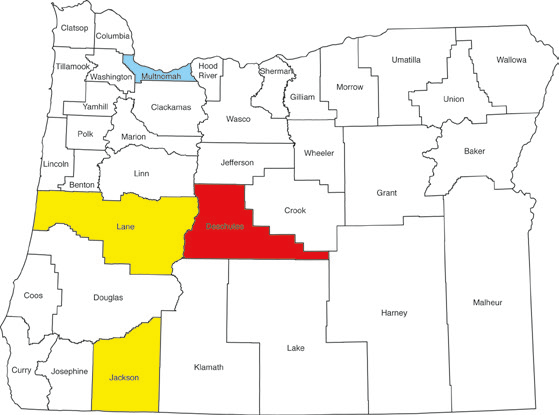
Location of State Medical Examiner Headquarters in Portland (Multnomah County; blue), Eugene (Lane County; yellow), Medford/Central Point (Jackson County; yellow), and proposed regional office in Bend (Deschutes County; red).
Forensic Support and Toxicology
The State Medical Examiner now has daily contact with the forensic laboratory and forensic toxicology, all located in the same modern facility.
Under the Health Division, toxicology was subcontracted to Oregon Health & Sciences University. It was limited in scope and funding and subject to lengthy delays in analysis. OSP now provides three full-time and two part-time forensic scientists responsible for postmortem forensic toxicology. The lab is American Society of Crime Laboratory Directors (ASCLAD) certified, turnaround time has improved, and expert medical testimony in court is available, if needed. The scope of analysis has vastly improved.
A board-certified forensic anthropologist is on site and available as needed. DNA, fingerprinting, trace evidence, ballistics and forensic photography are also on site. Forensic odontology services are available on call but not located in the state facility.
Teaching
At least two American Board of Medicolegal Death Investigators (ABMDI) approved medico-legal death investigation programs are presented annually at the state office. Deputy medical examiners, physician medical examiners, some district attorneys, and an occasional defense attorney attend. The 373-page training manual was authored by an F-ABMDI-certified death investigator located in the state ME office.
Currently, two mass fatality management training programs are presented annually. At present, these are confined to the northwest region of the state with plans to expand to the rest of Oregon next year. Major operational functions include human remains recovery, morgue and forensic services operations, and family assistance services. Two mobile trailers, modeled after DMORT, are kept in the central facility, used in training, and readily transportable in case of a mass fatality situation.
Future Plans
Oregon is a large state geographically. More rural and population sparse eastern Oregon remains underserved compared with the rest of the state. Scene investigations in most of eastern Oregon are the responsibility of appointed police officers that have received some training in the state office but have experienced few death investigations.
Proposed is the hiring of another forensic pathologist to be located in a newly constructed morgue facility to be built in the Bend area as part of the existing forensic laboratory (
At the present time, Oregon's 36 counties pay the medical examiner investigators and the state pays for forensic pathology services and toxicology. Plans to regionalize investigation services under the state have been proposed but not yet approved by the legislature. The problem, of course, is a funding issue.
Conclusions
There are those that feel it is a conflict of interest to operate a medical examiner program as part of a police agency. The majority of any medical examiner cases are medical problems, not criminal issues. We are trained to tell the difference. OSP has supported the ME program infinitely more in every way than the prior public health agency. The state police administration is not involved in the day-to-day investigation of death. The State Medical Examiner's office is located in the Portland area, while OSP general headquarters is located in Salem, fifty miles away.
The ME program was poorly understood, underfunded, understaffed, and on the verge of collapse under the health department administration. Prior to 1995, upgrades to the Medical Examiner facility and personnel had been proposed to the Health Division during five budget cycles over a ten-year period to no avail. The move, administratively, to OSP was not precipitated by a crisis, per se, but by a long period of misunderstanding and neglect.
For the foreseeable future, the Oregon State Medical Examiner's Office will need an administrative home in state government. It is too small (nine full-time employees and two contract employees) to warrant its own administrative infrastructure. While this structure works for the Oregon State Medical Examiner's Office, it may not for other offices that lack a strong medical examiner's law and an independent advisory board. Oregon Revised Statute 146.035 states “The State Medical Examiner shall manage all aspects of the State Medical Examiner's program.” The advisory board is composed of user groups who have the power to recommend the budget and set standards and policy (2).
As in all medical examiner systems, the Oregon State Medical Examiner's office investigates all violent and unexplained deaths, including those involving police (police shootings and in-custody deaths, etc.). These investigations also involve a variety of law enforcement offices, including city, county sheriff, or state police. Following completion of the conjoint medical and law enforcement investigation, the cause and manner of death is solely the responsibility of the medical examiner.
The Oregon medical examiner system continues to thrive and improve under the umbrella of the Oregon State Police. Other medical examiner systems with lack of funding and administrative support may wish to consider having a law enforcement agency serve as its administrative oversight body. Oregon is an example of how such a change can work for the better.
Footnotes
The authors, reviewers, editors, and publication staff do not report any relevant conflicts of interest.