







Abstract
Myriad factors influence the patterns of illegal migration of people from Mexico and Central America into the United States. The Pima County Office of the Medical Examiner (PCOME) has examined the largest number of recovered undocumented border crosser (UBC) remains of any single medical examiner jurisdiction in the United States since at least 2001. The examination and management of UBC remains is a unique process. Determination of the cause and manner of death are often compromised by advanced decomposition to the point of skeletonization. Unusual examination findings and death presentations not frequently seen in non-UBC populations are the norm. Ancillary techniques such as infrared digital photography and rehydration of mummified remains are commonly employed in the identification of these remains. Administrative challenges such as cold storage capacity, triage and handling of missing person's information, interactions with foreign governments, high media interest, identification, interment, and management of a large number of unidentified remains are ongoing issues. This review outlines the issues commonly encountered and techniques used by the PCOME to manage the remains of this vulnerable population.
Introduction
Peoples from Mexico and Central America have long crossed into the United States clandestinely for employment, in the attempt to fee violence or oppression in their country of origin, reunite or join family already in the United States or, less commonly, for illicit purposes such as drug trafficking. A long history surrounds border enforcement tactics in the United States in response to this flow of people. A strategy of deterrence was developed in the early 1990's in which the United States Border Patrol (USBP) sought to halt (“deter”) illegal entry in the U.S. at the border rather than focusing on apprehending people once they had already entered the country. Two large scale deterrence operations, Operation Hold-the-Line and Operation Gatekeeper, focused in El Paso, Texas and San Diego, California, respectively, made crossings much more difficult near these major urban centers (1–3). The more rural, remote, rugged, and austere environment of the Sonoran Desert in southern Arizona was considered to be a natural deterrent to the would-be-crosser and therefore sparsely patrolled. Unfortunately but somewhat predictably, the flow of migration adapted in response to enforcement patterns and crossings increased through southern Arizona as evidenced by the number of apprehensions in the Tucson sector of the USBP (
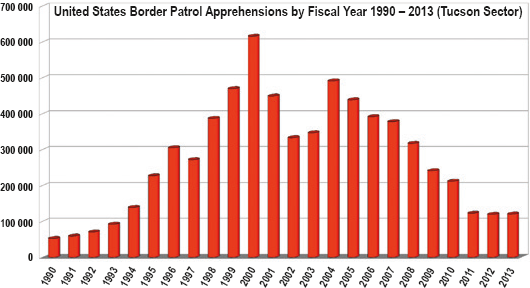
United States Border Patrol apprehension statistics for fiscal years 1990 – 2013 in the Tucson Sector. The Tucson Sector saw the highest number of apprehensions amongst the southwest border sectors from 1998 – 2012 only to be surpassed by the Rio Grande Valley Sector in 2013 (4).
A side effect of this increased traffic has been an increase in the number of deaths and remains found in the Arizona deserts, principally in Pima and Santa Cruz counties over approximately the same period of time (
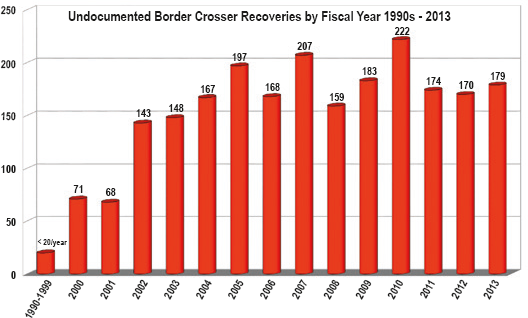
Suspected undocumented border crossers (UBC) examined at the Pima County Office of the Medical Examiner by fiscal year. On average, less than 20 UBC remains per year were examined through the 90's, compared to an average of 176/year from 2002 – 2013, a 780% increase in UBC deaths.
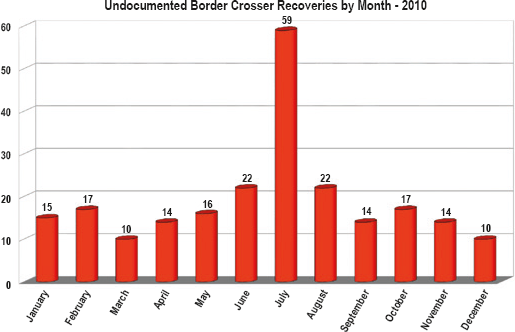
Undocumented border crosser (UBC) recoveries by month for calendar year 2010. 2010 was the busiest single year for UBC recoveries to date at the Pima County Office of the Medical Examiner and illustrates the “bell curve” of deaths over the hot months of the summer (June – August).
Analogous to a mass fatality event, the principal challenge concerning these remains is not the determination of the cause and manner of death, but identification and disposition. These deaths represent an “open” population without a passenger manifest to utilize. Families of the missing frequently call various organizations, including the PCOME, looking for loved ones, unknowingly attempting to file a missing person's report. No centralized “family assistance center” exists to collect, coordinate, and compare the missing person's information with the unidentified remains. Most medical examiner's offices, the PCOME being no exception, are not staffed to intake and administer missing persons’ information, a function typically handled by law enforcement agencies in the United States. Unfortunately, UBC family members are often foreign nationals, are distrustful of potentially corrupt foreign government, are possibly undocumented residing in the United States, and are therefore reluctant to interface with U.S. law enforcement concerning missing persons or the collection of biologic family reference sample materials. Inclusion of missing person's or biologic reference material into the National Missing and Unidentified Persons System (NamUs) is also problematic without direct involvement by U.S. law enforcement.
Discussion
Investigation of the Scene
Scene investigation of UBC remains generally falls into one of two categories: fleshed/decomposing remains or skeletal remains. Fleshed remains are often found in shaded, secluded areas, suggesting antemortem relief from the sun. Often some clothing was removed by the decedent to assist cooling. Personal effects such as water containers, backpack, toiletry items, extra clothing, food, etc., are often found and collected with the remains (
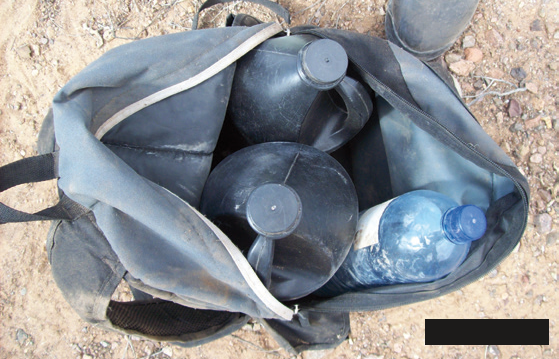
An example of typical personal effects; a backpack with two black water jugs and one water bottle found by nearby remains. Water containers are often black to decrease the reflection of light in an effort to evade la migra (border patrol).
Examination of UBC Remains
Common Examination Findings
The typical UBC is male and between the ages of 20–40 who presumably walked a great distance through the desert. Blisters and sloughing of the skin of the feet, and linear abrasions on exposed skin such as the arms and legs are common findings (
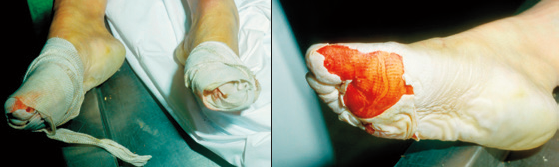
Blisters are common autopsy findings. Ill-fitting footwear and miles of travel through the rugged desert are the root of the problem.
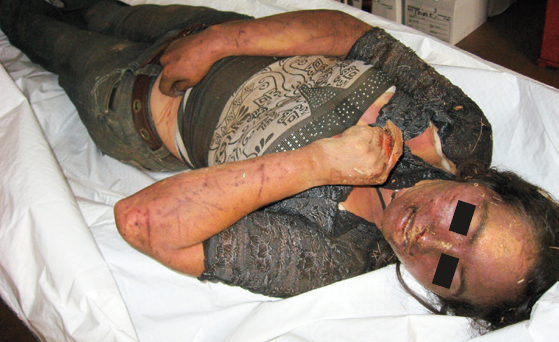
Linear abrasions on exposed skin mark the desert passage. Many dry washes have dense underbrush and cacti that cause the numerous abrasions seen on the arms of the women in the above image.
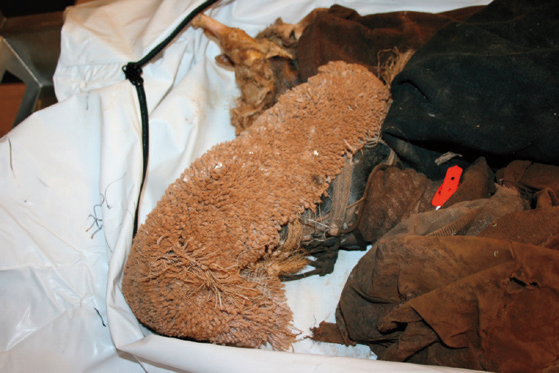
“Sneaky feet” are carpeted shoe coverings, either homemade or purchased from numerous vendors in border towns in Mexico. Sneaky feet are worn over shoes in an effort to obscure footprints and shoe tread patterns.
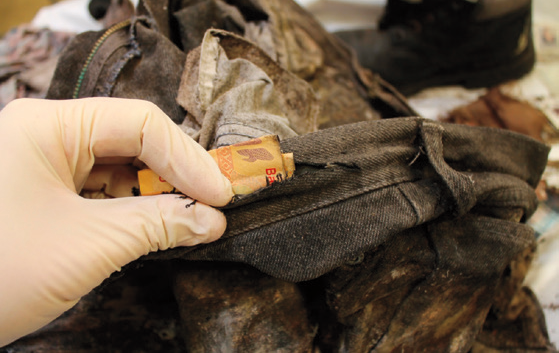
Clothing is meticulously examined for hidden compartments. Waist bands, belts, and cuffs are common locations to hide money, important phone numbers, and treasured mementos. Phone numbers and other effects may help guide an investigation and result in an identification. The above photograph shows money sewn into the waistband of a pair of blue-jeans.
Special Techniques
Special examination techniques, infrequently used in non-UBC populations, are often used to assist with identification. As previously published in this journal (6), the PCOME frequently rehydrates mummified hands using a simple and inexpensive sodium hydroxide rehydration technique to obtain fingerprints. Infrared photography of mummified remains is often helpful in the discovery of tattoos no longer viewable to the naked eye in the visual light spectrum (7) (
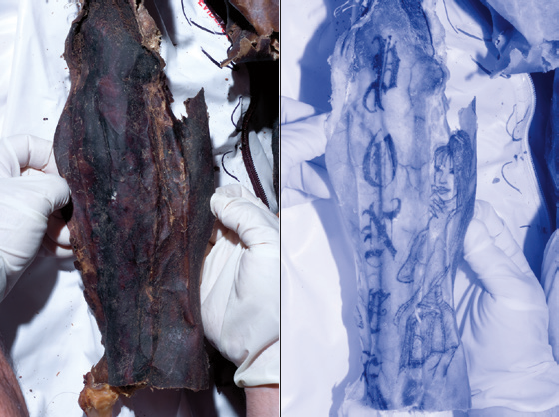
Tattoos can be difficult to distinguish with the naked eye on dark, dried, mummified skin. Infrared (IR) photography can clearly identify tattoos not otherwise seen in the visual light spectrum (6). The image above depicts the mummified skin of the right forearm of an unknown individual under visual light where nothing can be seen and again under IR light where “Ponce” and a topless woman tattoos are clearly visualized
Cause and Manner of Death
Undetermined
Many presumed UBC remains are discovered only after a period of advanced decomposition, and this includes a large number of skeletal remains. If no presumed natural disease or injury is found following a complete examination of these severely decomposed or skeletal remains, the cause and manner of death are classified as undetermined. Often the location of the remains and subsequent investigation of the death leads one to believe that the decedent was a border crosser who died as the result of exposure to the elements (hyperthermia, hypothermia, dehydration, etc.) but the condition of the remains precludes the adequate assessment of alternative causes of death. Undetermined was the most common cause of death amongst UBCs in 2013 (
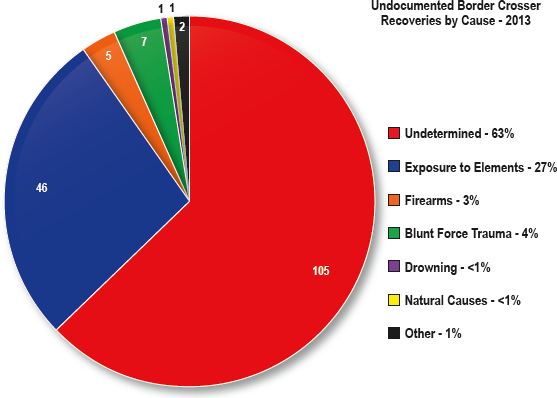
Generalized categories of cause of death of undocumented border crosser remains found in calendar year 2013. By and large, deaths are certified as undetermined cause when the condition of the remains precludes adequate examination. Exposure to elements includes deaths likely related to hyper or hypothermia and dehydration.
Accident
Accidental deaths in this population are most commonly related to environmental exposure, with the highest frequency of remains found in the summer months secondary to the high heat (
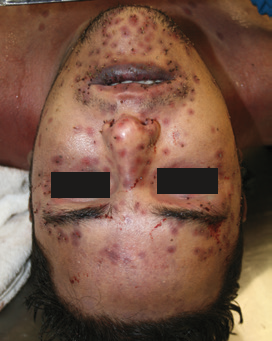
22-year-old undocumented border crosser from Mexico found covered in bee stings with dead bees in the mouth, oropharanx, and bronchi. Copious foam was within the airways and exuded from the mouth and nose. The cause of death was certified as mass envenomation due to multiple bee stings and the manner of death was accident.
Homicide
Homicides, principally as the result of firearms injuries (
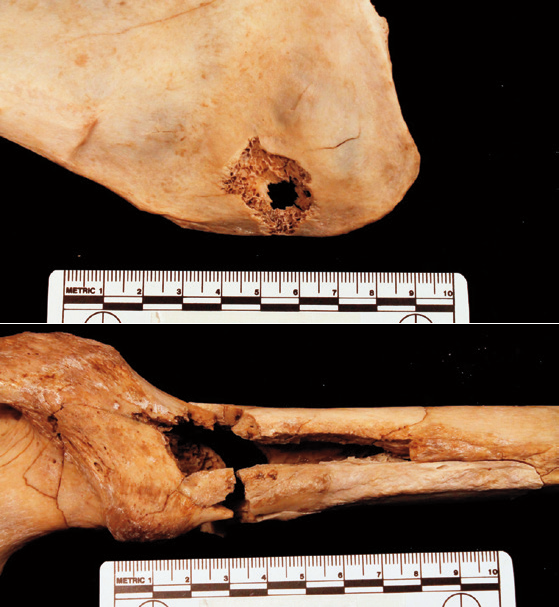
The skeletal and mummified remains of five unidentified adult male undocumented border crossers were found in a shallow grave in a remote desert area. All but one of the remains demonstrated gunshot wound injury as depicted in these examples with defects in the scapula and femur respectively.
Natural
Natural deaths in UBCs are also uncommon. Perforated gastric ulcers and coronary artery disease are the most often encountered. Deaths due to natural disease are diagnosed when extreme heat or cold or dehydration can be ruled out. These usually occur during the fall and spring. Quite often, the bodies have minimal decomposition because these deaths are usually reported to local law enforcement either in person or via an anonymous phone call.
Suicide
Suicides do occur in UBCs but are rare and present differently than one would think of a typical suicide seen in a normal medical examiner population. UBC suicides appear unplanned, affected by the desperation of the circumstances of weather extremes, dehydration, and being lost in a vast desert, and are unrelated to the more common risk factors of suicides in the usual population (psychiatric illness, substance abuse, troubled interpersonal relationships, or financial stressors). The means to end life is also dependent upon utilizing something close at hand.
For example, a 30-year-old Mexican male UBC was crossing the desert with his uncle when they became lost. The decedent became agitated and combative, trying to hang himself with his belt from a tree. The uncle stopped and calmed the decedent but left the scene in an attempt to seek help. The uncle was apprehended by border patrol and he led authorities to the decedent who was found partially suspended from a tree by a barbed wire ligature removed from a nearby fence. The cause of death was certified as hanging and the manner suicide.
In another example, USBP apprehended a male UBC who stated that he and three other UBCs had fallen behind the group with whom they were traveling. The apprehended UBC went looking for water and left the three others behind. Border Patrol officers found all three remaining UBCs deceased. Two of the decedents died as the result of environmental exposure. The last was found partially suspended from a small tree by a shoestring ligature removed from his boot.
Anthropology
The PCOME is fortunate to have a full-time forensic anthropologist and a postdoctoral position. All skeletonized remains are examined by the anthropologists. In addition, other cases of bodies with advanced decomposition but not skeletonized are evaluated for age, sex, and race determinations. Over half of all of the UBCs are reviewed by the forensic anthropologists. The anthropologists also obtain bone samples from the skeletonized remains for DNA analysis. The most commonly sampled sites are a two cubic centimeter piece of parietal bone or a five centimeter segment of femur or tibia.
Storage, Release, and Interment of UBC Remains
Storage
A large number of unidentified remains would tax the cold storage capacity of many facilities in the U.S., ours included. Of the 2203 UBC remains recovered from 2001 – 2013, 740 are still unidentified (
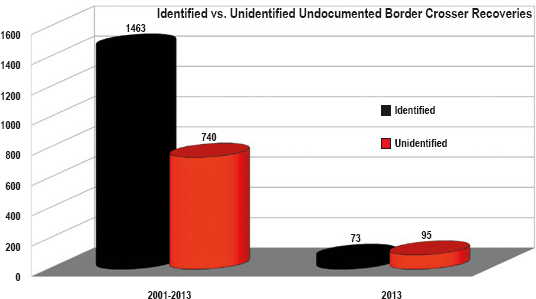
Of the 2,203 undocumented border crosser (UBC) remains recovered in calendar years (CY) 2001–2013, 1,463 have been identified through various means. Of the 168 UBC remains recovered in CY 2013, 95 remain unidentified.
Interment
Ideally, a “best practice” for the interment of unidentified remains would be burial rather than cremation. However, Pima County (and other counties in southern Arizona) cremates rather than buries unidentified remains primarily because of cost. A burial costs $2,000 - $3,000 in comparison to $400 - $600 for a cremation. If remains are later identified and disinterred, the difference in cost is also significant: $3,000 - $4,000 for a disinterment from a burial plot vs. $75 for disinterment of cremains from a columbarium.
Release of Identified Remains
When remains are identified, the release process is often slow and laborious, as the funeral and transportation arrangements are facilitated through the consulate of a foreign government. Of the 1463 identified UBC remains (2001 – 2013) 85% have been of Mexican nationals, followed by Guatemalan (7%) and Salvadoran (3%) (
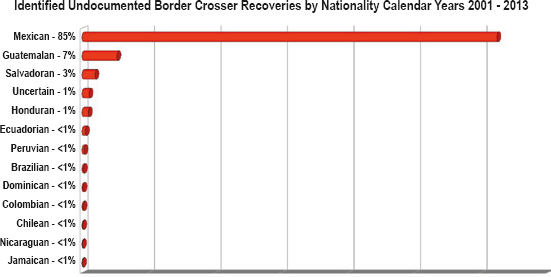
Of the 1,463 identified undocumented border crosser remains, 85% are of Mexican origin followed by Guatemalan (7%) and Salvadoran (3%).
Fragmented and Incomplete Remains
If the identified remains to be released are fragmented and incomplete, the PCOME uses a fragmented remains notification form (modified from the fragmented remains form developed by the New York City Office of the Chief Medical Examiner following the September 11th attacks) to ascertain the wishes of the family should additional portions of the identified loved one be recovered in the future. Additional portions of previously recovered individuals (identified or unidentified) are discovered every year via DNA analysis. Some families have found closure concerning the death of their loved one and do not wish to be notified if additional remains are found, whereas some families do wish to be notified so they may inter the additional remains.
Identification
Circumstantial
UBCs frequently travel under an alias or use false identification. They have often have a reason to remain unidentified. For example, a UBC from Guatemala apprehended while crossing the U.S./Mexico border may not wish to reveal his true identity for fear of being deported all the way back to Guatemala. He may give an alternate name and claim to be from Mexico with the intent to reenter the U.S. following deportation. With the above scenario in mind and with ample experience viewing false identifications and aliases, the PCOME rarely relies solely on circumstantial information to make an identification. In one instance, a man had three “official” identification cards with the same name but different photographs. Identification cards, phone numbers, distinctive personnel effects, scars, viewable faces, tattoos, surgical procedures, etc., all provide valuable information but must be used with caution. We err on the side of leaving remains “unidentified” in an effort to avoid making an incorrect “identification.” Once an individual is identified they fall off the proverbial “list” (NamUs, local unidentified databases, etc.) and if the identification were made incorrectly, it would be much harder for a searching family to find their missing loved one. Close cooperation with the consulate of the person's suspected foreign government is crucial in ascertaining if the name association is an authentic name and in facilitating contact with possible family members to gather additional information.
Fingerprints
Inexpensive, easy to obtain and accurate, fingerprints are the mainstay method of scientific identification in the U.S. For UBCs, fingerprints, while valuable information to collect, are more technically difficult to obtain if the remains are mummified. As previously mentioned, reliable rehydration techniques exist to fingerprint mummified remains (6). Fingerprints obtained from suspected UBCs are compared against the Federal Bureau of Investigation Automated Fingerprint Identification System (AFIS) and the United States Border Patrol Automated Bio-metric Identification System (IDENT). If a “hit” is received from the fingerprint comparison it is most often from the IDENT system, indicating that the deceased individual had been apprehended before. While valuable information may be obtained from the IDENT system such as a photograph of the individual, date and location of prior apprehension(s), and the individuals name, the name and demographics are simply that which the UBC supplied to USBP upon apprehension and there is no way to confirm if that is the person's true identity. Again, the use of aliases frequently comes into play. Another source of fingerprint comparison is the Mexican voter identification card, which has a photograph and usually the fingerprint of the right index finger.
Dental
Many UBCs originate from poor, rural, indigenous areas of their respective home countries and have minimal if any dental interventions. Even with those UBCs who have distinctive dental restorations the likelihood of identifying and obtaining antemortem dental radiographs from their country of origin is small. Very few UBCs have been identified via comparison of antemortem and postmortem dental records or radiographs.
DNA
The way in which DNA is used in the identification of unidentified UBC remains continues to evolve and an exhaustive explanation is beyond the scope of this paper. The principle challenges of the utility of DNA are funding, limitations of different laboratories, databases, comparisons, and the collection of biological family reference material. Collection and processing of unidentified DNA is important, but without anything meaningful with which to compare it, the opportunities to make identifications beyond one-to-one comparisons to family reference samples are limited.
Much of the funding for the collection and processing of unidentified DNA is obtained through grants. The laboratories used to processes the DNA samples have changed over time, as have the techniques and criteria used to determine if a particular DNA sample is eligible for inclusion in a particular database. If different labs and different funding sources pay for and process unidentified and family reference sample DNA independently, who does the comparison? Who pays for the comparison? Some funding sources pay for both mitochondrial and single tandem repeat (STR) processing of unidentified samples, and some for STR only. Historically, samples processed for STRs only (no mitochondrial DNA) were not eligible for entry into the FBI's Combined DNA Index System (CODIS). Some of our UBC DNA samples have been run multiple times, over time, utilizing different funding sources in order to make use of new technologies or in an effort to process the sample with a different intent (e.g., add mitochondrial testing, rerun STR loci). The use of DNA in this population for the purposes of identification represents a bit of a moving target.
Administrative Challenges
Missing Persons & NamUs
As previously discussed, law enforcement agencies are the owners of collecting and maintaining missing persons information for the average citizen in the U.S. With UBCs, more often than not, U.S. law enforcement is not involved with the intake or handling of missing person's information. Families of the missing contact humanitarian organizations, their consulate, the medical examiner's office, journalists, etc., are involved, but not law enforcement, for myriad reasons. The PCOME has struggled over time with the challenge of managing phone calls and in person visits from family members looking for the missing, given that simply referring the family to local law enforcement may not be an option. After some trial and error, the most effective model, and the one we currently use, is that of the “family assistance center” used in mass fatalities. We partner with the Colibri Center for Human Rights (9), a humanitarian group with extensive experience in the collection of missing person's information. Colibri maintains an office in our facility with grant funded and volunteer staff. Calls from the community, consulates, families, etc. are funneled through the Center, relieving much of the missing person's administrative burden from PCOME staff. As of June 2014, the Colibri Center has collected over 1300 reports of UBCs believed missing in Arizona since 2006 and over 100 reports of UBCs believed missing in Texas.
The National Missing and Unidentified Persons System (NamUs) was developed as a better alternative to the National Crime Information Center (NCIC) for the purposes of identifying the unidentified (10). Missing person's reports and family member DNA reference samples are entered and published in the missing person's portion of the National Missing and Unidentified Persons System (NamUs) by the law enforcement agency that collected the report or sample. Reports and DNA samples collected by non-law enforcement entities are not eligible for publication in NamUs. Since the vast majority of UBC missing person's reports and family DNA reference samples are not collected by law enforcement, as previously described, the utility of NamUs assisting with an identification within this population is limited. Blind DNA matches (facilitated through NamUs) to CODIS from PCOME's UBC unidentified samples do occur, but identifications made through NamUs via comparison of missing persons to unidentified reports are nil given the fact that our missing persons reports are not eligible for entry. Some non-law enforcement collected Arizona missing persons reports were published in NamUs in the past but that practice is no longer allowed. Since NamUs may not be a helpful tool in assisting with the identification of hundreds of these unidentified remains (because of NamUs’ inclusion and publication criteria), the need for a separate “NamUs-like” database for the UBC missing and unidentified is currently being investigated.
Public Interest & the Media
Most medical examiners offices in large enough jurisdictions have procedures for interaction with the media or interested members of the public concerning high interest deaths, requests for clarification and teaching. Some offices may use state or county government public information officers (PIO) and some may appoint an office employee or utilize the Chief Medical Examiner to serve as PIO. The PIO for the PCOME is the Chief Medical Examiner. The PCOME Chief Medical Examiner has received 479 media inquiries within the last three years (May 2011 – May 2014), approximately 350 of which relate to UBC issues. Print journalists, TV outlets, documentarians, and interested members of the public are continually “discovering” the issue of UBC deaths and seeking interviews, access and comment. Some of the more noteworthy media efforts to illustrate the UBC issue are listed within the references for interested parties (11–17). Without the UBC issue, the media demands at the PCOME would likely be similar in amount and content to other jurisdictions of our size.
Conclusion
The investigation, examination, identification, storage, interment, and administration of UBC remains provides a unique set of challenges for the PCOME and other offices along the U.S./Mexico border. Some of the techniques used to examine these remains can and currently are being used for non-UBC applications, such as rehydration of mummified tissue and infrared photography of tattoos. As migration patterns change over time, other medical examiners offices, previously spared the brunt of UBC deaths, may face similar challenges.
Footnotes
The authors, reviewers, editors, and publication staff do not report any relevant conflicts of interest.