







Abstract
Since 1928, there have been multiple analyses and reports issued about the status and needs of death investigation systems in the United States. Using references contained in the National Research Council's (NRC) report, “Strengthening Forensic Science in the United States: A Path Forward,” and backtracking references from those documents, previous reports and meeting agendas were obtained and reviewed which relate to formal study or discussion of death investigations systems and forensic pathology dating back to 1928. These include National Research Council Bulletins from 1928 and 1932, the 1954 “Model Postmortem Examinations Act,” a 1968 Forensic Pathology Progress Report, the 1985 Wingspread Symposium, a 2003 Institute of Medicine Death Investigation Workshop, a 2004 National Association of Medical Examiners Report on America's Medicolegal Offices, the 2009 NRC Report on Strengthening Forensic Science, and a 2010 Forensic Death Investigation Summit. These events and reports are briefly reviewed in this article. Over the past 82 years, needs for the death investigation system have been described. Although progress has been made in meeting those needs and improving death investigation systems, progress has been slow and much work remains to be done. Recent formation of the National Commission on Forensic Science and the National Institute of Standards and Technology's Organization of Scientific Areas Committees (OSAC) may provide an impetus for more rapid and significant change.
Introduction
Since 1928, there have been multiple analyses and reports issued about the status and needs of death investigation systems in the United States. This article briefly summarizes those events and reports as an introduction to more extensive reviews of each, which occurred in 1985 or before, also published in Academic Forensic Pathology (1–5).
Methods
Using references contained in the National Research Council's (NRC) report “Strengthening Forensic Science in the United States: A Path Forward” and backtracking references from those documents, previous documents and meeting agendas that relate to formal study or discussion of death investigations systems and forensic pathology dating back to 1928 (6) were obtained and reviewed. This article contains a listing of such documents and events for reference, along with a brief discussion of each.
Results
The historical documents and events are cited in
Historic Documents Relating to Analyses of Death Investigation Systems and Forensic Pathology
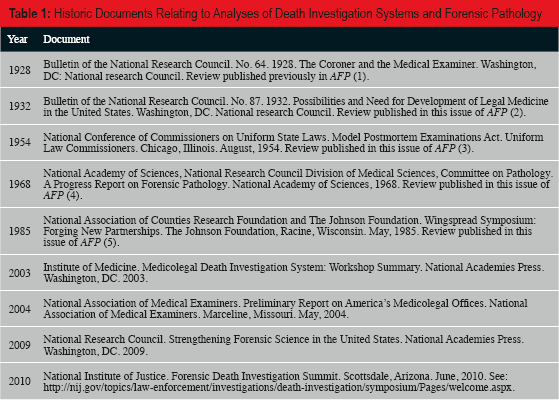
The 1928 NRC Bulletin examined and compared coroner systems and medical examiners systems, and the general recommendation was that coroner systems be replaced with medical examiner systems. Such conversion has occurred in many areas of the country but has not been complete, as coroners still exist in 28 states (7, 8).
The NRC Bulletin of 1932 proposed that centers of legal medicine be developed in the United States similar to those in Europe, which would be multidisciplinary centers involving death investigation systems, universities, law enforcement agencies, psychiatric services to serve the justice system, and quality laboratories (9). Although a few such centers were begun, they eventually failed, and today, centers of legal medicine have not been realized as envisioned in the 1932 Bulletin.
The 1954 “Model Postmortem Examinations Act” provided a model to establish state Commissions that would oversee a state Office of Postmortem Examinations and a Chief Medical Examiner for the state. To-date, only 13 states have such commissions and 25 states have a State Medical Examiner (10, 11).
The 1968 report on Forensic Pathology made recommendations that there be more exposure to forensic pathology and legal medicine in medical school, more exposure of pathology residents to forensic pathology, formal affiliations between medicolegal offices and academic centers and medical schools, more research and publication of journal articles, an increase in the number of forensic pathologists, an increase in forensic pathologists salaries, and more appreciation and support by the public and government entities concerning what forensic pathologists contribute to society (4). These same concerns hold true today (8, 12).
The Wingspread Symposium of 1985 was to “examine the historic roles of coroners and medical examiners” and to develop “strategies for improving the quality and delivery of death investigation services in the community” (13). It had a diverse group of participants who discussed needs and strategies to improve medicolegal death investigation. Unfortunately, a final summary report of the symposium was not prepared because of a dispute among some of the researchers. Thus, the symposium resulted in little or no meaningful follow up activity.
The 2003 Institute of Medicine workshop took an in-depth look at death investigation systems in the United States (14). It concluded that there were many “gaps” in the system needing further study, possibly by the Institute of Medicine. However, it appears that the Institute of Medicine (which is part of the National Academies of Science) workshop may have been a driving force for the formation of the “Committee on Identifying the Needs of the Forensic Science Community,” which led to publication of the 2009 NRC Report on “Strengthening the Forensic Sciences” (see
The 2004 National Association of Medical Examiners (NAME) report on America's Medicolegal Offices was prepared for the National Institute of Justice's “Forensic Summit” which was held in May, 2004. A report of that Summit is not available. In its report to the National Institute of Justice (NIJ), NAME recommended funding of the Paul Coverdell Forensic Science Improvement grants, active federal interest in medicolegal death investigation via a lead federal agency, forensic pathologist-based death investigation systems, programs by the U.S. Department of Health and Human Services to recruit and retain forensic pathologists, federal support of NAME's accreditation program and performance parameter, medical examiner eligibility for homeland security “first responder” funds, a federal medical examiner's liaison within the Department of Homeland Security, an information sharing system between medical examiners and federal agencies, and federally sponsored research and policy discussions concerning forensic pathology and death investigation. One can argue that recent creation of the National Commission on Forensic Science and the National Institute of Standards and Technology's Organization of Scientific Areas Committees (OSAC) are, in part, outgrowths of the NAME recommendations and can provide further effort to achieve NAME's recommendations.
The 2009 NRC Report, relevant to death investigation, recommended that offices be accredited, personnel be certified, that further research be conducted, and that medical examiner systems be developed further to eventually replace coroner systems. The Report is quite lengthy and the reader is referred to it for further details (6).
In June, 2010, a forensic death investigation summit was held in Arizona, sponsored by the NIJ (15). The agenda and summative information are available on the web site listed in
Discussion
Following the NAME Report of 2004, the National Institute of Justice prepared a 33-page Report to Congress titled “Status and Needs of Forensic Service Providers” (17). With respect to death investigation, the report encouraged that quality medicolegal death investigation “be encouraged” and that states need to re-examine their death investigation systems. Also cited were needs to support manpower and equipment, continuing education, professionalism and accreditation, and collaboration among federal, state, and local service providers.
Over the past 82 years, needs for the death investigation system have been described repeatedly. Although progress has been made in meeting those needs and improving death investigation systems, much work remains to be done. There remain medical examiner and coroner offices in need of improvement. There are not enough forensic pathologists and recruiting them and retaining them faces obstacles. Funding and support are dismal in many areas of the country. Research needs to be expanded. Accreditation of offices and certification of staff are not what they should or could be. Progress has been made, slowly, but we should not abandon our efforts. Recent formation of the National Commission on Forensic Science and the National Institute of Standards and Technology's Organization of Scientific Areas Committees (OSAC) may provide an impetus for more rapid and significant change.
Footnotes
Acknowledgements
The author wishes to thank forensic pathologist James Luke, who chaired the ad hoc Forensic Pathology Committee in 1968, for providing copies of the report. Thanks also go to Richard Rau, formerly of the National Institute of Justice, and Donald Murray, formerly of the National Association of Counties, for providing the author with a copy of the Wingspread Symposium meeting agenda.
The author, reviewers, editors, and publication staff do not report any relevant conflicts of interest.