






Abstract
A severely decomposed body was found partially submerged in a creek. A bag of brown fibrous seeds was found nearby. Postmortem examination revealed saponified soft tissues and assorted skeletal elements without evidence of ante- or perimortem trauma. Anthropological, dental, and investigative evidence identified the decedent as a 31-year-old man who had been reported missing approximately two months prior after a suicide note was found at his residence. Investigation indicated he had purchased Cerbera seeds from the Internet. The fruits of the Cerbera “suicide” tree contain the toxin cerberin, a cardiac glycoside, which can induce heart block and lethal arrhythmias. Extensive putrefaction of the tissues and a lack of appropriate laboratory reference standards precluded identification of cerberin on postmortem toxicology. The seeds found at the scene were sent to a research botanist who identified them as Cerbera manghas L. of the plant family Apocynaceae. Based on these findings, the cause of death was determined to be cerberin poisoning. We are not aware of previously reported cases of cerberin poisonings within the United States, even though its use for suicidal and homicidal means has been well documented in eastern Asia and the Indian Ocean regions. The relative ease of obtaining these seeds through the Internet may result in deaths anywhere in the world. This case highlights the difficulties in identifying the putative toxin in postmortem samples when unusual and exotic poisons are used. Atypical consultants, a botanist in this particular case, may allow appropriate determination of the cause and manner of death.
Introduction
Many cases that present to the Medical Examiner's or Coroner's office involve deaths of unidentified persons who die in unknown and unwitnessed circumstances. Toxicologic analysis often is invaluable in determining the cause and manner of death in these cases. A quandary exists when local and reference toxicology labs are unable to isolate the drugs or toxins relevant to a particular case. We report a case of suicidal poisoning by ingestion of a Cerbera Manghas seed for which current toxicologic standards are not readily available in the United States. In this instance, a research botanist was consulted and was able to identify and confirm the deadly seed.
CASE REPORT
In August 2013, several hikers came across the decomposed remains of an individual in a heavily wooded area. The body was partially submerged in a creek; the lower torso was hanging over a log in the waterway and the largely detached upper torso was in the water in front of the lower torso. The water was approximately two feet deep. A nearby campsite was located which held various personal belongings including plastic bags containing brown fibrous seeds. Additional items in the campsite appeared to be consistent with the belongings of a 31-year-old white male who had been reported missing in the area approximately two months prior. A suicide note was found in his residence. Investigation by law enforcement found evidence that he had purchased poisonous Cerbera seeds on the Internet shortly before his disappearance.
Postmortem examination revealed advanced decomposition including skeletonization of the majority of the remains with articulated elements attached by adherent, saponified soft tissue. Facial features were not identifiable and absence of several skeletal elements was consistent with postmortem animal activity and scavenging. There was no identifiable evidence of significant peri- or antemortem injury grossly or by radiologic examination. Forensic anthropological consultation found the remains to be consistent with a 30 to 33-year-old Caucasoid male with a stature of 68.5 inches (+/- 3.2 inches at 90% confidence); the postmortem interval was estimated as approximately two months. These features were consistent with that of the suspected missing person. Identification was made by a combination of odontologic, anthropologic, and investigative findings.
Due to the advanced decomposition, the only available specimen for toxicologic testing was the adherent soft tissue. The tissue was tested for alcohol, a routine drug screen that included an acidic neutral and alkaline drug screen, color tests for acetaminophen and salicylate, and ELISA (enzyme-linked immunosorbent assay) for morphine and benzodiazepines. All results were negative. Discussion with a forensic toxicologist revealed difficulty in confirming the presence of cerberin within the remains. Extensive putrefaction of the tissues complicated postmortem toxicology testing. In addition, the rarity of cerberin poisoning in the United States meant that reference standards were not readily available (i.e., even if the decedent were not decomposed, confirmation of cerberin poisoning would be difficult).
Attention was then turned to the fibrous seeds found at the nearby campsite
Discussion
Cerbera Manghas L. belongs to a group of mangrove-type trees in the Apocynaceae family which also includes Cerbera Odollum - a similarly toxic species - and the more well-known common and yellow oleanders (1). These trees, also referred to as the “suicide tree,” grow along swamps and creeks in eastern Asia and Indian Ocean regions with the majority of documented poisoning deaths originating in Madagascar, and later Sri Lanka and the Indian state of Kerala. Historically, in the 19th century, the seeds were used to prove guilt or innocence. Those accused of a crime would be forced to eat a seed and the only the “innocent” would survive the ordeal; this accounted for approximately 3000 deaths per year in Madagascar during that time (1).
In more recent times, cerberin poisoning still accounts for a substantial amount of deaths in certain regions in which the plant is easily accessible. A study of the number of deaths due to cerberin poisoning over an 11-year period in Kerala India between 1989 and 1999 found 537 deaths, accounting for 50% of plant poisonings and 10% of all poisonings (1). Although suicide is thought to be the cause of the majority of these poisonings, smashing the seed and mixing it with spices to hide its flavor has been documented in homicides as well. Such deaths may go undetected due to the lack of analytical tools, in addition to being unreported due to social and political norms. In these regions, cerberin has acquired the label as “toxin of the perfect murder” ((1), (2).
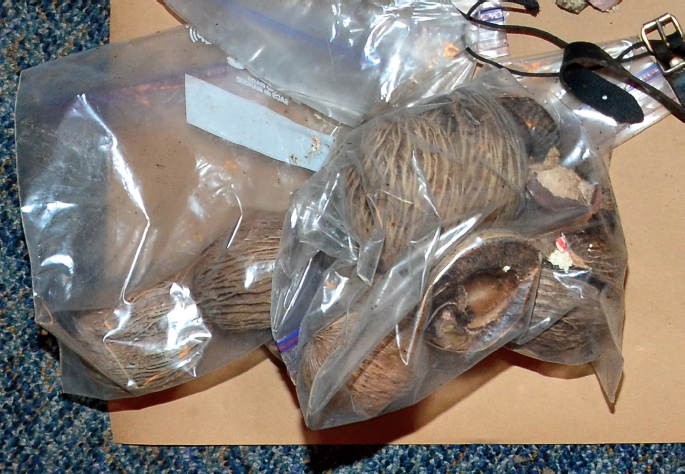
Fibrous seeds found at the nearby campsite.
The fruit of the Cerbera tree initially resembles a small mango in size and shape, with a fibrous shell, which encases the poisonous seed or kernel
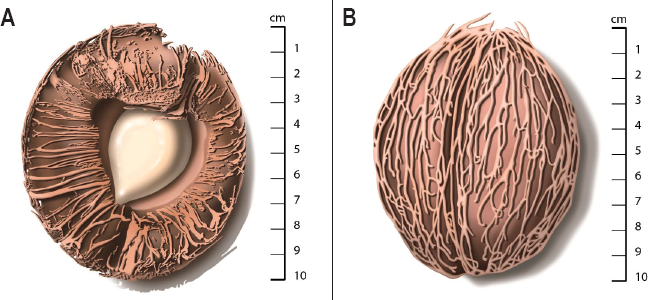
Graphic renditions of the Cerbera fruit. Image created by: Patrick Mooney, Biomedical Illustrator/Animator.
Even in endemic areas, diagnosis of cerberin poisoning is generally reliant upon a history of ingestion or visual identification of the seeds or fruit if these materials were brought in with the patient (3). A case report in China of nonfatal cerberin poisoning was reliant upon a history of ingestion of the pertinent seeds (4). Neriifolin, one of the cardenolides found in the Cerbera tree, does have commercially available standards for detection, however, positive identification of this compound only supports a possible diagnosis of ingestion of the neriifolin rather than provide definitive diagnosis of cerberin poisoning (2). Advances have been made to attempt detection of cerberin compounds, historically with thin-layer chromatography and most recently by ultra-high-performance liquid chromatography-high resolution tandem mass spectrometry (2). Although this is a valuable advance for the detection of the toxins, the current toxicologic research in this area has been largely overseas and the availability of testing in the United States with recognized reference standards is essentially nonexistent.
CONCLUSION
Although Cerbera suicidal and homicidal poisonings have been well documented in eastern Asia and the Indian Ocean regions, the lack of reported cases in the United States and worldwide highlights the difficulties encountered when trying to apply the usual postmortem toxicological methods when determining cause and manner of death with these toxins. The relative ease of obtaining these seeds through the Internet may result in more cases throughout the world. Careful consideration of the history and investigative findings, coupled with use of atypical consultants (a botanist in this case), may prove useful in accurately determining cause and manner of such deaths.