







Abstract
Purpose
Forensic pathologists typically depend upon case reports or published compilations of case reports when determining the role a drug may have played in death. Case reports may provide a helpful range, but the cases reported are typically few and often lack information on circumstances surrounding death and autopsy findings. A searchable database recording circumstances, autopsy findings, drug concentrations, and the cause and manner of death would allow forensic pathologists to compare a specific case to similar cases, facilitating evaluation and interpretation of toxicology results.
Method
This project uses data extracted by computer programs from over 18 000 computer files of autopsy and toxicology reports generated between 2004 and 2012. Using PHP Hypertext Preprocessor and MariaDB, a relational database, we developed a webpage that stores the data and allows for complex queries.
Results
Users can search for cases by specifying drugs and medical conditions, demographics, height, body mass, and manner of death. The number of cases with a given drug for this eight-year span from one office is comparable to the numbers reported in compilations of case reports.
Conclusion
Our webpage enables a pathologist evaluating a case to search the database for cases with similar circumstances and findings. New cases are easily added to the database as they are completed. The database allows other institutions to contribute data and records the data source, which increases the usefulness of the database even more. This database provides pathologists a powerful new tool for the evaluation of toxicology findings in their practice.
Introduction
Forensic pathologists regularly interpret the results of toxicological analyses. Usually, abundant data exist to guide interpretation for drugs that are commonly abused, such as cocaine. Data for comparison, however, is often scant for less frequently abused substances. For example, searching PubMed for “Tramadol postmortem results” returns 16 case reports and reviews that typically involve isolated fatalities (1). Using Baselt as a reference, 53 tramadol cases are found, the majority from a study by Tjaderborn et al. (2, 3). These reports are often limited to single institutions with limited numbers, and many do not provide details that allow the reader to find cases that match the given scenario. Furthermore, the case reports including a larger population generally contain a diverse group, such as age ranges from teenagers to the elderly or a disproportionate amount of males to females. The significance of an identical blood concentration of a given drug likely differs between a 250 lb male and a 100 lb female.
The advent of data analytic technologies in pathology, coupled with current trends in electronic medical records (EMRs), has resulted in an unprecedented increase in both the quantity and quality of data generated by our specialty. It is now theoretically possible to perform sophisticated analyses and meta-analyses of clinical data, yet much of this data remains locked in forms that are completely inaccessible to modern data analytic tools (4). Even in instances where the data is available for analysis, the data tends to be unstandardized in nature, leading to lengthy time and effort expenditure to normalize datasets for use with automated analytic algorithms (5). These problems are especially apparent in the field of forensic pathology, which has traditionally lagged behind general anatomic and clinical pathology in the adoption of informatics methods.
Using toxicology and autopsy data from our institution, as discussed in our companion paper “Development of an Extraction Program for Autopsies and Toxicology Reports,” we created an online database that contains specific information, such as age, race, height, body weight, and drugs (6). A user can query the database using all these fields simultaneously. This query returns both a summary of all applicable cases as well as a table containing individual case information. Furthermore, this database has potential to grow with subsequent years and additional institution participation.
Methods
We developed the online database using a Dell Latitude, model number E6520. Instead of creating the database directly on the machine – which would have had the side effect of making the database inherently nonportable and therefore not deployable in other environments – we made the following infrastructural decisions: 1) utilize virtualized computing as a hardware-agnostic platform for future development and deployment (7), 2) install Oracle VirtualBox VM – an open-source virtual machine hypervisor – for virtual machine development (7), and 3) Install a standard LEMP stack
Etox's Stack Infrastructure
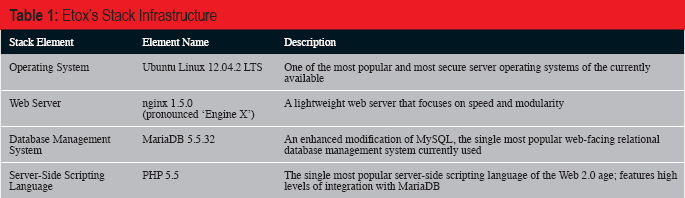
Using this infrastructure stack, we implemented an online relational forensic toxicology database that we have named “Etox;” its schema is shown in
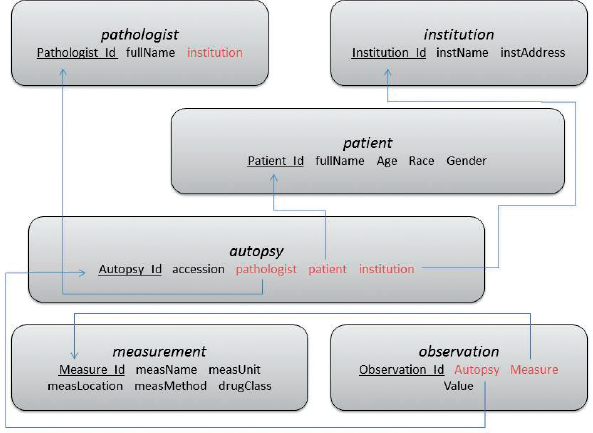
Table layout for Etox database. Italicized font indicates a table name, underlined items represent primary keys, and red font indicates foreign keys.
We used custom computer scripts to extract specified data from autopsy reports and then insert those data into a Microsoft Excel spreadsheet. We then used a Visual Basic macro to convert the data into a format compatible with the relational database. This macro sorted the Excel data into six spreadsheets that match the SQL format described in
Next, we designed the user interface of the webpage using Hypertext Markup Language (HTML), PHP, and a free design library known as Twitter Bootstrap, which comes equipped with JavaScript files and Cascading Style Sheets (CSS) that enhance the user interface and ensure compatibility across different browsers and devices (e.g., mobile devices, tablets) (9). A form allows users to specify parameters such as height, weight, sex, and organ weight, as well as selecting drugs by using check boxes. PHP receives these form entries and constructs a query to select cases from the Etox database, generating a summary table at the top and providing individual case information in a table underneath the summary.
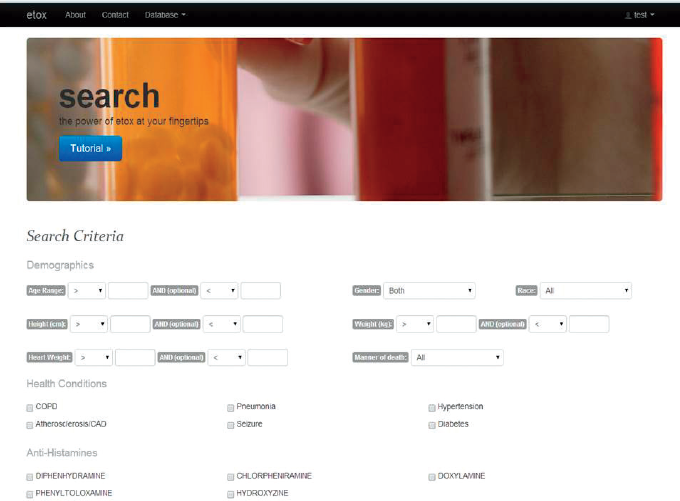
Index page for a “Tramadol” search.
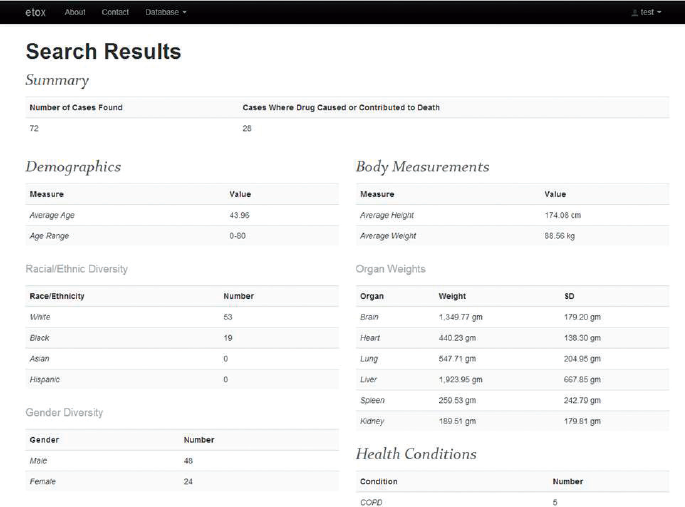
Results page for a “Tramadol” search.
Results
We created a queryable, online database that currently holds the Univeristy of Alabama at Birmingham's (UAB) autopsy and toxicology data. The macro programs that we developed extracted data from over 18 000 computer files, representing roughly 7000 cases examined between 2004 and 2012. Because of corrupt or deleted files, we were only able to obtain data on 3455 cases. The UAB's Excel records between 1995–2003 supplied an additional 6406 cases that included demographics, manner and cause of death, and toxicology results. Currently, the Etox database holds 9861 cases.
Usage of our program reduced toxicology search times significantly and provided much more detail and applicable data (6). For example, running a complex query for black males over the age of 20 years who had diabetes as well as ethanol intoxication takes approximately 11 seconds to enter the query criteria and the search is almost instantaneous. Currently, we have nine decedents that meet these criteria, two of whom had direct complications from ethanol.
Discussion
We have developed a novel tool for forensic pathologists to use as they try to determine the role of substances detected on toxicological analyses. Pathologists can query not only for specific drugs, but also fine tune the search for body habitus, sex, age, and medical conditions such as diabetes. The number of cases available and degree of detail exceed anything that published case reviews are able to offer.
Currently, our database contains 9861 cases with information regarding age, sex, race, size, organ masses, health conditions, cause and manner of death, and toxicology data. Performing a query for “Tramadol” generates 72 cases, 28 of which are related to cause of death. The webpage displays the average and maximum concentrations for various specimens, such as central versus peripheral blood, as well as specific demographics
Additional benefits for a webpage where many institutions contribute include regional data, broader range of queryable drugs, more accurate drug concentrations, and pediatric toxicology information. Medical Examiners will be able to query for specific criteria, such as “cocaine, homicide, male, 150 to 200 pound” and initially find hundreds of cases, but, after a few years with multiple institutions working together, could potentially find thousands of cases with much more refined toxicology values as well as information on complicated cases where an assortment of various drugs may have caused or contributed to death.
Because Etox was developed as a virtual machine disk image using standardized infrastructural components with widespread adoption, it is easily deployable on any machine that has a compatible virtual machine hypervisor, of which Oracle VirtualBox VM (which is available for Windows, Linux, and Mac OS X) is an example. Other popular hypervisors include VMWare ESXi (Windows, Linux), VMWare Fusion (Mac OS X), Parallels Workstation (Mac OS X), and Microsoft Virtual PC (Windows). This means that Etox can be deployed privately as well as publically, with no requirement for specific hardware/software configurations.
We plan to develop Etox further. Currently, checkboxes generate “and” statements that create queries such as “find decedents with cocaine and ethanol and heroin”; however, the option to use “or” statements will follow (“find decedents who had cocaine or ethanol or heroin”). It is also possible to alter the database so that pathologists can search by institution. We intend for this database to be a useful resource for the forensic pathology community, and as the database develops over time we will make adjustments to improve its usefulness.
Our website can be found at: http://etox.path.uab.edu/.
Footnotes
Acknowledgements
We would like to thank Egiebade Iriabho, Dr. Robert Brissie, and Dr. Jonas Almeida for their contributions to the development of this project.