







Abstract
Utilising qualitative methodology, this research explored the impact of team coaching on enhancing team mindfulness traits in the context of teams in the workplace. With teams facing ongoing changes and stressors, the quality of interpersonal interactions between team members can suffer, affecting a team’s capacity to be mindful. The research sought to identify whether team coaching fosters an environment whereby team mindfulness behaviours can be heightened. Four areas of perceived change within teams were characterised as relational, behavioural, cognitive and emotional. However, the effectiveness of the intervention can be hindered by the leader’s behaviours. This article highlights the benefits of developing team mindfulness traits through team coaching and offers practical suggestions for coaches to support teams in dynamic environments.
Keywords
Introduction
This article emphasises the importance of research on team mindfulness in the context of team coaching. It presents a conceptual model that illustrates perceived changes within teams, indicating heightened team mindfulness traits and behaviours. This contributes to team coaching and team mindfulness knowledge. Additionally, the model informs practical applications in team coaching education and practice, ultimately supporting team development.
In modern workplaces, teams confront the challenges of constant change and escalating complexity (Sopow, 2020), leading to stressors associated with heavy workloads and time pressures (Health and Safety Executive, 2022). These stressors can significantly affect interpersonal interactions, prompting adaptive behaviours such as conflict and judgemental attitudes. These behaviours are indicative of low team mindfulness, causing dysfunction within teams (Cole et al., 2008) and diminishing overall teamwork (Salas et al., 2015).
Despite extensive research focusing on individual mindfulness in the workplace, understanding team mindfulness remains limited (Yu & Zellmer-Bruhn, 2018), and there is a lack of knowledge regarding how to cultivate team mindfulness, let alone through the lens of team coaching. This qualitative study extends beyond the current literature by exploring the perceived impact team coaching has on a team’s ability to be mindful, as well as considering the experience of both team members and coaches. Much of the existing empirical research on team coaching often emphasises the role of the team coach, with little consideration of team members’ experiences.
The article summarises relevant literature and describes the qualitative methodology, including how thematic analysis was used to identify key themes. It presents important findings on the influence team coaching has on team mindfulness, culminating in a conceptual model that illustrates changes indicative of team mindfulness development. The article concludes by acknowledging limitations and making future research recommendations.
Literature Review
There is a realisation that teams play a crucial role in enhancing performance (Kozlowski et al., 2001) and driving organisational change to survive in a competitive landscape in the workplace (Sopow, 2020). Due to this challenging and complex environment, teams can experience high-pressure situations such as excessive workload, tight deadlines and too much responsibility, leading to work-related stress, depression or anxiety. Another contributing factor is a breakdown of interpersonal relationships and changes at work (Health and Safety Execuitve, 2017), leading to a significant loss of working days.
Taskwork involves delivering the work activities (Cooke et al., 2024), whilst teamwork is exhibited through shared behaviours, attitudes and cognition, all of which are crucial to delivering the taskwork. Team failures often stem from inadequate teamwork (Mathieu et al., 2008). Teamwork is easier to observe when it is happening, but more difficult to decipher why it is not (Driskell et al., 2018). This study focuses on the collective interactions among team members and aligning these behaviours with team mindfulness traits.
Teams consist of individuals with unique personalities, cognitive styles, values, behaviours and goals. These can translate into a multifaceted complex of interacting elements that are not static qualities; they are constantly developing and emerging, and potentially deteriorating as team members work together (Day et al., 2004). This constant change can lead to conflict, breakdown in communication and detrimental to team interactions, creating hostility and tension (Saavedra et al., 1993). This can lead to emotional reactivity, as well as stress and anxiety (Jehn & Mannix, 2001). A mindful team demonstrates traits such as shared views on interacting with non-judgemental behaviours (Yu & Zellmer-Bruhn, 2018).
There is substantial research on mindfulness in the workplace to support individuals, particularly regarding work-related stress reduction programmes. These have shown to have positive effects on emotional and behavioural conditions (Brown & Ryan, 2003). Whilst organisations recognise teams to be crucial for success, surprisingly, team mindfulness has not attracted the same interest.
Team mindfulness is defined as a ‘shared belief among team members that their interactions are characterised by awareness and attention to present events and experiential, non-judgemental processing within-team experiences’ (Yu & Zellmer-Bruhn, 2018, p. 326). Previous studies (e.g. Wang & Wang, 2023; Xie, 2022) have primarily examined team mindfulness through a quantitative lens. However, despite current research demonstrating the benefits of teams exhibiting team mindfulness traits such as team cohesion (Khan, 2018), managing team conflict and safeguarding against social undermining (Yu & Zellmer-Bruhn, 2018), as well as improving team flow (Xie, 2022), and creativity (Liu et al., 2021), there remains a significant lack of empirical evidence on how to cultivate team mindfulness (Yu & Zellmer-Bruhn, 2018). This study addresses that lacuna through the context of team coaching.
In reviewing the limited team coaching literature, the majority of studies focus on the team coaches’ experience (Hastings & Pennington, 2019; Lawrence & Whyte, 2017) or their own practice (Carr & Peters, 2013; James, 2017), with limited studies from the voice of the team members. I would argue that having a greater knowledge of how team coaching is experienced by those team members is of equal importance. This understanding can mitigate biased perceptions regarding the advantages of team coaching interventions. Additionally, the current studies focus on the task-orientated behaviour of team coaching, few explore its interpersonal impact (Fernández Castillo & Salas, 2024).
As identified, there are notable gaps in the literature, highlighting the urgent need for qualitative research that explores the nuanced experiences of team coaching and its perceived impact on team mindfulness. A significant shortfall is the absence of empirical evidence capturing the perspectives of team members – an often overlooked aspect of team coaching, alongside the insights of team coaches who have delivered these interventions. This lack of diverse viewpoints not only hinders the advancement of team coaching but may also neglect the needs of teams operating in complex, high-pressure environments. Enhancing team mindfulness could empower these teams to thrive collectively.
Gaining a deeper understanding of the experiences related to team coaching and the perceived changes in team member interactions, particularly regarding team mindfulness behaviours and traits, is valuable. This research aims to enhance awareness of team mindfulness and how to develop its attributes through team coaching. Such clarity is currently lacking in the existing literature on team coaching and team mindfulness. Ultimately, these insights will assist coaches, leaders and sponsors in recognising additional benefits that can be derived from implementing team coaching strategies.
Methodology
The rationale for adopting a qualitative methodology was two-fold: firstly, from a team coaching perspective, the study explored perceived experiences, and secondly, current studies of team mindfulness are mostly quantitative and focused on measuring team mindfulness levels. This qualitative research provided the opportunity to obtain rich data on how team coaching is experienced, focusing on perceived changes in team member interactions, and aligning the data with interpreted team mindfulness traits.
The research paradigm was based on a social constructivist perspective, whereby there are multiple and, at times, conflicting social realities (Guba & Lincoln, 1994, p. 111). Social constructivism has merit for exploring team mindfulness through team coaching as reality is understood through multiple, intangible mental constructs, which are uniquely individual and constructed through individuals interacting within their social worlds (Merriam, 1998, p. 6). Varying levels of team mindfulness exist in all teams (Yu & Zellmer-Bruhn, 2018), from a social constructivist stance, this would be experienced through communication and interaction within the team, such as the interpersonal, and collective cognitive processes between team members (Sutcliffe et al., 2016). Team coaching provides a context for individual team members to engage together, an opportunity for knowledge to be constructed through their interactions (Denicolo et al., 2016, p. 27).
The research explored how team members and team coaches experienced changes in team member interactions during a team coaching intervention. The research design encapsulated a qualitative inductive approach, to capture participants’ understanding of any perceived changes. This was done through one-to-one semi-structured interviews, and using thematic analysis to identify patterns created in the data. Recruitment involved purposive sampling of participants with team coaching experience (Symon & Cassell, 2012), as they are relevant to the research question and information-rich (Bell et al., 2018). Data was collected through interviews using Zoom video conferencing.
As a purposive sample, participants were team members and team coaches who had experienced team coaching within the past five years. For participation, team coaching was classified as at least one team coach working with the collective team for months, with a minimum of three team coaching sessions. The focus of the team coaching for each participant may have been different. The study aimed to explore the perceived impact of team coaching on team behaviours, specifically, team mindfulness. Twenty participants were recruited, ten team members and ten team coaches, providing a breadth of insights into twenty-five plus team coaching experiences. The study sought in-depth data based on participants' experience and understanding, similar in size to qualitative studies on mindfulness in the workplace (Hugh-Jones et al., 2018), and larger than many team coaching studies (e.g.Carr & Peters, 2013; Hastings & Pennington, 2019; Wotruba, 2016). This study aligned with Kvale’s (2009) suggestion of 5-25 participants. Figures 1 and 2 display participant information.
Team member information
Team coach information
The study utilised a thematic analysis approach to data analysis (Braun & Clarke, 2006; King et al., 2019; Nowell et al., 2017), described as a ‘Big Q’ approach, and theoretically flexible (Braun & Clarke, 2021). Adopting a social constructivist epistemology stance acknowledges that knowledge is open to multiple understandings. To establish trustworthiness (Lincoln & Guba, 1986), Tracy’s eight ‘big-tent’ criteria (2010) filtered through the entire process of the study. The study also adopted the six phases of thematic analysis (Braun & Clarke, 2006), outlined in Figure 3.
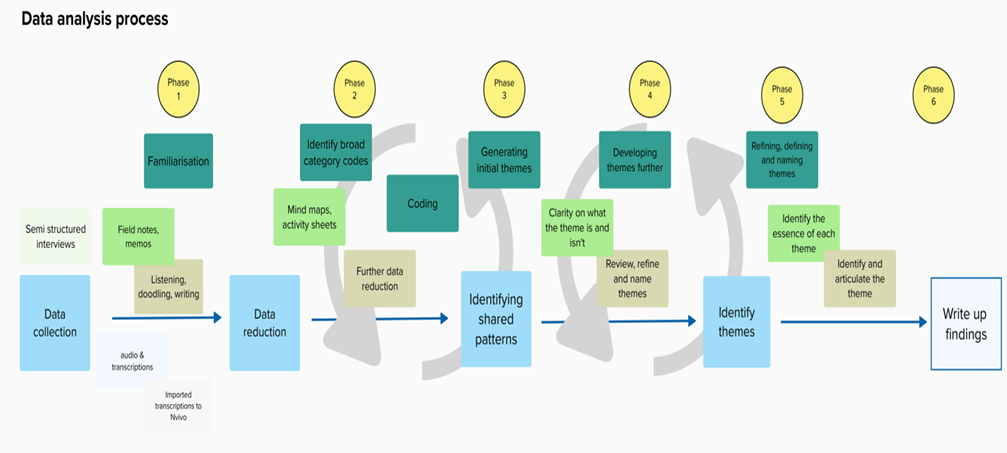
Model of the data analysis process
Bringing the data from two different perspectives provided a richer and more subjective view of how team members interacted by the end of the team coaching intervention. The thematic analysis model (Figure 3) illustrates the iterative process used to analyse the data. NVivo was used to sort the data; the analysis process then moved through six phases, which incorporated familiarising and analysing the data (Phase 1). The initial codes were established to create analytical and meaningful descriptions (Braun & Clarke, 2006), intending to capture single concepts and qualitative richness (Boyatzis, 1998). These were placed into broad categories of ‘first impression of the team’, ‘team coaching impact’, and ‘team coaching process’ (Phase 2). The next phase involved the generation of initial themes from these broad categories (Phase 3), which was then followed by a rigorous review and further elaboration (Phase 4). This included critically examining any pre-existing assumptions, as well as enhancing previously overlooked elements during the analysis, such as the impact of the leader and team coach.
Focused coding and categorising highlighted overlaps. For example, in the initial theme of ‘less ‘I’, more ‘we’ – greater team awareness’, there were overlaps, which were subsequently divided into subthemes: ‘developing deeper relationships’ and ‘building respect and openness’. The next phase involved taking analysis into a deeper level of construction and aligning them with interpreted team mindfulness traits and behaviours from the team mindfulness scale (Phase 5). This involved checking the validity and quality of the themes and refining and defining them further. Whilst the research identified three main themes, this article focuses on one theme: ‘less ‘I’, more ‘we’ – greater team awareness’. The final phase was writing up the findings, which naturally created further scrutiny of the themes, as seen in Figure 4. Column one denotes the theme, column two displays the sub-themes, column three presents an example of how it relates to the team mindfulness scale, and column four describes the interpreted traits of team mindfulness behaviours.
Theme and subthemes
Findings
Four distinct team member interactions were perceived to have changed following the team coaching and were identified in the theme ‘less ‘I’, more ‘we’ – greater team awareness. This provided rich data on the impact team coaching had on the team’s ability to be mindful, showcasing the developed team mindfulness traits and behaviours. Levels of team mindfulness development were also influenced by leader behaviours, and their inclination to engage and manage their own emotions, highlighting the importance of leaders being self-aware and understanding the impact of their behaviours on the team they lead.
Less ‘I’, more ‘we’ – greater team awareness
It was apparent that team coaching helped many teams become more aware of how team members were interacting as a team, with both participant groups noting that numerous teams developed stronger team-like behaviours indicative of experiential processing within teams: a team mindfulness trait. Before the team coaching, the concept of ‘team’ was limited:
“We were more of a group of high-performing individuals, than we were necessarily a team” (Mason)
“It didn’t feel like a team, if truth be told, we were disparate in what we were doing” (Max)
The team coaching supported the shift towards a greater awareness of the team and how it was functioning.
“The team coaching, I think it really helped to accelerate our cohesiveness […] the team actually came together” (Matt)
Teams that attained this shift in awareness and attention on the team, moving from an emphasis on “I’ (individualism) to ‘we’ (teamwork) sparked further discussions about the behaviours observed and differences noticed, leading to the development of the four interconnected subthemes that relate to a team being more mindful.
Building deeper relationships
Developing deeper relationships between team members was evident in how participants described the change in their understanding and knowledge of each other as people, beyond the role they did. The conversations were more personal; team members were listening with attention and awareness of each other, far more present to each other denoting a level of mindful behaviour, such as active listening and being present with each other:
“the quality of the conversation, the willingness to share, it was at a deeper level […] it was more personal” (Clark)
“sharing information about their personal lives” (Cooper)
Team members valued the strength of the relationship that was developing; they were more interested in, and receptive towards each other:
“the relationships were stronger” (Marley)
The evidence from the data makes a compelling case for the significant contribution that team coaching made to fostering stronger relationships between team members and feeling part of a team.
Building respect and openness
Many experiences were shared where team members were perceived to be more open and respectful in their communication with each other, which contrasted with how they interacted before the team coaching. Conversations moved from being guarded and, in some cases, hostile and judgemental:
“there was a blame culture, it was very accusatory” (Callum)
towards team interactions where conversations were:
“much more respectful” (Connor)
“the openness meant you could actually say what you meant” (Millie)
These shifts in behaviour towards other team members are indicative of team mindfulness behaviour, where team interactions are signified by non-judgemental interactions.
Clarity and harmony
When there was confusion about roles and responsibilities or collective team goals, this lack of clarity led to frustrations and negatively impacted how team members interacted. Creating clarity and harmony represents a recurrent theme following team coaching. Teams experienced a significant shift in collective awareness, which facilitated enhanced transparency regarding those interactions. This improvement in information sharing subsequently led to improved teamwork:
“things moving towards more harmony, the team’s ability to focus on the needs of the team” (Cooper)
“I think collective responsibility was very important, that we were prepared to passionately and forcibly put across our views when we were in a meeting” (Mia)
Enhanced visibility between team members fosters a collective understanding of the team goals, which cultivates a heightened sense of cohesion and encourages information sharing within the team. A mindful team consciously maintains focus on team interactions and present events, promoting attention and awareness of shared experiences. This clarity leads to a greater sense of harmony emerging between team members but also facilitates deeper engagement with team interactions.
Compassion and emotional maturity
Many experiences were shared where team members expressed and demonstrated a more inherent level of care towards other team members, including an increased level of compassion, emphasising an emerging level of emotional maturity amongst team members. This was a shift from experiences such as:
“some kind of resistance to sharing stuff and understanding each other” (Callum)
“we were independent and competitive towards each other” (Mason)
Experiences such as these diminished the likelihood of team members engaging in mindful interactions. In a mindful context, team members exhibit support and empathy, actively acknowledging and valuing each other’s thoughts and ideas without bias or judgement.
In contrast, interviewees described becoming ‘more self-aware and also aware of others’, including more understanding of what others were experiencing:
“more compassion, more willingness to help” (Carter)
“a little bit more understanding of the challenges that each person’s got, and more empathy. Previously, they would have got frustrated because they could see how it could be done differently” (Matias)
Team coaching supported team members to engage in supportive and compassionate behaviour within their teams. Teams were described as more emotionally mature, characterised by a reduced tendency for judgemental reactions. Instead, members demonstrated increased empathy and compassion for other team members’ experiences, along with a commitment to supporting each other through challenging circumstances. These behaviours are reflective of team mindfulness traits.
The caveat to team mindfulness development was the impact of the leader’s behaviours, more specifically, a leader exhibiting a lack of awareness of their behaviours or regulation of emotions. Consequently, this lack of awareness impaired team mindfulness development of traits such as openness between team members. In these cases, the focus shifted towards individual task output, neglecting the opportunity to have awareness and attention on working together as a team.
Discussion
This section discusses key concepts informing team coaching fundamentals for developing perceived team mindfulness traits and behaviours. Team mindfulness is a relatively new construct (Yu & Zellmer-Bruhn, 2018), with benefits still emerging. This is in comparison to the plethora of studies on mindfulness for individuals in the workplace (e.g. Badham & King, 2019; Glomb et al., 2011; Weick & Sutcliffe, 2006), and the well-recognised benefits to individuals.
Empirical studies of team mindfulness describe advantages in team members’ interactions, such as safeguarding against social undermining (Yu & Zellmer-Bruhn, 2018) and destructive conflict (Wang & Wang, 2023). High levels of team mindfulness are associated with enhancing team cohesion (Majeed et al., 2023), team flow and reduced team stress and anxiety (Xie, 2022). While team mindfulness traits exist in all teams at varying levels (Yu & Zellmer-Bruhn, 2018), current research lacks guidance on how to develop these traits. This study addresses this lacuna, offering findings to contribute to current team coaching knowledge as a catalyst in the development of team mindfulness attributes. In answer to the question ‘What is the perceived impact that team coaching has on a team’s ability to be mindful?’, the study found that team coaching enhances the perceived relational, behavioural, cognitive and emotional changes which indicate a team’s heightened ability to be mindful. This is discussed in the following section.
Team coaching enhances the perceived relational, behavioural, cognitive and emotional changes which indicate a team’s heightened ability to be mindful
I have synthesised the findings of this study and constructed a new conceptual model that delineates the experiences associated with the varying levels of team mindfulness traits within the context of team coaching. To illustrate this, the model captures the perceived relational, behavioural, cognitive and emotional changes which indicate a team’s heightened ability to be mindful (Figure 5). To clarify, team mindfulness and teams being mindful are closely related concepts; team mindfulness is the trait, whilst being mindful describes the action of awareness and intention within the team, representing an active state of mind, consciously helping people avoid automatic behaviours (Gethin, 2011; Williams et al., 2024). Thus, this study adds new insights into the team coaching and team mindfulness literature.
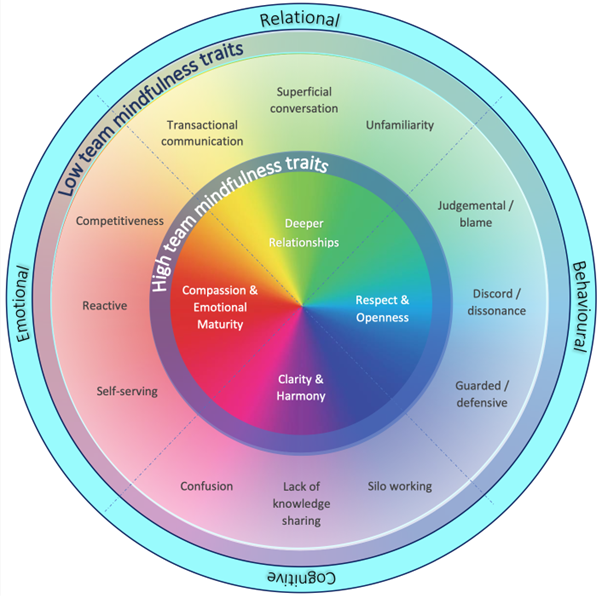
A conceptual model of the experiences associated with the varying levels of team mindfulness traits within the context of team coaching
Labelled on the outer ring, the four quadrants of relational, behavioural, cognitive and emotional represent different types of perceived changes between team members and are indicative of varying levels of team mindfulness traits. The central circle, illustrated with brighter colours, relates to the theme ‘Less ‘I’, more ‘we’ – greater team awareness’, and denotes higher levels of team mindfulness traits. The relational quadrant relates to developing deeper relationships; behavioural signifies building respect and openness, cognitive characterises creating clarity and harmony; and emotional denotes compassion and emotional maturity.
The middle ring with a subdued colour tone illustrates the traits teams exhibit when reduced levels of team mindfulness are present. These are described by keywords from the data. This conceptual model encapsulates the complexity of developing the construct of team mindfulness. It is essential to note that these four individual quadrants are interconnected; this is illustrated in the model by the wheel of colour being purposefully blurred between segments. The model is designed to simplify the intricacies of human interaction within teams. An example of this would be, a team member who does not know the other team members particularly well (relational), becomes guarded in their responses to a perceived experienced team member (behavioural), and does not share team information (cognitive) in fear of saying the wrong thing (emotional).
In the context of this model,
The next quadrant,
The final quadrant in the model is
These indicators from the four quadrants show team coaching is a catalyst for developing a team’s heightened ability to be mindful; part of this was the team’s exhibiting more compassion. Current literature (e.g. Badham & King, 2019; Hollis-Walker & Colosimo, 2011) states that mindfulness and self-compassion were positively related to individual well-being, which invites the question – does team mindfulness and compassion support team well-being? As team members showed a level of awareness of other team members’ suffering or pain and took action to provide support (Dutton et al., 2014), suggested teams developed a level of compassion, which evoked a reciprocal emotional response, leading to a level of team well-being.
Conclusion
In conclusion, it is widely acknowledged that teams can experience high-pressure situations in the workplace, which can impede how team members interact, causing hostility and tension. When teams become more mindful, there is a greater propensity for collective beliefs and agreements in team interactions, reducing the likelihood of conflict and social undermining. How to develop these traits, until now, has not been understood. The findings demonstrate that team coaching acts as a catalyst for developing team mindfulness traits, adding new insights into team coaching and team mindfulness knowledge.
The synthesis of findings offers a valuable theoretical and practical contribution to the fields of team coaching and team mindfulness by presenting a conceptual model derived from the experiences of both team members and team coaches during a team coaching intervention. This model elucidates the different levels of team mindfulness that may be experienced within a team through the team coaching intervention. It highlights the value of engaging teams to become more mindful. The construction of the model offers a visual understanding for coaches and leaders to explore and normalise the varying levels of mindful traits, with the potential of focusing on key areas for development.
The study introduces new approaches to developing team mindfulness traits and the significance of leader behaviours, which can positively or negatively impact the team’s ability to be mindful.
Limitations are inherent within research methodologies, creating opportunities for further research. Data was collected post-team coaching from multiple teams and sectors, whilst giving a breadth of knowledge and experiences, it did not follow one team through the intervention. Future research is, therefore, recommended to investigate team mindfulness development through team coaching from a one-team perspective. A case study approach could be adopted to collect data from one team at multiple stages, such as prior, during and after team coaching. The conceptual model could be used to validate team mindfulness traits