







Abstract
This paper presents an emerging theory of coaching as a Generative Scaffold which can support managers experiencing stress at work. This conceptualises a process in which the coach supports the manager to generate insights, strength, and action, in order to improve their situation. Developed using Constructivist Grounded Theory, my findings suggest that common coaching approaches might be missing vital ingredients if they are to be effective in supporting managers in this context. Underpinned by critical inquiry, the study raises important ethical questions for coaches working within organisations and it makes a case for coaches as agents of social change.
Introduction
Work stress is extremely damaging to public health, quality of life, and the economy (Grant, 2017; Gyllensten and Palmer, 2012; Mucci et al, 2016). The number of working days lost due to stress, depression or anxiety has been steadily increasing over the last twenty years, and in 2019/20 accounted for 55/ of all working days lost due to work-related ill health (HSE, 2020). It is clearly a significant and growing issue, and yet, despite the vast body of work stress literature, Tinline and Cooper (2019, p.93) suggest ‘we have collectively failed to make a positive impact…in terms of substantially reducing worker stress and improving psychological wellbeing’.
Over the same time period, the use of coaching to support learning and development in the workplace has accelerated, and the evidence base supporting its effectiveness is becoming ever stronger (for example, Jones, Woods and Guillaume, 2016). Indirect outcomes of workplace coaching reportedly include stress reduction (for example, Athanasopoulou and Dopson, 2018), and yet, it appears that coaching is rarely considered as an intervention to support managers experiencing stress at work. Perhaps this is because stress is largely seen as a health issue and coaching is seen as a development tool. At present, it seems that tackling work stress and the practice of coaching exist within distinct disciplines and, at an organisational level, within different budget lines. This compartmentalised thinking may well be inhibiting the opportunity to expand the utility of workplace coaching and to make a positive impact on the challenge of stress at work.
At a time when coaches are increasingly likely to find themselves working with clients experiencing work-related stress, the aim of this research was to understand how coaching supports managers experiencing stress at work with a view to explicating the recognised stress reduction outcomes of coaching. I believe this inductive study potentially contributes something new to the coaching and stress literature and my hope is that it might act as a catalyst for further research which might yield something of value to both disciplines, with the potential to build a bridge between the two.
In the next section I give a brief overview of the relevant literature. This is followed by a description of my research methodology, a high-level summary of my findings, such as the word count for this article will allow, and the presentation of my emerging theory. I end the paper with some reflections on the implications of this study for coaching research and practice, I acknowledge the limitations of the study and offer some concluding remarks.
Literature Review
Coaching at work
Several review papers identify wide-ranging outcomes of workplace coaching which, in addition to learning and development, include general wellbeing and coping (Theeboom, Beersma and van Vianen, 2013); work-life balance, improved assertiveness and increased confidence (Blackman, Moscardo and Gray, 2016); reduced stress and anxiety, improved time management, improved resilience and a source of support (Athanasopoulou and Dopson, 2018); and self-efficacy and improved leadership behaviours (Lai and Palmer, 2019). Many of these outcomes relate to stress management, either directly or indirectly, so it seems curious that there is very little robust literature which seeks to explore this connection further. In addition, the coaching outcomes research does not offer any explanation of how coaching achieves these effects.
Lai and Palmer (2019) suggest that psychological approaches, such as Cognitive Behavioural (CB) coaching, play a key role in effectiveness although they recognise that more evidence is required to understand how or why this is the case. Athanasopoulou and Dopson (2018) suggest the most frequently used approach in workplace coaching is CB coaching, either used on its own or combined with other frameworks such as Solution-Focused (SF) or strengths-based coaching. However, I feel it is important to recognise that while an approach may be commonly reported this does not mean it is necessarily the most effective. The research supporting CB and SF coaching is problematic in that these approaches are not clearly defined, the measurements of effectiveness are short term self-reports, and there are no studies which directly compare these approaches with alternatives such as psychodynamic coaching. I believe the literature to be potentially biased, and self-reinforcing, in this respect, perhaps owing partly to hidden socio-political and economic structures within our society (Dalal, 2018). Theeboom, Beersma and van Vianen (2014) suggest there is a need for more theoretical development in coaching and I support this view.
Bozer and Jones (2018) acknowledge the triadic nature of workplace coaching, highlighting that coaching outcomes sit within an organisational context. It is interesting to note, therefore, that the majority of coaching research reports only individual level outcomes. This limits the findings in that they give only a single perspective from within the triadic coaching relationship. This might be linked to the strong influence of psychological theories within coaching, which by their nature tend to assume the problem sits with the individual (Blackman, Moscardo and Gray, 2016). Tabarovsky (2015) highlights the potential risks of coaching inadvertently reinforcing the neoliberal agenda by holding individuals personally responsible for their own wellbeing and performance, without considering their context and the power structures contained therein. Similarly, Athanasopoulou and Dopson (2018, p.71) criticise executive coaching research for being indirectly preoccupied with the meso level…and very limitedly with the macro level’.
It seems timely, in our increasingly complex world, that coaching research should begin to move beyond outcomes, and limited studies looking at effectiveness, to explore how coaching works, to do this from multiple perspectives, and to consider the impact of the wider systems involved in organisational coaching. It is in this space that my study sought to make a contribution.
Stress Management Interventions at work
Historically, work-related stress has been seen as an individual level problem requiring an individual level solution (Quick and Henderson 2016). The most common stress management interventions (SMIs) seem to be counselling and training (Michie, 2002; Richardson and Rothstein, 2008) which are usually targeted at the individual level without considering the organisational context. Increasingly however, work stress research into SMIs is recognising the systemic nature of stress and, as a consequence, is including multi-level interventions (individual, manager, group and organisational) within their designs (for example, Jenny et al, 2014). This research is concluding that the greatest impact can be achieved when the intervention operates at both the individual and the organisational level, (for example, Li et al, 2017). It is also interesting to note that interventions seem to be most successful when participation is voluntary (Weinberg, 2016) and a number of studies have highlighted the impact of individual characteristics, such as self-efficacy, on the effectiveness of SMIs (for example, Lloyd, Bond and Flaxman, 2017), perhaps sign-posting a role for personalised non-clinical interventions, such as coaching.
Richardson and Rothstein’s (2008) meta-analysis found CB training-based interventions had the greatest impact in stress management. However, a major limitation of this analysis was that the studies it analysed varied hugely in design. For example, of the CB skills training interventions reviewed, one lasted for one week and others lasted for up to eleven weeks. Some were in person, others online, and they were often combined with other treatment components. This leads me to question the reliability and generalisability of some of the conclusions drawn by the authors. In contrast, Li et al (2017) found, following a nine-year follow-up study, that an SMI which combined psychodynamic principles and CB techniques had a lasting impact on stress reduction. Given these issues in research design in the field of evaluating SMIs, I would suggest that our understanding of what is truly effective at an individual level is still patchy. Also, as with the coaching literature, research into the effectiveness of SMIs considers the outcomes and not the process. This means there is a gap in the literature regarding our understanding of how an SMI supports individuals experiencing stress at work.
Coaching as a Stress Management Intervention
The extant literature exploring the possibility of coaching as an SMI is limited and fragmented. The conceptual literature articulates itself in narrow terms, for example, CB coaching to address procrastination (Palmer and Gyllensten, 2008) and an existential approach to develop self-awareness in order to tackle stress (Krum, 2012). Gyllensten and Palmer (2012) suggest that coaching has less of a stigma than counselling which means individuals may be more likely to seek help at an earlier stage if coaching was available. Grant (2017) suggested that it is important for coaching to support both performance and wellbeing in the workplace and proposed a conceptual framework to guide coaches in this effort. However, the matrix structure of his framework feels simplistic. There is clearly an opportunity for further development in this field. There does not appear to be any empirically grounded theory which explores how coaching can support managers experiencing stress in the workplace and this constitutes a gap in the literature which I sought to address.
In terms of empirical studies, Grant (2017) referred to emerging literature on the impact of coaching on stress reduction, however, the studies cited were small and, arguably, highly context specific, for example, rural GPs (Gardiner et al, 2013) and bank managers (David et al, 2016). A recent study, with a robust, longitudinal research design, found convincing evidence that coaching contributes to individual level coping by promoting self-management and problem-solving skills (Ebner et al, 2018). This is encouraging, however, again the context was very specific with the intervention taking place in a German military university. While these studies suggest that coaching can support individuals experiencing stress, they do not explain how it might do this.
This literature review hints that coaching has potential as an SMI but the bridge between these disciplines is not yet firmly grounded. My study sought to explore this gap in the literature in the hope of bringing these communities of research closer together.
Methodology
From an epistemological point of view, my research question sought to understand how coaching can support managers experiencing stress at work. The emphasis on understanding and sense-making in connection with individuals’ experiences of coaching and stress indicated that my research sat within a constructivist research paradigm. In addition, I felt quite strongly, given the gaps highlighted in the literature review, that my research should extend beyond the individual level of analysis to consider ‘the structural contexts, power arrangements, and collective ideologies on which the analysis rests’ (Charmaz, 2017, p.35). With this in mind, I selected Constructivist Grounded Theory (CGT), as described by Charmaz (2014), as my methodological approach, with an awareness of Critical-Constructivist Grounded Theory, as described by Levitt (2021, p.19), and the growing acknowledgement of the power of CGT for critical inquiry (Charmaz, 2017). CGT offered an ‘inductive, comparative, emergent and open-ended approach’ (Charmaz, 2014, p.13) and allowed consideration of multiple perspectives which all felt like important factors in addressing the research question fully.
I developed broad selection criteria, to keep my inquiry as general as possible, and sought participants representing all three perspectives within the standard triadic workplace coaching relationship. I recruited participants through my professional network using purposive sampling followed by theoretical sampling. My recruitment approach yielded a total of twelve participants; five coaches, five managers and two coaching commissioners. This small number constitutes a limitation of my study, however, it was all that was possible in the time available for the project and with the challenges imposed by the Covid-19 pandemic. It is why I describe my theory as emergent and tentative.
I collected data via semi-structured interviews which were recorded and transcribed. Data analysis began at the same time as data collection and was conducted in rounds. This formed an iterative process whereby the interview questions evolved with each round to enable the development of categories. I coded the transcripts manually, using gerunds, which ensured the coding remained focused on actions and processes. I developed a CGT coding and category development structure based on recommendations from Charmaz (2014), see Figure 1, which involved a process of initial coding, focused coding and theoretical coding. From this, I identified preliminary categories, which led to theoretical sampling and the use of abductive reasoning to reach conceptual categories which formed the basis of my emergent theory.
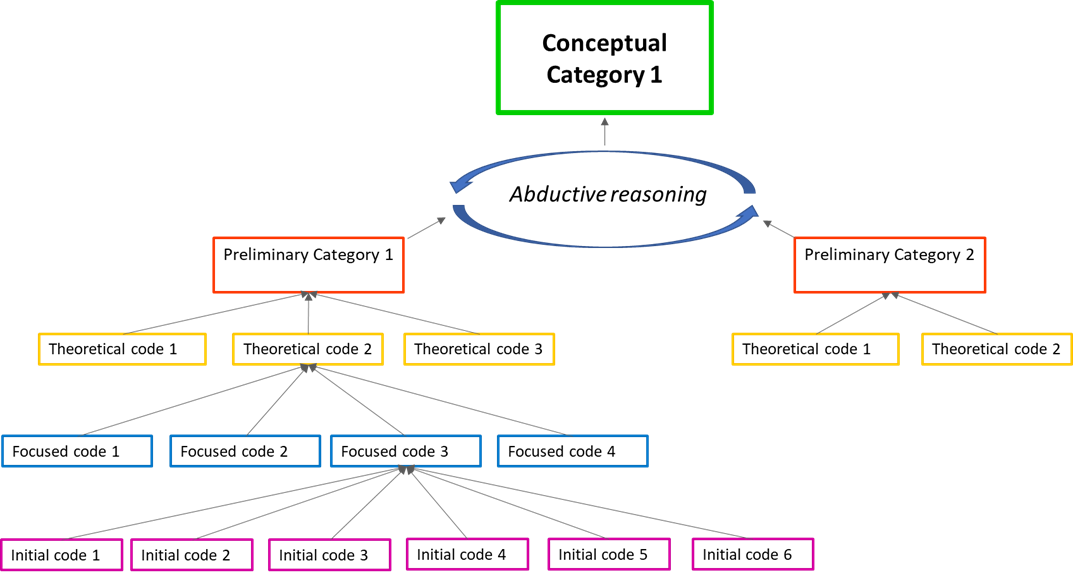
Category development structure
Memoing was a core part of my research process which began after the first interview and continued throughout the writing phase of the project. During the data analysis phase I continuously moved backwards and forwards through the data using strategies such as making comparisons, questioning, reflecting on different meanings of a word and the language used to describe situations, making use of my own life experience and considering tone of voice and emotions that may have been expressed (Corbin and Strauss, 2015).
Saturation of data is the aim of grounded theory, however, according to Charmaz (2014), ‘saturation’ is often invoked uncritically. I do not feel able to claim complete saturation as my study was limited; however, I made a judgement to conclude my data collection in the interests of time and for reasons of practicality which according to Wiener (2007) is acceptable. Dey (1999, p.257) suggests the term ‘theoretical sufficiency’ as an alternative to saturation and I believe my study reached sufficiency such that my emerging theory is credible.
I took care to observe ethical standards in relation to my participants. Participant data was anonymised and held securely. I chose a number of unisex pseudonyms and removed references to gender and also to organisations and industry sectors to preserve anonymity further. As this study was motivated by my own experiences of stress in the workplace and the inadequate support I had received at the time, I was very aware that my personal experiences, values and beliefs had the potential to bias my approach. I used a practice of critical reflection throughout the research process, to explore where I might be exhibiting bias and to adjust towards a more objective approach. Corbin and Strauss (2015) suggest that, to be credible, grounded theory should be easily understandable and sufficiently general that it can be applied in a variety of situations. I believe I have managed to develop an emerging theory which fits these criteria. I certainly made every effort to ensure it is ‘trustworthy and believable in that [it] reflects participants’…experiences with the phenomena’ (Corbin and Strauss, 2015, p.346).
Findings
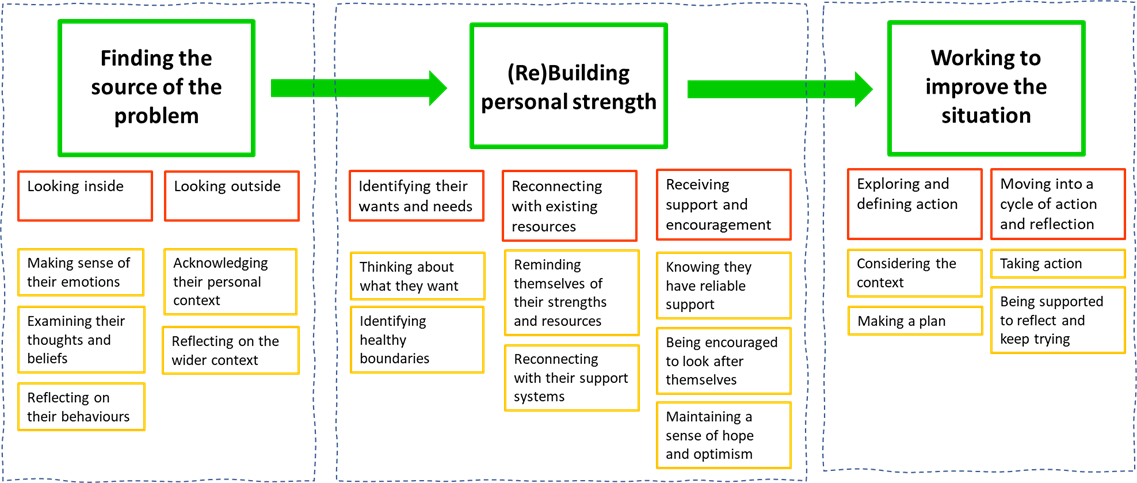
By amalgamating the data from managers, coaches and coaching commissioners, and using the coding structure described above, three main conceptual categories were identified as follows; Finding the source of the problem, (Re)Building personal strength, and Working to improve the situation, see Figure 2. I will briefly summarise the key features of each of these categories before going on to explain how my tentative theory emerged from this data.
Finding the source of the problem
This was a critical process in the emerging conceptualisation of how coaching can support managers experiencing stress at work. By offering a calm, non-judgemental space in which to share, and the support to explore themselves and their situation, coaching helped managers work towards a depth of awareness and understanding about the root cause of the problem that they may otherwise struggle to achieve while experiencing symptoms of stress.
Summary of findings
The two main features of this category were Looking inside and Looking outside. Looking inside involved a process, facilitated by the coach, of the manager exploring and identifying what was going on within themselves, including how they might be contributing to their own experience of stress. The coaching focused on supporting them to make sense of their emotions, to examine and challenge their thoughts and beliefs, and to reflect on their behaviours. This investigation offered useful information about the source of the problem. Looking outside captured an exploration of their personal context and the wider environment. Acknowledging their personal context included consideration of any family pressures outside of work, identification of training gaps which may have been overlooked, and exploring dynamics around the work situation, such as the quality of line management relationships and feelings of job insecurity. Reflecting on the wider context included examining the clarity and achievability of organisational expectations and exploring the impact of organisational culture and values on attitudes towards stress. For example, ‘there’s almost a badge of honour for those who have burned themselves out and it’s really frustrating…we shouldn’t be rewarding that’ (Dylan, Manager).
It seemed vital for the coaching to examine both internal and external aspects when looking to find the source of the problem because, for example, ‘why there’s too much work could be for many reasons. It could be lack of efficiency…or not enough resource’ (Terri, Coach). In accordance with the critical constructivist approach to my research, it felt important to recognise that the source of the problem did not necessarily originate with the individual manager.
(Re)Building personal strength
One of the fundamental challenges that an experience of stress at work posed for most managers was a loss in confidence in their capabilities or judgement, or an erosion of their self-regard. This seemed to range from underlying feelings of self-doubt to more paralysing levels of procrastination and withdrawal. Coaching helped managers to (re)build their sense of personal strength. The key features of this category were Identifying their wants and needs, Reconnecting with existing resources and Receiving support and encouragement.
Identifying their wants and needs was a critical part of the coaching engagement as it helped to create a sense of clarity and direction for the manager. Managers experiencing stress were often stuck in thinking about the problem and what they did not want, without having clarity around what they did want; ‘that’s why they can’t do the right things, because they don’t know what they want to achieve’ (Terri, Coach). At the same time, managers were often not looking after their basic physical and mental needs in terms of sleep, healthy eating, exercise and rest, so taking time to identify healthy boundaries was important. Either the manager would recognise this self-sabotaging behaviour for themselves, or coaching was able to prompt some critical reflection on the part of the manager which ultimately led to a change in their attitude towards their boundaries around work.
Reconnecting with existing resources involved helping the managers to remind themselves of their strengths, resources, coping mechanisms or the value of their intuition, for example, by encouraging them to reflect on past experiences and successes; ‘coaching helps any manager remind themselves of their own resourcefulness’ (Stella, Coach). Coaching was also able to initiate exploration around a manager’s available formal or informal support systems, especially if the experience of stress had caused the manager to withdraw from existing support networks.
Receiving support and encouragement was especially important for managers in senior positions who were involved with sensitive projects. In these cases, the coach themselves became the support network on which the manager relied as they often had nowhere else to turn. It was comforting for the manager to feel they were not alone with the problem; ‘having someone to talk things over with is also just soothing’ (George, Manager). Coaches were able to encourage managers to look after themselves; ‘I think having somebody saying, yeah, results really matter…but you matter too…It helped me prioritise my own wellbeing more than I was’ (Louis, Manager). The coach also played an important role in helping the manager to maintain a positive outlook and not to dwell on aspects of a situation that might be beyond their control; ‘[reassuring them] that this is a situation that will pass, it’s temporary’ (Charlotte, Coach).
Working to improve the situation
This conceptual category evoked some of the more fundamental action-oriented processes typically associated with workplace coaching. However, it was important to recognise that while coaching can support a manager to improve the stressful situation, it may not always be possible for coaching to help completely resolve the problem. This reflects both the deep-rooted nature of some limiting beliefs, which might only be addressed through counselling, and the contextual character of stress which might mean the solution is beyond an individuals’ control. The features of this category were Exploring and defining action and Moving into a cycle of action and reflection.
Exploring and defining action involved considering the individuals’ organisational and personal context and making a plan. Considering the context included assessing what was within the individual manager’s control and understanding what action felt possible for the individual. The reasons that some options may not feel possible included deep-rooted commitment to the organisational cause, not wanting to appear selfish, ‘wanting to prove oneself, both to yourself as well as to your managers and superiors’ (George, Manager) and a culture where stress and busyness were glamourised. Coaching could support an individual to explore the reality around these factors and to test out potential assumptions or thinking errors. It could also encourage the individual to consider the personal cost of not taking action. Making a plan included helping the manager to develop a prioritised action plan to ensure they had a clear sense of direction and purpose. Breaking the plan down into manageable steps was particularly important for managers experiencing stress as it helped to limit the sense of overwhelm they were already experiencing. For example, ‘I wasn’t coping, I was very tired, I felt I wasn’t good enough…but I stopped and thought about it, and you break it down, it’s all manageable’ (Dylan, Manager).
Moving into a cycle of action and reflection involved developing the necessary resources to implement the plan, putting the plan into practice, being supported to reflect and to keep trying. Resourcing included learning and practicing new skills, rehearsing potentially difficult conversations and information gathering. Taking action included, for example, implementing healthy boundaries around work, saying no to someone, taking a more assertive stance with colleagues or their line manager, asking for help or asking for additional training. Coaching offered on-going support as the individual worked to improve the situation. Individuals felt empowered and, in some cases, were more likely to follow through or stay on track when they knew they had someone taking an interest and supporting their progress. Repeat coaching sessions through this period were important, ‘so they can come back and say…that didn’t quite work, or guess what, the same old bad habit kicked in’ (Terri, Coach).
An Emerging Theory: Coaching as a Generative Scaffold
The findings above conceptualised the process of how coaching can support managers experiencing stress at work. In moving towards theory development, Charmaz (2014, p.230) suggested that ‘theory emphasises interpretation and gives abstract understanding greater priority than explanation’. Therefore, I worked towards a further level of abstraction. Inspired, in part, by the idea of coaching as a ‘generative conversation’ (Hawkins, 2012, p.68), Finding the source of the problem was abstracted to Generating Insight, (Re)Building personal strength became Generating Strength and Working to improve the situation became Generating Action, see Figure 3.
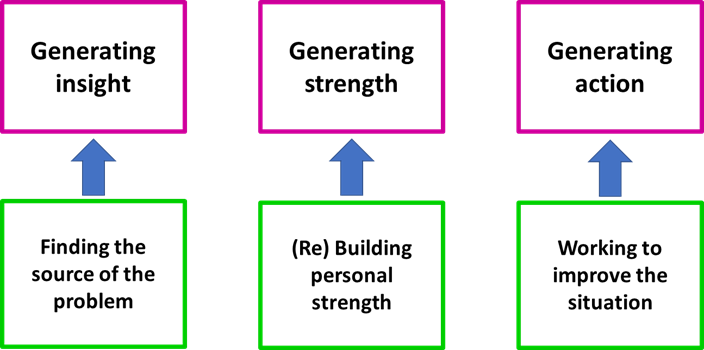
Theory development
Martin (2006, p. 126) defined theory, albeit in the objectivist tradition, as ‘an integrated series of concepts integrated by a core concept’. With this in mind, I developed a core concept of coaching as a Generative Scaffold. This is because coaching not only helps a manager to generate insight, strength and action to improve their situation but because the coaching relationship acts as a temporary scaffold which grounds the manager and supports them while they do this work.
Figure 4 considers the relationships between the abstract conceptual categories of Generating Insight, Generating Strength and Generating Action. My findings suggested that not every coachee went through each stage of the process to the same level of depth or at the same pace, and that the process did not necessarily occur in a linear fashion. I also found that stress was often a layered problem in that managers might go through the basic insight, strength, action process several times, addressing deeper layers each time. In addition, I noticed that there could be interactions between different stages of the process, for example, sometimes generating strength could lead to generating further insight. As individuals felt better about themselves, and more supported, they were more open to reflecting on their situation. Similarly, generating action could lead to generating further strength as confidence built over time.
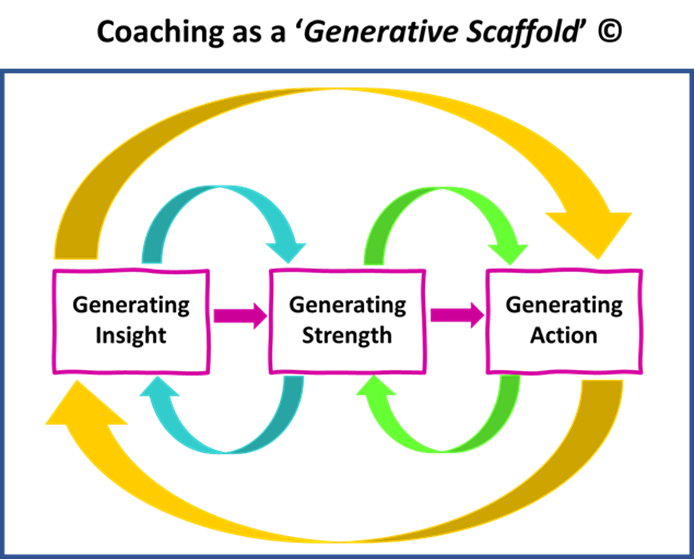
Relationships between the categories
Charmaz (2014, p.233) explained that with positivist or interpretive theory ‘we need to think of its theoretical reach and power within, beyond, and across disciplines’. I believe that my emerging theory of coaching as a Generative Scaffold to support managers experiencing stress at work has the potential to reach into other contexts such as developmental coaching or health coaching and also beyond one-to-one coaching into other formats such as team, group, or organisational level coaching.
Discussion
This emerging theory of coaching as a Generative Scaffold offers wide-ranging scope for discussion. While analysing and situating this tentative theory in the context of existing literature I became aware that it sits at an intersection where it has the potential to draw on a number of academic disciplines including psychotherapy (emotion-focused, psychodynamic and family therapy), organisational psychology, positive psychology, adult learning, change, burnout, work stress, and coaching, to name a few. Unfortunately, a detailed discussion of these is beyond the limits of this paper. However, the multi-disciplinary nature of this analysis prompted me to reflect on the benefits of a critical CGT approach to coaching research and the value this, in itself, can offer in terms of contribution to knowledge and implications for practice. For the purposes of this discussion, therefore, I offer two overarching thoughts.
The first of these is that considering the how in coaching research, using an inductive, empirical methodology such as CGT, creates an opportunity to broaden the scope of coaching knowledge by revealing data which is grounded in lived experience of the phenomena under investigation. Rather than reinforcing a ‘top-down’ research agenda which is arguably biased in favour of popular psychological theories such as CB and SF, and other fashionable ideas from related disciplines, a CGT approach allows the development of a more nuanced understanding of how coaching is actually working. This inspires consideration of fresh and, potentially more effective, disciplines from which the coaching field can draw. In turn, new hypotheses can be developed and tested accordingly. For example, my emerging theory identified that an important part of the coaching process in supporting a manager experiencing stress is about exploring an individual’s inner world and external context in order to locate the source of the problem. SF coaching is one of the more commonly researched and practiced approaches in the workplace (for example, Lai and Palmer, 2019) and one of the characteristics of this approach is that it does not focus on trying to understand the cause of the problem but, instead, emphasises the search for practical solutions (for example, Grant and Cavanagh, 2018). The suggestion here is that dwelling on the problem can induce negative thoughts and ruminations which are unhelpful for the coachee (Grant, 2012). However, more recent research in family therapy literature found that ‘solution-focused problem-talk’ can be helpful and a necessary precursor to solution-building (Choi, 2019). Lane and Corrie (2009, p.195) make a compelling case for the use of formulation, ‘an explanatory account of the issues affecting the client’, in coaching contexts in which the work may be complex and is developmental in nature.
Similarly, the importance of exploring emotions, which was a key aspect of ‘Finding the source of the problem’, does not feature broadly in the existing coaching literature, perhaps because it is dominated by an emphasis on cognitive-behavioural and positive psychology practices. This is out of step with organisational psychology and stress literature which describes an ‘affective revolution’ taking place in the twenty-first century which is transforming our understanding of the role of emotions in organisational contexts (Ashkanasy and Dorris, 2017; Dewe and Cooper, 2017). There seems to be increasing recognition that emotions can be a valuable source of information (Bachkirova, 2011) and that emotional awareness and regulation are vitally important in the workplace (Troth, Rafferty and Jordan, 2021). Greenberg (2008, p.55), a pioneer of emotion-focused therapy, explains that ‘bringing troublesome feelings into awareness is correlated positively with outcome’ and that helping people to overcome avoidance or suppression of their emotions can be important in bringing about change.
We can see from these examples that the CGT approach to theory development in this study has offered a more nuanced understanding of how coaching works in the context of workplace stress. This, in turn, suggests that common coaching approaches might be missing vital ingredients if they are going to be effective in this context, especially if they are used uncritically and in textbook form.
My second overarching thought is that using CGT, underpinned by critical inquiry, to develop coaching theory, offers an important, and overdue, opportunity to consider the impact of wider organisational systems and dynamics on individuals in the workplace. This, in turn, raises some complex ethical questions for coaching practice. For example, my findings acknowledged that when the source of the problem sits within the organisation, such as a failure to offer sufficient training or development, unrealistic expectations, or a culture that glamourises a fast, relentless pace, an individuals’ ability to address the problem of stress may be seriously limited, even with coaching support. So, what is the coach’s role in a situation such as this?
There might be an opportunity for coaching to encourage critical reflection by an individual on their situation and to support their agency in bringing about positive change within the organisation rather than adapting to the status quo (Diochon and Lovelace, 2015; Shoukry and Cox, 2018). An alternative outcome of coaching is that the individual might simply choose to leave their current organisation in favour of one whose culture aligns more closely with their own values. However, this presupposes a favourable job market and the luxury of choice. This notion of coaching actively encouraging consideration of one’s context might raise ethical issues, especially if the organisation is funding the coaching. Blackman, Moscardo and Gray (2016) identify the possibility of tensions between the benefits of coaching for the individual coachee and the wider organisation and suggest that the primary beneficiary of workplace coaching can be unclear. This highlights the importance of robust three-way contracting conversations in order to achieve a shared understanding of the objectives, priorities and potential outcomes of the coaching programme.
When an individual’s health is at risk, however, I suggest that coaches have a moral responsibility to prioritise support of their coachee’s basic needs over their obligations towards the organisation, especially if the individual is at risk of exploitative organisational practices or is operating within a ‘perverse culture’ (Einzig, 2017) or ‘morally uninhabitable’ work environment (Peter, Macfarlane and O’Brien-Pallas, 2004). Van Nieuwerburgh and Love (2019) agree that advanced coaching practitioners should consistently prioritise the wellbeing of their individual clients, partly because ethical codes of conduct contain a duty of care towards coachees, and also because health and wellbeing is a fundamental requirement for sustained performance over time. Although it might seem directive or ‘overly parental’ (Van Nieuwerburgh and Love, 2019, p.98) for coaches to actively encourage health and wellbeing, especially if this has not been raised as a concern by the coachee, I would argue that my emerging theory emphasises it. It is important for coaches to advocate for and empower their clients towards good health, while respecting their autonomy. I believe this could extend to ensuring they are aware that their employer has a legal duty of care to ensure the physical and mental health, safety and welfare of their employees under the Health and Safety at Work Act 1974. In this way, coaches have an opportunity to work sensitively in pursuit of positive social change. It is only by using CGT to examine organisational coaching through this critical lens that challenges of this nature can be revealed.
Conclusion
In this paper, I have presented an emerging theory of coaching as a Generative Scaffold which can support managers experiencing stress at work. This conceptualises a process in which the coach supports the manager to generate insights, strength and action, in order to improve their situation. My study was limited in that my emerging theory was developed from twelve interviews and my participants lacked diversity both culturally and in terms of gender, therefore, it very much represents a starting point in terms of theory development. All of my participants were coaching advocates so this will have influenced my findings and I feel the study would have benefitted from additional theoretical sampling to explore further the Generating Action element of the process. Nevertheless, it represents a contribution to coaching knowledge and, even though it requires further development, I hope it may inspire further research into how coaching can support managers experiencing stress.
I have reflected on the value of a critical CGT approach to the much-needed development of coaching theory and I have explained how this has the potential to inform coaching practice. I believe coaches have moral responsibility towards their individual clients to ensure that, in the course of their coaching practice, they are not reinforcing a neoliberal agenda where an individual is held personally responsible for their own wellbeing and performance when the organisational culture and expectations make these impossible to balance. Coaches can do this by encouraging individuals to prioritise their health and by being aware of, and encouraging their clients to consider, the impact of wider organisational systems and dynamics such that individuals can make decisions from a position of critical awareness. As we adjust to a different workplace landscape in the wake of the Covid-19 pandemic, I feel that coaching researchers and practitioners have the opportunity to play an important role, if they so choose, in supporting positive social change by advocating for a sustainable balance between health and performance in the workplace.