







Abstract
As organisations struggle to increase and maintain their gender diversity levels, this qualitative study, conducted in Germany, explores coaching approaches supporting gender diversity through 30 semi-structured interviews with coaches and organisational stakeholders. The findings suggest that current approaches may perpetuate the status-quo. The concept of coaching with gender-sensitivity is proposed as an expansive approach, accommodating individuals' diverse and intersecting identity categories within their socio-cultural contexts, involving relevant organisational stakeholders to address structural challenges. This article focusses on findings regarding contracting as an integral part of coaching with gender-sensitivity, where roles, responsibilities, values and goals can be delineated, articulated and aligned.
Introduction
Context
This article is based on a qualitative study conducted in Germany, exploring coaches’ and organisational stakeholders’ approaches to support gender diversity (Vitzthum, 2023). The findings of the study identify challenges and propose recommendations to increase the understanding of the coaching process through developing the concept of coaching with gender-sensitivity. This article focusses on a pivotal finding of the study, which has received little consideration in both research and literature but has been recognised as of paramount significance in ensuring a successful collaboration among all stakeholders involved: contracting in the context of coaching with gender-sensitivity. It is structured as follows. An introduction to the literature covering relevant background information is followed by a section on the methodological approach, giving details of the way in which the research is conducted, before findings on contracting are presented and discussed as a significant result of the investigation and a conclusion, highlighting practical implications is presented.
Literature Review
Organisations around the world have long recognized the challenges of achieving gender diversity in the workplace (Franczak & Margolis, 2022; Elisabeth K. Kelan, 2020). Despite legal requirements, entrepreneurial advantages, social justice arguments, and well-intended diversity programmes progress is slow and limited (Johnson, 2022; Davies, Yarrow, & Syed, 2020; Ely & Thomas, 2020;). The Covid-19 pandemic further exacerbated existing challenges as women were disproportionately affected by an increase in family and domestic responsibilities, often resulting in reduced working hours or complete exits from the workforce. (Franczak & Margolis, 2022; Johnson, 2022). For decades, there has been a plethora of different theories and empirical evidence about the role of gender in organisational life and the causes of gender inequality, all with their perspectives and remedies to achieving gender equality (Paluch, Nishii, Khattab, & Shemla, 2017; Ely & Meyerson, 2000;). However, organisational gender inequalities such as gender stereotypes, biases or evolved and often covert discriminatory behaviours persist (Williamson, 2020; Dashper, 2019; Ibarra, Ely, & Kolb, 2013;) as evidenced by the continued metaphors of glass ceilings, glass labyrinths, glass cliffs, sticky floors and Teflon-effects (Bourabain, 2021; Brieger, Francoeur, Welzel, & Ben-Amar, 2019; Gray, De Haan, & Bonneywell, 2019). Organisations can be perceived as gender neutral and meritocratic, while it is ignored that masculine values often shape underlying expectations within supposedly meritocratic organisations (Dashper, 2019; Humbert, Kelan, & Van den Brink, 2019).
With companies actively seeking to promote gender diversity, coaching has emerged as a popular initiative (Elisabeth K. Kelan, 2022; Trainor, Black, Soto-Torres, & Reichard, 2020; Abdul-Hussain, 2019; Baron & Azizollah, 2018; Stout-Rostron, 2017; Ludeman, 2013). It can be used as an explicit means, for example, when developing women through different career stages (e.g., from mid-career to senior management) (Yip et al., 2020) or offering parental transition coaching to re-engage and retain new parents (Filsinger, 2012; K. Smith, 2020; Vitzthum, 2017). More frequently, however, gender diversity challenges are implicit, and underlying problems addressed in coaching are related to gender issues, such as management decisions based on stereotypical gender assumptions (Filsinger, 2021; Baron & Azizollah, 2018; Bereswill, 2018;).
Frequently, coaching to support gender diversity is solely understood as a format to support women in their organisational advancement (Bollhöfer, 2017; Gondorf, 2020). This approach, however, places the onus on the individual women within the organisation and thereby potentially misses the opportunity to address structural challenges on a broader scale (Fatien Diochon & Lovelace, 2015; Tabarovsky, 2015). This can bear the risk of individualising structural problems and discourage coachees from challenging the status quo or pushing for socially just agendas (Bonneywell, 2016; Fatien Diochon & Nizet, 2019; Shoukry, 2016; Western, 2012).
Furthermore, several agendas are inherent in the triangular relationship that connects coach, coachee and organisational stakeholders (Pandolfi, 2020). They can extend to and impact the coaching relationship and its effectiveness as they may involve ethical dilemmas concerning conflicts of interests and issues of confidentiality – dynamics that tend to be neglected in the literature (Fatien Diochon & Lovelace, 2015; Pandolfi, 2020). The limited critical coaching research evaluates different types of coaching interventions and outcomes, which can be considered on a spectrum ranging from an empowering space with a promise to reconcile personal and professional settings to a hypermodern form of control (Fatien Diochon & Lovelace, 2015; Shoukry & Cox, 2018; Sugarman, 2015; Tabarovsky, 2015). At this end of the spectrum, coaching can be used as a control mechanism that maintains and reinforces adherence to organisational norms (Fatien Diochon & Lovelace, 2015). Thus, coaching can be used as a space for organisations to avoid being challenged in relation to structural problems, inherent belief systems or neoliberal ideologies (Louis & Fatien Diochon, 2018; Shoukry & Cox, 2018; Tabarovsky, 2015).
In this context, there is a risk that the focus remains on coaching women to advance gender diversity as they are perceived as the problem in need of ‘fixing’. Coaching could then function as a hypermodern form of control (Shoukry and Cox, 2018) to equip women with the supposedly necessary skills to become competitive and conform to the norms and values of the organisational culture. In the absence of innovative and more nuanced strategies, organisations are likely to continue implementing well-intentioned but ultimately limited initiatives while failing to launch more controversial and remedial measures (Schoen & Rost, 2021).
A recent development in the coaching field that may answer the call for more controversial and nuanced initiatives is coaching for social change (Shoukry, 2017). It critiques coaching’s inherent potential to be used as a neoliberal form of organisational control and proposes a political approach to coaching in which coaches make their values explicit and bring their political agenda to bear (Fatien Diochon & Lovelace, 2015; Gannon, 2021; Louis & Fatien Diochon, 2018; Shoukry, 2017; Tabarovsky, 2015). While uncomfortable, widening the coaching scope and using coaching as a postmodern approach might be the impulse needed to move from an individual intervention to a movement that considers, incorporates, and assumes responsibility for the social context, thus contributing to more gender equality and sustainable social change. However, particularly when coaching occurs in an organisational context, these critical approaches may not be appreciated. Change efforts may oppose contracted coaching goals or be challenging to integrate into the organisational culture (Kemp, 2021; Western, 2012).
Despite the widespread use of coaching to support gender diversity, there is little research in this area, and if any, it focusses predominantly on an analysis of outcomes for coachees (Athanasopoulou & Dopson, 2018). The voices of coaches and particularly those of organisational stakeholders, their understanding and concepts of coaching to increase gender diversity, and the approaches they adopt have been neglected (Athanasopoulou & Dopson, 2018; Schoen & Rost, 2021). The underlying study (Vitzthum, 2023) explores precisely these dual perspectives to gain an understanding of the context, practices and implications of coaching to support gender diversity and the underlying generative mechanisms that lead to these approaches, whether neoliberal tendencies (Tabarovsky, 2015) are (unconsciously) supported, or whether coaching can be used to address underlying power dynamics and hidden agendas and drive sustainable change (Louis & Fatien Diochon, 2018). Contracting plays a particularly relevant role in this context, as it provides a space for all stakeholders involved to address and align these agendas.
Methodology
In the following section, the research paradigm followed by the research design are presented to provide an understanding of how the underlying study (Vitzthum, 2023) was conducted.
Research Paradigm
The underlying study’s research aim of exploring the approaches of coaches and organisational stakeholders in support of gender diversity (Vitzthum, 2023) necessitated a philosophical approach that allowed for a description and explanation of participants’ experiences while connecting their knowledge with a more general contextual and organisational knowledge. Therefore, a philosophical position was required that appreciates context-specific conditions and respondents’ perspectives while recognising general trends and patterns (DeForge & Shaw, 2012). Critical realism provides a such a connection and offers a mediating position on the philosophical continuum between objectivism and subjectivism, as it acknowledges and embraces elements of both perspectives. (Fleetwood, 2005; Fletcher, 2017).
Critical realist scholars endeavour to explain and change the world by seeking probable causal explanations for events and proposing pragmatic suggestions for remedying and transforming social issues. (Alvesson & Billing, 2009; Fletcher, 2017). They advocate a threefold, layered ontology, consisting of a real, an actual, and an empirical level (Bhaskar, 2008; Sayer, 1992), as depicted in Figure 1. At the real level, underlying generative mechanisms, for example, socio-cultural influences, exist. They act as causal forces to generate events and actions at an actual level. The actual level is free from human interpretation; events and actions occur, whether anyone experiences them or not, for example, in relation to gender role assumptions. The empirical level is where events and actions are experienced and observed through peoples’ filter of perception and interpretation, for example, feeling discriminated against because of other people’s behaviour (Bhaskar, 2008; Danermark, Ekström, & Karlsson, 2019; Fletcher, 2017; Sayer, 1999).
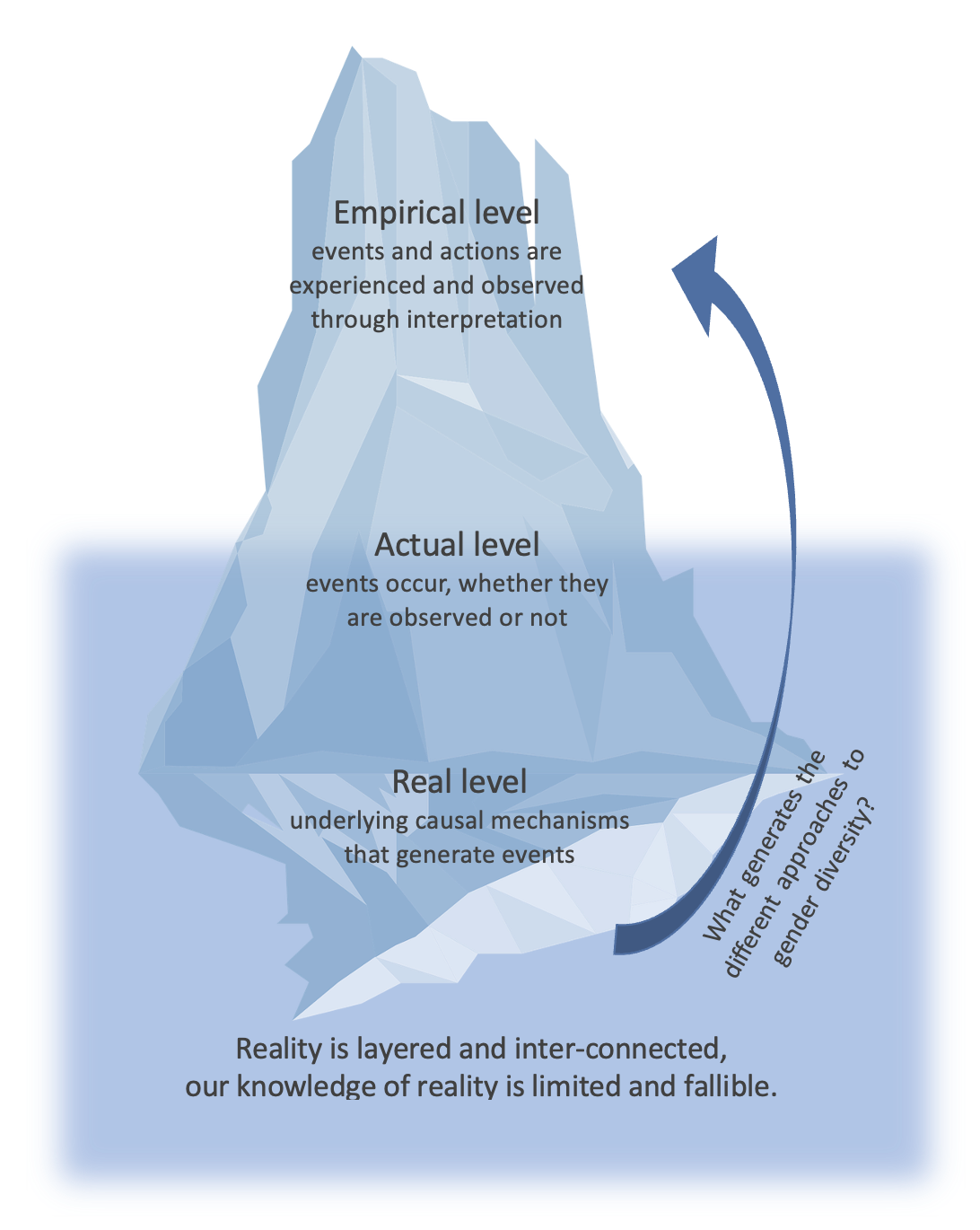
Stratified critical realist ontology (Adopted from Fletcher, 2017)
As a researcher, I accept that access to any form of data is always mediated by individual, social or inter-subjective resources (beliefs, accepted theory, social norms etc.) (Fletcher, 2017; Fleetwood, 2005;). Hence, the study assumed a socially produced knowledge of reality, an interpretivist epistemology, bearing in mind that this knowledge is fallible and open to adjustment (Danermark et al., 2019). Consequently, knowledge produced as part of this study was subject to my interpretation of the research participants’ accounts. It is entirely possible and legitimate that other researchers would come to different conclusions (Welsh, 2002).
Research Design
While grounded theory and case study approaches were considered when designing the study, a generic qualitative approach (Kahlke, 2014; Caelli, Ray, & Mill, 2003;) with semi-structured interviews was adopted to meet the research aim and not compromise by claiming complete allegiance to an established methodology, adapting strategies and methods to fit the approach. Based on anticipated adequate representation (Patton, 2015), similar research projects (Fletcher, 2017; Pereira, 2016), and recommendations in the literature (Baker & Edwards, 2012), 30 interviews with 15 coaches and 15 organisational stakeholders were conducted. Since ideas and insights were repetitive after completing the final interviews and no new or unexpected topics were identified that would have warranted an increase in the number of participants data collection was considered complete at this stage.
In order to allow for a sample of information-rich cases, a purposive sampling strategy (Patton, 2015) was employed. For the purposes of this research, it was considered important that participants had experience of the German socio-cultural context (Gekeler, 2019) and an understanding of the complex nature of coaching to support gender diversity in organisations (Alvesson & Billing, 2009). The participants were recruited via professional bodies’ newsletters and websites as well as my LinkedIn profile. They were all volunteers, who either self-selected or were referred by previous participants.
There was an unbalanced gender distribution of 27 female (90/) and three male (10/) respondents. This gender split neither represents the gender ratio in German organisations at any hierarchical level, nor the gender ratio of coaches in Germany (60/ women, 40/ men, according to a market analysis carried out by Rauen in 2020). However, it indicates that gender diversity is not a topic that generates equal interest and resonance among all gender, as it is frequently considered a women’s issue (Bollhöfer, 2017; Hoobler, Lemmon, & Wayne, 2014).
Prior to interviewing participants, 60-minute pilot interviews were conducted via zoom with a coach and an organisational stakeholder (not part of the final participant group) to ensure the questions could contribute to the expected knowledge production and to assess the flow and duration of the interviews (C. Smith & Elger, 2014). All interviews were conducted virtually via a Zoom-account provided by the university. They were audio-recorded and lasted approximately 60 minutes. The interviews were conducted in German and transcribed by myself.
Reflexive thematic analysis, a data analysis technique that is not bound to a specific theoretical orientation but aligns with the values of the qualitative paradigm (Braun & Clarke, 2019; Clarke & Braun, 2017), was employed to identify, analyse, and interpret the interview data. Reflexive thematic analysis employs codes as the smallest unit of analysis, from which broader patterns of shared meaning, known as themes, are derived (Braun & Clarke, 2019; Clarke & Braun, 2017). Initially, the data was manually coded, with subsequent utilisation of a computer-assisted qualitative data analysis software. Final analysis was conducted in Excel, leading to the creation of a thematic map that identified two overarching themes. Ethical concerns were taken into account throughout the study, with measures in place to ensure informed consent, data confidentiality, participant awareness of potential risks and benefits, and consideration of my role as a researcher. To enhance the study's robustness, evaluation criteria such as credibility, dependability, confirmability, and transferability were considered (Bloomberg & Volpe, 2018).
Findings
The key findings of the underlying study (Vitzthum, 2023) pertain to topics regarding the current status of gender diversity in Germany, specifically in German organisations, and the intricate and multi-faceted nature of the topic. Furthermore, significant results include aspects concerning the application and organisational implementation of coaching to support gender diversity, the professional and personal development of coaches dedicated to gender diversity, the concrete coaching practice, and the challenges and opportunities associated with coaching to support gender diversity. In the context of this article, contracting is addressed as a key finding and an essential component of this approach. The following section illustrates the findings regarding the purpose, roles, and responsibilities as well as aspects of confidentiality and goal alignment in contracting, as these were perceived as particularly relevant by the participants.
Contracting in Coaching with Gender-Sensitivity
Purpose
Coaches and organisational stakeholders considered contracting as an integral part of coaching with gender-sensitivity. It was perceived as the cornerstone for the collaboration between the organisation, the coachee, and the coach, clarifying a wide variety of aspects, including responsibilities, logistics, fees, time frames, scope, measures, methods, expectations, confidentiality, and the involvement of pertinent stakeholders. Having a clear and detailed contract was seen as a solid foundation for the coaching engagement, ensuring that expectations were appropriately aligned, and that there was a shared understanding of the coaching process. The use of a well-designed contract also promoted transparency, enabling all parties to be fully informed of their roles and responsibilities throughout the coaching engagement as detailed in the following section.
Roles & responsibilities
Participants perceived the contracting process as an opportunity and responsibility for coaches – rather than sponsors – morally to check and evaluate the coaching assignment, negotiate terms, and potentially decline it. Most coaches “weighed financial against value-based reasons” (Chloe) and had declined work in the past, for instance because the organisation insisted on contracting for a list of pre-defined, fixed outcomes or because coaching was being used as a “marketing ploy” (Caroline) to increase employee loyalty and employer branding. Chloe, remembered: “It happened to me once that the manager tried to let his issues filter in through me, that I became a pawn in the game.” Further extending this discussion, several participants reported a delegation of responsibility in the coaching process, where complex tasks or unpleasant contents were delegated from the sponsor to the coach without the sponsor being willing to take on further responsibility. Cynthia recounted: “I am the car repair shop. The unnamed car owner leaves his car with me and says: ‘Fix it!’”.
All participants considered aspects of manipulation or ‘fixing’ of employees to be severely problematic and morally and ethically unacceptable. Because of this discussion, both sets of participants agreed that a severe risk of coaching could be an instrumentalisation, where organisations want the coachee to “get bent, I see a disadvantage in that” (Scarlett) or, as Catherine put it in relation to gender diversity: “You make the women work on themselves in the hope that they will adapt to the system”.
For many coaches, standing their ground, their moral and ethical position during the contracting process was a matter of authenticity and integrity, requiring self-awareness, reflexivity and the confidence to say ‘no’. These attitudes were influenced by coaches' personal and professional experiences, and their personal preferences.
For some coaches, contracting was furthermore a space where the continued involvement of relevant stakeholders could be invited and aligned so as to share previously agreed feedback or support a learning transfer of coaching insights into the organisation. While some organisations welcomed such opportunities and agreed to assume additional engagements, Cynthia noted:
I’ve told some companies: I’ve coached dozens of people now, I see patterns. I’d like to offer to talk to you about those patterns. Not interested... Or, interested yes, but no time.
To avoid these dilemmas, some coaches had precisely defined procedures to ensure a link back to the client’s direct manager or other organisational members. For them, it was a mandatory part of the contract to include relevant stakeholders in the coaching process as they were perceived as ‘primary transfer source’ (Christoph), contributing to the transferability and sustainability of coaching outcomes in the organisation. In a similar vein, Camilla commented: ‘I insist on a three-way exchange, again and again to communicate success, gather feedback and share learnings.’
Participants agreed that an organisational lack of engagement in the coaching process might lead to a missed opportunity to ensure the effectiveness and compatibility of coaching outcomes and potentially identify structural weaknesses. Carla, therefore, urged organisations to question:
What is our role as actors in this change process? And I think there is a lot of potential here if the organisations’ view of coaching would change more towards their role and responsibility in this process.
In this context, a significant discrepancy emerged between the desire for coaches to engage the wider system and the willingness of organisations to commit to the process beyond the basic necessity of bringing coach and coachee together.
Confidentiality
A further essential aspect in this discussion concerned the approach towards confidentiality. While all participants considered confidentiality between coach and coachee as sacrosanct to ensure a trustworthy relationship, some coaches explicitly contracted for it, while others regarded it as self-evident. However, many participants were aware of confidentiality breaches. These were condemned as unjustifiable and unethical. Scarlett, a very experienced senior executive, who received and commissioned numerous coaching engagements, shared her experiences as follows:
I do experience [breaches of confidentiality] when I talk to HR and they know something they can't know. Then I ask myself, [...] have you become clairvoyant now? And at the point where a coach tells me from another coaching, [...] and uses names, it's easy for me to rhyme certain things together. And that's it, we start RHYMING. It leaves me with the worst possible feeling, because I ask myself, when is the coach talking about me? When am I the example? And when can the others start rhyming about me?
This example illustrates the risks and harms a breach of confidentiality may entail for the individual coachee, and potentially for the reputation of coaches in general.
Goal alignment
The interview questions on the responsibilities of coaches towards coachees and sponsors in terms of goal alignment during the contracting process led to the greatest discrepancies in responses for this study. For example, Catherine was very clear that her responsibilities were towards coachees only and that they set the agenda and the goals, regardless of organisational intentions. She explained:
I am not interested in what the client wants to do with his employee. I listen, but pfffh…. Coaching is a tête-à-tête conversation, which is strictly confidential and none of the manager’s business. [...] Whether or not that’s the progress the manager or the company wants, is of no interest to me.
Some participants justified their attitude with an a priori positive expectation and an inherent added value of coaching for the organisation, which would otherwise not be inclined to pay for it.
Other respondents, however, explicitly raised the notion of dual responsibility regarding goal alignment. They believed coaching in the workplace involved two contractual obligations – one with the coachee; the other with the sponsor. It was considered the coach’s responsibility to align those agreements during the contracting phase so that coaching goals and outcomes would be coherent for both the organisation and the client. However, a different view was held by an organisational stakeholder who suggested that a coach’s responsibility was towards the sponsor and entailed a clear mandate to achieve certain goals as it was a paid for and contracted service.
These findings provide valuable insights into the tensions and responsibilities that are inherent in the process of contracting in coaching to support gender diversity. Managing these has been shown to be the responsibility of the coach. However, balancing the needs and expectations of all parties involved requires careful consideration and communication of expectations, which can be complex and challenging, particularly when dealing with sensitive and tension-laden issues such as gender diversity. The findings underscore the critical role that contracting plays in coaching to support gender diversity and the need for careful attention to the moral and ethical dimensions of this process, as there is a risk of power imbalances between the organisation, the coachee, and the coach that requires attention during the contracting phase.
Discussion
This article is based on a study in which the concept of coaching with gender-sensitivity was developed from the results of the discussion (Vitzthum, 2023). This concept is outlined in the following section, before contracting as an essential part of this approach is discussed.
Coaching with gender-sensitivity
The findings of the underlying study (Vitzthum, 2023) illustrated a clear discrepancy between theoretical gender diversity debates and practical implementations of coaching to support gender diversity. While theoretical gender diversity debates commonly address gender as a complex social construct with intersectional aspects that take into account the heterogeneity of individuals (Acker, 2006; Cameron, 2020; Cho, Crenshaw, & Mccall, 2013), in practice ‘gender’ is frequently perceived as a ‘women's issue’ and coaching for gender diversity understood solely as a format to support women’s organisational advancement (Bollhöfer, 2017). This discrepancy led to the development of coaching with gender-sensitivity (Vitzthum, 2023), a concept, which acknowledges the importance of supporting women's leadership development while broadening the focus to include all genders. Coaching with gender-sensitivity can be considered a more political approach that recognises the complexity, intersectionality and implications of gender (Acker, 2006), requiring coaches' gender competence and awareness of social contexts to examine, bring to the fore and address underlying structural challenges. Understanding coaching to support gender diversity as coaching with gender-sensitivity has the potential to create shared understandings of gender diversity and reduce polarising gendered behaviours (Gondorf, 2020; Romani, Holck, & Risberg, 2019).
The concept of contracting
“It’s the demand the coach has on herself or himself.” (Celine)
The findings of the study indicate that contracting is a critical aspect of coaching with gender-sensitivity and that stakeholders' positioning during the process is crucial. Contracting was perceived as an infrastructure clarifying logistics, responsibilities, and expectations within the coaching triad. This aligns with coaching practitioner literature (Louis & Fatien Diochon, 2019; Fielder & Starr, 2008) that distinguishes between administrative elements of coaching contracts that consider the general terms (e.g., duration, length, cost), professional elements regarding the coaching practice (e.g., objectives, methodology, confidentiality, observable results and clarification of stakeholder roles), and psychological elements that turn to more implicit aspects (e.g., personal needs and stakeholder beliefs regarding the conditions and relationships). The study further found that contracting provided coaches with an opportunity to evaluate, negotiate, commit to or walk away from the coaching engagement.
However, considering the importance of contracting as a prerequisite for effective coaching engagements (Gettman, Edinger, & Wouters, 2019), the limited research in this area is surprising (Pandolfi, 2020; Gettman et al., 2019; Athanasopoulou & Dopson, 2018). A possible explanation might be a commonly held assumption that ‘qualitative research in coaching arguably starts with the coaching session itself’ (De Haan, 2019, p. 228), thereby neglecting important antecedents.
Nevertheless, the results of this study suggest that contracting is a crucial part of the engagement and seen primarily as coaches’ responsibility, based on their experiences and personal preferences. Furthermore, consistent with the literature (Gettman et al., 2019; Louis & Fatien Diochon, 2019), this study found that a transparent and structured contracting process increases trust in the process and creates an atmosphere of reliance and security from the outset. Participants identified professional elements of the coaching contract as requiring further clarification, particularly in relation to confidentiality, goals and stakeholder roles and responsibilities, as explained in the following sections.
Confidentiality as part of the contractual agreement
"Specific contents are very confidential and will not be disclosed to the sponsor.“ (Charlotte)
Consistent with the literature (Bozer & Jones, 2018; Pandolfi, 2020; Rekalde, Landeta, & Albizu, 2015), confidentiality within the coach-coachee relationship was identified as the highest premise of collaboration. It was considered non-negotiable and critical for establishing trust to accelerate positive coaching outcomes. Findings suggest that while for some coaches, confidentiality is an explicit part of the contract, consciously addressed with all parties involved, others consider it an implicit, self-evident part of the agreement. It has been shown that this, however, can result in an expectation among the commissioning managers that they will receive confidential information concerning the coachee.
Given the significance of confidentiality as a prerequisite for an effective coaching engagement (Pandolfi, 2020), it is remarkable that it is not more prominent in the context of contract negotiations, particularly as several participants reported significant breaches of trust where confidential information was passed on to managers or Human Resources without agreement. Hence, although many dimensions of the coaching process may be considered self-evident, findings of this study illustrate that implicit understanding might not be shared equally, while explicitly addressing relevant aspects of collaborative determinants was beneficial. Consequently, it can be advantageous for coaches to address confidentiality as an explicit part of the contract negotiations in order to create transparency and avoid misunderstandings, thus facilitating a trusting, effective coach-coachee relationship and managing stakeholder expectations (Bozer & Jones, 2018).
Goals as part of the contractual agreement
“The manager [sponsor] demanded things from me that I could not stand behind. She insisted that I dance to her tune and represent values that are not mine.” (Chloe)
The results of this study vary greatly in terms of how the relevant parties addressed coaching goal alignment in contracting, thereby supporting findings from previous research in relation to power dynamics in the coaching triad of coach, coachee and sponsor (Fatien Diochon & Nizet, 2019; Louis & Fatien Diochon, 2018). Coaches identified organisational goals to ‘fix’ women, implying skills deficits to be remedied so women would function in supposedly meritocratic organisations, revealing neoliberal tendencies to individualise structural issues (Fatien Diochon & Lovelace, 2015; Tabarovsky, 2015).
Further substantiating previous research (Fatien Diochon & Lovelace, 2015), findings suggest that coaching may be used as a form of validation where coaches are presented with lists of goals designed to align coachees with organisational cultures and values. Coaching may also serve as an externalisation of the leadership role, a kind of delegation of responsibility, with the goal to outsource uncomfortable conversations to the coach. While not unprecedented, these findings highlight the risks and potential of manipulation in coaching and the need for stakeholders, whether coach, coachee or organisational stakeholder, to engage with the implications of coaching, to critically reflect on and challenge coaching goals (Fatien Diochon & Lovelace, 2015), and to use the contractual space to render the hidden dynamics and expectations transparent and negotiate alignment (Gettman et al., 2019).
Coaches’ reactions to these dynamics varied greatly. While all coaches reported resistance to becoming an 'instrument' (Louis & Fatien Diochon, 2018), pursuing only the organisation's agenda, in some cases, coaches contracted with the organisation but then followed and fulfilled only the client’s agenda, becoming what Louis and Fatien Diochon (2018) refer to as ‘isolators’. Other coaches recognised the multiple responsibilities and negotiated boundaries and goals as part of their contract. They aspired to become ‘moderators’, achieving positive outcomes for both the coachee and the organisation, or ‘revealers’ of hidden agendas and power dynamics (Louis & Fatien Diochon, 2018). In this context, the coaching contract was seen as a means of creating working alliances to ensure that all relevant parties are involved in the success of the coaching experience, presupposing that the contract was clearly defined, agreed with all parties and the formulation of goals was not too narrow (Louis & Fatien Diochon, 2018). This chimes with Kemp’s (2021) recent work, which calls for ‘more meaningful discussions with contractors of coaching’ (p. 169) in order to avoid disappointment and fulfil the (contractually agreed) expectations of sponsors.
Taken together, these findings may encourage coaches to explicitly address their approach to goals in the context of the coaching contract in order to clarify different expectations and acknowledge the different demands and responsibilities of all relevant stakeholders within the coaching triad to ensure morally and ethically sound behaviour (Louis & Fatien Diochon, 2018). Furthermore, organisational buyers of coaching may benefit from reflecting on the underlying intent of commissioning a coach and evaluating whether coaching is the most appropriate intervention for the declared goal (Gondorf, 2020). However, organisational responsibilities extend beyond the considerations relating to coaching goals and intents, as explained in the following section.
Organisational responsibilities as part of the contractual agreement
“The organisation does not perceive itself as a stakeholder in one-to-one coaching.” (Carla)
The roles and responsibilities of the different stakeholders in coaching with gender-sensitivity were considered highly significant in terms of coaching outcomes and sustainability. While the importance of organisational support is repeatedly emphasised in the literature (Bozer & Jones, 2018; Rekalde et al., 2015), there is a dearth of empirical research addressing how it can be achieved. Consistent with previous work (Gettman et al., 2019; Pandolfi, 2020), the results support the notion that the coach is held accountable for managing relevant stakeholders’ interests and responsibilities. However, the findings suggest a variety of different approaches in this context. While some coaches contract for organisational involvement from the outset to align expectations and responsibilities and ensure ongoing support and exchange, others either do not consider it to be part of their mandate and/or try but fail due to lack of time or interest on the part of the organisation.
Nevertheless, a general supportive organisational culture was seen as a prerequisite for sustainable coaching interventions (Rekalde et al., 2015) beyond the isolated ‘laboratory’ situation. Providing spaces for sharing feedback beyond the dyadic coach-coachee relationship was considered a way to address hidden systemic gender inequalities identified during coaching that warrant further attention at different organisational levels. A prerequisite here is the readiness of all relevant stakeholders to engage in this potentially uncomfortable process and accept the social responsibility associated with it (Shoukry & Cox, 2018).
The findings offer encouragement to organisations to reflect on and recognise their organisational commitment and responsibility in the coaching process. As a result, the potential of coaching with gender-sensitivity could extend beyond the individual coachee, as structural challenges can be identified and thus addressed. This understanding further expands the concept of coaching with gender-sensitivity by considering the opportunity of including other stakeholders in the process, thereby further broadening the scope.
Conclusion
While the foundational study addressed different aspects of the coaching process (Vitzthum, 2023), this article focusses on contracting as an integral part of coaching with gender-sensitivity. The findings in this context expand our knowledge concerning contracting as a key element in the coaching process where aspects such as goals, issues around confidentiality and stakeholder expectations, roles and responsibilities can be considered and aligned by all relevant stakeholders. It was shown that coaches can directly address concerns relating to coaching as a space for individualisation of structural challenges or as a form of organisational control and decline the mandate when differences cannot be reconciled (Fatien Diochon & Lovelace, 2015; Prior, 2019). Furthermore, the results illustrate that contracting may be understood as an opportunity to agree on further involvement of relevant stakeholders to contribute to transferring the coaching insights and serve as a space where underlying structural challenges identified in the coaching process can be addressed. Thus, contracting in coaching with gender-sensitivity can be considered a key part of the coaching engagement and a critical contributor to the effectiveness of the intervention (Gettman et al., 2019).
Building on the theoretical understanding, the results have practical implications regarding the significance of contracting as a means to establish the foundations for further collaboration, particularly as coaches are frequently expected to manage all stakeholders in the coaching process (Gettman et al., 2019; Pandolfi, 2020). Coaches may be encouraged to explicitly address and align expectations, roles and responsibilities, and contract for the involvement of other stakeholders. They may thus benefit from being clearly aware of their responsibilities and positioning in this process and the limits of what they are willing to accept in terms of organisational requirements and goals. Organisational stakeholders are encouraged to consider the extent to which they are willing to be involved in the process, reflect on their role as conduits in transferring the coaching learnings to everyday business and deliberate on the information coaches may require to conduct their work as systemically relevant and transferable as possible.
Overall, organisational stakeholders and coaches who are interested in creating more inclusive and effective coaching experiences to support gender diversity can see the findings of this study as an invitation to explicitly and consciously enter the contracting phase. By doing so, they can contribute to ensure that coaching with gender-sensitivity is tailored to meet the unique needs and perspectives of all individuals involved, and that all stakeholders have a clear understanding of what is expected of them throughout the process.