







Abstract
Interpretative Phenomenological Analysis was applied to explore coaches’ experience using a values-based coaching framework within an international non-profit organisation. The ‘Coaching for Alignment’ model facilitated values-based coaching through semi-structured interviews; the subjective experience and phenomenological thinking of values were explored. The participants' experience provided emergent themes of thought provocation, empowerment, and discomfort through the coaching dialogue. Preliminary insight into how coaching for values can support the coaches’ development in realising values congruence, interpreted through a positive psychology coaching lens, is offered. Values-based coaching in non-profits organisations can encourage self-reflection and empowerment in coaches supporting organisational coaching programmes.
Values-based Coaching in Organisations
Coaching for values is an ambiguous concept; academic research focus on this area, where an individual’s values-based thinking is explored within coaching practice is relatively rare. Coaching has become a mainstream activity in organisations within the past decade, with an acceptance of internal coaches improving individual effectiveness and organisational development through a traditional goal-oriented coaching methodology (Grant, Cavanagh, Parker, & Passmore, 2010; Jones, Woods, & Guillaume, 2016; O’Connor & Cavanagh, 2013; Watson, 2020). Values-based coaching in organisations has a bearing as numerous organisations build internal value attributes to guide their organisational objectives as drivers for goal attainment within the organisation’s social construct. Theoretically, organisations can support their staff through values-based coaching to achieve goal attainment, motivation and engagement (Arieli, Sagiv, & Roccas, 2020; Maio, Hanel, Martin, Lee, & Thomas, 2020; Sagiv, Roccas, & Oppenheim-Weller, 2015). However, there is relatively little exploration of the relationship between individual and organisational values; therefore, the significance of values-based coaching within organisations is worth considering (Bush & Bennett, 2018; Stelter, 2016).
This study intends to understand the relevance of a values-based coaching approach for individual alignment to one's values within an organisational context from a coach’s perspective. An examination of theoretical value paradigms and the various coaching frameworks of values-based coaching with applicability in an international context, where diverse cultural values assemble and in a non-profit organisational setting, will be reviewed. Positive psychology has previously been criticised for omitting the significance of values (Robbins & Friedman, 2019); therefore, this study contributes to further research into positive psychology coaching within an organisational setting
Literature Review
Defining positive psychology coaching
Informed by theories from coaching psychology and positive psychology, positive psychology coaching asserts enhancement of well-being, resilience and achievement, supporting goal attainment and change strategies for individuals with immediate or sustainable effect (Green & Palmer, 2019; Lomas, 2019; Passmore & Oades, 2014; Schwartz, 1992). Positive psychology coaching is defined as “a managed conversational process that supports people to achieve meaningful goals to enhance their well-being” (van Nieuwerburgh & Biswas-Diener, 2021, p.315). Coaching within organisations is a non-clinical setting, focusing on the one-to-one relationship between coach and coachee (Palmer & Whybrow, 2018). Among the strategies for change used within coaching, values play a crucial role. They can be used as a motivational feature and criterion for influencing decisions and behaviours in everyday situations within the individual's environment (Bush & Bennett, 2018; Schwartz, 1992).
Defining values
Basic human values can be defined as “trans-situational goals varying in importance, that serve as guiding principles in a person or group” (Schwartz et al., 2012). Values are a social construct seen as the basis of motivational goals that serve to manage decision-making and reach desired outcomes (Belic, Djordjevic, Nikitović, & Khaptsova, 2021; Schwartz et al., 2012; Schwartz & Sortheix, 2018). Schwartz (1992) has identified that: values underlie beliefs and ethics, values motivate action to achieve goals, values exceed precise actions or situations, and values function as standards linked to affect action. Schwartz (2012) developed a cross-cultural theory of values rooted in personality, social psychology, and philosophy that has been widely adopted as the basis of values research (Arieli et al., 2020; de Wet, Wetzelhütter, & Bacher, 2019; Roccas & Sagiv, 2010; Rojon & McDowall, 2010). Systemic organisational values and culture can also determine individuals' ability to work productively with optimal functioning, positively or negatively affecting subjective well-being (Schein, 1993; Schwartz & Sortheix, 2018).
Values in organisations
Through socialisation or selection, individuals can align to values instilled within organisations; they can either adopt the values or select the organisation congruent to their values and beliefs (Sagiv et al., 2015). Coaching within organisations can help deal with personal issues arising in the workplace (van Nieuwerburgh, 2015). Coaches are supported by institutional values espoused by the organisation and coaching professional bodies to guide their practice through ethical principles and values (Iordanou, Hawley, & Iordanou, 2016; Jamieson, Church, & Vogelsang, 2018; Jarden, Rashid, Roache, & Lomas, 2019).
In cross-cultural psychology, Krumov & Larsen (2014) state that global organisations seek to instil cultural values and meaning in the workplace to support their economic advancement and employees' performance. International organisations have complex cultural phenomena, given that values shift over time due to social, economic, and political changes and instabilities (ibid). Assumptions are based on theoretical universal value constructs, where multiple cultures converge in international organisations, and values can be generalised in situations or institutions. Therefore organisational values applicability are precarious (Fischer, 2020). Organisations’ values can be misconstrued by aligning individual values with system-wide ones (Arieli et al., 2020). Integrating systemic organisational values is considered a complicated endeavour, requiring value awareness and motivational goals in congruence to organisational development; leaders and their values need periodic review for relevance (Arieli et al., 2020; Bush & Bennett, 2018; Jamieson et al., 2018).
Challenges in international non-profit organisations
Bush and Bennett (2018) explored values-based coaching in organisational development practice. The coachee’s cognisance of values is vital for coaching practice where organisational change is the focus. Understanding values can support a leader or individual realise how they can positively impact the system (Jamieson et al., 2018). Research supports the importance of value congruence in organisations and the individual; Arieli et al. (2020) affirm that individuals with social and enterprising interests complement occupational roles in non-profits. Nevertheless, there is insufficient evidence on how values operate within non-governmental organisations or how coaching for values could be applied in multicultural organisations.
It could be argued that culture and values in non-profit organisations can be compromised when deep structures of power and influence become misaligned when individuals oppose shared organisational values leading to adverse outcomes (Cha & Edmondson, 2006; Vijfeijken, 2019). Adherence to social norms and broader systemic impact would be worth consideration (Stelter, 2016), within coaching, in contexts where positive behaviours and values are expected, as is the case in non-governmental organisations (Vijfeijken, 2019). Value congruence between organisational and individual values is therefore worth exploring.
Values in individuals
Value paradigms build a picture of how values motivate individuals to develop their goals and navigate their paths to align with their values. There is a need to consider values in the motivation for growth in adult learning and development (Cox, 2015). Values are seen as strengths; Peterson & Seligman (2004) devised a popularised method where character strengths and virtues are classified. Using the Values in Action Inventory of Strengths Survey (VIA-IS) (ibid), a person's character profile is self-identified and labelled as twenty-four-character strengths. Rather than focus on negative qualities, cultivating the strengths of positive character traits will increasingly affect well-being and personal growth when using strengths-based practice and interventions (ibid). However, classifying character strengths is more descriptive than prescriptive; individuals can resonate articulating their strengths through various methods, but there is no one conclusive approach or framework for application (Niemiec, 2013; Ruch, Niemiec, McGrath, Gander, & Proyer, 2020). Using strengths-based coaching with congruence to values has been generally validated and adopted for use in positive psychology interventions for well-being; in coaching, it is subjectively experienced (Fouracres & van Nieuwerburgh, 2020; Green & Palmer, 2019; Linley, Nielsen, Gillett, & Biswas-Diener, 2010; Ruch et al., 2020; Seligman, Steen, Park, & Peterson, 2005). In another method to evaluate values Passmore (2012) recommends psychometric assessments to understand individual values within the workplace culture for alignment. However, coaches need to be knowledgeable and trained effectively to administer such tests as the validity is variable (ibid).
Applying values is an integral part of acceptance and commitment coaching (ACC). It borrows from acceptance and commitment therapy (Hayes et al. 1999, as cited in Green & Palmer, 2019), where values are a vital component for developing the capability to live consciously (acceptance) in accordance with central values and beliefs (commitment). Within ACC bringing meaningful facilitation of change in individuals' lives is achieved by enabling them to live their values and principles daily. Coaches encourage their coachees to increase their psychological flexibility to face uncomfortable thoughts and feelings and attain a distanced perspective from their fears allowing decisions to be made based on their values (ibid). Early empirical research on ACC has shown promising results for performance and development coaching (Green & Palmer, 2019; Skews, 2018). ACC is akin to values-based coaching, encouraging values-based actions to help coachees create meaningful change.
Dolan (2020) interrogates values from a leadership perspective using the "3Es triaxle model of values", based on Rokeach's theory of values (1973). This framework is applied to organisations and individuals and allows flexibility to discover, classify, prioritise, and align values. Dolan appraises the model for its simplicity and applicability to individual, institutional and communities circumstances (Dolan & Richley, 2006; Zhang, Dolan, & Zhou, 2009). However, limited empirical information was available on the applicability of the triaxle coaching model.
Spiritual or transpersonal values are relevant in coaching, particularly for individuals whose religiosity is an integral part of their approach to life. Transpersonal psychology can be applied to the workplace; employers seek to improve relations by considering values for operational provisions, whereas transpersonal coaching can provide a juncture for aligning values (Drew & Law, 2017; Plaister-Ten, 2013).
The ‘Ershad’ coaching framework offers an appropriate application of coaching for value concordance in Islamic culture (van Nieuwerburgh & Allaho, 2018). This distinctive approach to coaching allows coaches to align their practice to Islamic ethics and traditions and, therefore, to individuals from the Muslim faith. Most coaching models are predominately individualistic and developed in western theory and practice (van Nieuwerburgh & Allaho, 2018; Palmer & Whybrow, 2018); Ershad coaching framework enables the learner (coachee) to cognitively consider positive intentions rather than goals, which are facilitated by the coach using 'the alignment wheel'. The concept of "Coaching for Alignment” (CFA) (van Nieuwerburgh & Allaho, 2020) is based on Ershad coaching framework and positive psychology theories. It can be applied in a transpersonal and organisational context.
Rationale
Individual values explain why divergent attitudes and behaviour determine internally held character traits that motivate individuals to achieve their goals. Cultural values significantly influence work values, but this varies at the individual level. Values-based coaching can support alignment to one's values when an individual is situated in an organisation with set value systems that may differ from their own. The coaching frameworks explored within the literature review demonstrate a strong case for values-based coaching to support individuals to align their values to develop positive outcomes in organisational settings.
Much of the literature within coaching psychology is concerned with professional and career services, financial services, and non-profits such as health services, governmental and educational settings (van Nieuwerburgh, 2015); there is a limited application of empirical data related to coaching within international non-governmental organisations and even less discussing alignment of values (Watson, 2020).
There is limited empirical research on values-based coaching within non-governmental charitable organisations. The coach’s perspective on values-based coaching would warrant exploration in this context; coaching for values alignment is a relatively new area of practice and could provide meaningful insights into a coach’s development.
Cross-cultural diversity is a foundation of global organisations; navigating complex systems requires interrogative approaches to support individual alignment to values. Modifying a framework or model to organisational values, language, and context would be vital for aligning to organisational goals (Grant & Hartley, 2013). A values-based coaching model such as the CFA framework would allow individuals to align with their principles and beliefs systems, intent, and goals; this is relatively unexplored in evidence-based coaching psychology literature and merits further investigation. Therefore, this work undertakes an introductory exploration of the coaching experience from the coaches’ perspective by asking: “How do coaches experience the values-based 'Coaching for Alignment' model in an organisational context?”
Methodology
Interpretative Phenomenological Analysis (IPA) is used to investigate the insights of coaches’ experience of using the CFA framework. Themes of experiential meaning are drawn to observe the participants’ understanding and practice of the model (Pietkiewicz & Smith, 2012). Few studies look at IPA in coaching for values, including strengths-based coaching and transpersonal values (Duncan, 2012; Fouracres & van Nieuwerburgh, 2020; Griffiths, 2010). However, the literature review conducted reveals very little IPA based research on coaching in an organisational context (Mayhead, 2020). There is no existing research on the CFA framework.
This paper will add a considered examination that will inform positive psychology coaching scholarship and coaching practice within an organisational context. Imperatively, this research follows ethical guidance and boundaries to produce a worthy contribution to the study of coaching experience and the potential contribution of the CFA model to the coaching experience.
IPA is used as a qualitative approach to understanding the coach's personal perceptions and subjective experience using the CFA model for inclusive coaching practice. It focuses on the coaches' experiences of using a values-based conversational framework. IPA accounts for the embodied experience and the connection between talking about the experience and the participants’ sense-making and simultaneously their emotional reaction to the experience (Smith, 2011). As an ideographic method having a small cohort allows the discovery and analysis of individual inflections (Brocki & Wearden, 2006).
Participants
Participants were recruited from an international non-profit organisation in the international development sector known for fighting against the injustices causing inequality and poverty. This organisation prides itself on being driven by feminist values. Participants were recruited from a pool of attendees of Workplace Coaches who had participated in a continuous professional development training held by the charity on the ‘Coaching for Alignment’ model. Each participant's professional coaching experience was a minimum of five coachees. Participants had used the model/conversational framework at least once to be eligible to participate in the study.
Demographic information was gathered, including gender, age group, ethnicity, years of coaching experience, and years of service with the organisation. All personal data has been anonymised (see Table 1).
Demographics of Participants
Before recruiting participants and data collecting data, and ethical approval was obtained from the University of East London. All participants were given a verbal explanation of the study and an information letter; they confirmed consent through a signed form. Participants were debriefed with a letter and a follow-up conversation after their interviews. The interview format was semi-structured to support the interview dialogue. Semi-structured interviews were conducted online; participants were working from home. The interviews were approximately 35-45 minutes and were recorded. Open questions were prepared to facilitate broader and specific enquiry of the lived experience of values-based coaching using the CFA framework to guide the interview.
Data analysis
Each interview was video recorded and transcribed; preliminary information about the participants' subjective experience was collated and transcribed verbatim to extract exploratory themes to gain fuller meaning and understanding of the phenomenon. The transcript was cross-checked numerous times to confirm the accuracy of transcriptions. Exploratory annotations were added under descriptive comments with descriptive conceptual coding and were categorised under themes. Conceptual, descriptive, and linguistic analyses were distinguished. Each participant transcript was transcribed independently with the identification of themes to avoid confirmation bias. Each was analysed after completing the transcription to connect emerging patterns and themes cyclically.
Exploratory insights were drawn from coaching psychology, positive psychology, and organisational psychology by observing significant statements, meaning units/themes, and textual and structural descriptions in the essence of the experience. Emerging themes were categorised and extrapolated to find clustering themes (Pietkiewicz & Smith, 2012). IPA method is seen to be an accessible technique in terms of language and process but has been criticised as having varying levels of interpretation from each researcher. Metaphors, sequential and social evaluation can vary from each IPA researcher depending on their partiality to different topics (Brocki & Wearden, 2006); a cognisant approach was taken when interpreting the data. However, IPA allows the researcher to view the subjective meaning of how the phenomena of the model resonated with the participants through their experience (Eatough & Smith, 2017) as an iterative hermeneutic approach.
The conversational framework of IPA is a natural way to find out how individuals make sense of their experience, rather than forming explanations of experience, which are selected in a discourse analysis method of research (Smith, 2011). IPA leads to readers creating their own interpretation, which is part of the process (Rajasinghe, 2019). Passmore & Fillery-Travis (2011) reviewed the extent of coaching research and found that IPA brings significant coaching practice insights. Research in coaching subjective experience is limited; Rajasinghe (2019) argues that researchers should look to position coaching as a social activity to help understand coaching's fundamentally subjective nature. Rajasinghe (2019) finds that much of coaching research is still directed by positivist approaches. There is a need to create deeper appreciative enquiry, which was taken into consideration, cyclically ensuring an interrogative interpretation.
Findings
Interpretation of the data revealed three emergent themes from the experience of using the CFA model: thought-provoking, feelings of empowerment, and feelings of discomfort. Ava (Participant A), Beth (Participant B), and Caroline (Participant C) all experienced self-reflection using values-based coaching.
Thought-Provoking
All participants articulated a “shift” in thinking, experienced by themselves as self-reflection but congruently as a perceived shift in their coachee.
“It's really interesting having those conversations with the coachee asking those questions what’s going on because I don't think they've ever really thought about it [...] like it opens up another doorway” [Caroline].
Opening another doorway signifies new thinking or seeing things differently and a change in perception. The transferal of thinking was experienced through the exploration of questions and the cognisance of being able to “dig deeper or wider” [Ava].
The alignment model led the coach to ask more profound questions around the coachee’s values; “…it led me to ask questions I don't think I would have otherwise” [Beth].
The coach was able to reflect and created curiosity and interest, which led them to ask more profound questions of their coachees:
“I feel this model gets to the root of some of the challenges and the issues, and the difference is that people are grappling with, so this is where I could see I've been reflecting a lot… rather than staying at that superficial level, you can go a bit deeper” [Caroline].
Within the organisation, dialogue of values is encouraged; however, the reflection of personal values for the coach was experienced during the coaching sessions when using the model.
“It really helps you to break down some of the things that you believe to be true in organisations, maybe believe to be true about yourself…” [Beth].
Participants experienced re-evaluation due to the novelty of their experience of delivering value-based coaching, which provoked embodied feelings of inciting change in their thinking as well as their coachees’:
“…they were thinking about the values, and they haven't thought about that experience in that way, and they really just lit up. You know when you see people go wow, that’s what I noticed with that individual” [Caroline].
Initiating new thinking through values-based conversation could be perceived as an “aha” moment:
“… [sic] that shift in the conversation, and I remember thinking at that were like, oh now something is changing in his thinking” [Ava].
Feeling empowerment
Supporting a change of thinking by discussing values brought the participants a sense of enthusiasm as “…interesting and it's quite exciting” [Beth]. The feeling of engagement through CFA extended to the perceived change within the coachee, which energised the participants to feel empowered:
“This shift […] in an individual. I also find it to be empowering, […], it just creates a sense of empowerment because, I guess it’s because they don't feel as trapped as I thought, because they have this challenge” [Caroline].
Self-efficacy is expressed when the participants feel they have unlocked something within the coachee. Their role as a coach enacts embodied feelings of agency and motivation as a coach. There are perceived changes in behaviour that support their sense of empowerment:
“I feel the energy, I see the energy in the individuals, the way they speak the way they start holding their body changes that, the way they talk about things actually changes” [Caroline].
“… it felt like at the same time you felt quite energising, to be able to use it and at the same time it felt some, it felt like it was something like, challenging… but I think it […] enriches the experience for both” [Ava].
Two participants felt coaching for values was a natural way to coach and were empowered by experiencing the model as an authentic way to coach. “it's almost like a justification or credibility for me to still do this [sic] that way” [Ava]. Both Ava and Caroline expressed that this way of being, conveys a “holistic” approach to their coaching experience. “…It feels more, it also feels more feminist” [Ava], whilst also aligning to key principles of the organisation, as well as personal expression.
All participants felt that rather than coaching for goals, the shift in the coaching discussion facilitated deliberation for substantiated outcomes based on intention:
“We're looking at it holistically. We’re looking at the relationships; we’re looking at values, beliefs, you know what’s behind people’s intentions. And I find that really useful” [Caroline].
“…it’s just being human. When you when you get to know each other a little bit, and you share something about yourself as a Coach or as a person that’s doing coaching, I think it gives both of us, it builds a connection. It gives both of us an element of warmth, and that’s how I feel it” [Ava].
Connection and developing the coaching relationship empowered the process and feelings of authenticity, a more progressive approach to coaching that resonated with the participants.
Feeling discomfort
Ava expressed the feeling of discomfort in using challenging questions and felt that the coaching was more personal and perceived internal resistance to addressing the needs of the coachee:
“I think this model is more challenging to use. They might not be interested in thinking about their values or intentions or bigger questions behind why they want to do certain things. They just want to get on with it…” [Ava].
There appears to be speculative hesitation in using the model to dive deeper into exploring values when confronted with reluctance from the coachee; that feeling of discomfort comes with anticipating a challenge. There is a level of inadvertent feelings of not knowing or a sense of confusion when there is perceived friction of values:
“I find that then there's a clash quite often between the coachee and the organisation, and the values, and I don't even know who's right or wrong anymore because those are really difficult situations and difficult to get right in there. I don't think there's right and wrong [sic]” [Ava].
Beth experienced anxiety in anticipating the reaction from her coachee and the congruence of her values being incompatible; Beth reflexively reveals her account of using the model:
“So the one thing that makes you think about which I think is helpful, but also but scary as a coach, is your own values and your, um where that might not like connect to that person and how do you stay... ‘cause values is so affecting and they’re so bias[ed]”.
When asked about experiences of coaching for values in an international context, with various cultural perspectives, participants felt it was useful to consider differences in the use of language, and English as a second language; participants accounted:
“…it can cause misunderstandings and confusion…even what do you mean by values can be so different or intentions or pathways or anything…” [Ava];
“…as a coach, … you're watching a lot of signals, … read body language or understand so you can kind of test it” [Beth];
“…I know sometimes when we have the conversation, they will ask me to qualify what I mean by a question or what I've said or words, because I think it means something slightly different, and it's great that they do…” [Caroline].
Although it was not confronting, this awareness of being potentially misunderstood roused the sense of awkwardness or unease in the coaching experience.
Summary
The emergent themes presented feelings and thoughts, challenge and excitement, discomfort and empowerment were all expressed simultaneously by the participants:
“I felt it was challenging at that moment because it was such a change in the conversation like the focus changed quite [sic] sharply, which was good. It was exciting, but it also felt challenging, and I was just wondering if he can follow me and follow those questions” [Ava].
Ava experienced curiosity in bringing the coachee along with her questioning. It evoked excitement within the interview. It was evident that the level of discomfort was liberating.
Beth had a comparable experience of positive anxious enthusiasm and used humour to moderate the account:
“…a very deep, thoughtful face saying like (laughs) …. ‘huummm’… which is often a good sign. It can just feel really unnerving ‘cause you're like. ‘ohh are you ok?’. It provokes thought of some kind, which is normally a really good sign in coaching, that there’s some deep learning work going on there” [Beth].
Discussion
The transcription process recorded the emotions in the conversations, which were sensed through the interpretation of the data; the researcher experienced their own curiosity transferal through iterative thought analysis. The accounts of perceptions of the coaching model were analysed and emerged into three themes: thought provocation, the feelings of empowerment and discomfort. The framework applies positive coaching psychology; the process starts with a reflection on the coachee’s current circumstances, moves on to explore their intentions and then supports them to develop pathways. The coachee reflects on the chosen path, aligning it with their beliefs, principles, and challenges to be compatible with the self, environment, and relationships. By evaluating personal intentions, the coach enquires through values-based questions and guides the individual through to the effort required to align their actions with their values and chosen pathway (see figure 1).
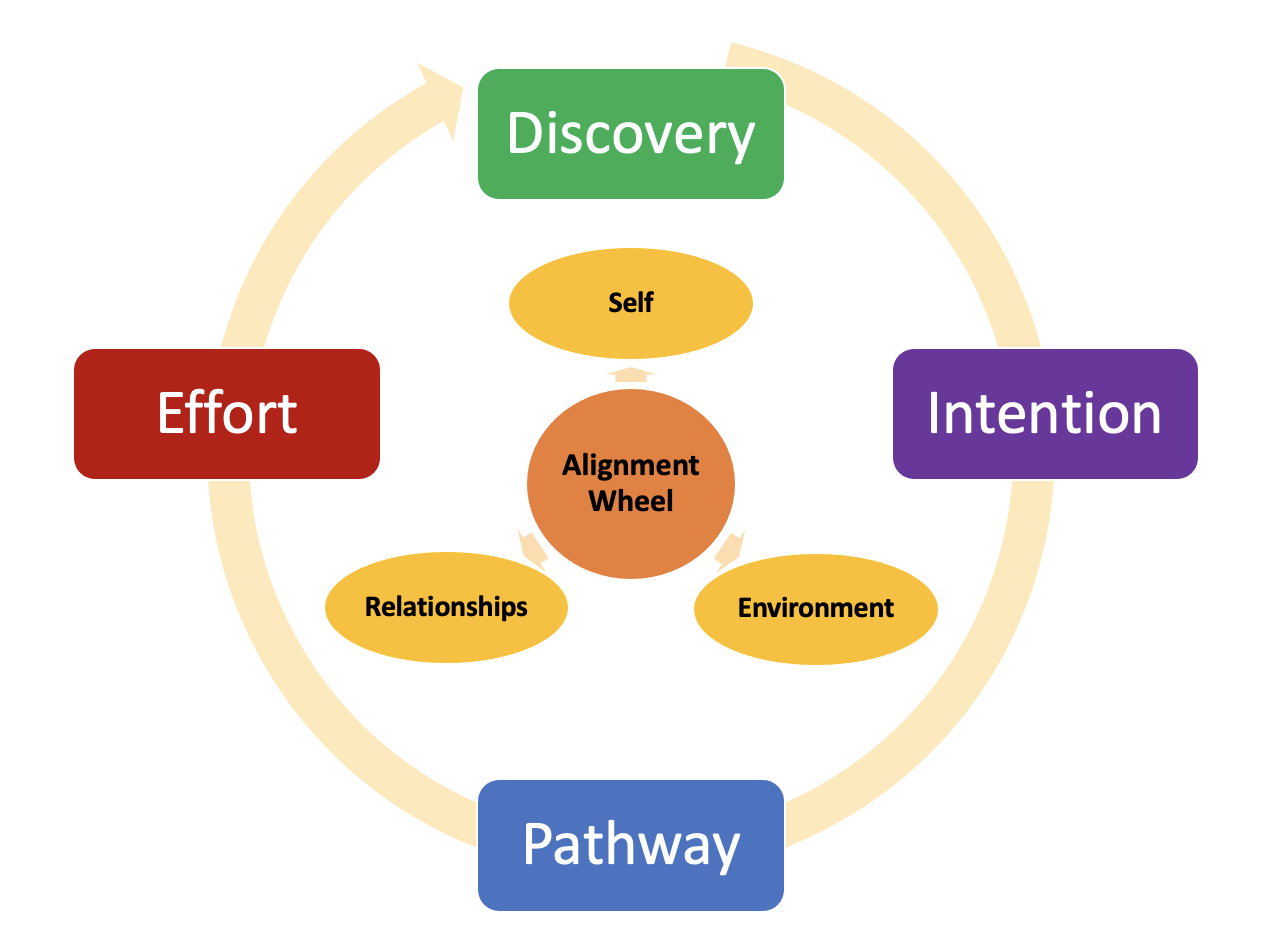
Coaching for Alignment framework (adapted from van Nieuwerburgh & Allaho, 2020)
Alignment through reflection. As the model sections were explored, countertransference of cognisance through thought provocation, excitement and self-reflection prevailed with all participants. A totalist approach to countertransference would view this as an inevitable outcome of sense-making where assumptions would be part of the interaction (Craighead & Nemerof, 2004), as demonstrated in the participants' accounts in their contextualisation of the phenomenon.
Concurringly, the participants' experiences facilitation and exploration of values at a deeper level using the CFA model; the discussion of values as a foundational motivation, such as meaning-making in the organisational context is stimulated (Stelter, 2016). Thought provocation with curiosity was founded through deep questioning of values, and this supported the coaching relationship with connection, endorsing this as a positive outcome for coaching for values (van Zyl et al., 2020). Reflective focus, understanding narratives, and sense-making of values for the coach is a significant finding. There is a mutual interest in examining values to gain perspective for learning and trust (Cox, 2012; Stelter, 2016).
Value congruence is evident as a desirable component in coaching relationships where participants cited comfort or discomfort when aligned to their personal values and those in their perception of their coachees. The experience of exploring positive intentions and values, in turn, shifted a change of thinking for the coach and the coachee and supported self-efficacy. The exploration of the conscious and unconscious is resonate as a person-centred approach (van Zyl, Motschnig-Pitrik, & Stander, 2016), enriching the experience of growth and an interpersonal relationship between coach and coachee.
Participants felt engaged and empowered through their use of the CFA model and reported increased self-awareness, which led to further examinations of their motivations (Bush & Bennett, 2018; Schwartz, 1992), indicating that CFA supports growth and development for the coach (Cox, 2015). Therefore engagement, motivation, empowerment, and mutual interest in examining values are achieved, and it increases trust and sense-making; the alignment with one's values is a reflective outcome.
Empowerment
The coach felt empowerment as a positive outcome of the values-based approach to coaching. The raised self-awareness of the participants and a reinforced relationship through greater connection supported a more holistic and natural way of coaching, creating a more profound dialogue through values. (Stelter, 2014). The association of empowerment was felt in the experience of “aha” moments and shifts in thinking and openness in the coaching relationship sustained the exchange. Although empowerment is noted as a positive experience for coaches (Biswas-Diener, 2012), there is little research on the experience of empowerment within coaches in a further look into the extant literature. However, empowerment is a precondition for a positive relationship between the coach and coachee (van Zyl et al., 2020)
Empowerment can be drawn from increased positive cognition, such as psychological capital (Youssef-Morgan & Luthans, 2013). A holistic experience of hope, resilience, self-efficacy and optimism were all perceived in the participants' experiences.
Feelings of excitement and interest arose within the participants. Coaching on transition and organisational change was the coaching dialogue’s main topics when using the CFA model. The year 2020 has been marked by organisational crises and global catastrophes. The organisation’s employees have needed to respond to humanitarian crises and their own individual needs; by supporting others, participants felt the energy and engaged from their experience of empowering their coachees to make decisions through values (Joo, Lim, & Kim, 2016).
Values are typically used in a circular continuum based on compatible and conflicting emphasis; the dynamics of conflict or congruence are identified. Schwartz’s (2012) cross-cultural theory of values is perceived to fit well: the sense of stimulation-self direction is significant for novelty and mastery. This is classified as openness to change and self-transcendence. Values congruence and conflict are implicated simultaneously in choices that the coaches perceive within coachees, whereby the interpretation of empowerment is perceived. Furthermore, participants were empowered to overcome feelings of hesitation and discomfort.
Discomfort
Participants reflected on the boundaries of the coaching relationship; the CFA model allows exploration of personal and deeper issues. There is an awareness that participants feel challenged by an emotional response. They are apprehensive yet curious about exploring values (Cox & Bachkirova, 2007). The challenge may lie with incognisance of the coach's individual values, organisational values, and the coachee’s values. The triadic connection is adrift in the experience, where it is revealed but not thoroughly evaluated in the coaching dialogue. A possibility for the reluctance to explore values is alluded to by the lack of congruence to organisational values or the coachee’s values (Maio et al., 2020). There may be indirect and more complex correlations of values where a multi-level lens would provide a perspective of the paradox of values and workplace coaching (Arieli et al., 2020; Cox, Bachkirova, & Clutterbuck, 2010). However, this was not within the scope of this study.
Coaching in various professional settings is paradoxically similar yet has distinctive challenges (van Nieuwerburgh, 2015); values-based coaching supports the thought-process of individual alignment, yet, the coach experiences perilous exploration within the organisational context, where one would need to be cognisant of their own values (Arieli et al., 2020; Roccas & Sagiv, 2010; van der Horst & Albertyn, 2018; Vijfeijken, 2019).
These aspects of discomfort did not deter the participants; it allowed metacognition for considering various diversity factors in their coaching: language and being misunderstood were concerns for fear of offending. Nonetheless, it was overcome through mindfulness of assumptions (Spence, 2015; Van Der Horst & Albertyn, 2018).
The discomfort experienced by the participants is perceived to be linked to the anxiety of uncertainty. The countertransference in the positive and adverse feelings was accounted for in their reflections. This may be due to the unfamiliarity with the process or agitation, or heightened feelings within the coach related to fear of failure or negative feedback (Riddell, 2018).
The values and principles that uphold coaching practice form a definitive guide to coaching that can support the coaching relationship's discomfort and ambiguity through supervision and adherence to coaching ethics provided by professional coaching bodies (Cox & Bachkirova, 2007; Iordanou et al., 2016). Within the context of this study, organisational values of empowerment, courage, inclusivity, accountability, solidarity, and equality are embedded under feminist principles. Although not overtly referred to within the coaching dialogues or accounts of the participants' experiences, this forms part of the coaching way of being (van Nieuwerburgh & Love, 2019), where the CFA framework allows an authentic, holistic and feminist approach to values-based coaching, embodying the organisational values and personal interest.
Limitations
The researcher's perspective as a coach within the organisation could bring its own biases, both concerning the organisational context and the CFA model. It could inevitably form part of the interpretative analysis. However, the researcher was cognisant of personal and professional preconceptions throughout the research process to ensure neutrality. Recruitment was on a volunteer basis, self-selective, and within the context of the 2020 COVID-19 pandemic. All interactions were through virtual online delivery, which potentially could hinder the individual subjective experience of coaching and the research. Only a few participants came forward. Overall, having a small cohort limits the examination of the diversity of perspectives on the experience of values-based coaching.
Future Research
Research into the perspective of the coachees lived experience of the CFA model, and one's values would provide valuable insights for those receiving the intervention. The complexity of understanding the experience of indirect value congruence to the organisational context and individual perspectives of alignment is undetermined. Supporting this line of enquiry and further realising how values within coaches as individuals their relationship to the organisation through psychometric tools would support organisational workplace coaching programmes for workplace culture alignment (Passmore, 2012). Further research into how values-based coaching can impact well-being, transformation, and performance in an international non-governmental, non-profit organisational setting, where pro-social interests align with interpersonal and transpersonal values, would be welcomed. It may be interesting to explore the use of the CFA model in other values-driven contexts such as healthcare.
Analysis of the utility of values (Fischer, 2020) through lived experience would provide insights into the applicability of using the model in other charitable or non-profit organisations would be a valid next step with a larger cohort through qualitative exploration. The modification of CFA to the organisational context and its values may support congruence and coaches' upskilling using intentional questioning and aligning into the coaching way of being (Grant & Hartley, 2013; van Nieuwerburgh & Love, 2019). All levels of the organisation could assess how their values align through individual exploration; this would apply especially to leaders as coaches in their position as role models, where they can apply values in action integrating well-being and psychological capital (Athota, Budhwar, & Malik, 2020; Joo et al., 2016). Through the socialisation of values, training can be a means for realising congruence to one’s values (Cox, 2015), which would support an organisation's motivation, engagement, and well-being by developing the workforce and the organisation's culture.
Conclusion
The participants’ reported experiences revealed feelings of excitement and empowerment and feelings of discomfort. Although not a new concept for coaching, empowerment is a strong experiential outcome and finding for CFA intervention; despite navigating challenging values-based conversations and facilitating introspection for the coach. The 'Coaching for Alignment' model proves a distinctive framework for values-based coaching that allows deep thinking and raised self-awareness in coaches. According to this study's participants, the model supported introspection and exploration of value congruence in the coachees who experienced CFA, which would be meaningful for values-driven non-profit organisations. Overall this paper contributes to the body of research in phenomenological thinking and the provides the subjective individual experience of values-based coaching within organisations. The CFA facilitates understanding values alignment within organisations, making it a valid intervention for values-based coaching as part of the workplace coaching toolkit.
Footnotes
Acknowledgements
The researchers would like to acknowledge and express their gratitude to the study participants for generously sharing their insights and experiences. This study would not have been possible without the support of staff at the international non-profit organisation where this research took place.