







Abstract
There is a recognition that continuous development is intrinsic to the professional practice of coaching. However, coach development is a complex issue, and there is a lack of consensus on what it means for practitioners. This article discusses the outcomes of a Q methodological study that aimed to enhance the understanding of the concept by exploring how forty-eight executive coaches prioritised their development needs. It presents a typology of developmental strategies that provides fresh insight into understanding coach development. The distinctive nature of the developmental types substantiates arguments for a more pluralistic attitude to identifying and addressing developmental needs.
Keywords
Introduction
Continuous development is essential to maintaining standards and enhancing a coach’s ability to deliver quality coaching (Myers & Bachkirova, 2021). However, while academics acknowledge the importance of a systemic approach to coach development, there is a lack of consensus on how the concept is understood (Bachkirova & Cox, 2019; Garvey, 2011). As a result, approaches to identifying and addressing developmental needs are often confused and haphazard.
This has significant implications for the coaching profession. Over the last decade, there has been continued growth in the coaching sector and an increase in executive coaches (Coach Source, 2020). This type of coaching is a complex relational process (De Haan, Duckworth, Birch, & Jones, 2013). Scholars make a strong case for in-depth learning and development to ensure coaches have the professional capability and personal capacity to support leaders in dealing with their complex challenges (Carden, 2022).
The study addressed this issue by exploring how executive coaches prioritised their development needs. Identifying groups of shared viewpoints on developmental priorities offered insights into how these practitioners conceptualised coach development. These different views provided the basis for a typology of developmental strategies.
There are over ten professional coaching bodies in the UK. Throughout this article, the term Professional Coaching Bodies (PCBs) is used to encompass the Association for Coaching (AC), the European Mentoring and Coaching Council (EMCC), and the International Coaching Federation (ICF) as these organisations account for 93/ of UK coaches who belong to a PCB (Crosse, 2023). They all have a form of competency-based assessment for credentialing and promote competency-based development (AC, 2022; EMCC, 2022; ICF, 2022). Some smaller PCBs, such as the Association for Professional Executive Coaching and Supervision (APECS), have taken a different approach to supporting coach development and assessing expertise. They have rejected coaching competencies in favour of demonstrating work-based learning and the values and principles of coaching. However, the AC, EMCC and, in particular, the ICF are the dominant voices and have the most impact on practitioner opinion.
Literature Review
In the practitioner literature, coach development is generally referred to as continuous professional development (CPD), a term used to describe the development of the knowledge and skills needed to perform in a professional context (CPD Standards Office, 2021). Megginson & Whitaker (2007) refer to CPD as a process in which the coach takes “control of their learning and development by engaging in an ongoing developmental process of reflection, goal setting, and action” (2007, p.3). In this conceptualisation of coach development, the influence of the managerial discourse is evident (Garvey, 2011) to the extent that the Chartered Institute of Personnel and Development (CIPD, 2021) is often cited as a resource for developmental planning (Hain, Hain, & Matthewman, 2011).
Historically, the practitioner literature focused on CPD, emphasising acquiring knowledge, skills, and coaching competencies. The implicit assumption was that coach development could be understood and addressed in terms of competency levels as ‘the purpose of competency frameworks is to provide a descriptor of a coach at four distinct levels to help coaches understand their level of development’ (EMCC, 2022). However, this stance is shifting as reflective practice and formal supervision have become mandatory for maintaining a professional credential (AC, 2022; EMCC, 2022). Hullinger and DiGirolamo’s (2020) research suggests that practitioners view reflective practice as a critical element for coach development. This is also evidenced by a 44/ increase in UK coaches participating in formal supervision in the last decade (Hawkins & Turner, 2017). In addition, the latest PCB’s competency models emphasise the need to demonstrate a commitment to ongoing self-development and reflective practice. This is a shift to focusing more on enhancing self-awareness and self-understanding. Increasingly, more importance is placed on the maturation of personal capacity, reflecting coaching scholars' thinking (Bachkirova, 2022; Carden, 2022; Clutterbuck & Megginson, 2011).
In defining coach development in terms of CPD and providing guidance on the type of activities to undertake, practitioner literature offers some clarity for coaches. The academic literature provides a more sophisticated view. Coach development is considered more complex and problematic, involving questions about the meaning and purpose of coaching and the nature of human development (Jackson & Bachkirova, 2019). In this context, coach development is viewed more holistically, encompassing personal and professional development (Bachkirova, 2016; Drake, 2011; Hullinger & DiGirolamo, 2020). The theories of adult development, rather than the theories of professional expertise development, most influence the academic conceptualisation of coach development.
Concepts from cognitive and ego developmental theories integrated as a constructive developmental theory (CDT) (Berger, 2012; Kegan, 1980) most influence thinking on coach development. CDT focuses on how individuals make meaning and how meaning making becomes increasingly complex as one develops. These describe sequential stages of development towards a point at which the coach could be considered to be fully developed (Clutterbuck & Megginson, 2011; Bachkirova, 2016; Sheppard, 2016). This idea is also reflected by the PCBs credentialing pathways, with Master Coach or Master Practitioner being the highest level.
Despite a sparse and largely untested evidence base and criticism of a lack of diversity in research participants (Mercaldi, 2018; Torbert & Livne-Tarandach, 2009), CDT is reflected in the theoretically based conceptual models of coach development. The two dimensions of CDT, the cognitive reflective and ego development strands, provide theoretical underpinnings for models and frameworks that aim to encompass the personal and professional aspects of coach development. However, Cox and Jackson (2018) question the efficacy of these relatively simplistic models, as they do not explain the complexity of coach development. Perry’s research (2014) on the developmental consciousness of professional coaches was inconclusive. Still, it did highlight that very few coaches accredited at the ICF’s Master Coach level demonstrated higher-order thinking skills, equating to Kegan’s (1980) attributes of a self-transforming mind. Nevertheless, models of coaching maturity that provide the basis for conceptual and operational frameworks offer ways of thinking about how coach development is addressed.
For academics and practitioners, coach development is about enhancing professional capability and personal capacity. The practitioner literature emphasises professional capability, enhancing knowledge, and competency-based skills. In contrast, coaching scholars focus on personal capacity, enhancing reflexivity and criticality. Cook-Greuter (2004) suggests this reflects two fundamentally different ways that adults develop, horizontally and vertically. Horizontal development focuses on acquiring new skills and knowledge without significantly expanding perspectives or changes in mental models. This process is often described as enhancing capability. Vertical development is considered to occur throughout life. Boston and Ellis (2019) relate it to developing new, more integrated, and broader perspectives as individuals build their ability to manage complexity. This process is often described as enhancing capacity.
While there is recognition of the importance of continuous coach development, there has been little empirical work exploring this area (Bozer & Jones, 2018). Existing research has focused on how coaches develop in foundational coach education (Carden, Jones and Passmore, 2021) or supervision (Sheppard, 2016). This study sought to address this gap by exploring coaches' priorities when identifying developmental needs to better understand the practitioner's viewpoint on coach development.
Methodology
This study uses Q methodology (Q), as it was explicitly designed to identify different opinions or attitudes on topics of public interest. It offers a structured and systematic way of exploring the diversity of subjective perceptions, experiences, and beliefs. It has been applied to various disciplines, ranging from socio-environmental to healthcare research and, in the last decade, to coaching related studies.
The assumption that there are numerous interpretations of coach development and that executive coaches make meaning of the concept based on holistic experiences and interactions with others aligns with a constructionist epistemology. Q was well suited to the nature of the study as it sits in “the constructionist tradition” (Watts & Stenner, 2012, p.46). Furthermore, Q offers methodological rigour as it allows different perspectives on coach development to be identified by combining the benefits of quantitative and qualitative procedures. It uses statistical techniques for data analysis and a qualitative approach for data interpretation and categorisation of viewpoints. The viewpoints elicited reflect the different ways that coaches conceptualise coach development and offer a way of articulating a typology of developmental strategies.
The research took place in three phases, drawing on established processes for Q. Phase one focused on creating the research instrument, the Q set. Phase two was the data collection process, the Q sort. Phase three involved statistical data analysis and qualitative interpretation, which generated the factor descriptors underpinning the developmental typology.
Phase One: Creating the Research Instrument, the Q set
The Q set was a number of statements that needed to capture the range of opinions on how coach development was understood without being value-laden or biased toward academic or practitioner viewpoints. In addition, the items needed relevance and clarity for coaches to explore how they met their development needs. The literature review and conversational dialogues with the researcher’s community of practice provided an initial set of items. These were augmented by conversational interviews with nine coaches with ten-plus years of experience. They all held a master coach credential from their PCB and contributed to the field of coaching either as a supervisor, coach educator, or writer. These steps created a list of 72 items, which was appraised by six executive coaches whose experience ranged from eighteen months to twenty-five years. Their feedback was used to refine and cull the items, creating a final Q set of fifty-six statements.
The primary source of the items differed, with twenty-four initially derived from the literature. The twenty-two initiated from the interviews, and ten from the researcher’s conversational dialogues and CPD were then collaborated by a further review of the literature ensuring the final Q set was supported by evidence-based research. Arguably, the items' formulation is unimportant as “participants impose their meaning through the sorting process” (Watts & Stenner, 2012, p.64). However, the statements were phrased to allow them to be prioritised in response to the prompt ‘When thinking about my development, I consider…’. The iterative process of the Q set creation is illustrated below in Figure 1.
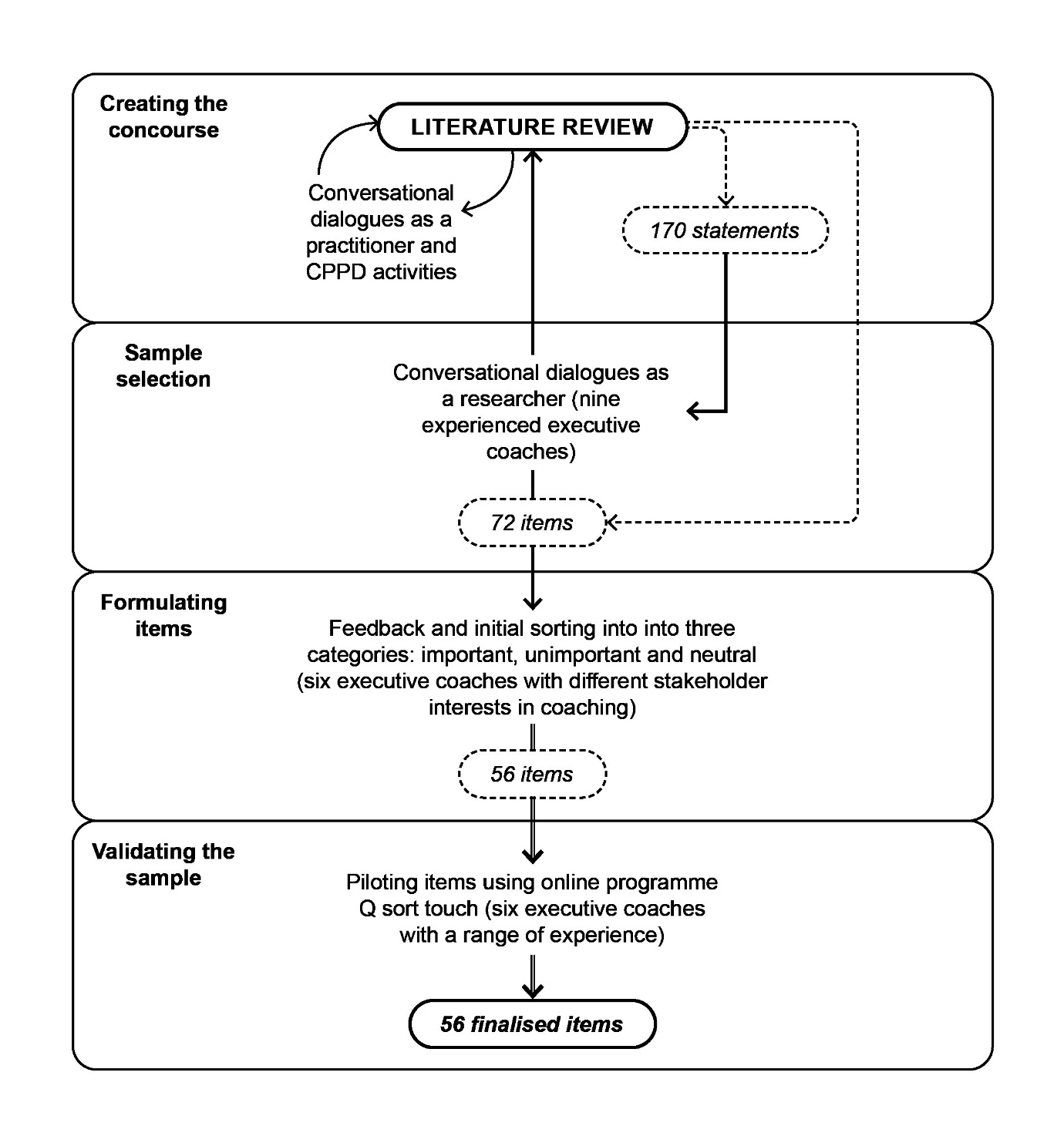
The Iterative Process for Creating the Q set
Phase Two: The Data Collection Process
The data collection process required the participants, the P set, to rank the Q set using a forced distribution. Participants completed an online Q sort process using the Q software programme Q-sorTouch (Pruneddu, 2013). They were asked to arrange the Q set using a response grid to sort items across the 11 category continuum from most important (+5) to most unimportant (-5). Each scale point had a certain number of items that could be assigned, as shown in Figure 2.
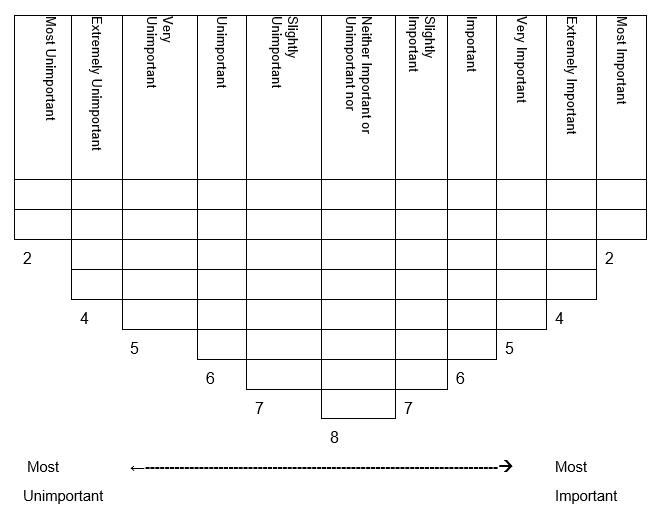
The Response Grid
At the end of the Q sort, participants were asked to give a brief rationale for selecting the statements they chose for ‘most unimportant’ (-5) and ‘most important’ (+5). These qualitative responses were used to help define and differentiate the typologies.
The Research Participants
As Q uses an inversion of conventional factor analysis, the P set needed to be smaller than the Q set, so fewer than fifty-six coaches were required. A meaningful Q sort required a group of coaches that could articulate relevant and interesting viewpoints on coach development. Executive coaches fulfil this requisite as they are a varied, clearly defined group that plays a significant role in the coaching field (De Haan, 2019). There is also a recognition that this type of coaching requires the ability to work with self-awareness in addition to core coaching skills (Carden, Jones, & Passmore, 2021). This suggests they were likely to have informed and different opinions on developmental priorities.
Purposive sampling was used to recruit forty-eight executive coaches, the P set, from alumni of executive coaching programmes and APECS, AC, EMCC and ICF members. All were UK based coaches who worked with senior managers and leaders in an organisational context and had not taken part in the first phase of the research. The demographic information that could influence a participant’s viewpoint was gathered to assist with interpreting the data analysis, as shown in Table 1.
Demographic Details of the P Set
Phase Three: Analysis and Interpretation of Results
Q uses a combination of statistical analysis and qualitative techniques to analyse and interpret the data in three methodological transitions: Q sorts to factors, factors to factor arrays and factor arrays to interpretation.
Q Sorts to Factors
The data was analysed using qmethod in the R Foundation software package (Zabala, 2014). The creation of the factors was a two-step data reduction process: factor extraction and rotation. Q sets with similar configurations were identified by correlating each Q sort with every other one, using principal component analysis (PCA). This process identified the unrotated factors, the Q sorts with sizable proportions of shared meaning. These factors were then extracted and rotated using Varimax to clarify the data structure. Unlike many statistical tests, factor analysis does not offer a single solution. All factor solutions that met the commonly used criteria, eigenvalues >1.00, two or more significant factor loadings (p<0.01) and accounting for >35/ of the total variance were identified. The three-factor solution was selected because it accounted for 94/ of the participants’ Q sorts, and the factors were distinct, portraying a comprehensive summary of the quantitative and qualitative data. The statistical characteristics of the three-factor solution are shown in Table 2.
Characteristics of the Three Factor Solution
Factors to Factor Arrays
The factor arrays are a ‘single Q sort configured to represent the viewpoints of a particular factor’ (Watts & Stenner, 2012, p.140). They were derived from the Z scores of the Q items, the weighted average of the scores given to the item by the participants who loaded onto the factor. These Z scores are shown in Table 3, which presents the three arrays side by side so that comparative rankings of each Q item in the respective factor array is evident.
The Tabulated Factor Array
Factor Arrays to Interpretation
The final transition is interpreting the factor arrays to create the factor descriptors, a narrative for each perspective that accounts for an array's entire configuration. The interpretation was based on the item’s Z scores, demographic data and the participant comments at the end of the Q-sort process. Each item needed to be considered in the context of the overall configuration of the factor array to give a sense of “the gestalt of the item” (Watts & Stenner, 2012, p.70). While it may appear that there is an overlap between factors as items are given identical scores, their meaning is interpreted by considering the position of the other items. This process ensures that methodological holism is maintained in the factor descriptors and provides a distinct narrative for each perspective.
Findings
The factor descriptors start with summarising the relevant statistical and demographic information and the factor arrays. They have been given a name that offers a ready identifier for the viewpoint. This is followed by a narrative based on the relevance of the position of the items within the array. The items and their position are identified throughout the description by two numbers in brackets. The first refers to the item’s designation in the Q set, and the second relates to its position within the factor array from -5 to +5.
Factor 1: The Craft of Coaching
Factor 1 explained 14/ of the study variance and accounted for 35/ of the viewpoints. Seventeen participants were significantly associated with this factor. This group included the majority of the least experienced coaches. Coaching practices range from one to twelve years, averaging five years. Only 12/ of the group had over 1000+ hours of coaching, with 53/ having less than 500 hours. Some of the group did not belong to a professional body, hold a coaching credential, or engage with supervision. The Factor One array is shown in Figure 3.
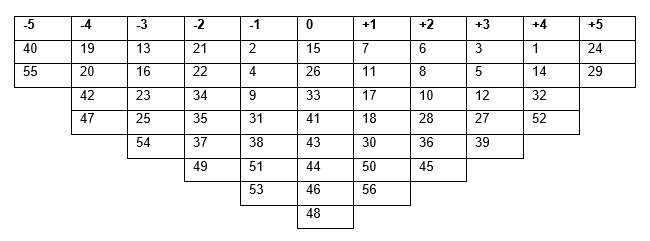
Factor One Array
The name ‘The Craft of Coaching’ reflects the importance of enhancing professional capabilities when considering developmental needs. This viewpoint focuses on the knowledge, skills, and experience required to coach effectively. It is characterised by prioritising acquiring new tools, techniques, and expertise in a coaching genre (29,+5; 14,+4). They seek to build confidence (10,+2) in their coaching (1,+4) by gaining a wide range of techniques, models, and processes. Coaching in a way that aligns with them as a person (36,+2) is about adapting tools and techniques to meet client needs (32,+4). Some priority is given to building the capacity for creating psychological safety (5,+3), but this is likely to be addressed by focusing on the coach-specific client context (50,+1) and engaging experiential learning (24,+5) rather than through deep self-work (19, -4).
Developmental activities which prioritise gaining feedback from clients (12,+3) and experienced coaches (28,+2) are more important than trusting their intuition (25,-3) when seeking to understand what is required to deliver quality coaching. Development activities that lead to gaining coaching qualifications have value (27,+3), and they look to draw on the expertise of others (52,+4; 14,+4) when developing their approach (44,0). This may be about the need to foster confidence in their coaching. It may also reflect the lack of importance in developing their philosophy of practice (2,-1) in defining their coaching offer.
These coaches also place more weight on defined standards of excellence for CPD (52,+4; 11,+1) than their developmental strategy (38,-1) when identifying their needs. They look to accentuate their learning through activity-based courses (24,+5) and reflecting on practice (8,+2). Less importance is given to doing inner work (19,-4; 42,-4; 54,-3) and engaging with the type of activities that address the potential for self-deception (21,-2), developing ethical maturity (23,-3) and enhancing personal well-being (22,-2).
Factor 2: The Being of Coaching
Factor 2 explained 12/ of the study variance and accounted for 27/ of the viewpoints. Thirteen participants were significantly associated with this factor. The years of experience ranged from five to twenty-one, with an average of sixteen years. However, the majority had worked as coaches for over ten years. All held a coaching credential, belonged to a PCB, and participated in formal supervision.
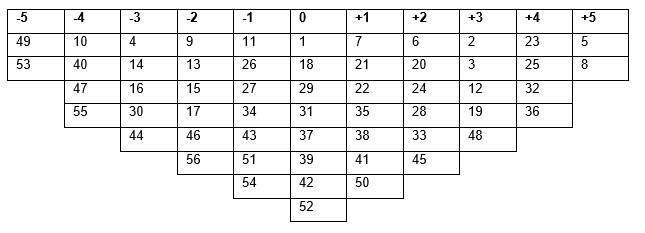
Factor Two Array
The name ‘The Being of Coaching’ reflects a viewpoint that holds the concept of self as the instrument of practice as a guiding principle when identifying development needs. There is a focus on developing personal capacity (19,+3; 42,0) to enhance their ability to work congruently (36,+4). Priority is given to developing the self-awareness to recognise, respect, and navigate their clients’ contextual, emotional, and psychological needs (5,+5; 23,+4; 48,+3). These coaches seek to benefit the client (32,+4) by creating coaching relationships based on depth and authenticity (36,+4). They are not looking to develop confidence (10,-4) or feel they must prove themselves to have a viable coaching business (30,-3).
These coaches trust their intuition (25,+4) and make developmental decisions that are congruent with their values (36,+4) and beliefs (2,+3) rather than relying on what others may suggest is required (11,-1; 27,-1). There is less interest in developmental activities directly relating to enhancing their reputation (39,0) or giving them a competitive edge (15,-2). Learning opportunities that have the potential to improve self-awareness, such as supervision (8,+5) and being coached (33,+2), are relatively more important than knowledge and skills acquisition (14,-3; 56,-2). There is little interest in engaging in learning that comes from being involved with the development of other coaches, either directly (43,-1; 44,-3) or indirectly by contributing to the coaching profession (13,-2).
These coaches are likely to use their criteria to decide what is needed to enhance their coaching rather than relying on standards of quality coaching defined by PCBs or clients (9,-2; 27,-1). Their personal standards are informed by reflection on practice and feedback from clients and other coaches (12,+3; 28,+2). There is an interest in refreshing skills and knowledge (3,+3) and intellectual challenges (6,+2). However, the lack of importance given to engaging with new ideas (20,0; 56,-2), experiencing different coaching genres (14,-3) or updating their coaching approach (44, -3) suggests a degree of complacency. While they see some importance in addressing blind spots (21, +1) and are willing to move from their comfort zone (45, +2), their approach to development is shaped more by their existing mindset (2,+3) than by opportunities for fresh input from learning relationships with others (43,-1; 53,-5).
This stance embodies a confident coach who feels little need to prove themselves competent. There is a greater emphasis on personal development than on acquiring skills and knowledge or obtaining qualifications. What is seen as essential is enhancing the ability to work with the personal congruence needed to create psychological safety (5,+5) and to add value to clients (32,+4) from different contexts and backgrounds (48,+3; 50,+1). Factor Two Array is shown in Figure 4.
Factor 3: The Art of Coaching
Factor 3 explained 11/ of the study variance and accounted for 21/ of the viewpoints. Ten participants were significantly associated with this factor. These executive coaches were the most experienced group, whose practices ranged from six to thirty-seven years, with an average of nineteen years. A unique feature of this group was that, while all belonged to at least one professional coaching body, 60/ belonged to two or more.
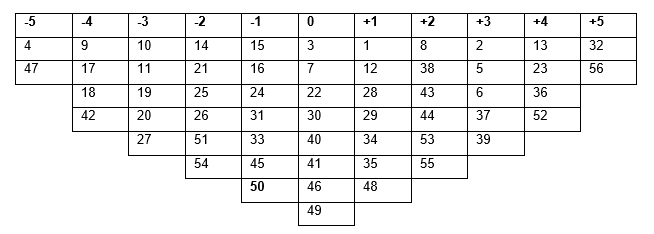
Factor Three Array
Like The Being of Coaching, the Art of Coaching focuses on developing personal capacity. It is influenced by the concept of self as an instrument of practice (36,+4) and the values and beliefs that underpin their coaching practice (2,+3). There is little emphasis on building professional capability as acquiring knowledge of genres of coaching, skills, and experience (4,-5; 14,-2; 17,-4) is a low priority. While the benefit to the client sits at the heart of identifying development needs (32,+5), the purpose of development reflects a broader remit. These coaches want to develop the capacity to navigate multiple complex relationships and systems within the coaching field (13,+4) and have a social impact (35,+1).
When considering developmental needs, the priority is stimulating interactions with others. This goes beyond the developmental learning that supervision offers (8,+2) to engaging with the broader community of coaching (13,+4) and supporting other coaches’ personal and professional development (37,+3) through activities such as teaching, mentoring, supervising, researching, and writing (40,0; 55,+2). The importance of developing learning relationships was also expressed by the relative importance of having meaningful connections with other coaches (43,+2) and ‘working with someone I like’ (53,+2).
There appears to be a tension between the emphasis placed on developing other coaches and the importance of contributing to the coaching profession (13,+4), with the lack of engagement with the professional bodies’ competency frameworks (9,-4) and CPD requirements (11,-3). These are confident coaches (10,-3) who are likely to have gained the required coaching qualifications (27,-3), so developmental activities that focus on coaching competencies have little personal relevance (9,-4; 11,-3).
Enhancing the capacity for working with personal congruence and ethical maturity are important considerations when identifying development needs (23,+4; 36,+4). However, these coaches are not interested in enhancing self-awareness by engaging in deep self-work (42,-4; 19,-3). A distinguishing feature of this viewpoint is the emphasis on the desire for an intellectual challenge (6,+3) through theoretical learning (44,+2; 56,+5). While ‘doing academic research’ was placed in a neutral position (40,0), the other factors ranked this item at -5 and -4, respectively. This suggests a tentative agreement on this being a relevant consideration when identifying needs.
The Art of Coaching reflects confident, experienced coaches who are at a place in their development where ‘quality’ (18,-4; 52,+4) and ‘contribution’ (32,+5; 13,+4; 37,+3) are drivers for their ongoing learning. For these coaches, development is seen as a continual journey (47,-5) as their model of practice continually evolves (44,+2) to enhance personal and professional alignment in the way they work (36,+4; 39,+3). Factor Three Array is shown in Figure 5.
The Typology of Developmental Strategies
The three factors represented three distinct viewpoints on what executive coaches prioritise when identifying development needs. These provided the basis for a typology of developmental strategies reflecting the three distinct stances on coach development. Table 4 provides a comparative interpretive summary of developmental strategy types. The names of the factor descriptors inform the acronyms DTC, DTB and DTA.
Comparative Interpretative Summary of Developmental Types
Discussion
Executive coaches are a diverse group. Their approach, specific contexts, personal definitions of quality coaching, and years of practice differ. This made it unsurprising that the analysis produced three distinct types of developmental strategies. The findings suggest that many executive coaches focus on developing professional capability. As a result, the approach to development is shaped by the priority given to gaining knowledge, tools, and techniques that have existing traction in the coaching field. However, for most executive coaches, building personal capacity is the primary consideration when considering their development. Some of these coaches are interested in developmental activities that enable them to do deep work with clients, reflecting a desire for depth rather than breadth in their practice. Fewer executive coaches seek development opportunities that enhance their personal capacity by engaging with others. These practitioners are interested in the learning that comes from supervising and involvement with communities of practice.
The findings indicate that approaches to identifying development needs change over time. The developmental type is impacted by the current context, previous developmental activities, and practical considerations such as sustaining a viable business and experience. However, experience alone does not determine a developmental type. The need to evidence competency-based coaching skills for obtaining, maintaining, and upgrading a coaching credential influences the type of developmental strategy. This substantiates the claim that the professional bodies’ competency frameworks significantly impact how executive coaches identify and address their development needs.
Understanding Coach Development
Coaching scholars have drawn on adult development theories to portray coach development as a process of change towards a more integrated level of functioning or coaching maturity (Bachkirova & Cox, 2019; Clutterbuck & Megginson, 2011; Drake, 2011). This would imply that a coach’s developmental strategy changes as they become more experienced. The majority of the least experienced participants identified with DTC (Craft of Coaching), and the most experienced with DTA (Art of Coaching), which appears to provide some support for this argument. However, the interpretation of Q analysis infers that the developmental types are dynamic. This suggests that development is more of an iterative process, and coaches engage in a cyclic developmental process of intention-setting, action, and reflection.
This construction of coach development is better explained by journey theories of adult learning (Daloz, 1999; Perry, 1970) rather than theories of adult development that see developmental changes as an ordered progression. Perry (1970) argued that developing the ability to think more critically can happen regardless of where individuals are on their development trajectory. Although he refers to ‘stages’, he proposes that learning journeys do not follow a particular route, and individuals are likely to be in different positions for different areas of their learning. This reflects the ethos of the development typology. The type is determined by what coaches consider relevant for meeting their current developmental needs. Coaches may stay in a particular developmental type if they find other developmental strategies unattractive or irrelevant to their context.
Coach development models draw on Cook-Greuter’s (2004) concept of horizontal and vertical development, viewing professional capabilities as discrete from personal capacity development (Drake, 2011). In contrast, the developmental typology offers a more integrated view of coach development. Each developmental type focuses on capability (horizontal development) and capacity (vertical development). They differ in the primary focus, but either type of learning activity has the potential for development to occur. This supposition draws on transformational learning theory. The significant learning experiences that involve “qualitative developmental changes in the way the world is viewed” (Mezirow, 1985, p.149) can be small events. Knowledge acquisition can create a small transformation that provokes shifts in meaning perspectives, resulting in integrating new learning into a behavioural repertoire (Dirkx & Mezirow, 2006; Keen & Woods, 2016). Coaches who focus on building professional capacity will have opportunities for new meaning-making, which underpins building capability. Coaches who focus on building personal capacity enhance their ability to manage complexity, allowing them to use existing skills and knowledge differently.
Limitations and Future Research
The three-factor solution, which was the foundation for the typology, accounted for 83/ of the participants’ viewpoints, indicating that some were unaccounted for. Given the subject’s complexity and coaches’ diversity, it is reasonable to assume that many views on developmental priorities will exist. Whilst the Varimax rotation, which yielded the selected factors, accounted for substantial variance, other factor solutions and typologies were eminently possible. Furthermore, Q relied on a large amount of interpretation, and other explanations of the data offer the potential for different findings.
The typology provides a meaningful way of describing practitioners' opinions on coach development to establish a foundation for comparative and evaluative research. It offers the possibility of comparing the effectiveness of different developmental strategies and looking at which learning activities are most beneficial in helping coaches enhance their ability to deliver quality coaching. The findings indicate that the development type will likely change when a different developmental strategy is required. This is an area for future research as there is a lack of longitudinal studies on coach development.
The findings highlighted that the PCB's emphasis on evidencing competency-based development impacts how coaches identify and address their developmental needs. Further research in this area has the potential to provide empirical evidence to support these contentions. However, addressing this issue has implications beyond coach development. It invites a more comprehensive investigation of the reductionist nature of a commercial learning agenda that is becoming evident in the coaching field (Nadeem, Garvey & Down, 2021).
Conclusion
The study’s findings highlight the need for debates and discussions on how coach educators, PCBs (Professional Coaching Bodies), and supervisors can foster the continuous development of coaches. The distinctive nature of the three types substantiates the argument for a pluralistic attitude to coach development (Bachkirova & Lawton Smith, 2015). The findings corroborated other research results that implied coaches recognise the value of learning activities that move beyond traditional CPD approaches (Carden, 2022; De Estevan-Ubeda, 2018). Against this backdrop, the PCBs continue to accentuate the professional development of the coach’s competence.
The typology illustrates that coaches embrace various learning activities for continuous development rather than solely focusing on coach-specific skills, knowledge, and competencies. This invites the PCBs to re-evaluate what they accept as evidence of CPD, for example, recognising well-being activities, such as yoga, mindfulness or spiritual practices. More controversially, the PCBs could shift their focus away from the need to evidence hours of CPD to requiring members to demonstrate a commitment to their learning and development. APECS has already taken this approach, requiring members to submit a development plan that has been agreed upon and reviewed with their supervisor.
The findings implied that for many coaches, engaging in competency based development is only important when seeking to obtain or upgrade a coaching credential. This adds weight to the calls for reviewing competency-based approaches to assessment (Bachkirova and Lawton Smith, 2015; Nadeem et al., 2021) so the credentialing processes are more meaningful and relevant for coaches. A recommendation from the findings would be to consider including client feedback. All three types rated providing benefit to the client as one of the most important considerations when identifying developmental needs. However, client feedback is not a mandatory part of the PCB’s evaluation of coaching proficiency.
For many coaches, enhancing their self-awareness and personal capacity to manage complexity is germane to their ability to deliver quality coaching. To some extent, these needs are addressed by post-graduate education programmes, which aim to enhance reflexivity and criticality. However, these courses can be costly and time-consuming. There is an opportunity for providers of advanced coach education, including academic institutions, to explore alternative learning experiences that encourage coaches to enhance the quality of conceptual thinking and self-understanding.
Supervisors play an essential role in the continuous development of coaches. However, Humphrey (2021) highlighted that little helps coaches decide what to bring to a session or how the supervisor would discern what is appropriate. The typology offers a basis for conversations that clarify decisions about focus and approach for supervision. As the relationship progresses, it could inform discussions and decisions about the changing nature of the work that needs to be supervised.
The typology offers fresh insight into understanding coach development and provides an empirical basis for coaches to take a more informed approach to developmental planning. Considering the diverse, dynamic, and contextual nature of developmental needs these findings can encourage practitioners to take a more holistic approach to their learning to better foster their ability to work with expertise.