







Abstract
The study explores how internal coaches working in the HE sector manage the interplay of individual change and organisational change, and the implications for undertaking a change agency role during the coaching process. It is a qualitative study using constructivist grounded theory. The context for the research is Higher Education institutions operating internal coaching and mentoring services. The research offers a conceptual framework for how internal coaching supports organisational change, integrating three models constructed from the findings: the wayfaring organisational change model, the coach as change mediator model, and the coaching fulcrum model.
Introduction
Supporting employees to adapt to a changing environment and to contribute to improved organisational performance (Jones, Woods and Guillaume, 2016) remains a strategic priority for all organisations, accentuated since the pandemic by concerns about employees being overwhelmed and destabilised by constant change. Organisations remain keen to find appropriate and cost-effective ways to support organisational change and Higher Education institutions (HEIs) are no exception, recognising that there is a need to build capacity and capability to deal with major changes effectively (Carnall and By, 2014).
This study explores how internal coaches working in HE manage the interplay of individual change and organisational change, connecting change at an individual level with change at an organisational level. Internal coaches potentially have the agency, knowledge and mandate to use their coaching practices to support organisational change, including addressing any tensions arising from misalignment of goals. Therefore, the study considers the implications for undertaking a change agency role during the coaching process.
There were 18 participants recruited to the study, drawn from internal coaches, coach supervisors and sponsors of internal coaching and mentoring services, operating across 15 Universities. The findings identified that internal coaches perform an agentic role in supporting organisational change, acknowledging that organisational change is intrinsically linked to achieving change at the individual level. This emerged as a nuanced position and the descriptor ‘coach as change mediator’ was constructed from the research. The consideration of intentionality in supporting organisational change at the individual level was a central factor in the shift away from the term ‘agent’ towards that of ‘mediator’.
The professionalisation of internal coaching has created a distinction between internal coaching undertaken by line managers with their teams and that provided by an internal coaching service, situated outside the management chain (St John-Brookes, 2014). This remains largely unexamined in the research literature as a separate and distinct category of coaching. Given the limited research into this topic, the study employed an exploratory qualitative methodology using constructivist grounded theory (Charmaz, 2014). The methodology aligns with the researcher’s ontological stance, which asserts the existence of multiple, socially constructed realities through shared narratives, both at an individual level and an organisational level, and with an epistemological stance of pragmatism.
For coaches who work in the same organisation as their coachees, the realities of organisational life may no longer align, if they ever did, with the delineation of a neutral coach (Fatien, Louis & Islam, 2023). This resonates with a change agency role (Gerwing, 2016), whether overt or instinctive, eclipsing the prevailing narrative of the coach being a neutral bystander (Downey, 2003) and taking into consideration the ‘coaching dance’, where non-directive and directive coaching practices become interwoven (van Nieuwerburgh, Knight & Campbell, 2019).
Literature Review
The coaching conversation has the potential to be considered a change intervention in and of itself, yet the role of coach is rarely explicitly referenced in change models (Hughes, 2010). There is some recognition in the literature relating to Human Resources Management (HRM) and organisational change management (OCM) that coaches have a role in ensuring that people have the capacity and motivation to adapt to change (Boyatzis, 2006). However, any focus on the organisational context tends to be minimal, highlighting the person-orientated rather than systemic aspects of organisational change. Where there is a focus in the literature on balancing competing agendas and the coach’s accountability towards both the organisation and the coachee, it is mostly viewed through the lens of executive coaching, rather than from the perspective of an internal coaching service (Grant, 2014; Passmore and Fillery-Travis, 2011). The tendency has been to study the dyadic relationship of coach and coachee, rather than a triadic one where the organisational context holds equal weight.
Change agency
The potential for coaching to align with a change agency role is regularly ascribed in the literature to an external consultant supporting a major change initiative (Grant, 2014, Rock and Donde, 2008), or to leaders and managers within an organisation who are tasked with managing the change where the coaching itself may be viewed as an organisational change intervention (Stouten, Rousseau and de Cremer, 2018). The literature on change agency makes the distinction between internal and external change agents (Gerwing, 2016; Monnot, 2017; Gilley, 2005; Lunenburg, 2010) with most concluding that everyone in the organisation has the potential to be a change agent.
Few researchers have connected change agency specifically to coaching, yet many of the skills appear to overlap: active listening, skilful questioning, a high level of integrity and the ability to earn trust (Gerwing, 2016). Internal coaches regularly operate in the liminal space between the change at the individual level and change at the organisational level and this offers the opportunity for a purposeful facilitative stance, akin to Cheung-Judge’s concept of ‘Self as instrument’ (2001). Similarly, Bennett and Bush (2013) note that change coaches bring a valuable asset into an organisation: themselves, identifying the potential for change coaches to be an instrument of change.
Organisational change
A review of the early change management models could mislead one to conclude that transformative change can be fully controlled with the right design, invariably viewed as a top-down process. The prevalence of linear step/stage change models (Hiatt, 2006; Kotter, 1996; Lewin, 1952; Lueck, 2003) may have reinforced this perception. Hughes (2016) suggests that an organisation will not change unless we understand that individual change is part of the organisational change process, recognising the interplay of individual and organisational change. Stober (2008) identified this as an important factor in embedding change for the longer term observing that for ‘change to stick at the workforce level, individuals need to understand how the organisational change is meaningful to them and how their individual actions contribute to effecting change’, (Stober, 2008, p.73). She suggests that only when change becomes meaningful and understood by the people it will impact, does the potential for successful implementation of organisational change become more likely.
Organisational context and coaching practices
Acknowledging the role played by the recipients and implementers of the change, Pundyke (2020) emphasises the importance of taking the organisational context into account. Internal coaches are uniquely placed to bring this organisational context into the coaching process and, together with their coachee, to draw on the context to inform their collaborative sensemaking (Balogun, Bartunek and Do, 2015; Weick 1995; Sandberg and Tsoukas, 2020, Schwandt 2021). The organisational context relates both to how the coachee makes sense of the world around them, as well as to how they make sense of themselves, including their work identity.
Determining from the literature which coaching practices are relevant to supporting organisational change is challenging, partly due to the conflation of terms. The terms executive coaching, leadership coaching, business coaching and workplace coaching are often used interchangeably (Blackman, Moscardo and Gray, 2016; Theeboom, Beersma and van Vianen, 2014). Although meta-analytic results have confirmed that workplace coaching is effective, this varies in its interpretation across different studies, therefore conclusions about effective coaching practices that support organisational change are tentative at best.
The interpretation of the concept of the neutrality of the coach is similarly variable. Fatien, Louis and Islam (2023, p. 1486) offer a working definition of the concept of neutrality in coaching: ‘the ability to provide objective, value-free support as an expert third party, while avoiding biases, personal interest or involvement’. For internal coaches operating within the same eco-system as their coachees, avoidance of a personal connection to the organisational context is simply not available to them. Instead, they face dilemmas of confidentiality, credibility and trust (St John-Brooks, 2014), alongside navigating the organisation’s expectations of its internal coaching service and the expectations of the coachees.
Coach-mentor
This coaching-mentoring continuum (van Nieuwerburgh, Knight & Campbell, 2019) has particular resonance for internal coaches for whom the organisational context is inescapable, given that they are enmeshed in the same ecosystem as their coachees. For internal coaches, it can be more helpful to recognise the fundamental interconnection of coaching and mentoring, rather than seeking to decouple them (Guccione and Hutchinson, 2021; St-John Brooks, 2014; Stokes et al., 2020). Stokes, Fatien-Diochon and Otter (2021) question whether the distinction between mentoring and coaching remains valid or even helpful. They explore the requirement for a distinction between the terms coaching and mentoring, arguing that context plays an agentic role and influences which of the helping orientations is used by practitioners.
Coachee wellbeing supported through coaching
The link between coaching and wellbeing is now well documented with studies demonstrating the positive impact of workplace coaching on wellbeing (Grover and Furnham, 2016; Theeboom, Beersma, and van Vianen, 2014). This has become a specific focus of positive psychology coaching and there are useful parallels to be drawn in the literature relating to the role of psychological capital (PsyCap) in enhancing wellbeing (Avey et al., 2010; Newman et al., 2014) and in supporting individual change (Brandes and Lai, 2022). Giraldez-Hayes (2021) established that it is possible to use coaching to develop psychological capital to support change, noting its potential to support individual resilience, wellbeing and performance in the workplace. Newman et al (2014) conceptualise PsyCap as a state-like resource which is open to change and development, hence can be impacted positively by coaching.
Methodology
This is a constructivist grounded theory (CGT) study set within a pragmatic paradigm to explore how internal coaches manage the interplay of individual and organisational change and the implications for undertaking a change agency role during the coaching process. A grounded theory approach is helpful when there is a paucity of relevant literature, as is the case for this study; it facilitated the construction of a conceptual framework for how internal coaches support organisational change, resulting in the development of three integrated models.
Sampling
The initial purposive selection required (i) participants to be internal coaches actively undertaking coaching as part of an internal coaching service in an HEI, (ii) for organisational change to be in progress at the participants’ institutions (i.e. changes in strategy, culture, internal processes or people structures), and (iii) for the participants to be working with individual coachees impacted by the organisational change(s). The sample focused primarily on the internal coaches, while also including perspectives from coach supervisors and the sponsors of internal coaching and mentoring services. The participants were recruited via two HE-specific networks: the Organisational Development in HE Network (ODHE) and the Staff Development Forum (SDF), which has a special interest group for coaching and mentoring.
18 participants were recruited to the study including: 14 internal coaches; 2 sponsors of coaching and mentoring services; 2 coach supervisors. The composition of the group was 3 males:15 females. Participants had been coaching for an average of 14 years, ranging from 3 -39 years.
Participant demographics
The chosen data collection method was semi-structured interviews as this allowed for both structure and flexibility, (Lincoln and Guba, 2015). Each round consisted of 4-5 participants and took place over an elapsed period of 12 months.
The initial codes were grouped into broader focus codes which were reviewed to identify connections, relevance, explanatory power and scope, and were clustered further to create the conceptual themes. The research aim and objectives (subsequently reframed as research questions) were deliberately loosely designed, to ensure an authentic exploration of the topic, rather than a search for prescribed answers. The conceptual themes that emerged did not align exclusively with a particular research question but instead related to more than one question.
Findings
The findings are considered in relation to the research aims and objectives which were reformulated as the following research questions to facilitate the analytic process (Charmaz, 2014):
How do internal coaches working in the HE sector manage the interplay of individual change and organisational change?
What are the implications for undertaking a change agency role during the coaching process?
How do internal coaches apply their knowledge and experience of the organisational context to their coaching practices during periods of organisational change?
How do internal coaches support the alignment of individual and organisational goals during organisational change, and address the tensions that may arise?
Findings Overview
The findings indicate a nuanced position about whether an internal coach undertakes a change agency role when coaching during periods of organisational change. The phrase ‘mediator of change’ was considered a more relevant depiction of how internal coaches support organisational change in their coaching practices. The coaches were enablers or facilitators of change, bringing the organisational context into the coaching space and proactively ‘nudging’ their coachee towards more agentic positions. The consideration of intentionality in supporting organisational change at the individual level was a central factor in the shift away from the term ‘agent’ towards that of ‘mediator’.
Four overarching conceptual themes were constructed from the coding and analyses of the transcripts, (depicted in Figure 2, together with the related focus codes). The development of the conceptual themes facilitated the construction of three separate models which integrate to provide a conceptual framework for supporting organisational change when working as an internal coach in HE institutions.
The findings are discussed in relation to each of the four research questions
Table of conceptual themes
How do internal coaches working in the HE sector manage the interplay of individual change and organisational change?
Several coaches described how the coaching process delineated a container for the coachee, providing an essential space to pause and reflect. This ‘coaching container’ was viewed as a neutral space, separate from the complexities of organisational life, where the coachee could work in partnership with their coach, both to make sense of what was going on and to acknowledge the direct impact the change was having on them:
‘I often think that coaching relationships are the organisation's safe houses, because you can come here in the middle of stuff going on and the environment is neutral’, - Cyan, supervisor and internal coach.
It was notable that the coaches’ perspective on managing the change interplay focused almost wholly on supporting the attunement of the coachee to the change, rather than on facilitating a more dynamic interplay to recalibrate the implementation of the organisational change. This appeared to be a missed opportunity as valuable ‘soft intelligence’ was rarely captured and fed back in any meaningful way. One sponsor characterised this as:
‘Being on a ship, on the water, and people swimming across shark infested waters, getting hauled onto the ship, being given a bit of support and then chucked back in. And meanwhile, the ship sails on with all the knowledge of how to deal with the sharks’, - Jae, sponsor and internal coach.
The coaches made a distinction between a neutral coaching space and the dominant paradigm of the neutrality of the coach, acknowledging the complexity of the organisational context and recognising the coach is enmeshed in the same system as their coachee:
‘How you feel about the organisation, is a really big thing. And I have to really try to be conscious of [whether] this is my experience actually, or am I too caught up in the story here?’, - Enola, internal coach.
In a few cases, the challenge of managing the change interplay affected the coaches’ personal wellbeing. They described stepping away from the coaching process, recognising that they lacked the psychological capital to support others being negatively impacted by organisational change. Mostly this led to a re-setting process, in discussion with peer coaches and/or their supervisor, to enable the coach to regain a more balanced perspective.
What are the implications for undertaking a change agency role during the coaching process?
All coaches considered that a key aspect of their internal coaching practice was to facilitate the coachee to find a place of resourcefulness and proactivity, rather than one of passivity and powerlessness. They identified a heightened sense of the coachee feeling ‘done to’, together with a greater likelihood of negative emotions being expressed during the coaching sessions. The coaches described holding competing perspectives in tension in order to ‘nudge’ the coachee to a point of equilibrium and support them to make decisions and take actions:
‘You as the coach [are] holding that positive space for them because they’re not really able to do it in that moment for themselves’ - Alyx, internal coach
The coaches were keen to distinguish between fostering the agency of the coachee and the coaches themselves being a change agent. They viewed their role as mediating the impact of the organisational change on the individual:
‘I remember thinking that I really needed to steer her away from that negative space and those negative feelings, just to get her to think about what she could influence in terms of how this change was impacting her’, - Francis, internal coach.
The internal coaches were unanimous in their view that they were not under any pressure to be an advocate for the organisational change projects and initiatives that were underway, or even for the organisation itself. However, they recognised that, simply through the questions they asked or the guidance they gave, they were drawing on their own experience of change, their knowledge of the organisational context and their insights into the coachee’s current situation. They acknowledged this was not a position of a ‘neutral bystander’, asserting that ‘there is no such thing as neutrality when you are an internal coach’. They described the balancing act required between facilitating the coachee to explore the options available to them honestly and without judgement, whilst also being transparent about the direction of the organisation and its expectations of the coachee:
‘Am I serving the organisation’s needs, am I nudging? Or is it in the interest of the coachee? [...] You're sitting in the middle expected to be neutral, in service of your coachee, and yet there’s this big ball of context sitting on your shoulder’, - Hillary, internal coach.
However, although they enacted a series of focused ‘nudges’, they were clear that this did not equate to being a change agent, which they viewed as requiring overt advocacy.
How do internal coaches apply their knowledge and experience of the organisational context to their coaching practices during periods of organisational change?
Most coaches identified that their knowledge of the organisational context aided them to formulate coaching questions to challenge the assumptions and perceptions of the coachee, ensuring that they did not simply take the coachee’s narrative at face value:
‘I feel that it gives me the license to challenge people on how they are behaving and acting as a leader and manager [...] The organisation's goal is we need you to step up and be the manager’, - Chris, internal coach.
The coaches’ organisational knowledge facilitated the ability to challenge cognitive distortions about the organisation’s aims and motives that were preventing the coachee from making progress. They described the sense of ‘stuckness’ that coachees presented with in the early stages of the coaching process and how they sought to steer towards a more positive, productive mindset. It was notable that this integration of the organisational context into their coaching practice involved a greater prevalence of the ‘coaching dance’, sliding back and forth along the coach-mentor spectrum. There were varying degrees of comfort with the shift between coaching and mentoring modes, also referenced as a shift between a non-directive and a directive coaching stance. The pressure to shift towards a mentoring approach appeared to be more keenly felt by the coach when the coachee was anxious about the impact of change or struggling to deal with uncertainties surrounding the organisational change: ‘if [the coachee] had nothing left in the tank, asking more questions wasn’t going to help them’.
How do internal coaches support the alignment of individual and organisational goals during organisational change, and address the tensions that may arise?
There was evident variability in acknowledging the importance of balancing the needs of the organisation with the needs of the individual coachee. Some coaches were explicit about the coaching process being about both the coachee’s goals and the organisation’s goals:
‘It’s not just in service of the coachee, we're both here together actually because there's an organisational element of some sort that we're working towards, in terms of for the good of the university,’ - Hayley, internal coach.
Experienced coaches who also had senior leadership roles, articulated a much clearer sense of being in service of the organisation, not just of the coachee. Their awareness of the triadic relationship encouraged them to be honest about the organisation’s expectations of the coachee and they were prepared to set out alternative perspectives to those shared by their coachee. However, the majority of the coaches tended to foreground the dyadic perspective of coach and coachee, rather than a triadic one, citing that: ‘whatever is good for the coachee is good for the organisation’.
Discussion
The role of the internal coach
The insights that emerged support Western’s (2012) notion of internal coaching as the ‘unsung hero’, considering it to have huge potential to effect positive change for an organisation, positioning internal coaching as part of an ecosystem that encapsulates the interconnections and interdependencies of working life.
Change Agency
As the majority of the coaches’ substantive roles were in OD, in answering the question whether the internal coaches are change agents or neutral bystanders, the coaches mostly aligned with Burnes (2006, p.21) description of a change agent as someone who plays ‘a mainly neutral facilitating role and working with a transparent and ethical agenda to help those involved identify options and make their own choices’. This is perhaps unsurprising, given that Burnes was an advocate for Kurt Lewin’s work (commonly acknowledged as ‘the father of OD’), although for most of the research participants, ‘accidental change agent’ was feasibly a more accurate term. Despite sharing many of the characteristics and traits outlined for change agents, such as active listening, ability to earn trust, skilful questioning, and integrity (Nikolaou et al., 2007; Gerwing, 2016), it was through exploring the issue of intentionality (Bennett and Bush, 2013) that a more nuanced understanding emerged of how internal coaches support organisational change. Ultimately, this led to the role of ‘coach as change mediator’ being constructed from the rounds of analysis, to encapsulate the implications for undertaking a change agency role, and to provide a suitable descriptor for how internal coaches manage the interplay of individual change and organisational change.
Bringing the organisational context into the coaching space provided the underpinning for a purposeful, facilitative stance, shaping the coachee’s journey and encouraging them towards a beneficial outcome. This conceivably challenges the concept of the neutrality of the coach; this was not a simple delineation of a neutral holding of a space in which coaches waited for the coachee’s self-awareness to expand (Fatien et al, 2023). It was an intentional approach to catalyse agency in their coachee, and to enable them to take the decisions needed to deal with the change (or to make a deliberate choice to withdraw from it).
The coaches were clear that this was not a process of explicitly directing coachees or showing them what to do, but rather it was about steering people forward, ‘setting a compass to help them navigate the change’. This has parallels with the nudge theory expounded by Thaler and Sunstein (2009) which seeks to avoid ‘telling people what to do’ but instead devises a series of cues to encourage agentic choices of constructive behaviours and actions, a position of gently steering rather than overtly directing.
Sense-making
The dissonance experienced as a result of their world shifting was often a catalyst for coachees to seek coaching and the coaches referenced encountering the coachee at the point of reacting to the change. They described a cyclical process of supporting the coachee to make sense of the changes, drawing on the organisational context to clarify the situation and to bring coherence and an interpretation to what the coachee was experiencing. This process of sense-making enabled the coachee to map what was happening to them and ultimately to navigate the change. This aligns with Weick, Sutcliffe and Obstfeld’s (2005) description of sense-making as a process of creating an emerging picture that enables us to act when the world seems to have shifted.
Coach-Mentor
The ‘coaching dance’, sliding back and forth along the spectrum from coach to mentor, is often viewed as a feature of internal coaching, (St John-Brooks, 2014). All participating coaches identified that they switched between a non-directive and a directive coaching approach (van Nieuwerburgh, Knight and Campbell, 2019), anticipating that the extent to which they did this was probably unique to internal coaches. Coaching during periods of organisational change appeared to increase the impetus for the internal coach to offer a mentoring perspective and this was identified as a source of ongoing conscious effort for many. There is an important distinction to be made between offering advice and offering context (Barber, 2018), which relates to the ‘coach or mentor’ dilemma that many of the coaches experienced. Pask and Joy (2007) suggest that context plays an agentic role and it is this which determines which helping orientation is used by the practitioner (i.e. coach or mentor). This aligns with the coaches’ experience of determining when to adopt a coaching approach, when to use a more mentoring style, and what degree of challenge to adopt during a coaching session.
Building psychological capital
The coaches referred to the fracturing of the psychological contract between the individual and the organisation (Rousseau, Hansen, & Tomprou, 2018) where goals and values no longer aligned, resulting in competing tensions between the focus and aspirations of the individuals and those of the organisation. Achieving a point of equilibrium, where the competing tensions could be brought to a place of balance, however briefly, emerged as an important aspect of enabling the coachee to find a resourceful position to move forward from. It was apparent from the findings that the coaches put considerable effort into supporting their coachees to build their psychological capital so they could make meaningful choices during periods of change. Giraldez-Hayes (2021) suggests that all psychological capital (PsyCap) components can be learned and argues that coaching to develop PsyCap supports change; she identifies workplace coaching as a key strategy to secure individual and organisational change.
The Conceptual Framework
The analysis of the findings supported three interrelated models:
wayfinding organisational change model (WOC)©: a taxonomy of how coaching supports individuals to navigate organisational change,
coach as change mediator model© which indicates four sub-roles to demonstrate how internal coaches support organisational change at the individual level,
coaching fulcrum model© which depicts how the internal coach facilitates the coachee to find a position of equilibrium.
The Wayfinding Organisational Change Model (WOC)©
The WOC model (Figure 3) was constructed from the observations shared by the research participants when describing the impact of organisational change on their coachees. Five cycles of change were identified: reacting to change, processing change, responding actively to change, assimilating change, and integrating change.
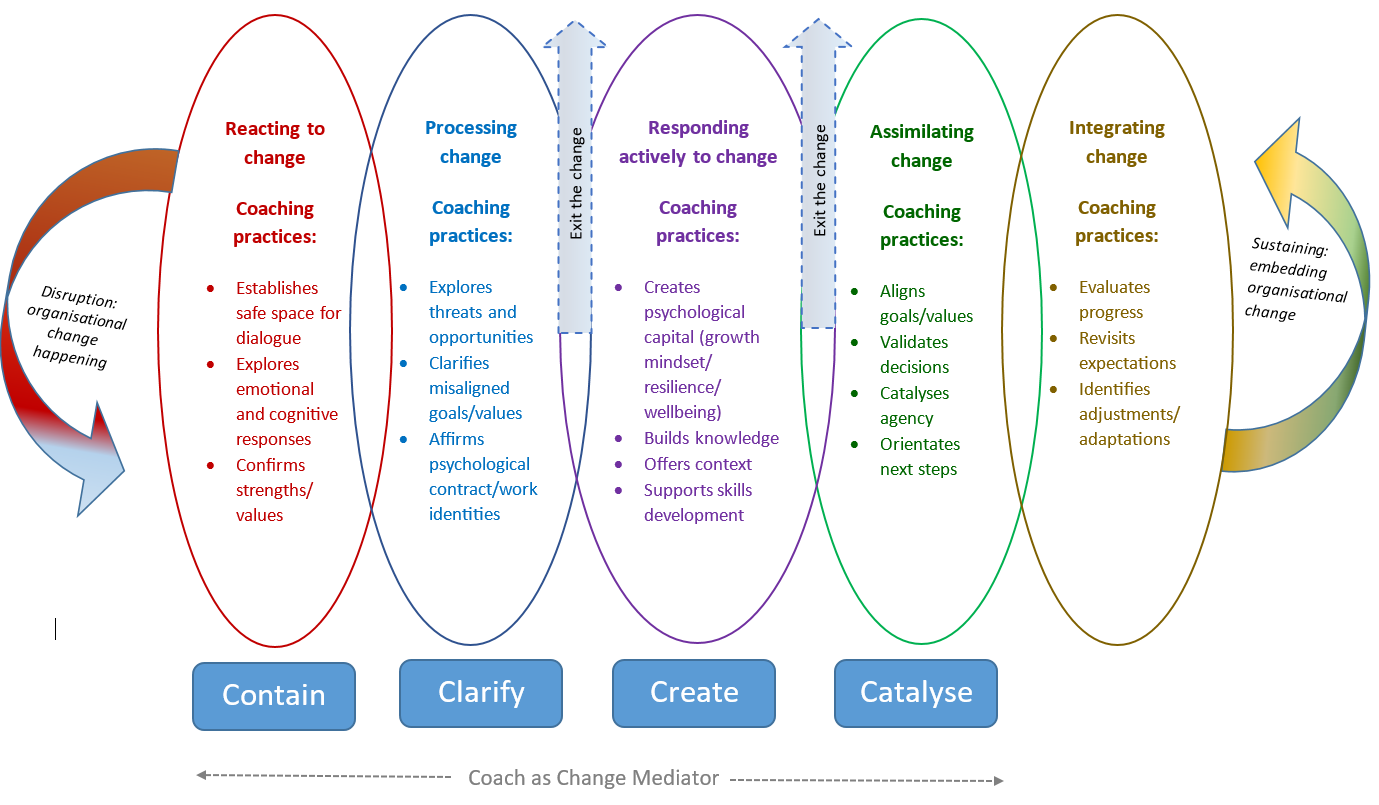
Wayfinding Organisational Change model (WOC)©
The most common coaching practices utilised at the different cyclical stages were constructed from the analysis of the initial codes. The WOC© model interconnects with the Coach as Change Mediator Model© (see further details below), aligning each sub-role with the most relevant stage of the coachee’s change journey, (while acknowledging the potential for the sub-roles to be applied to any stage).
The Coach as Change Mediator© Model
The coach as change mediator role is located at the nexus of individual and organisational change, operating within the organisational context. It has 4 sub-roles: contain, clarify, create and catalyse (see Figure 4) which illustrate how the coach operates as a change mediator when coaching during periods of organisational change.
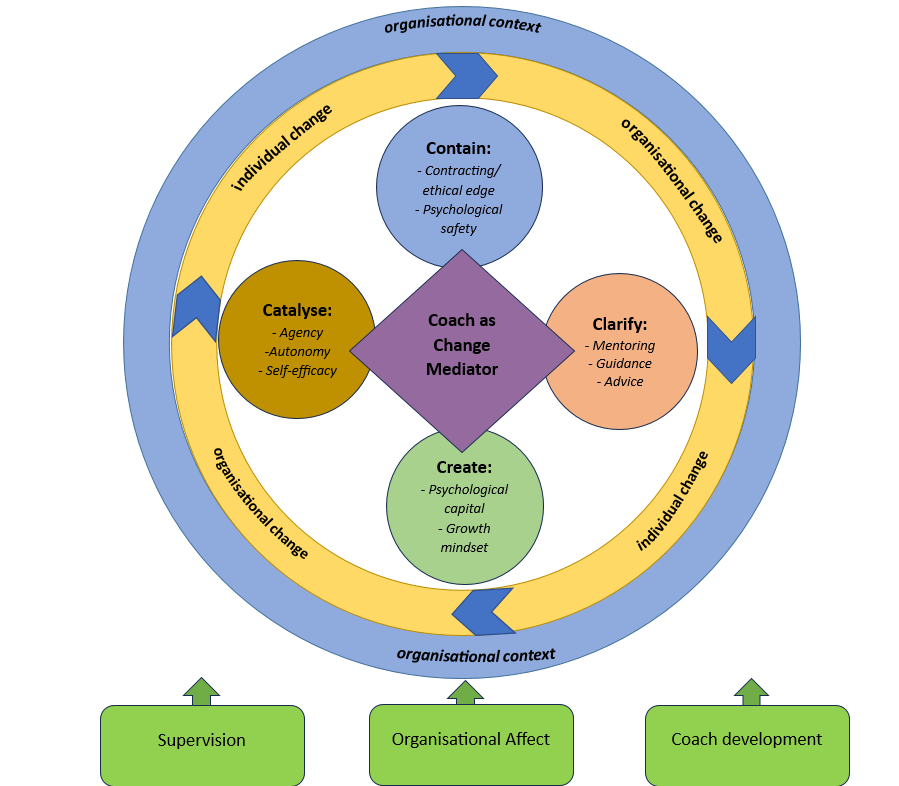
Coach as change mediator©
The ‘contain’ role relates to the framing for the coaching process and aligns with the concept of creating a psychologically safe ‘coaching container’, delineating the boundaries of the coaching conversations. The ‘clarify’ role is arguably closest to a mentoring role and is considered to be a unique feature of an internal coach supporting organisational change. It is a role where the organisational context is brought explicitly into the coaching process and which offers potential for added value for the coachee by doing so. It is also a means of helping the coachee to navigate sources of support, advice or development. The ‘create’ role was developed as a result of the coaches referencing how they actively sought to increase the resilience of their coachees, enabling them to progress from a negative mindset to a more positive one. The ‘catalyse’ role is potentially closest to the definition of change agent represented in the literature, enabling the coachee to find both the capability and the capacity for individual change, facilitating them to respond effectively to the organisational change. The role is one of encouragement to act, ensuring that the responsibility and the decisions remain with the coachee.
Three underpinning support mechanisms were identified as important enablers for undertaking the role of change mediator: supervision (one-to-one and group); development (e.g. CPD, communities of practice and individual reflective practices); organisational affect. This third enabler refers to the coach’s perceived level of organisational commitment. It was commonly described in terms of the coach’s connection with their institution, agreement with its strategic aims, and confidence that their values were aligned with those of their organisation.
Although arguably more pertinent when coaching during organisational change (Hawkins, Turner & Passmore, 2019), supervision and coach development are considered to be best practice support mechanisms for any coach. However, organisational affect appears to be specifically relevant to internal coaching during periods of change. It was notable that nearly all internal coaches shared a high level of commitment to their respective institutions. Endorsement of the direction and values of the organisation and its espoused intentions, even if the actuality was falling short, appeared to be a key enabler for internal coaches to support their coachee to navigate the organisational change. This accords with Allen and Meyer’s (1990) description of organisational affect as a central attribute of organisational commitment. Meyer, Vandenberghe and Becker (2004) observed that employees who are affectively committed tend to feel valued and thus act as ambassadors for their organisation.
The Coaching Fulcrum© Model
The concept for the coaching fulcrum (refer to Figure 5) emerged from the descriptions of the careful and thoughtful balancing act that many coaches undertook to support their coachee to navigate sometimes opposing factors resulting from the interplay of individual and organisational change. Achieving a point of equilibrium, where competing tensions could be brought to a place of balance, however briefly, facilitated the coachee’s release from ‘stuckness’. Four tensions were commonly mentioned by the research participants: current reality vs future focus; person-centric vs strategic drivers; individual values and goals vs organisational values and goals; individual autonomy vs hierarchical permissions. These tensions, or dualities, clustered into two main areas: the inner world of the individual and the outer world of the organisation. In supporting the coachee to find a position of equilibrium, five constructs were identified that connected the dualities. These were frequently cited in relation to supporting the coachee to balance the dualities: (i) psychological contract, (ii) sense-making, (iii) alignment, (iv) change-readiness and (v) building psychological capital (PsyCap), which interconnects with the other four.
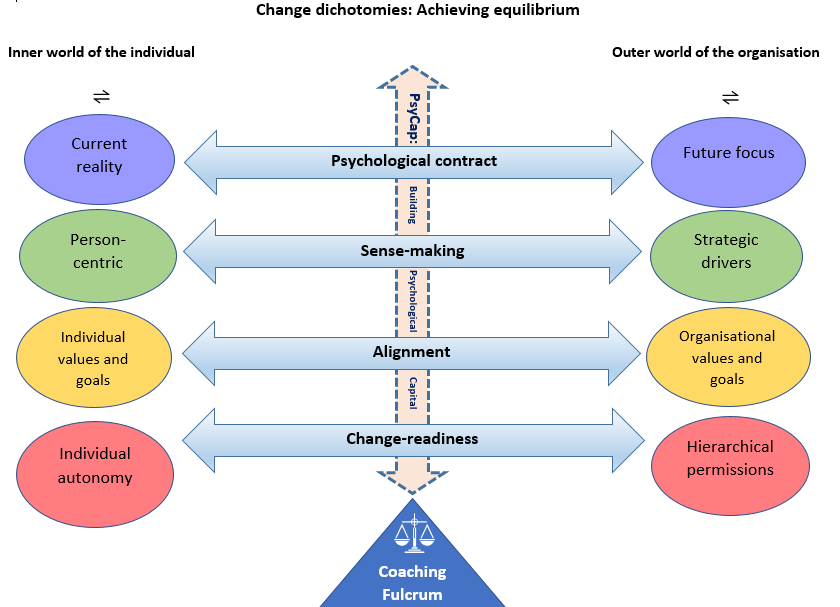
The coaching fulcrum©
Conclusion
The construction of the internal coach role as change mediator rather than change agent had greater resonance for the coaches as this placed the coachee at the centre of the conceptual framework and shifted the focus towards building the agency of the coachee, rather than considering the agentic role of the coach in supporting organisational change. It also allowed coaches to hold their obligations to the organisation lightly, alongside their responsibilities to the coachee, ensuring the goals and values of each were attended to. This positionality avoided any potential defensiveness about the series of nudges or steering behaviours they described in supporting their coachee to ‘unstick’ their thinking and to regain self-efficacy and a sense of agency (Dweck, 2013).
The conceptual framework constructed from the findings integrates three models: wayfinding organisational change, coach as change mediator and the coaching fulcrum. The framework can be applied to enhance the coaching practices of internal coaches working with coachees during periods of organisational change, and to contribute to coach development and coach training provision, benefitting the internal coaching community in HEIs. (Currently, coaching for organisational change is rarely included in training and development programmes for coaches). It is also intended that these research outcomes will facilitate sponsors of internal coaching services to develop protocols and support for their internal coaches.
This research contributes to knowledge by illuminating the underexplored area of coaching practices of internal coaches in HEIs experiencing organisational change, confronting the presumed neutrality of the coach. Additionally, it highlights an area that has received little attention in relation to coaching for change, that of coaches working with middle managers and below, rather than working with the senior leaders who devise and lead strategic change, which is the more usual context for workplace coaching studies.
It was apparent that working at a ‘peer level’ (most of the coaches were middle managers or equivalent), brought with it a notable pressure to ‘change hats’, swapping between coach, mentor and even, on occasions, developer roles. This ’coaching dance’ appeared to be a prominent feature of coaching during periods of organisational change and there were multiple references to sliding back and forth along the coaching spectrum (van Nieuwerburgh, Knight and Campbell, 2019). For the more experienced coaches who were also senior managers, there appeared to be greater confidence in knowing when to switch perspectives from coach to mentor; they appeared to view this as more Möbius strip [1] than spectrum (Kaufman et al., 2021) making flexible use of the interplay between directive and non-directive coaching approaches.
The research did not seek to evaluate the effectiveness of the coaching in providing support during organisational change, but instead to understand better the process by which it did so. What emerged was a reactive approach to how change is supported, seeking to establish a better alignment of goals and values and to facilitate the coachee to find the capacity and motivation to change behaviours and approaches to work. One internal coach summed this up as a process of ‘fixing the problems that are emerging because of the changes happening and see if we can get a better fit for people or work out what the other options are’. However, they also pointed out that this was a missed opportunity to consider how coaching could build readiness to change ‘looking at what can be done before it gets to the point of it being a problem and needing fixing, to actually work with people around their career progression and their potential, building on their strengths’. A more intentional focus on the coaching process during organisational change would ensure that important aspects of the change mediator role were attended to, in particular the contracting aspect of creating the ‘coaching container’, a better appreciation of how and when to bring the organisational context fully into the coaching space and an intentional focus on building psychological capital for the coachee, steering them towards a position of resourcefulness and proactivity.
Limitations to the research
An important limitation for the study was that the volunteers for the research were drawn almost wholly from people whose substantive role was in organisational development, and the majority were also professional services staff rather than academics. Therefore, the level of understanding of organisational change was already high among this group; many also had greater ready access to information about planned organisational change than would be expected for other internal coaches situated in different functional areas to OD. This has implications for the organisational context, which the majority acknowledged as an inevitability, mostly viewing it as an advantage that they were able to bring this context into their coaching practice.
A second limitation was the lack of a baseline assessment of organisational commitment, for example, using the overall engagement index from staff experience surveys. Organisational commitment was a feature that emerged from the descriptions of the coaching process, becoming evident due to the contrast between the descriptors of the coachee’s organisational affect and that of the coach. It appeared to be a relevant factor in the coach being able to maintain their personal wellbeing when coaching during periods of change. Its absence resulted in some coaches withdrawing from offering coaching, or pausing existing coaching contracts, as they did not feel best placed to coach others whose organisational commitment was similarly compromised.
A further limitation was the lack of direct access to the perspective of the coachees, rather than this perspective being reported solely through the lens of the coach. This would be a fruitful area for further exploration, using matched coach-coachee dyads in the context of ongoing change.
Footnotes
Möbius strip was a model popularised by Bloom et al (2005) in relation to coaching principals and school leaders in the US.