







Abstract
The arrival of AI-powered coaching, particularly via generative AI chatbots, has sparked debate over its efficacy and potential to democratise coaching. This study explored whether AI-based coaching qualifies as ‘coaching’ and how it aligns with traditional practices. Using Constructivist Grounded Theory, 15 professionals’ experiences were analysed. Findings suggest AI coaching acts as an asynchronous, intelligent agent prompting self-reflection. A theoretical framework highlights the coachee’s ‘working relationship with self and other’, reshaping human–AI relationality. The study suggests AI shifts coaching from relational depth to facilitated self-reflection, challenging traditional definitions of coaching as a unique developmental support tool.
Keywords
Introduction
This research explores the role of Artificial Intelligence (AI) in coaching by critically examining the experience of being ‘coached’ by an AI chatbot, and what it reveals about the evolving nature of coaching in the age of AI. The rise of ‘Generative’ AI in 2023 and 2024, led by tools such as OpenAI’s ChatGPT, has accelerated developments in AI’s conversational capabilities, and its potential for coaching. These ‘Large Language Models’ (LLMs) generate text by analysing human input and predicting the next ‘tokens’ in a sequence based on huge datasets (Mollick, 2024), enabling highly responsive and human-like dialogue. Prompt engineering techniques further allow designers to shape AI behaviour by assigning roles and contexts (Sanh et al., 2022), further enhancing its conversational adaptability in contexts such as coaching. As a result, the digital coaching market has become ‘swamped’ with AI coaches, with a significant continuum of quality; from models developed by coaching professionals and specific training data, to quite mediocre ‘coaches’ that any internet user can set up (Price, 2024; Rutschmann, 2024); and with many professionally packaged chatbots created by technologists with no coaching expertise (Passmore & Woodward, 2023).
Reactions to these developments have been mixed, with some coaches strongly resistant to the very concept of AI coaching (Schermuly, 2022; Grassmann & Schermuly, 2021; Bachkirova & Kemp, 2024; Passmore & Tee, 2023), and others viewing it as an opportunity for human coaches to learn from the success of coaching bots (Terblanche et al., 2022), or to conceptually differentiate between human and AI coaching (Bachkirova & Kemp, 2024). Some see opportunities in AI as an “adjunct to human coaching” (DiGirolano, 2024 p. 278), a coach's assistant (Plotkina & Sri Ramalu 2024), or to support human/AI hybrid coaching, e.g. by providing between-sessions micro-coaching (Geissler, 2024; Price, 2024; Taylor, 2024).
Democratisation of coaching
Coaching scholars, along with entrepreneurs and tech startups, have framed these developments as an opportunity to ’democratise coaching’ (Terblanche, 2020; Bachkirova & Kemp, 2024). Braddick and Woodward (2024) suggest that it has pushed the focus towards a broader range of employees beyond just ‘elite executives and emerging leaders’ (p. 287) who can access coaching services through easier, more affordable digital solutions. However, although such scalable and affordable solutions that were previously limited to senior executives (Passmore, Diller, Isaacson & Brantl, 2024) are more accessible, they might only be cost effective for larger organisations. ‘True democratisation’, according to Braddick and Woodward (2024), needs something much more nuanced and scalable that can utilise technology to go beyond a one-size-fits-all model to address the varied demands of a global workforce. By eliminating the need for ongoing remuneration and other human-related factors, AI coaching can be more cost-effective and time-efficient compared to human coaching (Diller, 2024; Passmore et al., 2024; Terblanche, 2020); and easily scaled to serve a large number of clients simultaneously, without the limitations of human coaches' availability (Terblanche & Kidd, 2022; Passmore & Tee, 2023), as it can be accessed from anywhere, making it more convenient and geographically independent for clients (Diller, 2024; Terblanche, 2020). However, Bachkirova (2025) cautions that we should be critical of the commercial power dynamics behind this push for an efficient cost-effective form of coaching, which may lead to a two-tier offering of coaching, rather than true democratisation.
As this new phenomenon gets rolled out to the masses both in organisations or to the general public, it becomes increasingly important to define what ‘AI coaching’ actually means in practice – is it a potential replacement for human coaching, or an inferior substitute (Bachkirova & Kemp 2024)? Does it offer a different type of professional development support to human coaching, or is it conceptually something quite different to how we have traditionally understood ‘coaching’? As such, this study attempts to answer some of the following questions:
Is AI-led coaching actually ‘coaching’ as currently understood?
How does the user experience compare with human coaching, and what similarities or differences emerge in practice?
What are the implications for coaching as a professional discipline?
Literature review
Peer-reviewed research on the phenomenon of AI coaching is limited, particularly using the latest Generative AI models, therefore I supplemented my review of literature with an analysis of discourse in LinkedIn conversations, blog posts and industry articles by leading coaching experts and practitioners during 2024. Research has so far shown that AI coaching chatbots can be as effective in supporting outcomes such as goal attainment, well-being, and self-reflection (Plotkina & Sri Ramalu, 2024) – across both pre-generative AI models (Terblanche et al., 2022; Ellis-Brush, 2021) and newer LLM-based systems (Isaacson, 2024a; Diller, 2024). There is also evidence of AI coaches meeting International Coaching Federation (ICF) credentialing standards and matching human coaches in core competencies for specific tasks (Passmore 2024; Passmore et al., 2025). However, much of this literature is descriptive and outcome-focused, and few studies address the qualitative experience of being coached by AI or critically examine whether these interactions align with existing theoretical models of coaching (Passmore & Woodward, 2023).
Definitions of coaching
Coaching itself is not a tightly defined concept; it often overlaps with mentoring, therapy, and training (Grant, 2013; Joo, 2005), and definitions vary in their emphasis on process, outcomes, or relational dynamics. The ICF (2019) describes coaching as “partnering with clients in a thought-provoking and creative process”, whilst Kilburg (1996) emphasises behavioural techniques and mutual goal setting. Other definitions, such as Whitmore’s (2017, p.12), frame coaching as “unlocking people’s potential to maximise their own performance”, with no explicit reference to a coach. Isaacson (2021) defines it as a “conversation-led change tool”, suggesting a shift toward process over relationship. These definitions leave room for non-human involvement yet traditionally imply some form of human relationality – particularly in models that emphasise trust, empathy, and presence (Rogers, 2004; Starr, 2021).
This ambiguity becomes critical as generative AI enters the coaching space. Some argue that AI coaching aligns well with structural and goal-focused elements of coaching, particularly in solution-focused and cognitive-behavioural approaches that emphasise autonomy, goal clarity, and problem solving (Grant & Cavanagh, 2018; Williams, Palmer & Edgerton, 2018). For example, AI chatbots have been shown to prompt reflection, encourage action, and support short-term behaviour change (Plotkina & Sri Ramalu, 2024.) In fact, even pre-LLM tools, such as Coach Vici, demonstrated effectiveness on par with human coaches in goal attainment (Terblanche et al., 2022). However, these gains often come without relational depth, as AI coaching may lack the mutuality and embodied presence that characterises many human coaching relationships. Critics note the absence of emotional intelligence, humour, intuition, and care (Passmore & Tee, 2023; Logan, 2024; Bachkirova & Kemp, 2024). Emotional presence, central to many coaching models, is difficult to simulate convincingly, even with advances in generative AI (de Haan, 2024; Rasool, 2024b). While chatbots can mimic empathy – what Price (2024) calls ‘predictive empathy’ – this lacks the felt authenticity of a human encounter.
Despite the limitations, research in adjacent fields such as digital therapy report participants feeling understood, safe, and motivated by AI coaches, and able to form supportive relationships with chatbots, particularly when discussing sensitive topic (Fitzpatrick et al., 2017; Beatty, 2022; Haque & Rubya, 2023). Replika users, for instance, have described AI companions as friends or mirrors, despite knowing they are artificial (Maples et al., 2024). Studies show that the lack of perceived judgement, combined with predictability and control, can foster a sense of psychological safety (Gratch, 2014; Blut et al., 2021; Suler, 2004). These findings are echoed in coaching contexts: Ellis-Brush (2021) found that AI coaching provided users with a non-judgemental space, even if it did not establish a traditional ‘working alliance’. The working alliance – commonly cited as a key mechanism of coaching effectiveness (de Haan et al., 2013) – remains a contested concept in AI coaching (Plotkina & Sri Ramalu, 2024; Passmore et al., 2025). Some studies suggest users can develop a form of alliance with chatbots (Bickmore et al., 2010; Beun et al., 2017), while others, such as Molyn et al. (2022) and Solms et al. (2024), question whether alliance strength reliably predicts coaching success. External support systems, contextual fit, and user expectations may play a larger role.
Defining ‘AI coaching’
Early attempts at describing and defining what AI coaching can do suggest that it is either a quite distinct form of coaching, or something conceptually distinct from coaching. For example, definitions include a form of ‘self-coaching’ or more ‘systematic process’ (Grassmann & Schermuly, 2021); a form of self-help, through ‘auto intimacy’ (Zeavin, 2024); an ‘e-coaching system’ (Beun et al., 2017); a type of journaling (Grassmann & Schermuly, 2021); a form of digital diary or mirror (Turkle, 2017); a safe-space reflexivity tool (Ellis-Brush, 2021); “synchronous or asynchronous coaching using AI or a computer as a coach instead of a human coach” (Passmore & Tee, 2023 p. 3); or more recently, ‘facilitated self-reflection’ (Isaacson, 2024c), or a kind of on-demand agent in a feedback loop (as mentor) with other AI agents and humans (Mollick, 2024).
It’s unclear if the future role of AI coaching is for the AI to jump directly into the position of the relationship partner/facilitator – or to just retain the technique and outcome of coaching, but remove the relationship entirely and make the process self-coaching or self-help, where individuals engage with AI applications to guide their own development, thus shifting the dynamic from interpersonal, to personal interaction with technology. Research to date suggests that AI coaching can be relatively successful at offering practical, transactional support, but is so far unable to match humans in facilitating truly transformational or transcendental coaching interventions (Ellis-Brush, 2021; Rasool, 2024a). The shorter session lengths typical of AI coaching (Isaacson, 2024a; Price, 2024), and their emphasis on goal-orientated approaches over spontaneity, may reflect this divergence, and some scholars think this reflects that AI coaching is superficial compared to human coaching (Bachkirova, 2025).
In both coaching and therapy, chatbots have been seen to simulate empathy and structure conversations to encourage reflection and action – but some see a lack of emotional depth and mutuality as potentially problematic. For example, Huang et al. (2023) found that AI agents struggle to foster autonomy in participants to the same extent as human therapists. Similarly, some critics highlight that AI exhibits ‘predictive empathy’ (Price 2024), or ‘simulated empathy’ (Rasool 2024c) – a mimicry that may be persuasive but not ultimately helpful. This raises ethical concerns about AI as a substitute for human relationality (Sedlakova & Trachsel, 2023), including potential risks to users’ self-perception, agency, and mental health.
In summary, the existing research highlights three critical tensions: (1) whether coaching must involve a human relationship; (2) whether AI-led processes can support behavioural change or only surface-level adjustments; and (3) how coachees experience relationship, trust, and reflection when interacting with non-human agents. Exploring these questions requires greater attention to the coachee's perspective and a clearer theoretical understanding of what coaching means, including in a post-human context. This study aims to contribute to the current gap in knowledge by exploring how individuals make sense of being coached by AI, and whether this interaction can support meaningful reflection.
Methodology
Selecting a method
I chose Grounded Theory (GT) as a method for my research because I want to find out and define ‘what is going on’ (Glaser & Strauss, 1967) in AI-based coaching, allowing me to start with human experience of the phenomenon of being coached by AI, and iteratively build concepts and theory up from there. GT sees the world as complex, and that individuals’ experiences can’t be separated from their context in the social, cultural and technological frameworks in which they are embedded (Corbin & Strauss, 2008). Based on the philosophical foundation of pragmatism, GT should not just explain phenomena but provide insights that are useful in practical contexts. It is focused on practical application, and the analysis of action and interaction – specifically how individuals act and interact with their environments in the real world (Corbin & Strauss, 2008). As part of this approach, it’s important to note that individuals are members of multiple social worlds (Chamberlain-Salaun, Mills & Usher, 2013), and I wanted to consider both participants' memberships (for example, coaches or professional workers), and also reflect on my own as a researcher.
Charmaz (2006) developed Constructivist Grounded theory (CGT) to advocate for a flexible approach to data collection and analysis, allowing the research process to adapt as new insights emerge. This approach prioritises the co-construction of meaning and researcher reflexivity over previous, more rigid methods of Straussian GT (Charmaz, 2014). This is important as there are many unknowns – not just in the ‘black box’ nature of generative AI, but also whether we count AI as an agent that co-constructs knowledge with humans (Gutiérrez, 2023).
Providing access to AI coaching
An important part of this research was actually providing the participants with a consistent experience of AI coaching before interviewing them. Multiple AI coaching applications were considered, but I identified AIcoach.chat as the best option: a chatbot powered by generative AI, with some early evidence of its efficacy as a coaching tool (Isaacson, 2024a).
Participants who were selected were professionals working for an organisation who have an interest in professional development and using technology for this purpose – a broad definition of the key target demographic for AI coaching and attempts to ‘democratise’ coaching. My exclusion criteria was those not working for an organisation, and senior managers who were likely to already have access to professional coaching. I initiated my participant recruitment with convenience sampling via a flyer through professional networks and public forums, particularly using LinkedIn as I was able to access a diverse group of professionals in my network. I asked participants to complete at least three ‘sessions’ with the AI coach before we set up a meeting. With participants’ consent, the Zoom interview audio was recorded and transcribed automatically using AI (Otter.ai). Any personal identifiers were replaced with pseudonyms to maintain confidentiality, and both recordings and transcriptions were stored securely on my password-protected personal computer.
Demographics and diversity of participants
Fifteen participants completed the sessions with the AI coach, of which nine were women and six men. Ten were from the UK, two from Africa, two from South Asia and one was from Canada. They came from a broad range of different-sized organisations including private business, government organisations, NGOs, and universities. Three had experience as a coach, three experience with mentoring and eight had no experience of coaching at all.
Data Analysis
Data was analysed using CGT’s (Charmaz, 2014), three-stage coding process: initial, focused, and theoretical coding, with a goal of developing a grounded, explanatory framework of the coachee experience in AI coaching. Initial coding was conducted line-by-line, remaining close to participants’ language and enabling concepts to emerge inductively from the data, free from predefined coding frames. Interviews were read in full before coding to support immersion and analytic sensitivity (Braun & Clarke, 2006), and was supported by regular memo writing, which played a central role in reflexivity, theory development, and the constant comparison of data, codes, and categories (Glaser & Strauss, 1967; Charmaz, 2014).
Focused coding involved clustering the most significant codes around recurring patterns. This generated a set of connected conceptual categories, refined through iterative comparison and discussion. The emerging codes were compared across transcripts to explore their analytic power and identify the most significant features of participants’ experience. Data saturation was reached when no new conceptual insights were emerging (Charmaz, 2014).
Theoretical coding moved beyond categorisation to explore the relationships between categories, using abductive reasoning (Charmaz, 2010) to develop a more integrated theoretical account. This stage involved revisiting the literature to engage critically with existing frameworks, testing emerging ideas against both data and prior research (Timonen et al., 2018). Through this process, a core category was identified: the coachee’s ‘relationship with self and other’, which linked the various dimensions of the coaching experience and anchored the emerging definition of AI coaching. QualCoder (Curtain, 2023) was used to support transparency and consistency in coding. The resulting framework offers a grounded understanding of how users experience AI coaching, and how relationality, reflection, and action unfold in interactions with non-human agents.
Findings
Fifteen participants were interviewed after completing three sessions with the AI coach within one month. Coaching sessions lasted on average around 20 minutes, ranging from 15 to 45 minutes in total. Nine participants used their desktop or laptop computer to complete the sessions, and six used their mobile phones. They reported using the AI coach for a broad number of themes, covering time management and productivity, communication skills, career development, performance management, effective meetings, improving technical skills, building confidence, and also stress and social anxiety.
Through focused coding I developed six categories that encapsulated and mapped onto the experience and process of being coached by AI – starting with the establishment of the ‘relationship’ with the AI coachbot and potential rapport or resistance, moving quickly to a non-judgemental safe space; experiencing a transactional – but professional – relationship; feeling understood by paraphrasing and summarising; being prompted into self-reflection through questioning; and seeing behaviour change in small steps (see Figure 1).
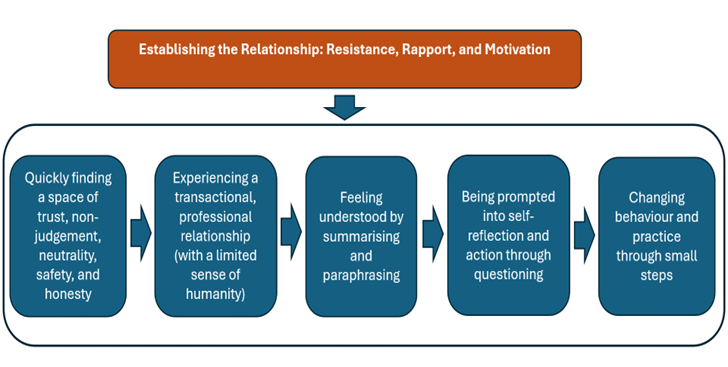
Six main categories explaining the experience of being coached by AI
These categories are summarised into four key themes below, that characterise the experience of AI chatbot coaching. While individual responses varied, participants consistently described a dynamic involving trust, reflection, and behavioural change – but with a distinct relational form. The AI was not experienced as a human proxy, but as an intelligent, structured presence prompting self-reflection.
Negotiating rapport with a non-human coach
Initial reactions to the AI coach varied and several participants described the early exchanges as formulaic, repetitive or lacking nuance, which led to disengagement for a minority. These participants struggled to build rapport and questioned the usefulness of the tool. However, most reported that after a short adjustment period, they found the AI’s structured, goal-focused dialogue helpful – even if it lacked emotional depth. Rather than relying on traditional rapport-building cues, participants described a different kind of motivation: one grounded in task orientation, curiosity, and a desire for developmental outcomes. These accounts suggest that motivation to engage may hinge less on the AI’s relational qualities and more on the user's motivation and readiness to adapt to the tool’s style. However, the experience of those who rejected the AI coach are also important.
Trust, neutrality and the safety of distance
Despite early reservations, most participants quickly felt safe and unjudged in their interactions with the AI. The absence of human presence – facial expressions, tone, or implied expectations – seemed to enable faster emotional openness. One participant noted they might have been more honest with the AI than they would have been with a human: “with a person, I might have felt there was more judgement”.
The neutrality of the AI facilitated a sense of control and psychological safety. Several participants described it as a space that felt “entirely theirs”, free from interpersonal demands or social performance. This effect was amplified by the asynchronous, text-based format, which allowed users to reflect at their own pace. Some felt this slowed down their expression and reduced spontaneity, while others found it helpful for clarifying thoughts. This suggests that the coaching dynamic was not devoid of relationality, but that trust was established through consistency, anonymity, and emotional distance – not empathy or human connection.
Prompting self-reflection through structure and questioning
Participants consistently described the AI coach as a facilitator of internal dialogue. Its most valued functions were summarising, paraphrasing, and prompting through non-directive questioning – features that created a strong sense of being heard, even without emotional feedback. The AI’s ability to reframe input, distil key points, and return clear summaries contributed to a perception of being understood. For some, the end-of-session summaries were pivotal: they felt like evidence of active listening and were often revisited as reference points. This kind of structured reflection often led to insight: “it really pushed for me to define my own answer … that’s probably what coaching is about anyway”.
Rather than offering advice, the AI helped participants unpack assumptions, clarify priorities, and shift perspective. Several described it as a “sounding board” – not a source of new ideas, but a reflective prompt that helped them untangle complex issues or commit to a course of action. This echoed traditional coaching mechanisms, but with a self-directed, internally anchored quality.
Action orientation and incremental change
Across interviews, participants described taking small, practical steps as a result of the coaching sessions. Themes included time management and productivity, communication skills, career development, performance management, effective meetings, improving technical skills, building confidence and also stress and social anxiety. The changes were not transformative, but cumulative: subtle shifts in thinking that led to concrete action. What stood out was how the AI’s structured questioning helped break down problems into manageable elements. Participants described being guided toward low-risk experimentation and incremental improvements, which contributed to a sense of competence and momentum. One participant noted, “it questioned me on why I couldn’t make decisions… and made me think about small steps I could take”.
Although the timeframe was short, several reported increased clarity, agency, and confidence. Even those who were initially sceptical often left with something tangible to apply. This outcome was not attributed to relational encouragement but to the AI’s capacity to hold participants to their own goals and prompt follow-through.
Summary of key themes
Participants experienced the AI coach not as a substitute for a human relationship, but as an intelligent, emotionally neutral agent that enabled self-reflection, insight and action. While lacking warmth or relational depth, the AI provided a consistent, goal-focused, and psychologically safe space that supported core coaching functions: reflection, reframing, and behavioural commitment. This reframing – from relational co-construction to reflective prompting – underpins the core category that I felt emerged from the data: ‘a working relationship with self and other’, where ‘other’ is an external, intelligent, non-human agent.
The core category: a working relationship with ‘other’ and ‘self’’
I developed a core category to explain the link between all of the key themes: what connects these phenomena is ‘relationship’ – more specifically the coachee relationship with their ‘self’ and relationship with ‘other’ in the context of AI coaching. Unlike traditional coaching, where the relationship with the coach plays a central role, AI coaching shifts participants' focus from the coach towards their relationship with themselves. Through neutral, reflective prompts, participants engaged in self-reflection, often recognising insights they already held but had not yet articulated. While many didn’t explicitly refer to a 'relationship’, the interaction with AI was meaningful enough to suggest that it was a relational aspect holding the coaching process together – from the initial safe space to goal setting, self-reflection, insight and action.
In this dynamic, the AI’s role as the ‘other’ functions as a mirror reflecting participants' thoughts in a structured way. The absence of judgement and focus on tasks allowed participants to explore their thoughts and behaviours without emotional interference, which prompted them toward greater self-awareness and action, and a focus on their relationship with ‘self’. Rather than being a relational partner, it seems that it functioned more as an external agent driving self-directed reflection and goal achievement.
However, the coachee’s relationship with ‘other’ is still significant. For some, who saw AI is as a ready-made safe space, there is the potential to bypass rapport-building and go straight into the practical reflection process. For others, the recognition of an intelligent ‘agent’ and their intrinsic motivation for self-development means they can establish a working rapport quite quickly. However, for a minority, there was an initial resistance to the coach and its style of conversation, leading either to a lack of trust with the coach, or a breakdown of the relationship.
Discussion
This study set out to answer ‘is AI coaching actually coaching?’, by looking to understand what actually happens during AI coaching sessions. Considering the research results, on the surface it seems like coachees are experiencing a basic form of coaching, with some advantages and disadvantages compared to human coaching, as suggested in the literature. We might be tempted to say then, that this is simply a form of coaching, and that this has an obvious trajectory to a low-cost, readily available method of support that can lead to the democratisation of coaching. However, participant experience suggests important underlying dynamics, starting with the differences in how people engaged with the AI coach, how rapport and relationship was manifested, and why there was a marked difference in how people were motivated to continue working with the AI coach. One useful model to help explain this might be Self-Determination Theory (SDT).
SDT and coaching
SDT proposes that intrinsic motivation and behaviour change are driven by the fulfilment of three basic psychological needs
Coachees’
The extent to which these needs are relevant likely depends on individual context and personality (Haivas, Hofmans & Pepermans, 2014). Some participants may not have required emotional connection, or already had those needs met elsewhere, making the AI’s functional style sufficient for their particular needs.
Participants’ descriptions of the AI’s structured, action-oriented style strongly resembled Solution-Focused Coaching (SFC) and Cognitive Behavioural Coaching (CBC). SFC emphasises client agency, clear goal setting, and problem reframing (Grant & Cavanagh, 2018), while CBC encourages rational, goal-directed thinking and Socratic questioning (Williams, Palmer & Edgerton, 2018). These models are less reliant on relational depth and arguably more compatible with AI delivery. Indeed, CBT and CBC both carry a tradition of self-help and autonomy over interpersonal process – a lineage that can be traced back to Albert Ellis, who envisaged therapeutic models that could function without a human therapist (Zeavin, 2024).
AI Coaching Competencies
Participants reported experiences closely aligned with several established coaching competencies, as suggested by previous research (Passmore, 2024), including active listening, as well as effective questioning, goal setting, and promoting self-reflection. While the AI coach lacked the relational nuance and emotional presence of a human practitioner, it consistently demonstrated core functional behaviours that supported client insight and action. However, competencies requiring co-created relational depth – such as cultivating trust or presence – were either absent or experienced differently, often reframed by participants as neutrality or emotional safety rather than interpersonal connection.
Reframing the coaching relationship: from mutuality to self
Although participants recognised that the AI demonstrated core coaching competencies, they consistently noted that the experience differed from human interaction. This raises the question: what kind of relationship is formed between coachee and AI? Coaching literature often draws on Buber’s (1985) distinction between I-Thou and I-It relationships (Rogers, 2016; Clarkson, 1995; Edelstein, 2022). I-Thou relationships imply mutual presence and authentic connection; I-It relationships are instrumental and transactional. Traditional coaching aspires to the former, yet few definitions explicitly consider the coachee’s perspective on this dynamic. From the coachee’s view, the AI may not fulfil the full role of ‘Thou’ – though Buber himself allowed that Thou-like presence might extend to animals, trees, or potentially even machines.
Some scholars argue that human–AI relationships could approach I-Thou under conditions of unscripted, generative dialogue (Stawarska, 2019), though others caution that simulated empathy and humour lack connection to lived experience (Trausan-Matu, 2019). Generative AI can convincingly replicate human relational styles (Graßmann & Schermuly, 2021), sometimes so persuasively that users forget they are interacting with a machine (Mollick, 2024). Yet this performative mutuality – however realistic – remains artificial.
Participants frequently described what was missing: deeper questioning, emotional resonance, and the responsiveness of real-time conversation. Typing often led to self-filtering, limiting spontaneity. Therefore, the asynchronous nature of AI coaching altered both the relationship with the ‘other’ and the tempo of the interaction. In presence-based or mindful coaching, presence includes the client’s embodied and environmental reality (Silsbee, 2010; Abravanel, 2018). In contrast, AI operates entirely through language, detached from physical context. The AI coach was referred to as ‘it’, yet many participants still carved out intentional time and focus for sessions, suggesting the relationship was meaningful – even if it sat somewhere between I-It and I-Thou.
This touches on reciprocity: while rapport typically depends on mutual respect, equality and disclosure (De Haan & Gannon, 2016; Chory et al., 2024), AI cannot reciprocate in the human sense. Some participants hoped for a stronger sense of recognition or feedback, but most were satisfied with the neutrality and safety the AI provided – echoing Cox’s (2012) view of relational reciprocity through holding space. Furthermore, Loeb (2024a) argues that relationships can feel meaningful even without reciprocated emotion – a point equally relevant in paid human coaching, where emotional depth is often asymmetrical.
This raises a broader challenge to the assumption that coaching effectiveness depends on a close dyadic relationship. While the ‘working alliance’ is often cited as central to success (De Haan et al., 2013), some studies have challenged this. Molyn et al. (2022) found that coachees’ wider support networks better predicted outcomes, while Solms et al. (2024) reported that alliance quality predicted satisfaction, but not results. Relatedness may arise from broader social contexts – a ‘caring climate’ or sense of belonging (Gano-Overway, 2024; Gabriel, 2014) – rather than solely from the coach–coachee dyad. Indeed, several participants reported success with the AI coach despite relational reservations, suggesting that the quality of interaction may matter less than its function.
What emerges, then, is a dual dynamic: the AI must provide a good-enough relationship with the ‘other’ to enable reflection – but more crucial is the coachee’s relationship with self. AI coaching, especially in asynchronous formats, encourages extended self-engagement. According to SDT, the ‘self’ is not fixed but dynamic and self-organising (Deci & Ryan, 1985; Spence & Oades, 2011). Growth and agency require deliberate self-awareness, which can be supported by external prompts. Zeavin (2024) suggests that in digital contexts, such prompts may create a kind of auto-intimacy – a mediated relationship that allows individuals to encounter themselves through the machine.
Emerging definition of AI coaching
Clearly, it seems that AI coaching has some conceptual and functional similarities to existing definitions of ‘coaching’. The basic processes here sound the same and the chatbot has demonstrated many of the core competencies of a coach. But how did this work without a human playing the key role? Does this shift ‘coaching’ to ‘self-coaching’? Does non-directive coaching without a human facilitator represent ‘self-directive’ development through periods of self-reflection? How can we differentiate this type of support from self-help?
What demarcates this from self-help was recognised by one participant, who observed that it requires something external from us, separate from our thought processes, which can prompt us to reflect. This external prompter must also be able to understand enough about us and be able to be dialogically responsive to us for us to be able to recognise its intelligence and feel understood enough to trust it and share further information. Critics such as Bachkirova and Kemp (2024), in particular, are very critical that AI has true ‘intelligence’ needed for a transformational coaching relationship – but this research suggests that it is already ‘good enough’ to prompt a useful level of self-reflection. With this in mind, I suggest a working definition of AI chatbot coaching of: ‘
This definition must be seen in the context of how humans understand their relationship to ‘self’ and ‘other’ in a digital environment where AI continues to expand. Therefore, alongside this, my core category ‘a working relationship with self and with other’ functions as a theoretical framework to conceptualise the role of the coachee in the AI coaching process, to potentially help understand the role of relationality in human–AI connection in coaching, and help guide further research. This framework (Figure 2) stresses the importance of the working relationship in connecting to the ‘other’ and connecting to one’s self-reflection and practice. The role of intrinsic motivation is also essential, acting as both an enabler and an outcome of the coaching – and the role of autonomy and relatedness is key to understanding this dynamic. Additionally, there are likely to be other factors involved in the strength of this relationship – for example, the conversational quality of the ‘other’ as chatbot; the coachee’s sense of relatedness in a broader societal context; and potentially – although this did not come out as strongly as expected – the role of anthropomorphism, which potentially drives coachees to respond to social cues from the ‘other’.
Finally, it may be helpful to think of the role, or process of the coachee as something more than ‘being coached’, and with the slightly more detached role of ‘coach’ in AI, I propose that this is more akin to a form of reflective practice.
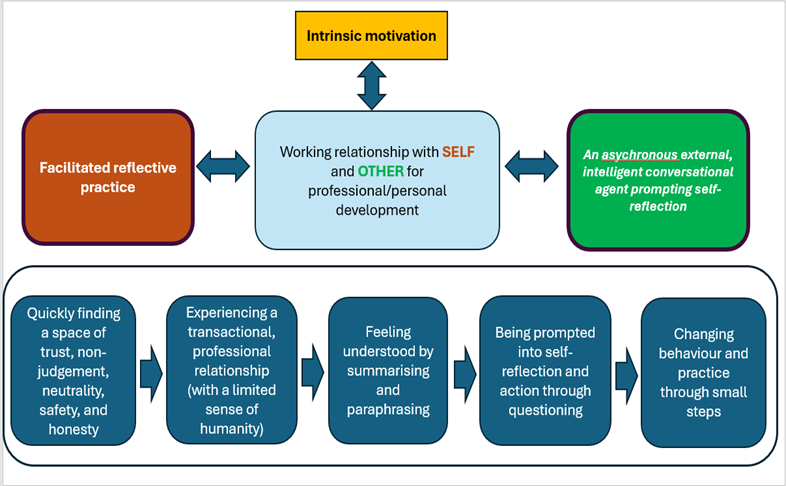
A theoretical framework of the coachee experience in AI chatbot coaching
Conclusion
This study explored whether AI coaching can be considered 'coaching' by examining the experiences of individuals using a text-based AI coaching chatbot. While still a pilot study, the findings suggest that AI can replicate several key coaching competencies – such as non-directive questioning, structured summarising, and prompting for goal-directed action. Participants often described the AI as intelligent, neutral, and responsive, though emotionally limited. Rather than replicating human coaching, AI coaching appears to reconfigure the coaching relationship, shifting it from a mutual, intersubjective process toward a more introspective, self-guided form of reflective practice.
Participants experienced psychological safety, autonomy, and competence, aligning with principles from Self-Determination Theory (Deci & Ryan, 2000). However, the need for relatedness was variably met. For some, the absence of human judgement fostered openness; for others, the lack of rapport or emotional nuance felt limiting. While AI coaching was experienced as structured and helpful, it lacked the co-created presence and mutual attunement that often define transformational coaching relationships. Nonetheless, the AI's role as a sounding board or mirror helped participants reflect and move forward – suggesting that for certain coaching goals, relational depth may be desirable but not essential.
Implications for practice
These findings have important implications for human coaches. Participants consistently valued skilled human presence, and AI is unlikely to replace this in the short or medium term. However, AI coaching does offer advantages in availability, neutrality, and consistency. What might this mean for human coaches that many of the participants in this study bypassed the rapport-building or ‘chemistry’ stage of the relationship and got straight into addressing practical problems? However, coaches should also reflect on how their unique strengths that differentiate them from AI, rather than try to mimic AI-like efficiency and neutrality. This could mean embracing practices that highlight human value – such as embodied, intuitive, or emotion-based work. As Rasool (2024a) warns: "If you coach like a robot, you’ll get replaced by a robot".
A hybrid model may offer an opportunity for coaches. Participants suggested that AI coaching could supplement human coaching by providing continuity between sessions or supporting clients without access to regular one-on-one coaching. As Terblanche (2024) notes, chatbot coaches can support client progress after sessions end, offering a kind of ongoing presence. In this framing, AI functions not as a replacement, but as a reflective support tool, freeing up human coaches to focus on areas where their relational and interpretive skills offer the most value.
The growing accessibility of AI coaching raises the question of whether it contributes to the 'democratisation' of coaching. While some see it as a lower-quality substitute (Bachkirova & Kemp, 2024), others argue that AI coaching may be better than no coaching at all (Kelly, 2024; Isaacson, 2024b). If many individuals engage with AI tools for self-development, perhaps AI coaching is best understood not as a diluted form of coaching, but as a new kind of reflective practice. In this framing, AI coaching offers an accessible, self-directed space that supports autonomy and behavioural insight – particularly for those who might otherwise receive no developmental support.
The findings suggest that AI coaching is structurally similar to established coaching models in its techniques, yet relationally distinct. This reconfiguration is not just a practical shift, but a theoretical one. The core category developed in this study – ‘relationship with self and other’ – highlights how AI becomes a kind of intelligent 'other' that facilitates internal dialogue. This may be sufficient for task-oriented or goal-focused coaching, but less so for clients needing deeper support and exploration. AI coaching is thus not a replication of human coaching, but a parallel modality with different constraints.
Limitations
It is important to note that there are limitations to this study as it was exploratory, with a small, convenience-based sample, and participants only engaged in a limited number of sessions. The findings reflect short-term experiences and may not capture longer-term developmental change. Further research is needed to explore how users' relationships with AI coaches evolve over time, whether more anthropomorphic or emotionally expressive systems alter user experience, and how AI coaching fits within broader support ecosystems. However, this study contributes an early, theory-informed account of how coachees experience AI coaching. It suggests that AI can support many core functions of coaching – but through a different relational logic. As coaching technologies evolve, the field must move beyond binary questions of whether AI coaching ‘counts’, and instead ask how AI reshapes the reflective, relational, and behavioural dimensions of coaching. More broadly, coaching theory must engage more directly with the coachee’s role and experience – whether in human or AI-led contexts – as a subject worthy of theoretical development in its own right.