







Abstract
Background
Dynamic regulation of respiratory ciliary beat frequency (CBF) is regulated by fluxes in intracellular calcium (Ca2+). P2X receptors (P2XR) are extracellular ATP-gated, Ca2+-permeable, nonselective cation channels. Zinc increases intracellular Ca2+ in a sodium (Na+)-free environment through activation of P2XR channels. We hypothesize that topical zinc increases CBF in a Ca2+-dependent fashion as a result of this mechanism.
Methods
The apical surface of mouse sinonasal air–liquid interface cultures were bathed in zinc in a Na+-free solution with or without Ca2+. High-speed digital video imaging captured and analyzed CBF at a sampling rate of 100 frames/s.
Results
CBF significantly increased fourfold over baseline from 5.99 ± 3.16 Hz to 22.4 ± 4.33 Hz in the presence of zinc chloride (50 micromoles) and calcium chloride (3 mM). This effect is abolished in the presence of extracellular Na+ and was pH dependent.
Conclusions
Zinc stimulates CBF in the presence of Ca2+ likely through activation of P2X receptors. Thus, zinc represents a promising agent for stimulation of mucociliary clearance.
Keywords
Chronic rhinosinusitis (CRS) is a complex disease with multiple contributing etiologies. However, ineffective sinonasal mucociliary clearance is a common pathophysiological mechanism. Normal sinonasal mucociliary function is an important host defense mechanism that clears the upper airways of inhaled particles such as bacteria, dusts, and aerosols. This protection is dependent on the production of mucus and the coordinated beating of ciliated cells that line the sinuses. Failure of cilia beating results in chronic respiratory diseases. 1 This is clearly illustrated in patients with primary ciliary dyskinesia and other disorders of cilia function who develop widespread sinus disease that is refractory to medical management. Stasis of sinonasal secretions likely contributes to infections and/or persistent inflammation. Fortunately, ciliary dysfunction resulting from mucosal inflammation and infection can often be restored after proper therapeutic intervention in most sinusitis patients. A wide array of treatment modalities are available that focus on the attenuation of mucosal inflammation, antimicrobial therapy, and removing sinonasal secretions. Currently, there are no pharmacologic agents designed for topical administration in the human sinonasal cavities to increase ciliary beat and mucociliary clearance. Thus, developing agents that could increase mucociliary clearance might create potential therapies for CRS.
Modulation of ciliary beat frequency (CBF) is complex and requires a number of interdependent regulatory mechanisms. Respiratory cilia beat at a baseline frequency but increase this beat frequency in response to a number of stimuli, including extracellular purines, β-agonists, cholinergic agonists, thermal changes, and mechanical deformation.2–8 Mounting evidence indicates that an increase in intracellular calcium (Ca2+) concentration is one of the primary mechanisms that drive the increase in CBF in response to these stimuli.2,4–6 For instance, of the agents that are known to stimulate ciliary beat, the most potent is ATP. ATP stimulates Ca2+ influx from the external milieu, as well as stimulating internal stores to release Ca2+. Intracellular Ca2+-mediated increases in CBF regulation are rapid and are shown to occur within one beat cycle.6,9 Thus, agents that increase intracellular calcium concentration are potential therapies for increasing CBF and mucociliary clearance in CRS. 10
At the plasma membrane, G-protein–coupled metabotropic receptors, such as the P2Y2, bradykinin, adenosine, and muscarinic acetylcholine receptors, regulate most of the effects on CBF. 11 The P2Y nucleotide receptors, in particular, have been shown to increase calcium concentration derived from intracellular stores.12,13 However, P2Y receptors are desensitized or down-regulated via multiple mechanisms.14–16 Therefore, the administration of P2Y receptor agonists as a pharmacologic method to stimulate CBF in sinus epithelium is less than ideal.
Recently, another subclass of nucleotide receptors has been described; the P2X receptor channels (P2XRs). These receptors function as ATP-gated, Ca2+-permeable, nonselective cation channels that lead to sustained Ca2+ entry when activated. These receptors are inhibited by extracellular sodium (Na+) and are pH dependent. Recently, Zsembery et al. 14 showed that extracellular zinc alone can stimulate Ca2+ entry in Na+-free conditions through the activation of P2X receptors. Furthermore, Ma et al. 17 reported that activation of P2X receptors was the reason a low Na+ environment and extracellular ATP will potentiate CBF. Despite the aforementioned findings, no prior studies have investigated zinc as a potentiator of CBF.
Zinc is required for healthy function of the human body, and no chronic disorders are known to be associated with its accumulation. 18 Therapeutically, zinc oxide creams alleviate dermatitis and provide skin protection from ultraviolet rays. Oral zinc sulfate is also an adjunct therapy for Wilson's disease. 19 Zinc is also used in homeopathic remedies such as Zicam (Matrixx Initiatives Inc., Scottsdale, AZ) and ColdEeze (Quigley Corp., Doylestown, PA) for treatment of the common cold. 20 Thus, zinc could be of potential therapeutic interest in CRS if it augments ciliary beat and mucociliary clearance.
Based on these observations, we hypothesized that topical zinc would increase CBF under Na+-free and Ca2+-dependent conditions in mouse nasal septal epithelial cultures. These cultures mimic the properties of human sinonasal epithelium and are a useful model for these investigations.
Materials and Methods
Cell Cultures
Culture of mouse nasal septal epithelium at an airliquid interface has been described in our prior studies. 21 Briefly, mouse septal epithelial cells were harvested and grown on Costar 6.5-mm-diameter permeable filter (Corning Life Sciences, Corning, NY) supports submerged in culture medium. The media is removed from the surface of the monolayers on day 4 after reaching confluence and the cells are fed via the basal chamber. Differentiation and ciliogenesis occurs within 10–14 days. Ciliary beat was confirmed with an inverted microscope before cultures were used for this experiment.
Solutions and Chemicals
The saline vehicle and control solution was Na+ free and contained 140 mM of Tris-HCL and 10 mM of HEPES. The Na+-free solutions are required because Na+ is an antagonist of P2X receptors. Other solutions included either alone or in combination 3 mM of CaCl2, 50 μM of ZnCl2, or 140 mM of NaCl. Unless otherwise indicated, all solutions were adjusted to a pH of 7.9 and applied to the apical surface of the cell monolayer at physiological temperature.
CBF Analysis
Images were visualized using a 63× objective on an inverted scope (Leica Microsystems, Inc., Bannockburn, IL). Images are captured using a Model A602f-2 Basler area scan high-speed monochromatic digital video camera (Basler AG, Ahrensburg, Germany) at a sampling rate of 100 frames/s with a resolution of 640 × 480 pixels. The video images were analyzed using the Sisson-Ammons Video Analysis system Version 2.1 (Ammons Engineering, Mt. Morris, MI). 22 For each experiment, a large area of beating cilia on the air–liquid interface cultures was detected with the inverted microscope. The digital image signal was then routed from the camera directly into a digital image acquisition board (National Instruments, Austin, TX) within a Dell XPS 710 Workstation (Dell, Auston, TX) running Windows XP Professional operating system. Images were captured, compressed, and stored to disk. Files were reloaded and analyzed with virtual instrumentation software highly customized to perform CBF analysis. All of the recordings in the reported experiments were made at 630× magnification. Experiments were all performed at physiologic temperature (37°C). Whole field analysis was performed with each point measured representing one cilia. For each sample, the reported frequencies represent the arithmetic means of these values, followed by standard deviations.
Apical Surface Fluid Ionic Manipulation
A baseline recording of the CBF was performed for each cell monolayer. Under sterile conditions, experimental solutions were applied to the apical surface of the cell monolayers. The effects of the control solution containing 10 mM of HEPES and 140 mM of Tris-HCl were tested to determine whether it would alter CBF. The effects of ZnCl2 on CBF were analyzed in a Na+-free environment with and without Ca2+-containing media. Ca2+-containing solution was also applied apically to determine changes in CBF. A video was captured every minute after application of the solution.
Statistics
Data are expressed as mean ± SD and tested for significance using unpaired Student's t-test. Results with a p < 0.05 were considered statistically significant. Because our data include thousands of individual points (cilia), very small changes in CBF result in a “statistical” significance because of the high power of the study. Prior studies have interpreted changes in CBF using a change of ≥15% over baseline to determine biological significance. 22 We will use biological significance as the main indicator in this study. For example, a change of ≥1.5 Hz was accepted as biologically significant if the baseline CBF was 10 Hz.
Results
Zinc Potentiates the Effect of Extracellular Ca2+ on CBF
Administration of 3 mM of CaCl2 with 50 μM of ZnCl2 solution (Na+ free) to the apical surface of the cell culture monolayer resulted in nearly a fourfold increase in CBF over baseline (Fig. 1, blue tracing). CBF increased dramatically from a baseline of 5.99 ± 3.16 Hz to a maximal stimulation at 2 minutes (22.4 ± 4.33 Hz), but maintained CBF threefold higher than baseline for 10 minutes. Interestingly, 3 mM of CaCl2 solution alone (Na+ free) significantly stimulated CBF to twofold higher than baseline for 10 minutes (Fig. 1, red tracing). However, when zinc was in solution with Ca2+, CBF still remained significantly elevated over Ca2+ alone.
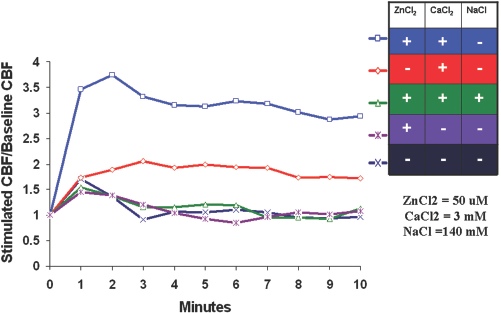
The effect of 50 μM of ZnCl2 and 3 mM of CaCl2 together (blue line) initiates a significantly sustained three-to fourfold increase in CBF when compared with 3 mM of CaCl2 alone (red line). An initial increase was shown in the control solutions, but returned to baseline after 4 minutes (change in ciliary beat frequency [CBF] is expressed as a ratio of the stimulated CBF over baseline CBF).
Conversely, zinc did not result in a sustained increase in CBF in the absence of extracellular Ca2+. Besides a small, but significant initial increase at 1 minute after topical application of a 50 μM of ZnCl2 solution, CBF returned to baseline in 3–4 minutes (Fig. 1, purple tracing).
The saline vehicle for Ca2+ and zinc was Na+ free with 140 mM of Tris-HCl and 10 mM of HEPES (for additional buffering). Control experiments were necessary with this solution to determine whether this affected CBF. The 10 mM of HEPES/140 mM of Tris-HCl solution did significantly increase CBF nearly twofold, but returned to baseline 3 minutes after application (Fig. 1, dark blue tracing).
Zinc and Ca2+ Initiate a Sustained Increase in CBF over 1 Hour
Because CBF was continually stimulated in the presence of extracellular Ca2+ or a combination of Ca2+ and zinc, we investigated if this effect decayed over time (Fig. 2). Apical administration of 3 mM of CaCl2 alone (Na+ free) resulted in a significantly sustained increase in CBF over a 1-hour time span ∼1.5 to twofold higher than baseline. Likewise, the fourfold increase in CBF seen in our initial experiments when a 3-mM CaCl2 and 50-μM ZnCl2 solution was applied to the surface also persisted for over 1 hour. Interestingly, Ca2+ and zinc together had a stronger effect toward the end of the hour.
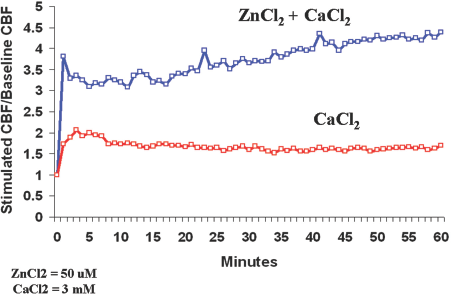
Although both Ca2+ alone (twofold increase) and Ca2+ and zinc together (fourfold increase) created a sustained elevation in ciliary beat frequency for over 1 hour, Ca2+ and zinc together had a much stronger effect as time progressed.
Zinc and Ca2+ Augmentation of CBF are pH Dependent
The maximum effect of 50 μM of ZnCl2 and 3 mM of CaCl2 was observed in an alkaline environment of pH 7.9 (Fig. 3). Differences between CBF at lower pH levels were not significant. Like the control solution/saline vehicle, a significant increase in CBF was observed at a lower pH within the 1st minute. However, this time a sustained increase in CBF was seen up to 10 minutes after application in all of the lower pH solutions. Even at a pH of 7.1, CBF was significantly elevated 1.7-fold over baseline at 10 minutes.
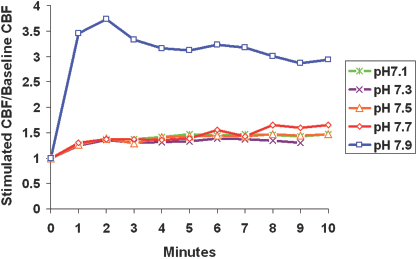
The maximum effect of 50 μM of ZnCl2 and 3 mM of CaCl2 was observed in an alkaline environment of pH 7.9. Differences between ciliary beat frequency at lower pH levels were not significant.
Discussion
Mucociliary clearance in the upper airway is necessary for optimal removal of mucus and inhaled pathogens and particles. Cilia on the surface of the respiratory epithelium beat in a uniform direction and coordinated fashion toward the natural sinus ostia and then to the nasopharynx to facilitate the movement of mucus. A key stimulus for enhancing ciliary beat is increased intracellular Ca2+ concentrations within the respiratory epithelia. 23 Sources of calcium are derived from either intracellular stores or from calcium influx through the plasma membrane. 24 If Ca2+ influx is impaired, this could lead to jeopardized mucociliary clearance—one of the major pathophysiological mechanisms at work in CRS.
Prior investigations have determined that extracellular zinc generates a sustained elevation in intracellular Ca2+ under Na+-free and pH-dependent conditions. In the present study, we show that zinc can dramatically enhance CBF in the presence of extracellular Ca2+. An airway surface solution, apically applied, containing 50 μM of ZnCl2 and 3 mM of CaCl2 significantly elevated CBF three- to fourfold above baseline for over 1 hour. Beyond a small, initial increase in CBF for several minutes that was comparable with the control solution, zinc alone did not augment CBF in the absence of Ca2+. Thus, zinc is completely dependent on extracellular Ca2+ to create a sustained increase in CBF.
Extracellular Ca2+ also increased CBF in this study, a somewhat unexpected finding. Extracellular 3-mM CaCl2 created a sustained, significant twofold elevation in CBF. In extended time trials, CBF was consistently elevated for over 1 hour. The reasons for this elevation are unclear. However, several potential explanations are presented.
In ciliated respiratory epithelia, mechanical stimulation is known to induce both extracellular Ca2+ influx 25 and noncytolytic intracellular ATP efflux. 26 Endogenous ATP release from ciliated epithelial cells could activate enough P2X receptors to initiate a partial influx of Ca2+. This might translate to a partial augmentation of CBF, while in the presence of zinc all receptors are activated. In addition, Na+ abolished any sustained augmentation of CBF in this study. Adding extracellular Na+ inhibits P2X receptors 14 and is consistent with this hypothesis.
Another intriguing rationale to help explain this phenomenon would be the presence of calcium-sensing receptors on the apical plasma membrane. The calcium-sensing receptor is a G-protein metabotropic receptor best known for its role in the parathyroid glands in the regulation of blood calcium. However, this receptor has a broad distribution of expression and is found in epithelial surfaces, such as gastrointestinal mucosa and squamous epithelial cells of the skin.27–29 Activation of this receptor is known to activate phospholipase C, which can generate the second messenger inositol triphosphate (IP3). IP3 binds to its receptors, IP3R, in the endoplasmic reticulum and Golgi apparatus membrane and triggers release of Ca2+ from internal stores. 30 Furthermore, these receptors are sodium sensitive. Raising and lowering Na+ decreases and increases, respectively, the potency of Ca2+ to activate calcium-sensing receptors. 31 In our current study, the effect of Ca2+ and zinc on CBF was abolished in the presence of extracellular Na+—evidence that supports both theories. However, the presence of the calcium-sensing receptor has not been identified on respiratory epithelia. At this time, both explanations are just speculative and further studies are warranted.
Investigating alterations in intracellular Ca2+ concentration, Zsembery et al. 14 felt the most likely target of activation with zinc was the P2X4 receptor because of the optimal increase in intracellular Ca2+ concentration at an alkaline pH. However, it is possible that P2X5 and/or P2X6 may also contribute to Ca2+ entry because they coassemble with P2X4. 32 Our investigations have determined a pH-dependent effect that is very similar. In an alkaline environment of pH 7.9, the maximal effect of zinc and Ca2+ was observed. Decreasing pH still resulted in a small elevation of CBF beyond the expected initial mechanical stimulation period seen with the control solution. Thus, P2X4 is potentiated in an alkaline environment and represents the likely mechanism for Ca2+ influx and augmentation of CBF.
The short-term stimulation of CBF observed with the administration of control solution/saline vehicle to the apical surface of the cultures is likely related to our method of application. Most CBF experiments are performed on explants, dissociated respiratory epithelial cells, or cultured cells in submersion with continuous temperature-controlled perfusion. 33 In contrast, we prefer to keep our cultures sterile to permit repetitive experimentation. Under sterile conditions, solutions are applied to the surface of the epithelial cells with a pipette. Unfortunately, application of the solution in this manner likely initiates mechanical stress on the cell surface. Mechanical stimulation causes a short-term release of Ca2+ from intracellular stores and results in an increase in CBF. 25 Future investigations on explants will be performed in a temperature-controlled perfusion chamber to mitigate this effect and determine whether our results are reproducible in another system.
Conclusions
The evidence presented in the current study indicates that extracellular Ca2+ and zinc dramatically increase CBF in cultured mouse septal respiratory epithelium at a pH of 7.9 and Na+-free solution. Any therapeutic irrigation for enhancing mucociliary clearance through this mechanism would require alkalinization and low Na+ content, and thus could present practical limitations. However, the concept of rescuing impaired CBF through manipulating ionic concentrations of airway surface fluid is intriguing and requires additional investigation.