







Abstract
Background
The aim of this study was to investigate recombinant marker allergens in patients with allergic rhinoconjunctivitis to tree and grass pollens.
Methods
Sera of 260 tree pollen– and 282 grass pollen–allergic patients were analyzed. Bet v 1 and Phl p 1/p 5 were used as marker allergens for allergies to pollen from birch and grasses. Profilin (Bet v 2 and Phl p 12) and calcium-binding protein (Bet v 4 and Phl p 7) were used as markers for polysensitization.
Results
Two hundred thirty-nine (92%) patients tested positive for IgE anti–Bet v 1. All of them were positive for IgE antibodies against natural birch extract (t3), hazel (t4), and alder (t2). Bet v 1 in combination with t3 identified allergies from related trees with a sensitivity of 99.2%. Two hundred fifty-six patients (91%) tested positive for IgE anti–Phl p 1 and/or anti–Phl p 5. All of them were positive for IgE antibodies against natural timothy (g6) and rye (g12) extract. Phl p 1/p 5 and natural timothy extract identified allergies from grasses and rye with a sensitivity of 99.3%. All Patients reacting to the cross-reactive allergens Bet v 2, Phl p 12, Bet v 4, and Phl p 7 were polysensitized.
Conclusion
Bet v 1 in combination with natural birch pollen extract identifies allergies from related trees with a sensitivity of 99.2%. Phl p 1, Phl p 5, and natural timothy extract identifies allergies from grasses and rye in 99.3%. Reactivity to the allergens Bet v 2, Phl p 12, Bet v 4, and Phl p 7 identifies polysensitization and cross-reactivity.
However, conventional extracts also show an inherent disadvantage. Polysensitized patients can not be diagnosed precisely using allergen extracts because sensitization to highly cross-reactive allergens (profilin or calcium-binding protein) that occur in many distantly related allergens might be interpreted as cosensitization to different allergens. 1 Advances in molecular biology have shown the feasibility of recombinant manufacturing molecules that resemble the natural allergens structurally and immunologically. Recombinant allergens can be produced without any genetic or biological variations and are available in constant quality and quantity.2–6 Component-resolved allergy diagnosis based on recombinant allergen molecules now allows the analysis of complex reactivity profiles in each individual patient. It is possible to identify symptom-eliciting allergens and to group patients who are sensitized against one allergen or structurally related allergens (monosensitized) and those who are polysensitized against a variety of immunologically unrelated allergen molecules. 7 However, recombinant allergens measurements alone are in fact too restricted in specificity for the general evaluation of allergy patients. If the patient is sensitized to an allergen that is not present in the assay that uses the recombinant major allergen, it will be miscategorized as a false negative. A combination of extract-based assays and recombinant allergens thus may be regarded as today's gold standard.
Allergens from taxonomically related sources show structural similarities that lead to IgE cross-reactivity. 8 These sources can be grouped (e.g., trees, grasses) and patients sensitized to one representative (e.g., birch and timothy) may also react to other sources of this group (e.g., hazel and rye). Among related allergens the allergen containing the most IgE-binding epitopes can be used as marker allergen for the entire allergen group. 9
The aim of this study was to investigate recombinant marker allergens in patients with allergic rhinoconjunctivitis (RCA) to tree and grass pollens. Bet v 1 was used as marker allergen for allergies to pollen from birch and related trees from the order Fagales (hazel and alder). Phl p 1 and Phl p 5 served as marker allergens for grass pollen allergy and related allergens (e.g., rye). Profilin (Bet v 2 and Phl p 12) and calcium-binding protein (Bet v 4 and Phl p 7) were used as markers for polysensitization. Profilin and calcium-binding protein are highly cross-reactive marker allergens that occur in many biologically unrelated allergen sources. Recognized by the same IgE antibody, patients appear polysensitized. 10 Profilin is a cytoskeletal protein, present in all eukaryotic cells, that shares a high degree of homology at the DNA and protein level among different plants. The calcium-binding protein also is abundantly distributed in trees, grass, and weed. 11 Different sensitization profiles were investigated in regard to the diagnostic value of Bet v 1, Phl p 1, Phl p 5, profiling, and calcium-binding protein as marker allergens for patients in Munich.
Patients and Methods
Tree- and Grass Pollen–Allergic Patients
We examined 260 consecutive patients presenting with complaints of RCA due to tree pollen and 282 patients with complaints due to grass pollen. All patients underwent routine in vivo tests such as skin-prick test and/or allergen-specific nasal provocation and in vitro tests such as total IgE and allergen-specific IgEs in serum. Patients were included in the study if medical history and skin-prick test revealed allergy against tree and/or grass pollens. The study was done in accordance with the Declaration of Helsinki and the study protocol was approved by the local ethics committee. All patients provided written informed consent.
Allergens
IgE reactivity to purified natural allergen extracts and recombinant allergens was investigated using a UniCAP 100 system (Phadia, Freiburg, Germany) according to the instructions of the manufacturer. Tree and grass pollen extracts and purified recombinant allergens were purchased from Phadia. Allergen-specific IgE against the following allergens was measured: (a) natural pollen extracts—birch (t3), hazel (t4), alder (t2), timothy grass (g6), rye (g12), parietaria (w19), mugwort (w6), domestic mites (hx2), fungi (mx1), and ragweed (w1); (b) recombinant allergens—birch (rBet v 1), timothy (rPhl p 1 and rPhl p 5) profilin (rBet v 2 and rPhl p 12), calcium-binding protein (rBet v 4 and rPhl p 7). The results are expressed in kilo-units of antibody per liter. All sera were tested at the allergy laboratory of the Ear, Nose, and Throat Department (University of Munich) using standardized methods.
Statistical Analysis
OriginPro 7.5 software (OriginLab Corp., Northhampton, MA) was used for the statistical evaluation of the data. Spearman correlation coefficients were used to evaluate whether serum levels of IgE to natural birch and grass pollen extract and the IgE levels to recombinant allergens were correlated. A value of p ≤ 0.05 was judged significant.
Results
We examined 260 consecutive patients with allergy to tree pollen and 282 patients allergy to grass pollen. Characteristics and demographic data of all patients are given in Table 1.
Characteristics of all patients
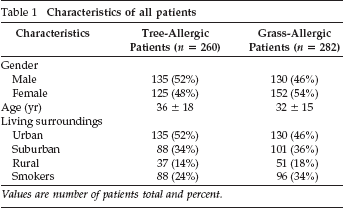
Values are number of patients total and percent.
Marker Allergens Bet v 1, Bet v 2, and Bet v 4
Figure 1 shows IgE profiles of Bet v 1, Bet v 2, and Bet v 4 reactivities. In vitro analysis of 260 birch-allergic patients revealed that 239 (92%) patients tested positive for IgE anti–Bet v 1, which revealed IgE antibodies against natural birch extract (t3) in all cases. All individuals displayed IgE reactivity to hazel (t4) and alder (t2). The mean value obtained for Bet v 1 was 21.77 kUa/L. Mean values for t3, t4, and t2 were 24.34, 20.74, and 23.97 kUa/L. Table 2 shows significant (p < 0.01) positive correlations between the mean values of Bet v 1, t3, t4, and t2.
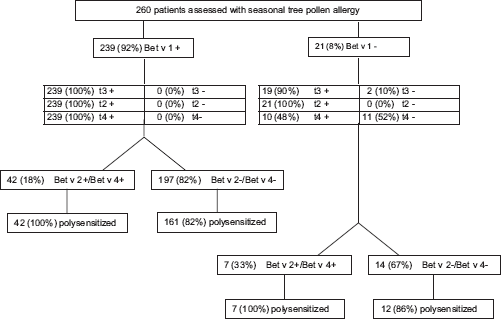
IgE profiles of Bet v 1, Bet v 2, and Bet v 4 reactivities.
Correlations between the mean kUa/L values of recombinent Bet v 1 and natural birch, hazel, and alder extracts t3, t4, and t21
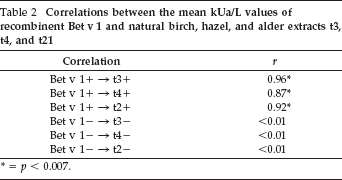
= p < 0.007.
Forty-two (18%) of the IgE anti–Bet v 1-positive patients also tested positive for IgE anti–Bet v 2 and anti–Bet v 4. All of these patients with IgE reactivity to Bet v 2 and Bet v 4 were polysensitized and revealed antibodies against numerous structurally not related allergens (timothy grass, parietaria, mugwort, domestic mites, fungi, and ragweed).
Twenty-one (8%) of 260 tested patients revealed negative reactivity for IgE anti–Bet v 1. Nineteen (90%) of these patients showed IgE antibodies against natural birch (t3), all (100%) against alder (t2), whereas 10 (48%) patients revealed reactivity against hazel (t4). Only two patients tested positive for IgE antibodies against hazel/alder and neither revealed antibodies against Bet v 1 or against natural birch extract (t3). Therefore, Bet v 1 in combination with natural birch extract identifies allergies from related trees with a sensitivity of 99.2%. Seven (33%) IgE anti–Bet v 1-negative patients tested positive for IgE anti–Bet v 2 and/or anti–Bet v 4. All patients with IgE reactivity to Betv2 and/or Betv4 were polysensitized and revealed antibodies against taxonomically not related allergens (e.g., timothy grass, parietaria, mugwort, domestic mites, fungi, and ragweed).
Marker Allergens Phl p 1, Phl p 5, Phl p 7, and Phl p 12
IgE reactivity to natural timothy and rye extracts (g6 and g12), to recombinant major timothy allergens (Phl p 1 and Phl p 5), and to cross-reactive minor allergens (Phl p 7 and Phl p 12) were analyzed.
Figure 2 shows reactivity profiles and the diagnostic value of Phl p 1, Phl p 5, Phl p 7, and Phl p 12 reactivities. Two hundred eitghty-two timothy-allergic patients were investigated. Two hundred fifty-five (90%) patients tested positive for Phl p 1 and/or Phl p 5. All of them revealed IgE antibodies against natural timothy (g6) and rye (g12) extract. The mean value obtained for Phl p 1/ p 5 was 24.22 kUa/L. Mean values for g6 and g12 were 22.54 and 17.87 kUa/L. Table 3 shows significant (p < 0.01) positive correlation between the mean values of Phl p 1/p 5, g6, and g12. Forty-three (17%) anti–Phl p1/5-positive patients tested positive for IgE against profilin Phl p 12 and/or against calcium-binding protein Phl p 7. Reactivity to Phl p 7 and Phl p 12 was accompanied with polysensitization to taxonomically not related allergens (e.g., birch, parietaria, mugwort, domestic mites, fungi, and ragweed) in all cases.
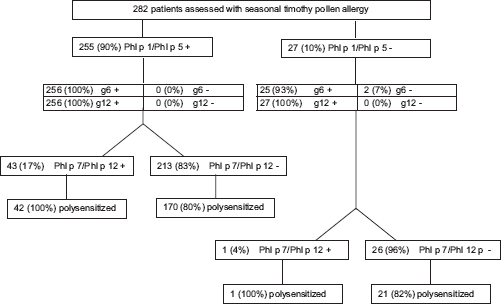
Reletivity profiles and the diagnostic value of Phl p 1, Phl p 5, Phl p 7, and Phl p 12.
Correlations between the mean values of recombinent Phl p 1/p5 and natural timothy and rye allogen extracts g6, g12
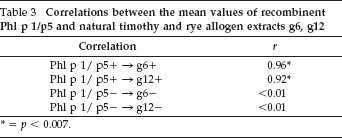
= p < 0.007.
Twenty-seven (10%) of 282 grass-allergic patients revealed negative reactivity for Phl p 1 and/or Phl p 5. However, 25 (93%) of these patients showed antibodies against timothy extract (g6). All patients showed reactivity against rye (g12). Congruently, to birch-allergic patients, only two individuals tested positive for rye and revealed no antibodies against Phl p 1, Phl p 5, and natural timothy extract. Phl p 1 in combination with Phl p 5 and natural timothy extract thus identifies allergies from rye with a sensitivity of 99.3%. One (4%) Phl p 1/5–negative patient tested positive for Phl p 7 and/or Phl p12. IgE reactivity to Phl p 7 and/or Phl p 12 was accompanied by polysensitization against structurally not related allergens (e.g., birch, parietaria, mugwort, domestic mites, fungi, and ragweed).
Discussion
Besides clinical history, diagnosis of allergy is based on skin tests, provocation tests, and in vitro investigations with natural allergen extracts. These are complex mixtures that not only contain relevant allergenic proteins in poorly defined concentrations, but also nonallergenic proteins and carbohydrates. 12 In contrast, recombinant allergens can be thoroughly quantified with respect to protein concentration and IgE reactivity.13,14 Furthermore, commercial extract potency may vary lot to lot. 15 Having a validated recombinant allergen for testing thus represents a major step forward.
Allergies to pollen of white birch and grass are among the most common type I allergies in Europe. 16 The aim of the present study was to investigate recombinant marker allergens in patients with RCA to tree and grass pollens and to correlate the results with reactivities to natural extracts. The allergen containing the most IgE-binding epitopes among a group of allergens was considered as marker allergen for the entire allergen group. 9
Bet v 1 is the major birch pollen allergen 17 and was used as marker allergen for allergies to pollen from birch and related trees from the order Fagales (e.g., hazel and alder). Besides the major birch pollen allergen Bet v 1, 17 profilin (Bet v 2) 18 and calcium-binding protein (Bet v 4) 19 were used as markers for polysensitization. Different sensitization profiles were investigated regarding the diagnostic value of Bet v 1, profiling, and calcium-binding protein as marker allergens for birch-allergic patients in Munich. Results were correlated with IgE reactivity against natural allergen extracts from birch, alder, and hazel. Our results show that reactivity to the recombinant birch allergen Bet v 1 can predict sensitization to tree pollen (e.g., birch, alder, and hazel). Sensitivity of Bet v 1 as a marker was 92% and was increased to 100% in combination with natural birch extract (t3). Under the use of Bet v 1 in combination with t3 we were able to identify 258 of 260 patients allergic to hazel and alder, indicating a sensitivity of 99.2%. In our opinion, this high sensitivity of Bet v 1 and t3 justifies excluding the determination of IgE reactivities against natural extracts from alder and hazel in Munich. This fact may contribute to use resources economically without a significant reduction of diagnostic quality.
Reactivity to Bet v 2 and Bet v 4 identifies polysensitized patients to numerous allergens (e.g., timothy grass, parietaria, mugwort, domestic mites, fungi, and ragweed). This polysensitization results from cross-reactivity of Bet v 2 and Bet v 4, which represents panallergens present in all eukaryotic cells and abundant in all pollen.
Grasses are a heterogeneous group of plants providing up to 71 allergens from 15 species distributed among 10 protein families. 20 For timothy pollen, Phl p 1 and Phl p 5 are the major allergens whereas profilin (Phl p 12) and calcium-binding protein (Phl p 7) are minor allergens. 21 Phl p 1 and Phl p 5 served as marker allergens for grass pollen and related allergens (e.g., rye). Phl p 12 and Phl p 7 were used as markers for polysensitization.
Our results show that reactivity to the recombinant timothy allergens Phl p 1 and Phl p 5 identifies sensitization to timothy and rye pollens. Two hundred fifty-five of 282 patients tested positive for Phl p 1 and/or Phl p 5. Two hundred eighty patients tested positive for natural timothy extract, indicating a sensitivity of 91% for Phl p 1 and Phl p 5 as marker allergen for timothy pollen. Sensitivity was increased to 100% in combination with natural timothy extract (g6). Under the use of Phl p 1, Phl p 5, and g6 we were able to identify 280 of 282 patients allergic to rye, indicating a sensitivity of 99.2%. Comparably with birch allergens, the high sensitivity of Phl p 1, Phl p 5, and g6 may justify an exclusion of natural rye extract from clinical routine in Munich.
Reactivity to Phl p 12 and Phl p 7 identifies polysensitized patients to numerous allergens (e.g., birch, grass, parietaria, mugwort, domestic mites, fungi, and ragweed). As in birch-allergic patients, polysensitization results from cross-reactivity of profilin and calcium-binding protein.
Our data challenge the widely applied diagnostic routine of testing related tree or grass allergens. Our results suggest that native, major, and minor allergens of birch and timothy are sufficient to detect solely all relevant sensitizations. In other words, there is almost no isolated allergy directed to alder or hazel, respectively, to rye, that does not involve t3, Bet v 1, g6, Phl p 1, Phl p 5, profiling, or calcium-binding protein. These results might have future diagnostic and therapeutic implications. Determination of IgE reactivities of tree pollen– and grass pollen–allergic patients can be reduced to three major allergens (Bet v 1, Phl p 1, and Phl p 5), two natural allergen extracts (t3 and g6) and two minor allergens (Bet v 2/Phl p 12 and Bet v 4/Phl p 7). In clinical routine the number of IgE determinations and the costs can be reduced without a relevant reduction of sensitivity. Furthermore, future immunotherapy with Bet v 1 or Phl p 1/Phl p 5 may be sufficient to treat allergic rhinitis caused by all related trees or grasses.
Conclusion
Bet v 1 in combination with natural birch pollen extract identifies allergies from related trees with a sensitivity of 99.2% for hazel and 99.6% for alder. Phl p 1, Phl p, and natural timothy extract identifies allergies from grasses and rye in 99.2%. Reactivity to the highly cross-reactive allergens Bet v 2, Phl p 12, Bet v 4, and Phl p 7 identifies polysensitized patients.