






Abstract
Background
Rhinitis affects a significant proportion of adults and children with typically seasonal or chronic symptoms. Botulinum neurotoxin type A (BoNTA) is a well-known cholinergic antagonist widely used in a number of approved neurological and esthetic indications. is study designed to assess the therapeutic effect of RT001, a novel topical gel formulation of BoNTA, in the treatment of allergic rhinitis using a rat model and to compare its safety profile with that of an aqueous formulation of BoNTA complex.
Methods
A rat model of allergic rhinitis was used involving induction of classic rhinitis signs (sneezing and nasal itch) in addition to nasal inflammatory pathology to assess the degree of therapeutic effect of RT001. Comparative safety of RT001 and BoNTA complex was assessed in guinea pigs based on lethality and body weight gain.
Results
Clinical signs of rhinitis were significantly (p < 0.01) relieved after a single intranasal administration of RT001 and resolved to normal baseline levels within 5 days after treatment. Mucosal inflammation characterized by edema, congestion, and vascular dilatation along with increased expression of vasoactive intestinal peptide was noted in control animals after allergy induction, whereas 001 treatment resolved inflammation to essentially normal baseline levels. Safety studies in guinea pigs via intranasal dosing revealed ~31-fold greater safety factor for RT001 when compared with BoNTA complex.
Conclusion
These results suggest that topical intranasal application of RT001 is effective in relief of clinical signs and inflammatory pathology associated with allergic rhinitis in a rodent model and may provide a safe treatment for rhinitis.
Botulinum neurotoxin type A (BoNTA) is purified from Clostridium botulinum and acts to block the release of acetylcholine from the presynaptic nerve terminal with consequent induction of muscular paralysis.3,4 Based on this anticholinergic activity, BoNTA has been used widely in the treatment of muscle spasticity disorders5–9 and for the cosmetic treatment of frown lines and wrinkles.10–13 In addition to these applications in the neuromuscular system, BoNTA blocks parasympathetic cholinergic transmission and has been used for treatment of glandular hypersecretory disorders, such as hyperhidrosis, Frey's syndrome, sialorrhea, epiphora, rhinorrhea, and sialadenitis. 14 In 1995, Shaari first reported that BoNTA could suppress electrically stimulated rhinorrhea in a dog model, 15 consistent with recent reports showing the effect of muscarinic cholinergic agents on canine nasal veins. 16 Subsequent studies in animal models17,18 and in human patients with different types of rhinitis19–25 indicated that local application of BoNTA effectively reduced rhinitis symptoms. In humans, one BoNTA treatment injected directly into the nasal turbinates significantly reduced rhinorrhea for 4 19 to 8 weeks 21 and provided better symptom relief than corticosteroid therapy for 20 weeks. 23 Despite this early evidence of efficacy, the application of BoNTA for treating rhinitis has not been widely accepted among clinicians and patients. In addition to procedural difficulty, the major limitations of intranasal BoNTA injection include pain, swelling, bleeding, tenderness, and possible infection.
In contrast to commercially available injectable BoNTA preparations (e.g., Botox [Allergan, Inc., Irvine, CA], Dysport [Medicis Aesthetics, Inc., Scottsdale, AZ], and Xeomin [Merz Aesthetics, Inc., Franksville, WI]), RT001 (Revance Therapeutics, Inc., Newark, CA) is a novel BoNTA gel formulation for topical application containing the purified 150-kDa BoNTA protein, which contains no toxin accessory proteins or human/animal-derived components and includes a proprietary peptide to enhance transcutaneous and transmucosal flux of BoNTA. RT001 topical gel has been shown to significantly reduce the severity of lateral canthal lines in humans. 13 The aim of this study was to evaluate the efficacy and practicability of a simple administration (intranasal instillation) of RT001 using an allergic rhinitis model in rats and to evaluate the relative safety of RT001 versus an aqueous formulation of BoNTA complex in guinea pigs.
Materials and Methods
Reagents
The following reagents were used: RT001 and control gel (Revance Therapeutics, Inc.), ovalbumin, aluminum hydroxide, gelatin, sodium phosphate, diaminobenzidine (Sigma-Aldrich, St. Louis, MO), sheep anti-VIP antibody (Millipore, Billerica, MA), biotinylated rabbit anti-sheep antibody and ABC kit (Vector Labs, Burlingame, CA), and BoNTA complex stock solution (Metabiologics, Inc., Madison, WI).
Animals
Female Sprague–Dawley rats weighing 200–250 g (Charles River Laboratories Inc., Hollister, CA) were used in the allergic rhinitis model. Guinea pigs weighing 283–325 g (Charles River, Raleigh, NC) were used in the comparative safety study. Animals were housed in a vivarium with a 12-hour light/dark cycle and a controlled temperature. Food and water were provided ad libitum. All procedures in this study were performed in accordance with the guidelines detailed in The Guide for Care and Use of Laboratory Animals published by the National Academy of Sciences and approved by the Institutional Animal Care and Use Committee.
Ovalbumin-Induced Allergic Rhinitis Model
The allergy induction protocol consisted of a series of seven i.p. injections of ovalbumin (0.3 mg) and aluminum hydroxide powder (30 mg) suspension in 0.9% saline (1 mL) administered every other day under anesthesia (~2% isoflurane in O2). Ovalbumin (2 mg) in 0.9% saline (20 μL) was then intranasally instilled daily for a total of seven doses under anesthesia (~2% isoflurane in O2).
Sneezing and nasal itching (indicated by nasal rubbing) are useful indications of allergic rhinitis in rats 26 and represent two of the four traditional clinical symptoms (along with rhinorrhea and congestion) monitored in patients. Consequently, a performance severity assessment (PSA) scale was established to score the extent of these two nasal allergic signs after antigen challenge. Clinical signs were scored before induction at baseline, after induction to establish maximal allergic signs on day 0 and on days 3, 5, and 7 after treatment using numerical scores: (a) itching (rubbing nose), 0, none; 1, <30 times; 2, 30–50 times; 3, ≥50 times; and (b) sneezing, 0, none; 1, <3 times; 2, 3–10 times; 3, ≥10 times (30-minute period). The sum of scores for itching and sneezing comprised the composite PSA score.
After completing the induction process, animals that did not respond were excluded from the study. The responding animals were randomly divided into two groups (n = 7/group) and treated with either RT001 (0.4 ng equivalent to 100 U) or control diluent (total volume of 40 μL/rat).
Administration of intranasal ovalbumin was continued every other day to maintain allergic signs. The animals were evaluated before RT001 (or control) treatment and posttreatment on days 3, 5, and 7, consistent with the emergence of treatment effect previously reported on day 5 after BoNTA treatment. 18
Histological and Immunohistochemical Analysis
Animals were sacrificed on day 10 after treatment with RT001 or control diluent. The nasal tissues were harvested and fixed in 10% formalin overnight, routinely processed, and transversely cut into 5-μm sections at a depth of 1.5 mm from the nostril. Alternating sections were processed for standard hematoxylin and eosin (H&E) staining and VIP immunohistochemical staining. The sections for VIP staining were incubated overnight at 4°C with the sheep anti-VIP antibody (1:1000 dilution). Sections were washed followed by incubation with biotinylated rabbit anti-sheep (1:200 dilution) for 30 minutes at room temperature. VIP immunoreactivity was then visualized using an ABC kit (1:100 dilution) with diaminobenzidine as chromogen.
Safety Testing in Guinea Pigs
Guinea pigs were randomly assigned (three per group) to each dose group with dose levels selected based on previous dose ranging studies. After intranasal administration, all animals were observed and weighed daily for the duration of the study. The no adverse effect level (NOAEL) was established as the highest dose causing no adverse clinical observation and no significant difference in mean body weight and overall body weight change compared with controls by t-test. The LD50 was calculated using nominal logistic platform in JMP 9.0. (SAS Institute, Inc., Cary, NC).
Data Analysis
One-way ANOVA was used to assess statistical significance between PSA scores across groups and days of observation. Post hoc Scheffé tests were performed to assess significance between specific day pairs of observation in the RT001-treated animal group. Student's t-test was used for comparison of treatments within treatment day and for comparison of body weights across treatment groups. For statistical significance, a confidence level of p < 0.05 was used.
Results
Effect of RT001 on Allergic Rhinitis in Rats
After the initial ovalbumin challenge, both itching and sneezing incidence increased significantly. The PSA score (mean ± SEM) increased from 1.0 ± 0.2 to 3.7 ± 0.4 in the RT001 group (p < 0.01) and from 1.1 ± 0.1 to 4.3 ± 0.4 in the control group (p < 0.01). There were no significant differences between the two groups either prechallenge or postchallenge before treatment (p > 0.05).
Allergic rhinitis severity was assessed on days 3, 5, and 7 after RT001 or control treatment. The PSA score did not significantly change in the control group, whereas the PSA score progressively decreased in the RT001 group (Fig. 1). One-way ANOVA analysis indicated that the PSA score changes were significantly different between the RT001 and control groups (F = 7.277; p = 0.009). Subsequent post hoc Scheffé tests showed that the PSA scores were significantly reduced on days 3, 5, and 7 when compared with pretreatment in the RT001 group (p < 0.05, p < 0.01, and p < 0.01, on days 3, 5, and 7, respectively). When compared with the prechallenge baseline, the PSA score in the RT001 group was still significantly elevated on day 3 (p < 0.05), but the scores on days 5 and 7 did not significantly (p > 0.05) differ from the normal baseline score, indicating that the allergic symptoms were essentially resolved to the normal level by day 5 after RT001 treatment. PSA scores for RT001 treatment were significantly reduced compared with same day control animals (p < 0.05). PSA scores for control animals remained significantly elevated (p < 0.01) from normal baseline throughout the experiment, indicating the sustained induction of allergic rhinitis clinical signs in the model throughout the course of the experiment.
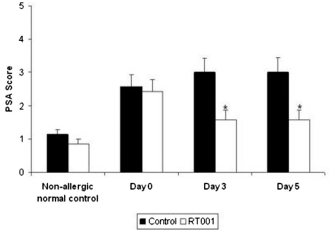
Effect of RT001 on clinical signs of allergic rhinitis. The performance severity assessment (PSA) score of rats (mean ± SEM) on days 3, 5, and 7 after treatment with control (filled bars) or RT001 (open bars). PSA values are significantly reduced for RT001 treatment compared with control by one-way ANOVA (p = 0.009) and are no longer significantly different (p > 0.05) from normal by day 5 whereas PSA scores for control animals remain significantly (p < 0.01) elevated compared with normal throughout the course of the experiment. Asterisks indicate days in which RT001 treatment caused significant reduction (p < 0.05) in PSA score compared with control treatment.
Histological and Immunohistochemical Evaluation of RT001 Treatment Effects
The hematoxylin and eosin–stained sections of control animals revealed typical signs of inflammatory pathology including edema, congestion, and vascular dilatation in nasal mucosa across the cavity, particularly in the turbinate (Fig. 2 b) and lateral nasal wall (Fig. 2 e), when compared with normal control animals (Fig. 2, a, and d). RT001 treatment resulted in essentially complete resolution of inflammatory findings (Fig. 2, c and f). Additionally, hyperplasia of serous glands also was found in some control animals (Fig. 2 b). The nasal mucosa of RT001-treated animals (Fig. 2, c and f) appeared essentially normal with only mild congestion (i.e., on the lateral nasal wall of this animal specimen shown in Fig. 2 e) on day 10 after treatment. No signs of atrophy or degeneration of serous glands were found after the RT001 treatment.
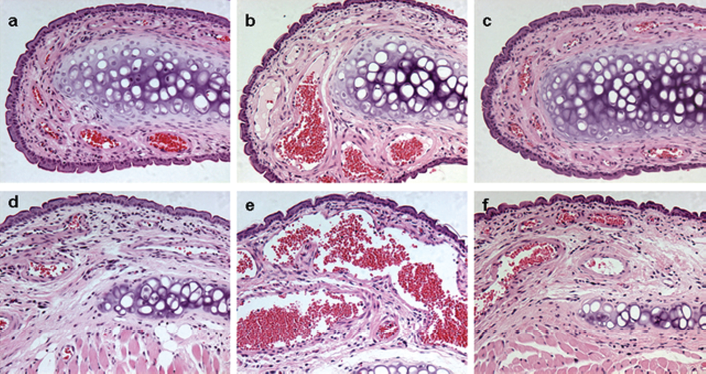
Effect of RT001 on inflammatory pathology associated with allergic rhinitis in nasal tissue. Histological staining of corresponding region of (a–c) left turbinate and (d–f) lateral nasal wall from three animals, (a, d) normal animal, (b, e) allergic control, and (c, f) allergic RT001 treated, respectively. The thickness of nasal mucosa was greater in (b, e) control animals than in (a, d) normal and (c, f) RT001-treated allergic animals. Remarkable mucosal edema, congestion and vascular dilatation were noted in (b, e) control animals when compared with (a, d) normal animals and (c, f) RT001-treated animals. (c, f) The RT001-treated animals showed essentially normal nasal mucosal tissue with only mild congestion (hematoxylin and eosin [H&E] stain; original magnification, X2).
VIP expression was dramatically increased after ovalbumin challenge and observed in the control animals (Fig. 3 b) in contrast to the normal animals (Fig. 3 a), especially around blood vessels and serous glands. After RT001 treatment, VIP expression in the nasal mucosa decreased markedly (Fig. 3 c) and appeared comparable with normal animal tissue samples (Fig. 3 a).
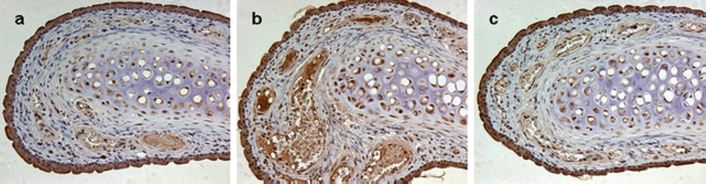
Immunohistochemical localization of vasoactive intestinal peptide in nasal turbinate. Serial sections from tissues shown in Fig. 2, a-c, were prepared and stained for vasoactive intestinal peptide (VIP) expression (indicated by brown staining). Strong VIP expression was noted in (b) control animals when compared with (a) normal animals. (c) After RT001 treatment, VIP expression was down-regulated essentially to normal levels (original magnification, X20).
Safety Evaluation of RT001 Compared with BoNTA Complex in Guinea Pigs
The safety profile of RT001 after intranasal dosing was compared with BoNTA complex in guinea pigs that are highly sensitive to the toxic effects of BoNTA, 27 thus providing a conservative estimate of safety for RT001 (Fig. 4). Death was observed in groups of animals treated with 110,000 U of RT001, and 1800 and 3600 U of BoNTA complex. The LD50 for RT001 and BoNTA complex via intranasal route of administration was determined as 108,350 and 1836 U, respectively. Dose levels of RT001 up to 55,000 U/animal were well tolerated with no abnormal clinical observations and no significant difference in mean daily body weight or overall body weight gain when compared with control (p = 0.2278 body weight gain). There was no significant difference in mean daily body weight or overall body weight gain of animals treated with BoNTA complex at 900 U (p = 0.1963 for body weight gain) compared with control. The NOAEL observed for intranasal dosing of guinea pigs was 27,500 U/animal for RT001 and 900 U/animal for BoNTA complex, indicating RT001 is ~31-fold safer compared with BoNTA complex via the intranasal route of administration. Furthermore, this NOAEL dose in guinea pigs is ~250-fold higher than the dose shown to be effective in treating allergic rhinitis in the rat model.
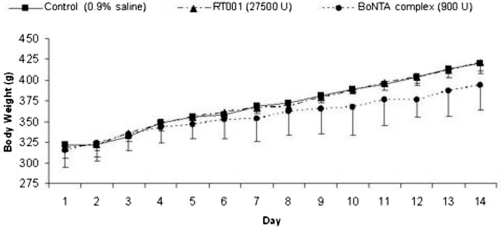
Effect of botulinum neurotoxin type A (BoNTA) treatment on mean daily body weight. Animals received a single intranasal dose of RT001, 27,500 U (▲); BoNTA complex, 900 U (●); or saline control (▄). Each symbol represents the average of three animals with SD shown by error bars. Asterisks denote values for RT001 that were significantly reduced compared with same day values for control (p < 0.05).
Discussion
In this study, an ovalbumin sensitization model was used to elicit clinical signs and inflammatory pathology representative of allergic rhinitis in rats. This model was used to evaluate the therapeutic potential of RT001, an investigative topical formulation of BoNTA, for the treatment of allergic rhinitis. A PSA scale was used that tracked the composite score of two clinical manifestations of rhinitis, sneezing, and itching. To further elucidate the RT001 effect on rhinitis pathology, histology and immunohistochemical staining were performed. The comparative safety of RT001 to that of BoNTA complex was further studied after intranasal dosing in guinea pigs, a species known to be highly sensitive to the toxic effects of BoNTA.
The PSA scale was shown to be sensitive and specific in tracking the onset of clinical signs of rhinitis. The typical total nasal symptom score used in clinical studies of rhinitis treatments tracks sneezing, itching, rhinorrhea, and congestion. For this study clinical observation of animals permitted quantitation of sneezing and itching (nasal rubbing) whereas congestion was addressed qualitatively as part of the histopathology assessment. Rhinorrhea was difficult to quantitate in rats and thus not included; however, it generally tracks with the other symptoms when evaluated in clinical treatment of rhinitis.21–23 Treatment with RT001 but not control resulted in significant reduction in PSA score by day 3 after treatment when compared with control and with essentially full resolution to normal baseline levels by day 5. In accordance with previous studies using BoNTA in animals15,18 and in humans, 25 these results indicate that the topical intranasal application of RT001 can relieve clinical signs in a rat model of allergic rhinitis.
Histological staining of nasal tissues of allergic animals revealed significant degrees of mucosal edema, congestion, and vascular dilatation along with hyperplasia of serous glands, which were resolved to essentially normal baseline levels after RT001 treatment. This effect of RT001 treatment on the inflammatory response associated with allergic rhinitis was further characterized by showing that the tissue level of VIP, a known mediator of nasal glandular secretions and the inflammatory process, was reduced essentially to normal levels after RT001 treatment.
Allergic rhinitis is caused by the interaction of allergens with inflammatory cells, resulting in release of vasoactive and proinflammatory mediators within the nasal mucosa. 1 Regulatory peptides, such as VIP, may play an important role in the hypersecretion of allergic rhinitis28–31 where a high density of VIP expression has been shown in nasal mucosa in allergic rhinitis patients 32 and rats. 18 It is therefore noteworthy that RT001 treatment reduced VIP expression to baseline levels and the suppression of VIP activity is associated with the reduction of congestion, vascular dilatation, and edema. This suggests that RT001 may also be a good candidate for treating idiopathic rhinitis as previously reported for BoNTA injection.19,22,24,25
Previous reports of topical application of liquid formulations of commercially available BoNTA complex relied on attempts to localize the dose by delivery in a saturated sponge or gauze packing,15,17,18,25 which presents procedural issues as well as safety concerns. Topical administration of such an improvised BoNTA treatment elicits potential risks of inadvertent oral exposure or ingestion of BoNTA and resulting systemic toxicity. BoNTA complex (used in Botox and Dysport) has been reported to be much more toxic (10- to 100-fold) via the oral route when compared with purified 150-kDa BoNTA present in RT001 33 because of the protective effect of the accessory proteins present in BoNTA complex that act to shield the 150-kDa neurotoxin from the harsh conditions of the gastric environment.
The current study shows that RT001 provides efficient transmucosal penetration in this rat model, eliminating the need for treatment by injection or nasal sponge packing. A specially designed proprietary peptide excipient enhances the transmucosal flux of BoNTA and the gel nature of the RT001 formulation helps to localize the applied dose to the intended treatment site presumably limiting spread to the gut via nasopharyngeal drainage, which is more likely to occur with liquid BoNTA formulations leading to systemic toxicity. A RT001-like formulation in development for intramuscular use has been shown to result in more targeted delivery of BoNTA to the intended treatment site in comparison with BoNTA complex formulation. 34 This safety profile of RT001 was confirmed in a comparative safety study with BoNTA complex in guinea pigs showing RT001 to be ~31-fold safer compared with BoNTA complex. The NOAEL dose in guinea pigs is ~250-fold higher than the dose shown to be effective in treating allergic rhinitis in the rat model, thus providing a large therapeutic window in preclinical models.
This study suggests that the intranasal application of RT001 is a safe and effective treatment for the symptoms of allergic rhinitis using animal models and may represent an effective alternative to procedures that require difficult injections into the interior nasal tissues as well as potentially reducing or eliminating the need for daily allergy medications. BoNTA treatment of rhinitis in prior clinical studies has led to symptom relief lasting at least 20 weeks after BoNTA injection 23 ; thus, it appears that BoNTA-based therapy for rhinitis has the potential to provide for long-lasting duration from a single treatment. These results warrant additional study of RT001 for its potential role in the clinical management of rhinitis.
Footnotes
Acknowledgments
The authors thank Jacob Waugh, M.D., Sharon Hall, and Christina Cocciardo for critical review of the article.