






Abstract
Background
Allergy test results can differ based on the method used. The most common tests include skin-prick testing (SPT) and in vitro tests to detect allergen-specific IgE. This study was designed to assess allergy test results using SPT, individual specific IgE tests, and a multiallergen IgE assay (multiple allergen simultaneous test) in patients with chronic rhinitis and controls.
Methods
One hundred forty total patients were prospectively enrolled in the study, including 100 patients with chronic rhinitis and 40 control patients without atopy. All eligible patients underwent SPT, serum analysis using individual specific IgE test, and multiple allergen simultaneous test against 10 common allergens. Allergy test results were then compared to identify correlation and interest agreement.
Results
There was an 81–97% agreement between SPT and individual specific IgE test in allergen detection and an 80–98% agreement between SPT and multiple allergen simultaneous test. Individual specific IgE test and multiple allergen simultaneous test allergy detection prevalence was generally similar to SPT in patients with chronic rhinitis. All control patients had negative SPT (0/40), but low positive results were found with both individual specific IgE test (5–12.5%) and multiple allergen simultaneous test (2.5–7.5%) to some allergens, especially cockroach, Dermatophagoides farina, and ragweed. Agreement and correlation between individual specific IgE test and multiple allergen simultaneous test were good to excellent for a majority of tested allergens.
Conclusion
This study shows good agreement and correlation between SPT with individual specific IgE test and multiple allergen simultaneous test on a majority of the tested allergens for patients with chronic rhinitis. Comparing the two in vitro tests, individual specific IgE test agrees with SPT better than multiple allergen simultaneous test.
SPT has traditionally been the most popular method of allergy testing because of its high sensitivity, reproducibility, and low cost. 4 However, certain conditions may influence and limit the use of SPT including skin conditions, patient age, and use of medications such as antihistamines, β-blockers, and select antidepressants. 4 SPT is also subject to some operator, observer, and interpretation variability.
In vitro allergen-specific IgE detection tests are less affected by these factors.2,5–7 The ImmunoCAP system (Phadia, Uppsala, Sweden) is a widely used, commercially available test that uses a fluorescent enzyme immunoassay to detect allergen-specific IgE (sIgE). ImmunoCAP also allows for a quantitative measurement of sIgE and has shown excellent reliability and reproducibility when compared with SPT.2,8–10
One disadvantage of ImmunoCAP is that it can detect only a single sIgE, so costs can be high when screening large panels of allergens. Multiallergen IgE assays can allow for detection of >30 sIgEs simultaneously.11–14 However, it can offer only semiquantitative sIgE results and its accuracy has been debated. 1 AdvanSure (LG Life Science, Seoul, Korea) is an in vitro multiallergen IgE assay. Unlike individual sIgE tests, AdvanSure can detect up to 42 allergen sIgEs simultaneously using only 100 μL of serum. 14 This test is based on the enzyme immunoassay technique with solid-phase allergen absorption and immobilization on nitrocellulose membrane. 14
Published studies have compared SPT with either sIgE tests or multiple allergen IgE assay systems,8–15 but not all three tests in parallel. The objective of this study was to evaluate and compare the efficacy of the AdvanSure and ImmunoCAP systems with SPT to detect IgE-mediated allergy in patients with chronic rhinitis and normal subjects.
Patients and Methods
This study was conducted prospectively over a 1-year period from January 2012 to December 2012. This study was approved by both Institutional Review Boards of Konkuk University Hospital (KUH1110020) and Korea University Hospital (MD12006).
Patients
One hundred patients with chronic rhinitis were prospectively recruited in the outpatient otolaryngology clinic at Konkuk University Hospital in Seoul, Korea. Inclusion criteria for this group were (1) adults, 18–60 years of age, and (2) diagnosis of rhinitis as defined by the 2008 Joint Task Force of Practice Parameters. 16 This included a positive clinical history and positive physical examination and one or more of the following nasal symptoms: rhinorrhea, nasal congestion, sneezing, and itching and rhinitis symptoms for >3 months. Exclusion criteria included (1) use of any medication 2 weeks before study enrollment (including β-blockers, antihistamines, or psychiatric drugs) and (2) inability to provide informed consent.
Forty healthy adult patient volunteers served as controls. These patients were recruited from the Department of Otorhinolaryngology–Head and Neck Surgery outpatient clinic at Korea University Hospital for the study. Inclusion criteria for this group were adults, aged 18–60 years. Exclusion criteria included (1) diagnosis of allergic rhinitis or allergy as defined by the Joint Task Force of Practice Parameters, 16 (2) any medication use 2 week before study enrollment, and (3) inability to provide informed consent.
Allergy Testing
Both study cohorts were given the SPT. Five milliliters of whole blood was collected for ImmunoCAP and AdvanSure tests in a vacuum tube. After centrifugation, serum was aliquoted and frozen at -80°C for storage until processing.
Skin-Prick Test
SPT was performed on the forearm using the 10 most common allergens among Koreans, viz., Dermatophagoides pteronyssinus, Dermatophagoides farinae, dog, cat, cockroach, birch, oak, ragweed, mugwort, and Alternaria per our previously described protocol. 13 Allergens were obtained from Allergy Therapeutics Limited (Worthing, U.K.). Wheal size was measured 15 minutes after pricking and compared with a histamine control. Wheals twofold larger in diameter than the histamine control or showing a pseudopod were classified as 4+ (>200%). If the wheal was >3 mm or up to two times larger than the histamine control, it was classified as 3+ (100–200%). If it was more than one-half the size of the control it was scored as 2+; if it more than one-quarter of the size of the control it was scored as 1 +; and if it was less than one-quarter of the size of the control it was scored as 0.3,13 Scores of 2+ or more were defined as positive.
ImmunoCAP.
sIgE in serum was measured by ImmunoCAP. Measurement of the same 10 allergens was performed according to the manufacturer's protocol (ImmunoCAP; ThermoFisher Scientific, Uppsala, Sweden). The results were graded into classes: 0 (under 0.35 kU/L), 1 (0.35–0.7 kU/L), 2 (0.7–3.5 kU/L), 3 (3.5–17.5 kU/L), 4 (17.5–50 kU/L), 5 (50–100 kU/L), and 6 (>100 kU/L). Class 1 or more was defined as positive.
AdvanSure.
Measurement of sIgE to 42 allergens (including the 10 allergens used in SPT and ImmunoCAP) was performed according to the manufacturer's protocol (AdvanSure Allergy Screen; LG Life Science). The results were graded using the same scale used for ImmunoCAP.
Statistics
Cohen's κ-analysis was computed to quantify the adjusted amount of agreement beyond chance between the allergy tests. The total nominal agreement percentage was calculated as (total number of results-number of discrepancy) x 100/total number of results. The correlations between SPT score (0 to +4), ImmunoCAP class (0–6), and AdvanSure class (0–6) were calculated using Spearman's rank correlation. Calculations were performed using SPSS statistical software (SPSS for Windows 13.0; SPSS, Inc., Chicago, IL). The p values for comparisons of correlation coefficient between SPT and ImmunoCAP and between SPT and AdvanSure were calculated using dBSTAT Version 4.1 (dBSTAT, Seoul, Korea). A value of p < 0.05 was considered statistically significant.
Results
The average age for patients with chronic rhinitis in the study was 42.3 years (±10.2 years), with a male/female ratio of 42:58. Age of control patients was 44.5 years (±13.1 years) with a male/female ratio of 22:18. Fifty-nine of 100 chronic rhinitis patients showed at least 1 or more positive results from three allergy tests, and 12 of 40 normal controls also did.
Results of SPT, ImmunoCAP, and AdvanSure
Patients in the chronic rhinitis group (n = 100) generally had similar allergy detection prevalence between the three tests (Table 1). However, positive rates for cockroach allergen were lower with AdvanSure (11%) compared with the other two tests (23% for SPT and 22% for ImmunoCAP).
Positive rate of SPT, ImmunoCAP, and AdvanSure

SPT = skin-prick test.
For the control patients (n = 40), SPT was negative for all 10 allergens. ImmunoCAP and AdvanSure showed very low positive test results (2.5–12.5%) depending on the allergen despite negative SPT. The most frequent positive allergens identified in the control group on both ImmunoCAP and AdvanSure allergy testing were to D. farinae, cockroach, and ragweed.
Diagnostic Agreement between SPT and Serum Allergy Testing (ImmunoCAP or AdvanSure)
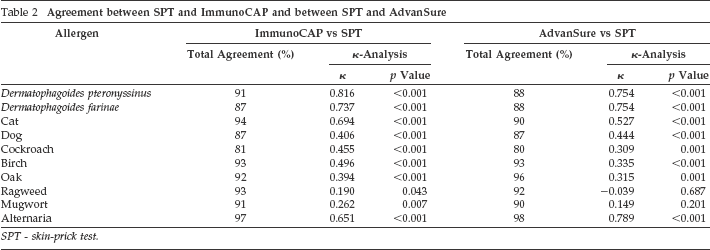
Total nominal agreement percentages between SPT and ImmunoCAP were >81% for all 10 allergens (range, 81–97%; Table 2). Agreement between AdvanSure and SPT was ≥80% or all 10 allergens (range, 80–98%). The κ-values for SPT versus ImmunoCAP were >0.40 for 7/10 allergens tested, with the exceptions being to oak, ragweed, and mugwort, where the number of positives were low. When comparing AdvanSure to SPT, 5/10 allergens had κ-values >0.40, with lower agreement to cockroach, birch, oak, ragweed, and mugwort, also likely because of the few patients who tested positive to these allergens.
Agreement between SPT and ImmunoCAP and between SPT and AdvanSure
SPT - skin-prick test.
The κ-value between SPT and ImmunoCAP was higher than with AdvanSure by >0.1 for five allergens (cat, cockroach, birch, ragweed, and mugwort), and vice versa for Alternaria.
Correlations between SPT and ImmunoCAP and SPT and AdvanSure
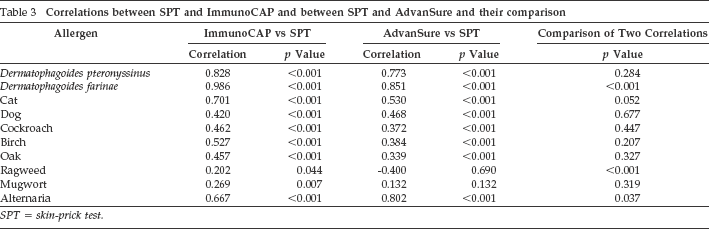
Correlation coefficients were >0.4 for eight allergens between SPT and ImmunoCAP and five allergens between SPT and AdvanSure (Table 3). However, ragweed and mugwort showed very poor correlation between SPT and both ImmunoCAP and AdvanSure systems. Correlations between SPT and ImmunoCAP were significantly stronger than those between SPT and AdvanSure for D. farinae and ragweed (p < 0.001), and vice versa for Alternaria (p = 0.037).
Correlations between SPT and ImmunoCAP and between SPT and AdvanSure and their comparison
SPT = skin-prick test.
Agreement and Correlation between ImmunoCAP and AdvanSure
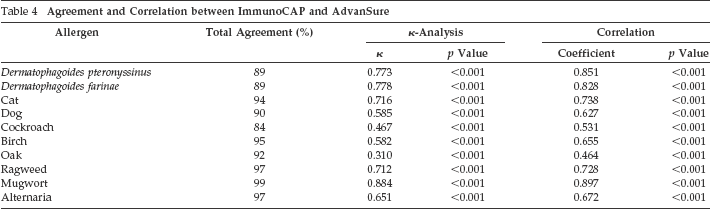
Total agreement percentage between ImmunoCAP and AdvanSure allergy tests was very high (range, 84–99%; Table 4). The κ-value and correlation coefficient were also high. Nine of 10 allergens had a κ-value of >0.58, with correlation coefficients of >0.46 for all allergens.
Agreement and Correlation between ImmunoCAP and AdvanSure
Discussion
Skin prick and serum allergy assays are both designed to detect type 1 IgE-mediated immediate hypersensitivity reactions. 2 In patients with history and physical examination findings suggestive of allergic disease, SPT has traditionally been the most popular testing method.2–4 However, SPT has some important limitations. SPT requires specialists to perform the test and interpret results, and various medications and medical conditions might influence results.3,4 In these and other situations, in vitro sIgE detection tests can have advantages over SPT. Concordance between in vitro sIgE assays and SPT results is between 85 and 95%, depending on the allergen being tested and the method used to detect sIgE. 17
Our study indicates that SPT, ImmunoCAP, and AdvanSure tests had generally very similar test results and were effective in detecting allergy in patients with chronic rhinitis. Total agreement between ImmunoCAP and AdvanSure to SPT was >80% for the allergens evaluated in this study (Table 2). When comparing ImmunoCAP and SPT, Devalue ranged from 0.816 to 0.190, but generally showed good agreement. D. pteronyssinus, D. farinae, cat, and Alternaria had the highest Devalues (>0.6), suggesting good agreement; however, ragweed (0.190; p = 0.043) and mugwort (0.262; p = 0.007) had lower κ-scores, which might be an artifact of too few patients testing positive. The κ-values between AdvanSure and SPT were smaller in 7/10 allergens when compared with ImmunoCAP and SPT, suggesting that ImmunoCAP agrees with SPT better than AdvanSure.
SPTs were negative for the allergens tested in the control group. However, both the ImmunoCAP and the AdvanSure tests used in this study showed occasional allergen positivity despite negative SPT. One potential explanation of the positive in vitro results in our control group is that, previously, the cutoff value was usually class 2, but now class 1 is considered to be positive.13,14 This change would cause more positive test results. Allergy serum assays are also known to give occasional false positive results because of nonspecific binding of antibodies used in the assays. 2
Our results indicate the results of SPTs correlate best with in vitro testing (ImmunoCAP or AdvanSure) on dust mites, cat, dog, cockroach, Alternaria, and birch The other allergens, specifically oak, ragweed, and mugwort evaluated in this study would require larger numbers of positive subjects to determine the true agreement between the tests. The correlation between SPT and ImmunoCAP was superior to SPT and AdvanSure. The agreement between ImmunoCAP and AdvanSure was excellent for all allergens (84–99%), suggesting that both tests do have similar results when compared with each other.
In summary, SPT and both in vitro sIgE detection assays had very similar results with good correlation and agreement to a majority of the allergens tested in this study. Among the two in vitro tests, ImmunoCAP agreed with SPT better than AdvanSure. Future research with larger study populations will provide more information on differences in SPT and serum allergy test correlations to the less common allergens (birch, ragweed, mugwort, oak, and Alternaria) identified in this study.
Conclusion
Both ImmunoCAP and AdvanSure were effective in detecting allergens in patients with chronic rhinitis when compared with SPTs. In general, both SPT and in vitro test results are concordant and appear equivalent for a majority of the tested allergens. Among the in vitro tests, ImmunoCAP agreed with SPT better than AdvanSure.