






Abstract
Ever since Mark Nathan Cohen's (1976) treatise, The Food Crisis in Prehistory, ethnobiological explorations of historic shifts in subsistence strategies, agro-economic structures and uses of biodiversity have explicitly dealt with the issue of cultural responses to food insecurity and declining nutrition health. More recently, sensationalistic and rather simplistic treatments of these topics by the likes of Jared Diamond (2005) have attempted to predict or ultimately avert future collapses in society's capacity to sustain food security, with dubious results. However, archaeologists and ethnobiologists have diligently worked together to arrive at more nuanced understandings of how climatic, ecological, social, economic and political factors have interacted during prehistoric and historic periods of food crises (McAnany and Yoffee 2009, 2010).
Nevertheless, the general sorts of questions posed by Diamond remain before us: Can the lessons learned from the historical sciences of archaeology, paleonutrition and ethnobiology be used to forge a more comprehensive and useful predictive science regarding trends and options for human health and food security? Can such predictions help assure the functioning of ecosystem services required for stable food production, while averting famine and improving nutritional health in the face of accelerating climate change, declining fossil fuel and fossil groundwater reserves, and burgeoning human populations?
A thoughtful summary of interdisciplinary literature on the links between biodiversity and food security by T. C. H. Sunderland (2011) suggests that such an integrative and predictive science is not only possible but increasingly necessary. Drawing on an extensive review of ethnobiological literature, Sunderland concludes that:
Although long considered mutually exclusive, biodiversity conservation and food security are two sides of the same coin… Maintaining diversity within agricultural systems is not a novel approach, but one practiced by many smallholder farmers globally, in many different ways. The nutritional and livelihood benefits of diverse production systems are one way of achieving food security. Such systems are also more resilient to climate induced events or other shocks…Managing landscapes on a multi-functional basis that combines food production, biodiversity conservation and the maintenance of ecosystem services should be at the forefront of efforts to achieve food security (Sunderland 2011:265)
While there is intuitive sense to Sunderland's take-home message of more strongly linking the maintenance of biodiversity and ecosystem services in agricultural landscapes to our quest for greater food security, it will take testing such principles at different scales and different cultural and political-ecological contexts to determine their operability for the future. In other words, ethnobiologists may need to play key roles in determining whether greater biodiversity correlates with greater yield stability and food security only at the scale of field, farm, and ranch, or at other scales (community, foodshed, ecoregion, nation, and planet) as well. This is but one of many ways that ethnobiologists can determine whether our insights from empirical studies of prehistoric, historic, and contemporary food systems have predictive value in redesigning food systems for a more secure and resilient future in the face of climate change.
If there is a strong correlation between biodiversity and food security at multiple scales, then the continuing loss of biodiversity should be of concern not merely to conservation biologists, but to nutritionists and health planners as well. The latest (2010) assessments by the Royal Botanical Garden staff at Kew suggests that one fifth of the world's plant species are currently under threat of extinction, and many of the food species under threat have nutrient densities and chemo-protective secondary compounds that, if still accessible to the poor, could improve or sustain their health. Since 1970, when the Southern Corn Blight revealed the relatively high genetic vulnerability of most commodity crops grown in the United States and Canada, considerable ink has been spilled about the decline in biological diversity in North America's commodity food system. As the diversity of nutrients and chemo-protective compounds has declined in the American diets, we have also witnessed a dramatic increase in nutrition-related diseases such as non-insulin dependent diabetes (NIDD).
For example, the number of Americans living with this form of diabetes has grown to an estimated 22.3 million—about seven percent of the US population. That marks an increase of nearly five million or 22 percent from 2007 to 2012 and, according to the American Diabetes Association, translates to 245 billion dollars of annual medical costs (Nabhan 2013a:x-xi). By 2030, we can anticipate that if the composition of American diets remains essentially the same as it is today, at least 9 million additional Americans will suffer from diabetes, and the cost of their treatment may be anticipated to surpass 1.2 trillion dollars a year (Nabhan 2013a). If our dietary diversity diminishes further due to crop failures associated with catastrophic climatic events, and loss of optimal conditions for crop and livestock production in the areas where they are currently grown, we might predict even higher levels in the incidence and prevalence of NIDDM and other nutrition-related diseases.
To test whether such predictions and the hypotheses within them are valid, ethnobiologists may wish to focus more attention on the nutritional health of households and populations in localities where food biodiversity has remained high or recently been restored. Curiously, over the same approximately three decades that commodity agriculture has lost diversity, the species richness and landrace diversity in small-scale agriculture in the U.S. and Canada has actually increased fourfold (Figure 1). This increase has likely occurred as a result of gardeners, farmers and other small shareholders wishing to provide healthy, locally-produced options to commoditized foodstuffs in the globalized food system. From less than 5000 unique offerings of farmer-selected, heirloom and landrace food plant varieties voluntarily offered by members of the non-profit Seed Savers Exchange in the early 1980s, between 20,000 and 22,000 unique offerings have been annually listed in SSE publications since 2006 (Nabhan 2013b). Today, some 640 domesticated species of crops and livestock now produced on American farms and ranches are making it onto the tables of home and restaurant kitchens, and many of them are back in the diets of North Americans for the first time in over half a century. In addition, U.S. scientists and other citizens have recently rediscovered that they have nearly 4600 species of wild crop relatives still growing in North American landscapes, many of which are listed as forageable staples or “famine foods” in Daniel Moerman's (1998) Native American Ethnobotany compendium.
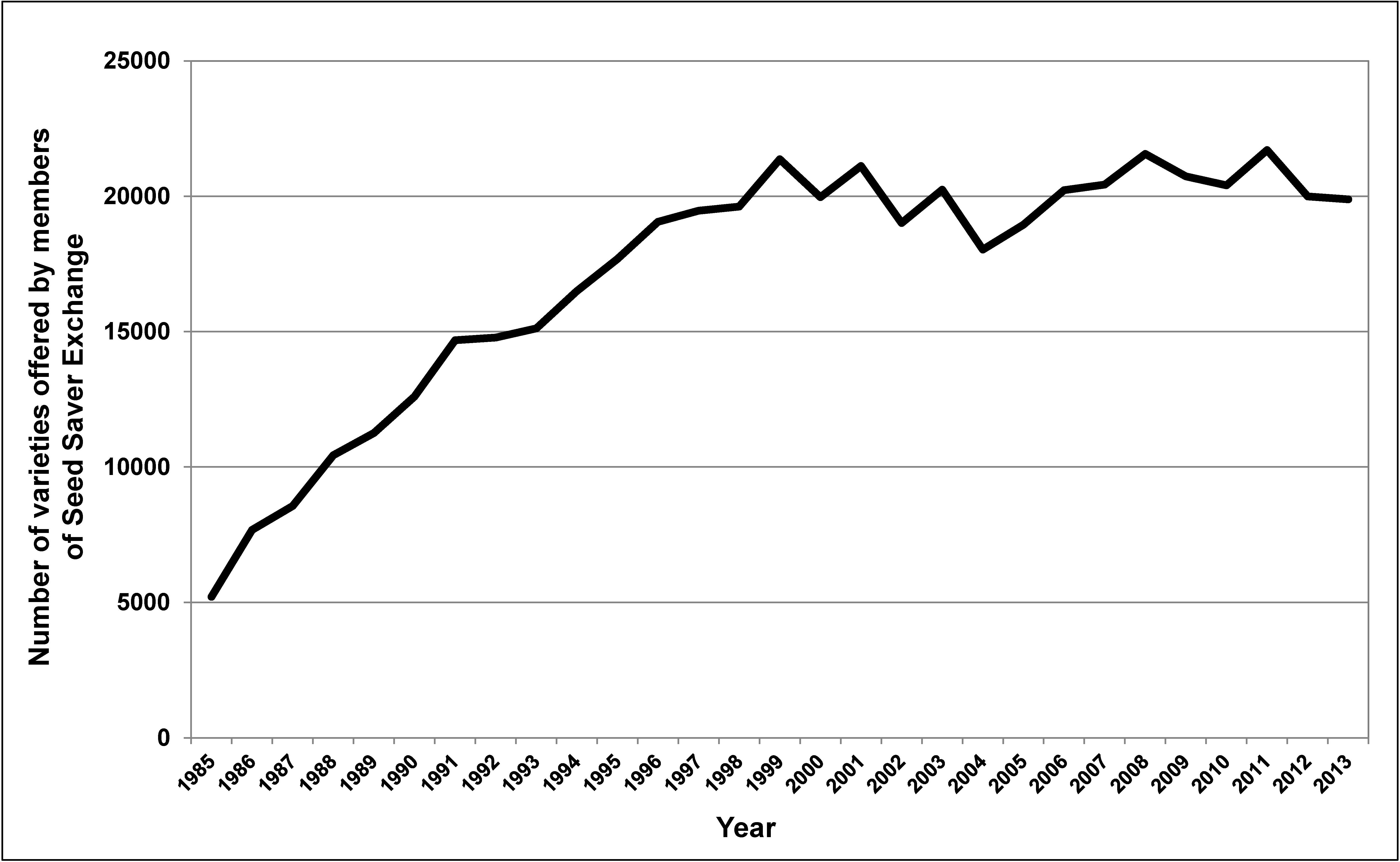
Yearly growth in the number of unique heirloom vegetable, grain, herb and fruit varieties, landraces, and genotypes voluntarily offered for public access by members of the Seed Savers Exchange.
If we could confirm that accessing such diverse food resources does indeed make a difference in the nutritional health of those who utilize them, then how would we reallocate financial resources in our food economy and health care system to use food diversity to prevent nutrition-related diseases? For example, what if just one hundredth of what is expected to be invested in diabetes treatment (e.g., $245 billion in the U.S. in 2012) were annually invested in a healthy food system offering culturally appropriate foods to America's diverse cultures? If strategically invested. How much good could $2.5 billion a year do to further rediversify America's food system at all scales in order to assure improved human health and increased food security in the face of climate change?
Nevertheless, if one only looks at species or varietal richness as a surrogate for the larger concept of biodiversity in the service of food security, one could reasonably claim that (a) the American food system is now diverse enough that we need not worry about food insecurity, or (b) that our present levels of species and varietal richness have little or nothing to do with protecting us from food insecurity and famine. The missing factor, of course—if you know how ecologists conceive of and measure biodiversity—is the relative abundance of each species and variety relative to the entire community. In this case, most of those 22,000 food plant varieties are now grown by gardeners and small farmers who manage only a small portion of America's arable lands and provide only two to five percent of the foods that U.S. and Canadian citizens consume. In other words, while the biodiversity is thankfully “present” in small pockets of our food system, it has not yet changed the way most Americans eat, nor does it yet offer most Americans resilience or protection from the kinds of “climate induced events or other shocks” that concern Sunderland.
Perhaps the key insight embedded in the quotation from Sunderland is that diverse production systems are but one way of achieving food security (italics added). No matter how many species or varieties of adapted and resilient crops and livestock are grown in a landscape, the production system is unlikely to be resilient if its agricultural inputs, labor forces, food processing infrastructures, and distribution and marketing subsystems are all controlled by a few large shareholders or absentee-owned corporations. Today, we may need structural diversity in agricultural production, processing, distribution, retailing and investment, not just in the crop assemblage of a dooryard garden or food forest at a desert oasis. This is but one more example of how ethnobiology and cultural ecology must be wedded with political ecology if these sciences are to help us predict how we can better design our food systems, not only to be resilient in the face of climate change and other “shocks,” but to be “good, clean and fair” as well.
As many of my colleagues’ fine work on food security demonstrates, achieving food security cannot be done merely with some technical fix (even if that fix is defined as simply increasing food biodiversity); it will require protracted attention to ethical, socioeconomic and cross-cultural concerns as well. If true food security entails “affordable access to nutritious, culturally appropriate foods” that do not further impoverish the soil community, the farmworker community, or the food-service workers community, all of whom bring us “our daily bread,” then our emerging predictive science of food security must embrace all the sciences as well as the humanities if it is to be of any lasting value. In short, achieving food security will ultimately be more about enhancing our “caring capacity” than simply about ramping up our landscape's “carrying capacity.”