







Abstract
The abundant anthropological and historical evidence for animal-based medicine, or zootherapy, suggests that animals are, and have always been, perceived as important components in maintaining human health and well-being. Despite being interwoven into every aspect of life, from food medicines to ritual practice and everyday human-animal interactions, zootherapies are widely considered invisible in the archaeological record, perhaps because of their organic nature, the method of remedy preparation, or potentially because of their sheer ubiquity. An alternative explanation is that archaeologists are just not viewing the evidence through an appropriate theoretical lens. This article sets out to examine whether archaeologists might make a greater contribution to our understanding of ancient zootherapy. As a case study, it draws particularly on evidence pertaining to the European fallow deer (Dama dama dama) an exotic species that is well represented in classical mythology and iconography and appears to have been attributed with magico-religious medicinal qualities. Indeed, here we argue that their perceived magico-medicinal value may even have been the prime mover in their human-instigated spread across Europe.
Introduction
The World Health Organization (WHO 1993) estimates that today, about 80% of the world's population (six billion people), rely on animals, their parts, and products as a method of primary health care. The use of animals to diagnose and treat illness is known as zootherapy and is particularly common across Asia (Bensky and Gamble 1986; Dev 2001; Mahawar and Jaroli 2008), Africa (Abbink 1993; El-Kamali 2000; Low 2011; Morris 1998; Rekdal 1999), Latin America (Alves and Rosa 2005, 2013; Alves et al. 2011a, 2011b, 2013; Costa-Neto 2004; Ferreira et al 2012; Jacobo-Salcedo et al. 2011 Martinez 2013; Oliveira et al 2010; Walker 2010), and the Middle East (Lev 2003; Rosner 1995).
Zootherapy can take many forms. Live or dead animals may be used in therapies, rites, and rituals, with animal-derived products “consumed” (either orally or through any of the senses) or worn as personal adornment. The motivations behind these different practices are equally varied, as they are employed for protective, preventative, diagnostic, or curative reasons (Alves and Rosa 2005; Insoll 2011). Zootherapy does not form a single discrete group of medicinal practices; rather it pervades throughout daily life, economics, and diet and is often bound up with religious and spiritual beliefs. This is especially because, in many cultures that practice zootherapy, disease, illness, and other misfortunes are believed to have divine origins (Abbink 1993; Kee 1986; Ogden 2014; Walker 2010). For instance, the Piaroa of the Amazon believe that diseases are sent by the Spirit Masters, so they keep tamed parrots to “sing away” illness (Walker 2010). In other cases, animals may be used to invoke the supernatural for diagnostic or curative interventions. For example, the Me'en of Ethiopia sacrifice livestock when a member of their community appears mortally ill. It is believed that at the point of sacrifice the animal becomes a medium for communication with the spirits who are called upon to leave a message in the animal's intestines. This message can then be understood through the process of haruspication (entrail reading), a form of medical prognosis (Abbink 1993).
Sacrifice and haruspication are widespread and important aspects of zootherapy, but after death, animal bones, meat, and other products (fat, hair, shell) take on equally important medicinal roles (e.g., Lev 2003). It is difficult to classify such practices within a modern, western notion of medicine, but many of the explanations seem consistent with Frazer's (1993:12) concept of “sympathetic magic,” which he subdivided into a further two categories: “homeopathic magic” and “contagious magic.” In homeopathic magic, like produces like; for example, people in Siberia use a woodpecker's beak to cure toothache because “there is a point of view from which a woodpecker's beak and a man's tooth can be seen as ‘going together’” (Lévi-Strauss 1966:9). For similar reasons, in Brazilian zootherapy, a centipede is taken for pains of the leg, as they clearly excel at generating lower limbs (Christman 2008; Costa-Neto 2004). Contagious magic holds that contact between things can have a lasting effect, even at a distance of time and space. For example, in Brazil, a young child can be imbued with the sure-footedness of a donkey by scrubbing its knee in the animal's footprint (Alves et al. 2011a). Amongst the KhoeSān of Southern Africa, ostrich shell is used to create protective beads for children, on the basis that the bead captures the potency of the ostrich and passes the bird's strength onto the wearer (Low 2011). For the KhoeSān, ostrich egg shell is not only worn for amuletic reasons, but also powdered for medicinal consumption. This is because the shell is deemed to have “cooling” properties and is seen as a powerful treatment for “hot” fevers (Low 2011).
The concept of hot/cold and wet/dry maladies and their corresponding treatments is one of the most widely accepted medical belief systems in the world (see papers in Manderson 1987; Pool 1987). Across cultures, disease and illness are considered in hot/cold and wet/dry terms, with zootherapeutic cures requiring the “consumption” of animal products with opposing characteristics to restore balance. The global occurrence of such medicinal theories, and the fact that there is great geographical variability in what is considered “hot,” “cold,” “wet,” or “dry,” suggests that these concepts emerged independently in different areas of the world (Anderson 1987).
The most influential branch of the belief in hot/cold and wet/dry imbalances—that of humoral medicine—has a clear line of descent that can be traced back through early modern, medieval, and Roman scholars of medicine to the Hippocratic Corpus of the fifth century BC (e.g., Arikha 2007; Manderson 1987; Nutton 2012). Markedly similar humoral concepts of medicine can be found in even earlier documents (c. 1600 BC), such as the Indian Rigveda (Arikha 2007) and the Diagnostic Handbook from Mesopotamia (King 2001), as well as the c. 900 BC Chinese Shih Ching (Kong and But 1985). This indicates a common ancestry whereby schools of medicine had a mix of influences, transmitted along the Silk Roads (Ogden 2014; Subbarayappa 2001; Touwaide and Appetiti 2013).
All of these ancient texts contain remedies that reveal the permeability of medicine and how human well-being, both in the past and present, cannot be separated from broader aspects of lifestyle, diet and, in particular, religion and supernatural forces (Nutton 2012). The magico-religious links to medicine are unsurprising because, as with the modern Piaroa, illnesses and cures have, throughout time, been perceived as having divine origins. For the Minoans (c. 3500–1700 BC) and Mycenaeans (c. 1600–1100 BC), the gods had ultimate power over human health and it was to them that disease was often attributed (Faraone 1993; King 2001). The divine nature of disease is also alluded to in Homeric epics (c. 850 BC); for example, in the opening of The Iliad 1 , the deities Apollo and Artemis shoot disease-causing arrows into men and women, respectively. The connection between medicine, natural philosophy, and religion continued into the fifth–fourth centuries BC, as evidenced by writings such as Hippocrates’ On the Sacred Disease 2 . As such, magical rites and preparations were not alternatives to medicines; they were the corporal aide through which healing manifested, if it was the will of the gods (Gesler 1993; Parker 1983).
Through the course of the Greco-Roman period, scholars of medicine attempted to separate the healing arts from magic and religion (Carrick 2001), but it is clear that such distinctions were difficult to draw (e.g., Baker 2013; Nutton 2012). Pliny the Elder, a Roman author of the first century AD, was amongst the most outspoken objectors to magico-religious therapies, in particular the quackery pedaled by itinerant Greek physicians (Kee 1986). Yet his Natural Histories are replete with animal-based cures that are indistinguishable from the very sympathetic and homeopathic magic that he attributed to fraudulent medics (Kee 1986). In his Natural Histories
3
, Pliny explains that:
…there is no place where that holy Mother of all things did not distribute remedies for the healing of mankind, so that even the very desert was made a drug store, at every point occurring wonderful examples of that well-known antipathy and sympathy.
Evidence for Pliny's subscription to sympathetic magic can be seen in his remedy for rabies, which, in common with homeopathic magic, prescribed eating the liver of the biting dog 4 . This same remedy is given by Dioscorides in his de Materia Medica 5 , although his suggested treatment contains the added advice of tying a tooth from the biting animal to the arm, a cure more consistent with contagious magic 6 . The works of both Pliny and Dioscorides contain extensive evidence for the importance of zootherapy in the Roman world, with animal products prescribed in special diets, pharmaceutical concoctions, votives for intercessions, wards against the occult, spirits and astral influences, and in efforts to placate the gods. Similar animal-based medicinal practices are seen in ancient cultures around the world. Zootherapy figured large in texts from ancient Egypt (Bryan and Smith 1874; Ebbell 1937; Halberstein 2005; Lev 2003; Nunn 2002), Mesopotamia (Cragg and Newman 2001a, 2001b; Lev 2003; Nakanishi 1999), China (Bensky and Gamble 1986; Kong and But 1985; Nowell et al. 1992; Subbarayappa 2001), Persia (Subbarayappa 2001), and India (Dev 2001; Mahawar and Jaroli 2008; Pool 1987; Scarpa 1981; Subbarayappa 2001), as well as amongst Amerindian groups across North and South America (Alves et al. 2007; Silva et al. 2004).
Given how widespread animal-based medicine is in societies both past and present, it seems inconceivable that the remnants of zootherapy are not preserved in abundance within the archaeological record.
Finding Zootherapy in Archaeology
Archaeological studies of animal-derived medicines are rare, a point not only made by Baker's (2013:9) The Archaeology of Medicine in the Greco-Roman World but also exemplified by the same volume's limited zooarchaeological discussion. The lack of attention given to medicine by zooarchaeologists has been noted by Russell (2012:392–94), who argues that evidence is difficult to find, although she admits that few people have looked. Sykes (2014b:129–30) proposed that the apparent elusiveness of zootherapy in archaeology may, in part, be related to the process of converting animal materials into medicine; in modern zootherapy, animals are transformed into medicines mainly through the grinding up and consumption of burned bone (Insoll 2011). Classical texts similarly refer to the ashing and powdering of animal products7,8 (Ogden 2014). This means that the very act of converting an object into medicine was destructive, not to mention the fact that the ultimate aim was often consumption. Little would therefore be detectable in the archaeological record.
Beyond this, our inability to find archaeological evidence of medicine is almost certainly an artifice of our own worldview, which has the expectation that medicine and medical practices are distinct from other forms of food/drink or behavior. However, as has been shown above, across cultures past and present, life is seldom so neatly compartmentalized and it seems likely that for many ancient societies, all animal-derived foods, objects, or interactions had the potential to be conceptualized and used medicinally. The possibility that any animal-derived product may represent medicine offers another possible explanation why such materials are overlooked archaeologically—they are obscured by their omnipresence. That said, modern zootherapies often preferentially target the remains of animals that are exotic or wild, as geographical distance is equated with supernatural distance, and that healing power increases with cultural remoteness (Helms 1993; Rekdal 1999). It is certainly interesting to note that, given the greater availability of domestic animals, both Dioscorides and Pliny place comparatively more emphasis on the medicinal value of wild and exotic animals. From an archaeological perspective, these animal categories also tend to be highlighted in the zooarchaeological literature, especially exotica (e.g., Lepetz and Yvinec 2002; Mackinnon 2006; Prummel 1977; Ryder 1975; Schmid 1965; Sykes 2012), and they would therefore seem to offer a logical focus for an archaeological exploration of zootherapy.
As a case-study, this article sets out to examine archaeological evidence for the use of deer in Greco-Roman medicine. Cervidae (deer family)—animals so iconic of the wild—are among the mammal species most frequently used in zootherapies across the world and have been labeled “the ultimate medicinal animal” (Kong and But 1985). Their body parts, in particular their antler, antler velvet, and penises, are important ingredients in zootherapy, especially in China where the medicinal association with deer dates back to at least 900 BC (Fletcher 2011; Kong and But 1985). The Shen Nung Pents'ao Ching text (200 AD) states that velvet antler (pantui) “tastes sweet and its property is warm,” the last point suggesting a link to humoral medicine (Kong and But 1985:312). The text goes on to list ailments that pantui treats, including conditions of the teeth and epilepsy (Kong and But 1985). Interestingly, Pliny also recommends the use of deer antler to treat epilepsy and tooth ache 9 , the similarity again indicating a shared tradition of knowledge.
While this paper will at times consider deer in general, it focuses specifically on the role of the European fallow deer (Dama dama dama) in medicinal practices in antiquity. This species is not only “wild,” but is also non-native to much of Europe, potentially rendering it more powerful medicinally as an “exotic” animal, as well as more visible in the archaeological record.
The Case of the Fallow Deer
The European fallow deer is characterized by a spotty coat and, in the males, palmate antlers and a distinctive brush-like penis sheath not found in other European cervids (Chapman and Chapman 1997; Figure 1). It has a close relationship with people who, over the last 10,000 years, have transported the species from its native range in the Eastern Mediterranean to locations worldwide (Miller et al. in prep.).
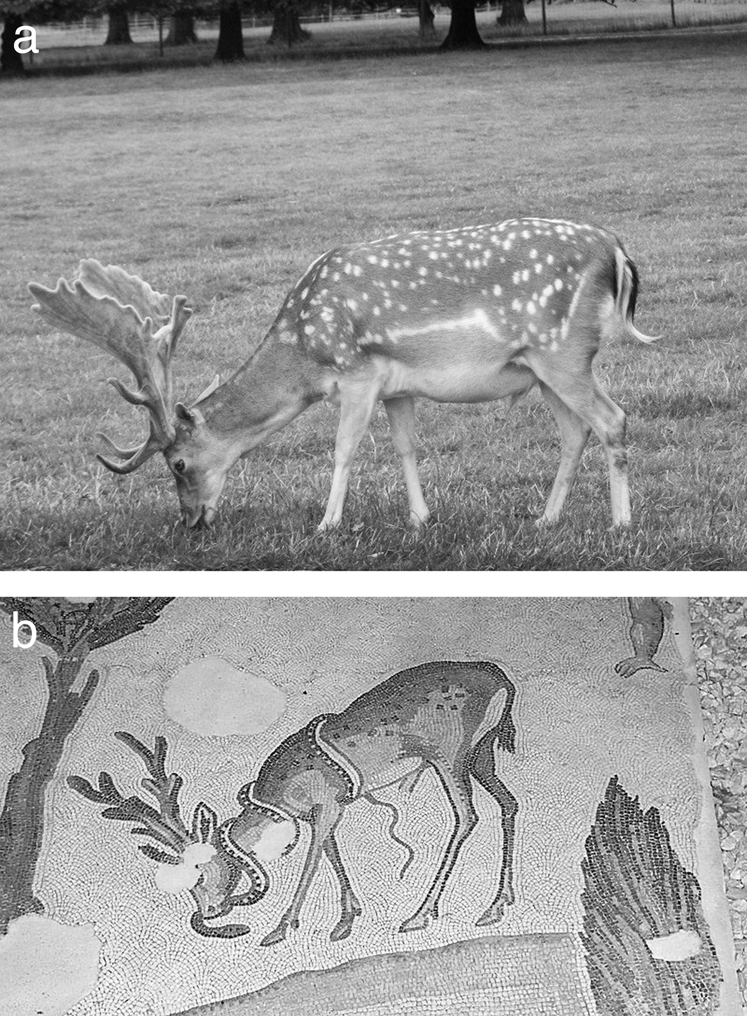
(a) Fallow deer buck: its distinctive spotted coat, palmate antlers and prominent penis sheath rendering it highly identifiable in ancient art (Photo credit N. Sykes) (b). Image Byzantine mosaic, sixth century AD, on display in the Great Palace Mosaic Museum, Istanbul.
Our recent international research project on the fallow deer has shown that movements appear to have begun in the Neolithic and Bronze Age, when they were taken to Aegean islands such as Rhodes and Crete (Masseti et al. 2006; Yannouli and Trantalidou 1999). The Roman period witnessed further translocations to Italy, Sicily (Wilson 1990), Portugal (Davis and MacKinnon 2009), and even northern Europe. There is good evidence that breeding populations of fallow deer were established in Britain at the elite site of Fishbourne Palace in Sussex (Sykes et al. 2006) and on the Isle of Thanet (Kent), which during the Roman period was a true island (Madgwick et al. 2013; Miller et al. 2014; Sykes et al. 2011).
The reason why people went to such efforts to translocate this species has been the subject of some debate. Legend recounts that fallow deer were transported around the Mediterranean region because of their ability to eradicate snakes by trampling them and then eating them (Masseti 2002). There are many iconographic representations depicting this scenario (e.g., see Figure 1b), suggesting that the fallow deer-snake relationship was widely recognized and accepted; indeed, Pliny mentions that no one was unaware of it 10 . Archaeological interpretations have less to say about snakes and instead emphasize the value of fallow deer as a quarry and as a source of meat, suggesting they were transported for the purpose of creating hunting reserves—game larders where venison could be stored “on-the-hoof” (Masseti 2002; Sykes et al. 2006). More recently, the cosmological significance of fallow deer, in particular the species’ well-known association with the Greek and Roman goddesses of hunting (Artemis and Diana respectively), have been proposed as key drivers for the diffusion of fallow deer (Miller et al. 2016; Sykes 2014b). The possibility that this religious association might have become entangled with zootherapy seems likely, especially since Artemis/Diana, the goddess of hunting, was called upon particularly during childbirth in her capacity as protector of women and children (Crummy 2010; Faraone 2003).
There are clear parallels in the geographical spread of fallow deer and that of the Artemis/Diana cult. For instance, Artemis is thought to have emerged from a prehistoric goddess of hunting indigenous to either Crete or Anatolia (Fischer-Hansen and Poulsen 2009; Rigoglioso 2009), both of which had large Neolithic and Bronze Age populations of fallow deer (Sykes et al. 2013). For Bronze Age Crete, there is textual, iconographic, and archaeological evidence that fallow deer were used in sacrifices (Harris 2014) and both Ekroth (2014) and Larson (2016) have suggested that this played an important role in honoring goddesses of the hunt. Similarly, large numbers of burnt red deer (Cervus elaphus) remains were recovered from the Bronze Age sanctuary at Monte Polizzo on Sicily, which is thought to have been dedicated to a local goddess who was gradually identified with Artemis (Ekroth 2014; Morris et al. 2003). From the Archaic period (c. 700 B.C) onwards, the relationship between fallow deer and Artemis is made explicit in ancient Greek iconography and it is also from this point that fallow deer seem to have become particularly associated with women and children (Yannouli and Trantalidou 1999). Archaeological evidence suggests that other cultic figures associated with women and children also employed fallow deer in their rituals; for instance, approximately 60 fallow deer astragali (ankle bones) were recovered from the Korykeion Antron near Delphi, a cave associated with the cult of Nymphs who were thought to protect children (Sykes 2014a). A further 11 were recovered from the Kabireion sanctuary at Thebes, a sacred space thought to be linked to fertility and maturation rituals (Sykes 2014a).
The choice of the astragalus for these votive depositions is significant because this skeletal element is known to be intimately linked to sacrificial rites, in particular haruspication and cleromancy (Affanni 2008; Holmgren 2002; Sykes 2014b). As in many cultures today, haruspication was common throughout the Classical World in antiquity. The internal organs of the sacrificed animal were examined for information about human health and well-being (Struck 2014). The astragalus was seen as representing the animal in its entirety, including the soul (Gilmour 2002; Holmgren 2002), and they were routinely removed from sacrificed animals to be used in astragalomancy, a more sustainable, repeatable, and portable form of divination than the single event of soft-tissue haruspication (Affanni 2008). Indeed, there is good evidence that some fallow deer astragali were moved considerable distances as objects in their own right. For instance, an isolated specimen was recovered from a first century AD deposit in Rouen, northern France (Lepetz and Yvinec 2002). Given that fallow deer were not established in northern France at this time, this specimen must have been imported, most probably from the eastern Mediterranean, as the astragalus is morphologically consistent with the deer from this region rather than those living further west (Sykes et al. 2013). This evidence suggests that we may be able to detect these practices, associated with the insurance of “well-being” and good luck in the archaeological record if these items come, as in the case of the fallow deer, from animals that are not present in the faunal record of the region at that time.
Fallow deer astragali were not the only skeletal elements to have been moved around in antiquity. Other foot bones—in particular the metacarpal and metatarsal—also appear to have been transported as artifacts. For instance, one fallow deer metatarsal was recovered from a Punic ship, wrecked off the coast of Sicily (Ryder 1975). This specimen was found in association with remains from other exotic animals, namely two teeth from a false killer whale (Pseudorca crassidens) and a worked radius of a white stork (Ciconia ciconia) which, given the magical/medicinal potential of exotic species, suggests some special significance. A further three fallow deer foot bones (one metatarsal and two metacarpi) were recovered from Augst in Switzerland, in a context associated with a temple to Diana. The location indicates that the religious significance of fallow deer endured into the Roman period (Miller et al. 2016; Schmid 1965). A more compelling example of the medicinal value attached to fallow deer parts is provided by a metapodia, recovered from the Roman Castellum of Valkenburg in the Netherlands, which had been made into a case for a medical instrument (Miller et al. 2016; Prummel 1977).
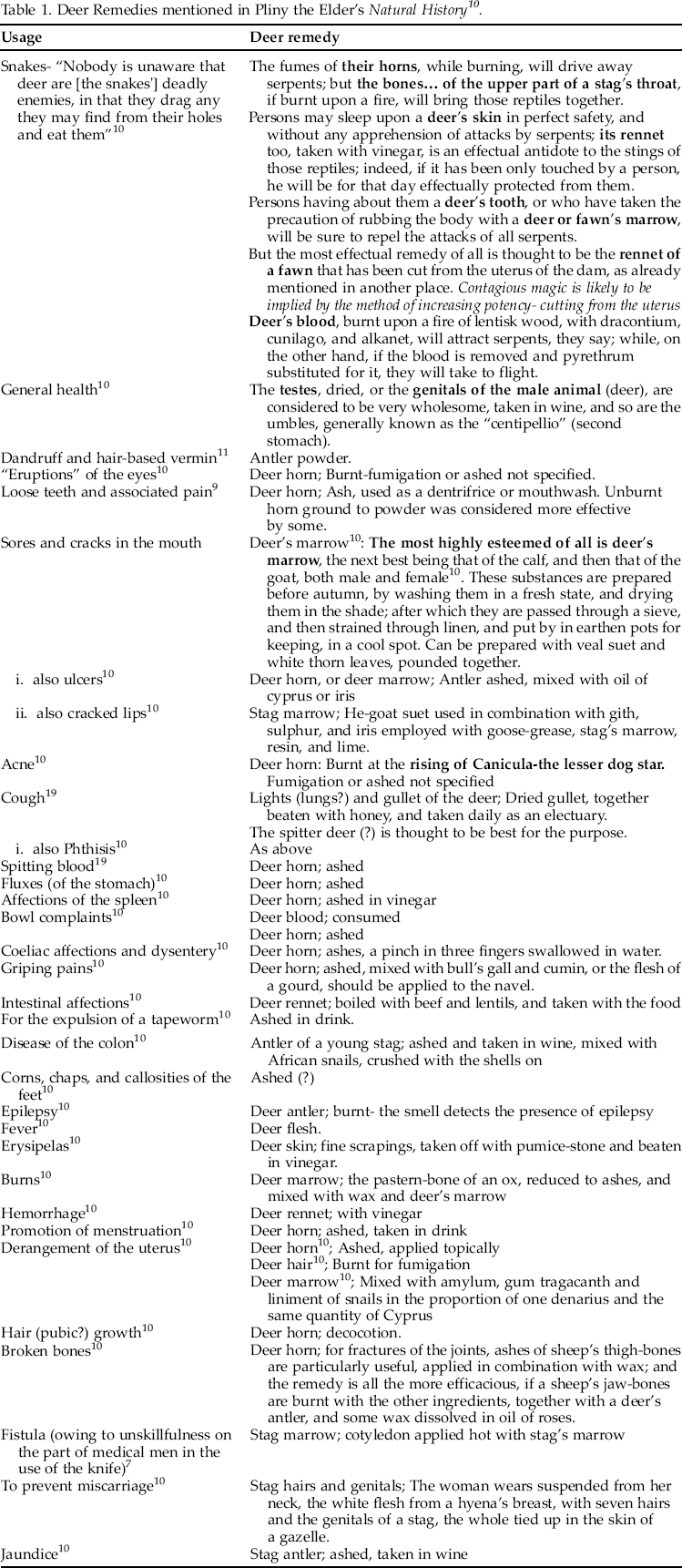
Aside from foot bones, shed antlers also appear to have been selectively transported. Since isolated specimens are again often recovered from regions where fallow deer populations were not present, it is reasonable to conclude that these body parts too must have been moved by people. A well-preserved shed antler was recovered from a tenth–ninth centuries BC context at the site of Morgantina, Sicily, despite the fact that this species did not become established on the island until the second century AD (Sykes et al. in prep.). Similarly, across northern Europe, and in contrast to regions where fallow deer were well established, shed antlers dominate fallow deer assemblages and have been noted as highly distinctive oddities in the zooarchaeological record (Sykes 2010). Their frequency suggests that these elements were being exported from the Mediterranean (Sykes 2010, 2014b). Why were shed antlers moved in this way? Traditionally, it was assumed that fallow deer antlers might have been desired as a source of raw material for antler working (Sykes 2004), especially since many of the specimens show signs of having been cut, sawn, and scraped (see Figure 2), features often noted in zooarchaeological reports. However, it is now widely accepted that fallow deer antler is entirely unsuited for bone working because the compacta is too thin and prone to fracture and crumbling (Riddler 2003). While such mechanical properties are not ideal for bone working, they do lend themselves to the production of antler powder, an important ingredient of Roman medicine. Indeed, more than half of the 30 deer-related remedies mentioned by Pliny require “deer horn,” including those for spitting blood and fluxes of the stomach 10 (see Table 1), “wet” complaints that were seemingly remedied by the consumption of “dry” antler.
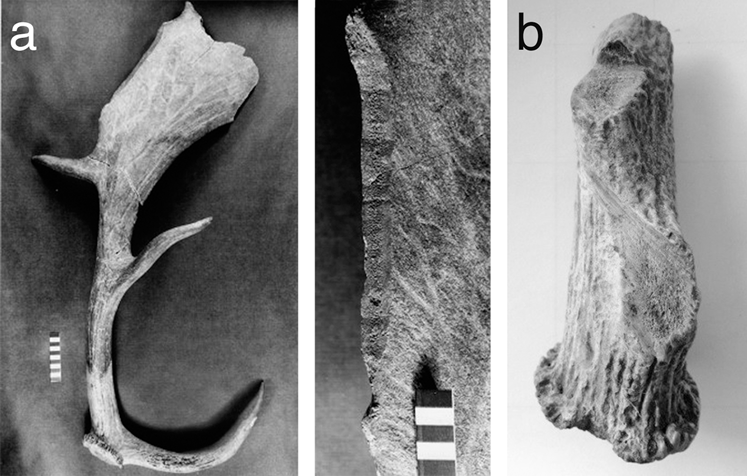
Shed antlers, with evidence of shaving, (a) from Scole Dickleburgh (Image: P. Baker) and (b) Fishbourne Roman Palace.
Deer Remedies mentioned in Pliny the Elder's Natural History 10 .
The idea that antlers were brought in from a distance and prepared in this way for medical reasons is not only visible in the archaeological record, but also supported by the writing Lucanus, a Roman poet of the first century AD, who states in Pharsalia:
And when the chieftain bade the tents be fixed, First all the sandy space within the lines With song they purify and magic words From which all serpents flee: next round the camp In widest circuit from a kindled fire Rise aromatic odours: danewort burns, And juice distils from Syrian galbanum; Then mournful tamarisk, costum from the East, Strong panacea mixed with centaury From Thrace, and leaves of fennel feed the flames, And thapsus brought from Eryx: and they burn Larch, southern-wood and antlers of a deer Which lived afar. From these in densest fumes, Deadly to snakes, a pungent smoke arose
8
A connection between deer and snakes is again highlighted by this passage and it is in accord with Pliny's suggestion that:
…it is not only while alive and breathing that deer are thus fatal to serpents, but even when dead and separated limb from limb
11
.
Both of these statements indicate that deer body parts were moved around for reasons of protection, but they also suggest bodily remains continued to hold the potency of the live animal, a potency that could be transferred to those who came into contact with them, as seen in many hot/cold and wet/dry belief systems, including humoral theory. Further evidence for this is found in Pliny's advice that people will not be attacked by snakes if they sleep on a deer skin, wear a deer tooth pendant, or rub themselves with deer marrow, rennet, or fat (see Table 1), a remedy also suggested by Dioscorides 12 . These examples of transformative, contagious humoral magic/medicine are interesting in the light of available evidence for the Isle of Thanet, where fallow deer populations are known to have been established by the second century AD (Sykes et al. 2011). By the fourth century AD the author Solinus described the island as being “crawled over by no snakes” and that “earth brought from it to any other place kills snakes” 12 . It is tempting to interpret this as another example of contagious magic; the presence of fallow deer on this island was sufficient to imbue its soil with snake-repelling properties. In turn, the example of the Isle of Thanet is reminiscent of so-called “Lemnian Earth,” a healing soil that was dedicated to the goddess Diana, stamped with her image and collected only by her priestesses from a hill in Lemnos, northeastern Greece (Hall and Photos-Jones 2008). Lemnian Earth was a popular medicine, which, according to Galen, had the power to stop wounds bleeding and induce vomiting if poison had been taken7,13,14 (Brock 1929). For Pliny, it could treat dysentery7,10,14, relieve pain and inflammation around the eyes 14 , as well as curing the effects of swallowed poison and, again, snake bites7,14.
While snakes appear to have been the cause of many medical complaints, they also played an important role in Ancient Greek and Roman cures to the extent that they became a symbol of the healer-god Asklepios (King 2001). Snakes were associated with health, continuity, and eternity because of their apparent ability to renew themselves by shedding their skin (Angeletti et al. 1992; King 2001; Subbarayappa 2001). It may be this trait that saw snakes become so closely linked to male deer, an animal also characterized by the annual shedding and regrowth of its antlers. Concepts of regeneration were central to many aspects of classical religion, including sacrificial rites where death was seen to lead to the ultimate “rebirth” (Christman 2008; Howell 1996). Within this ideological context it seems likely that the deer's capacity for regrowth and regeneration is what made its body parts, particularly antler, attractive as a source of healing.
The death/rebirth symbolism attached to antlers has been proposed as one of the drivers behind the phenomenon of antler roundel pendants (Figure 3), which have been recovered from archaeological sites across the Roman Empire (Greep 1994). These pendants, made from the shed antlers of deer, are thought to have been worn as amulets to gain protection from diseases and other misfortunes. Many of these roundels are plain, but others have phallic decoration, the phallus itself being perceived as a significant good luck charm within the Roman world (Montserrat 2000). Various scholars have suggested that the placement of phallic decoration upon deer antler was in recognition of the sympathy between the masculine stag, power, potency, and human fertility (Green 2011; Greep 1994) and this would appear to be a connection that is found across cultures (Jacobson-Tepfer 2015; Totelin 2007:534).
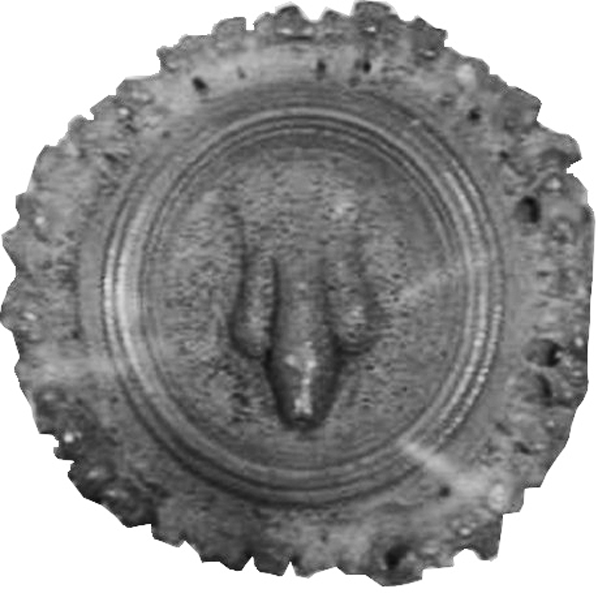
Roman red deer antler roundel pendant with phallic decoration (Photo credit N. Sykes).
In reviews of the Hippocratic gynecological treatises, Totelin (2007, 2009) suggests that deer penises were often employed in fertility treatments in classical Europe. An example recorded in Sterile Women involves the penis of a deer, powdered and taken in wine (Totelin 2007). The same remedy is used to quicken the birth in labor, whereas the powdered horn (antler) is used, particularly for a “displaced womb” 15 (Totelin 2007). Similar recipes are given by Pliny the Elder 16 , who advised that pregnant women should wear a necklace of deer genitals and hair in order to avoid miscarriages. Deer hair and bone marrow were also used to counter “derangement of the uterus” (Table 1). Unfortunately, the soft tissues of the deer penis, hair, and bone marrow do not survive in the archaeological record; however, it is possible that fallow deer were transported in part to supply this demand (Miller et al 2016; Sykes 2014b). The perceived utility of deer body parts for gynecological problems and issues of childbirth can probably also be explained in terms of sympathetic magic: Pliny records that female deer have no pain on delivery 17 and it seems likely that it was thought that this ability could be transferred to pregnant women who consumed their body parts. A connection to Artemis/Diana can also be found here because, like deer, she is said to have been born without causing her mother pain, hence her promotion to goddess of childbirth 18 .
With the high probability of death for mother and/or child, childbirth must have been a source of great anxiety in antiquity. French (2004) outlines some of the many animal-based remedies employed in Roman obstetrics. The ingredients used extend far beyond the body parts of deer, with many other species being employed, but the majority of recipes also involve soft tissues and, consequently, this most important aspect of ancient medicine is entirely overlooked by archaeologists. The same is true for many of the remedies listed in Table 1, which utilize blood, fat, marrow, and organs, applied in one of four ways—as amulets, in salves, through ingestion, and through fumigation (the burning and inhaling the smoke)—depending upon the ailment (Ogden 2014). For a cough, Pliny prescribes deer lungs and gullet 19 , a clear example of homeopathic magic, but one that would be archaeologically invisible. Similarly, both Pliny and Dioscorides suggest deer marrow is superior to that from all other animals with the potential to be used as a salve for burns, fistulas, and ulcers 20 (Table 1); however, archaeological studies of marrow extraction generally focus on its calorific value, with no consideration given to its medicinal role (e.g., Outram and Mulville 2005). This is largely because, within modern Western ideology, “food” is seen as distinct from “medicine.” That the same was not true in the past is demonstrated by Roman therapeutic recipes that suggest deer rennet be eaten to improve “intestinal affections” or advise the consumption of venison to reduce fever; the flesh was recommended because deer were believed to be free from fever (Table 1).
Even the briefest reading of Table 1 serves as a useful indicator to archaeologists that studies of animal-based medicine must encompass the mundane as well as the sacred. True, it is perhaps easier to identify evidence for zootherapy in sacrificial and votive contexts or when isolated animal body parts are found outside a species’ native range, but the expectation has to be that most human-animal relationships in the past had the potential to be perceived therapeutically. How the fallow deer may have come to be viewed as important magico-religious medicinal animals and the meaning of this study for moving zooarchaeological analyses of medicine forward are subjects to which we now turn.
Discussion and Conclusions
Deer are the focus of numerous medicinal remedies across societies that practice zootherapy, largely because of the animals’ innate ability to grow and regenerate antler, a cross-cultural symbol of health and longevity. One of the earliest references to the medicinal use of deer comes from China, where the antlers and penises from spotted deer were seen as being particularly potent (Kong and But 1985). Treatises from the Han Dynasty dating to c. 168 BC discuss the use of their antlers in treating snakebites, a recommendation also seen in ancient European zootherapy. The similarity of advice given by the broadly contemporary Shen Nung Pents'ao Ching (Kong and But 1985) and by the work of Pliny 10 regarding the same ingredients reaffirms the idea of common tradition of knowledge. Indeed, it would appear to be an example of the transmission and transformation of medical expertise along the Silk Road. Touwaide and Appetiti (2013) have identified considerable exchange between Eastern and Mediterranean medicine. As advice spread, it was modified to fit existing systems and available species. For example, the spotted deer referred to in China is not fallow deer, but rather the native sika deer (Cervus nippon), which also have spotted coats. Sika deer were not present in Europe until very recently and, at the time that Pliny and Dioscorides were writing (first century AD), the fallow deer cannot have been a common sight in Italy either, which may explain why neither author makes explicit reference to spotty deer. The original Eastern remedies were thus reconfigured for the native deer species.
While the scarcity of fallow deer in Roman Italy most probably accounts for the lack of contemporary documentation concerning them, there are other possible reasons why the species was neglected by Pliny. He wrote specifically for the “man on the street,” providing information about remedies that could be found freely within the natural world (Kee 1986). The fallow deer, an exotic animal so clearly the preserve of the elite (Sykes 2014b), may have been deliberately overlooked. This is especially so since it derived from the eastern Mediterranean and, with its Artemis/Diana association, symbolized many of the magico-religious values to which Pliny objected, particularly with regard to foreign physicians.
The role of peripatetic medics in the transmission of both knowledge about, and the body parts of, fallow deer is worthy of consideration, particularly as elements of this are visible in the archaeological record. Isolated fallow deer foot bones and antlers were clearly being moved around in antiquity, but a commodified trade in body parts seems unlikely. Instead, the specimens recovered from the Punic shipwreck (Ryder 1975), from Rouen (Lepetz and Yvinec 2002), and, in particular, the medical implement case from Valkenburg (Prummel 1977) could all be accounted for as the property of itinerant physicians, perhaps even providing a proxy for their geographical distribution.
If it is accepted that, initially, imported fallow deer body parts were used as “luxury” medicine administered by wandering practitioners, it stands to reason that the elite would wish to secure ready access to the animals’ therapeutic qualities by establishing their own breeding populations. Indeed, if antlers and penises from spotty deer were deemed to be a powerful medicine in antiquity, this may be the very reason why fallow deer were selectively transported and maintained above other cervid species: the male's large palmate antlers, pronounced penile sheath, and spotty coat (Figure 1) promoted them as the medicinal deer of choice. With this possibility in mind, the traditional interpretation that classical parks were mere stores for venison on-the-hoof is overturned. Rather than representing “walking larders,” the fallow deer were perhaps more valuable in life than death as “walking pharmacies”: the bucks were capable of providing a sustainable supply of shed antler that could be ground into medicine (e.g., Figure 2). Given the important and varied medicinal properties that were attributed to antler (Table 1) and the fact that it takes a minimum of three years for fallow bucks to develop sizeable specimens (Chapman and Chapman 1997), it would make sense for males to be maintained in high numbers and to an old age. This hypothesis may be supported by the zooarchaeological evidence, since most of the fallow deer remains recovered from Greco-Roman sites in Europe tend to be from old, adult males (Sykes 2014b).
The potency of antler as a symbol of fertility and protection is well known, its perceived power due not only to its regenerative association, but also its links to the phallus, itself a Greco-Roman symbol of protection (Green 2011; Greep 1994; Henig 2003; Totlin 2007, 2009). These connections saw deer antler, but also deer genitals, become vital ingredients in gynecological and obstetric medicine. And it is within discussions of childbirth that the entangled nature of religion, medicine, and magic can be seen: it can be no coincidence that zootherapeutic remedies derived from the animal familiar of Artemis/Diana, the goddess of childbirth, were selected to treat pregnant and laboring women. Medico-magical connections between the fallow deer and Artemis/Diana are also indicated, albeit obliquely, by Solinus's description of the Isle of Thanet and its snake-repelling soil: the island was seemingly imbued with the same qualities as both the fallow deer (Figure 1b) and Artemis's healing Lemnian Earth. This example also reveals something of the belief systems of the time, in particular that concepts of contagious magic were pervasive within medicinal thought.
Lemnian Earth is an interesting case as it is one example of ancient medicine that has been investigated by archaeological scientists (Hall and Photos-Jones 2008; Klaproth 1807). Analytical focus on this healing soil was facilitated by the fact that it is well-documented, archaeologically identifiable, and, as a discrete substance, is conceptually closer to modern medicine. By contrast, many of the zootherapeutic remedies discussed by the likes of Pliny and Dioscorides required the destruction of animal bone through grinding and ingestion or involved archaeologically invisible soft tissues and their applications were not compartmentalized from other aspects of daily life and religious beliefs (e.g., see Table 1). These are perhaps the main reasons why archaeological studies of animal-based medicine are scarce: the evidence is hard to find and perhaps even harder to interpret (Russell 2012; Sykes 2014b). Nevertheless, the difficulties of identifying zootherapy in the archaeological record should not deter archaeologists from attempting to do so.
In order to better understand the role of zootherapy in the past, archaeologists must come to recognize that, as is the case in many cultures today, animal-based medicine is likely to be everywhere—from food waste to personal adornments to lipid traces in ceramics. Such remnants of zootherapy are perhaps easier to locate when viewed through the lens of sympathetic magic, which promoted the “consumption” of homeopathic or contagious remedies, often related to their hot/cold and wet/dry natures, to bring the body into healthy balance. Historical texts pertaining to humoral medicine make clear the importance of animals to human health and well-being: they were perceived as making the difference between life and death. The absence of archaeological discussion of this medicinal belief system, and the roles of animals within it, is an oversight that we hope this paper has gone a small way to redress.
By examining the case of deer, more specifically fallow deer, within ancient medicine, we have tried to highlight the potential for examining zootherapy from an archaeological perspective. In so doing it has been possible to suggest that body parts and living population of these exotic deer were potentially desired and transported primarily for magico-religious medicinal reasons. Fallow deer are just one of many species that were translocated in antiquity and it seems possible that further archaeological analyses of exotic and/or wild animals will reveal more information to fill a critical knowledge gap within the medical humanities.
Footnotes
Acknowledgments
This research was conducted as part of the Dama International Project, which is funded by the Arts and Humanities Research Council (standard grant no. AH/1026456/1). We are grateful to Simon Malloch and to two anonymous reviewers who gave feedback on an earlier version of the text.
1
Homer. The Iliad. Translated by Anthony Verity. 2012. Oxford University Press, Oxford. Book 4.369
2
Hippocrates. Prognostic. Regimen in Acute Diseases. The Sacred Disease. The Art. Breaths. Law. Decorum. Physician (Ch. 1). Dentition. Translated by W. H. S. Jones. 1923. Loeb Classical Library 148. Harvard University Press, Cambridge, MA.
3
Pliny. Natural History, Volume VII: Books 24-27. Translated by W. H. S. Jones and A. C. Andrews. 1956. Loeb Classical Library 393. Harvard University Press, Cambridge, MA. Book 24.1
4
Pliny. Natural History, Volume VII: Books 24-27. Translated by W. H. S. Jones and A. C. Andrews. 1956. Loeb Classical Library 393. Harvard University Press, Cambridge, MA. Book 24.98–102
5
Dioscorides. The Greek Herbal of Dioscorides. Translated by J. Goodyer, and edited by R. T. Gunther. 1934. Oxford University Press, Oxford.
6
Dioscorides. The Greek Herbal of Dioscorides. Translated by J. Goodyer, and edited by R. T. Gunther. 1934. Oxford University Press, Oxford. Book 2.49
7
Pliny. Natural History, Volume VII: Books 24-27. Translated by W. H. S. Jones and A. C. Andrews. 1956. Loeb Classical Library 393. Harvard University Press, Cambridge, MA.
8
Lucanus, A. M. Pharsalia. Translated by Sir Edward Ridley. 1905. Longmans, Green, and Co., London. Book 9.839
9
Pliny. Natural History, Volume VIII: Books 28-32. Translated by W. H. S. Jones. 1963. Loeb Classical Library 418. Harvard University Press, Cambridge, MA. Book 28.49
10
Pliny. Natural History, Volume VIII: Books 28-32. Translated by W. H. S. Jones. 1963. Loeb Classical Library 418. Harvard University Press, Cambridge, MA.
11
Pliny. Natural History, Volume VIII: Books 28-32. Translated by W. H. S. Jones. 1963. Loeb Classical Library 418. Harvard University Press, Cambridge, MA. Book 28.46
12
Dioscorides. The Greek Herbal of Dioscorides. Translated by J. Goodyer, and edited by R. T. Gunther. 1934. Oxford University Press, Oxford. Book 2.94
13
Solinus. Collectanea Rerum Memorabilium. Translated by T. Mommsen. 1895. Weidmann, Berlin. Book 32.8
14
Sophocles. Vol 2: Antigone. The Women of Trachis. Philoctetes. Oedipus at Colonus. Translated by H. Lloyd-Jones. 1994. The Loeb Classical Library, 21. Harvard University Press, Cambridge, MA
15
Pliny. Natural History, Volume IX: Books 33-35. Translated by H. Rackham. 1952. Loeb Classical Library 394. Harvard University Press, Cambridge, MA.
16
Hippocrates. Generation. Nature of the Child. Diseases 4. Nature of Women and Barrenness. Edited and translated by Paul Potter. 2012. Loeb Classical Library 520. Harvard University Press, Cambridge, MA.
17
Pliny. Natural History, Volume VIII: Books 28-32. Translated by W. H. S. Jones. 1963. Loeb Classical Library 418. Harvard University Press, Cambridge, MA. Book 28.27
18
Pliny. Natural History, Volume III: Books 8-11. Translated by H. Rackham. 1940. Loeb Classical Library 353. Harvard University Press, Cambridge, MA. Book 8.81
19
Callimachus. Hymn 3, to Artemis. Translated by A.W. Mair. 1921. William Heinemann, London.
20
Pliny. Natural History, Volume VIII: Books 28-32. Translated by W. H. S. Jones. 1963. Loeb Classical Library 418. Harvard University Press, Cambridge, MA. Book 28.53
21
Dioscorides. The Greek Herbal of Dioscorides. Translated by J. Goodyer, and edited by R. T. Gunther. 1934. Oxford University Press, Oxford. Book 2.95