







Abstract
This paper is a literature review of the relationships Indigenous peoples in the Lower Murray of temperate South Australia had with the local avifauna as recorded in the early years of European settlement. Birds were prominent as clan ancestors in their creation stories, being credited with the formation of landforms and the establishment of law and custom. Aboriginal origin stories describe bird behavior and detail the relationships between birds, plants, rain, and fire. Ornithological bodies of knowledge that are framed outside of Western science, such as the ethno-ornithological information discussed here, provide an alternative lens with which to view avifaunal biodiversity in a manner that respects local cultural values.
Introduction
In Aboriginal Australia, at the time when Europeans first arrived, knowledge concerning birds was incorporated into the mythologies that explain the order of the universe. Creation stories related to the earliest conceivable period during which events occurred that led to the separation of animals and people. These accounts often indicate behaviors and describe characteristics such as plumage, calls, habitat, and food. Traditional ecological knowledge encoded in myth was essential for the long term survival of peoples who relied upon gathering and hunting for their subsistence (Berkes et al. 2000). While pre-European Aboriginal Australia was culturally highly diverse, with over two hundred language groups spread across an ecologically varied landscape (see Clarke 2003), the importance of birds for people appears to have been universal (Blythe and Wightman 2003; Gosford 2009; Roth 1903; Tidemann and Whiteside 2010; Tidemann et al. 2010).
The main aim of the present work is to synthesize information from creation stories concerning the bird-human relationships among the people of the Lower Murray. I found, as have others (Sault 2010), that cultural interpretations of birds and their role in the landscape required people to pay close attention to avian characteristics and behaviors. Ethno-ornithological research methodologies that focus upon myth narrative and storytelling reveal much concerning Indigenous Australian knowledge of birds (Tidemann et al. 2010). While Indigenous peoples in the Lower Murray today generally live without reference to the spirit Creators, they still consider that the recorded myths of their ancestors are an integral part of their cultural heritage and identity (Clarke 1995, 2007). More recent Indigenous traditions of this region, such as those concerning spirits that take on the form of birds, are outside the scope of the present paper (see Clarke 1994, 1999a).
Methods
Study Area
The Murray Basin extends from the mountainous regions of eastern Australia to the Lower Murray region, where the river flows from Murray Bridge to Lake Alexandrina through an open valley cut across a low and flat limestone karst plain. Below Wellington, the river becomes two large lakes (Alexandrina and Albert) and a series of channels in the form of a delta, eventually exiting behind scattered islands at the Murray Mouth (Figure 1). Here, the river meets the Coorong, which drained the southeast region of South Australia before European intervention. For early Aboriginal inhabitants, the delta of the Lower Murray was a rich foraging area (Clarke 1994), which supported a diverse avifauna with many waterfowl species (Horton et al. 2013; Kingsford et al. 2014).
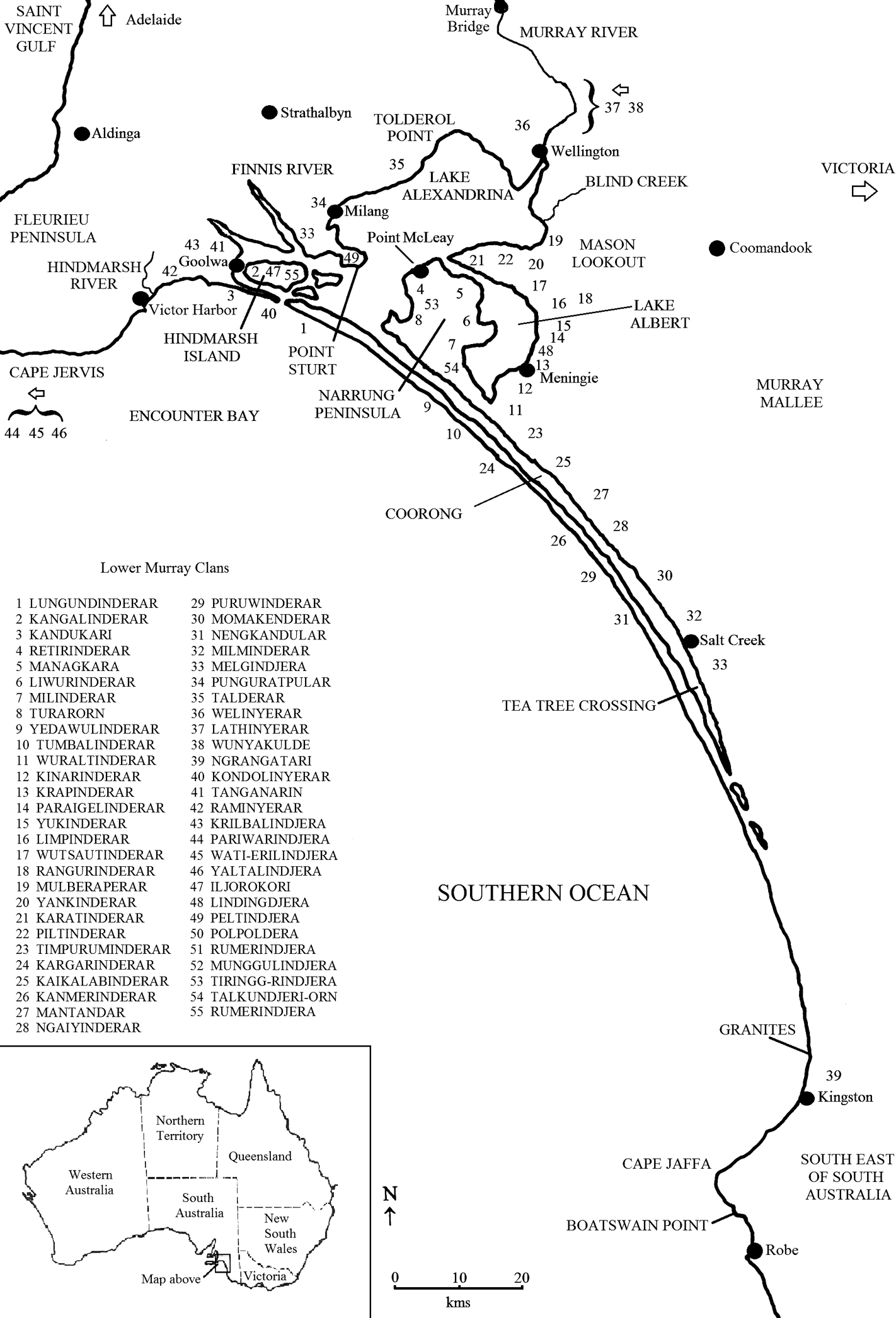
Clan distribution in the Lower Murray (after Clarke 1994). Note that these are approximate locations of the main clans, since some boundaries moved after European coloniation.
When European settlers first arrived in the Lower Murray in the late 1830s, the Indigenous peoples living there were differentiated into distinct societies comprising numerous descent groups and several dialects, such as Yaraldi, Tangani, and Ramindjeri (Clarke 1994). The Lower Murray peoples possessed common subsistence technologies and a shared ceremonial life, and were collectively referred to as Ngarrindjeri (Narrinyeri, Narr-inyeri, Ngarinderi, Ngarinderar) as they lived in the same cultural area (Brown 1918; Meyer 1843; Taplin 1879a, 1879b). Along with their neighbors based further upstream, with whom they had ceremonial and close trade relations, the Ngarrindjeri were known as Kukabrak (Berndt et al. 1993).
Data Sources
The following review of human-bird relationships in the Lower Murray is synthesized from several categories of sources. Historical records relevant to ethno-ornithology of the Lower Murray are widely dispersed, the bulk of which are found in reminiscences of colonists and in the notebooks of scholars studying Aboriginal mythology and language (Clarke 1999a, 1999b). The reliability of such sources varies considerably. Anecdotal accounts were provided by nineteenth century explorers, settlers, missionaries, and colonial officials who often had only cursory knowledge of local Aboriginal cultures, while twentieth century researchers with ethnographic and linguistic interests generally had poor knowledge of the local avifauna. Some sources relate specifically to particular dialect groups, although many are simply associated with Ngarrindjeri people. Among the Indigenous people who provided information were the survivors of the first wave of European settlement, and while many of them were unnamed in the nineteenth century, we do know that among them were Yaraldi speaker Billy Poole and Tangani speaker Jenny Pongi. During the 1930s and 1940s, anthropologists and museum-based researchers recorded aspects of gathering, fishing, and hunting practices from elderly Yaraldi speakers, such as Albert Karloan, Pinkie Mack, Jacob Karruck Harris, and Mark Wilson, and from Tangani speaker Clarence Long (Milerum). They were people who had maintained a “memory culture” of the late pre-European era of their society (Tonkinson 1993:xix). The bird names utilized in this paper are those used in the official Australian checklists (Christidis and Boles 2008; Gray and Fraser 2013).
Results
Birds as Ancestors
The Lower Murray people had patrilineal clan totemism (Elkin 1933). Each exogamous clan, known as a lakalinyeri (lakatindjeri), possessed one or sometimes several totemic emblems, ngaitji (ngatji), which were generally birds and other animals or plants, but sometimes entities such as the sun or atmospheric phenomena like wind (Berndt et al. 1993; Fison and Howitt 1880; Meyer 1846; Taplin 1879a). It was claimed that for the ngaitji, “most…are considered to be birds (e.g. crow, eagle, silver gull, pelican), although when the events of the stories are taking place they usually are manifesting more of their human attributes than of their bird-like ones” (Tindale 1938:18). Many of the Lower Murray sites of cultural significance were linked to bird ngaitji and associated with their origin myths (Tindale 1934b).
The ngaitji were present during the creation of the Lower Murray and were perceived as ancestors of living people. Their role “was to humanize the natural environment and establish a workable relationship of a spiritual kind between themselves and human beings to come” (Berndt et al. 1993:243). The ngaitji also had involvement with primary male Creator beings like Ngurunderi, Nepeli, and Waiyungari, although they were not genealogically related to them. The ngaitji as the “totem” in such systems “guards the totemite,” or clan member, and were important elements in each individual's identity (Elkin 1933:115; Table 1). Yaraldi man Jacob Karruck Harris 1 described them as a “signature or a coat-of arms.” On occasion, people referred to a person by using the name of their primary ngaitji, particularly in song (Berndt et al. 1993).
Lower Murray clans (lakalinyeri) and associated totemic bird species as ngaitji5,6,7,10. Data from Berndt et al. (1993), Brown (1918), Howitt (1904), F.E. Mann (cited in Padman 1987), G. Taplin (1879a) and Tindale 12 (1935, 1938, 1974). Note that only those clans with bird ngaitji are included.
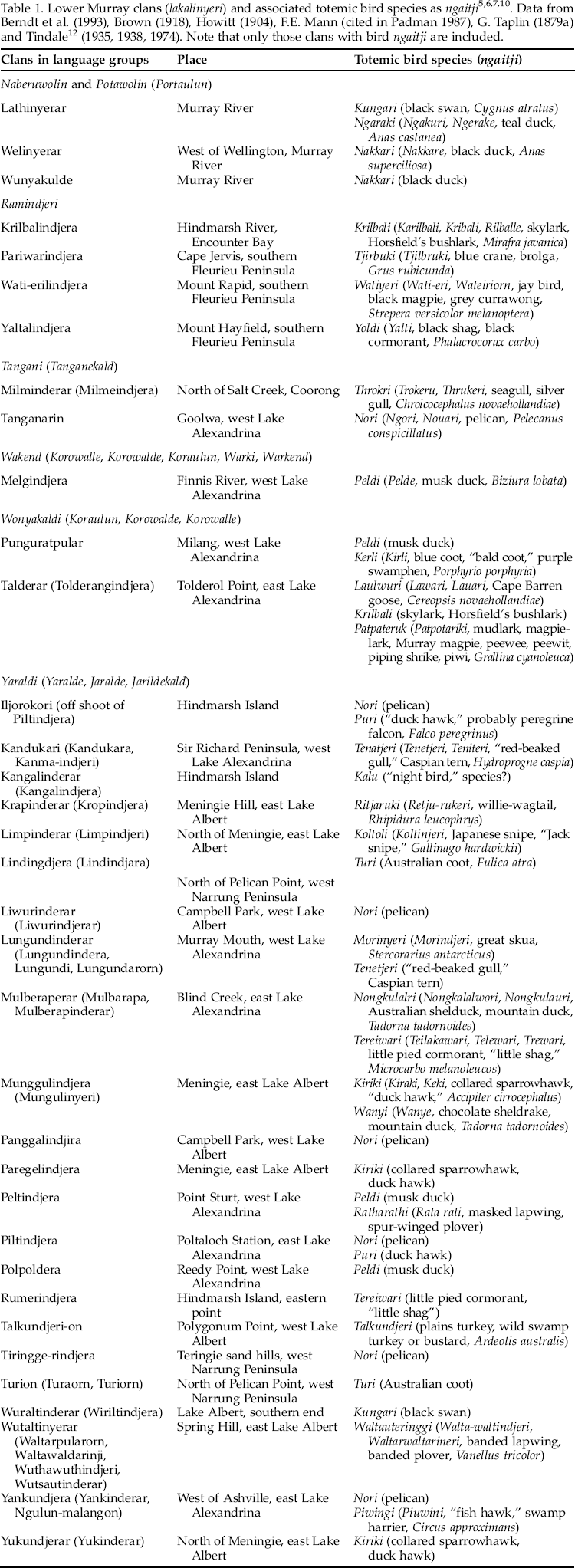
The connection between people and their ngaitji was close. In cases when an animal species, such as a bird, was involved, people associated with a particular ngaitji species would avoid killing and eating that species, although others were allowed to do so (Berndt et al. 1993; Taplin 1879a) The ngaitji were ritually consulted when the community determined who was responsible for a sorcery death. For instance, it was recorded at the Point McLeay Mission that local people believed that “Louisa was millined [sorcery involving a club] and ngadhungied [sorcery involving fat mounted on a bone] too, and that her ngaityengk [ngaitji], viz. a little duck and a lizard, were seen scratching inside her stomach after her death, as a sign that this was the case” 2 .
Lower Murray clans held ceremonies in honor of their ngaitji, many of them birds. In the 1940s, Albert Karloan remembered his participation at a Tenetjeri (Caspian tern, red-beaked gull, Hydroprogne caspia) ceremony with the Kandukara (Kanma-indjeri) clan at the Murray Mouth, probably in the early 1880s. It was said to have:
Consisted of singing and dancing which reproduced the behaviour pattern of this bird…With arms outstretched and then at their sides the dancers mimicked the gull diving into the water. The owner of the ngatji [ngaitji] cried out like the bird first and was then followed by all the other participants. Then he sang as the actors danced the flight of the gull (Berndt et al. 1993:210).
The turkey (bustard, Ardeotis australis) dance that was performed in the Lower Murray, having come downstream from the upper reaches of the Murray River, involved a symbolic “tail-feather” made of red-ochred human hair cord (Berndt et al. 1993). Another ceremony that came downstream involved a pole, decorated with emu (Australian ostrich, Dromaius novaehollandiae) feathers and a boomerang, which was placed in the middle of a canoe. Such religious paraphernalia would have been used in a similar fashion to the nurtunga (ceremonial pole) and waninga (thread cross) of Central Australia, which were often decorated with feather plumes and down (Davidson 1951). In the Lower Murray the ngaitji were a source of power in ritual life.
Lower Murray people interpreted their first direct contacts with Europeans in accordance with their worldview that gave prominence to beings such as the ngaitji (Clarke 2007). This is apparent in the reminiscences of Tangani speaking woman Jenny Pongi (Pundji), who was Albert Karloan's mother and recalled when the first European explorer arrived at the Murray Mouth in 1830. Jenny said “how she ran away with her folk when frightened by the approach of [Charles] Sturt down the Murray River. They thought he was a spirit and associated him with the Seagull [Silver gull, Chroicocephalus novaehollandiae] totem” 3 .
Bird Creators
In addition to the ngaitji mythologies there were major myth cycles concerning the arrival in the Lower Murray of a class of “Supreme” beings: the male Creator Ngurunderi, Young Men and Girls (Orion and Pleiades), Red Ochre Man Waiyungari (planet Mars) who had eloped with Nepeli's two wives, and Marangani (Australian Raven/Crow, Corvus sp.). From a reading of the available literature, it appears that these powerful beings were not considered to be the actual ancestors of living peoples, but rather the Creation entities who were acknowledged as having formed major parts of a relatively featureless landscape upon which people lived, as well as having established their customs. Birds became part of the landscape they transformed during the Creation. For instance, in the Ngurunderi mythology, which gave an account of the formation of the Murray River and the making of its fishes, a group of people who were hiding in the reeds were turned into waitji birds (wetjungali, Superb fairy-wrens, Malurus cyaneus) (Berndt 1940; Berndt et al. 1993).
Crow
In the Lower Murray, Australian ravens (“crows”) were observed in burial grounds, where they stripped the dried flesh off the bones of the dead on funeral platforms (Angas 1847, 1877; Stirling 1911). According to Tangani man Milerum (Clarence Long), the Australian raven (marangani) was the “bird that eats anything” 4 . The Raven/Crow ancestors are prominent in mythologies recorded from other parts of Australia, and are usually portrayed as difficult characters who readily take offence (Berndt and Berndt 1989).
In Yaraldi versions of the Crow myth, Marangani was described as generally disliked, due to his habits of calling every man he met “ronggi” (brother-in-law) as a tactic for gaining access to their women (Berndt et al. 1993). After the Creation, it was said that he and Waiyungari (Mars) were both responsible for causing women to indulge in kuruwolin (ritualized sexual license). As an old man, Marangani was always the first to appear when fish were being drawn in with nets. He would sit next to women who were cooking the catch, with his enlarged penis traveling underground to enter them. Since then, women who were jabbed by something when sitting down would cry out “That is Old Crow again!” (Berndt et al. 1993:240). In some Lower Murray recordings, Marangani's name is given as Wak (Waak, Wark), which refers to a crow species (probably Australian raven, Corvus coronoides). Naramendjarang is a site south of Lake Alexandrina which was described as a “Hill with blackwood [Acacia melanoxylon] trees where in the Waak or Crow story the ancestral being prepared boomerangs by chiselling wood of the trees which remain as a memorial” 12 .
After coming downstream along the Murray River and spending time in the Lower Lakes, the Crow being traveled south along the Coorong, where he was credited with creating landforms and was acknowledged as having brought there the returning boomerang (Tindale 1934a). According to the associated myth, the Owl (probably Eastern barn owl, Tyto delicatula) and Mopoke (Southern boobook owl, Ninox novaeseelandiae) ancestors challenged Waak (Wark) the Crow at a pipeclay lake (saltpan) near Salt Creek, which is southern tributary of the Coorong, where they:
…said they would allow him to live at Salt Creek only if he could throw five consecutive boomerangs in complete circles otherwise they would kill him. The Crow threw four of them successfully, but the fifth was caught by the wind and fell short. Thus today in the lake there are four complete islands and the fifth is a peninsula connected to the shore by a tongue of land. The men of the tribe held boomerang throwing competitions there until recent times (Tindale 1934a).
The Owl and Mopoke then tried to spear Waak, but he crawled away to the southeast where his tracks remained as a series of saltpans. When the Crow eventually stopped on the edge of the Coorong, he could see that he was no longer being pursued. In order to look about from this high vantage point, he thrust his spears into the ground, where they left holes that could later be seen in the limestone cliff. Gerum Gerum was a sacred lake near the Coorong where “The Crow, an ancestral being threw boomerangs on this lake and they flew with such an erratic course that the shores of the lake which they cut out were sinuous” 5 .
As with the living species, Crow had problematic relationships with other bird ancestors. Tanitjari, the Wandering Albatross (Diomedea exulans) ancestor of the Needles, prevented Marangani the Crow coming from the Coorong
5
, while Throkopuri (Torakopuri) the Seagull [Silver gull] ancestor had “challenged the Crow being”
5
. Throkopuri had his camp at Tarakorinking (Tea Tree Point), which means “home of the sea gull,” and he was:
a mythical man, one of the Tanitjari or seagulls, [who] lived here, he fought the malicious Crow men who spied on his methods of fishing and stole his ngorankuri or hair charms. He thrashed the crows so severely about the eyes and head that the crow thereafter always walked as if lame and his eyes are white
5
.
As shown by the accounts provided here, the Crow was spoken of either as a singular entity or as a group in the Lower Murray mythologies.
Brolga and Emu
The Lower Murray mythology of the Brolga (Native Companion, Grus rubicunda) and Emu ancestors is based in the southern parts of the region, particularly in the country surrounding present day Kingston3,6 (Berndt et al. 1993; Tindale 1936, 1983). The Brolga ancestor was the ngaitji of some clans based at the southern end of the Coorong (see Table 1), as well as at Kingston (Berndt et al. 1993). It was Lower Murray tradition that if any man from Brolga country was “knocked down and bruised by one from another tribe, and left on the ground unconscious, the Brolgas come down, lift him up, and show him the road home” (Wilson 1937).
The main unifying theme in several recorded Lower Murray accounts is that a pair of Emus tricked a pair of Brolgas into killing all but two of their own chicks. Yaraldi man Mark Wilson said that “In their deep grief, they [the Brolgas] put their heads in the fire, and rubbed hot ashes on their heads and necks, and that is why Brolgas now do not have any feathers on their heads or neck”
6
(Wilson 1937). The Brolgas sought revenge and by pushing their long sharp beaks into the ground in the Kingston area, caused a flood that killed the Emus, which are land birds and therefore unable to fly away. It was recorded that:
You can see to this day the young emus in the water, and the father and mother emu on the beach in the form of granite rocks a few miles north of Kingston.…The Brolgas, knowing that the emus, if they escaped, would hunt them up to kill them, flew up into the air, and, like the pelican [Pelecanus conspicillatus] flew up in circles getting higher and higher, until they reached the sky, and found it a good country to live in. So they stopped there. You can now see them at night in the form of two pieces of cloud at the end of the Milky Way (Wilson 1937).
Some Yaraldi accounts of this mythology emphasized the female gender of the main birds involved (Berndt et al. 1993), although it is widely known that it is the male emu that incubates the eggs (Mahato et al. 2006). It has been suggested that the “Emu wives” of the Waiyungari (Mars, Red Ochre Man) mythology, in which Nepeli's two wives attracted Waiyungari's attention by mimicking the sound of the Emu (Berndt et al. 1993; Clarke 1999b; Tindale 1935), were connected with the Emu and Brolga myth (Roheim 1971; Tindale 1983). For Lower Murray people, evidence of the Creation events were all round them. At the southern end of the Coorong, north of Kingston, the large boulders known as the Papajara (the Granites) were associated with the Emu ancestors, with some of the chicks being seen as other granite outcrops at Kingston and at Boatswain Point on the eastern side of Cape Jaffa5,6,7 (Berndt et al. 1993).
While the collection and study of ethnographic data relating to scientific definitions of what constitutes a bird serves the purpose of an ethno-ornithological study, it is apparent that there was not a similar Indigenous concept in the early Lower Murray worldview. This is demonstrated by the apparent lack of a term for bird in the Indigenous languages. While all small flying birds in general were classed in the Lower Murray dialects as pulyeri (Gale 2009), this term excluded all larger species. This situation is not unique in Aboriginal Australia, as in many Aboriginal languages the emu is not classed among the birds, probably because it is large and flightless (Brown and Naessan 2014; Maddock 1975). The focus on birds presented here nonetheless highlights their broad cultural role.
Bird Fishers
A Lower Murray myth described how fishing birds were once men who lived at Tenetjanual (Murrayville) in western Victoria (Harvey 1939, 1943). Having fished out the surrounding lagoons, the ancestors of the Gulls, Terns, Shags (Phalacrocorax sp.), Divers (possibly Hoary-headed Grebe, Poliocephalus poliocephalus), and Pelicans traveled overland west towards Lake Alexandrina in South Australia and:
The pelicans and all the other birds, as they travelled through the mallee scrub, made a great “pad” by treading down the vegetation. This is now a line of clear spaces in the mallee, patches of claypan and samphire swamp running south-west from the Wimmera to Lake Alexandrina (Harvey 1943:109).
The path closely follows the zone of calcareous soils which has open scrub growing on it (Griffin and McCaskill 1986).
At Lake Alexandrina, these bird ancestors made fishing nets and avoided the areas of saltwater, which pushed in from the sea. Along the lake edge, these fishing birds traveled in company with land birds, among them the Australian Magpie (Gymnorhina tibicen) ancestor who was in possession of firesticks. The bird ancestors were annoyed that the Magpie repeatedly refused to make fire, so gave him from their nets only the thukeri (tukkeri, silver bream, Nematalosa erebi), which has excessively bony flesh. As a result:
The magpie, becoming angry, began to belabour the other birds with the fish he had been given. And so arose the magpie's characteristic action of chasing the smaller birds. He hit the crow's eyes with his firestick, and gave him his “smoky” eyes. The pelicans, who previously were coal black, became splashed with white where the scales of the tukkeri, [thukeri] wielded by the irate magpie, stuck to their bodies (Harvey 1943:111).
As the Creation period was ending, these ancestors were transformed into bird species. The Pelican man dived into the water, taking with him the drum nets that became his pouches, while the Blue Coot (Purple Swamphen, Porphyrio porphyrio) ancestors ran into the reeds, where they remain today.
In a Yaraldi account recorded in the 1930s, of what appears to be the same mythology, the Crow being and the bird ancestors reached Mononggal (Mananganggel, Point Sturt) where:
…the crow became annoyed at their scurvy treatment and fought them [seagulls, Silver gulls], wielding the bones of the bony bream [silver bream] as weapons. The pelican and the magpie joined in the fray, and they and the seagulls all received many blows which smeared their feathers with the “slime” of the tukuri. Wherever the blows fell they became “blacked” and many turned into birds their feathers still bear the white patches which are the marks of the blows. The crow did not escape uninjured for a seagull thrust a firestick in his eyes, thus causing them to become cloudy and white, so that every crow to this day bears the marks of the firestick
8
.
Other Lower Murray peoples had related beliefs, as it was mentioned that “In the Tanganekald Pelican story the beings followed Blind Creek west from Kumanduk [Coomandook] and made a new home at Terewarang [Mason Lookout]” 12 .
Another Yaraldi version described the events as taking place between two opposing groups of bird ancestors—those of the land, being the Magpie, Crow, and Wedge-tailed Eagle (Eaglehawk, Aquila audax), and those of the water, being the Pelican, Swamp Hawk (Swamp Harrier, Circus approximans), Silver Gull, and Shag (possibly Black shag, Phalacrocorax carbo) (Berndt et al. 1993). The leaders of each group—the Magpie and Pelican—began fighting over the silver bream (thukeri) at Mananganggel (Monongenggl, Manungenggl), which was “the place of the Magpie's Beak—Point Sturt, jutting out into Lake Alexandrina, [and] is the beak”
5
(Berndt et al. 1993:236, 451–452). In the case of the bird ancestors and beings:
When they fought, they used the bream like clubs, hitting each other with them. Prior to this argument all birds were black, but…as each bird was hit, some of the silvery whiteness of the fish adhered to his body (feathers). Pelican received most of the flogging because he had refused to share his food and that is why he became so white. Magpie was smart, he was hit less than the others and consequently had only white stripes, Crow and Hawk escaped, flying away at the beginning of the fight and avoided being hit with the bream. Other birds were unable to avoid this–—all because of the grumbling by Pelican (Berndt et al. 1993:236).
It was claimed that here, “pelicans and magpies still frequent the Point as though ready to renew the fight” 5 .
Creators of Rain
A myth recorded from Ramindjeri speakers at Victor Harbor in Encounter Bay, that involved three men known as Kortuwe, Munkari, and Waingilbe, established a link between birds and rain (Meyer 1846). After an argument over fish, Kortuwe created rain with a song, and the three were transformed into birds. It was recorded that “as often as Kortuwe makes a noise it is a sign that rain will soon follow” (Meyer 1846:204). While the bird species involved are not recorded in this account, recorded words from Lower Murray vocabularies 4 suggest that Kortuwe became the Nankeen Kestrel (kortawi, Falco cenchroides) and Munkari was transformed into a small kind of hawk (munkeri). Another myth that Meyer (1846:202) recorded from Victor Harbor gave details of the formation of the Inman and Hindmarsh Rivers by Palpangye, who later “became a bird, and is frequently near the rivers.”
Creators of Fire
Various birds were players in the corpus of Fire Creation mythology from the Lower Murray. A recorded Ramindjeri myth that is localized in the upper Hindmarsh River area concerned Kondoli (Kondole) the Whale ancestor and the origin of fire, where at the termination of a ceremony the decorated young male performers, “who were ornamented with tufts of feathers, became cockatoos, and the tuft of feathers being the crest” (Meyer 1846:204; see also Johnston 1943). There was a fight over the power to make fire, and Rilballe the Skylark (Horsfield's Bushlark, Mirafra javanica) speared Kondoli in the neck, giving the whale its distinctive blowhole. Different bird species are involved with other recordings. A Ramindjeri version recorded from a Yaraldi speaker chiefly involved Krilbali the Skylark and Kuroldambi the Eastern Barn Owl 7 . According to a Yaraldi version, it was the Skylark and Willie-wagtail (Rhipidura leucophrys) who conspired to spear Kondoli and steal his fire (Berndt et al. 1993). The fire released by the spearing was spread throughout the country by the Skylark flying off and dropping the sparks onto the ground, where they were transformed into flints. In another recorded Yaraldi account, which is essentially the same as above, it was Krilbali the Skylark who speared Kondoli 8 . As with many Aboriginal myths, the Kondoli narrative was told as a song 6 .
Other myths from the Lower Murray region implicate different bird ancestors in the origin of fire. For instance, Tuta the Scarlet Robin (Petroica boodang) was involved with the release of fire, and as a result had his chest burnt a bright scarlet 8 . In another Lower Murray myth, the Tjelgawi (Australian Ringneck Parrot, Barnardius zonarius) ancestors “were women who attacked the Being rat:aragi [Scarlet Robin]” 7 .
Celestial Beings
The perceived existence of the Heavens as an image of the terrestrial landscape is common across Australia (Clarke 1997, 2009, 2014, 2015). Yaraldi man Billy Poole, from Lake Albert, told a settler that one group of stars “was a turkey [bustard] sitting on her eggs, the eggs being our constellation Pleiades” (Giles 1887). Among the Tangani, the “doctor men” interpreted the appearance of Lawarikark, which was Vega in the constellation of Lyra, as the sign that it was the nesting time for the lowan (Malleefowl, Leipoa ocellata) (Tindale 1983). These birds were known to make a harsh scolding call when racking plant debris into mounds for the incubation of their eggs, so it was therefore considered that the Malleefowl ancestors in the Skyworld would also be quarrelsome (Clarke 1997).
At the close of the Creation period, Lower Murray people believed that the Crow climbed into the Skyworld to become a far distant star seen in the southeast during autumn. Autumn was known as Marangalkadi, which is a time when stars of this name appear (Berndt et al. 1993), and reportedly meant “pertaining to the crow” (Taplin 1879b:126). According to Yaraldi tradition, the autumn stars are low in the southeastern sky because it was to the southeast of the Lower Murray that Marangani entered the Skyworld. A Goolwa settler claimed that Lower Murray people “had great reverence and awe for the heavenly bodies, and had names for certain stars, calling the morning star “Murrunungu–—the crow” (Atkins 1911). Tindale recorded a Yaraldi “rutting season,” or breeding time, and:
When Marangali [Marangani] the “Crow” star is in the zenith (not yet identified) women and all animals seek their mates. When a woman was reported to be “going wild” and taking two different men on successive nights old men shook their heads and took younger men out of the huts and pointing to Marangali said “When Marangali is up there women are always like that”
8
.
Crow had a positive influence on fishing, and it was stated that:
Crow, metamorphosed as a star…is propitious for fishing and is responsible to the ebb and flow of the tides.…Crow appears in June-July (winter) when fishing is sporadic, since he spends little time in the sky and most in the huts of various women: he disappears in October, coinciding more or less with Waiyungari [Mars] (Berndt et al. 1993:367).
The Yaraldi considered that there were two Prolggi the Brolga ancestors somewhere in the sky, having got there after fighting with Pindjali the Emu ancestor, who became the Magellanic Clouds (Berndt et al. 1993; Taplin 1879b). In the Lower Murray perspective, there were probably other Emu ancestors seen in the night sky, as the black patch to the west of Ngurunderi's canoe (the Milky Way) was said to be the Emu (Berndt et al. 1993). As with their terrestrial counterparts, these celestial beings migrated according to the season. It was recorded from Yaraldi speakers from the Lower Lakes that “The Native Companions [Brolgas] (husband and wife) may be seen rising in early spring in the south-eastern sky, disappearing to the south-west. They were said not to rise too far into the sky ‘because they belonged to the South-East’” (Berndt et al. 1993:240). By another account, the Brolgas are seen lying to the southeast in the winter sky and then in spring are south of the Milky Way, and then shifting towards the western sky in summer 3 .
Discussion
In the Lower Murray mythology, the physical form of bird species was widely described as tangible “proof” of events taking place in the Creation, with the origin of plumage color being a major element within the mythology discussed in this paper. Aggressiveness is another prominent theme in many Australian bird myths, and reflects the observed characteristics of living species. In the case of the bird fishing narratives of the Lower Murray, they explain the post-Creation behaviors of each species; for example, with the magpie being a territorial species or the pelican attempting to steal fish from their companions.
In southern Australia, the epic struggle between two bird Creators, the Wedge-tailed Eagle and Crow/Raven, was a dominant mythological theme in societies that possessed moieties or dual social organization9,11 (Blows 1975; Hassell 1934; Hercus 1971; Mathew 1899; Smyth 1878). The early anthropological debate concerning why this was so led to speculation that the physical contrasts between these birds was symbolic of differences between moieties (or phratries) that may have been derived from two different groups (Mathew 1910). Given that Lower Murray marriage systems were based on exogamous patrilineal clans without moieties, its presence here appears anomalous. In spite of Tindale (1938:18) having described the Crow and Eagle as ngaitji for Lower Murray clans, there is no ethnographic evidence to support this in the Lower Murray (Table 1), although they were Creators and as such the ancestors of their associated bird species. It is possible that here the Crow and Eagle myths were overlays of the ngaitji system of beliefs, and as such had been introduced during the early post-European contact period from neighboring upstream cultures.
Data provided in this paper indicates that observations of links between bird behavior and celestial movements were incorporated into seasonal calendars of the Lower Murray region. This finding is consistent with other parts of temperate southeastern Australia. For instance, it was recorded from the Swan Hill area of central Victoria that Lyra represented the flying Malleefowl (Stanbridge 1857), which is similar to the Lower Murray version given above. The acronychal (at dusk) rising of Vega in this constellation during mid-August signaled the time when the malleefowl begins building its nest mound (Hamacher 2012). Another example of egg laying being linked to celestial movements comes from southwest Victoria, where it was recorded that “when Canopus is a very little above the horizon in the east at daybreak, the season for emu eggs has come” (Dawson 1881:75). Canopus will rise helically (at dawn) in early May, as seen from southwest Victoria, which coincides with the emu egg-laying season and also with the acronychal rising of the celestial emu in the Milky Way (Hamacher pers. comm., 24 March 2015).
In the Lower Murray, birds were prominent ancestral beings to the extent that they were a major element in the expression of Aboriginal identity during the classical period. An Indigenous belief was that in the Creation the bird ancestors possessed transformative powers that were used to give meaning to the landscape, both on land and in the heavens. Their actions also established the basis for elements of Aboriginal social structure and seasonal life. The incorporation of observations concerning the physical form and behavior of individual species within the Aboriginal mythologies of the classical period demonstrates the existence of an alternative body of ornithological knowledge outside of Western science. Findings from ethno-ornithological research therefore have the potential to inform how land management agencies can perceive the landscape with its rich avifauna and, in doing so, recognize its cultural values. The deep understanding of the ethno-ornithology of the Lower Murray provides unique insights into the regional culture.
Footnotes
Acknowledgments
Valuable comments upon drafts of this paper were received from Kim Akerman and two anonymous reviewers.
1
Harris, J. K., Aboriginal of Point McLeay, to Willoughby George Bell, 1894-95; Letters, Point McLeay Aboriginal Mission; D6510(L)13-17; State Library of South Australia, Adelaide, SA.
2
Taplin, G. “Diary of the Reverend George Taplin of Point McLeay, Volume 1-3” April 4, 1859 to August 1, 1879. Family History Collection, Point McLeay Aboriginal MissionHistory; Mortlock Library, Adelaide, SA.
3
Tindale, N. B. 1938-56. Journal of Researches in the South East of South Australia. Vol.III. AA338/1/33/3; South Australian Museum Archives, Adelaide, SA.
4
Tindale, N. B. “Birds I&II”, c.1931-c.1991; Series AA338/07, Index Cards Relating to Language Research; AA338/7/1/27 and AA338/7/1/27; South Australian Museum Archives, Adelaide, South Australia.
5
Tindale, N. B. “Place Names: N.B. Tindale Ms SE of S Australia,” c.1931-c.1991; Series AA338/07, Index Cards Relating to Language Research; AA338/7/1/44; South Australian Museum Archives, Adelaide, South Australia.
6
Tindale, N. B. “Journal of Researches in the South East of S. Australia, Volume 1,1931-34”; AA338/1, Bound Volumes of Expedition and Office Journals, Notes and Compilations; AA338/1/33/1; South Australian Museum Archives, Adelaide, SA.
7
Tindale, N. B. “Journal of Researches in the South East of South Australia, Volume II, 1934-37”; AA338/1, Bound Volumes of Expedition and Office Journals, Notes and Compilations; AA338/1/33/2; South Australian Museum Archives, Adelaide, SA.
8
Tindale, N. B. “Murray River Notes, 1930-52”; AA338/1, Bound Volumes of Expedition and Office Journals, Notes and Compilations; AA338/1/31/1; South Australian Museum Archives, Adelaide, SA.
9
Bulmer, J. 1999. John Bulmer's Recollections of Victorian Aboriginal Life, 1855-1908. Compiled by A. Campbell and edited by R. Vanderwal. Museum Victoria, Melbourne, Vic.
10
Tindale, N. B. “Notes on the Kaurna or Adelaide Tribe and the Natives of Yorke Peninsula and the Middle North of South Australia, 1935-69”; AA338/01, Bound Volumes of Expedition and Office Journals, Notes and Compilations; AA338/1/35; South Australian Museum Archives, Adelaide, SA.
11
Tindale, N. B. 1939. Eagle and Crow Myths of the Maraura Tribe, Lower Darling River, N.S.W. Records of the South Australian Museum 6:243–261.
12
Tindale, N. B. 1987. “Yaralde Tribe Place Names, June 1987”; AA338/08, Compiled Vocabularies and Grammatical Sketches; AA338/8/17; South Australian Museum Archives, Adelaide, SA.