






Abstract
The use of whirligig beetles (Gyrinidae) and predaceous diving beetles (Dytiscidae) for stimulating breast growth in East Africa is a unique traditional practice. The beetles are collected by young girls from rivers and pools and held to their nipples where the beetles “bite” in a defensive reaction. Simultaneously the beetles secrete defensive substances which are produced in special glands to discourage possible vertebrate predators. Gyrinids produce, among other substances, norsesquiterpenes. The Dytiscids also possess prothoracic defensive glands, which produce, among other substances, hormone-like steroids. Larvae of antlions (Myrmeleontidae) are similarly used in East Africa.
Introduction
Insects as medicine are undoubtedly underrepresented in most ancient and modern pharmacopeias. Due to the entomophobic attitude of most Western cultures, insects are less commonly used in traditional medicine in the West than, for instance, in Asia. The role of insects in medicine is becoming more important as many insects are known to produce or use highly specific chemical substances as defensive mechanisms against possible predators or against microbial or fungal infestation (Attygalle et al. 1993; Conner et al. 2000; Eisner et al. 1997; Smedley et al. 2002).
This study combines ethnographic data with findings from life science (see Etkin 2001). It shows how traditional knowledge and Western bioscience can be closely related. Nader (1996:3) states that “creative ideas in the practices of indigenous people and our own folk are routinely overlooked.” This seems to be especially the case with the traditional medicinal use of gyrinids and dytiscids, widespread in Ethiopia, Tanzania and Uganda but also in Congo and Zimbabwe. The question that remains unanswered is why so little is known about it in the ethnobiological literature.
Insects in Medicine: Entomotherapy
Pedanios Dioscorides, who lived in the first century A.D., was one of the first, together with Galen, to mention the use of insects in European medicine. His Materia medica (Dioskurides 1902) was the most extensive book on botany and pharmacy of his time (Aegina 1914; Winkler 1909); its remedies survived at least up to the twentieth century in European folk medicine (Hovorka and Kronfeld 1908/1909; Netolitzky 1913, 1916). Materia medica mentions at least ten different insects and their products used for medicines.
Many social insects—bees, wasps, ants, and termites—and their products are used all over the world as medicine, food, and aphrodisiacs (Costa-Neto 1998; Groark 2001; Römer 1980mer 1981; Schwab 1938). Some lesser known medicinal insects include white grubs (Melolonthidae) (Gómez et al. 2000) and ticks (Argasidae and Ixodidae) (Dieck 1983); the latter were used in European folk medicine until the 1980s. The use of insects in Asian medicine and cuisine (Pemberton 1999; Read 1982) and in South American zootherapy (Costa-Neto 1999, 2002; Costa-Neto and Oliveira 2000) are especially well documented. The hunting poison of the Kalahari Bushmen plays a unique role because it is the only arrow poison in Africa of purely animal origin. It is obtained by pressing out the body liquid of the larvae of certain beetles that belong to the genera Diamphidia, Polyclada, and Lebistina (Neuwinger 1998:908ff.).
The Chinese blister beetle, Mylabris phalerata Pallas., has been employed since ancient times as an aphrodisiac—parallel to the “Spanish fly,” Lytta vesicatoria L., in Europe—and for treating poor blood circulation, dropsy, pleurisy, pericarditis, and amenorrhea (Wang et al. 2000:77f.). Cantharidin is a defensive compound found in the hemolymph of blister beetles. It is applied in the treatment of molluscum contagiosum (Silverberg et al. 2000) and its blistering properties are used to investigate acute inflammation in humans (Day et al. 2001). It is a cytotoxic agent that can induce cell death (Wang et al. 2000). Norcantharidin, a demethylated form of cantharidin that is less toxic to mucous membranes, is now applied routinely as an anticancer drug against hepatoma in China (Chen et al. 2002) and is studied as a possible treatment against human colorectal carcinoma (Peng et al. 2002). It has also shown activity in several tumor cell lines (McCluskey et al. 2003).
The Ngemba of Australia have used maggots for thousands of years to clean their wounds. Similar practices are known among the Maya Indians, and have been reported from Burma and China (Grassberger 2002a:13). In America, blowfly maggots (Lucilia sericata Meigen) were first applied on a larger scale by John Forney Zacharias during the American Civil War. Ten years later, William S. Baer started to treat children suffering from severe osteomyelitis with maggots with surprising success. After the discovery and large-scale production of antibiotics in the 1940s maggot therapy fell into oblivion until Ronald Sherman reconsidered it in the 1990s (Grassberger 2002a:16 ff.; Sherman et al. 2000). Today, maggots are especially useful for therapy-resistant acute and chronic wounds (Angel et al. 2000; Fleischmann et al. 1999; Grassberger 2002b, 2002c; Horobin et al. 2003).
Water Beetles in Medicine
There is little information about the use of gyrinids or dytiscids in folk medicine (Kassa 1998). Netolitzky (1916) mentioned gyrinids being used in the Alps as an aphrodisiac to substitute for cantharids. Pemberton (1999) reports on the former use of a water beetle, Cybister tripunctatus Greshew, in Korean traditional medicine. Van Huis (1996:13) mentions briefly the use of gyrinids, dytiscids, and the larvae of Myrmeleontidae to enhance breast growth in East and southern Africa, but unfortunately no additional information is given.
Methods
We gathered information through qualitative interviews with randomly selected informants from three East African countries. Fieldwork was carried out at different times: 1997 and 1998 in the Oromia region, Ethiopia; 1999 and 2004 in the Njombe region, Tanzania; and 2003 in the Mbarara region, Uganda. In 2004 we asked two colleagues to do short investigations in the region Haut Uele, Congo and in the region Matebele Land North, Zimbabwe.1
Much attention was paid to traditional knowledge about insects and how they are caught, and to conceptions about the human body. We mostly employed focus group discussions (Fern 2001) because we found that in groups the informants—especially the young girls—were more relaxed than when interviewed alone. With adults open interviews were also employed. The interviews were partly tape-recorded and transcribed; some interviews were only written down without recording. They were mostly conducted in a regional lingua franca (Amharic, Swahili, or Lunyankore) and translated into English by ourselves or by competent local informants. The beetles were preserved in alcohol or ethyl acetate and placed in a private collection.2
In Ethiopia we interviewed 15 rural adolescent girls and 18 suburban adolescent girls. Most of the suburban girls were chosen from schools. Since many of the rural girls are not allowed to go to school (see Kassa 2001), they were interviewed in their home villages. In both groups we used focus group discussions and participant observation as the main methods. The focus groups were homogenous with regard to social status, educational background, age, and residence. The number of participants was between six and eight. Most interviews were performed in Amharic, some also in Oromiffa, the latter with the help of a translator. For the interviews in schools quiet rooms were chosen; discussions with the rural girls took place outside. The focus group discussions were tape-recorded with the girls’ permission.
In Uganda the interview setting was less formal. During our one month stay in Mbarara we visited five families who were either related to our main informant Richard Szeriosa or to good acquaintances of his. We usually started our interviews with adult women, all of whom confirmed that in their youth they used beetles to enhance breast growth. We then asked their daughters and their friends to show us the places where they usually collected the beetles. Together with the girls we walked to the respective places. In this setting we asked them our questions. The girls were aged between 7 and 12 years; the groups consisted of 5 to 12 girls.
The first author did extensive fieldwork on traditional medicine in Tanzania from 1995 to 1998. She was able to use contacts to informants employed at this time. As in Uganda the interview settings were quite informal. During discussions of issues related to traditional medicine, the main informants were asked if they knew of the method of enhancing breast growth. In this way more than nine adult women, one traditional healer, and one young man were interviewed. The women confirmed that when they were young they used beetles for this purpose and that their daughters still do so. In a few areas in Tanzania men also use water beetles (see below).
Despite our many interviews we never observed the use of water beetles. Like other practices related to bodily intimacies, it is not openly shown. In Uganda, however, one girl agreed to demonstrate the use to us.
In 1997 and 1998 two of the girls whom we interviewed collected beetles for us. In 1997 two dytiscids were collected and identified as Rhantus capensis Aubé.3 In 1998 the girls collected four gyrinids. Two were identified as Dineutus gondaricus ssp. ragazzi Regimbart.4 The other two belong to Aulonogyrus ater Brinck. In 1998 in Tanzania three beetles were collected and identified by our informants as the ones used for enhancing breast growth.5 They were identified as Dineutus grossus ssp. angolensis Regimbart, Gyrinus natalensis Regimbart, probably ssp. katangensis Ochs, and Orectogyrus sp. (all Gyrinidae).6 In 2004 ten beetles were collected by young girls; one was identified as Dineutus aereus Klug, the remaining ones as Orectogyrus sp. (Gyrinidae).7 In Uganda a group of seven girls caught ten beetles, all but one of which were identified as Dineutus micans micans Fabricius (Gyrinidae).8 The other was identified as Hydaticus wittei Gschwendtner (Dytiscidae). The three beetles from Congo were identified as Dineutus micans serra Régimbart and Orectogyrus speculans Aubé; the two beetles from Zimbabwe are most probably Dineutus aereus Klug (Figure 1).9 The antlions from Uganda were identified as Myrmeleon obscurus Rambur (Myrmeleontidae, order Neuroptera).10
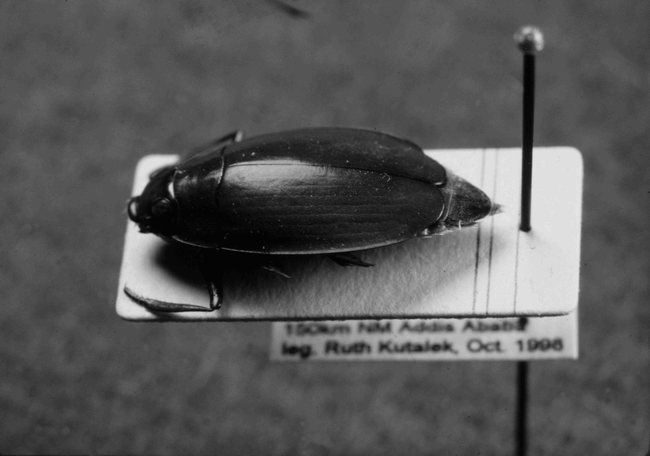
Dineutus sp. (Gyrinidae) from Ethiopia. Photograph by Ruth Kutalek.
Results
Traditional Use of Water Beetles in Ethiopia
In Ethiopia water beetles are called
The beetle is placed on the nipples where, in defense, it “bites” the girl. After that the insect is released. The bite is described as a stabbing and burning pain that eases after 30 to 60 minutes. Two to three days after the bite the breast is reported to be slightly swollen. Most of the girls said that their breasts grew bigger during the following 6–12 months which is in fact the main reason why they undergo such a practice: their concern is a cosmetic one. They want to appear more adult, or to be “like our older sisters,” as many of them said. The increase in breast size after a bite is not attributed to normal bodily changes around puberty but is considered to be caused by the bite of the beetles. The girls reported no undesired side effects. Often girls of this age have already undergone circumcision and other painful body mutilitation, such as tattooing the skin and gums, so that the pain of the beetle's “bite” is tolerated easily (Figure 2).

Young girl collecting water beetles, Fitche, Ethiopia. Photograph by Armin Prinz.
Knowledge of the special properties of these beetles is quite widespread in Ethiopia; it is passed on amongst the young girls and not from mothers to daughters, which is a rarely reported mode of transmitting traditional medical knowledge. As far as we can judge, the practice is not connected to any ritual activity and is seen as part of normal day-to-day life.
As can be expected, the custom is more widespread in rural areas than in urban areas, where water is received in central tubs and access to rivers and ponds is limited. Young urban girls often did not know much, if anything, about the practice. Also the use of
Traditional Use of Water Beetles in Tanzania
In Tanzania girls use gyrinids and dytiscids in much the same way as in Ethiopia except that the beetles also play a role in magic and they are occasionally used by boys. Fetching water and doing the laundry is the task of girls and women. For them the river is a social place where news and opinions are exchanged and, most importantly, where they are among themselves, unobserved by adults. Therefore, it is not surprising that in Tanzania mostly women know about the practice of stimulating breast growth with beetles. Men, even if they are specialists as traditional healers, are rarely aware of the practice.
These beetles are traditionally used among the Bena in the southwest, but we assume that the use is more widespread. In the region of Njombe they are called
Water beetles are also used in traditional medicine against dizziness (
In some areas
Traditional Use of Water Beetles in Uganda, Kenya, Zimbabwe, and Congo
Girls use water beetles for stimulating breast growth in Uganda and Kenya, too (Kassa 1998). In the Lugishu language, water beetles are called
Unlike Ethiopia and Tanzania, in the Mbarara region it is believed that the smaller specimens, which are the ones used for stimulating breast growth, are females. Larger specimens are considered to be males, and they are not used because they do not have the desired effect. The young girls explained that male beetles are more rare. One male lives with several females in a puddle of approximately 2 m2. In contrast to girls in Ethiopia and Tanzania, those in Uganda learn the practice from their grandmothers. They use the beetles when they are a bit older, around 14 to 15 years old, if their own breast development is unsatisfactory. They use them the whole year through, in the rainy season and the dry season. They catch the beetles skillfully with their bare hands without using a cup or sieve.
In Tsholothso, Zimbabwe, the beetles are called
In Ethiopia, Tanzania, Uganda, Zimbabwe, and Congo the people do not differentiate between the families, let alone the species, which is indeed difficult even for experts. Girls take beetles of similar appearance, often preferring larger specimens because they are said to be much stronger. In Uganda our informants distinguished between “male” and “female” beetles—the gyrinids are perceived as “female,” living together with one “male” beetle, the dytiscid, in a pool. One informant reported that only the females are known to have the desired effect.
Traditional Use of Antlions in Uganda
In Uganda, and apparently in other parts of East and southern Africa as well (van Huis 1996:13), the larvae of antlions (Myrmeleontidae) are also used for stimulating breast growth. Some specimens in question which were collected near Kampala in September 2000 could be identified as Myrmeleon obscurus Rambur. In the Lusoga language, antlions are called
Chemistry
Gyrinidae and Dytiscidae
Gyrinids in their pygidial glands produce unique nor-sesquiterpenes: gyrinidione, gyrinidone, gyrinidal, and isogyrinidal (Miller et al. 1975; Newhart and Mumma 1978). In addition, amino acids and a significantly high portion of polar lipids were found. One compound that is structurally related to the gyrinid norsesquiterpenes and also well known for its neurological activity is nepetalactone (X), the active component of catnip (Nepeta cataria), which is excitatory to felids (Miller et al. 1975:81).
The gland secretion of many aquatic beetles contains substances that are antibacterial, antimicrobial, and antifungal (Kovac and Maschwitz 1990). From time to time, especially if the water temperature or light intensity increases, the beetles groom themselves with the pungent secretion to remove parasites and to make the body surface water-resistant (Schildknecht 1970:20). Pygidial gland secretion might be important for respiration by facilitating the secretion's ability to inhibit the growth of microorganisms (Kovac and Maschitz 1990:136).
Some main components of the pygidial gland in dytiscids are aromatic compounds such as benzoic acid, p-hydroxybenzaldehyde, hydroquinone, p-hydrox-ybenzoic acid methyl ester, p-hydroxybenzoic acid, 3,4-dihydroxybenzoic acid methyl ester (Classen and Dettner 1983; Newhart and Mumma 1979; Schildknecht 1970), methyl p-hydroxybenzoate (Fescemyer and Mumma 1983), phenylacetic acid, and phenylpyruvic acid (Kovac and Maschwitz 1990).
Dytiscids also possess prothoracic glands which secrete a great variety and unexpected high quantities of steroids (for a review see Miller and Mumma 1976a), which are similar to those produced by other aquatic bugs (e.g., Lokensgard et al. 1993). Some of the steroids that have been isolated are progesterone, androsterone, deoxycorticosterone, testosterone, estradiol (Chapman et al. 1977; Gerhart et al. 1991; Miller and Mumma 1976a:116f.; Schildknecht 1970:20ff.), cholesterol (Fescemyer and Mumma 1983:1462f.), mirasorvone (Meinwald et al. 1998), and fully saturated pregnanes (Schaaf et al. 2000). Because insects are not capable of synthesizing the steroid skeleton de novo it is suggested that microorganisms play a major role in transforming these steroids (Schaaf and Dettner 1998, 2000).
Many compounds seem to act as toxins or feeding deterrents against predators (Eisner and Aneshansley 2000). When administered externally in solution to fish, isolated norsesquiterpenes possessed narcotic and toxic activity similar to that of the anaesthetic steroids deoxycorticosterone and testosterone which, in high concentrations, can act as a narcotic in fish (Miller et al. 1975:75). Gyrinidal and gyrinidione may possibly be hemolytic agents (Miller and Mumma 1976a: 128, 1976b).
Myrmeleontidae
Little is known about the defensive chemistry of Myrmeleontidae. Some make cone-shaped holes in the sand to trap ants and other insects. The larvae also feed on insects that are much larger than themselves so that it was commonly assumed that they use a venom to catch their prey. Researchers found that Myrmeleon bore indeed uses a toxin, a single polypeptide which was named ALMB-toxin, that could be collected from the tip of the mandibles of the larva. The toxin, which could be detected clearly in the larval sample, but only faintly in the pupal and adult preparations, has very potent paralytic activity against cockroaches. It could well be that not only M. bore but also other species of antlions may secrete powerful toxins (Matsuda et al. 1995; Yoshida et al. 1999).
Discussion and Conclusion
Many questions about the chemistry and physiology of the use of insects to stimulate breast growth remain unanswered. An open question is whether or not the breasts of the young girls do actually grow after this practice. Our fieldwork was relatively short term, so we were unable to observe possible effects of the mentioned insects discussed here. There is insufficient evidence to conclude that the chemical defense mechanisms of the insects are responsible for a possible growth of the breasts. We would have to determine whether the human skin can absorb the compounds and if the amounts of the chemical ingredients are sufficient to have an effect on the human body. The attributed effect might well only be in the imagination of people and undetectable by Western science. It seems implausible, however, that an ineffective therapy would be so widespread in Africa geographically and among so many ethnic groups. It would therefore be worthwhile to investigate mechanisms that might stimulate the skin surface, leaving the breasts slightly swollen.
Most of the beetles used are gyrinids. Unlike dytiscids, which live in the water and only approach the water surface for breathing,14 they are usually easier to catch because they live on the water surface. This also explains why people in Uganda believe that one “male” dytiscid lives together with many “female” gyrinids. People usually do not distinguish between gyrinids and dytiscids. They do, however, possess an empirical knowledge of how certain insects applied in a special way may alter the condition of the body.
One of the unexpected aspects of the use of water beetles and antlions for enhancing breast growth is that it is so widespread. Young girls of diverse ethnic and religious backgrounds use similar insects almost in the same way and around the same time in their lives. The knowledge is mostly transmitted from girl to girl or from grandmother to girl. It is a traditional practice that is not especially kept secret, but women will not talk about it unless they are encouraged to do so. They might feel that the practice is not something that is particularly interesting to Western science. Wherever we went our requests for more information about water beetles was often answered with a shrug of the shoulders or laughter. It could well be the that women in these areas are not especially eager to relate their ideas about the body to foreigners, which is not surprising when we realize that the African body, and even more so the female African body, was for such a long time the focus of a eurocentric power relation (Butchart 1998).
Williams and Bendelow (1998:105f.) rightly state that “children's bodies [have] been peculiarly ‘absent’ in much of the (adult-centered) sociological discussion of the body and society to date” and that there has been “a tendency for children's embodied voices and concerns, feelings and emotions, to remain silent or under-researched.” It might represent a social value in these areas that large breasts are conceived as symbols of adulthood and fertility. Castelnuovo and Guthrie (1998: 36) state that “women's breasts are viewed as a critical body part identifying female sexuality” and that sexual identity is one of the dominant discourses of Western societies. We might argue that breasts as a symbol for adulthood might also be interpreted in the light of the status of girls and women in these societies.
Future studies should focus on the ethnoentomological aspects, on the identification of further species used for stimulating breast growth, and on the identification of their compounds. We also assume that where girls know this technique there is more and other use of insects in cosmetic, medicine, as poison, and as food.
Footnotes
Acknowledgments
We want to thank all our interview partners in Ethiopia, Tanzania, and Uganda. We are also grateful to Gü nther Wewalka, Paolo Mazzoldi, Manfred Jäch, and Horst Aspöck for identification of the insects; Betty Kwagala, Mathias Wewalka, Doris Burtscher, and Armin Prinz for collecting specimens and providing constructive information; Bob Pemberton, Nina Etkin, Valerie de Garine, and John Janzen for their inspiring comments and for reviewing this article. Also, we want to thank two anonymous reviewers for their useful suggestions.
1
The two colleagues are Dr. Doris Burtscher and Prof. Dr. Armin Prinz, Institute for the History of Medicine, Medical University of Vienna.
2
The beetles are kept in the care of Prof. Dr. Gü nther Wewalka, Institute for Medical Microbiology and Hygiene, Vienna.
3
The beetles were identified by Dr. Manfred Jaech, Zoological Department (Insects), Museum of Natural History, Vienna.
4
The beetles were identified by Prof. Paolo Mazzoldi, specialist on Gyrinidae, Genova, Italy.
5
The beetles were collected by Mathias Wewalka.
6
The beetles were identified by Prof. Paolo Mazzoldi.
7
The beetles were identified by Prof. Paolo Mazzoldi.
8
The beetles were identified by Prof. Dr. Gü nther Wewalka.
9
The beetles were identified by Prof. Paolo Mazzoldi.
10
The antlions were collected by Dr. Betty Kwagala, Makerere Institute of Social Research, Uganda; they were identified by Prof. Horst Aspöck, Department for Medical Parasitology, Institute of Hygiene, University of Vienna.
11
Research notes: R. Kutalek, Tanzania 1995/96.
12
Dr. Betty Kwagala, conversation 2003; Richard Szeriosa, Mbarara Hospital, personal communication 2002.
13
Dr. Betty Kwagala, personal communications 2000, 2003.
14
Prof. Dr. Gü nther Wewalka, personal communication 2003.