






Abstract
We worked with Iskatewizaagegan (Anishinaabe) elders to create a holistic representation of their plant knowledge as well as a more standard ethnobotanical system of classification. In order to understand the holistic approach, chosen by elders to represent their plant knowledge, it was necessary to understand the ontology, epistemology and phenomenology of plant knowledge. This is explored through an examination of the ethnobotanical data, collected in 2000 and 2001, as a system of classification that includes the processes of classification, nomenclature, and identification. In conclusion, we propose that elders emphasize a holistic ethnobotany since they believe plant knowledge resides in the plants of a place and the relationships between persons and plants of that place. This leads to the conclusion that a critical factor in perpetuating knowledge over time, and between generations, is the ongoing creation of relationships through land-based activities.
Knowing Plants
When I1 started learning about plants from the Anishinaabeg2 of Iskatewizaagegan my approach consisted of going into the bush, finding a plant with an Ojibway name, recording its uses, and linking that plant to a scientific taxon. During my first field season the community researchers and elders tolerated four months of this listing and knowledge recording exercise. Through this work we were able to generate a list of plant names linked to an associated set of information. The approach, of course, mimicked the way I learned about plants through my formal training and education. I had not really considered that there could be other modes of knowing plants.
Over the course of the winter, my main research associate in the community, Edward Mandamin, suggested that during the second field season we might want to try a different way of knowing plants. He suggested we undertake a set of ceremonies in the spring during which we would tell the elders what we wished to learn about and ask them to guide our learning over the course of the coming summer. Ed and his colleagues, Phyllis Jack and Brennan Wapioke, were most interested in documenting elders’ knowledge and acquiring skills for surviving on the land. Iskatewizaagegan elders distinguish the widely shared land-based knowledge of the community from the highly restricted and specialized knowledge of, for example, healers and hunters (See Ellen 2002, who provides a detailed discussion that contrasts generalized and specialized knowledge).
We focused on generalized knowledge for two reasons. First, elders felt this was a body of knowledge that could be part of a research project and taught to an outsider; specialized knowledge is transmitted privately between an elder and a young person. Second, elders were concerned that this knowledge is disappearing, because young people do not experience the land as previous generations did due to the disruption of land-based activities. The approach that emerged to document shared knowledge was first to learn practices associated with land-based activities under the tutelage of elders. This allowed us to become familiar with the plant gifts bestowed upon the Anishinaabeg of Iskatewizaagegan for their survival. Some of the activities that were undertaken during this phase of the research are shown in Figures 1–4. These activities resulted in an approach that provided both written materials and experiential learning modules that could be linked to the curriculum of the IIFN education authority.

Ella Dawn Green showing Walter Redsky how she would practice making patterns with bite marks on blue-bead lily (Clintonia borealis) leaves. The chosen patterns then would be applied as decoration on birch bark baskets and other items.

Brennan Wapioke harvesting birch bark (Betula papyrifera).
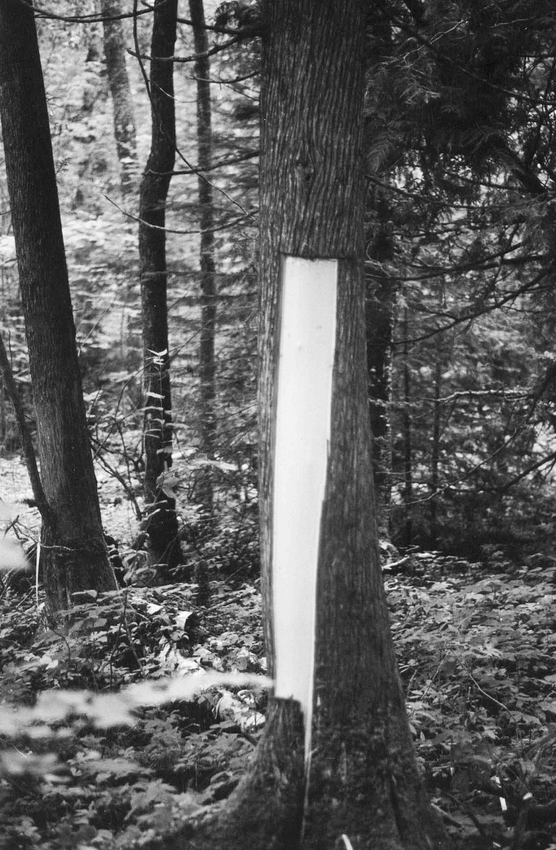
Proper way to harvest cedar (Thuja occidentalis) so that the tree will survive.

Ella Dawn Green teaching youth how to make an arched birch dwelling (
Learning plants through the practices utilized by elders for survival on the land was, in my initial thinking, simply a methodological choice. However, through the process of the research and listening to Anishinaabe elders, I also came to learn that it also reflects ontological and epistemological propositions regarding how other beings can be known. In many societies in which ethnobotanists work, systems of plant classification are interwoven into practices, institutions, technologies, values, and worldviews (Berkes 1999; Turner et al. 2000). Plant taxa, signified and organized within a system of classification, are not learned as independent entities, but become known through a process of learning guided by elders (Davidson-Hunt and Berkes 2003a).
This paper explores three related puzzles. First, why do our data support Berlin's (1992) suggestion that a basic rank of folk generics exists universally across societies, but not his idea of nontransitive, higher order classes? Second, why do rules of Anishinaabe plant nomenclature allow multiple names for a taxon? Third, why were elders hesitant to assume that every plant encountered in the bush could be assumed to be a part of a taxon on the basis of physical characters or location? Sometimes ethnobiologists conflate the processes of plant classification, nomenclature, and identification (Ghiselin 1999). In our study of Anishinaabe plant knowledge, we have tried to take into account the discrete processes of these different aspects of plant systematics.
Following an introduction to the people and place of Iskatewizaagegan, we discuss plants through an exploration of an Anishinaabe ontology focused on plants. In order to probe the puzzles of classification, nomenclature, and identification we look at the ethnobotanical data collected with Iskatewizaagegan elders, while at the same time bringing the results of other scholars’ work into the discussion as a means to help understand our data. This approach allows us to explore the three puzzles posed above and provide our interpretation of an Iskatewizaagegan way of knowing plants.
People and Place
Research was undertaken with Anishinaabe (Ojibway, Ojibwa, Saulteaux, Chippewa) people of Iskatewizaagegan No. 39 Independent First Nation (IIFN). IIFN is located in northwestern Ontario approximately 120 km east of Winnipeg, Manitoba. IIFN is one of two First Nations with permanent communities on Shoal Lake, with a combined population of 530 on-reserve band members and some 300 members living off-reserve.
Anishinaabe is an Algonquian language and is one of the largest indigenous language groups in North America. In the written historical record, the presence of Anishinaabeg in the region dates back to the early 1600s (Davidson-Hunt 2003a); they were important participants in the fur trade of the sixteenth to nineteenth centuries. Although a treaty was signed with the Government of Canada in 1873, settler and First Nation governments disagree about its intent. First Nations say that the treaty was a promise to share the land equitably and peacefully between settlers and First Nations, while settler governments say it was simply to allow for subsistence activities until such time as the resources were needed for development. The latter interpretation resulted in the marginalization of First Nation peoples from the dominant economic activities of the twentieth century: mining, forestry, tourism, and commercial and recreational fishing. In spite of these processes over the last hundred years, Iskatewizaagegan people have continued to search for space to maintain their relationships to the land and identity through commercial and subsistence activities (Davidson-Hunt and Berkes 2003b).
The Shoal Lake watershed forms part of the Lake of the Woods watershed that is one of the main headwater regions of the Hudson Bay. The natural history of Shoal Lake is notable, as it brings together three great biomes: Prairie, Great Lakes-St. Lawrence Forest, and Boreal Forest (Davidson-Hunt 2003a). This is partly a result of the geology of the region. The thin, acidic soils of the Precambrian Shield give way to the deeper and more basic soils of the Prairie biome as one moves in a southwesterly direction. The region has a mean summer temperature of 15°C and a mean winter temperature of −13°C. Precipitation is evenly distributed throughout the year and is about 600 mm. The intermixing of plant and animal species has produced a region that is higher in biological diversity than any of the three biomes on its own.
Methodology
The research used a cooperative approach that has been described in Berkes and Davidson-Hunt (2001), Davidson-Hunt (2000), and Davidson-Hunt (2003b). It includes a process of trust building, collaboration in developing research protocols, and review of research results, including a draft of this paper. Although it would be preferable to report that this approach settled potential points of conflict, it is more accurate to report that the process is continuing and trust is built day-to-day with some advances and some setbacks. Community researchers and translators Brennan Wapioke and Phyllis Jack both played a role in ensuring the success of the research process since 1999.
In order to discuss individual plant taxa and confirm scientific identifications it was necessary to collect voucher specimens during field seasons in 2000 and 2001.3 If a plant was not abundant or was a rare species, photographs and videos were taken instead of voucher specimens. Digital video was also used to record names, uses, stories, and plant harvesting ethics.4 When a specimen was collected, or other harvesting activities undertaken, the elders offered prayers and tobacco; additional ceremonies were undertaken as determined by the elders. Three verification workshops have been held with the elders and community researchers to discuss the results of the research.5 This extended conversation with community researchers and elders improved our understanding of the Iskatewizaagegan ethnobotany that we present in this paper.
A Holistic Iskatewizaagegan Ethnobotany
Iskatewizaagegan ontology regarding individual beings begins from the position that the Creator placed all things, including the Anishinaabeg themselves, upon the earth (see also Latour 1993). The living kinds that we call plants are thus part of what Iskatewizaagegan people refer to as

A holistic representation of Iskatewizaagegan ethnobotany created by the research team.
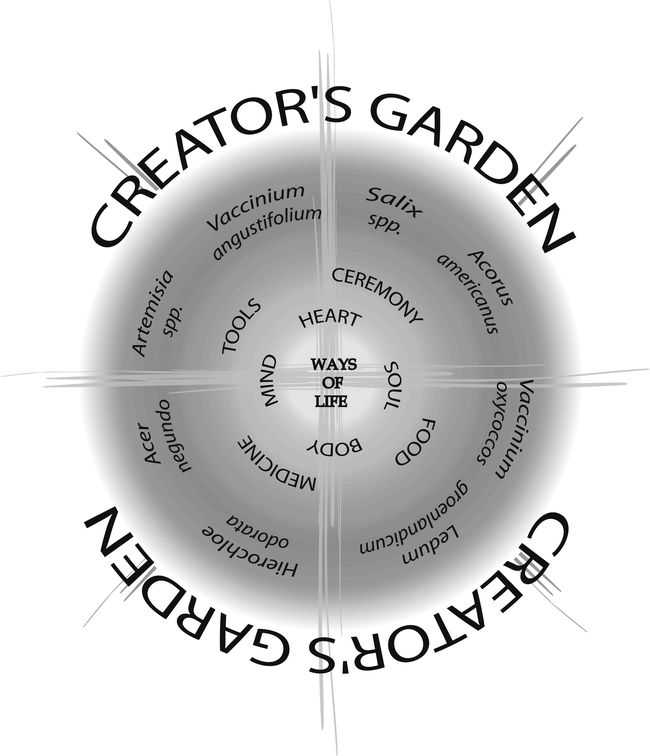
A holistic representation of Iskatewizaagegan ethnobotany created by the research team. English translation.
In return for this abundance of gifts provided to the Anishinaabeg, the Creator also placed a moral, “custodial” responsibility upon the Anishinaabe that Robin Greene has called the principle of
The Creator's garden provides the sustenance to Anishinaabe ways of life that are placed as the center point in the illustration shown in Figure 5. An Anishinaabe who follows this way of life experiences the world through the wholeness of her being which includes
There is one other important point that can be drawn from Figure 5 that relates to Anishinaabe ontology. An individual being, an inhabitant of the Creator's garden, can also be thought of in terms of functional properties (material use), but is not defined by those properties. As the elders noted, a blueberry (Vaccinium spp.)6 is categorized as culinary when eaten, technological when used as a dye, medicinal when treating an ailment, and ceremonial when eaten as part of a feast. The taxon is signified by the lexical term ‘blueberry’ and as a taxon has many potential uses, but each individual blueberry plant is placed by the Creator on this earth to sustain the Anishinaabeg in a way that can only be known at the time of use.
The Anishinaabe ontology of knowing plants sheds some light on the first puzzle we previously identified. One of the major questions of ethnobiology is whether ethnobiological systems of classification are based purely on qualities inherent in the organisms themselves or are influenced to some degree by cultural use (Berlin 1992; Hunn 1982). This is a reasonable concern insofar as it can be assumed that a system of classification can be independent of daily life and that the human mind is an organ independent of its environment (Bateson 1972, 1979). However, Iskatewizaagegan ontology does not permit the brain to become the privileged organ for apprehending the world, nor the mind to be the dominant site of knowledge that subordinates and coordinates other ways of knowing located in the body, soul and heart. Elders insist that plants become known as beings of the Creator's garden who provide for the Anishinaabeg and to whom the Anishinabeg hold a duty. The system of Anishinaabe plant classification, nomenclature, and identification to which we now turn exists within this broader worldview.
An Iskatewizaagegan Ethnobotanical Classification System
Previous Ethnobotanies
The ethnobotanical literature of Ojibway people has tended to focus upon the names and uses of plants rather than the Ojibway system of plant classification. The best known Ojibway ethnobotany, for example, is that of Frances Densmore, “Uses of Plants by the Chippewa Indians” (Densmore 1928). It has since become well-known in a reprinted edition, How Indians Use Wild Plants for Food, Medicine and Crafts (Densmore 1974). Other ethnobotanies that likewise focused on the names and uses of plants include Hoffman (1891), Gilmore (1933), Reagan (1928), Smith (1923), and Stowe (1940). These studies were reviewed recently and compiled into a new volume of Ojibway plant names and uses titled Plants Used by the Great Lake Ojibwa (Meeker et al. 1993). This body of work has provided a great contribution to our knowledge of Ojibway plants names and uses.
Although the “classics” of Anishinaabeg ethnobotany did not examine their systems of plant classification, some relevant work has emerged from the ethnographic and ethnoscientific literature. A. Irving Hallowell, in his work with the “Berens River Ojibway,” was the first to consider an Ojibway system of classification of living kinds (Hallowell 1976, 1991). Mary Black drew extensively on Hallowell's work to deepen this discussion and provide an ontological basis for Ojibway ambiguity regarding their classificatory schema (Black 1977a). A recent paper on Ojibway (Lac Seul) ethnobotany provides another recent approach to an Algonquian system of plant classification (Kenny and Parker 2004). We attempt to integrate the thinking of earlier authors into our paper in creating our interpretation of an Iskatewizaagegan ethnobotany. This allows us to pay attention to the ontology and epistemology of knowing plants in our consideration of classification, nomenclature, and identification.
An Iskatewizaagegan System of Plant Classification
Iskatewizaagegan plant classification is similar to that suggested for other North American indigenous peoples. As Johnson (1999) reports for the Gitxsan (northwestern North America), the plant classification system is a shallow hierarchy, with higher order plant classes, a basic rank (folk generics) and folk varieties. The idea that a basic rank is the ontological foundation of the classification of living kinds meets with widespread agreement amongst ethnobiologists (Atran 1990; Berlin 1992; Ghiselin 1999). This idea also appears to hold across societies including the universal system of classification that has emerged in the modern period based upon initial efforts of Carl von Linné and other biologists (Atran 1990; Raven et al. 1971). At higher order classes and folk varieties, however, more variation occurs, along with more variation amongst ethnobotanists as to how such classes are created (Ghiselin 1999; Hunn 1976; Taylor 1990).
This has led some ethnobiologists, such as Atran (1990) and Berlin (1992), to insist that higher order ranks, such as intermediate groups, life forms, and kingdoms, should be nontransitive and mutually exclusive. In other words, in a shallow hierarchical system, a taxon should belong to only one higher order class. This follows from the idea that the defining properties of higher order classes should be based on the physical characters of a plant, similar to the Linnaean system. Higher order classes that are created using defining properties other than physical characters, in this approach, should not be considered as part of a society's system of plant classification. However, this assertion has generated opposition from other ethnobiologists such as Turner (1987, 1988, 1989) and Hunn (1976, 1977, 1982), who argue for a greater range of defining properties for higher order class membership.
Classification
In the ethnobotanical literature, classification, nomenclature, and identification are often presented as one and the same thing. However, as Ghiselin (1999) has noted, these three processes should be considered separately. Classification is “a creative process whereby the materials are arranged in some kind of order, or system, perhaps providing names for groups of them” (Ghiselin 1999:451). Nomenclature is the process by which names are provided to the groups but identification is “the assignment of an individual such as a botanical specimen to a place in a preexisting system, and perhaps to decide that a name applies to it” (Ghiselin 1999:451).
Ghiselin's work also makes an important contribution by clarifying the nature of groups (taxa) at the basic rank versus higher order groups. At the basic rank, he suggests, groups are not classes (which could have overlapping membership), but wholes composed of organisms or “individuals at a supraorganismal level” (Ghiselin 1999:448). This is an important distinction in that diagnostic properties are utilized to decide if a part (an individual plant, for instance) belongs to a whole (for example, a species) for the basic rank. Higher order groups (e.g., foods, medicines) are conceptually distinct, as they are considered to be classes with defining properties of membership. Following this logic, an individual plant can only be a member of one species, or basic rank taxon. However, the same restriction does not hold for groups (taxa) that are considered to be classes. This is similar to Needham's (1975) idea of polythetic classification in that there is no logical reason that a lower order taxon cannot be a member of multiple higher order taxa; there is no logical requirement for such groups to be mutually exclusive, while there is for basic rank groups. We use this distinction between basic rank and higher order groups to organize our discussion of classification through a consideration of folk generics and major plant groups.
Folk Generics
Our research with Anishinaabe elders provides further support for the ethnobotanical concept of a basic rank that we term, following Berlin (1992), folk generics. In Table 1 the Iskatewizaagegan folk generics documented during this research are presented. They exhibit a high degree of correspondence with Linnaean plant taxonomy as well as with the names collected in previous ethnobotanical research.7
Iskatewizaagegan (Anishinaabe) generics. Includes alternate nomenclature, folk varieties, common English names, and Latin nomenclature.

Some plants that were utilized but not named by Iskatewizaagegan elders.

Iskatewizaagegan classes that group basic rank individuals.

Lexemes (affixes) and nouns related to Iskatewizaagegan plant knowledge.
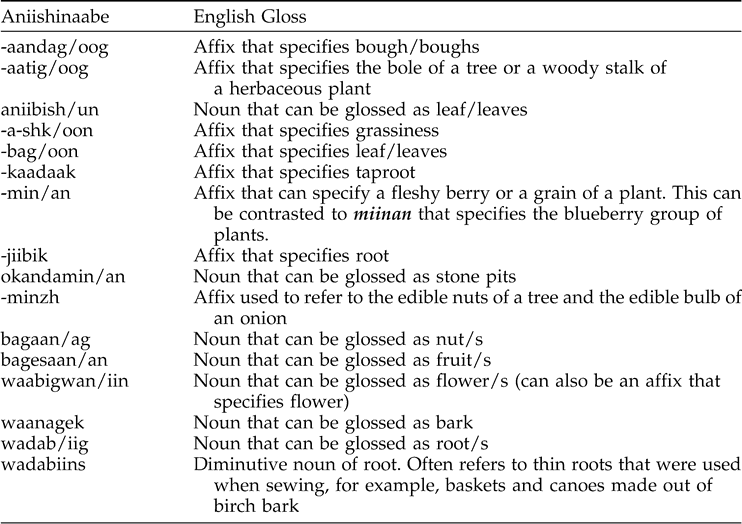
Examples of how plant nomenclature can be constructed using lexemes that specify plant structures.

We present only taxa for which elders recognized a prototypic individual for which they could provide an Anishinaabe name and which we were able to verify with a voucher specimen. There are many other plants that they recognized as useful for medicines but for which they did not provide a name even when asked. Examples of some taxa which they recognized as distinct but for which they do not know an Anishinaabe name are provided in Table 2 and Appendix 1. Such taxa are called covert; a covert taxon is recognized as distinctive—it has been classified, but is not named (Berlin 1992).
Berlin (1992) and Taylor (1990) say that names constructed through the modification of a primary lexeme should be considered as divisions of the basic rank. For example, the primary lexeme
The list of Anishinaabe names presented in Table 1 provides additional support for the idea that a basic rank exists across cultures. The table also presents a current set of basic rank taxa recognized by Iskatewizaagegan elders that can be compared with previous ethnobotanies and recent work by Kenny and Parker for Oji-Cree (Kenny 2000; Kenny and Parker 2004).
Major Plant Groups
Ethnobiologists disagree about which higher order classes are necessarily part of a folk classification. For example, a dominant line of thought maintains that there should be a universal model of classification that includes the basic rank (e.g., folk genus), a rank that divides the basic rank (folk varieties), a higher order rank that groups the basic rank (intermediate ranks) and a unique beginner (Atran 1990; Berlin 1992; Raven et al. 1971). After much scholarly debate, there appears to be a consensus favoring expanding the defining properties of higher order classes to include utilitarian, symbolic, and aesthetic considerations (Ellen 1993; Hunn 1976, 1982; Turner 1989). The existence of cross-cutting higher order groups, however, is still considered problematic for the idealized ethnobiological model that emphasizes such groups as nontransitive and mutually exclusive (see Needham 1975 regarding polythetic classification).
Some authors have recognized that an odd contradiction emerges when cross-cutting groups are excluded from an ethnobiological system of classification simply on the basis of philosophical propositions (Clément 1990). In his work with the Tobelo people, Taylor (1990) provides examples of cross-cutting groups. Some authors who have included such cross-cutting groups in their analyses use the general term “major plant groups” (Johnson 1999; Turner 1987).
Similar to Johnson's (1999) and Taylor's (1990) findings, the class of a unique beginner that would be the equivalent of plant (Plantae) appears to be a covert class in Anishinaabe. Elders, all of whom are bilingual, recognized that we were not talking about knowledge related to what are called animals, fish, and birds in English. However, when pressed for an Anishinaabe word that would include all of the things that are included in the English term for plant, they were not able to provide such a word. More work would be required to conclude that the unique beginner exists as a covert class in Anishinaabe, or that elders recognize this class on the basis of their familiarity with the English taxon ‘plant’.
Although taxa in many systems of ethnobiological classification are not well developed at the rank of kingdom, there are often those that are similar to the botanical concept of life form (Berlin 1992). There are a number of names that we consider to indicate higher order, life form taxa (Table 3). Examples include:
Table 3 also demonstrates the appearance of higher order taxa whose rank is unclear. Taylor (1990) also noted that for an empty group, it is often difficult to determine the appropriate rank specified by the existence of a name. For example,
Other cases that are unclear are
There are also higher order groups that do contradict the rules and which we include here as major plant groups. The difference between these classes and life forms is that a taxon can belong to more than one of these groups. For example, one such group is identified through the prefix
The prefix
In two other cases, it was difficult to determine whether the term was an example of polysemy at the basic rank, or a major plant group. This occurred in the cases of
Another major plant group that follows this pattern is that of wiigobiig, which may be glossed as ‘willows’ in English. This group includes Salix spp. as well as
The taxonomic structure of the Iskatewizaagegan system of plant classification supports the proposition that a basic rank is ontologically privileged; taxa of this rank can be subdivided (folk varieties) and grouped into classes (life forms, major plant groups). Our research also supports the notion that folk taxonomies have shallow hierarchies. However, we include major plant groups with defining properties that are chemical (e.g., poison), ecological (e.g., muskeg), functional (e.g., medicine/construction), and ceremonial (e.g., smudging).9
Plant Nomenclature
Some ethnobotanists have insisted that nomenclature should be considered as its own process distinct from both classification and identification (e.g., Taylor 1990). While classification focuses on how groups are created, nomenclature looks at the rules by which a name is applied to a group. For example, plant taxonomists follow very strict formal rules of nomenclature (Woodland 1997). The emphasis of the rules, in this case, is to standardize the form of a name for a taxon that is universal and independent of any particular context.
Nomenclature in an Iskatewizaagegan system of plant classification operates on the epistemological basis for learning plants (taxa), and plant names (nomenclature); knowledge is learned as you do things within a context of being on the land (Davidson-Hunt and Berkes 2003a). Anishinaabe nomenclature rules modify the form of the name depending upon the context within which the name is being used. There is no rule that requires a universalized name to be created. In understanding this basic rule of nomenclature it becomes possible to understand why a name for a folk generic can take different lexical forms.
Since eliciting names is basic to the method of ethnobotany, it is important to find out whether a variation in a name signifies different taxa at the basic rank, or is simply one taxon with many names (Taylor 1990). When we encountered variations in names among elders, and between our data and other Ojibway ethnobotanies, we decided to examine the construction of names to clarify what the variation signified. Tables 4 and 5 reflect the results of this work. Many names are constructed on the basis of lexemes for what Johnson (1999) calls plant partons. For instance, a tree name can be constructed in such a way as to specify the boughs by using the affix
This pattern repeats itself for
Another interesting variation is the group of ‘berry-stick.’ These are the shrubby trees that provide fruit and medicine from their bark. There is no confusion, for Iskatewizaagegan people, when pin cherry (Prunus pensylvanica) is called
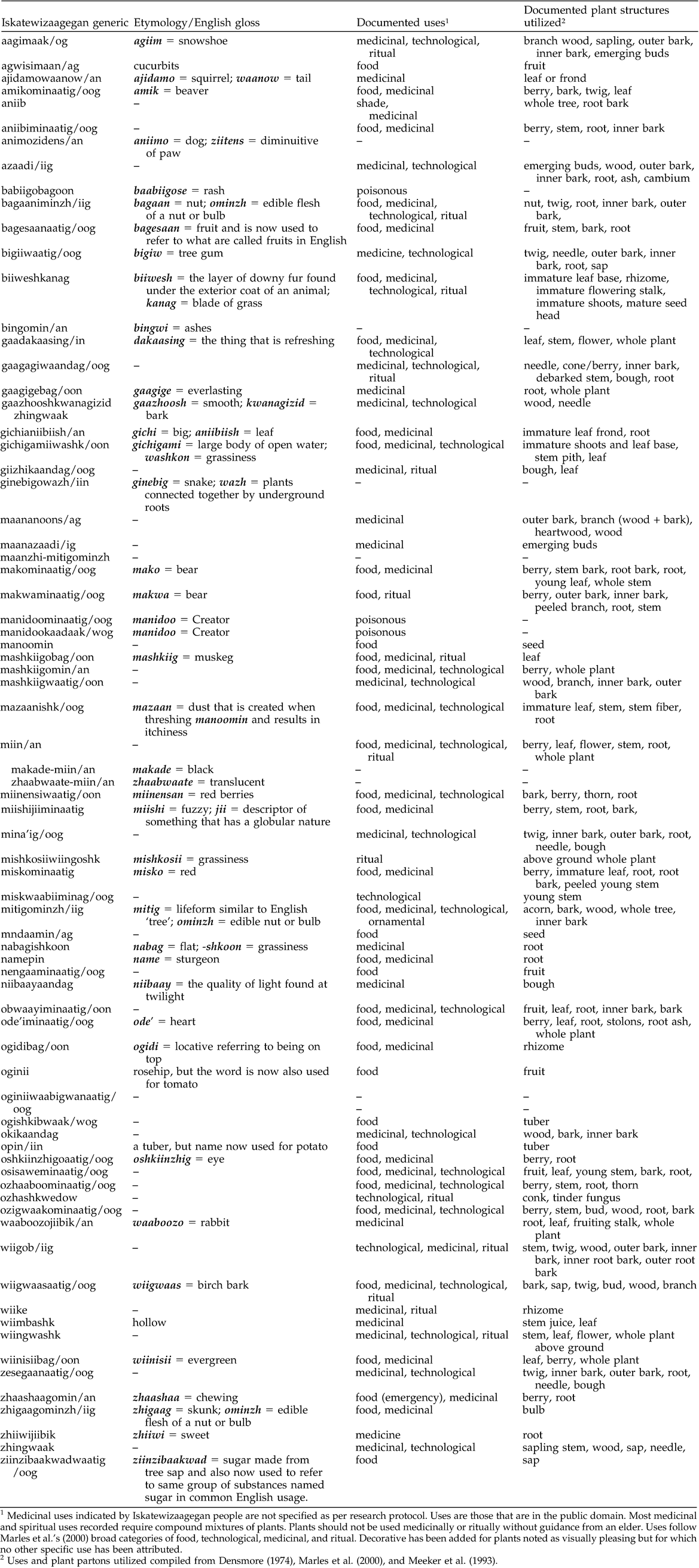
In Table 6 the translations of the names are provided along with the general use category and plant structures that are used. These represent the combined knowledge of elders collected during the current research, along with information recorded in previous ethnobotanies. Understanding which parts of a plant are used helps to clarify the possible lexical forms that may be constructed for a taxon; conversely the lexical form chosen tells us something about the part of a plant utilized. The lexical form uttered emerges out of the context in which reference is being made to the plant. So a plant whose leaf is medicine will be signified using one lexical form. There will be another lexical form if the same plant has berries that are food. The construction of the word will be based upon the root lexeme for the plant plus a lexeme that refers to the plant parton for a specific use. For an Anishinaabe speaker, both lexical forms would signify the same folk generic, so it would be inappropriate to infer that this demonstrates disagreement about the name of a taxon.
Etymology, documented plant uses and structures utilized.
The importance of context in relation to the name utilized also became apparent during verification workshops. Long discussions occurred among the elders as to the name that should be utilized for a taxon that is devoid of context. When we wanted to place an Anishinaabe name on the collection labels it was not clear which lexical form to utilize even when we had agreement on the folk generic it represented. Should we create a set of rules that would standardize the written names on collection labels, should we simply list all the lexical forms, or should each Anishinaabe name represent a different specimen? We chose to utilize one name to refer to the type specimen of a folk generic based upon the following rules: shrubby berry plants use the suffix
Plant Identification
Plant identification is the process by which an organism that is encountered during day-to-day life is placed into a taxon, so that a name and other associated properties of the taxon can be attributed to that organism. In contrast, identification for Anishinaabe people is rooted in a phenomenology that insists that physical appearance (morphology) and location (ecology), while necessary diagnostic features, are not sufficient in and of themselves. Identification can only be completed by experiencing an individual organism in day-to-day life (Black 1977a, 1977b). The importance of experience and context is a general characteristic of all Anishinaabe systems of knowledge (Davidson-Hunt and Berkes 2003a).
Iskatewizaagegan elders do utilize visible characters to describe a particular organism. These include life form, leaf shape, flower shape, flower color, smell, root structure, and other visibly perceptual structural features of an individual organism. The context and location of where a plant is found is also important in the process of identification. Elders prefer to travel to a place to identify a plant, rather than have a plant brought to them to identify. A plant found in a known context or location provides more information that increases the level of comfort in identifying an individual. However, a final decision regarding identification is not made until an experience with the plant occurs and the person assesses the outcome of that encounter.
The need to assess outcome pertains to the spiritual beings who can occupy the forms of physical plants. A healer does not choose a plant but rather a plant being offers itself for healing. A healer may receive such a gift through a dream, vision, or other ceremony, while trying to heal someone. The healer will be given information to identify the physical form of the plant that should be used in the healing process. This will include a constellation of features based upon physical characters and location but identification will also be assessed on the basis of the outcome of the healing process. A successful outcome indicates a successful identification while an unsuccessful outcome may imply misidentification. Becoming a powerful healer depends upon both the ability to identify the physical forms of plants as well as the ability to see the presence of a spiritual being within a plant. While plant identification on a day-to-day basis is often straightforward, it is important to note that identification can also include additional factors within an Anishinaabe system of plant classification.
Discussion: Toward a Holistic Anishinaabe Ethnobotany
We posed three puzzles that emerged out of our work with Anishinaabe elders regarding Iskatewizaagegan plant knowledge. First, why does our data support Berlin's (1992) suggestion that a basic rank of folk generics exists universally across societies but not his idea of nontransitive, higher order classes? Second, why do rules of Anishinaabe plant nomenclature allow multiple names for a taxon? Third, why were elders hesitant to assume that every plant encountered in the bush could be assumed to be a part of a taxon on the basis of physical characters or location? In order to explore these puzzles we used two approaches to represent the data we collected with Anishinaabe elders of Iskatewizaagegan. The first representation we presented was constructed with elders, and attempts to reflect Anishinaabe ontology and epistemology, while the second followed a standard ethnobotanical methodology. We organize our concluding discussion on the basis of these two approaches to represent Iskatewizaagegan plant knowledge.
The holistic representation of plant knowledge emplaces a system of plant classification within the total life ways of the Iskatewizaagegan Anishinaabe. Anishinaabe epistemology links the maturation of an Anishinaabe person and plant knowledge through an interweaving of Iskatewizaagegan institutions, practices, and world view. When Iskatewizaagegan plant knowledge is constructed as an abstract system of plant classification, or a set of plant names and uses, it becomes divorced from the place and people of Iskatewizaagegan; the familiar is rendered unfamiliar. Instead, a holistic representation is preferred that positions plants in relation to Anishinaabe ways of life. Individual plant beings and taxa are not considered to exist independent of a people or place within Anishinaabe ontology.
Second, identification of an individual as a member of a taxon requires more information than can be provided by a system of plant classification that separates the process of identification from an encounter with an organism. Iskatewizaagegan elders concur that processes of classification and nomenclature link taxa to associated names and properties. These processes differ from Linnaean taxonomic systems, however, in that direct experience of an individual organism is also a necessary diagnostic property for identifying a plant. This phenomenological approach to a system of plant classification is reinforced by epistemological principles, which stress that knowledge resides in the land, and is progressively revealed through an individual's experience of the land (Davidson-Hunt and Berkes 2003a). The Iskatewizaagegan system of plant classification does not place authority regarding knowledge into an abstract system of classification divorced from a people and place.
The ontological, epistemological and phenomenological basis of a holistic approach to Iskatewizaagegan plant knowledge brings together the cognitive structure of classification and the importance of practice. The Iskatewizaagegan system of plant classification supports the ethnobiological proposition of a basic rank and also that of a shallow hierarchy. The basic rank of taxa appears to be stable, but is open to modification as is any dynamic system of knowledge, including that of Linnaean systems of classification (Berlin 1992; de Queiroz and Gauthier 1994). Higher order groups result in cases in which the rank specified by a word is unclear and others which contradict the idealized ethnobiological model. We see no reason to exclude such cases of cross-cutting, higher order groups from an Iskatewizaagegan system of plant classification, agreeing with Ghiselin (1999) that there are distinct advantages to being able to create such classes on the basis of different types of defining properties. Since these classes do not represent the idealized model they are often not documented and thus we diminish our understanding of a society's plant knowledge.
The holistic representation helped us to understand the basic proposition that knowledge resides in the individual beings of a place, and is revealed through the relationships between the whole being of a person and others, in the Creator's garden. This is why elders emphatically state that ethnobotanical writings cannot teach an Anishinaabe how to know plants, in spite of the importance of such documents in creating respect for their knowledge and their potential use in a school system. It is more important, in this perspective, to find ways for Iskatewizaagegan youth, adults, and elders to maintain the relationships within the Creator's garden, the substrate of survival and self-determination for a contemporary Iskatewizaagegan way of life (Davidson-Hunt and Berkes 2003b). In holistic ethnobotanical systems of plant knowledge, it is through the relationships within the Creator's garden that plant knowledge will remain dynamic and an integral part of the Iskatewizaagegan way of life.
Footnotes
Acknowledgments
We would like to acknowledge the elders, the late Dan Green, Ella Dawn Green, Robin Greene, Jimmy Redsky, and Walter Redsky. They taught us the little bit that we know about Iskatewizaagegan plant knowledge. They are the experts in these topics and have been generous teachers.
We would also like to thank the Chiefs and Councils of Iskatewizageegan who have supported both SLRI and this research during the past decade. Jane Driedger produced digital forms of the graphics for Figures 5 and 6 based upon sketches produced by the elders. The comments of two anonymous reviewers and a sharp editorial eye have made this a better paper.
Funding for this research was provided by a Sustainable Forest Management Network research grant to Berkes, a Social Sciences and Humanities Research Council (SSHRC) grant to Berkes and a SSHRC doctoral fellowship and a Canadian Forest Service SSHRC supplement to Davidson-Hunt.
1
First person singular refers to Davidson-Hunt as contrasted to colleagues of the Shoal Lake Resource Institute.
2
In reference to the language, Anishinaabe and Ojibway are used interchangeably. Ojibway is more common in the ethnobotanical literature, while many communities, including Iskatewizaagegan, prefer to use Anishinaabe to refer to the language. Anishinaabe also can be used as an adjective to specify identity, i.e., Anishinaabe people. Anishinaabeg is used to refer to the collective identity of the society, i.e., the Anishinaabe people. Ojibway is retained when referring to historic documents that use the word to specify a collective identity.
3
Voucher specimens were deposited in the Herbarium of the University of Manitoba (WIN) and can be examined with permission of the Shoal Lake Resource Institute. The ethnobotanical collection provides labels with scientific name, Anishinaabe name, Universal Transverse Mercator (UTM) coordinates of collection, habitat, and general use categories. Vouchers are stored according to scientific classification (family, genus, species) or may be found in the alphabetical index of Anishinaabe ethnobotany vouchers.
4
All materials (photographs, digital audio, digital video, interview transcriptions, and publications) produced during the research were duplicated and provided to the community. The Shoal Lake Resource Institute of Iskatewizaagegan No. 39 Independent First Nation is the keeper of these archives. SLRI has also made research products freely available within the community for purposes of education, healing, interpretive tourism, future research, and political negotiations.
5
Conventions for the spelling of Anishinaabe words in this paper were created through workshops with a community language teacher (Ella Dawn Green), community researchers (Brennan Wapioke, Edward Mandamin, Roberta Greene), elders (Walter Redsky, Ella Dawn Green, Jimmy Redsky, Robin Greene), and myself. A final workshop took place 19 February 2005 when we all met with John Nichols, an Algonquian linguist, from the University of Minnesota. This workshop established the spelling conventions used in this paper.
7
The folk generics presented in  show a high degree of correspondence with scientific species. In one case,
8
In English this term is also complex. Medicine can refer to the pharmacopoeia of substances often called drugs or the science and art of treating and curing disease and sickness and improving or maintaining health. The class
9
In the workshop (19 February 2005) with John Nichols we also discussed that basic rank taxa are nouns and in Ojibway can be considered to be either animate or inanimate. However, while linguists have noted that some nouns are always animate and others inanimate, it is also possible for a noun to shift categories depending on the specific context of a sentence. Hallowell (1991) and Black (1977a, 1977b) provide a detailed discussion on this indeterminacy within Ojibway thought and grammar. Hallowell talks about the time he asked an elder whether a rock was a person (animate). The response was that some rocks were while some were not. It is often assumed that in Ojibway thought all things are animate, but that is an oversimplification of a more complex idea. Furthermore, as bibr
