







Abstract
The richness of common names of Brazilian marine fishes was studied based on a sample of 725 species, covering 67% of all marine fishes recorded in Brazil. The richness of names is considerable (mean = six common names per species) and is positively related to commercial importance and habitat type, with more names associated with exploited or reef-associated, pelagic, and demersal species. No names were associated with bathypelagic, bathydemersal, and benthopelagic fishes. This richness, while culturally and linguistically interesting, poses a problem for national catch statistics. Some species such as Aspistor quadriscutis, Cathorops spixii, and Genidens genidens were not listed in the catch statistics, but may have been caught for a long time without being recorded. Catches of Sardinella brasiliensis may be higher than what was officially reported, only due to the use of different common names. This may contribute to slow down the recovery process of this collapsed stock. Any attempt to assess the relative impact of different fishing sectors (subsistence, artisanal, industrial, and recreational) on the ecosystem will be undermined by the incomplete understanding of the connection between folk and scientific nomenclature. This issue is even more pervasive when each sector uses its own common name to describe the same species.
Introduction
Fisheries are collapsing all over the world (Hilborn et al. 2003; Pauly et al. 2002), mainly due to overfishing. Not only are target species impacted, but also non-target species caught as by-catch and subsequently discarded. Some fish stock collapses are not even noticed, as the species in question may not have been correctly identified. In addition, the connection between common and scientific names may not be correctly established and different species may be lumped together in catch statistics, thus undermining stock assessments.
To overcome this problem requires an understanding of the connection between common and scientific names; for this, one must be able to comprehend the way people classify and name living beings. Berlin (1992) presents some “principles” that govern the naming process of animals and plants: commonness, ease of observation, size relative to humans, and striking appearance. He concludes that these principles are language universals common to all cultures. Palomares et al. (1999) corroborated these principles for Philippine fishes. Freire and Pauly (2003), working on the names of Brazilian marine fishes, confirmed only the first three of these principles: commonness, expressed in terms of commercial interest, with 78% of commercial species associated with at least one common name versus 26% of noncommercial species; ease of observation, indicating that 73–75% of easily seen reef-associated and pelagic species were named against 3–5% for less visible (for example, bathypelagic and bathydemersal) species; and size, with 79% of the large species receiving names against 50% of the small species. Striking appearance could not be confirmed, at least not using monotypy as a proxy, as suggested by Palomares et al. (1999).
Some researchers consider common names completely unnecessary, and suggest they should not be even mentioned in scientific publications, reports or legislation. However, common names convey much information about what is known about each species and it is the preferred way to refer to them in daily life. Besides, if perhaps paradoxically, common names of organisms are more stable than scientific names (Robins et al. 1991). On the other hand, common names present high local and spatial heterogeneity, which creates problems when dealing, for example, with catch statistics, especially in tropical and developing regions such as Brazil, where artisanal, multi-species fisheries are very important (Freire 2003; Paiva 1997).
The objective of this paper is to quantify the richness of common names of Brazilian marine fishes, to assess the importance of commercial interest and ease of observation on the richness of common names, and to quantify the effect of richness of common names on catch statistics in Brazil. The results presented here may contribute, as well, to an understanding of how fisheries induce losses of local biodiversity.
Methodology
A database of 4,156 common names of 725 Brazilian marine fishes was compiled from 30 sources (hereafter referred to as NAMEDAT), with publication dates ranging from 1962 to 2000, including names that ranged geographically from Pará state, in northern Brazil, to Rio Grande do Sul state, in southern Brazil (Anon. 1976; Barcellos 1962; Brandão 1964; Carvalho and Branco 1977; Carvalho-Filho 1999; CEPA-MA 1978; CEPENE 2000; Chao et al. 1982; Ferreira 1999; Ferreira et al. 1998; Ferreira et al. 1996; Figueiredo 1977; Figueiredo and Menezes 1978, 1980, 2000; Godoy 1987; Ihering 1968; Lima 1969; Lima and Oliveira 1978; Martins-Juras et al. 1987; Menezes and Figueiredo 1980, 1985; Nomura 1984; Rosa 1980; Santos 1982; Santos et al. 1998; Soares 1988; SUDENE 1976; Suzuki 1986; Szpilman 2000). This extended database was constructed based on previous work by Freire and Pauly (2003), which resulted in a large expansion of the list of Portuguese common names of Brazilian marine fishes available in FishBase (see http://www.fishbase.org). The state where the name is used was recorded in the database, when this information was available. The richness of common names was assessed as the number of common names per species (synonyms) sensu Minelli (1999). The number of species associated with each common name (homonym) was also assessed. The spelling of all scientific names follows FishBase, which also contains the authorities responsible for the description of each species.
The number of common names per species was grouped into classes: 0, 1, 2–5, 6–10, 11–20, 21–30, >30. Information on local commercial importance (for either industrial or artisanal fisheries) was obtained from CEPENE (1997, 1998), Carvalho-Filho (1999), and Szpilman (2000). Habitat type was used as a proxy for ease of observation and reflects the definition presented in FishBase (Froese and Pauly 2000, see also http://www.fishbase.org):
pelagic—at the sea surface or mid water, from 0 to 200 m depth;
demersal—on or near the bottom and feeding on benthic organisms;
reef-associated—on or near coral reefs;
bathypelagic—from 200 m to the bottom and thus includes the mesopelagic, bathypelagic, and abyssopelagic zones;
bathydemersal—on the bottom below 200 m;
benthopelagic—at zones about 100 m off the bottom at all depths below the edge of the continental shelf.
The association among number of common names, commercial importance and habitat type was graphically represented using multiple correspondence analysis (MCA) (Greenacre and Blasius 1994), which was performed using SAS Version 8.2.
Mean annual catches for the period 1995–2000 were used to analyze the effect of richness of common names in the Brazilian catch database (hereafter referred as CATCHDAT). This period was chosen due to the existence of an electronic catch database compiled by Freire (2003), based on national fishery statistics, and to the relative stability of the size of catches throughout the period. This analysis followed three steps:
Step I. Common names associated with the ten largest mean annual catches from Brazilian artisanal fisheries (1950–2000); these fisheries include manual collection, paddling/sailing boats, and motor boats <12–15 m and <20 RGT (Registered Gross Tonnage);
Step II. Common names associated with the ten largest mean annual catches from Brazilian industrial fisheries (1950–2000); these fisheries are associated with boats usually ≥12–15 m and ≥20 RGT;
Step III. Selection of ten common names associated with the highest number of species (homonyms).
The catch recorded for one group by common name (for example,

Flowchart presenting the steps followed to split the catch recorded for a common name among all commercial species it is linked to. ‘C’ represents catch and ‘n’ represents the number of coastal states that record catches for a given common name (maximum n = 17). Equal denominators used to split catches among species indicate the use of equal weight. The small circles are bridges representing unrelated crossing lines.
The results of split catches were presented in flowcharts that we found better able to simultaneously represent synonyms and homonyms, to properly indicate the split of catches, and, overall, to visually represent very high richness of common names (synonyms). In general, these flowcharts presented the species of commercial interest associated with one common name in the left side and noncommercial species in the right side. These flowcharts should be read from the common name located on the top-center and then follow the lines accordingly to find which scientific names are associated with that common name. If the species was considered of commercial interest, the arrows indicated how much of the catch associated with a common name was assigned to that species after following the procedure presented in Figure 1 (separated in industrial ‘I’ and Artisanal ‘A’, when appropriate). Circles indicate unrelated lines which crossed and should be seen as ‘bridges’. Thus, the symbol  indicated that there were relationships between the box in the left and the box in the right, between the box in the top and in the bottom, but no relation between the boxes in the top or in the bottom with the boxes in the right or left.
Results
Richness of Common Names
The richness of common names of Brazilian marine fishes is very high, with an average of six common names per species. Only 37 species of Brazilian marine fishes have a unique common name that refers to no other fish species (Table 1). A total of 208 fish species are associated with only one common name, though many of these are used for other fish species (homonymy) (Figure 2a). On the other hand, 1,908 common names refer to only one fish species, though each species is associated with at least one other common name (synonymy) (Figure 2b). The two extreme cases are found in the species Macrodon ancyclodon (king weakfish), which is associated with 37 common names (Figure 2a), and the common name
List of species presenting one unique common name in Brazil, based on the database NAMEDAT.


Richness of names of Brazilian marine fishes represented by: a) the frequency of scientific species that have one to thirty-seven common names—synonyms; and b) frequency of common names that correspond to one to thirty-one species—homonyms.
The graphic representation resulting from the multiple correspondence analysis based on frequency tables indicated that no common name was associated with benthopelagic, bathypelagic, and bathydemersal species, which are not easily seen (Figure 3). The same held true for species for which no information (‘no info’) on commercial interest was stated. The fact that no clear statement was found may be a strong indication of lack of commercial interest. Species for which a clear statement of no commercial interest (‘no int’) was found are linked to only one common name, indicating a low richness of names for such species. The richness of common names was higher for easily seen species (reef-associated, pelagic, and demersal), which received 2 to 10 common names. Species of commercial interest (‘comm’) presented the highest richness of common names (11 or more).
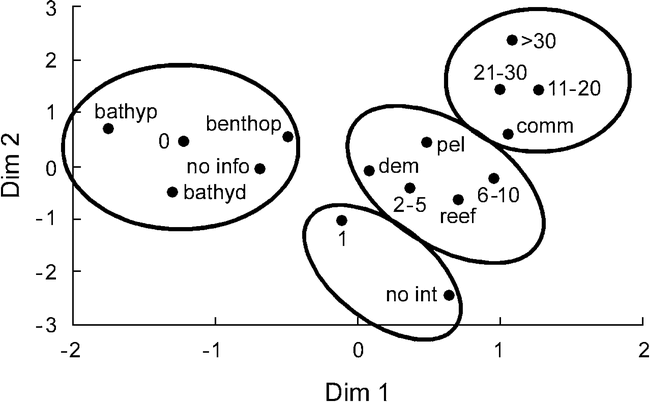
Relationship between number of common names (0, 2–5, 6–10, 11–20, 21–30, >30), commercial importance (no interest, commercially important, no information available), and habitat (reef-associated, pelagic, demersal, bathypelagic, benthopelagic, bathydemersal). Dim 1 and Dim 2 are the two axes obtained with the multiple correspondence analysis and which explains 100% of variation in the data. Dim 1 may be seen as the ‘habitat dimension’ and Dim 2 as the ‘commercial dimension’.
Effect of Names’ Richness on Catch Statistics
This effect is analyzed separately for artisanal and industrial fisheries (Steps I and II). Additionally, one case with the highest degree of homonymy is presented for combined artisanal and industrial catches (Step III).
Artisanal fisheries (Step I). The largest catches from Brazilian artisanal fisheries (1995–2000) are associated with the categories ‘shrimp’ and ‘other fishes’, which account for mean annual catches of about 39,500 tonnes (Table 2). The use of these two broad terms is the first symptom of the poor quality of the system by which catch statistics are recorded in Brazil. In third place is the Atlantic seabob, Xiphopenaeus kroyeri, with a mean annual catch of 11,553 tonnes.
Common names associated with the ten largest mean annual catches from Brazilian artisanal and industrial fisheries (1995–2000), based on the database CATCHDAT.
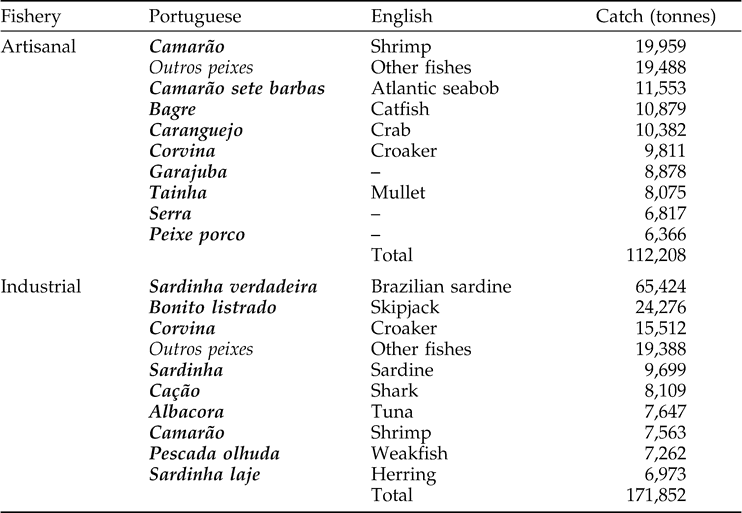
Catfish comes in fourth place with a mean annual catch of 10,879 tonnes. Catfishes are recorded under the common name

Artisanal mean annual catch of bagre in Brazil (1995–2000) split among all possible commercial species. Numbers in parentheses represent other common names besides bagre that each species is linked to. The other numbers in the box represent the total catch for each species considering all common names it receives.
The six commercially important catfish species are associated with a total of 59 other common names:
Industrial fisheries (Step II). The largest industrial catches are Brazilian sardine, skipjack, croaker, other fishes, and sardine, which together account for about 134,300 tonnes or 42% of the total industrial catch (Table 2). Except for skipjack, which is clearly linked to Katsuwonus pelamis, all the other four categories are problematic.

Industrial (I) and artisanal (A) mean annual catch in tonnes of
Sardinella brasiliensis is also known by 13 other common names:
The case of highest homonymy (Step III). As mentioned in the beginning of this section,
Common names related to the highest number of different species (homonyms) for Brazilian marine species (representing 25% of all species in the database).


Link between common names and scientific names for all commercial and non-commercial species that receive the common name
The total annual catch for
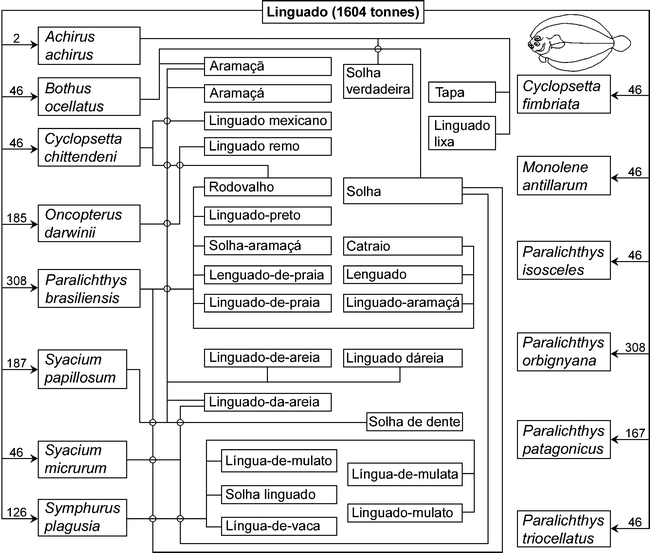
Catch data split among species that share the same common name (
Discussion
Two interconnected concepts and their implications have been extensively discussed worldwide: biodiversity and risk of extinction. More recently, the risk of extinction of marine species has been estimated. It turns out that industrial fisheries are not the only ones capable of pushing species into extinction; artisanal fisheries can do this as well (Dulvy et al. 2003). As a signatory country to the Convention on Biological Diversity, Brazil is committed to reducing the rate of biodiversity loss by the year 2010 (see http://www.biodiv.org). Although there is an intense effort towards quantifying biodiversity in Brazilian territory and adjacent waters (Baer 2001; MMA 1998; Sabino and Prado 2003), Brazil is still far from being able to assess how fisheries activities may contribute to biodiversity loss.
Inaccuracy in catch statistics can have serious implications, as some species may have been caught for years without any record. A series of local depletions can be unnoticed for a long time, ending in global extinction (Pitcher 2001). The official national catch database for 2000, for example, does not mention Sardinella aurita as part of the Brazilian fisheries. This name was considered synonymous with Sardinella brasiliensis in the 1970s (Matsuura 1975). For the last 20 years, Sardinella brasiliensis has been applied to the species occurring off southeastern Brazil (Paiva 1997), while Sardinella aurita is applied to another species that ranges from the United States to Argentina (see http://www.fishbase.org). The dilemma this poses seems to be far from being solved, even after DNA analyses have been performed (Tringali and Wilson 1993). Assuming that there are two distinct species, S. brasiliensis catches are increased by 9% if the category
Catches recorded as ‘catfish’ could potentially include up to six species from five different genera. Some of these species may have catches of almost 3,800 tonnes a year, if catches assigned to other catfish common names are combined. Given that we are dealing with an artisanal fishery, this difference is too high to be neglected. A similar situation occurs for flatfish, although with lower total catches (1,604 tonnes). This total may be associated with 14 different species, with catches as high as 308 tonnes.
The understanding of how people name fishes (and life forms in general) would help fisheries managers to interpret common name richness. In this regard, Berlin (1992) and more generally Lakoff (1987) present a significant contribution on the principles involved in the naming process and categorization. More specifically, Begossi and Garavello (1990), Begossi and Figueiredo (1995), Costa-Neto and Marques (2000), Mourão (2000), and Seixas and Begossi (2001) have dealt with categorization of fishes in local communities along northern, northeastern, and southeastern Brazil. At the national level, Freire and Pauly (2003) analyzed the naming process for Brazilian marine fishes. However, no attempt was made in the present study to completely consider all the principles involved in the naming process, except for showing the effect of the commercial importance in the richness of common names (also previously reported at some localities by Begossi and Garavello 1990; Mourão 2000), and the effect of habitat types as representing species that are easily seen and then named.
The richness of common names as presented here has profound implications when one tries to assess the impact of fisheries in the ecosystem. Accurate catch values are usually referred to as one basic problem involved in this assessment, with underestimation resulting from poor data collection systems combined with discards and illegal catches. However, poor assignment of the catches to the species that have been actually caught seems to be an even more pervasive problem. This can undermine attempts to analyze the impact of different sectors of the fishing industry (subsistence, artisanal, industrial, and recreational), mainly if we consider the difference of common names used by these sectors (Freire n.d.). Thus, decision makers ought to take this issue more seriously if assessment of fisheries impact and biodiversity are in the agenda.
Some of the sources of uncertainty related to this work are: overestimation or (more probably) underestimation of catches, misidentification of species, incomplete lists of commercial species, common names not properly attributed to a state because of the lack of local name lists, and equal weights used to split catches among species associated with each common name in each state. There might be many ways of dealing with this uncertainty in the future: improving landing data through the incorporation of discarded by-catch or improving the available data based on any indication of bias (Gasalla and Tomás 1997, for example, indicate that shrimp and sardine catches are probably underestimated in São Paulo state); checking the commercial status of species with local experts; accessing lists of common names used by the authorities in each state; and estimating better weights, with the help of local experts, to split the catch among species. As soon as more local data are incorporated in the common names database, an analysis of the impact of the richness of common names can be performed in more detail for each state and can be tested in the field.
Conclusions
The richness of common names of Brazilian marine fishes is high and increases for those species that are easily accessible (reef-associated, pelagic, and demersal) or commercially important. Thus, this richness affects negatively the recording system of catch statistics, for both artisanal and industrial fisheries, as many species may be caught but not properly recorded. Any attempt to compare the relative impact of diverse sectors of the fishing industry (including subsistence and recreational) would be undermined by the lack of knowledge about actual species been caught. This is particularly true if we consider new recommendations that multispecies fisheries be managed in such a way as to protect more susceptible species. Ethnobiologists have a crucial role in this issue as promoters of the understanding of the naming process leading to more accurate linkages between scientific and folk nomenclature.
In order to conserve the biodiversity in one of the hot spots of diversity in the world, one should be able to understand, among other things, how fisheries may be accelerating the loss of biodiversity that has been occurring in the last decades and this study could be seen as a starting point. However, it depends on future collaboration for continuity and success.
Footnotes
Acknowledgments
We would like to thank Marcelo Vasconcellos and Daniela Kalikoski who initiated, with Deng Palomares, the introduction of Brazilian common names into FishBase; Juarez Rodrigues for helping to encode part of the data; Les Lavkulich and three anonymous reviewers for reviewing a first draft of this paper; Aque Atanacio for drawing the flowcharts; and Alfredo Carvalho-Filho for sending copy of his book. We would like to particularly thank Arthur Tautz for suggesting the analysis of the impact of common names richness on catch statistics. The Brazilian Council for Research and Technological Development (CNPq) provided financial support for the first author.