







Abstract
A year-long ethnobotanical study was carried out in several indigenous communities on the Nieva River, in the Peruvian Amazon, to determine how the Aguaruna Jívaro identify trees of their local environment. Eight key informants provided freelists of tree names and in follow-up interviews explained how they identify 63 of the named trees chosen for detailed study. Voucher specimens were collected for the 63 taxa. This study made use of the Aguaruna concept of
Introduction
Anecdotal evidence suggests that many indigenous groups of the Amazon basin can identify tree species simply by observing the visual, olfactory and gustatory characteristics of the trunk and bark (see Berlin 1992:7; Davis 1996:453; Gentry 1993:4). This stands in contrast to the identification methods outlined in Western taxonomic keys that rely heavily on floral, fruit, and leaf characters to make tree identifications. A notable exception to standard scientific floral key production is seen in the work of the late Alwyn Gentry, one of the foremost neotropical botanists of recent years. He has even commented specifically on the difficulty of identifying neotropical plants by flower or fruit characters, since there is a high degree of morphological convergence of these structures (Gentry 1993:3). In his classic work, A Field Guide to the Families and Genera of Woody Plants of Northwest South America, Gentry presents a key to the woody flora of the Amazon based mostly on characters of the trunk, bark and leaves. Gentry's key represents a pioneering approach to identifying woody flora of the Amazon, emphasizing sterile characters that appear to share something in common with indigenous methods of botanical identification.
A few studies have touched on the subject of how indigenous peoples of the Amazon identify woody flora. In his classic paper “The Knowledge and the Use of Rain Forest Trees by the Kuikuru Indians of Central Brazil,” Carneiro (1978) describes several different methodologies for eliciting tree identifications from his informants. López Zent (1999) has briefly noted the steps that the Hoti of Venezuela go through when identifying woody flora. Typically, the Hoti first examine the outer trunk and bark. If that is not sufficient to make an identification, they cut the bark in order to smell it, to look for latex, and to observe the appearance of the inner wood. If those last steps still yield no identification, they observe fruit or flowers, if present, and look for dried leaves on the ground. López Zent (1999) also provides examples of sets of contrasting morphological and habitat characters for a few trees in the same Hoti folk genus.
In 1974, Berlin, Breedlove and Raven (1974:153) identified what they believed were the three most basic questions of cognitive ethnobotanical research. These are: what groups of plants do people recognize?; how are these groups organized hierarchically into taxonomies?; and how are individual plants recognized and identified? They noted that, of these three major concerns, identification remained largely unstudied. With a few exceptions (Carneiro 1978; Ellen 1993; López Zent 1999), this remains true to this day. Roy Ellen (1993) has discussed theoretical aspects of identifying living organisms, arguing that there are two major processes involved. The primary process is based on cognitive prototypes; people perceive the gestalt of an organism. This is supplemented by individual distinctive features that are used to confirm the original identification or for difficult cases. Ellen also believes, however, that informants will often be able to consciously analyze their general impression according to some of the discrete sensory impressions that make it up.
Some authors have discussed identification in the context of children's ethnobotanical knowledge. Dougherty (1979), for example, investigated how children in Berkeley, California, form a hierarchical system through contrast and inclusion based on morphological features. Stross (1973) found that when Tzeltal Maya children mistakenly identify one folk genus with another, this usually corresponds to a covert recognition by adults that the two folk genera in question are morphologically similar. Both examples underscore the importance of morphological clues in identification.
Other research has investigated the related question of how people identify plants with particular kinds of medicinal properties from the many species growing in their local environment. For the Peruvian Amazon, Glenn Shepard (2002) reports that the Matsigenka make use of taste, smell, and irritation to recognize medicinal plants, whereas the Yora mainly rely on smell, visual and tactile clues. Lisa Gollin (2004) has investigated the sensory clues, particularly taste, smell and tactile ones, that allow Kenyah Leppo‵ Ke of Borneo to recognize medicinal plants.
Background
I conducted research on Aguaruna Jívaro plant identification from January to December, 2004. The study focused on how people identify members of the life form category
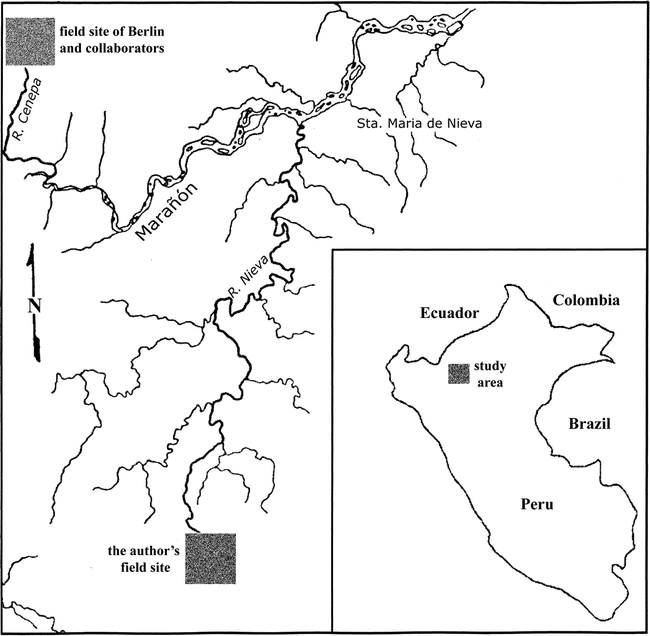
The study area for this research. Adapted from Berlin and Markell 1977.

Jempentsa Mujaji, a mountain near the study community of Pagki.
Trees play a number of important roles for the Aguaruna. Many of the trees included in this study have cultural uses. A few of these, including
A detailed treatment of Aguaruna uses for local tree species is beyond the scope of this article. The subject of utility is, in fact, quite independent of the present discussion of how identification occurs. A classic and ongoing debate within the field of ethnobiology relates to the relative strengths of intellectualist and utilitarian explanations of folk classificatory systems (e.g., Anderson 2000; Berlin 1992; Hunn 1982; Posey 1984). On this matter, however, identification should be less controversial than classification. Clearly, one must recognize a plant before one can use it. The motive for identifying a tree might be utilitarian, but the actual process of identification should not be influenced by utilitarian concerns. This is still true even when a person uses a plant without being able to name it. For example, an Aguaruna man who fells an unknown tree and discovers that it is very hard, might decide to use the tree as a post for house construction. In this case, recognition of usefulness still relies on the prior recognition of a physical property. Nor will the act of using the tree provide the man with any additional information that could enable him to make a more precise identification.
As the taxonomist Tod Stuessy notes (1990:10), the process of identifying individuals and the process of constructing a biological taxonomy are logically closely related. In an important sense, making an identification is the reverse of constructing a taxonomic hierarchy, since the former involves distinguishing an organism from all others based on a unique set of characters, while the latter requires grouping of organisms based on similarities. Berlin (1992) has suggested that it should be possible to discover discrete observable characters that allow informants to assign one name rather than another to a plant. Based on his work with the Itzaj Maya, Scott Atran (1999) has proposed that members of small-scale societies tend to use both ecological and morphological criteria for determining relationships between two organisms or for predicting which properties they are expected to share. Following Berlin's (1974, 1992) and Atran's (1999) proposals, the hypothesis evaluated here is that the process of tree identification among indigenous peoples involves both sensory and ecological reasoning, at least part of which can be verbalized by informants in terms of discrete clues. Sensory reasoning here refers to visual, tactile, olfactory or gustatory clues. Ecological reasoning here refers to clues related to plant communities, plant-animal interactions, hydrological features (e.g. proximity to a river drainage), soil types, and topographical features.
Berlin et al. (1974:155) argue that folk specific taxa within the same folk genus should be easily differentiated by “a few obvious morphological features.” It follows that one means of understanding indigenous methods of tree identification would be to ask informants to contrast particular trees with other trees in the same folk genus. However, approximately 82% of Aguaruna folk genera are monotypic (Berlin 1976:389), so this method would have limited utility for the majority of tree taxa recognized by the Aguaruna.
The Aguaruna concept of
The Aguaruna word
This research uses the
Methods
Key informants for this study were selected in a purposive fashion based on expertise in the folk biological domain
There was not enough time to study the identification process for all named Aguaruna tree taxa (well over 300 folk genera). Therefore, I chose a representative sample of some of the most widely recognized folk genera, large enough to illustrate the variety of clues and methods the Aguaruna use in making identifications. The 63 folk genera in this study span 48 biological genera in 17 plant families, which is clearly only a small portion of the biological diversity in the area. They were selected in a purposive fashion appropriate for evaluating the hypothesis that Aguaruna use both sensory and ecological characters to identify trees. My approach is summarized as follows: 1) informants were requested to list features that allow them to recognize each tree, and 2) informants were requested to group
For each of the 63 study trees, I first asked each of the eight key informants
The second set of questions was designed to elicit the reasoning that grouped folk taxa as
I included isolated folk genera in the sample in order to widen the botanical range of trees covered in the study, since trees considered to be related by the Aguaruna are often also closely related under western taxonomy. For isolated genera, informants could answer the first question, how they recognize a type, without being able to explain why they do not belong to a
The questions described above are designed to elicit informants’ idealized mental images of the study trees and did not rely on observing actual examples of the trees in question. This approach has several theoretical and practical advantages. First, it encourages informants to focus only on the features that are essential for inclusion in the category in question. Noticeable variation can be found among individuals of the same biological species. Most Aguaruna tree names encompass multiple biological species, making the potential physical variation even greater. When informants describe an idealized image of a tree, they will not be distracted by trivial individual variation. Observing actual identifications of the 63 study trees in the field would be quite impractical, since it would require selecting individuals of all of these trees and then, showing the same trees independently to each of the eight key informants.2 Over the course of my research, I did observe living examples of the study trees, in order to verify my understanding of the adjectives used to describe the trees and for making botanical collections.
Collections of the study trees were made in the vicinity of the five participating communities.3 I attempted to confirm the Aguaruna name for each tree collected with more than one informant, although this was not always possible, since some trees were only found in one location. Due to the occasional difficulty in locating fertile material, I was unable to collect three of the study trees. Also, at the time of this writing, some of my specimens have not yet been fully determined. For this reason, I have used specimens collected by Brent Berlin and his collaborators4 near Aguaruna communities on the Cenepa river, along with my own data, for determining which scientific names correspond to each Aguaruna name.
Results and Discussion
Table 1 shows the botanical range for all Aguaruna trees included in this study. I have arranged the Aguaruna tree names to show which ones informants grouped together as companions and which were considered to have no companions. The tree names listed in Table 1 that are comprised of two words correspond to polytypic folk genera. For example, Table 1 shows that group 3 contains the trees
Aguaruna names and corresponding scientific names for members of the

Many of the folk taxa listed in Table 1 correspond to more than one botanical species, within a single genus. Some Aguaruna names correspond to species in more than one genus of the same botanical family, while one Aguaruna name,
The underlying hypothesis of this research, that the process of tree identification involves both sensory and ecological reasoning, was successfully tested. Eight informants provided descriptions of the 63 study trees, yielding a total of 504 descriptions. Each of these descriptions consisted of a freelist of salient features, which could include physical qualities of specific tree parts, assessment of overall growth habit, or ecological qualities, such as favored habitat and association with animals or plants. Analyzing the data involved counting the overall number of descriptions that include particular characters (e.g., leaf size, sap color, habitat). The data collected only partially support the research hypothesis. All of the descriptions involved sensory reasoning. Likewise, all companion comparisons involved sensory reasoning. However, only 21% of the tree descriptions involved ecological clues. Ecological clues were involved in only six percent of companion similarities and 11% of companion differences. Sensory clues mentioned by informants referred to specific tree parts (e.g.,
Aguaruna names for the parts of a tree.

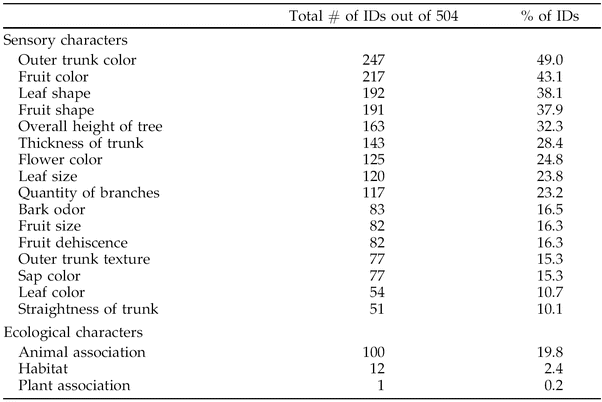
Table 3 indicates how often informants referred to various characters in answering the question, “How do you recognize this tree?”. A thorough description of all the sensory characters named by informants for the 63 study trees would require many pages and is beyond the scope of this article.5 Table 3 includes only those sensory characters mentioned in at least 10% of informants’ descriptions of the study trees. For the purpose of comparison, Table 3 also includes all of the ecological clues mentioned by informants. Some particular tree parts appear to be more significant for identification than others. Fruit characters are well represented and include color, shape, size and dehiscence. Outside trunk appearance is also quite salient, particularly color and texture. Salient leaf characters include shape, size and color. Informants also mentioned growth habit quite often, particularly tree height and thickness and straightness of the trunk. Flower color, quantity of branches, bark odor and sap color are also salient characters.
The most common characters from tree descriptions.
As previously noted, 14 of the 63 study trees are considered by a majority of informants to have no companions. The other 49 make up 17 groups of companions recognized by a majority of informants. Two of the companion groups (12%) have members from different botanical families, while 15 of the 17 (88%), have members from a single botanical family. Eight of the

The correspondence between biological species and the folk genera that make up

The correspondence between biological species and the folk genera that make up
Table 4 indicates how often informants referred to various characters in comparing and contrasting members of companion groups. It includes only those sensory characters mentioned in at least 10% of either companion group differences or companion group similarities. It also includes the relatively less important ecological characters for the purpose of comparison. Characters that are particularly important for the broad recognition of companion groups include fruit color, shape and dehiscence. Sap color and bark odor are also relatively important for explaining the cohesion of the companion groups. A number of features are important in making the finer distinctions between members of

The two approaches employed in this study appear to yield fairly compatible results. Both the tree descriptions (Table 3) and the companion comparisons (Table 4) place significantly greater emphasis on sensory clues than ecological ones. Furthermore, 13 out of 16 (81%) of the sensory characters that are important in the tree descriptions are also important for the companion comparisons. Only the characters flower color, branch quantity and trunk thickness appeared in at least 10% of the descriptions, but did not appear in at least 10% of the
Conclusion
One factor that likely complicates elicitation of identification methods is the tendency of informants to make identifications based on an overall impression (its gestalt) (Berlin et al. 1974: 154). The reliance on the gestalt of an organism in identification may make it difficult for informants to verbalize all the discrete features that help them distinguish a particular tree from other similar ones. One could easily imagine informants responding to questions about how they recognize a specific tree by saying something like “I can just tell,” or “It is just obviously an X.” Glenn Shepard has suggested that people's reliance on the gestalt of an organism for identification is likely to make it particularly difficult for them to cognize the identification criteria for common, highly utilized or cultivated species (written communication 2003). Berlin et al. (1974) argue that it should be easier for informants to verbalize the relatively minor differences between conspecifics of a particular folk genus than it would be to distinguish between folk genera. A study such as the one I have made can never reveal all of the clues that are important to the Aguaruna for identifying trees. I do share the optimism of several authors (see Berlin et al. 1974; Ellen 1993) that informants will be able to verbalize at least some of the important clues.
I have assumed that answers to the question: “How do you recognize this tree?” will correspond to the most salient features of the tree for each informant. However, the most salient features of a particular tree for a particular informant may not always be the same features that person would actually use to identify a living example of that tree. Some features, such as fruit and flowers, are seasonal for many species and may not be present when an actual identification is made. A few informants also mentioned that birds or other animals eat the fruit of certain trees. The role of any such ecological interactions in tree identification is also contingent on circumstances, since the animals in question will not always be present.
It is worth noting that the findings of this research only partly agree with the anecdotal reports mentioned in the introduction of this paper, which have emphasized the ability of indigenous peoples of the Amazon basin to identify trees in their local environment simply by observing trunk and bark characters. As Gentry (1993: 4) put it, “[a]nyone who has ever observed a good ‘matero’ effortlessly identify trees with nothing more than a machete slash of the bark and a sniff of his nose can begin to appreciate some of these… characters.” Trunk and bark characters do appear to be very salient to the Aguaruna. My informants mentioned outer trunk color in nearly half (49%) of their descriptions and outer trunk texture in 15.3% their descriptions (Table 3). Additionally, they mentioned bark odor and sap color in 16.5% and 15.3% of their descriptions, respectively. These last features are included in what Gentry refers to as “bark and slash characters” (1993: 4). Data from the companion comparisons also suggest that trunk, bark and sap characters play an important role in tree identification among the Aguaruna (see Table 4). However, my informants’ descriptions and companion comparisons also place a heavy emphasis on fruit and leaf characters as well as overall growth habit.
One way to explain the discrepancy between my data and the anecdotal reports is to consider, as López Zent (1999) has done, that some features of a tree present themselves to the attention more easily than others. In some cases, a simple glance at the trunk and up at the leaves may prove sufficient to identify a tree, without needing to cut the bark or observe the sap. Indeed, informal walks through the forest with Aguaruna informants revealed that they usually look at the trunk first, then up at the leaves. This was sometimes enough to make an identification, but, if not, they would cut the bark to smell it, look for sap and observe the inner color and hardness of the trunk. Occasionally, fruits or flowers fallen on the ground also aided in identification. The sorts of formal interview questions that I asked encouraged informants to describe their ideal image of a tree that would include all the most salient features. However, an informant may not actually need to see all of the most salient features of any given tree in order to identify it. Through years of observation, they would have a clear image of which features go together, so that, in some cases at least, simply observing one or two of these features (e.g., the trunk or leaves) would be enough to bring to mind any important features that are not actually present (e.g., fruit) (Glenn Shepard, written communication 2005). Clearly more studies are needed, both cross-culturally, and on different folk taxonomic life forms (e.g., vines and herbs) to better understand how people identify plants. It seems probable that with herbs and shrubs, leaves and fruit would play an even greater role in the actual process of identification, since they would be much easier to observe than they are for large trees. This is a prediction that future research could address.
Footnotes
Acknowledgments
Generous support for this research was provided by a grant from the National Science Foundation (no. 0314289) and the Wenner-Gren Foundation for Anthropological Research. I would also like to thank Glenn Shepard and Brent Berlin for many helpful comments and much encouragement. Additionally, three anonymous reviewers of this manuscript provided valuable suggestions for its improvement. Various people in the herbarium of the Universidad Nacional Mayor de San Marcos (UNMSM) in Lima kindly helped me identify botanical specimens. These included Joaquina Albán, Hamilton Beltrán, Severo Baldeón, Franco Mellado, Mirbel Epiquien and Irayda Salinas. Most of all, I would like to thank the people of the communities of Bajo Cachiaco, Kayamas, Tayunts, Alto Pagki and Atash Shinukbau, where this research took place. In particular, Martín Reategui, Nestor Reategui and Gregorio Reategui were very helpful in their assistance with coordinating this research.
1 The orthography used in this article for Aguaruna words is borrowed from Uwarai Yagkug et al. (1998). Underlined vowels indicate nasalization. Single vowels indicate short vowel sounds, while doubled vowels indicate long vowel sounds. The letter
2 Although all trees selected were known to all eight key informants, some of the trees only occur in very particular kinds of habitat and were not easily accessible from all five study communities. Furthermore, a few of the study trees are highly valued timber species that have been made rare by selective logging. It would not be possible to find an actual example of all 63 trees near any single one of the five study communities. Even if it had been possible to find all of the trees near one community, it would still have been necessary to transport key informants from the four other study communities in order to make it possible for every informant to respond to the same stimuli.
3 Voucher specimens of the trees collected were deposited in the herbarium of the Universidad Nacional Mayor de San Marcos (UNMSM) in Lima.
4 These voucher specimens are deposited at the Missouri Botanical Garden in St. Louis, Missouri. Data for these collections has been compiled in an unpublished report by Brent Berlin, Cathy M. Crandall, and Walter H. Lewis, entitled: Taxonomic checklist of plants collected in the department of Amazonas, Peru 1972–1980. The report lists the Aguaruna name and corresponding scientific name of over 3500 specimens collected by Berlin and collaborators.
5 A more thorough treatment of this subject will appear in the author's dissertation (in prep.).