Seaweeds (limu) have a long tradition of human use in Tonga. Low-income families who reside near tidal areas rely almost exclusively on ocean resources for their family's nutritional needs and eat limu as part of their regular diet. However, most Tongans consume limu as a novelty item in their diet, with the exception of times of stress that follow major hurricanes and droughts. Nine taxa of seaweed are eaten in Tonga; however, Caulerpa racemosa is by far the most common species eaten. One specific type of limu, tanga'u (Cladosiphon sp.), is now being commercially harvested in Tonga and sent to Japan. There are no rules or laws establishing a gathering season or restricting the amount of limu that can be harvested. Conservation is practiced primarily on an incidental level in Tonga, meaning that conservation takes place primarily because of other issues. Up until now, limu has been used sustainably. However, with the lack of formal conservation methods, limited research, and recently introduced industrial farming techniques, the future of limu as a sustainable resource is questionable.
Seaweeds—macroscopic marine algae—have been used throughout coastal regions of the world for food, fodder, medicine, and other purposes for thousands of years (Abbott 1988; Chapman and Chapman 1980; Turner 2003). The Chinese, the Japanese, the Filipinos, and the Hawaiians have been consuming seaweed as an essential part of their diets for thousands of years and consider seaweed a food of great delicacy (Leyman 2002). While not consumed as extensively as the Asians or Hawaiians, historically seaweed, known as limu, was eaten as part of the staple Polynesian diet (Abbott 1992; Schonfeld-Leber 1979). Tongans were no exception; they also consumed several species of limu. Previous work in Tonga (Ostraff and Ostraff 1997, 1999; Ostraff et al. 2000) indicated that limu harvesting was an important women's activity and a significant component of the traditional food system of Tongans. However, very little research or documentation has been accomplished regarding this important aspect of traditional Tongan food systems, or of the knowledge women hold regarding collection and use of limu and the tidal flat environments in which limu species are found.
Seaweeds are a valuable source of food, containing the full spectrum of required nutrients: proteins, fats, carbohydrates, vitamins, and minerals. All marine algae are rich in vitamins A and E, even more than amounts found in cod liver oil (Madlener 1977). The protein found in seaweed is a complete protein in that it contains all eight essential amino acids, but has virtually no calories (Webb 1997). Dulse (Palmaria palmata (L.) Küntze), for example, contains high amounts of protein at 20–25%, compared to beef's 25%, canned salmon's 20% and soybean's 30%. Protein in algae can account for as much as 25% of the total dry weight although these percentages depend on the species, time of year, and age of the specimens. Green algae are high in B vitamins and folic acid, found in quantities similar to fruits and vegetables. Some green algae have even higher amounts of B12 than animal liver (Morgan et al. 1980; Webb 1997). Seawater contains an almost identical proportion of mineral content as human blood, and marine algae gain their nutrients directly from the water (Guiry 2003). The nutritional value of seaweed as a resource for food and medicine is unquestioned, as seaweed contains micronutrients such as boron, iron, manganese, potassium and calcium. Boron is essential for proper brain function, and iodine found in seaweed can prevent thyroid conditions such as goitre and calcium aids in building strong bones and teeth (Novaczek 2001a, 2001b, 2001c).
Historically, the harvest of marine algae has often taken place within the poorer, disadvantaged sectors in communities, and was most commonly an activity performed by women (Briand 1991; FAOSTAT 2003; Guiry 2003). Globally within this more traditional activity, females outnumber men 70 to 30 in the harvest of seaweed (Nayak 2000). However, as traditional harvesting practices give way to modernized, mechanized, and commercialized seaweed production, men often take over as the leading harvesters (Briand 1991). Nevertheless, non-mechanized harvesting of seaweed continues worldwide, especially among the economically poorer sectors of society (British Broadcasting Corporation 2002). Tongans are no exception; it is the poorer members of the population who particularly rely on limu as part of their dietary needs, and women are the prime collectors.
The Kingdom of Tonga is Polynesia's only remaining monarchy. The Tongan archipelago is located in the South Pacific at 15–23° south and 173–177° west (Figure 1). It is spread out over 362,000 km2, and it consists of 170 islands, of which 36 are occupied. The islands are divided into four major geographical groups: Tongatapu, Ha'apai, Vava'u, and the Niuas (Stanley 1999). The first known human occupants were descendants from the Lapita People, dating from approximately 1500 BC (Burley 1999; Kirch and Ellison 1994; Poulsen 1987; Spennemann 1996). Spennemann examined skeletal remains from several archaeological sites located in Tonga, noting that many of the female skeletons showed a high concentration of arthritic vertebrae in the lower spine and hardly any in the lower neck region. According to Spennemann, such patterns are due to the carrying of heavy loads and frequent bending consistent with a number of different activities, or a combination of these, most notably gardening work, tapa cloth production, shellfishing, and/or transporting heavy loads. Although there is no direct indication, it is likely that seaweed harvesting was also among these ancient activities.
Map of the South Pacific, with a close-up view of Tonga.
As in the past, women of the 21st century still spend time gardening and growing crops such as taro and yams, raising their children, gleaning from the tidal areas and creating traditional art forms such as mats and tapa cloth. The biggest contribution women in Tonga make to their families’ diets comes from their comprehensive fishing and gathering along reefs and inshore lagoons, where they collect limu and shellfish (Ram-Bidesi 1995). Women's roles in Tonga, especially regarding contributions to the family's diet, are similar to those in islands throughout the Pacific (Lambeth 1999, 2000a, 2000b, 2001a, 2001b).
I chose to focus my study in the Vava'u island group, which consists of 34 islands, 21 of which are inhabited. The population of Vava'u was 15,715 in 1996, with almost equal numbers of men (8,055) and women (7,660) (Statistics Department 1999). One of the main reasons for choosing the Island group of Vava'u is because it is one of the more rural island groups. There are a considerable number of waterways and inner tidal flat areas on Vava'u, and for all but one village, there is direct access to a tidal area where gleaning of limu and women's fishing can occur. A majority of families in Vava'u still exist at a near-subsistence level of farming and fishing. Of the 5,681 people economically active in Vava'u, 3,679 (65%) are involved in farming, fishing or crafts (Statistics Department 1999).
Methods
I carried out research on Tongan limu harvesting from January through June of 2001, with a follow-up visit from June to August of 2002. I began my research with a purposive or theoretical sampling method aimed at identifying and developing consultants with pertinent information (Strauss and Corbin 1990). I visited the local market in order to develop a list of key sellers of limu and to locate tidal areas where limu was being harvested most extensively. I then spent several days observing these tidal flat areas, making note of the number of people collecting, gender of collectors, and the conditions that seemed most conducive to harvesting, such as time of day and height of the tide. I contacted friends, and they in turn introduced me to women living in proximity to selected tidal areas who were active collectors of limu. After formal introductions, I received multiple invitations to join these women in collecting limu from selected tidal flats. Working alongside them, I learned how to locate, identify, collect, and properly store many types of limu. At times when weather, tidal movements, and other factors limited harvesting, I conducted formal and informal interviews with the harvesters until I felt universal harvesting/gleaning issues had reached the saturation point and I had developed a knowledge base that allowed me to define categories of more specific and relevant information. Once I had established these categories, they helped me to distinguish collectors with superior knowledge of limu, such as the phases and cycles of limu growth, number of limu species known and used, preparation methods for various limu species, parallel cycles of marine and land plants, and specific harvesting techniques. In turn, I was able to increase my depth of focus to those I felt were “experts” in the field. By systematically narrowing my sampling field to “experts,” I was able to maximize opportunities for verifying information and for further development and clarification of the above categories.
I organized focus groups with women from four villages to discuss limu harvest and use. I interviewed people who sold and bought limu in the market. I also administered and developed several written surveys. In order to assess the amount of limu consumed in Vava'u, I conducted a survey with 200 women between the ages of 20 and 50 (the prime age to participate in limu collection) from ten villages. Finally, in order to better understand the overall usage and understanding of limu knowledge island-wide, I interviewed government fisheries personnel, high school children, people who grow and sell limu commercially, and families living near tidal flat areas. I also collected voucher specimens for each type of edible limu, as well as some major types that are not eaten. Voucher specimens are currently being stored in the Bean Museum Herbarium at Brigham Young University in Provo, Utah. Isabella Abbott, from the University of Hawaii, helped in correctly identifying my specimens.
Results
Limu Species
There are at least 185 species of seaweed in Tonga (Ohba 1996): 77 species of Chlorophyta (green algae), 29 species of Phaeophyta (brown algae) and 79 species of Rhodophyta (red algae). I have identified nine taxa (seven Chlorophyta and two Phaeophyta) commonly eaten in Tonga (Table 1). But of those nine, seven are from the genus Caulerpa, with by far the most common and favorite type eaten being C. racemosa [v. macrophysa], known locally as fuofua. The other Caulerpa species are as follows: C. serrulata (kaka); C. cupressoides [var. lycopodium f. amicorum] (also called kaka); C. scalpelliformis [var. denticulata] (palalafa); C. racemosa (toke); C. sertularoides (louniu); and C. peltata [var. peltata] (fuofua).
Common edible types of limu found in Tonga.
Caulerpa is also known as “sea grapes” (Figure 2). The plant has basal runners up to 3 mm wide with upright branches that can grow up to 10 to 15 cm tall. It is bright green in color and bears grape-like branchlets. These vary in shape and size from round and sparsely spaced (e.g., fuofua) or tightly clustered (e.g., toke), to trumpet-shaped (fuofua) or hook-shaped (e.g., palalafa). Caulerpa can also have branchlets that are feather-shaped (e.g., louniu) or three-sided (e.g., kaka).
Caulerpa racemosa, called fuofua in Tonga. Photograph by Brian Wilcox.
Two other species of algae are also eaten. The first is limu vai, Hypnea charoides J.V. Lamouroux, a light brown or yellowish, highly branched plant (Figure 3). It creeps along the sea floor and forms tangled mats. It is usually floppy and entangled in clumps. The cylindrical branches are about 1 mm wide and the branchlets are short and stubby, resembling clumps of light brown hair. The second is tanga'u, Cladosiphon sp. (Possibly C. novae-caledoniae, but the species has not been officially identified yet [Lovell 1997]), which is slender and pale to dark brown in color. It is slippery to the touch and jelly-like. Branches are 1–2 mm wide and the plant is about 30 cm in length. It grows in tangled masses (often covered in sediment) and commonly attaches to sea grass or other seaweed rather than the sea floor.
Hypnea charoides, called limu vai in Tonga. Photograph by Ashley Knudsen.
Caulerpa is a stenohaline marine alga, meaning it is highly susceptible to salinity changes in the water. During heavy rains the influx of fresh water can cause the lagoons to become less saline. Whenever the salinity drops below 30 ppmt, Caulerpa will begin to die (Trono 1986). Edible seaweed thrives in cooler water (20°–25°C); tanga'u and limu vai will die if the water temperature reaches above 26°C (Lovell 1997). Limu fuofua and the other common types of edible limu can survive at higher temperatures (up to 29°C), but they do not thrive as well as when the average temperatures are lower. Thus, the most productive time of year for limu harvesting occurs in the cooler months of May through September.
While seaweed can be found in depths of over 100 m in Tonga, as elsewhere, most edible algae are collected from shallow inter-tidal areas (Littler and Littler 1988). This is mostly due to the difficulty of harvesting algae that grow in deeper waters in Tonga. The substratum for edible limu varies from coral and sand to soft, silty bottoms of mangrove swamps. In Vava'u, there are six types of environments where limu are located: coral reef flats, mangrove swamps, sandy lagoons, reefs, rocky cliffs, and deep-water coral gardens. These ecosystems and the edible algae they support are itemized in Table 2.
Limu environments in Vava'u.
Limu Harvesting
Today in Tonga, both men and women participate extensively in the search for food from tidal areas, but men are more likely to fish using nets, diving gear, spears, and a variety of lines with hooks and lures. The type of fishing women do is called fangota, which consists of reaching, groping and/or searching with one's hands or feet. Some Tongan men who are expert in fishing are aware of edible marine algae; nevertheless, limu is almost exclusively collected by women. Studies conducted throughout the Pacific indicate that while men fish with tools considered masculine in nature and inappropriate for women's use, women are more successful at providing abundance and variety of marine foods from tidal areas on a regular basis for family needs (Ram-Bidesi 1995; Rodman 1993; Schoeffel 1995; Slatter 1995).
The majority of women collectors range in age from 20 to 50 years, and the most active collectors live adjacent to tidal areas. An exception to women collecting limu occurs with its commercialization. Even though women are extremely knowledgeable about the collection of limu, they are rarely involved on the industrial level of limu harvesting. Men are the primary collectors when it comes to collecting, working or selling limu on a commercial or industrial level. Limu tanga'u has been harvested in Tonga and sent to Japan, where it is known as mozuku, since 1996. Seastar Industries, owned by the Crown Prince of Tonga, farms most of their product, but they also purchase wild-gathered limu from locals. Seastar Industries only advertises to men, and encourages men to go out and harvest tanga'u (Pauline Moala, expert local fisherwoman, personal communication 2001). This has resulted in a large percentage of material collected being deemed unsuitable and subsequently discarded —up to 70% in some cases (Tongan Fisheries Department, personal communication 2001).
Based upon my interviews and observations, as well as other sources (Lamour 1995; South 1993, 1995), those who collect limu rarely collect it exclusively. They usually spend several hours “fishing” the tidal area. Gleaning is usually opportunistic with all edible or marketable species of animals and plants being collected as they are encountered. Each woman usually carries with her a large knife or machete, a collecting bucket or basket, usually made of woven coconut fronds, and sometimes a large stick for poking into holes and to aid in turning over large rocks. All collected specimens are stored in the collecting basket until she returns home.
In interviews with two primary limu harvesters, Vai and Elita Tupou, they informed me that in Tonga [as in most places in the Pacific (South 1995)] those who harvest limu usually collect only the upper shoots of the plants, leaving the stolons to regenerate. Sometimes the entire plant is collected, but during the cleaning process the stolons are broken off and returned to the sea. While they could not come up with an exact schedule for rotating harvesting sites, they felt that most limu areas were harvested on a rotating basis, with approximately three to four weeks between each cycle, in order to allow regeneration of shoots. This information is similar to South's data gathered in Fiji about crop rotation (South 1993, 1995).
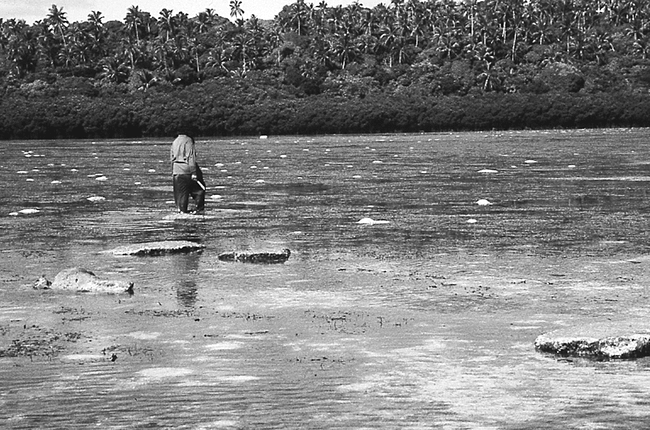
From the days and months I spent in the tidal flats observing women gleaners, I perceived the following factors that seem to affect the number of women fishing/gleaning on any given day: time of day of the low tide (associated with the highest number of women fishing), and high tide (when there is the lowest number); weather conditions; and day of the week. Low tide occurs on a 12-hour cycle occurring approximately 50 minutes later each day. When the low tide coincides with early morning hours, or other times of day that are normally spent meeting family needs, there are few women gleaning. On the other hand, when low tide occurs later in the morning or after family obligations are met, more women are able to participate in fangota (Figures 4–6). As noted, fangota can be a highly social activity and many women find this time convenient to associate with friends and promote camaraderie among neighbors. When low tide occurs in late afternoon or evening, the tidal flats frequently become the location for family gatherings and picnics. Young children, both male and female, accompany their mothers and join them in their gathering activities or simply play along the beach while their mothers work. Fathers and husbands also occasionally accompany their wives and children to the tidal areas and spend their time fishing using nets and spears.
Woman gleaning from tidal area in Vava'u. Photograph by Ashley Knudsen.
Woman gleaning from tidal area in Vava'u. Photograph by Ashley Knudsen.
Woman gleaning from tidal area in Vava'u. Photograph by Brian Wilcox.
Pauline Fakahua Moalae, from Oloua, reported that it is not good to fangota too early in the morning because “…there is a fish called nofu (stone fish), it can sting you and it hurts badly. Sometimes around noontime the nofu has gone elsewhere and that is when most people go to get limu.” Weather also affects the number of people gleaning or fishing. Obviously, if the weather is poor, people stay home; in good weather, they are more active in gleaning. The day of the week is another factor determining numbers of fishers. On Sunday, it is a national law that the Sabbath is strictly observed and no work-type activities occur—even the travel books warn travelers that no work takes place on Sundays and to be prepared for everything to be shut down (Stanley 1999). Saturday mornings are usually spent at the public market in the main town of Neiafu. Most of the morning is spent in some sort of shopping or selling activity. However, by noon the entire town is closed down and families return to their homes to prepare for Sunday. If the tide is right in the afternoon, this will be a good time for fishing and gleaning activities; otherwise no fishing will take place on that day.
Uses of Limu
While limu are very nutritious, relatively abundant and easily harvested, my interviews and surveys indicate that in Tonga limu consumption no longer plays a significant role in the diets of most Tongans. The families who rely on it the most live near tidal flat areas and have easy access to them. It is these families that consider the tidal flat to be what they refer to as a “living seafood banquet.” The reliance on limu as an important part of the diet seems to have changed as the increase of imported goods and the expanding capital market impact Tongan culture. While many eat limu only as an occasional delicacy, the same families that consider the tidal flats as a banquet refer to limu as the “poor man's meat,” because usually only the poorer sector relies on it as an important part of their family's diet.
Results of the “ten village” survey indicate that of the 200 women questioned, 88 women went to the tidal flats 114 times the previous week. Out of 114 trips made to the sea, limu was collected 24 times or 21% of the time. The average amount of limu collected during a trip to the tidal areas was approximately 1 kg for family use. An average of 44% of the women polled went to the sea to fangota the previous week. Since there are 2,634 women between the ages of 20 and 50 in Vava'u (Statistics Department 1999) and 44% of them went to the sea each week (1,159), 21% of them would gather, on average, a kilogram of limu. This would be 12,656 kg of limu per year. In addition to purely subsistence consumption, fresh limu was also sold in the markets on weekends (but only Caulerpa racemosa is sold regularly in the market). Approximately 20, 2-kg packages were sold each week for Tongan $1–2. If you add the 40 kg sold every week in the market (1180 kg/p/year), this translates into an average of 13,836 kg of limu consumed per year in Vava'u. The population of Vava'u is 15,715, and assuming each person were to consume an equal amount of limu, they would average 0.88 kg/year per person (Figures 7 and 8).
Numbers of women (age 20–50) who gleaned the first week of March 2001 or the first week of September 2001.
The average amount of limu in kg consumed per person in one year at home vs. purchased at the market.
While seafood gathering from the reef continues to be an important part of many families’ lives, the number of people relying on it for their nutritional needs is declining. A survey conducted in 1982 (Fleming and Tukuafu 1986) shows that nearly all women in the rural areas living near tidal flats went reef fishing and gleaning on a regular basis. However, in 1986 when the same survey was repeated, only 79% of the women surveyed carried out gleaning activities with any regularity. Women surveyed in my studies as of 2002, show only a 44% activity rate for gleaning and fishing (Figure 9).
Percentage of women in Vava'u regularly carrying out gleaning activities over the past 20 years. Data sources: Fleming and Tukuafu 1986; Ostraff Ten Village survey 2001.
In June of 2002, I undertook a study of the outdoor market in Vava'u. I recorded the name and village of each seller of limu and how many packets they brought to sell each day. A few buyers (14) were interviewed, noting their reasons for buying limu and frequency of purchases. An increase, compared to the previous year, in the marketing of limu was noted at this time. An average of 120 packets of limu were sold every week, as compared to the previous year when only 20 packets per week were sold. Two reasons were given by sellers/buyers for this increase. First, it was between the months of May and September, the peak season for limu fuofua, and second, due to the recent heavy destruction caused by a major cyclone that hit Vava'u in January of 2002, most residents of Vava'u were short of money. When money is short, more people consume limu because it is a healthy, inexpensive substitute for meat.
Discussion
Commercial Farming of Limu
Three commercial limu-farming ventures have taken place in Tonga since 1981. Eucheuma farming was tried unsuccessfully in the past, but is now being reintroduced as a possible commercial product. An American company recently (2001) launched a full-scale promotion of a new health food product they called “Royal Tongan Limu” (now called “Limu Moui”). It is an elixir made from seaweed found in Tonga, limu vai (Hypnea sp.). They claim their elixir fortifies and protects the body against a host of diseases, including acid reflux, diabetes, high blood pressure, cancer and even insomnia (Seekamp and Seekamp 2003). However, due to conflicts between the Tongan government and “Royal Tongan Limu,” they were shut down and not allowed to operate in Tonga. The third and most successful enterprise is the harvesting and farming of limu tanga'u.
Since 1996, limu tanga'u (Cladosiphon sp.) has been harvested in Tonga and sent to Japan, where it is known as mozuku. Government records show that 272,188 kg and 313,515 kg were exported to Japan in 1999 and 2000, respectively. Once the seaweed has been harvested, it is salted and stored in large containers until it is shipped to Japan where it undergoes drying and processing.
Very little research has been done to date as to the impact harvesting has had or will have upon the environment and future growth of tanga'u. A preliminary survey was conducted in 1996 to estimate the standing biomass of tanga'u in Tongatapu, Ha'apai and Vava'u. However, this survey took place during the off-season and was only conducted to assess Cladosiphon crop distribution rather than abundance. A more detailed survey was planned during the next growing season, but for unknown reasons was never undertaken and thus, there is no good estimate as to the abundance of the resource (Fisheries Sector Review 1998).
Conservation
There are no specific rules or laws restricting the amount of limu that can be gathered, nor are there laws establishing a gathering season that would limit when limu can be gathered. Conservation is practiced on an incidental level in Tonga, meaning that conservation takes place mostly in the context of other associated factors such as women's schedules, weather patterns or times of affluence. Women's schedules are often such that they do not allow for the extended amount of time necessary to harvest limu. Weather patterns also affect the amount of limu that is harvested and during times of affluence, less limu is harvested and consumed than during times of financial or environmental stress.
While there are no official programs establishing conservation efforts, some of the practices incorporated by women who regularly collect limu serve as conservation measures in and of themselves. First of all, the women collectors regularly rotate collection sites. Two women, Vai and Elita Tupou, informed me that they do not collect from the same limu site day after day. Instead, after collecting from any given site, they will rotate to a new location, not returning to that given site for several weeks. This allows the limu to regenerate and replenish itself. Thus, by rotating harvesting locations, no single site is over-exploited and harvested to the point of absolute depletion.
A second conservation method practiced by the gatherers occurs during the actual harvesting process. The normal method of harvesting limu is to pick only the upper shoots. The process of leaving the stolons behind allows the regeneration of new shoots, thus enabling the limu colony to continue growing.
A third conservation technique occurs during the harvesting and cleaning process. While the women wash the limu by vigorously rinsing, shaking and dunking the shoots in the seawater, small fragments of the limu break off and are redistributed, often coming to rest in bare areas not yet established with limu growth. This practice allows the fragments to reattach themselves to the substrate, thus beginning a new colony or extending an existing one.
Between the incidental factors such as women's schedules, weather factors and economic issues and the above-mentioned harvesting practices, conservation practices, while evidently not extensive or overt, do exist on a small-scale level. Whether or not these limited measures will be sufficient for the future, especially where commercialization of limu takes place, remains to be seen.
Conclusion
Today there is a slow upswing in the popularity of limu in Tonga as a nutriceutical. This phenomenon is due to information being circulated by western-trained medical personnel in Tonga and family relatives who have lived abroad and experienced the benefits of seaweed for high blood pressure, diabetes and heart conditions. Traditional healers and midwives continue to recommend the consumption of limu to those with low iron and to new mothers whose milk has not come in and/or to stimulate greater milk production. Healers have also recommended limu fuofua to help cure hepatitis.
Currently, the primary use of limu continues to be for food. It is eaten in a variety of ways, including raw, in salads, roasted, and cooked into a pudding or as an accompaniment to root crops. While usually only those families living adjacent to the tidal areas rely on limu as a regular part of their diet, the majority of Tongans eat it occasionally. Limu is sold in the local markets and is a common dish at feasts and on special occasions. It is also clear that environmental and/or economic stresses influence the amount of limu that is consumed. In the year 2001, a non-stressful year, an average of 20 packets of limu were sold in the Vava'u market each week. But, in 2002, after a major hurricane devastated the environment and economy of Vava'u, an average of 120 packets of limu were sold in a week.
In Tonga, as well as throughout the Pacific, approximately two-thirds of the population continues to support themselves and their families’ needs from the adjacent land and sea. Fishing and agriculture have been and continue to be accomplished on a subsistence or semi-subsistence level. Resources from land and sea have generally been sufficient to support local populations. However, disruption of food supplies and natural environments occurs on a much greater scale when subsistence economies are infused with new commerce, producing food for sale rather than consumption.
Policy makers continue to disregard the contribution that local women, who are in daily contact with the area, can make towards decisions or policies that will have an impact upon the environment. As Berkes et al. (1995) point out, local people are the ones who are the most familiar with a given area and the species within. Their knowledge is usually based on a longer time-series of observations and broader contextual understanding of the environment. By failing to enlist local co-operation in biodiversity conservation efforts and policies regarding use of tidal areas, businesses or government agencies may make the local people indifferent and perhaps even hostile to their efforts. Perhaps even more importantly, by excluding the people who possess the greatest knowledge of the tidal flat environment, businesses and other agencies are relinquishing their capacity to thoroughly comprehend the environment they are working in and the impacts they are generating.
Footnotes
Acknowledgments
I wish to thank my Tongan friends who so willing shared their time and knowledge about limu harvesting with me, in particular Vai and Elita Tupou. I also wish to thank the Tongan Fisheries Department and Seastar Industries for their help. I also wish to thank my husband Joseph and our children for all of their support, encouragement and endless hours of assistance.
References
1.
AbbottI. A., editor. 1988. Taxonomy of economic seaweeds with reference to some Pacific and Caribbean species, vol. II. California Sea Grant College Program, University of California. La Jolla, CA.
2.
AbbottI. A.1992. La'au Hawai'i: Traditional Hawaiian uses of plants. Bishop Museum Press. Honolulu, Hawaii.
BerkesF., FolkeC., and GadgilM.. 1995. Traditional ecological knowledge, biodiversity, resilience and sustainability. InBiodiversity conservation. edPerringsC., editor. 281–299.Kluwer Academie Publishers. Netherlands.
5.
BriandX.1991. Seaweed harvesting in Europe. InSeaweed resources in Europe: Uses and potential. edsGuiryM. and BlundenG., editors. 259–308.John Wiley & Sons. West Sussex, England.
6.
BurleyD.1999. Tongan archaeology and the Tongan past, 2850–150 B.P. Journal of World Prehistory12:3337–392.
7.
ChapmanV. J. and ChapmanD. J.. 1980. Seaweeds and their uses, 3rd ed. Chapman and Hall. London.
FlemingS. and TukuafuM.. 1986. Women's work and development in Tonga. South Pacific Smallholder Project, University of New England. New South Wales, Australia.
10.
Fishery Sector Review1998. Exploitation and aquaculture of limu tanga'u. Fishery Sector Review–Issue Paper #30 Version 3:. 14:51 A2/P2.
11.
GuiryM. D.2003. Seaweed website, National University of Ireland, Galway. Available at: http://seaweed.ucg.ie/ (29 July 2006).
12.
KirchP. V. and EllisonJ.. 1994. Paleoenvironmental evidence for human colonization of remote oceanic islands. Antiquity68:310–321.
13.
LambethL.1999. An assessment of the role of women within fishing communities in the Republic of Palau. Secretariat of the Pacific Community. Noumea, New Caledonia.
14.
LambethL.2000a. An assessment of the role of women within fishing communities in Tuvalu. Field Report No. 2.Secretariat of the Pacific Community. Noumea, New Caledonia.
15.
LambethL.2000b. An assessment of the role of women in fisheries in Pohnpei, Federated States of Micronesia. Secretariat of the Pacific Community. Noumea, New Caledonia.
16.
LambethL.2001a. An assessment of the role of women in fisheries in Yap, Federated States of Micronesia. Field Report No. 5.Secretariat of the Pacific Community. Noumea, New Caledonia.
17.
LambethL.2001b. An assessment of the role of women in fisheries in Kosrae, Federated States of Micronesia. Field Report No. 3.Secretariat of the Pacific Community. Noumea, New Caledonia.
18.
LamourG. W.1995. Roviana women in traditional fishing. InFishing for answers: Women and fisheries in the Pacific Islands. edMatthewsE., editor. 19–27.Women and Fisheries Network. Suva, Fiji.
19.
LeymanJ.2002. Seaweed power. Samudra32002:19–20.
20.
LittlerM. M. and LittlerD. S.. 1988. Structure and role of algae in tropical reef communities. InAlgae and human affairsedsLembiC. A. and WaalandJ. R., editors. 68–113.Cambridge University Press.
21.
LovellE. R.1997. Survey of limu tanga'u (Cladosiphon sp.) in Tongatapu, Ha'apai and Vava'u Islands in Tonga: Observations on growth in December 1996. South Pacific Aquaculture Development Project; Food and Agriculture Organization of the United Nations. Suva, Fiji.
22.
MadlenerJ. C.1977. The seavegetable book: Foraging and cooking seaweed. Clarkson N. Potter, Inc. New York.
23.
MorganK. C., WrightJ. L. C., and SimpsonF. J.. 1980. Review of chemical constituents of red alga Palmaria palmata (dulse). Economic Botany34:27–50.
24.
NayakN.2000. Seaweed industry in India. SPC Women in Fisheries Information Bulletin6:1–2.
25.
NovaczekI.2001a. Sea plants: Community fisheries training Pacific series 3, 3A, 3B. USP Marine Studies Programme/Secretariat of the Pacific Community. Suva, Fiji.
26.
NovaczekI.2001b. A guide to the common edible and medical sea plants of the Pacific Islands: Community fisheries training Pacific series 3A. USP Marine Studies Programme/Secretariat of the Pacific Community. Suva, Fiji.
27.
NovaczekI.2001c. Sea vegetable recipes for the Pacific Islands: Community fisheries training Pacific series 3B. USP Marine Studies Programme/Secretariat of the Pacific Community. Suva, Fiji.
28.
OhbaH.1996. A report of the investigation and research of marine algae in Tonga. Unpublished manuscript.Tongan Fisheries Office. Nuku'alofa, Tonga.
29.
OstraffJ. and OstraffM.. 1997. Kuo Hina ‘E Hiapo – The mulberry is white and ready for harvest, directed by Melinda Ostraff. Documentary Educational Resources. Watertown, MA.
30.
OstraffM. and OstraffJ.. 1999. Mauli: Tonga's traditional healers. directed by Melinda Ostraff.Documentary Educational Resources. Watertown, MA.
31.
OstraffM., AnitoniK., NicholsonA., and BoothG.. 2000. Traditional Tongan cures for morning sickness and their mutagenic/toxicological evaluations. Journal of Ethnopharmacology71:201–209.
32.
PoulsenJ.1987. Early Tongan prehistory: The Lapitoid Period on Tongatapu and its relationships, 2 vols. Canberra: Department of Prehistory, Research School of Pacific Studies, Australian National University. Terra, Australia.
33.
Ram-BidesiV.1995. Changes to women's roles in fisheries development in Fiji. InFishing for answers: Women and fisheries in the Pacific Islands. edMatthewsE., editor. 71–90.Women and Fisheries Network. Suva, Fiji.
34.
RodmanM. C.1993. Keeping options open: Copra and fish in rural Vanuatu. InContemporary Pacific societies: Studies in development and change. edsLockwoodV., HardingT., and WallaceB., editors. 171–184.Prentice Hall. New Jersey.
35.
SchoeffelP.1995. Women in fisheries in the Pacific islands: A retrospective analysis. InFishing for answers: Women and fisheries in the Pacific Islands. edMatthewsE., editor. 7–19.Women and Fisheries Network. Suva, Fiji.
36.
Schonfeld-LeberB.1979. Marine algae as human food in Hawaii, with notes on other Polynesian islands. Ecology of Food and Nutrition8:147–60.
37.
SeekampB. and SeekampG.. 2003. Limu Moui: A gift from the sea. Available at: http://www.healthtothemax.com (18 August 2006).
38.
SlatterC.1995. For food or foreign exchange? Subsistence fisheries and the commercial harvesting of marine resources in the Pacific. InFishing for answers: Women and fisheries in the Pacific Islands. edMatthewsE., editor. 137–147.Women and Fisheries Network. Suva, Fiji.
39.
SouthG. R.1993. Edible seaweeds of Fiji: An ethnobotanical study. Botanica Marina36:335–349.
40.
SouthG. R.1995. Edible seaweeds: An important source of food and income to indigenous Fijians. InFishing for answers: Women and fisheries in the Pacific Islands. edMatthewsE., editor. 43–48.Women and Fisheries Network. Suva, Fiji.
41.
SpennemannD. H. R.1996. Changing gender roles in Tongan society: Some comments based on archaeological observations. InTongan culture and history. edsHerdaP., TerrelJ., and GunsonN., editors. 101–109.The Journal of Pacific History. Canberra, Australia.
42.
StanleyD.1999. Tonga-Samoa handbook. Moon Publications, Inc. Emeryville, CA.
43.
Statistics Department (Tonga)1999. Population census 1996: Administrative Report and General Tables. Nuku'alofa, Tonga.
44.
StraussA. and CorbinJ.. 1990. Basics of qualitative research: Grounded theory procedures and techniques. Sage Publications, Inc. Newbury Park, California.
45.
TronoG. C.Jr1986. Seaweed culture in the Asia-Pacific region. Regional Office for Asia and the Pacific (RAPA) Food and Agriculture Organization of the United Nations. Bangkok.
46.
TurnerN. J.2003. The ethnobotany of “edible seaweed” (Porphyra abbottiae, Krishnamurthy and related species; Rhodophyta: Bangiales) and its use by First Nations on the Pacific coast of Canada. Canadian Journal of Botany8:2283–293.
47.
WebbG.1997. Medicine from the sea. Vegetarian Times41997:94–99.