






Abstract
Participatory research among the Kaiabi people at Xingu Indigenous Park in the southern Brazilian Amazon was conducted to support sound natural resource management. We studied aspects of the ethnoecology of an understory herbaceous plant, arumã (Ischnosiphon gracilis, Marantaceae), used in basketry weaving by Kaiabi men. Results of a three-year survey comparing arumã populations and of a transplanting experiment evaluating the growth of arumã seedlings in four different habitat types are presented. These, combined with discussions with Kaiabi communities and with results of studies conducted in other parts of the Amazon Basin, support a five-year rotating management strategy that allows for regeneration of harvested arumã populations.
Introduction
The interactions between Amazonian indigenous societies and Europeans that began in the sixteenth century have greatly transformed indigenous systems of natural resource management. Changes in land tenure systems, territorial displacement, and the establishment of physical and legal limits for indigenous reserves have produced changes at the subsistence level, which are intensified by the participation of the communities in local, regional or national market activities (Chatty and Colchester 2002; COICA 1996).
Many Amazonian indigenous groups have experienced population growth, sedentarization of villages, territorial relocation, and commercial exploitation of natural resources. These can interact at different scales to cause local scarcity or depletion of wild and cultivated plant species (Athayde 2000; Milliken and Albert 2004; Silva 2002). The changing political and economic landscape in which indigenous groups are joining in market economies has led to increased production of native crafts and other NTFPs (non-timber forest products). This can increase pressure on populations of harvested species (Athayde 2000). Therefore, research is needed on a case-by-case basis to determine whether natural resources used in both subsistence and market economies can be managed in a sustainable way.
Some authors have suggested that collaboration between local communities and outside researchers and practitioners (e.g., governmental institutions, NGOs) is a promising means of dealing with depletion of natural resources within the territories of traditional peoples (Castellanet and Jordan 2002; Cunningham 2001; Klooster 2002). The strategy consists of blending or integrating indigenous knowledge systems and practices with concepts and practices from Western forestry, ecology, and conservation sciences, with the goal of identifying and implementing alternative actions for the management or recovery of depleted resources. Participatory approaches have been named and applied differently in various contexts (e.g., co-management, joint management, participatory management, and adaptive management) but rarely specify the level of participation by local people (Aumeeruddy-Thomas et al. 1999; Castellanet and Jordan 2002; Chambers 2004; IIED 1994; Klooster 2002; Pretty et al. 1995; Richards 1985; van Bodegom 2000). Cunningham (1994, 2001) makes an urgent call for field-based training to promote cross-cultural communication and participatory research skills before traditional knowledge of ecosystem functions and species uses is lost.
Although they differ in name and application, participatory methods have proven to have at least five main advantages and principles in common (Chambers 2004; Pretty et al. 1995). First, they promote a two-way, cross-cultural, and cumulative learning process. Second, they allow multiple perspectives to be included in-group learning. Third, they can be applied and adapted to specific contexts, sites, and actors. Fourth, they help people identify their needs and how to implement changes. Finally, they allow local institution building or strengthening, because the local community works as a participant in the process, not as an object.
In this paper, we describe the results of participatory research with a case study that began in 1999 amongst the Kaiabi indigenous people at Xingu Park, southern Brazilian Amazon, and also suggest how such an approach might be applied elsewhere to promote the conservation of key natural resources by indigenous peoples. In the case of the Kaiabi, the use of participatory methods allowed us to generate information on ethnobotanical and ecological characteristics of the non-timber forest product arumã (Ischnosiphon gracilis). It helped raise awareness among Kaiabi communities and trigger actions directed towards improving local management practices by integrating indigenous and non-indigenous knowledge and sciences.
The Displacement of Kaiabi People: Social and Environmental Change in Xingu Park
Our research was carried out with the Kaiabi people, who are speakers of a Tupi-Guarani language in the Tupi linguistic stock. Their ancestral land comprised a vast territory of nearly 3 million ha located in the northwestern portion of the Tapajós River watershed (Grünberg 2004). After many years of conflict with rubber tappers and invasion of their lands by southern settlers, the Brazilian government relocated the Kaiabi from their original territory to the environmentally and culturally distinct Xingu Park region in the 1950s and 1960s (Grünberg 2004). Today, the Kaiabi number nearly 1,200 people dispersed among three territories (Figure 1). The largest of these populations reside in Xingu Indigenous Park, totaling approximately 1,000 people in 2004 (UNIFESP 2004).

Locations of Xingu Indigenous Park and two other Kaiabi reserves in the Brazilian Amazon. Adapted from Grünberg (2004).
The Xingu Indigenous Park, located in a transition zone between savannas and the lowland tropical forest, was created by the Brazilian government in 1961. Today it has an area of 2,642,003 ha, and in 1999 the 14 indigenous groups living there had a total population size of 3,705 (Ricardo 2000). The cultural and environmental characteristics of Xingu Park differ strongly from those of Kaiabi ancestral land in the Tapajós watershed. The weather is drier in the Xingu Park region, with the nonflooded forests characterized by an ecological transition or contact between the semideciduous forests of the south and central Brazil and the Amazonian forests to the north. Along the Tapajós River, the forest physiognomy, structure, and composition are typically Amazonian. The relocation of the Kaiabi resulted in the loss of access to many important plant and animal resources, which do not occur within Xingu Park (Athayde 2000; Grünberg 2004; Radambrasil 1981).
Ethnoecological Characteristics of Arumã
The genus Ischnosiphon, with some 35 species, occurs throughout the American humid tropics, and it is generally referred to as guarumã or arumã by traditional and indigenous peoples of the Brazilian Amazon. Most of the species are rosulate or caulescent herbs, and several can reach a height of 4–6 m (Andersson 1998). The species used by the Kaiabi—Ischnosiphon gracilis—occurs primarily in Amazonian closed forests, where it grows on well-drained soils of the upper slopes of steep hillsides (Andersson 1977, 1984). In Xingu Park, larger populations can be found at the headwaters of small rivers and in periodically flooded areas in the northwest region of the park, where the environmental conditions are more similar to those of lowland rain forests.
Arumã individuals have a subterraneous rhizome from which grows a group of stems referred to as a clump. Most reproduction occurs through vegetative propagation via the rhizome, and it is difficult to determine whether clumps are individual organisms (i.e., genets) clones or genetically identical individuals (i.e., ramets) (Hoffman 2001). For a depiction of arumã, including the Kaiabi names for the different parts of the plant, see Figure 2.

Kaiabi designations for arumã plant parts.
The fiber from various Ischnosiphon species is removed from the external surface of the stems and used for basketry weaving by many South American indigenous and traditional peoples (Balée 1994; FOIRN/ISA 2000; Guss 1989; Milliken et al. 1992; Nakazono 2000; Ribeiro 1985; van Velthem 2001). The main objects produced both for subsistence and for market sale are: baskets, mats, war club adornments, sieves, bracelets, and headdresses. In Brazil, distinct NGOs are working with indigenous and rural communities to develop projects for the commercialization of arumã basketry. These projects aim to empower local communities and valorize their cultures, generate income and promote activities that can subsidize the sustainable management of natural resources by the communities involved. Examples of successful initiatives include the Arte Baniwa Project in the Rio Negro region with assistance of the NGO Instituto Socioambiental1 (FOIRN/ISA 2000, 2001) and the Fibrarte Project, which works with riverine communities around Jau National Park northwest of Manaus with support of the NGO Fundação Vitória Amazônica2 (Nakazono 2000; Nakazono et al. 2002, 2004).
Participatory Research on Arumã with the Kaiabi
Kaiabi men use Ischnosiphon gracilis, which they refer to as
The scarcity of arumã in Xingu Park has meant fewer Kaiabi youths are learning to weave baskets. Furthermore, some elders are losing the knowledge of the diversity of graphic designs depicted on the baskets (Athayde 2003). Concerned about this, Kaiabi representatives have been developing activities for cultural rescue and management of natural resources used in basketry production in partnership with the Brazilian NGO Instituto Socioambiental (ISA) and ATIX. Since 1999, these groups have been conducting participatory and collaborative research on use and management of arumã with Kaiabi communities in the northern region of Xingu Park. This work includes ethnobotanical research on harvesting techniques; the documentation of plant characteristics; research on the ecology of natural and managed populations; and investigation of mythical aspects related to the plant and baskets. The research projects have been developed with Kaiabi communities and young Kaiabi men who are participating in the coordination of the activities.
The objectives of our study are twofold: first, to collect information on arumã ethnobotany in Xingu Park; and second, to investigate the ecology of arumã populations in the park. We did so by addressing the following five questions: 1) Which management strategies have traditionally been used by the Kaiabi, how have they changed, and how can they be modified to manage arumã in a sustainable fashion? 2) What are the mythical and symbolic aspects of arumã? 3) Are arumã substitutes being used for basketry weaving? 4) How does harvesting influence the growth rate of arumã individuals in naturally established populations? 5) Do experimentally established arumã individuals have similar growth rates in different habitat types?
Methods
All work was conducted from 1999 to 2003, and included the participation of the Kaiabi leadership and young men who have been trained as “managers” of natural resources in eight villages and in the Diauarum Indigenous Post (Silva et al. 2002). Data on the availability of arumã in each village, the harvesting and processing activities, mythical and symbolic meanings and the use of arumã substitutes were collected. This was done through participant observation, photographic documentation, field walks, and conduction of semistructured interviews with all males over 15 years old in eight Kaiabi villages and in the Diauarum Indigenous Post. These activities were carried out as part of the research on transmission and distribution of knowledge associated with Kaiabi basketry weaving (Athayde 2003).
In 1999, we promoted a workshop in Kururu village on basketry production and arumã ecology. We studied aspects of the ecology of the plant, the habitats where it occurs, the way it grows and how it is harvested and processed. The elders participated and told stories and myths related to arumã and basketry weaving, which were recorded, translated, and transcribed to Portuguese by Kaiabi school teachers. Aspects of arumã ethnobotany were also discussed during training activities involving local teachers and managers of natural resources held from 2000 to 2003.
The survey of two natural populations of arumã began in 2000 in a region near the Sobradinho village, located in the northwestern portion of the park. The community of Sobradinho village helped to choose the sites to conduct the research. The first survey was conducted in July of 2000, with the participation of two Kaiabi youths and one young Yudja teacher (the Yudja are another ethnic group from Xingu Park). The second survey was carried out in July 2001, with the participation of two Kaiabi youths. The third survey was conducted in July 2002, with the participation of four young natural resource managers.
Because arumã populations are very scarce and widely dispersed in the region, we used the intensity of arumã harvesting as the criterion to demarcate two areas to compare. These areas were both located in periodically flooded ombrophilous forest, and differed slightly in their physiognomy, geomorphology, light conditions and species composition (Athayde 2004). Eight plots of 10 × 10 m were established in a grid in each of two sites (hereafter Area 1 and 2), which were located nearly 100 m apart. Arumã had been harvested in Area 1 one year before the survey (1999), but the indigenous participants found no signs of recent harvest in Area 2. The sites are named “
During the initial survey, all arumã clumps ≥50 cm in height that were present in the plots were measured and tagged. We considered each clump an “individual,” because most are clones that result from vegetative reproduction. In each clump, we defined the tallest stem as the “main stem.” The tags were always attached to the main stems to avoid any errors in subsequent measuring. If the main stem died between surveys, the tallest surviving stem was measured and tagged as the new main stem.
For each clump, we took the following measurements: 1) the basal area of the clump in cm2, 2) diameter of the main stem 20 cm above the soil surface (measured with calipers), 3) the distance from the ground until first knot or “knee”, 4) the length of the internodes between the first and second knot, 5) the number of branches or ramifications above the first knot, 6) the height of the main stem, and 7) the number of sprouts, mature stems, and dead stems in the clump. We also assigned all individuals to size classes based on the height of the principal stem in 2000 (0.5–1 m, 1–1.5 m, 1.5–2 m, 2–2.5 m, 2.5–3 m, 3–3.5 m, and >3.5 m). We used a G-test to compare the observed frequency of plants in each size class in each of the two populations.
The Kaiabi showed interest in experimental planting of arumã near the villages. In order to evaluate the optimal conditions for arumã seedling growth, experimental transplantation of arumã seedlings was carried out in the surroundings of Sobradinho village in November of 2001. A group of eight young Kaiabi and Yudja natural resource managers participated in this activity, plus two nonindigenous researchers. The indigenous managers wrote reports and texts on the development of the seedlings and on arumã ecological characteristics in school activities promoted during the monitoring period spent at Sobradinho village. A total of 200 arumã seedlings were brought from a site near the Analôndia municipality, outside the park limits. The community of Sobradinho village, along with the researchers and natural resource managers, chose four different sites to plant the seedlings, all of them near a small stream.
The sites chosen for transplants, described in Table 1, represent two locally common habitats. One of them, known as
Characteristics of the sites where the arumã seedlings were planted.

In each site the researchers and Kaiabi natural resource managers planted 50 seedlings in five transects of 10 seedlings each. We left 1 m between seedlings and transects. The seedlings were randomly assigned to each location and were measured and tagged before planting. At the time of transplanting (July 2002) and one year later (July 2003), we recorded plant size as we did in the naturally established populations. The initial size of plants was not significantly different among environments (MANOVA, F9,465 = 0.914, P = 0.51).
Because diameter, height to the first knot, and height were all highly correlated, we used Multivariate Analysis of Variance (MANOVA) to compare the size of stems in the four environments 24 months after transplanting. Habitat type, such as
To compare the health of plants in each of the four habitats to which they were transplanted, we assigned plants to each of three health categories (good, fair, poor) during the 2002 and 2003 census. Although arbitrary, these health classes were used to access the overall health condition of each seedling and the same person was responsible for assessing plant health in each size class to maintain consistency in the assignment of plants to each category. We then used G-tests to compare the number of plants in each health category in each site in 2002 and 2003.
Results and Discussion
Traditional and Current Management Practices
To harvest arumã in Xingu Park, the Kaiabi usually have to walk long distances from their villages. In contrast, their ancestral lands had large arumã populations that were not restricted to special types of habitats and which, as they affirm, “can be found virtually anywhere” (Tarumani Kaiabi, elder at Kururu village). In the ancestral area there was also another species of arumã (Ischnosiphon sp., not identified until the present), which they call
To harvest the arumã stems, the men have to decide which plants are ready to be harvested. They can tell by the thickness, height, and color of the stems. If the plant is not mature, the stems get soft and break. Most of the time they collect the stems above the first knot, which allows the clump to resprout. They cut the stems with a machete, and then remove the leaves so that the stalks can be bundled and fastened. According to them, it is very important to be able to recognize if the stems are mature, and to cut only few stems in each clump:
The person who is going to harvest the arumã has to gather only half of the stems for them to sprout again. If they harvest many times the same clump, without taking care, the resource turns weak and dies. We have to gather only the mature stems, letting the green ones to grow. In this way, we will always have this resource. If we burn the area where the arumã clumps exist, they will not grow anymore. [Maure Kaiabi and Awatat Kaiabi, teachers of Xingu Park indigenous schools (Athayde 2004:10)]
After arriving home, it is important to separate the stems and pith as soon as possible. With a knife, the basket maker prepares the strands and puts them to dry in the sun, leaving them to dry for one day. It is then time to measure the strands and divide them using a knife. He does this with his hands and mouth, trying to keep all the strands the same width (Figure 3). He then prepares a bunch of strands and begins to weave. The remaining strands of poor quality, which are mainly the thicker ones, are used to make other types of baskets (e.g.,

Stages of arumã processing. A.) Koroné teaches Pirapy how to recognize and cut mature stems. B.) Popô carrying a bundle of stems. C.) Kway'wu is pithing arumã. D.) Arumã strands drying in the sun. E.) Eroit is weaving a basket. F.) Kaiabi basket painted and ready to use or for sale. A–E: photographs by Simone Athayde. F: photograph by Georg Grünberg, 1966.
Before beginning to weave, one needs to decide which design is going to be created to initiate the counting of the strands. The starting point of the basket is called
The Kaiabi say that after they moved to the Xingu and began to produce baskets to sell, the traditional way of selecting and cutting the arumã stems changed. Due to the difficulty in finding the plant and its scarcity in the park, harvesters started cutting most of the stems of an arumã clump without determining if they were mature and without leaving enough stems to permit resprouting. This practice heightens the pressure upon the resource, thus compromising its sustainability. In participatory workshops, Kaiabi teachers, natural resources managers, and elders have discussed the issue of arumã overexploitation in an attempt to raise awareness within the community and to trigger mechanisms to control its harvest. As a result, an educational book on the management of arumã is being produced with the Kaiabi youth and school teachers. This book will be distributed to all Kaiabi village schools (Athayde 2004).
Mythical and Spiritual Meaning of Arumã
In Kaiabi's creation myth, the ancestral hero and shaman Tuiarare used to spend hours weaving baskets in his hammock. Behind his hammock, there was a pile of discarded arumã. Under this pile lived a larva, which during the night transformed itself into a beautiful woman who became Tuiarare's wife. Some elders said that this larva is the “owner” of arumã, and that it has taken care of the plant until now. There is also a graphic design called “worm” or “larvae,” which is probably related to this myth.
Arumã species also have mythical meanings for other Amazonian indigenous groups. According to van Velthem (2001), the plant has the most symbolic associations of any of the raw materials used by the Wayana, Baniwa, Yekuana, and Aparai to weave plaited baskets. The Wayana (Carib speakers from northern Amazon) believe that different species of arumã possess features of a human-like covering material. This material has the property of being able to reproduce “skins”, either of primordial humans or that of the basic supernatural beings, thus permitting their expression in material form. Interestingly, when the Wayana weave a basket for sale they do not use the best arumã varieties. The better quality arumã fibers are reserved for the production of artifacts for their own use (van Velthem 2001).
Arumã Substitutes
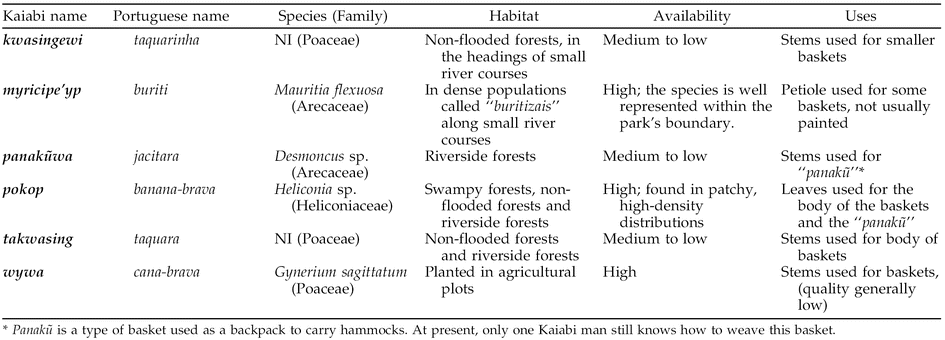
The Kaiabi are reluctant to use other species as arumã substitutes as a means of maintaining their knowledge of weaving. Many men interviewed said that the main reason they are losing their knowledge of basketry is because of a lack of arumã. Some of them say that the other species that can be used as substitutes are of poor quality, and they serve only as a way of learning because baskets made from these substitute species do not last long. However, the Kaiabi currently use at least six substitutes for arumã to make baskets (Table 2). Some, like
Plants currently used as arumã substitutes by the Kaiabi people. Adapted from Athayde (2003). NI = not identified.
Participatory Survey of two Natural Populations of Arumã
The results of the inventory of two arumã populations are summarized on Table 3. We found the average basal area of clumps was different for Areas 1 and 2, with Area 2 having bigger clumps. Two non-mutually exclusive mechanisms could explain this pattern. First, Area 1 was harvested one year prior to the inventory, which could lower the average size of plants in the population. Second, the clumps in Area 2 appear to be growing on mounds of soil that have higher nutrient levels and contain more organic matter, which could increase their growth rates relative to plants in Area 1. While plants in the two populations were similar with regard to most other morphological measurements (Table 3), it is worth noting there was a trend towards more branching from the main knot in Area 1 (x ± SD in area 1 vs. x ± SD in Area 2). This difference, albeit not statistically significant, suggests harvesting stimulates branching.
Results for the survey of two arumã populations, in a harvested (Area 1) and in an unharvested (Area 2) sites.

While individual plants in the two populations were very similar in most other morphological characteristics, they differed significantly when comparing the demographic structure of the populations. There was a highly significant difference in the frequency of plants in each size class between the two areas (G2 = 54.02, P < 0.0001). In Area 1, 59.26% of the population was in the two smallest height classes (0.5–1 m and 1–1.5 m), while in Area 2 these height classes accounted for only 19% of the population. In contrast, the three largest size classes accounted for 44.17% of the population in Area 2, but only 15.75% of the population in Area 1 (Figure 4). This is probably a reflection of selective harvesting of taller individuals in Area 1, which are preferentially cut by collectors.
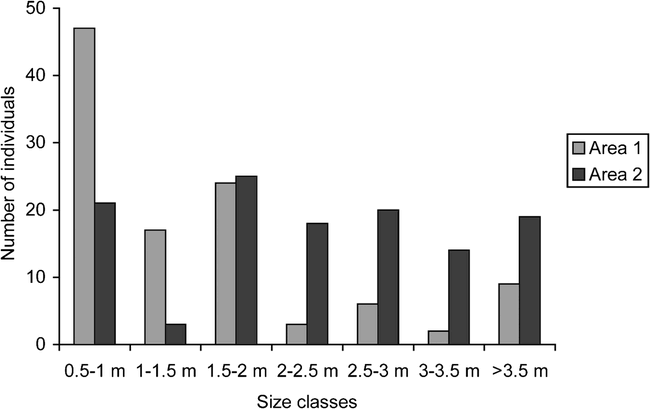
Number of individuals in each of seven size classes in Areas 1 and 2. The size classes are based on the height of the tallest stem.
Experimental Planting of Arumã Seedlings
After 24 months, there was no significant difference in the size of stems transplanted to the four environments (for the main effect of habitat type, Wilk's λ = 0.952, F = 0.829, df = 9,365, P = 0.59). However, there was a significant effect of initial stem size (for the effect of initial diameter, Wilk's λ = 0.642, F = 0.279, df = 3,150, P < 0.0001), with plants that had larger diameter stems at the start of the experiment having larger stems at the end of the study. The habitat type x initial diameter interaction was not significant (for the effect of initial diameter, Wilk's λ = 0.930, F = 0.124, df = 9,365, P = 0.27). Alternative means of comparing the relative growth rates of stems yielded qualitatively similar results.
From time of transplanting until measurement in the second year, the size of seedlings actually decreased. This initial decrease was the result of transplant shock, because by the third year the plants began to grow again (Figure 5). The maximum growth in the second year was of 6 cm in the

Characteristics of arumã seedlings in four environmental conditions in a period of 36 months.
There was no significant difference in seedling mortality among the four habitat types (G-test: G2 = 4.7, P = 0.19). However, the mortality in the two

Comparison of health conditions for arumã seedlings in four environmental conditions in a period of 24 months.
The results of our experimental transplants must be interpreted with caution, as we had only a single replicate of each habitat type and our experiment was conducted on a relatively short time scale relative to the life-span of the plant. Nevertheless, our results suggest transplanting could be effectively carried out into
One important ecological characteristic of arumã is that clumps are in constant flux. The vegetative propagation of stems from the rhizome occurs continuously, while the adult stems break or die when they reach a certain height (approximately 3 m). Larger stems are also subject to damage from treefalls, vines, severe rainfall, and strong winds. Because the growth of plants is so dynamic, with constant sprouting, we believe the harvesting of highest stems under a controlled management practice may not interfere severely in the ability to produce new stems or in clump development, when we consider arumã populations as a whole. Similar conclusions were reached by Nakazono et al. (2004), who worked with another species of arumã (Ischnosiphon polyphyllus) used by riverine communities in central Amazonia. While they found the greatest production happened in the non-harvested clumps, they also found that the production of new stems increased 25% after one year when 30–50% of the stems were harvested. Although longer-term patterns of growth were less conclusive, Nakazono and her colleagues suggested that the limit for harvesting each arumã clump could be as high as 50% of mature stems.
Nevertheless, we emphasize that these results will probably not apply to all arumã species. Shepard et al. (2004) and Silva (2004) worked with two arumã species used by the Baniwa people of the Rio Negro region in northwest Amazonia (Ischnosiphon arouma and I. obliquus). The Baniwa have commercialized arumã basketry for centuries, but since 1997 they have been involved in a project that seeks to consider the social, ecological and economic sustainability of basketry production.1 Arumã populations in the Rio Negro region differ from those in Xingu Park because they occur primarily in regions of human activity, especially in the old swiddens (capoeiras) abandoned after cultivation (Silva 2004). In the case of the Rio Negro, arumã occurrence and clump development are strongly related to light availability and indigenous agricultural practices; this enhances the possibility for sustainable extractivism, even in a market-oriented scale (Shepard et al. 2004; Silva 2004).
Shepard et al. (2004) found out that two years after cutting, the harvested clumps had still not completely recovered to their pre-harvest size. Interestingly, the rate of production of new stems was different for the two Ischnosiphon species: in I. arouma less than half of the cut stems were replaced with mature ones, while slightly more than half of the cut I. obliquus stems were replaced. However, despite estimates of a 2- to 8-fold increase in harvest pressure on arumã populations due to basketry production, Shepard et al. (2004) argue that the harvesting of arumã by Baniwa communities is not leading to depletion or overexploitation of the resource at a population level. They suggest that this is because not all clumps are harvested in every expedition, and because new clumps continue to be produced through vegetative growth.
Silva (2004) found that the proportion of mature stems produced by I. arouma and I. obliquus gradually diminished with the intensity of harvesting, but also recognized important management practices for the protection of arumã populations that are currently being developed by the Baniwa. Instead of cutting arumã clumps to keep the swidden garden clean, as was done traditionally, the Baniwa women now protect them.
Silva (2004) also suggested that the opening of light gaps in the old fallows might promote the growth of arumã clumps (see also Nakazono et al. 2004). The Baniwa, supported by ISA's technicians, have carried out experiments with planting arumã seedlings since 1999. In 2001, the community of Itacoatiara-mirim, near the municipality of São Gabriel da Cachoeira, carried out an experimental planting of seedlings of Ischnosiphon arouma and I. obliquus; the first successful harvest did not happen until March of 2005, and was highly celebrated by the Baniwa people and the team from the Instituto Socioambiental (Silva 2005).
These experiences of participatory research and management of arumã species elsewhere inspire and motivate the Kaiabi people. Even when considering intersite variation in the occurrence of these resources, there are clearly lessons to be learned from experiments conducted in different locations and experiences to be shared by the Baniwa and the Kaiabi concerning possibilities for adaptive extractivism and sound management of arumã.
Conclusion
Participatory research and management of non-timber forest products by indigenous peoples in the Amazon is an issue that has received great attention in recent decades. Participatory research can help to raise awareness and to identify possibilities for the establishment of adaptive management practices according to the new situations faced by indigenous peoples today. It also brings a new perspective for the integration of indigenous and non-indigenous knowledge systems for natural resource management and conservation within indigenous territories.
The Kaiabi people from Xingu Park have faced challenges in terms of limitation and scarcity of natural resources related to territorial displacement, village sedentarization, and population growth. They have demanded technical assistance to adapt their resource management strategies to the new situation they have faced after the transfer to Xingu Park. The participation of the communities and young indigenous environmental managers since the inception of our research makes it easier for them to understand and apply the results of this work, and also increases the chances that they will adopt the resource management plans designed with their participation.
The survey of two natural arumã populations show that repeated harvesting slows growth. Compared to our control plots, after three years, clumps in the harvested area had many more young stems, few of which reached the tallest height classes. Growth was slow, and repeated harvesting in the same site may reduce the viability of the population. Like fallow farming plots, harvested arumã areas also need time to recover, although we still do not know how many years are necessary for a harvested population to recover.
The growth rate of the arumã seedlings transplanted to the four environmental conditions has been low, ranging from 2 to 6 cm per year. The assessment of the seedlings’ health showed that the “
Arumã population concentrations at Xingu Park are generally scarce. As a result, the work of the young environmental manager along with their communities becomes even more important. As Pirapy and Tamakari, two youths working as managers of natural resources, wrote about arumã management:
The natural resources managers wish to explain the meaning of forestry management to the community. We would explain how the Kaiabi people might use the arumã, how it can be managed and how it can be harvested without overexploitation. The community needs to collaborate and plan for the future cultivation of this resource. The community also needs to talk to us, so we can work together. Without the participation of the community, we will not be able to continue the work.
We need to conduct research at Xingu Park to know the density and the stock of arumã. We need to find out the characteristics of this plant in order to manage it. We need to try to plant it, verify if it grows well, and the people need to stop using it until the population increases. When they are going to collect it, they need to choose which one is good to harvest. They should not cut all the stems from the same clump, to avoid weakening the plant (Athayde 2004:1).
The Kaiabi communities have to plan how the remaining arumã populations are going to be exploited and what are the alternatives to cope with arumã depletion in the region. Through this work we have identified some directions for sustainable use as others have done for other Ischnosiphon species (Hoffman 2001; Nakazono 2000; Nakazono et al. 2004; Shepard et al. 2004).
First, it is important to respect the traditional methods of management even as it is adapted to new conditions. We suggest that experienced adults, accompanied by a specialized researcher and/or practitioner, take youths to the field to teach how to recognize mature stems, how to cut them, and how many stems they should leave in the clumps for it to recover from the harvest. The communities should establish a limit for cutting the arumã stems in each clump, cutting only some of the mature stems and leaving at least 50% (as suggested by Nakazono et al. 2004). Combined with this strategy, the communities should try to promote a rotating system of exploitation, with an interval of at least five years prior to re-harvesting the same region.
Second, seedlings and young clumps should be brought to appropriate sites near the villages. The idea is to search for arumã populations where they are likely to occur (for example, in the headwaters of small rivers), collect the seedlings and bring them to places nearer to the villages, under appropriate ecological conditions where arumã grows better, monitoring their growth and favoring seedling development in the area. This strategy can promote a gradual concentration of arumã in the regions near the villages and can be combined with other agroforestry activities that are being developed in some villages by the indigenous managers of natural resources.
Third, it is important to use and study substitute plants. Currently, the Kaiabi are already substituting other plant resources for arumã. Collection of information on the availability, characteristics, and management of these plants should be encouraged, along with the promotion of research activities and exchange of techniques on how to collect and use these resources between them. The use of substitutes is a very important issue linked to arumã management at Xingu Park. As Aturi Kaiabi once said, “we have to use the substitutes at least to learn how to weave baskets, so we won't lose our knowledge due to lack of arumã.”
Fourth, expeditions to collect arumã in the ancestral area should be promoted. Some Kaiabi men in Xingu are already adopting this strategy. Because they still maintain strong kinship linkages with the Kaiabi who remained in the ancestral territories, some of them usually travel to these places to visit relatives and collect natural resources to bring to Xingu Park. Thus, the Kaiabi can write proposals and get funding in order to promote specific expeditions to collect arumã to be used in basketry weaving workshops.
Finally, the Kaiabi should organize themselves to control the sale of arumã baskets. They should raise their price and sell more baskets made with arumã substitutes, ensuring that the quality of the basket and its beauty are maintained.
Footnotes
Acknowledgments
We would like to thank the Kaiabi communities, elders, managers of natural resources, teachers and other representatives who have greatly contributed and participated in this work, especially to: Kupeap Kaiabi, Kawintaii Kaiabi, Tarumani Kaiabi, Sirawe Kaiabi, Aturi Kaiabi, Mawut Kaiabi, Yuamin Kaiabi, Tarupi Kaiabi, Tuiarajup Kaiabi, Kamani Trumai, Pirapy Kaiabi, Tamakari Kaiabi, Karin Yudja, Yasariku Yudja and Wetkere Suyá. The research was carried out through the Xingu Program of the Instituto Socioambiental, with financial support from The Norwegian Rainforest Foundation. ATIX provided logistical assistance and help in the field. Financial support during the preparation of the manuscript was provided by the University of Florida's Center of Latin American Studies (Tropical Conservation and Development program), and by a doctoral fellowship to SFA from CNPq (Conselho Nacional de Desenvolvimento Científico e Tecnológico/Brazil).
