






Abstract
The career of Dr. Heinz Brücher (1915–1991), a German-Argentine botanist of my personal acquaintance, demonstrates that while science may be impartial, scientists are not. Deconstructing Brücher's ethnobotanical writings has required also reconstructing a Nazi past to put his life and work in their appropriate historical context. Brücher's role in the theft of Vavilov's plant collections in the Ukraine in 1943 and his research on cultivated plants at an SS center in Austria have relevance for understanding his post-war presence and activities in South America. Analysis of his publications in ethnobotany and economic botany, especially as they relate to the potato and to Vavilov's ideas, are placed in the context of his ethnobiography. This retrospective on a life with plants raises issues about political and social ideology in science and about claims to objective knowledge. It also points to the value of broadening ethnobiology to include more reflexive perspectives.
Introduction
Ethnobiologists have uncovered a wide range of rich, often exotic, data about the human/biota interface in cultures other than their own, but they have not questioned their epistemological assumptions. Fieldwork generates most of its data using a methodology derived from the natural sciences, yet, since ethnobiologists also work with informants, more than straightforward reporting of the facts may be involved. Social and sometimes political influences affect the researcher, the conduct of his or her work, and the content of the report. In the following narrative, I have charted a life in order to understand the kind of science that came out of it. Just as most plants and animals have ethnobiological dimensions, so too can the deeds and attainments of humans be considered to have a cultural matrix that helps explain how earlier experiences influence an individual's life course (Söderqvist 1991). In piecing together this ethnobiological detective story over a thirty-year period, I have insisted upon the importance of historical understanding, reflected upon intellectual assumptions, and argued in favor of the need of persistent self-criticism to give another level of meaning to our work.
In the Field in Paraguay
In 1975, I went to Paraguay to carry out an ethnobotanical project on Citrus aurantium L. that put me in contact with both rural folk as well as city dwellers (Gade 1976, 1979). That experience was as memorable for the people I met as for the findings I made in the field, and three decades later, I still recall the gist of conversations that I had with several yerba-mate sipping farmers who showed me around their fields and answered my questions. Large landowners also welcomed me to their properties, some in quite remote locales where occasionally heavy rains made roads impassable. Most of all, I remember someone in neither category: Heinz Brücher (1915–1991) an indefatigable plant scientist of European origin with ethnobotanical interests. At the time, he was UNESCO advisor at the Instituto de Ciencias Básicas at the National University of Paraguay.
Soon after we met, I became aware of his assiduous dedication to scientific work. On a collecting expedition to the eastern Chaco, we also canvassed the crop diversity of garden plots at several small traditional farms. Brücher's keen eye for morphology and his enthusiasm for taxonomy, uncommon in someone trained as a geneticist, facilitated his bold hypotheses on crop origins. I had read his articles that identified Phaseolus aborigineus Burk. as the progenitor of the common bean (P. vulgaris L.) and Ullucus aborigineus n.sp., described as having given rise to ullucu (U. tuberosus Caldas) (Brücher 1967, 1968a). In Paraguay, we made small collections of putative progenitors of the peanut (Arachis hypogaea L.) and pineapple (Ananas comosus Merr.), both South American domesticates (Figure 1). The peanut, an allopolyploid whose genome of 40 chromosomes is derived from two wild species found in Paraguay, could plausibly have emerged there as a domesticated plant. Pineapple is probably not of ancient cultivation in this part of the continental interior, for closer bromeliaceous ancestors exist in northern South America, where this fruit is also more strongly integrated into the local folk tradition. But with no archaeological evidence for Paraguay, the place and time of either pineapple or peanut domestication have remained “secrets of antiquity.”
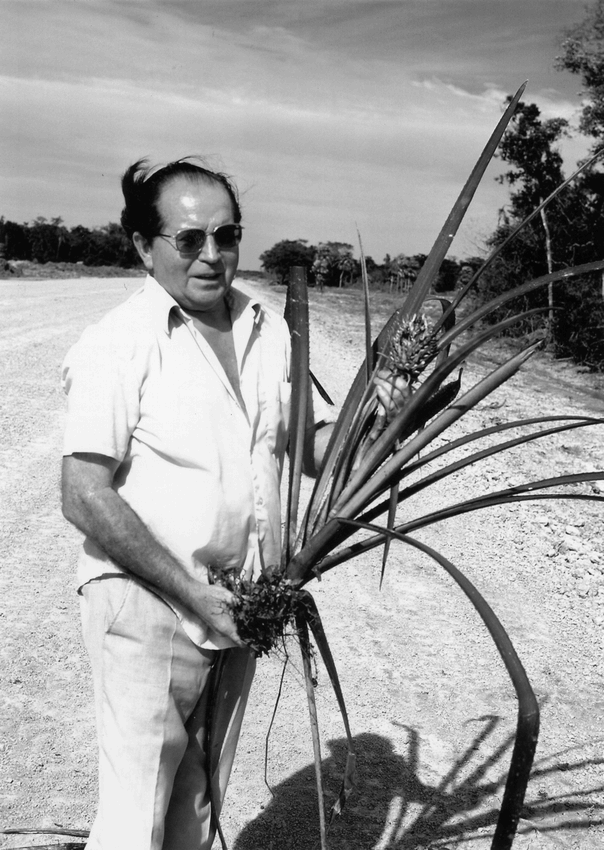
Heinz (a.k.a.‘Don Enrique’) Brücher in eastern Paraguay in 1975 holding a carataguá (Pseudoananas sagitarius), a wild relative of pineapple, but not part of the genetic makeup of the domesticated species, Ananans comosus. In 1944, this same man was SS-Obersturmführer Heinz Brücher. [Photograph by Daniel W. Gade.]
How Brücher came to acquire his fund of knowledge about crops and other plants was a reasonable question, but he volunteered only glimpses into his earlier life. He explained that during World War II he had been director in Austria of an agricultural experiment station where Jehovah's Witnesses, members of a nonconformist religious group that refused military service, made up the work force. He further explained that after the war he had gone to work for a seed company in Sweden, and there he met and married a Swedish plant scientist. They subsequently went to Argentina and lived first in Tucumán and then in Mendoza. On the outskirts of the latter city he bought a small farm as a source of income. Newly acquired Argentine citizenship did not keep him at home. He was part of several collecting expeditions and had teaching and consulting contracts in other countries. While living in Venezuela with his family, uniformed officers at a road checkpoint mistakenly killed his wife and one of his two sons. Thanks to his contacts with people in Germany and in North America he had an international perspective that was rare among South American scientists I had met. At the time, I did not know enough about him to connect the dots of his life trajectory as he had related it to me.
Maintaining Contact
Over the years following our 1975 encounter in Paraguay, Brücher and I maintained a correspondence. Several of his aerograms expressed his frustrations about life in Argentina; other letters were reports of his research activities, manuscripts in progress, and recent publications. After Springer-Verlag published Brücher's compendium of useful tropical plants, Brücher notified me that they wanted an English version of that part of the book that dealt with New World plants and asked if I would be available to make that translation. The substantial time commitment that would have required forced me to decline.
After his UNESCO contract at the National University in Asunción ended, Brücher stayed in Paraguay for a short time on a contract to make forest inventories. In 1976, he returned to Argentina to take up an academic post, but eventually his correspondence indicated a strong desire to leave the country and asked if I would serve as a North American intermediary to negotiate invitations for him to be a visiting scientist to universities in the United States. Although his command of spoken English posed communication problems, I agreed in principle to initiate those inquiries if he would send me his full curriculum vitae, a necessary first step for me to explore potential institutional interest. Brücher did not respond to that basic request.1 Our last correspondence was in 1991 when I mentioned that I would like to visit him in Mendoza to discuss crops. His failure to answer puzzled me. I heard no more from him. Only five years later did I learn that Heinz Brücher had been assassinated at his Argentine farm on December 12, 1991 (Rehm 1992).
The death notice hinted that cocaine traffickers carried out the crime. The motive was plausible, for Brücher had talked to me about propagating a viral disease (“estella”) as a form of “biological warfare” to destroy plantings of both species of coca (Erythroxylum coca Lam. and E. nova-granatense (Morris) Hier.) without damaging other plants. Although scientific reports on coca wilt go back to the 1930s, references to it go back more than a century.2 In the 1980s, its identity, Fusarium oxysporum f.sp. erythroxyli, was established by isolating it from dead coca plants and its mycoherbicidal specificity to the two cultivated coca species was confirmed (Sands et al. 1997). Full-scale research of this disease-carrying fungus dates from the 1990s, when a private North American company patented one strain (“EN-4”). The U.S. Drug Enforcement Agency (DEA) has considered this Fusarium to be a useful tool for coca eradication, but the governments of Peru and Bolivia have opposed its application in their countries. Not only would the spread of this mycoherbicide destroy many peasant livelihoods, mutations of the fungus might conceivably produce mycotoxins that could devastate food crops. Furthermore, inoculating coca plantings with Fusarium could rapidly infect an entire producing region, thus threatening not only small-scale coca producers but also the international syndicates in the Andean countries who buy the unrefined alkaloid-rich mixture (“pasta”) made from processing the leaf to make refined cocaine; those syndicates represent dangerous adversaries.
Heinz Brücher and the Nazi Past
The mysteries of H. Brücher deepened one day in 1997 when, purely by chance, I came across Biologists Under Hitler (Deichmann 1996), a work that had appeared originally in German in 1992 under the title Biologen unter Hitler: Vertreibung, Karrieren, Forschung. Heinz Brücher warranted a prominent place among the 445 entries in this book. He was described as being the SS (Schutzstaffel) commanding officer who had appropriated crop plant collections from the agricultural experiment stations in the Ukraine and moved them to Austria. I had no reason to doubt the veracity of this information, for the author was a respected biologist and a prestigious university press published the book. Learning this aspect of Brücher's personal history helped me to put into context the allusion in his book preface to “investigations in the Jaila Mountains of Crimea during the war year of 1943” (Brücher 1977b:ix). Under the czars, German colonists had founded in that region a series of villages, which the Soviets destroyed during World War II.
Brücher's reference to his presence in Crimea implied his own personal involvement in the larger plan that was hatched in Berlin to turn the Soviet Union east of the Urals into “living space” (Lebensraum) for Germanic peoples. Hitler charged the SS, the leading organ of Nazi terror, to organize this “new order for the east.” Russians and Ukrainians east of the Urals were to be relocated into Siberia; Jews were to be killed on the spot. From 1941–1942, the Eleventh German Army accomplished the first step in that plan by conquering the fertile food-surplus region that included the black-soil Ukrainian steppes south to the Black Sea. Of special interest to the Germans was the Crimean peninsula with its mild climate and its strategic location that gave access through the Bosporus to the Mediterranean.
The unexpected strength of Russian resistance in the Battle of Stalingrad in February 1943 altered the military plan. Uncertain of the future course of events, the Kaiser Wilhelm Institute, Reich Ministry of Food and Agriculture, and the SS decided to appropriate and remove the plant material from the Soviet agricultural experiment stations and other entities in lands still then under German control. In June 1943, the SS Reichsführer Heinrich Himmler placed Heinz Brücher in charge of the Sammelkomando that carried out those raids. Euphemistically called a “collecting expedition,” Brücher and cohorts raided 18 agricultural experiment stations or botanical gardens and loaded thousands of accessions of major crops onto SS trucks and took them to Austria.3 Some of the pillaged material came from the collections made around the world by the renowned Russian scientist Nicolai Vavilov and his associates. Most readers of Brücher's 1977 book never knew that the help he acknowledged from the “Vavilov Institut für Pflanzenbiologie” was an allusion to the seeds stolen in the Ukraine and Crimea.
Brücher's role as an officer in the SS put him in the elite corps of the Nazi party (NSDAP). After the war, some individuals in the SS elite were executed or committed suicide, while others assumed new identities or became fugitives. Brücher's postwar prospects were ambiguous. For several months he did contract research for the American occupation force, which considered his knowledge to be useful. But Brücher's personal history precluded a scientific career in the postwar atmosphere of his home country. The ideological content of his early publications, which tied the German biologist Ernst Haeckel to Nazi ideas about race and the potential for denunciation from subordinates with whom he was often arrogant, made him an unacceptable candidate for any responsible post. In a letter, Brücher complained that several manuscripts he submitted for publication between 1945 and 1947 had been rejected, and he concluded that his work was being judged for reasons other than scientific (Hossfeld and Thornström 2004). Still only 30 years old, expatriation seemed at the time to be the only feasible course for a scientifically-ambitious outcast. His chance came in February 1948 when Sven Hedin, the Swedish explorer and friend of Hitler, invited Brücher to Sweden. There Brücher worked at the Svälof seed company, published several papers in Swedish journals, and married a Swedish plant scientist. Helped by Argentine diplomats in Stockholm who actively facilitated the immigration of many Germans and some Scandinavians compromised by their war-time activities, he made arrangements to start a new life in Argentina.4
Together with his wife, Ollie Berglund, Brücher arrived in Argentina in late 1948 during Juan Perón's first presidency (1946–1955). In 1949, Brücher took a position at the Instituto Miguel Lillo, at that time the semiautonomous research-oriented biological science division of the National University of Tucumán. Funneling Europeans to this subtropical city became part of a Peronist plan to develop a leading science research center in the Argentine Northwest. Even before the War, Tucumán had gained a reputation as a center for expatriate European scientists. Two local figures, Ernesto Prebisch, a University administrator, and Agustín Barrére, the right-wing bishop of Tucumán who had gone to Europe in 1947 to help anticommunist Europeans move to Argentina, facilitated the postwar flow. An isolated population cluster supported by growing and processing sugar cane, Tucumán was more than 1000 km northwest of Buenos Aires, distant from prying foreign journalists and Nazi hunters, real or imagined.5
Fugitives, mostly German along with some Italian, Croatian and other nationalities, found positions in several institutions. CAPRI, a German-Argentine private enterprise that was awarded state contracts to improve the regional infrastructure and modernize the Tucumán sugar industry, hired 300 people; included among them were high-profile SS officers (Goñi 2002:300). Perón's interventions encouraged the National University of Tucumán to accept at least 26 German academics between 1947 and 1950 (Meding 1992:212). New faculties, or schools, of economics, sugar technology, agronomy, medicine, music, and architecture were part of a plan to turn Tucumán, an institution founded in 1914, into a major center of research and learning. To fulfill that objective, the university sought to establish an avant-garde campus on a prominent hill in the higher and cooler zone west of the city. Serious economic downturn in Argentina starting in 1953 stalled its implementation. When the 1955 coup d'état forced Perón into exile, the new government halted the project. Half a century later construction shells on the hill site are reminders of an ambitious project for the university that contrasts with the underfunded institution of today.
Ideological parallels between German Nazism and “criollo fascism” predisposed Perón to grant refuge to many German and other European military officers or specialists compromised by their wartime activities. More pragmatically, Perón believed that the knowledge and skills brought by expatriate Germans would create for Argentina a modern scientific image. However, for the fugitives, a safe haven far from Europe was the chief advantage of and motivation for immigration; this despite the fact that in 1945 Argentina and other Latin American countries along with the United States signed an agreement in Mexico that excluded Nazi criminals and collaborators as immigrants to the Americas (Newton 1992:360–372). By 1947, the United States government, consumed by the fear of Communism, had turned a blind eye to this treaty. In 1949, Perón formalized and guaranteed the concept of safe haven, in direct violation of the Act of Chapultepec. In Argentina, Perón's nationalistic economic policy began the long economic decline that also affected the health of civil society well beyond his administration. Brücher, who himself benefited from the Peronist connection in all his university appointments, spoke favorably to me of Perón, though the scientific and technical knowledge supposedly brought by postwar German immigrants did not deter that decline.
H. Brücher, Plants, and the SS
The path that Heinz Brücher took in his personal and professional development was heavily influenced by Hitler's rise to power. Brücher grew up in Erbach amid the castled and wooded hills of the Hessian Odenwald, and as a teenager in 1933 organized a local chapter of the Odenwaldklub, a politically-oriented hiking association.6 He once remarked to me that he was a “person of the forests,” which only later did I realize was a code phrase in Nazi rhetoric that expressed the concept of the mystical fatherland based on ancestral blood ties. In 1934, the same year that he joined the NSDAP as Nr. 3498152, Brücher went to the University of Jena to study biology and anthropology. In 1935, he transferred to the University of Tübingen where three years later he received his doctorate in plant biology with a specialization in genetics for a thesis on Epilobium (Brücher 1938). In that experimental project, he observed cytoplasmic inheritance, which contradicted the view of his major professor Ernst Lehmann. Charging that Lehmann tried to stop publication of his thesis, Brücher turned against his mentor, creating a dispute that was politically tinged due to Brücher's accusations that Lehmann held flawed political credentials (Hossfeld 1999).
Most important for Brücher's immediate future was his decision to join the SS, the élite force of Nazism. While in Jena, where he was teaching, he earned a second degree (Habilitation) under the patronage of Karl Astel. Trained as an anthropologist, Astel, also an SS officer, became president of the university in 1939 (Weindling 1989:536). More than other German universities, Jena became a propaganda machine for the Nazis who redefined science as a socially-organized political enterprise. Brücher also became a member of the Ahnenerbe (“Ancestral Heritage Society”), the organization founded by Heinrich Himmler in 1935 and incorporated into the SS in 1937. Many Ahnenerbe members were academics with doctorates who disseminated a mixture of scientific fact and ideology as “objective truth.” The Ahnenerbe sponsored expeditions—the most famous of which was that led in 1938 by Ernst Schäfer and Bruno Beger to Tibet—and appropriated books from libraries and seized collections from museums in lands conquered for the Reich. To supervise their institutional plunder, the Ahnenerbe organized special units (Sammelkommando) (Hale 2003; Kater 1997). Other Ahnenerbe members carried out vivisection on humans, conducted espionage, and made studies of occultism.
Looking for scholarly inspiration to match his ideological commitment, Brücher delved into the life and work of Ernst Haeckel (1834–1919), a biologist who had spent his career at Jena. Haeckel had introduced to Germany Darwin's ideas of selection for fitness, but went beyond that in his view of evolution as a cosmic force. His notion that biological inheritance explained and determined cultural differences gave a strong impetus to the development of eugenics in Germany. The Nazis expanded that into “race hygiene.”7 Brücher's (1935) fascination with Haeckel prompted him to write an article about him in the Nationalsozialistiche Monatshefte and, the following year, a book-length biography (Brücher 1936). Gasman (1971:72) summarized that work by stating that “Haeckel's Nazi biographer, Heinz Bruecher, gave assurances not only of his importance for the development of the basic doctrines of National Socialism, but also of his proper biological package—his Aryanism, his blond hair and his blue eyes” (Figure 2). Though still a young man, Brücher's doctorate in genetics, his publications on Haeckel, and his membership in the SS Ahnenerbe gave him the standing to help him play a part in formulating the nationalist ideology.

Frontispiece and title page of Brücher's 1936 book in the Fraktur script favored in that period. The book title can be translated as “Ernst Haeckel's Genealogical and Spiritual Inheritance: A Cultural Biological Monograph.” The quote from Haeckel written in his longhand can be translated as “True education consists not of dead knowledge and senseless memorization, but of the vivid development of the mind's power of discernment.”
Avoidance of alcohol, smoking, and mind-altering drugs became part of the racial hygiene movement directed at people defined as Aryans. Controlled studies bolstered scientific claims for the damaging effects of these “genetic poisons” (Volksgifte). In 1939, the Reich established a bureau against alcohol and tobacco use. Government decrees prohibited tobacco use in public space by those younger than 18, banned smoking on trains and buses, and enjoined military men to refrain from smoking in the streets. In 1941, Karl Astel established at Jena the world's first Scientific Institute for Research into the Hazards of Tobacco (Zimmermann et al. 2001). The Ahnenerbe and the larger SS command in general also worked to control alcohol sale and consumption. The government restricted alcohol advertising and distribution, published the names of irresponsible drinkers, criminalized drivers under the influence, and either sterilized problem drinkers or defined them as psychopaths and antisocials (Fahrenkrug 1991). Alkaloid-based psychotropic drugs fell into a taboo category, though ironically it had been German expertise, often used by the Nazis as one proof of their scientific superiority, that had made drug use feasible. For example, in the nineteenth century, German biochemists had extracted heroin from the opium poppy, cocaine from the coca leaf, and caffeine from the coffee bean. The Nazi campaign (“Rauschgiftbekämpfung”) against visionary inebriants was much more low-key than that against tobacco. When I knew him, Brücher was against all tobacco, spirits, stimulants, and mind-altering drugs. He did not eat meat and he advocated natural medicines, including the healing power of garlic. Other Nazis, including Joseph Goebbels and Hitler himself, had these same health practices (Arluke and Sanders 1996:150; Kater 1997).
Heinz Brücher had started his career in the Reich as a broad-based and ideologically committed plant scientist. His self-defined expertise embraced genetics, taxonomy, phytopathology and agronomy, as well as anthropology and geography. These disciplines converged in his natural history explorations and his studies in ethnobotany and economic botany. Largely through connections made both before and after the war in Germany, Brücher traveled frequently and widely as a researcher, professor, scientific advisor or traveler. In 1954, he formed part of a collecting expedition to bring back primitive barley (Hordeum spp.) from the Himalaya. His strong anti-Communist stance did not prevent him from being invited by and accepting an offer from the research institute at Gatersleben, East Germany, to give a lecture on potato origins in 1957 (Hossfeld and Thornström 2002:138). In South America, Brücher collaborated with several foreign-initiated plant collecting expeditions. Some of these include an expedition headed by the Russian P.M. Zhukovsky (who had been a colleague of N.I. Vavilov, but who presumably at the time did not know of Brücher's involvement in stealing Russian plant materials in 1943) in 1958, a West German potato collecting expedition funded by the Max Planck Institute (the postwar successor to the Kaiser Wilhelm Institute) in 1959, and another potato collecting expedition including American specialists Correll, Dodds and Paxman in 1960. These postwar research participations bolstered Brücher's sense of entitlement to a scientific post in West Germany or Austria, neither of which, however, materialized (Heim 2002:38).
H. Brücher and N. Vavilov
Brücher frequently criticized in print the plant scientist Nikolai Ivanovich Vavilov (1887–1943), who had carried out more than 100 plant-collecting missions in 64 countries between 1916 and 1942 (Vavilov 1992). As the first director of the of the All-Union Institute of Applied Botany and New Cultivated Crops (founded by Lenin in 1925), in the 1930s, Vavilov was responsible for 20,000 employees, 400 research laboratories and experiment stations, and the largest collection of cultivated plants in the world. Beginning in 1938, Trofim Denisovich Lysenko (1898–1976) gained ascendancy in the Soviet scientific establishment for ideological reasons and eventually replaced Vavilov's institute with his own. Lysenko held the Lamarckian belief that organisms inherited traits directly from the environment, a view in step with the Soviet determination to control nature. Jealous of Vavilov's worldwide reputation, Lysenko prepared to take over agricultural research in the Soviet Union. In 1940, the secret police imprisoned Vavilov in Saratov where, in 1943, he died of hunger (Popovsky 1984). Lysenko's lack of interest in Vavilov's collection explained the Soviet government failure to move the seed collections to protect them from the 1941 German invasion east of the Urals as they had done with heavy industry.
It was Vavilov's contribution to knowledge about wild forms of cultivated plants, not Lysenko's arguments, that German science found useful. During the 1930s and 1940s, Germany, the Soviet Union, and the United States were the only countries with research programs that clearly appreciated the benefits of controlling germplasm for plant breeding (Flitner 2003). International competition for this plant material and ideological divergences between Germany and the Soviet Union were part of the basis for Brücher's disparagement of Vavilov's ideas. Over a period of three decades, Brücher took issue with Vavilov's theory of gene centers (Brücher 1960, 1968b, 1969, 1971, 1975, 1977b, 1979, 1987, 1989). The Russian's early coupling of centers of crop diversity with those of agricultural origin has merited correction; Harlan (1975), Hawkes (1983) and Harris (1990) have cogently explained this erroneous conflation, while still acknowledging Vavilov's massive contributions to the study of agricultural origins and maintenance of biodiversity. Brücher (1969), however, went farther than those specialists to deny the whole gene center theory, even where certain definable areas of the world clearly have clustered crop biodiversity.8
Prior to the Russian research on the tuber-bearing Solanum, plant scientists viewed the potato as being of just one cultivated species. Bukasov, who collected from Mexico to Colombia in 1925 and 1926, built on Vavilov's work in Ecuador and Juzepczuk's mission to the Andes of Peru and Bolivia from 1927–1928, to identify fifteen species at several ploidy levels (Juzepczuk and Bukasov 1929). Although later research cut that species diversity in half, potato taxonomy revealed a complex pattern of hybridization over more than 3000 years. More controversially, Vavilov and his associates selected Chiloé (south latitude 42°) as the center of origin of the common potato (Solanum tuberosum L.). A photoperiod analogy provided the basis for the supposition that a plant that so successfully adapted itself to the high latitudes of northern Europe must have evolved in a relatively long-day environment, rather than in the short-day tropical Andes of Peru. Brücher argued that the common tetraploid potato had not been domesticated in that part of Southern Chile. He claimed that the cultivar he found growing in the long summer days on Chiloé had been selected under the high mountain conditions of Peru and Bolivia in the short-day tropics. He also discovered oca (Oxalis tuberosa Molina), indisputably a plant native to the tropical Andean highlands, growing in Chiloé. These facts strongly suggested to him not a local origin, but diffusion southward. [The true story may not be so simple. Grun (1990) reported molecular evidence to suggest that an unidentified wild diploid entered into the make-up of the tetraploid in Chiloé.] Brücher also used this case to attribute to Vavilov opposition to the idea of prehistoric diffusion of crops. That characterization seems unfair, for no one in the 1920s and 1930s knew much about the antiquity of crops. Only since the 1950s and the advent of radiocarbon dating has the archaeological work of retrieving and dating plant remains revealed the extent of crop movements from their places of origin.
Brücher's scorn of Vavilov's ideas had its roots in the turbulent German plant science community of the 1930s and early 1940s. Elisabeth Schiemann (1881–1972), notable at the time for her work on crop origins, had points of agreement with Vavilov (Schiemann 1939). At the same time, she became known for her outspoken refusal to submit to Nazi directives (Lang 1987), for during the Nazi period favorable citations of the scientific work of Russian or Jewish scholars were considered to be acts of betrayal. Her scientific integrity caused her to lose her teaching post at the University of Berlin in 1941. To Brücher, Vavilov was a Communist and a Slav, which, in the Nazi scheme of Herrenvolk and Untermenschen, became reason enough to disparage or even vilify his findings. Public intellectuals in Germany incited contempt for Slavs (Koonz 2003:213). Under that distorted premise, Vavilov was thought not to merit acclaim as the leading figure in world agriculture. Retrospection shows not only how wrong Brücher was, but clarifies another essential distinction; Vavilov was a principled man of science who paid for his refusal to mix genetics and politics with his life. This was in contrast to Brücher's behavior as a scientist in the service of the Third Reich who, later as a fugitive chose not to take the consequences of his actions or even to acknowledge them.
Brücher's Ethnobotany Deconstructed
Heinz Brücher's ethnobotanical writings centered on the origin and use of cultivated plants (Brücher 1950, 1977b, 1982, 1989). The 1977 book, published in German, covered the earth's low latitudes worldwide, whereas the 1989 work, in English, was restricted to plants of neotropical origin. Sections of the latter book were translations of the former. Between the publication of these two works, another volume on the world's most important food plants appeared (Brücher 1982). The latter, written for nonspecialists, included updated material from a work he wrote on crops that was published after the war (Brücher 1950). Brücher's books received minimal and superficial review. A short review in German of his 1977 Springer book commented on two substantive mistakes and complained about the book's “repetitions, Anglicisms and mistakes” (Ziegler 1979:272). Two brief evaluations of his 1989 book, also from Springer, expressed exasperation at its poor editing (Krikorian 1990:257) and careless writing style (Kavaljian 1990:1178), with hardly any specific remarks about its actual scientific content.
Brücher's writings brought together with his research findings and information from the literature, more personal opinions than do most works in plant science. He interwove fact and opinion especially concerning plants that are used as stimulants. For tobacco (Nicotiana spp.), the reader gets health briefings with ethnobotanical information:
Each year 1000 t of this poison are produced by the cigarette industry. An amount of 40–60 mg is already fatal for humans. A high percentage of lung cancer is undoubtedly caused by the increasing smoking habits in the Western nations (Brücher 1989:180).
Although these remarks would not elicit much disagreement now, they nevertheless introduced a nonscientific tone in a purportedly scientific treatise. The 1989 English version, however, omitted his 1941 condemnation about tobacco “…to prevent further deterioration of the genetic material and to preserve the genetic health of the German people and the Nordic-Germanic race” (Deichmann 1996:259).
His discussion of coca as a plant domesticated for the alkaloid content in its leaf was similar. Rather than informing the reader about coca's role in Andean culture history, Brücher stated that coca mastication is a “widespread and dangerous habit” (Brücher 1989:175). Coca chewing (as opposed to cocaine consumption) has always been largely confined to the indigenous population of Peru and Bolivia and, while mildly numbing, can hardly be considered to be “dangerous.” Part of his disapproval seemed to be aesthetic: “We should mention here that this custom is highly repugnant, as a green slimy saliva drops from the mouth of the coca-addicted chewers” (Brücher 1989:177). The “green saliva,” mentioned to evoke personal disgust at an indigenous custom he did not share, is a short phase of the mastication process; alkaloids in the leaf rapidly slow salivary flow and cause dryness of the mouth. He went on to deliver a lesson on the “danger of intoxicating the human body with alkaloids” and stated that he could not believe that “educated and hygiene-prone persons could find a lasting pleasure in masticating coca leaves” (Brücher 1989:178). Facile condemnations of an Andean folk habit that has had deep symbolic significance for 4000 years reflected more than simple Eurocentrism. The curious expression “hygiene-prone” is a usage borrowing from the Nazi application of the word hygiene in the 1930s. Brücher then claimed that “the USA alone had more than 5,000,000 cocaine [sic] addicts (mostly of African descent).” Those lines contain twin errors, one that cocaine is physiologically addictive and the other, that African-Americans numerically comprised most of its users, revealing his prejudices.
Other stimulants elicited either negative comments or got no mention. Pulque, the fermented sap of Agave americana L.with six-percent alcohol content, is incorrectly described as a “narcotic beverage” (Brücher 1989:145). Only with hallucinogenic additives such as peyote or datura, which were occasionally used, can pulque be said to impart a narcotic effect. The dietary value of carbohydrates, vitamins, and amino acids in pulque escape mention. Since coffee is an unquestionably important crop and has but one use, it gets substantial treatment in one of his books. The author mentioned the “agitation, sleeplessness and heart palpitations” that only 0.5 grams of caffeine in the human body can cause (Brücher 1977b:459). He applied the term Vergiftungserscheinungen (“symptoms of poisoning”) to those effects, the same term used by the Hitler Youth Movement to warn children away from it (Kitzing 1941). His discussion of coffee also mentioned the negative economic aspects of growing this crop on good agricultural land more appropriately used for food crops to alleviate hunger (Brücher 1977b:444–445). Betel, a stimulant that combines the Areca catechu L. nut and Piper betle L. leaf, elicits the admonition that chewing it is addictive and leads to mouth carcinomas (Brücher 1977b:504). Though nutmeg (Myristica fragrans Houtt.) was entered in his book under the spice category, its psychotropic constituent, myristicin, is mentioned as a “powerful poison” to humans (Brücher 1977b:426).
Other psychotropic plants that produce an altered state of consciousness were not mentioned in his 1977 world survey. Unacknowledged was khat, the alkaloid-rich leaf of a domesticated tree (Catha edulis Forsk.) of the Horn of Africa. Like coca, its mastication produces quiescent psychophysiological effects when chewed. Kava (Piper methysticum Forst.), a series of cloned cultivars unknown in the wild from which Pacific Islanders make a ritual drink, also received no entry. Neither poppy (Papaver somniferum L.) nor cannabis (Cannabis sativa L.) was included, both of which are widely grown within tropical latitudes even if they are not of tropical origin. Given his bias against hallucinogens, it is perhaps understandable why Brücher did not mention that plants used to induce altered states of consciousness have been, in spite of other drawbacks, a source of human creativity. Less defensible was his decision to simply omit some of them. His negativity about psychotropic substances paralleled that of Reko (1938) who, although not cited by Brücher, wrote the most detailed work on this subject during the Nazi period.
Scientific concern with predicting crop potential had early snared Brücher's attention in keeping with the Nazi concern with self-sufficiency. Brücher (1989:50) made bold assessments about the possibilities of New World crops for “future phytogenetic improvement.” He considered the domesticated llacon or yacon (Polymnia sonchifolia Poepp. and Endl., Asteraceae), grown for its watery sweet root, to be not suitable for improvement efforts. But subsequently it has been found to have a high content of inulin in its roots and protein in its leaves, and one day llacon may become an accepted food outside western South America. Brücher also misjudged the value of maca (Lepidium meyenii Walp), a cruciferous perennial grown for its roots above 4000 m elevation. Since he wrote comments about that, study of its medicinal and nutritive value led to new appreciation of it as a cultivated plant. In 1994, maca, then cultivated on less than 50 ha in Peru on the Pampa de Junin, was close to extinction; by 1999, this crop covered more than 1200 ha and found export markets as far away as Japan.
Another pre-Columbian domesticate, this one from Mesoamerica, is chia (Salvia hispanica L.), which received no mention in Brücher's books. Long forgotten, the seeds of this plant have now been found to be rich in omega-3 fatty acids, which opens big possibilities in the food industry (Ayerza and Coates 2005). Brücher considered himself to be an agricultural visionary, but in retrospect that self-ascription was unwarranted. What future generations might want from cultivated plants or what useful substances might be found in them cannot be predicted (Flores et al. 2003; National Research Council 1989).
In the sections on sapodilla (Achras zapota (L).= Manilkara zapota (L.) P. Royen), Brücher conveyed his disdain for the habit of gum chewing by stating that Indians used chicle without knowing that this “really repulsive custom had been imitated by the ‘civilized’ of North America” (Brücher 1977b:451). His allusion to chicle in the context of “the bad custom of spitting around with chiclets….” (Brücher 1989:247) was largely gratuitous, as synthetic products replaced chicle in making chewing gum by the 1950s. His discussion of sisal (Agave sisalana Perrine.) followed a logic borrowed from the past. German planters in Tanganyika (now Tanzania) introduced sisal from Mexico by way of Florida, using a narrow breeding base of this plant that in the author's mind required a broader gene pool. The remark “…but who cares about this in Tanzania” (Brücher 1989:145) did not mention the possibility that Africans might not want plantation agriculture that benefited only Europeans. Comments on Cinchona spp., the source of quinine, included the assertion that the species in the Andes would have become extinct if the German pharmaceutical industry had not discovered synthetic antimalarial drugs (Brücher 1989:175). However, decades before atebrine and plasmochine had appeared on the market in the 1930s, cinchona plantations had come into production, especially in Southeast Asia, foreclosing the possibility of extinction of the wild species.
Brücher's inclusion of plant breeding into his ethnobotanical account came from a wartime mindset about German self-sufficiency in basic foodstuffs. Crop improvement was a major goal in Germany between 1933 and 1945. Breeding trials of grain and tuber staples used germplasm that had to come from outside Germany (Brücher 1950). The SS crop plant institute at Lannach in Austria, which Brücher directed between 1943 and 1945, had as its main mandate the improvement of the Reich's food supply. Seeds, especially grains, brought back from the 1938/1939 Ahnenerbe expedition to Tibet and the material stolen from the Ukraine, were taken to Lannach. New plant sources that could contribute to self-sufficiency also received attention. During the wartime search for alternative sources of edible oils, Brücher (1968a or b:I:281) made experiments with Madia sativa Mol., a plant in the Asteraceae native to western North America. Historical evidence cited by Zardini (1992:38–39) indicates that this plant was cultivated in Chile for its nutritious oily seeds into the early twentieth century. At the SS center in Lannach, selection for increased oil yield and frost and drought resistance suggested that this plant would be useful in the conditions of the conquered eastern lands. German surrender cut short that research, but after the war the American occupation authorities were sufficiently interested in the plant's potential to allow Brücher to continue that work under their auspices (Brücher 1948).9
Brücher's South American explorations were driven by practical applications, the model for which came from Nazi Germany. His breeding of tarwi, the bitter-seeded domesticated lupine (Lupinus mutabilis Sweet) of the Andes, used sweet lupine (L. luteus L.) as his model (Brücher 1974a). Nazi era German scientists gave such intensive attention to this latter species that Wieland (1999) described it as a “technological artifact.” Though tarwi toxicity is still high, agronomists gained a new perspective on the potential of this plant that had contracted in Andean agriculture since the introduction of European legumes in the sixteenth century (Gade 1969). Brücher also conducted trials on a Paraguayan native plant, Stevia rebaudiana Bertoni, the leaves of which contain the sweetening agent stevioside (Brücher 1974b). Thirty times sweeter than cane sugar, Stevia has since been commercialized as a health food item.
Crop improvement was a major goal of German plant science during the 1930s and 1940s, when Heinz Brücher was being trained in the discipline and indoctrinated by the prevailing politics. The contribution of his focus is evidenced in Brücher's life work in which cultivated plants were treated as objects of genetic manipulation and serious discussion of the use of natural selection in conferring fitness on the wild progenitors was omitted. Thus he gave little attention to the evolutionary processes that had occurred over millennia before domestication and that made plants susceptible to human intervention in the first place.10
Understanding Heinz Brücher
To understand Brücher's ethnobotanical and related work one must review his cultural background and the influence of Nazism on his thinking. Brücher's relentless integration of plants and people in an evolutionary and applied framework was the kind of syncretic approach favored under the Third Reich. He was inspired by Haeckel's idea of an interdisciplinary holistic science, which ran counter to the narrow specialization, reductionism, and abstract knowledge then pursued elsewhere in Europe and in America (Gasman 1971). In Haeckel's scheme, natural systems and human society were susceptible to the same laws and Nazi doctrine promoted their integration, both as a philosophy and a science. Nazi thought also adopted from Haeckel the idea that aesthetic judgment is instinctive and thus “objective.”
The Nazis accepted as a biological truism Haeckel's assumption that the Caucasian race is superior. Brücher reaffirmed it for himself by his “scientific observations” during his more than a year spent in southern Africa and later in 1965 in the course of an extended coast-to-coast trip across the United States on a Greyhound bus. In the entry on sugar cane in one of Brücher's books, he included a digression stating that the legacy of transatlantic transfer of African slaves became an “almost unsolvable race problem for North Americans” (Brücher 1977b:84). Brücher's broadsides against Jews are recorded in his 1936 Haeckel biography. Brücher believed his own judgments about individuals, groups, and substances of various kinds to be based on science. When I knew him, his repertoire of value judgments mirrored those in force or in vogue during the Nazi period. He was cautious, however, about expressing them in print and in some cases resorted to circumlocution to make his point.
A notable example of such a circumlocution appears in his book preface in which he refers cryptically to the “politically debatable background” of Julius and Eva Lips, who performed research ‘in favor of the oppressed’ (Brücher 1977b: 8). Brücher's reference to them becomes meaningful to those who recognize that Julius Lips (1895–1950), a professor of ethnology at the University of Cologne, rejected the Nazi view of the world. In his innovative early work, he tried to see nature and history through the eyes of native peoples and from this he developed a critical attitude towards his own German culture (Hauschild 1987:247). Lips refused to teach Nazi racial theory—the only Gentile university professor in his field in Germany who dared to publicly challenge party doctrine.11 In 1934, Franz Boas invited Lips to Columbia University where he and his wife Eva began research on North American topics. In 1937, Lips went to Howard University, a historically African-American institution, where he started the anthropology department. At the end of the war in 1948, reassessing his political commitments, Lips returned to the German Democratic Republic to became professor at the University of Leipzig and, a year later, its rector, the position he held until his untimely death at the age of 55. East German authorities promoted him as an activist scholar whose life's work was sympathetic to North American native peoples and blacks. Brücher especially took exception to Lips’ refusal in 1933 to conform (Gleichschaltung) to Nazi ideology and his joining the Communist party in East Germany in 1948.
The career of Heinz Brücher combined ideology and personal ambition. SS documents describe him as willful and headstrong (Hossfeld and Thornström 2004). Although the idea of using Vavilov's collections had been conceived at the Kaiser Wilhelm Institute of Biology in 1942 (Macrakis 1993), it was the SS and the Ahnenerbe, most specifically Heinz Brücher, who organized and executed the raids. At the time, he, better than most, grasped that the plunder of Soviet seed banks was the most expeditious way to acquire high-yielding and cold-resistant germplasm which could be used in crop improvement. In his mission report on the execution of this biopiracy operation, he included a complaint that military officers of the Wehrmacht had initially refused to hand over material to him, a denunciation that brought a reprimand from Ahnenerbe chief Wolfram Sievers (Kater 1997:308). Appropriation was one thing, but decisions about the use of this material was another. His opportunity came when the youthful Brücher was named the director of the newly established SS Center for Crop Plants near Graz. Near the end of the war, he refused to follow Sievers’ orders to blow up the SS castle at Lannach and thus prevent the Soviet plant material from falling into enemy hands. That act of disobedience may have enabled him to retain some of the Vavilov germplasm for his own personal use after the war.12 The connection between Brücher's interest in and knowledge about inoculating plants with a lethal virus and his SS experience cannot be established. However, Karl Schramm, the leading virus geneticist in Germany, was a member of the SS. The Nazi biological warfare project at Nesselstedt (near Poznan now in Poland), camouflaged as the Reich Institute for Cancer Research, carried out experiments on plant viruses and other agents (Proctor 1988:262–263).
The personal decisions that Brücher made in the course of his life suggest that though he was once one of the true believers in Hitler's project, he primarily was a career-minded opportunist. He used his SS affiliation to further his plant science research agenda when it was expedient to do so. The power represented by his black uniform gave him the upper hand in his debate with his Tübingen mentor, Ernst Lehmann. Membership in the SS Ahnenerbe opened for him a teaching position at the University of Jena.13 In response to the Nazi emphasis on food self-sufficiency, Brücher shifted his research focus from classical genetics to plant breeding. Between 1941 and 1943, he collaborated with the Kaiser Wilhelm Institute (KWI) for Plant Breeding Research in Müncheberg, and in 1943, Dr. Hans Stubbe offered Brücher a position at the KWI center in Vienna. Instead, Brücher successfully lobbied within the SS for the establishment of a separate Ahnenerbe center for the study of cultivated plants—an unnecessary duplication of effort—of which he would be its director.
Even his postwar positions came through ideological affinities and political connections. Sven Hedin, Nazi admirer to the end, helped him get to Sweden and also recommended Brücher to a friend, the president of the Svälof seed company, where he got a position. In Argentina, the Peronists arranged a professorship for Brücher at the University of Tucumán before he even arrived, though he spoke no Spanish and had at that point a modest level of scientific accomplishment. In 1976, near the end of Isabel Perón's government but while his political patrons were still in place, Brücher became the head of the Plant Biology Institute in Mendoza. While appealing to the highest authorities of the Argentine government to further his position, he continued to work his European connections.14 Early in his South American exile, he realized that potato research would find support, especially in Germany where potato was a vital staple in need of improvement.15 Between 1949 and 1965, Brücher collected many Solanum specimens for herbaria, made chromosome studies, got involved in a program to produce virus-free seed propagules, and cultivated living material in experimental plots. One of the four plants Brücher described as being new species was named Solanum brucheri Corr. by the American potato specialist Correll (1962:311).
He got research grants from Europe and his UNESCO contract came through German, not Argentine, influence at the Paris headquarters. Ties with his publishers suggest more than a straightforward scientific transaction. J. Lehmann in Munich, the major publisher in Germany of Fascist biology and anthropology, published his 1936 work on Haeckel (Weindling 1989:470–474). Konrad Springer at Springer-Verlag, who published books by various authors with important Nazi connections, also brought out two of Brücher's works (1977 and 1989) without removing his extremist remarks. The Frankfurt publisher of his 1982 book on major world food crops had been a wartime comrade.
A critical evaluation of Brücher's published work suggests that political involvement more than scientific attainment characterized his work on plants. Deichmann (1996:326) has noted that the great majority of German biologists in the period between 1933 and 1945, even those who were not members of the NSDAP, compromised themselves in some way by their collaboration with or acquiescence to the Nazis. H. Brücher, much more than others in that group, built his career in plant science through his special ties to those in power before and during the war, and after the war, through his connections with influential people who openly or covertly shared his sentiments. In that regard, Brücher was apparently not unusual. The Nazis enlisted science in the cause of politics, but many among them also used politics to advance their careers (Hirschfeld and Jersak 2004).
Brücher was a keen plant explorer whose greatest satisfaction was to find what he considered to be crop cultivars or ancestors previously unknown to science. He claimed to have found four new wild-growing tuberous Solanum species. However, Hawkes and Hjerting (1969:6) took issue with those conclusions and showed that the eponymous S. brucheri was actually a hybrid of S. acaule Bitt. and S. infundibuliforme Philippi.16 Brücher described other plants that he asserted had not been previously described and announced them in print without first working out their nomenclature. One was a Paraguayan wild rice (Brücher 1977a), the other an unidentified Lycopersicum found in Panama (Figure 3). In his field ethnobotany, Brücher was a good observer, but this work suffered from a lack of patience in drawing out informants. I observed that unlike Brush (1992; 2004) and Zimmerer (1996;1998), who have shown how a humanized view of crop biodiversity opens a range of new perspectives, Brücher simply assumed much too much about a farmer's motives or the workings of the agronomic system of which the plants were one part.

H. Brücher in Panama in 1986 holding an unidentified Lycopersicum species found growing in a disturbed site of the Chocó Indians of the Darien region. He suggested that this tomato was a disease-resistant “biotype” well adapted, unlike cultivated Lycopersicum, to tropical wet conditions.
That excessive self-assurance may help to explain the numerous factual errors in his books. For example, he placed the Ozark highlands in Montana and described the Seminole Indians as inhabiting the Everglades of Florida “since time immemorial” (Brücher 1989:261, 263). His assertion that Communist revolutions occur because of population pressure for which religion is partly responsible scarcely fits twentieth-century history (Brücher 1982:112). Beyond specific errors or misconceptions, Brücher's work manifests the drawbacks of the philosophy of science he embraced. Solid work in economic botany and especially in ethnobotany requires careful attention to the full scope of biological and human factors. Brücher might have achieved that had he been willing to develop his knowledge into a monographic level of detail,17 but he was drawn to a series of new ideas offering a quick avenue to international recognition rather than the slow patient work required for true expertise.
Conclusion
The life of Heinz Brücher illuminates the times through which he lived and the events in which he participated. Scrutinizing a life and work in which ideological commitments affected one man's approach to plants and people leads one to the discomforting realization that other clever, energetic, and resourceful researchers holding inordinately strong opinions or extreme outlooks can nevertheless view themselves as doing “good science.” Brücher's life trajectory, which spanned the most traumatic period of the twentieth century, makes this case seem exceptional. The larger issue, however, is universal and timeless; ethnobiological knowledge is not simply a matter of registering an objective world. The notion that truth is out there simply waiting to be discovered cannot be sustained. What ethnobiological practitioners bring in the way of personal background to their studies influences the limits of their understanding. When science is seen as a social and cultural process, objectivity of its design or results becomes a myth. Still, an empiricist vision using an external criterion for validation is the right one for ethnobiology. If, however, a critical self-evaluation based on reflexive thinking can be added to that empirical foundation, another dimension could be added to the studies undertaken on the biota-human interface. All researchers have unavoidable perspectives that come from their background, and some have strong personal biases. If the two dimensions can be acknowledged and juxtaposed, readers will be able to better make scholarly and scientific judgments about the work presented.
Footnotes
Acknowledgments
Dr. Carl-Gustaf Thornström of the Swedish University of Agricultural Sciences in Uppsala generously provided information and encouragement. I wish also to thank Dr. Uwe Hossfeld (Leipzig, Germany), Prof. Jörn Seemann (Crato, Brazil), Dr. J. Hjerting (Copenhagen, Denmark), Dr. Philip L. Wagner (West Vancouver, B.C., Canada) and three referees for Journal of Ethnobiology who critiqued different submissions of the manuscript. Dr. Naomi F. Miller provided astute editorial suggestions.
1 A list that Brücher prepared in 1975 of 121 publications (1938–1975) did not include his work on Haeckel. Hossfeld and Thornström (2004:287–291) have provided an unexpurgated but still incomplete list of Brücher's publications.
2 A coca disease called estella or estalla in Bolivia and seca seca in Peru has been known historically in different valleys at various times. For example, in 1900, estalla severely damaged coca plantations in several warm valleys of Cochabamba (Meruvia Balderrama 2000).
3 “Bericht über das SS-Sammelkommando.” [1943]. Berlin Document Center. SS-Akte Brücher, Bl. 61, 13 ms. pp.
4 Unlike thousands of Germans who assumed a false identity in the aftermath of World War II, Brücher did not change his surname. The surname may also be written Bruecher, since in German that is the standard orthographical shift when the umlaut is omitted. In most of his publications, he used either the given name Heinz or abbreviated it to H.; in some cases he or another author (e.g., Correll 1962: ix, 575–576) used Enrique, its Spanish rendering, or abbreviated to the initials E.H. for the Spanish-German hybrid “Enrique Heinz”).
5 Adolf Eichmann (1906–1962), kidnapped by the Mossad in 1960 in Buenos Aires and put on trial and then executed by the state of Israel as a notorious war criminal, lived in Tucumán under an assumed name between 1950 and 1953 (Goñi 2001:301).

7 Racial hygiene (from “Rassenhygiene”) was an expression coined in 1895 by Alfred Ploetz (1860–1940), founder of the eugenics movement in Germany. Although innocuously defined as the doctrine of the conditions underlying the optimum preservation and perfection of the human race, racial hygiene had, in practice, a specific racist agenda (Zentner and Bedürftig 1985:466).
8 In an ironic twist, after the Soviet government rehabilitated Vavilov in 1963, the Soviet Academy invited Brücher to visit the renovated N.I. Vavilov Institute in Leningrad. As Brücher described it to me, he spoke on that occasion about Vavilov's role in saving gene pools of diversity for posterity. Years later, I realized the irony of that visit, which avoided mention of his own role in stealing a part of Vavilov's crop collection. Only in the 1990s did Russian plant scientists learn who was involved in that 1943 biopiracy.
9 American authorities exculpated many German scientists as a way to access their useful knowledge (Deichmann 1996:288). Nevertheless, Brücher mentioned to me that the American government had made it impossible for him to immigrate to the United States. The CIA has held secret files on individual Nazis; as late as 2005, the agency has resisted the release of these documents to the U.S. Congress.
10 As a contrast to Brücher's approach, Sauer's (1993) book on cultivated plants discussed the ecology of the wild relatives of each crop, thus opening a perspective on them as more than objects of human manipulation.
12 The speculation that Brücher took Russian plant material to Sweden and from there to Argentina is entirely plausible. Brücher brought with him 400 kg of baggage on the SS Orinoco that sailed in November 1948 from Göteborg to Buenos Aires (Hossfeld and Thornström 2004).
13 At Jena, Brücher was part of an SS group that turned that university into a Nazi institution by redefining science as a socially organized political enterprise. As university president, Karl Astel reallocated funds to favor scientific work that promised direct utilitarian benefit to meet that objective (Weindling 1989:536).
14 In an attempt to restore his position in Mendoza, Brücher personally appealed to two presidents of Argentina, Raul Alfonsin (administration from 1983 to1989) and Carlos Menem (administration from 1989 to1999) to intervene on his behalf (letters from Heinz Brücher to Daniel Gade, August 7, 1985 and December 2, 1990). In the latter appeal, Brücher, although 75 years old, asked Menem to make an exception to the decree that forced all professors into compulsory retirement. Brücher argued that the order would interrupt his research projects and “…probably damage the still favorable reputation of our Argentinean research institute and, at worst, oblige me to abandon the country which I consider my ‘second homeland’.”
15 Brücher's major research attention to the potato was a decision motivated by the importance of this crop in Germany, the need to improve it, and thus the prospect of research funds from German institutions. The 1941 supply crisis, which created a national wartime emergency, made clear the need in German agriculture to improve the poor storage qualities of the potato varieties in use (La Barre 1947:102). In that year, the government had to ration the harvest and requisition transport facilities to quickly move the excessively moist crop to centers of consumption. Since germplasm for potato improvement necessarily comes almost entirely from South America, Brücher, by making extensive field collections, was able to position himself as an intermediary in providing the material or facilitating its transfer.
16 A biographical dictionary of the history of plant breeding described Brücher as “…an enthusiastic researcher with many original ideas which, however, did not always find the approval of colleagues” (Röbbelen 2002:39).
17 Brücher never finished the book-length manuscript on the potato and its wild relatives that the criticisms of J.G. Hawkes had motivated him to prepare as a retort (letter from Heinz Brücher, Mendoza, Argentina, to Daniel Gade January 30, 1991).