Abstract
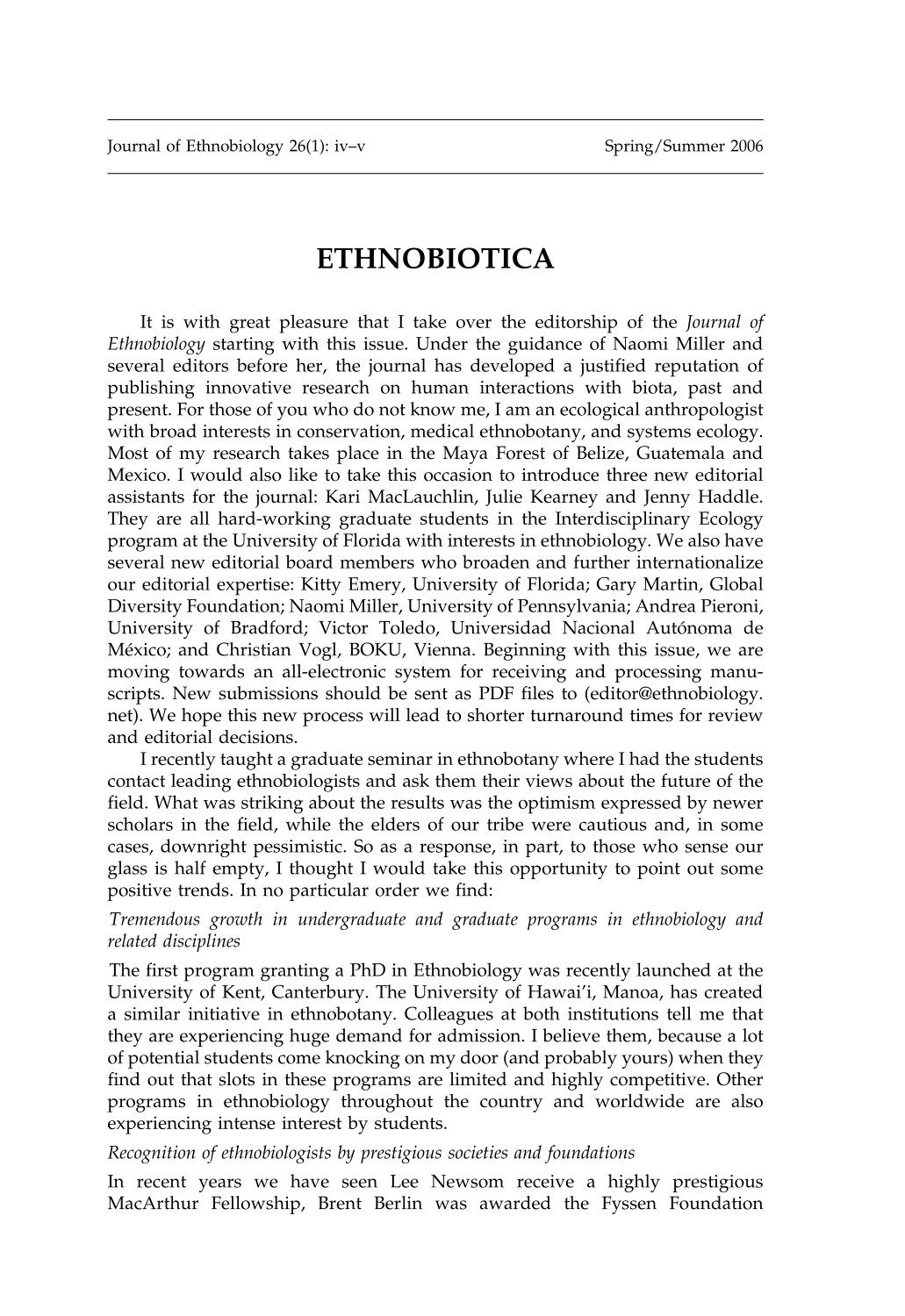
It is with great pleasure that I take over the editorship of the Journal of Ethnobiology starting with this issue. Under the guidance of Naomi Miller and several editors before her, the journal has developed a justified reputation of publishing innovative research on human interactions with biota, past and present. For those of you who do not know me, I am an ecological anthropologist with broad interests in conservation, medical ethnobotany, and systems ecology. Most of my research takes place in the Maya Forest of Belize, Guatemala and Mexico. I would also like to take this occasion to introduce three new editorial assistants for the journal: Kari MacLauchlin, Julie Kearney and Jenny Haddle. They are all hard-working graduate students in the Interdisciplinary Ecology program at the University of Florida with interests in ethnobiology. We also have several new editorial board members who broaden and further internationalize our editorial expertise: Kitty Emery, University of Florida; Gary Martin, Global Diversity Foundation; Naomi Miller, University of Pennsylvania; Andrea Pieroni, University of Bradford; Victor Toledo, Universidad Nacional Autónoma de México; and Christian Vogl, BOKU, Vienna. Beginning with this issue, we are moving towards an all-electronic system for receiving and processing manuscripts. New submissions should be sent as PDF files to (
I recently taught a graduate seminar in ethnobotany where I had the students contact leading ethnobiologists and ask them their views about the future of the field. What was striking about the results was the optimism expressed by newer scholars in the field, while the elders of our tribe were cautious and, in some cases, downright pessimistic. So as a response, in part, to those who sense our glass is half empty, I thought I would take this opportunity to point out some positive trends. In no particular order we find:
Tremendous growth in undergraduate and graduate programs in ethnobiology and related disciplines
The first program granting a PhD in Ethnobiology was recently launched at the University of Kent, Canterbury. The University of Hawai'i, Manoa, has created a similar initiative in ethnobotany. Colleagues at both institutions tell me that they are experiencing huge demand for admission. I believe them, because a lot of potential students come knocking on my door (and probably yours) when they find out that slots in these programs are limited and highly competitive. Other programs in ethnobiology throughout the country and worldwide are also experiencing intense interest by students.
Recognition of ethnobiologists by prestigious societies and foundations
In recent years we have seen Lee Newsom receive a highly prestigious MacArthur Fellowship, Brent Berlin was awarded the Fyssen Foundation International Prize and most recently, Elizabeth Wing was inducted into the National Academy of Sciences. I am sure that there are many more accolades presented to our membership of which I am unaware. In future columns I would like to note these, so please let me know.
New journals in ethnobiology and related disciplines
In the last two years, at least two new journals have emerged: Journal of Ethnobiology and Ethnomedicine and Ethnobotany Research and Applications. Meanwhile, under the leadership of Dan Moerman, the venerable journal Economic Botany is as strong as ever and publishing exciting and theoretically important work. Other journals, too numerous to list, have gotten on the bandwagon and either sponsored special issues relevant to ethnobiology or have increased the number of articles published with ethnobiological themes. While there may be some concerns about the possibility that the Journal of Ethnobiology's impact will be diluted, I would like to think this represents an organic process of growth in the field that will only lead to increased visibility and better research down the road.
There is a sign hanging in the lab of Brent Berlin at the University of Georgia that reads “Ethnobiology Lives!” While originally commissioned upon the eve of Brent's move from the University of California, Berkeley to UGA, the sign has been a beacon for many ethnobiologists who have passed through his lab ever since. We would all do well to take this message to heart. It is an exciting time to be editor of the Journal of Ethnobiology and I look forward to receiving your manuscripts and learning about your research.