







Abstract
We report on the recovery of sunflower head (disk) remains and associated achenes (Helianthus annuus L.) from Mammoth Cave, Kentucky, U.S.A. These remains were directly dated to 2560 ± 40 BP (810-540 cal BC) and indicate the use of weed sunflower before obvious signs of domestication. Although sunflower achenes are more commonly found at archaeological sites, sunflower head remains have been reported previously at only four other rock shelter sites in North America (Dick 1965; Heiser 1978; Smith 1950; Yarnell 1978; Young 1910). The various uses of sunflower in rock shelter and cave contexts are discussed.
Introduction
Sunflower (Helianthus annuus L.) is one of the most important crops produced for oil in the world and is a common ornamental (Putt 1997). Its domestication process and prehistoric uses continue to be issues of strong interest. Until recently, sunflower was thought to have been one of the few plants originally domesticated in eastern North America, probably for its achene and seed use as food (Heiser 1951, 1978, 1985; Yarnell 1978). Although the location of its original domestication was brought under question based on the recovery of sunflower remains dating to the 3rd millennium BC from Mexico (Lentz et al. 2001), recent genetic and morphological evidence now point to a single domestication event in eastern North America (Harter et al. 2004; Rieseberg and Harter 2006; Smith 2006; see also Wills and Burke 2006). Its usefulness for purposes other than just for food is also being more fully explored based on the recent sunflower head remains recovered from Mammoth Cave in west-central Kentucky (Figure 1).
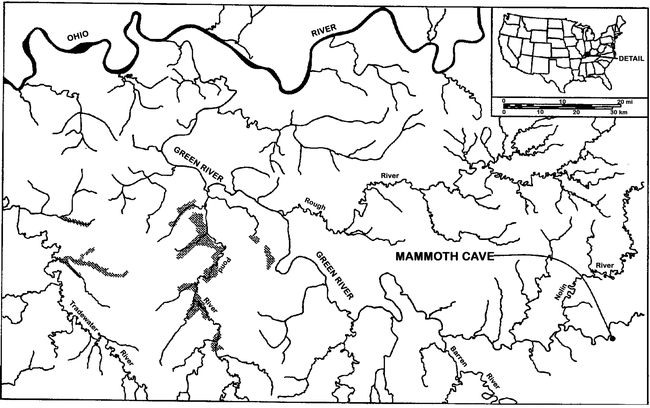
Location of Mammoth Cave, west-central Kentucky, U.S.A (prepared by George M. Crothers).
In determining the status of domestication of sunflower remains, the length of the achene is commonly utilized to differentiate between wild versus domesticated specimens. The achene is defined as a dry, indehiscent, one-seeded fruit with the seed remaining free from the ovary wall (Jones and Luchsinger 1986; Montgomery 1977). Achene length of less than 7 mm has been accepted to indicate wild or weedy sunflower, while achene lengths over this threshold are taken to be indicative of domesticated sunflowers (Fritz 1997; Gremillion 1994; Heiser 1978, 1985; Lentz et al. 2001; Simon 2000; Smith 1992; Smith and Cowan 2003; Yarnell 1993). An achene size index (the product of length x width) of less than 23 is also argued to be from undomesticated sunflower (Lentz et al. 2001:371; Yarnell 1978:296).
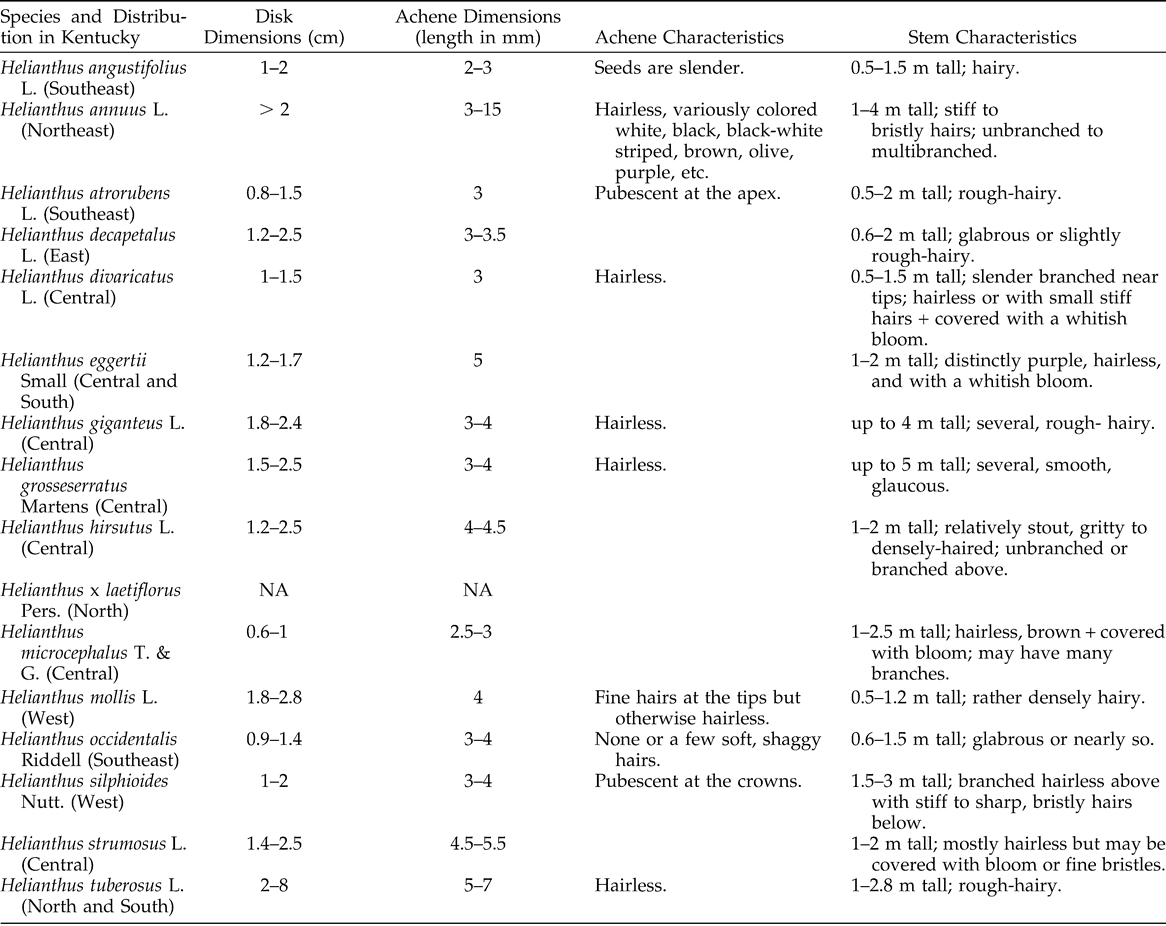
The size of the disk may also be used to differentiate weedy and domesticated sunflower (varieties of Helianthus annuus) from wild sunflower types (Table 1) (Heiser 1978; Meijer 1972; Rogers et al. 1982). However, the point at which disk diameter in weedy but undomesticated sunflower (Helianthus annuus subsp. annuus) can be differentiated from that of domesticated sunflower (Helianthus annuus var. macrocarpus) has yet to be determined as overlap does occur. Disks over 5 cm in diameter are generally accepted to represent domesticated sunflower (Heiser 1978; Rogers et al. 1982). Without other diagnostic attributes that often do not remain in archaeological specimens, identification of a domesticated form based on disk diameter alone is difficult. Therefore, length of recovered achenes is often used to determine the domesticated status of a specimen.
Sunflower species distribution in Kentucky and characteristics of disk (head) and achene dimensions from Heiser 1978 and Rogers et al. 1982.
Archaeological Sites with Early Sunflower Achene and Seed Remains
Early sunflower achene and seed remains from North America occur at the Hayes Site in Tennessee (Crites 1993), the Napoleon Hollow Site in Illinois (Ash and Ash 1985), the Marble Bluff Site in northern Arkansas (Fritz 1997), and the Higgs Site in eastern Tennessee (Brewer 1973). Other sites with Terminal Archaic/Early Woodland achene remains also occur in Kentucky (Table 2). The Hayes Site dates from 3023-2666 cal BC and yielded six carbonized seeds with average achene length estimated at 6.9 mm, which falls within the range of wild populations, though adjusted original achene size estimated for three of the seeds was over 7 mm (Crites 1993; Lentz et al. 2001; see Yarnell 1978:296 for correction factors). The Napoleon Hollow Site dates to 2834-2074 cal BC and yielded an estimated sunflower achene length of 6.1 mm, also representing wild sunflowers. The Marble Bluff Site dates to 1264-912 cal BC and yielded adjusted mean achene lengths ranging from 8.8 and 8.9 to 9.3 mm (on 13 achenes, 19 achenes, and 24 kernels, respectively), within the range of domesticated sunflower. The Higgs Site, dated to 1259-829 cal BC, also yielded 24 seeds with mean lengths of 5.9 mm (the largest measuring 7.5 mm in length) and a possible achene measuring 9.1 mm in length (Brewer 1973). Estimated achene length of the remains from this site was 7.8 mm, representing domesticated sunflower (Lentz et al. 2001; Yarnell 1978).
Macrobotanical remains of sunflower from Central and North America.

Other sites with dates in the 3rd millennium BC also occur in Central America (Table 2). These sites include remains (the earliest identified as Helianthus annuus var. lenticularis) recovered in coprolites from two caves in Ocampo, Tamaulipas, Mexico (Callen 1969), dated to 2900-2200 cal BC (Lentz et al. 2001). These remains were reported to be wild but size measurements were not given. Recent discoveries of sunflower achene and seed remains have also been reported for the San Andres Site in Tabasco, Mexico, although these identifications have been questioned due to a lack of published documentation on taxonomically diagnostic morphology (see Smith 2006). These remains date to 2875-2575 cal BC (seed measuring 7.8 mm in length) and 2867-2482 cal BC (achene measuring 8.2 mm in length) (Lentz et al. 2001).
Archaeological Sites with Early Sunflower Head Remains
As indicated, the majority of the sunflower remains recovered from archaeological sites have been of achenes or seeds. The recovery of complete or fragmented sunflower heads is somewhat rarer with reports of such recoveries being only found in rock shelter or cave contexts. Sunflower heads have been reported from Bat Cave in New Mexico (Dick 1965; Smith 1950), the Ozark Bluff Dweller Site in Arkansas (Heiser 1978), and the Newt Kash Hollow Site in eastern Kentucky (Heiser 1978; Yarnell 1978). At least one sunflower head is also reported from Salts Cave, located within Mammoth Cave National Park, central Kentucky, and approximately three miles from Mammoth Cave (Young 1910). Young (1910) states that a withered sunflower head in a state of good preservation was recovered during his visit to the cave. In addition, Young (1910) reports that part of a sunflower stalk measuring 2.5 ft (0.76 m) was also identified. Dates for the sunflower head remains from these sites are either unknown or are approximate estimations based on stratigraphy.
Specimens from Bat Cave are indicated to have come from all levels of the excavation with the earliest dates given at 3981 ± 310 BC (Smith 1950). Sunflower heads recovered from Bat Cave are 2.5 to 3.5 cm in diameter and were from wild plants. The date of the sunflower heads from the Ozark Bluff Dweller Site are unknown; the specimens from Newt Kash Hollow Site are estimated to date to the 1st millennium BC (Heiser 1978). Two sunflower heads from the Ozark Bluff Dweller Site were indicated to be 17 cm in diameter indicating domesticated specimens. Those remains recovered from Newt Kash Hollow Site consist of one head with a diameter of 7.5 cm, two heads with diameters of 5.0 cm, and two heads with diameters of 2.8 and 1.5 cm. These remains were interpreted by Heiser (1978) to indicate a sunflower population that was intermediate between wild and domesticated forms. The dimensions for the sunflower head noted by Young (1910) in Salts Cave were unreported and the date of this specimen is unknown.
Sunflower Head Remains from Mammoth Cave
The sunflower heads recovered from Mammoth Cave (Figures 2 and 3) include fragments of more than one head based on field descriptions. The sunflower remains were recovered from Test Unit B2, Stratum II at Giant's Coffin, located 732 meters from Mammoth Cave's historic entrance. The sunflower remains were found below the modern trail surface in good context at a depth of 58 cm and were found in association with abundant fragments of wood charcoal and torch fragments (Trader et al. 2004). The largest fragments of disks measure: 4.3 × 4.6 × 1.0 cm; 2.6 × 3.8 × 1.0 cm; and 2.7 × 4.15 × 1.1 cm, but these measurements do not represent estimated complete sizes of the heads. Disk size rules out an identification of wild forms of sunflower that have disks of less than 2 cm in diameter. Disk size instead falls into the weed (3 to 5 cm in diameter) or cultivated sunflower type of Helianthus annuus subsp. annuus. If original disk sizes were larger than 5 cm, the remains may represent the domesticated sunflower type Helianthus annuus var. macrocarpus.

Sunflower head fragments recovered from Mammoth Cave, Kentucky, dated by AMS to 2560 ± 40 BP (810-540 cal BC)

Achenes from sunflower head fragments recovered from Mammoth Cave, Kentucky
However, this identification is unlikely based on the sizes of four recovered achenes. The four achenes measure: 5.76 × 3.69 × 2.30 mm; 6.50 × 3.28 × 2.15 mm; 5.75 × 3.36 × 1.85 mm; and 6.20 × 2.70 × 2.06 mm (L × W × TH). The size index (L × W) of the achenes recovered from the sunflower heads are 21.25, 21.32, 19.32, and 16.74, respectively. The achene lengths and size indexes are indicative of undomesticated sunflowers, although variations in size do occur. The exact reason for this variation is unclear but may be related to differences in the size of the disks from which the achenes were dislodged. On the other hand, morphological variations of achene sizes located in different positions on a single sunflower disc may also have occurred.
The achenes (n = 4) are longitudinally striate, pubescent, and reddish in color turning to black at the apex. A beak at the base of the achene is noted on three of the four specimens. Such beaks are hypothesized by Heiser (1978) to represent a trait found in early domesticated sunflower, which was replaced later by unbeaked types except in Mexico. A beak is also not found on wild species of Helianthus. The single specimen lacking the beak has white and red coloration on the achene. The achene sizes indicate a wild or weedy form, being closest to the ruderal or weedy sunflower achene length that typically ranges from 4.0 to 7.0 mm. The achene length of all of these remains indicates that the population was most likely in an early, but not initial, stage of domestication. These remains, therefore, probably represent a weedy or transitional type (Helianthus annuus subsp. annuus) between wild sunflower and the larger single-headed domesticate (Helianthus annuus var. macrocarpus) (Heiser 1978; Yarnell 1978). The species of Helianthus annuus currently does not occur in the vicinity of Mammoth Cave National Park, apparently due to relatively recent total canopy cover forest management practices in the area (Randy Seymour, author of Wildflowers of Mammoth Cave National Park (1997), personal communication 2005), although under indigenous practices of clearing and burning it would have done well.
A portion of a sunflower head fragment from Mammoth Cave yielded an AMS date of 2560 ± 40 BP (810-540 cal BC) (Beta-183579; calibrated using Calib ver. 5.0; Stuiver and Reimer 1993), placing this specimen within the early portion of the Early Woodland period in eastern North America. Cane charcoal fragments recovered from the same context as the sunflower remains yielded a radiocarbon date of 2460 ± 60 BP (770-410 cal BC) (Beta-183328). A similar date of 2660 ± 140 BP (1190-410 cal BC) was recovered from human paleofecal specimens recovered from Salts Cave, containing sunflower remains (Kennedy 1996; Watson 1969), supporting the use of sunflower at this time. Yarnell (1997) suggested that domestication of indigenous plants (i.e., sunflower) was well established by the second millennium BC. Gardner (1987) suggests that an emphasis on garden crops was not common during the Late Archaic period. Rather, cultivation of weedy annuals, such as sunflowers, was firmly established by the mid-first millennium BC. According to Smith (1992, also see 2006 for information on other eastern North American domesticates), the transition of wild to domesticated sunflower occurred between 1550 and 1450 BC, well before these dated remains. The remains from Mammoth Cave suggest that weedy sunflowers continued to be used in this area in the early first millennium BC after the domestication process had occurred.
Discussion
The midlatitude Eastern Woodlands of North America have been identified as one of the centers for the initial domestication of indigenous seed plants (Smith 1992, 2006; Smith and Cowan 2003). Four of these plants exhibit morphological changes related to domestication and include squash (Curcurbita pepo subsp. ovifera), chenopod (Chenopodium berlandieri var. jonesianum), marshelder (Iva annua var. macrocarpa), and sunflower (Helianthus annuus var. macrocarpa). Wild populations of the first three species still occur along floodplain settings in the East (Smith and Cowan 2003). Heiser (1951) also hypothesized that sunflower (Helianthus annuus) domestication occurred in the east-central United States. Current archaeological and genetic evidence for the early domestication of sunflower in eastern North America supports this hypothesis (Brewer 1973; Crites 1993; Harter et al. 2004; Rieseberg and Harter 2006; Smith 2006).
Many of the earliest sunflower remains, as noted above, also come from upland and cave/rock shelter settings as opposed to riverine settlements. Why is this? The reason for the domestication of sunflower has been indicated to be for the use of the seed and achene for food. Corroboration of a use as food has been recovered through the identification of sunflower achenes in human paleofecal specimens recovered from both Mammoth Cave and Salts Cave (Gremillion and Sobolik 1996). According to Yarnell (1969), sunflower was probably stored for use in the winter and spring for food. However, sunflower stalk has also been recovered from Salts Cave (Young 1910) and this may have been utilized as torch or lighting material. Torch remains are commonly recovered from cave and rock shelter sites and botanical identifications to date include that of cane (Arundinaria sp.), goldenrod (Solidago sp.), and false foxglove (Gerardia sp.) (Watson 1969, 1997a:63, 1997b:186). However, the vast majority of scattered torch material noted throughout numerous of the passages of Salts and Mammoth Caves remains to be identified (see Watson 1997a, 1997b).
Interestingly, ethnobotanical sources for indigenous groups from the Southwest of the United States do record uses of sunflower stalk for lighting material (Moerman 2000) and two landraces from the desert Southwest, the Hopi and Havasupai, appear to represent the most primitive of the extant domesticates (Harter et al. 2004; Wills and Burke 2006). The ethnobotanical sources include the Pima, who use the inner pulp of dried stalks of sunflower, broken into pieces and strung on a string, to make candles that burn down quickly (Curtin 1949). Among the Isleta the pith is used to light ceremonial cigarettes (Jones 1931); similarly, the Tewa Indians of the American Southwest utilize the dried stalks of sunflower to make fire sticks that can be used to light cigarettes (Robbins et al. 1916). It is probable that such uses occurred in the prehistoric past, as well. Future archaeological work in rock shelter and cave deposits is expected to address this issue more explicitly.
Though potentially a novel idea, the use of the stalks of plants like sunflower growing in the vicinity of rock shelter environments is not unexpected. Previously, Watson (1997c:222) noted that prehistoric Native Americans used weed stalk torches for light when no nearby cane stands occurred. The early use of plant parts other than seeds by humans has also previously been noted for important economic domesticates (Bonzani 2002; Iltis 2000; Scarry 2003; Smalley and Blake 2003;Yarnell and Black 1985).
Conclusions
The head remains of sunflower (Helianthus annuus) from Mammoth Cave, Kentucky, are an important discovery, because such remains having only been reported previously at four other rock shelter and cave sites in North America. These remains were directly dated to 2560 ± 40 BP (810-540 cal BC) and indicate the use of weed sunflower without obvious signs of domestication (achene size over 7 mm, large monocephalic head) (Heiser 1978; Yarnell 1978). Given their context of recovery (rock shelters and caves) and ethnobotanical evidence of stalk use for lighting material, archaeological remains of sunflower heads and stalks may represent various uses that were occurring in the past. Sunflower achene and seed use for food did occur early in these rock shelter settings. However, it is hoped that this paper instigates further investigation into alternative early uses of present day economically important plants such as sunflower.
Footnotes
Acknowledgments
The authors would like to thank Daniel Moerman, Bruce Smith, Maria Teresa Pulido, Henry Holman, Randy Seymour, and other anonymous reviewers for assistance and comments on the paper. Thanks also are extended to Ana Maria Boada, Sonia Uruburu and Juan José Vieco for translations of the abstract.