







Abstract
During the last several centuries, the high granite mesas in eastern Portugal south of the Douro river have been a major rye growing region. About half the rye produced was carried away to feed urban populations. The loss from the village agro-ecosystem of the nitrogen in the rye grain was replaced because farmers used giesta (Cytisus, Fabaceae), a nitrogen fixer, to make the compost with which they fertilized their crops. Farmers used to keep about 20 sheep for every hectare they cultivated. These sheep produced very few lambs, could be milked only briefly, produced low quality wool, and were not eaten. Farmers kept so many sheep to mix their excrement with giesta. Two experimental rye plots in the county of Trancoso, Beira Alta Portugal were grown with traditional technology except one had giesta plus sheep manure, and the other had only giesta, but enough extra to add the same amount of nitrogen. By the end of the growing season, rye in the plot with giesta plus manure was approximately twice as productive, and much of the giesta added without manure had not decomposed. The carbon/nitrogen ratio of mature giesta is near 30, which is too high for giesta alone to rot readily in the soil. Manure lowers the C/N ratio to near 20, which enables it to rot and release nutrients at the rate rye needs them.
Introduction
The county of Trancoso is on the granite mesas South of the Douro River in part of a larger region commonly called Beira Alta (high border). There, farmers usually kept five different kinds of useful vertebrate animals: cows for traction; pigs for meat; chickens for eggs and meat; sheep, whose real role is the subject of this report; and goats to give milk and to help herd the sheep, and once in a while a young male goat would be slaughtered for meat. A few of the wealthier farmers might also have a mare for personal transport. In terms of biomass, far and away the most abundant of these animals were the sheep. One pair of cows was sufficient to pull a plow or cart; typically one and rarely more than two pigs were sufficient to produce the family's meat; a couple dozen chickens and a half a dozen goats were adequate to their tasks. But farmers used to keep about 20 sheep for every hectare of soil they cultivated. On some farms this could amount to well over 100 sheep. The care and feeding of these sheep represented a significant fraction of resources invested by farmers. Figure 1 shows a small herd of sheep going up to pasture in Sebedelhe da Serra, Trancoso, Portugal.

A herd of sheep going to pasture in Sebedelhe da Serra, Trancoso, Portugal. (Photo by G.F. Estabrook 2003)
The breeds of sheep traditionally kept by farmers in Beira Alta have been selected to survive on relatively little pasturage of low quality. Because they were not fed very well, they produced small amounts of wool, very few lambs, and could be milked only briefly after weaning a lamb. Sheep's milk was highly valued to make cheese retted by the thistle Carduus, and enjoyed in the villages as a special treat, if only for a few weeks each year.
In traditional Beira Alta farming villages, sheep usually produce a lamb in the second or third fall of their life, and another in the fourth or fifth fall. Most males were gelded at sexual maturity. At approximately age seven, sheep were walked to the market in the closest county seat and sold to provide meat and skins to urban populations. Although this income was welcome, it was a fraction of the cash value of rye. Older residents of rural Beira Alta tell me that in their village during their childhood, sheep or lambs were never slaughtered and eaten; pig and chicken were their only sources of meat.
All of this raises the question why farmers invest so much effort to keep so many sheep when they do not seem to be worth very much. This paper reports the results of an experimental test of the hypothesis that in this traditional agricultural system, sheep have played an essential part in the maintenance of nitrogen soil fertility.
Geographic, Historical and Ethnographic Setting
In Beira Alta Portugal, crops have been produced using basically the same technology for at least 800 years (Raposo 1994), even though the New World crops, corn and potato, joined the rotations in the mid 17th century, and the land reforms of the early 19th century increased the number of resident owners (Oliveira 1980). A 19th century account of agricultural technology in Beira Alta is given by Almeida (1882). Two or more generations have passed since the advent of agricultural technology based on large inputs of fossil-fuel energy in America and Europe, where few people alive now have even witnessed the practice of traditional agricultural technology. However, during the middle half of the 20th century, Portugal was ruled by a dictator who did little to develop its interior (Bruce, 1975). During the last quarter of the 20th century, traditional agriculture was still practiced, although by fewer and fewer people, in the mountainous interior of Portugal. As a consequence of the economic decline of this region, younger people moved away and unchecked fires destroyed much of the forest cover (Damaso 1992). Most of the older people who remained simply retired from agriculture instead of replacing traditional technology with modern. Thus, much of the land and equipment, although no longer in use, has been left as it was, and many people still remember the technology. For these reasons the mountainous interior of Portugal has been a good place to study traditional agriculture.
Over the past two decades, I have studied the traditional agriculture of the mountainous interior of Portugal, South of the Douro and North of the Tejo Rivers. I lived there for several weeks in each of 1984, 1991 and 1993, for 5 months in 1987, and for the entire academic years of 1996/7, and 2002/3. During those times, I have talked with life-long residents (now mostly in their 60's, 70's or 80's) and observed their practices. In addition to consulting primary and secondary historical sources, and other published work, I have also sampled plant and animal material, as well as soil, to measure quantitatively the effectiveness of traditional practices. Some of these results are reported in Estabrook (1998).
The practices described here are based on the informative collaboration of four farmers in the parish of Sebedelhe da Serra, and three farmers in the parish of Aldeia Nova. Of these seven, five are still growing crops by traditional methods and the other two are retired but still in residence in Aldeia Nova. Both parishes are in the county of Trancoso, as shown in Figure 2.

Map of Trancoso, Portugal, and vicinity. (Drawn by Vaike Haas 2002)
During the last several centuries and continuing until the last quarter of the 20th century, Beira Alta has been a major commercial rye-growing region. Until mid twentieth century, many of the villages in this area were accessible only by footpaths. Residents practiced mostly subsistence agriculture. However, as much as 50% of the rye produced was sold to feed urban populations in county seats, such as Trancoso, or district capitals, such as Viseu. Those who bought rye from village farmers carried it away on the backs of mules because the paths between villages were too narrow or too rough for carts. In the proteins of this grain, nitrogen (and other plant nutrients) was also carried out of the village agro-ecosystem. Because this traditional agriculture has been sustained for centuries, this lost nitrogen must have been replaced. Farmers have traditionally used giesta (Cytisus), a nitrogen fixer, to make the compost with which they fertilized their cultivated crops. Giesta branches are cut, hauled to the village, and spread on the ground where domestic animals are housed. There it is mixed with animal excrement. About once a week this mixture is removed, placed in a pile, and eventually carried to the cultivated fields where, to maintain soil fertility, it is plowed into the ground before rye (or other crops) are planted. Estabrook (2006) reports quantitative measurements that demonstrate the importance of giesta in this tradition, and show that the nitrogen fixed from the atmosphere by giesta is more than sufficient to replace the nitrogen losses from the export of grain, leaching, denitrification, and the evaporation of ammonia. But culture (not scientific understandings of, for example, nitrogen fixation, soil micro biology or C/N ratios) has informed the technology of this tradition that fertilizing soil with giesta alone will not work.
Experimental Methods and Results
Following the rye harvest in May, at night farmers enclose sheep in portable corrals placed in the mown rye fields so that sheep excrement will go directly onto the soil. They move these corrals systematically over their rye fields during the next three warm months to distribute this benefit evenly. Before the fields are plowed in the early fall, sheep are housed at night again in the permanent roofed stone structures built for that purpose. Farmers spread giesta on the floors of these structures where it becomes mixed with sheep excrement. This mixture, called estrume, is removed periodically (typically weekly) and stored in piles until it is buried in the soil, at the rate of about 10 metric tons dry weight per hectare, before sowing rye (or planting other crops). To quantitatively measure the importance of the contribution of the sheep to the effectiveness of giesta in enhancing soil fertility, I constructed two experimental plots on 25 September 2002, the time of year when farmers prepare to plant rye. To the soil of one I added estrume in the traditional manner, and to the soil of the other I added just giesta, but in sufficient quantity to contain the same amount of nitrogen as was in the estrume. Both plots were sown in rye. I made these experimental plots in Quinta da Pisao, parish of Aldea Nova, county of Trancoso, Portugal, on land loaned to me for that purpose by Antonio Fonseca, a retired farmer. Antonio had last grown rye on that land about 10 years ago, and it had been uncultivated since. Also farming and raising sheep in Quinta da Pisao was Manuel Andrade. With his help, I was able to demonstrate experimentally and quantitatively the importance of mixing a high nitrogen source, such as sheep provide, with giesta before burying it in the soil to fertilize rye. He gave me some of his estrume and some of his rye seed that he saved from his previous harvest to plant again this season (as did his ancestors before him). He also advised me about how much estrume to use, how to mix it into the soil, how densely to sow the rye seed, and how to cover it. His supplies and his advice helped to ensure the authenticity of the experiment.
In an area about 3 m by 2 m, I removed several giesta plants and dug the soil to a depth of about 1/2 m, also removing copious roots of nearby pine trees, to make two plots side by side, each about 2 m by 1 1/2 m. Before returning the soil to the plots, I placed in the center of each plot at a depth of about 1/2 m, a plastic pan 16 cm by 35 cm and 10 cm high. In one corner of each pan, one end of a short length of plastic tubing was glued into a hole 2 cm in diameter; the other end of the tube was inserted into a length of hose that ran into a 20 L plastic container. These two containers were placed at the bottom of a hole about a meter deep at the edge of the plots, where their contents could be removed and measured periodically to determine how much water had leached past the roots of the growing rye to replenish the ground water. The design of the experimental plots is shown in Figure 3.

Design of experimental plots. Soil in the plot marked E was fertilized with giesta composted with sheep excrement. Soil in plot marked G was fertilized with giesta alone. (Drawn by Tao Zhang 2007)
Nitrogen content of Manuel Andrade's estrume and nearby giesta were determined from samples dried and homogenized in the plant physiology lab of the Department of Botany of the University of Coimbra, Portugal, and analyzed by mass spectrometry at the Stable Isotope Laboratory of Faculty of Sciences of the University of Lisboa, Portugal. Estrume is about 3.2% dry weight nitrogen and giesta is about 2.0% dry weight nitrogen. Thus, to one 3 square meter plot I should add 3.0 kg dry weight of estrume, and to the other I should add 4.8 kg dry weight of giesta. The dry weight of each is about 40% of its wet weight, so I added 7.5 kg estrume to one plot and 12.0 kg giesta to the other.
A rain gauge, consisting of a plastic tube with a circular opening 8.5 cm in diameter (about 57 cm2) and 60 cm long was buried upright about 40 cm into the soil near the experimental plots. After rainwater was captured, it passed through a constriction about 2 cm in diameter 20 cm below the opening before reaching the closed bottom of the tube. Both this restriction and burial in the cooler soil reduced evaporative loss from the rain gauge. Every time the leach containers were emptied and their water measured and sampled, the same was done for the rain gauge. Nitrogen levels in water samples were measured with a gas chromatograph at the Laboratory for Agricultural Chemistry of the Portuguese Ministry of Agriculture in Lisboa.
On 23 Oct 2002, early in the growing season, I removed the rye plants and roots from a square area 10 cm on a side in each plot. There were 33 plants in each sample. For each plant, I measured maximum root and stem length, and counted the number of leaves, and number of shoots. Values, followed by standard deviations in parentheses, for plants from the plot with estrume are given before those for plants from the plot with only giesta: average maximum stem height 27.3 cm (7.4), 17.3 cm (4.1); average maximum root length 9.1 cm (2.2), 8.1 cm (2.4); average number of leaves 3.9 (1.2), 2.4 (0.5); and average number of stems 1.3 (0.5), 1.0 (0.0).
On 25 April 2003 when the rye culms had bolted and seed heads had formed, I removed plants from a square area 30 cm on a side in each plot. There were 62 plants in the sample from the plot with estrume and 72 plants in the sample from the plot with only giesta. For each plant I measured maximum height of stems and counted the number of stems. The mass of roots was so intertwined that I did not attempt to identify which roots belonged to which plants. Values, followed by standard deviations in parentheses, for plants from the plot with estrume are given before those for plants from the plot with only giesta: average maximum stem height 97.5 cm (28.0), 83.2 (20.0); average number of stems 1.4 (0.9), 1.2 (0.4); and total number of stems (87, 86).
I separated vegetation into roots, stems and inflorescences, and took them to the plant physiology lab in the Botany Department of the University of Coimbra to determine total dry weight. Values for plants from the plot with estrume are given before those for plants from the plot with only giesta: roots 16.3 g, 6.3 g; stems 53.3 g, 26.7 g; and inflorescences 6.8 g, 3.3 g.
Samples of inflorescences were also sent to the stable isotope laboratory of the Faculty of Sciences at the University of Lisbon where percent dry weight of total nitrogen was measured: inflorescences from the estrume plot had 2.9% nitrogen, those from only giesta had 2.5% nitrogen. Thus inflorescences from plants in 900 cm2 in the estrume plot accumulated almost 0.2 g nitrogen, while those from plants in the same area in the plot with giesta only accumulated just over 0.08 g nitrogen.
Although not significant early in the growing season, the trends in these measures indicate that plants growing with estrume may already be doing better than those growing with giesta alone. By near the end of the season, differences in plant size are more pronounced, but it is the direct measures of productivity (accumulated dry weight per area) that clearly show the difference. Plants grown with estrume produce nearly three times as much root, twice as much stem, and twice as much inflorescence that accumulates tree times as much nitrogen.
On 25 April 2003, also the soil and contents to a depth of 30 cm were removed from the two square areas 30 cm on a side, and separated using a screen with a mesh opening 0.5 cm by 0.5 cm. What did not pass through the screen was placed in a pan of water to separate sticks from larger stones. The sticks were dried and weighed. Before planting rye, an average of about 90 g dry weight of estrume or 145 g dry weight of giesta were added to the soil of each sampled area. Of the approximately 90 g of estrume initially placed in the sampled area about 18 g remained; of the approximately 145 g of giesta originally placed in the sampled area about 120 g remained. Figure 4 (a & b) shows these areas after the removal of rye plants but before excavating soil and sticks.
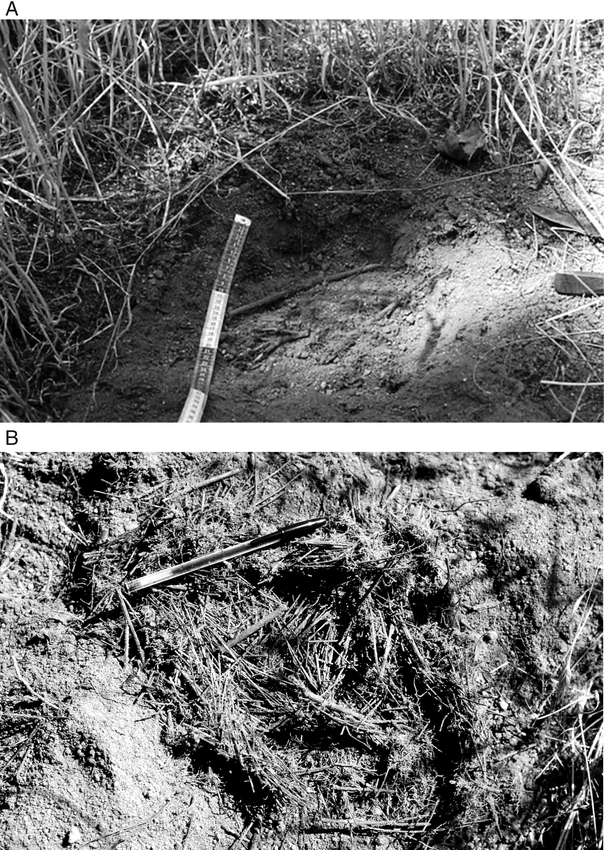
Soil after removal of rye plants 25 April 2003. a. with sheep manure added, nearly all giesta branches have rotted; b. with giesta alone, most giesta branches have not rotted. (Photo by G.F. Estabrook 2003)
Water measurements are reported in Table 1. Technology to measure nitrogen concentration in water was precise only to 0.3 mg/L so all measurements are multiples of this, resulting in an accuracy below the apparent precision. In calculating liters per square meter per day, 10 ml were added to the measured leach water to account for wetting the tubes that led the water from the catch pans to the jugs that held it until it could be measured.
Rain and leach water at the experimental plots showing dates of collection, days since last collection, amount of leach water caught in a pan with surface 560 cm2, and amount of rain water caught in a cylinder with surface 57 cm2; amount of water in L/(m2 × da) since last date of collection; amount of nitrogen in mg/L; and amount of nitrogen in mg/(m2 × da). — indicates that the sample was too small to analyze.
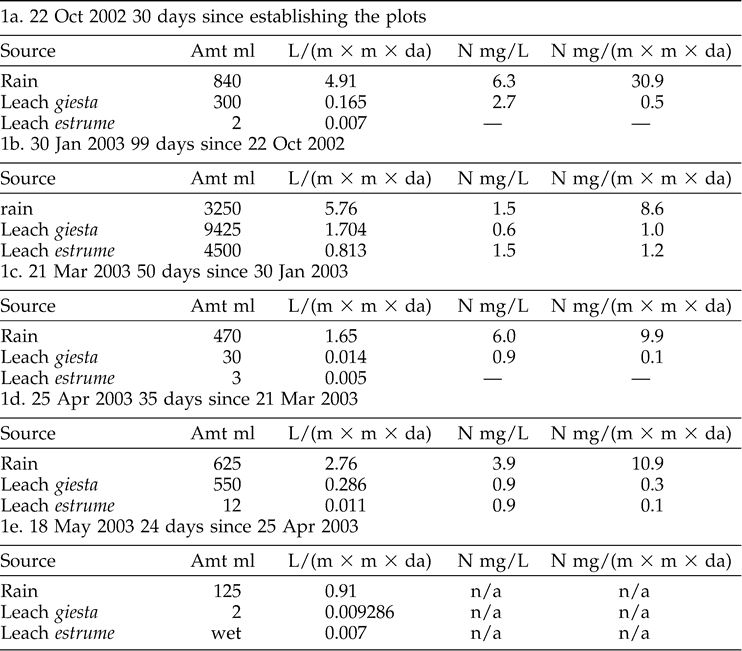
Only during the 99 day period of heaviest rain did substantial amounts of water leach past the roots of the rye growing in the plot with estrume. Compared with the rye plants growing in the plot with estrume, the rye plants in the plot with giesta allowed a substantially higher fraction of the water available to them to leach down to the pan below. Amount of nitrogen brought down in rainwater is highly variable, and depends on local activity, e.g., factory or car exhausts or fertilizer use. Concentrations in rain are higher at the beginning and the end of the rainy season. During the periods of greatest rain, nitrogen concentrations are diluted by the volume of rainfall. Even the highest values measured here (31 mg per square meter per day), were they to persist for the 100 days or so of the rainy season, would result in well below the 5 kg nitrogen per hectare per year typical of many places (Wild 1988). Very little nitrogen is being lost to leach water. Only once, after rainfall was heavy enough for a substantial quantity of water to leach past rye roots growing in the plots with estrume, could nitrogen levels in this water be compared with those in leach water collected from the plot with giesta only. With higher levels of soluble nitrogen in the soil with estrume, we might expect higher concentrations of nitrogen in the leach water, which we do see. However, more than twice as much water leached through the soil of the plot with giesta only, so the difference in concentration could be explained by dilution.
It seems clear that the main effect on water of the contribution of the sheep is to enable rye plants to grow at a rate at which they can take up more of the water available to them. Nitrogen losses that might be expected from the release of nitrates to the soil water are countered by the conspicuous reduction in the amount of water allowed to escape uptake by the rye plants growing in estrume enriched soil. In any case, nitrogen losses to leach water are minimal.
Discussion
For the past many hundreds of years, agricultural technology in Europe changed very little until the early 20th century, when technology that consumed large amounts of (fossil fuel) energy to break the stable bond of N2 to transform atmospheric nitrogen into ammonia and nitrate was developed. This technology soon came to be used to manufacture nitrogen fertilizer, the availability of which stimulated the development of new varieties of (especially) cereal crops that could use large quantities of soil nitrogen. Machinery and agro-chemicals to complement this high-energy fertilizer and the new crop varieties that respond to it soon followed. Wilson and Loomis (1992, p. 9) define the sustainability (of a particular agricultural technology in a particular place) as the continued existence of a farm enterprise (using that technology in that place). They point out realistically that profitability is an important factor in sustainability. By the third quarter of the 20th century, yields (profitability) of farm enterprises using the new technology had increased dramatically, but in many cases so had contamination and erosion of soil, and pollution of air, water and even the crop itself. This new technology will not remain sustainable when it depletes or contaminates the soil and water on which it depends, so that yields fall, or the costs of inputs increase, to the point that profitability is lost. By late 20th century many agronomists had become aware of the need to address this situation. A more ecological approach to agricultural research was initiated in which sustainability was included explicitly as an objective (Altieri 1987; Gliessman 1990; Loomis and Conner 1992). Some researchers became aware that traditional agrarian communities contain valuable ecological knowledge (Hunn 1999), which is often expressed in cultural rather than scientific terms (Estabrook 1994). The study of a traditional, solar-energy based technology that has been practiced sustainably for hundreds of years in the same place may help us access and preserve traditional ecological knowledge and cultural diversity (Hunn 2001), and provide understandings of the natural world that may contribute to the development of healthier and more sustainable modern agricultural technology.
Today, agricultural science can explain why animal manure is so important in an agricultural technology that uses large (10 metric tons per hectare) quantities of woody plant stems as a primary source of fertilizer. The primary productivity and nitrogen fixation rates of giesta in Beira Alta have probably been sufficiently high to replace the nitrogen lost to the agro-ecosystem; about two percent of the dry weight of giesta is nitrogen (Estabrook, 2006). However, the carbon to nitrogen (C/N) ration of giesta is typically near 30, which is too high to foster large populations of the soil microbes that rot plant material quickly. Sheep seem to be kept primarily for their high nitrogen excrement to mix with giesta to lower the C/N ratio of the compost to nearer 20. This stimulates large populations of soil microbes that rot giesta and release its nutrients at the rate rye needs to take them up to grow productively. The effects of C/N ratio on soil organic matter decomposition rates have been known for decades (Buckman and Brady 1969), and Harris (1988) explains in more detail the relationship between C/N ratio and the availability of soil nitrogen to growing plants. More recently, the relevance of C/N in restoration ecology (Vinton and Goergen 2006) and sustainable agriculture (Magdoff and Es 2000) has become more widely appreciated.
Now in Beira Alta, very little rye is grown by traditional technology to produce cereal grain commercially; most of what is grown is produced using chemical fertilizers and gasoline-powered tractors. The preference for construing sheep as an unquestioned part of the farming tradition is evidenced by Martinho (1980), who reports data from the Portuguese Ministry of Economics on the numbers of sheep and goats at four census dates in counties where they were important. In Trancoso in 1940 he reports about 34,000, in 1955 about 20,500, in 1972 about 12,500, and in 1980 only about 8,600. Today there are certainly even fewer. Martinho (1980) attributes this steep decline to government reforestation programs and the exodus of agricultural workers and families. I believe that more likely it reflects first the advent of chemical fertilizer, which reduced the need for sheep in their real role, and later the inappropriateness of the shallow soils and mountainous terrain to commercial farming with tractors, which led to a decline in modern commercial farming and induced especially younger people to seek employment elsewhere.
A few farmers, such as Manuel Andrade, continue to grow rye traditionally. However, he does not sell rye grain commercially but now feeds rye plants directly to his sheep, as shown in Figure 5, allowing only enough rye to set seed for replanting the following year. His well-fed sheep continue to produce milk for a much longer time. From this milk his wife makes the highly prized traditional cheese, queijo da serra, which sells for over $20 a pound in international retail markets.

Sheep grazing in a winter rye field in Trancoso, Portugal. (Photo by G.F. Estabrook 2003)
The use of giesta and sheep described here has long been a part of the traditional technology in Beira Alta. Farmers recognize its role in restoring the fertility of their soil, but they do not describe and explain their activities in stewarding and collecting giesta and in herding sheep in relation to restoring soil fertility. Instead, they explain it in relation to caring for their cows and sheep (giesta is not placed in pig pens or chicken coops). Farmers' explanations construe estrume as a by-product of caring for cows and especially for sheep; they explain that they take advantage of this by-product by burying it in their cultivated soil, but they explain their management and harvesting of giesta as animal care. Their explanations most certainly do not evoke agro-ecological concepts, which only relatively recently have come to be well understood by agronomists and ecologists. These scientific explanations serve a scientific purpose. However, the preferred explanations of these traditional farmers not only celebrate their participation in the traditions of their community, but also help them remember the details and timing of their practice. Because this technology is informed by culture, its real purpose is placed outside the realm of the responsibility of its practitioners, eliminating the need for a boss or decision-maker to implement it, and protecting it from question during years when yields are low. These cultural explanations help to encode and inform traditional ecological knowledge (Estabrook 1994) for the benefit of its practitioners. Modern science, however, can also benefit when traditional knowledge is better understood as a result of using ecological concepts and technology to measure the consequences of traditional practice, and scientifically explaining its mechanisms.
Footnotes
Acknowledgments
Manuel Andrade of Aldeia Nova and Antonio Sovral Dias of Sebedelhe, both experienced farmers raised in the traditional agriculture of Trancoso, Portugal were valuable sources of information and help. Maria de Concecao Alexandre of Trancoso provided valuable logistic support. Professor Helena Freitas, Department of Botany, University of Coimbra, Portugal, made available laboratory space there for me to prepare specimens. Professor Jorge Paiva of the Botany Department of the University of Coimbra was a valuable source of encouragement and helped me with Portuguese language questions. I appreciate the welcome as invited professor extended to me by the Anthropology Department of the University of Coimbra. I thank Professor Cristina Maguas of the University of Lisboa Portugal who facilitated my use of the Mass Spectrometry Laboratory of the University of Lisbon, and Rodrigo Maia, her technician who performed the analysis of my samples. I admire the skill of artists Vaike Haas who drew the map of Figure 1, and Tao Zhang who drew the design of  . Pierre LeGendre, University of Montreal, Canada, translated the abstract into French, and Dr. A. Pedro Belchior, National Wine Experiment Station, Torres Vedras, Portugal, translated the abstract into Portuguese. I appreciate financial support from Fundacao Luso-Americano de Desenvolvimento, and the sabbatical leave program of the University of Michigan.