







Abstract
Looking at non-timber forest products is one of the ways that people are trying to find a balance between forest use and conservation. In areas designated as protected, around and in which people live, this balance is even more crucial. Such is the case in the Mache-Chindul Ecological Reserve in Ecuador. Conservationists, governments, and local activists are particularly concerned. This paper looks at how three different ethnic groups, mestizo, Afro-Ecuadorian, and the indigenous group, the Chachi, use a potentially sustainable resource, mocora, Astrocaryum standleyanum¸ (Arecaceae), for fiber, fruit and oil. This study explores the differences and similarities between each group's use and collection of this plant while exploring the current and potential market possibilities. The study shows that considerable differences do emerge in terms of each group's utilization of this plant resource, and at the same time, commercial opportunities can exist for all three.
Introduction
Three separate ethnic groups in the rainforest of northwestern Ecuador have access to forest resources to satisfy personal needs. The palm, mocora, Astrocaryum standleyanum L.H. Bailey (Arecaceae) 1 provides fruit, oil and especially fiber to all three groups. The three peoples have roughly the same degree of isolation and possess similar household needs, so one might expect that the uses of mocora would be the same among all three. This is not the case. What the three peoples do with the resources gathered from the palm differs significantly. In this study, the use of mocora by these three groups is examined, as well as the market potential for this non–timber forest product.
This study is significant not only culturally, and potentially economically, but also because of its geographical location. The Mache-Chindul Ecological Reserve in northwestern Ecuador encompasses forest considered to be in one of the hot spots of biodiversity, and with a high degree of endemism. (Dodson and Gentry 1991; Foster 1992; Gentry 1992; INEFAN 1996; Sierra 1999). This area is of particular importance not only because of its high numbers of distinct flora and fauna, but also because so little of the forest remains. Thus, protection of this area and sustainable resource use by its residents are goals of both development and conservation organizations working in the area. Because mocora can be collected in such a way that the plants continue to grow after harvested parts have been removed, in principle, this material can be used sustainably.
Mocora is used for basketry in Panama (Velásquez Runk 2001) and for numerous other articles in other parts of Ecuador (Acosta-Solís 1944, p. 52; Bernal 1992; Borgtoft Pedersen 1994; Bustos-Gómez 1994; Dahlgren 1944; Duke 1970; Forero Pinto 1980; Galeano and Bernal 1987; Henderson et al. 1995; Palacios Santa Maria 1993; Patiño 1977; Borgtoft Pedersen and Balslev 1992; Usma et al. 1996; Warner 1996). However, it is yet to be studied in the Mache-Chindul Ecological Reserve. Moreover, emphasis has not been placed on different ethnic uses, as it is in this study.
Study Area and Communities
The Mache-Chindul Ecological Reserve is located principally in the province of Esmeraldas with its southernmost part extending into the province of Manabí (Figure 1). Esmeraldas is a humid area (Foster 1992; Sierra 1999). Between 2,000 and 3,000 mm of precipitation fall in the region each year (Aguirre et al. 2000; Cañadas 1983; Gavilanes et al. 2000; INEFAN 1996, 1998; Winknell 1997). The forest type for most of this area is considered lowland rainforest, with lush vegetation. (Aguirre et al. 2000; Dodson and Gentry 1978; Faber-Langendoen and Gentry 1991; Gavilanes et al. 2000; Gentry 1992; INEFAN 1996; Neill 2006). The soils in western Ecuador on which these forests grow are mostly alluvial and volcanic (Dodson and Gentry 1991). Specifically, in the Mache-Chindul Ecological Reserve, the soils are in the order Alfisols, and the suborder udalfs (SECS 1986).
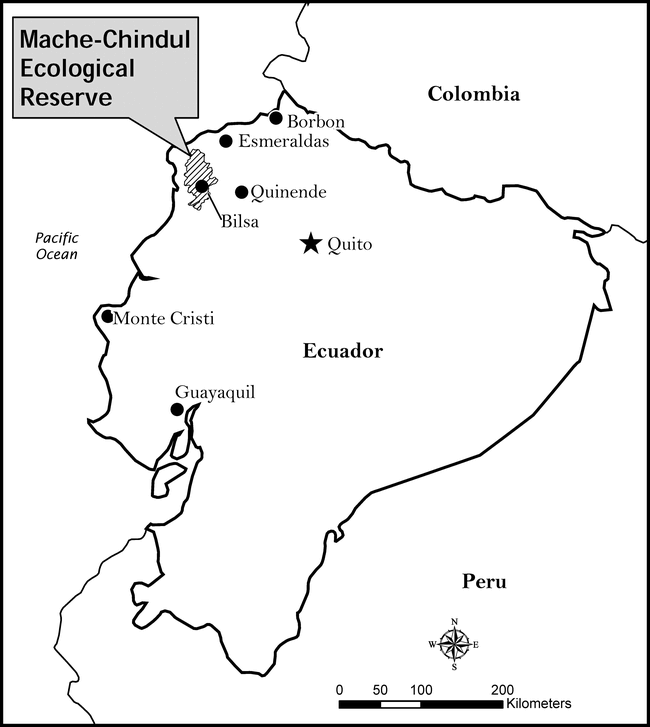
Ecuador with the market towns and the Mache-Chindul reserve highlighted. Credit: Bryson Bedell.
Three groups of people live in and around the Mache-Chindul Ecological Reserve. The first group is made up of mestizo colonists who migrated mostly from the provinces of Loja and Manabí. In both cases, they began to move in during the 1950's, searching for available land to farm. (INEFAN 1996, 1998). The second group is comprised of Afro-Ecuadorian colonists who immigrated from Esmeraldas in the late 1940's. It is generally agreed that the Esmeraldas community is comprised of a historically free community (from a shipwrecked slave ship) who gradually mixed with slaves and ex-slaves (Speiser 1991; Whitten 1974). The people in the third group are the indigenous people, the Chachi. Although their history is not well documented, most researchers agree that they were originally from the highlands, living on the western slopes of the Andean Cordilleras, near to Ibarra. The Chachi history or mythology is that they fled to the lowlands from either the Inca or the Spanish invasion (Alarcón 2000; Barrett 1994; Novoa 2001), eventually arriving in the Mache-Chindul area in the early 1940's. All three groups practice subsistence farming, fishing, hunting and gathering from the surrounding forest.
Methods
For this study I conducted interviews with 26 families: 11 mestizo, nine Afro-Ecuadorian, and seven Chachi families. The study took place from December 2000 to December 2001. The mestizo people with whom I worked live in the communities of Cuadrado, Perrera, Tigrillo, and San Pedro. The Afro-Ecuadorian informants were from the community of Chiva. And finally, the Chachi informants live in the community of Río Bravo (Figure 2) 2 .

Study communities within the Mache-Chindul Ecological Reserve. Credit: Bryson Bedell.
Thirty-one communities subsist in the area. Three are Chachi, three Afro-Ecuadorian, and 25 mestizo. The number of mestizo families with whom I visited is greater than for the other two groups, because they make up the majority of the population in the reserve. I chose communities wherein there was an expression of interest in the project and that were located within two-day's walking distance from my base location, Bilsa biological station (Figure 2).
Additionally, to evaluate the current and possible market situation, I worked with sellers and buyers. I interviewed three raw material buyers and sellers in the town of Quinendé. Two finished product vendors were interviewed in Quinendé, three in Esmeraldas, three in Monte Cristi and one in Borbón (Figure 1).
Most interviews were semi-formal or informal (Bernard 2002). I worked principally with the weavers within the families. However, as many people do some artisan work, or at least are usually present when the activity takes place, whoever was present in the home or on the walk frequently joined in the discussion. We discussed weaving details and processing in the home, and collection in the forest and field. When I spoke with sellers and merchants, I visited them in their places of business. Although the main informant in these situations was the person who owned the business, usually there were spouses, workers and friends who also joined in the discussion. This aided in giving consensus to the information I received (Heinrich et al. 1998; Reyes-García et al. 2003). Also, I helped with some weaving and processing of material, and accompanied them on collecting trips, engaging in participant observation (Bernard 2002).
Interviews were carried out in Spanish, using Chachi interpreters with those Chachi who spoke only Cha'paalachi. In the latter case I did run the risk of having the interpreters' opinions enter into the translation (Bernard 2002; Martin 2004). All interviews were conducted with informed consent and each consultant was compensated for their time and effort. Throughout the study period, I lived with various families. This added casual discussion and observation about the entire process, enhancing the information I gathered from the more structured interviews.
Plant Description
The genus Astrocaryum has 50 species distributed from Mexico south to Brazil and Bolivia (Kahn and Granville 1992; McCurrach 1960; Moore 1973). Mocora, Astrocaryum standleyanum (Arecaceae) occurs along the Pacific slope in Costa Rica (Puntarenas), the Atlantic slope of Panama (Canal Area, Panama, San Blas), the Pacific lowlands of Colombia (Antioquia, Chocó, Cauca, Valle, Nariño) and Ecuador (Esmeraldas, Pichincha) (Balslev and Barfod 1987; Croat 1979; D'Arcy 1987; Galeano and Bernal 1987; Henderson et al. 1995; Skov 1997).
Mocora grows most commonly in lowland rainforests on poorly drained soils, usually below 200 m elevation (Henderson et al. 1995), but can be found up to 500 m (Borgtoft Pedersen 1994). Mocora has a solitary, medium sized, stout, subcanopy stem 8-15 m tall and 16–22 cm diameter. Flattened spines that may reach 20 cm in length protect the trunk, rachis, and leaflets. The mature leaves are pinnately compound, about 3–4 m long (Borgtoft Pedersen 1994; Croat 1979; Galeano and Bernal 1987; Henderson, et al. 1995; Velásquez Runk 2001). The inflorescence stands erect among the leaves, becoming pendulous when bearing fruit. Mocora is monoecious, with 3 – 7 flowering branches each year (De Steven et al. 1987; Usma et al. 1996).
Mocora Use
My work complements previous research on mocora, such as Borgtoft Pedersen's (1994) work on mestizos' mocora use in the coastal plains of northwest Ecuador, based mostly in Calceta, and Velásquez Runk's (2001) treatment of the Wounaan and Emberá mocora basket weavers in Panama. I look at a completely different use from the basketry in Panama, and this work investigates mat weaving amongst three different ethnic groups, distinct in many ways from the commercial weaving of the mestizo group in Calceta, Ecuador.
Mats
The most common use of mocora in the Mache-Chindul Ecological Reserve is for mat weaving. Most mestizos and Afro-Ecuadorians in the reserve region sleep on mocora mats. Furthermore, in a few mestizo homes, they also hang mocora mats on the walls to prevent wind and moisture from entering through the cane structures.
The Chachi also sleep on mats, although they are less often made of mocora, but more often from the petioles of Carludovica palmata, rampira (Cyclanthaceae), a palm-like plant, most commonly referred to as the Panama hat palm. Although the Chachi say that they prefer mocora, because it is softer, they are more accustomed to weaving with rampira, and the material is easier to collect and prepare. For the Chachi, apparently more people made mocora mats in the past. Residents told me that ten years ago one would find mocora mats in most homes. Now, only those who consider themselves artisans continue to use this fiber. The colonists on the other hand, rarely use rampira.
The groups that use mocora gather the leaflets and bring them home, where the entire family removes the spines from the outer margins of each leaflet. They take off this sharp material by running a knife up the edge, removing the outermost portion of material from both sides of each leaflet. Then, with their fingers, they pinch the midrib from the top of the leaflet, slip their thumbnail underneath, and slide it to the base of the leaflet, separating the midrib from the leaflet blade (Figure 3). The preparer then breaks the midrib off higher than the base, so that the leaflet still remains intact at the bottom. Weavers and their families hang the leaflets over a line to dry, straddling the leaflets on the still intact base (Figure 4). The leaflets dry for approximately one week.

Mestizo removing the midrib from a mocora leaflet.
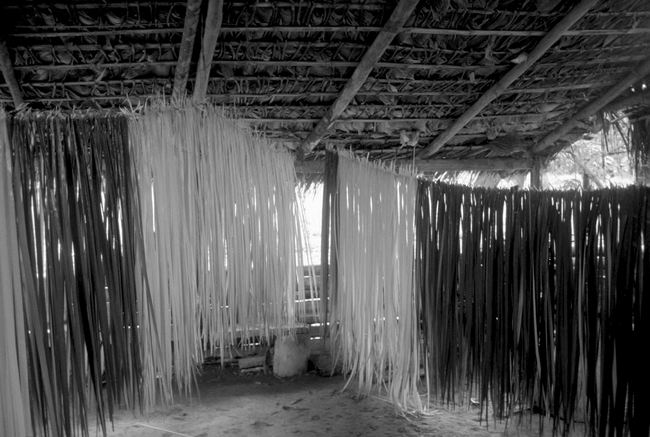
Hanging mocora leaflets (both spear and adjacent leaves) in Afro-Ecuadorian home.
Mache-Chindul villagers differ in their palm preparation from those in Calceta. According to Borgtoft Pedersen (1994), the weavers in Manabí cook the fiber, bleach it with sulfur, cut fibers into equal lengths, and then braid them into long ropes that they sew together. This also differs from Panama hat makers, who peel away the upper epidermis and mesophyll, using only the lower epidermis. These weavers then soak, dry, and bleach the material in sun. They then split and twist the fibers, like groups do with Astrocaryum chambira K.E.M. Burret in the Amazon (Jensen and Balslev 1995; Velásquez Runk 2001; Wheeler 1970).
Mestizos and Afro-Ecuadorians living in the Mache-Chindul Ecological Reserve each have their distinct style of weaving mats. The mestizos weave a twill or diagonal plait, creating a herringbone pattern (Figure 5). The Afro-Ecuadorians have a simple or plain plait, making a checkered pattern (Figure 6) (Adovasio 1977). Also, the material they use differs slightly from each other. Mestizos use only the spear leaves; those that are most recently emerged, and not yet open, while the Afro-Ecuadorians also utilize the recently opened leaves that grow on either side of the spear leaf. Afro-Ecuadorians say that they can obtain more material from each palm, and can create a design with the two different colored materials. The spear leaf is beige, and the more mature leaves are green, emphasizing the checkered pattern. The few Chachi mats made of mocora that I saw were woven in the Afro-Ecuadorian style.

Mestizo herringbone pattern of mocora mat weaving.

Afro-Ecuadorian checkered pattern of mat weaving with mocora.
Mestizos use the leaflets from four spear leaves for a double size mat. The Afro-Ecuadorians and Chachi use approximately six leaves, a mixture of spear and recently opened leaves, for the same size mat. In all three groups, people say that mats will last up to five years. Interestingly, almost every response included the stipulation that this length of time was without the occurrence of children urinating on the article.
The Afro-Ecuadorians and mestizos generally acquire weaving knowledge through their own interest, learning by watching an experienced friend or a family member. It is not a skill that seems to be consciously passed from one generation to the next within families. In one family, even though the mother weaves, her daughter learned to weave from a friend. This daughter then was the one to teach her sisters the skill. Many weavers learned the craft only after they arrived to the region. Within many colonist communities, no one in the family knows how to weave, and they obtain mats from those who do.
Although I observed few Chachi weaving mocora, those who knew how said they had learned from a parent, and that their children are learning to weave from them. Although the Chachi still see mocora weaving as a strong tradition, they also say that ten and twenty years ago many people knew how to weave mocora well, and that their grandparents had the “real” knowledge.
For the all three groups, both men and women harvest the leaves, and everyone in the family prepares the material. However, it is almost exclusively the women who weave the mats in all three groups. Although some male colonists know how to weave, they will usually teach their wives, so that the women can take over the weaving. Chachi men in general do not weave with any material, except to make fishing nets from purchased nylon filaments. However, the one mocora hammock I did see, was in a Chachi home, and was the product of the family's patriarch. Perhaps he was the weaver of this kind of product because this activity resembles the male dominated job of weaving fishnets.
Baskets
While no group in the Mache-Chindul Ecological Reserve makes the sewn mocora baskets from the leaves as in Manabí (Borgtoft Pedersen 1994) or the coiled baskets like in Panama (Velásquez Runk 2001), various mestizos make storage baskets from the left over midribs removed from the leaflets. Mestizo families use them to hold light kitchen items, with children being the most common weavers of these simple and useful containers.
To make midrib baskets the weavers place 40 midribs on the floor, in pairs, lined up parallel to each other. Then, they take 20 more pairs, and use these as the active agent. They weave each active agent under and over the passive agents. The active agents are also parallel to each other creating a simple plait square (Adovasio 1977). It is an open weave, leaving 3 cm space between each pair. The weaver then pulls the four unwoven edges, consisting of the ends of the strips, up towards the center. They twine mocora leaflets over the separate ribs, uniting them into four bunches. The weaver then crosses these over each other and ties them together with another piece of mocora leaf, making a cross handle (Figure 7).

Mocora midrib basket with a cross handle.
Cordage and Consumption
Although not a common use, the Chachi sometimes use dried leaf fiber of mocora as string to hang mosquito netting. They also use braided mocora ropes, tying these to their hammocks so that they can rock their babies from afar. All three groups in the area suck on the sweet mesocarp of the mocora fruit. This fruit consumption has been noted in various works with people who live near the palm (Borgtoft Pedersen 1994; Galeano and Bernal 1987; Borgtoft Pedersen and Balslev 1992). The Afro-Ecuadorians in Mache-Chindul also eat the endosperm. When ripe, this inner layer hardens to the consistency of coconut meat, which is why they call it ‘coco’. According to Barfod and Balslev (1988) the Chachi also eat this inner part, referring to it as
Jewelry
Most people discard the seeds after eating palm fruit. However, one man has a small ring making business. He most often sells them outside the community, or gives them as special gifts within it. After he dries the seed, he then cuts off both ends with a small saw or a machete. Carefully, he scrapes the hairs from the outside of the seed with a small knife or machete (Figure 8). He then scrapes out the endosperm, leaving the naturally hollow circle of the seed. To make it smooth he sands the outside, and as a final touch, he rubs the ring on a wooden board to make it shine. It takes about fifteen minutes to make a simple ring. Patiño (1977) also recorded the seeds as providing material for jewelry making.
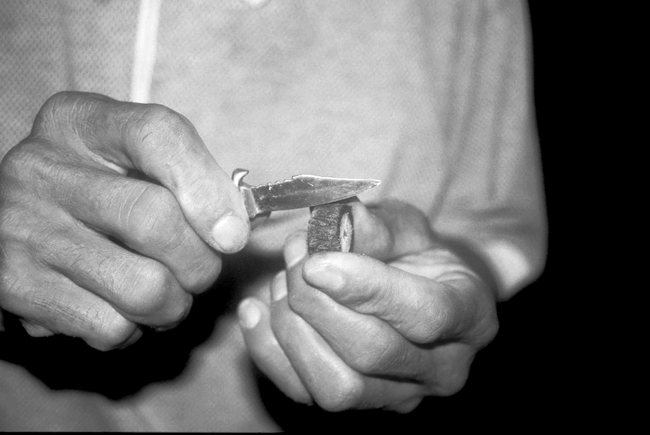
Ring maker scraping the outside of a cut mocora seed in preparation to make a ring.
Collecting Mocora
Weavers collect mocora using two distinct methods. When the palm is still young enough not to have surpassed three meters, the colonists use a pole with a chisel on the end to cut the fronds with which to weave. However, if a palm has grown too tall to comfortably use the pole, they will cut down the whole palm. The Chachi almost always prefer to cut down the entire palm, even young ones, because they find the spines too cumbersome. All three groups remove the leaflets from the rachis in the field, gathering the leaflets into a bundle to carry home.
Harvesting techniques are similar to those used in Manabí (Borgtoft Pedersen 1994). In Panama, the Wounaan and the Emberá usually fell the entire plant (Velásquez Runk 2001). Other collection methods recorded for mocora, which the people in Mache-Chindul Ecological Reserve do not employ, are climbing an adjacent tree in order to reach over and cut the fronds (Jensen and Balslev 1995), and in Panama, scraping the spines from the stem, and nailing small planks into the plant to climb the stem (Velásquez Runk 2001).
Most colonists prefer to collect from palms that they have left growing in their fields, while the Chachi rarely leave the palms in their fields when clearing. Colonist weavers have more palms on their farms than in the forest. One woman said that she would collect from a neighbor's farm before going to the forest to collect. Colonists all agree that they will collect from the forest if there is no available mocora material in the fields. The Chachi differ in this respect, always stating that they will go to the forest to collect.
Weavers from different ethnic backgrounds perceive the availability of palm resources differently. Colonists are confident they have access to a sufficient quantity of mocora. The Chachi, on the other hand, complain about a lack of mocora material. These indigenous people talk of having had an abundance of mocora in the past, but that now it is difficult to find.
Marketing Mocora
Given that all colonists sleep on mats, but they all do not weave them, some amount of exchange occurs between people within communities. Even for those people who can weave, some would still prefer to buy mats from more skilled weavers. Mat makers tend to charge between $4.00 and $8.00 (U.S.) for a double size mat. More commonly however, exchange occurs through trade. Neighbors will often trade one or two chickens for a mat. Those people who weave mats for sale usually do so when commissioned. A few people mentioned that they would go to towns such as Quinendé to sell.
I did see mats for sale in the towns of Quinendé, Esmeraldas, and Monte Cristi. All are of the mestizo, herring bone weave, and the prices are higher than within the communities. Store owners charge $6.00 for a single, and $12.00 for a double size mat. All of these mats are brought in from Manabí. One hammock in Monte Cristi, sold for $25.00. It was woven with the mocora in twisted cords, like the Chachi hammock in Río Bravo. There is not a market for mocora goods within Chachi communities, because the Chachi usually sleep on rampira mats, which do not usually enter the exchange system.
I saw no raw material for sale in any of the towns that I visited. This differs from what Borgtoft Pedersen (1994) described for Manabí, where vendors sell the raw material to families who braid the material into bands. These families sell the braids to weavers, or use the strands themselves to make hats and furniture. In looking at the jewelry market, the one man who makes rings sells to foreign travelers who stay in a nearby reserve, Bilsa. Although I did not see mocora jewelry for sale elsewhere, I did see markets in Quito selling similar rings for one dollar each (Figure 9).
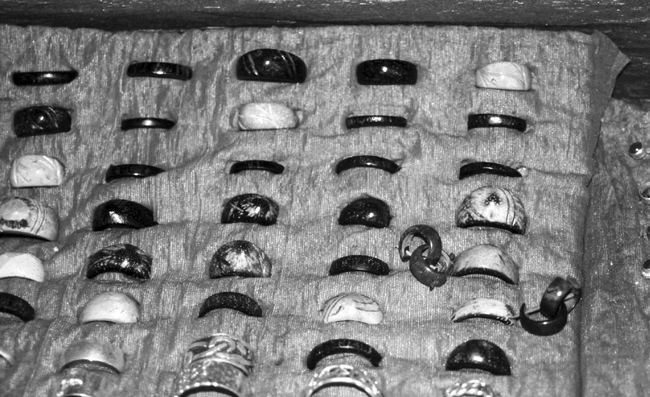
Palm seed rings, similar to those made of mocora, for sale in Quito.
Discussion
Ethnic Differences
The most notable difference in mocora use among the groups is that the Chachi do not use the material as extensively as the colonists do, although they did in the past. For mats, the chachi with whom I spoke say that they prefer the softer mocora mats to those that they make out of rampira, but that it was the previous generation who knew how to process and weave mocora. There are fewer mocora weavers now among the Chachi. This art may be dying in part because of a paucity of mocora close to home, resulting from the harvesting of the entire palm instead of the sustainable harvesting of leaves, as practiced by colonists. The lack of palm protection may be a function of their thinking of the forest, not their fields, as their main collecting ground. Additionally, they have more unfarmed land at their disposal.
Furthermore, the Chachi's established skill and dependence on rampira, which is easier to weave, collect, and prepare, makes them less dependent on other fibers. Their more common use of rampira for basketry as well as mats also explains why they do not make the midrib baskets. Finally, they have less reason to keep mocora standing, because this material is less central to their lives than it is to the lives of the colonists.
Given this, it is interesting that using the mocora as cordage is unique to the Chachi. Perhaps this use stems from the fact that rampira is too stiff to use as an effective tying material. The colonists, on the other hand, use a different plant for twine, piquigua, Heteropsis ecuadorensis Sodiro (Araceae), which the Chachi use less often.
Another difference between ethnic groups, this time between the mestizos and Afro-Ecuaodrians, is style distinction in mat weaving. Each design can be identified with the weaver's place of origin, and each group maintains its own style and does not weave the other. The Afro-Ecuadorian style is from Esmeraldas whereas the mestizo style is from Manabí. That the Chachi mats I witnessed in all of their communities were in the Esmeraldas style may be because the Chachi have had more contact with the Afro-Ecuadorians who were the first to colonize the area and to live in proximity to the indigenous people.
Market Potential
Economically, mocora is an important palm (Borgtoft Pedersen 1994). However, although the market is strong in areas such as Calceta and its surrounding villages, the selling of mats appears to have limited economic influence for the residents of the Mache-Chindul Ecological Reserve. The transport of the mats is an important factor, because they are cumbersome, and roads are muddy for half the year. For this same reason, trade volume among most communities in this region is low. Furthermore, the danger of damage to woven articles is a constant threat. Volunteers at Bilsa Biological Reserve, a biological station and reserve in the same region as the three ethnic groups, attempted to create an artisan program, but the goods meant for sale were bent and moldy before they reached their destinations. The Chachi's lack of selling, even between each other, is because families can weave the mats themselves. Additionally, although they may prefer a mocora mat, they will more likely weave their own out of rampira if they are in need of a new mat.
Whether they are leaves or fruits, people use only the regenerating parts of mocora. Thus, the plant is a potentially sustainable non-timber forest product. Also, the fact that collectors leave the rachises on the ground next to the palm after leaflet removal means that the rachis decomposes and the nutrients this provides for the soil can help in the continued growth of the palm (Borgtoft Pedersen 1994). However, if this palm is to be collected in a sustainable way, collectors can only obtain materials with a pole and blade. Borgtoft Pedersen (1994) claims that the harvesting of every other leaf does not hurt overall growth and reproduction of palms. Perhaps leaf reduction may increase palm growth, such as with the species A. mexicanum (Mendoza et al. 1987).
Clearly the other method of collection, felling palms, destroys the resource. In order to address unsustainable harvest practices, a project could be started in Ecuador, not unlike one that exists in Colombia. The Fundación de Educación Superior and Artesanía de Colombia is actively promoting the use of poles and blades as a way to collect leaves (Velásquez Runk 2001).
Although mocora seems to have limited market possibilities currently, changes in the area could increase these opportunities. Important factors in marketing are the spatial relations, particularly distance to market (Bennett 2002). These spatial concerns could be addressed by looking at close selling venues for the region. One community, San Gabriel, located at the convergence of three paths, serves as a meeting point for the colonist communities and sometimes for the Chachi as well. Although the latter rarely frequent the town, they do have access to this area. A small village near to San Gabriel, El Lago, is beginning to attract tourists. A small lodge has been built, and people come to spend the night. Additionally, volunteers and eco-tourists coming to stay at the Bilsa Reserve now spend a night at the lagoon on their way in or out of the reserve. Although there are numerous drawbacks to eco-tourism (Southgate 1998), these travelers are potential buyers of the woven goods.
Another potential market to be tapped is in the community of Perrera. People living in the community have an agreement with the Bilsa Reserve to provide an ecotourism experience. Bilsa brings groups of volunteers, classes and tourists to the village. Bilsa has helped the community build a lodge where guests stay. The times that I went to Perrera, a few locals would sell necklaces made from rainforest seeds, which the visitors eagerly purchased.
The last few times that I went, a half-woven mocora mat was hung on the lodge wall. The locals placed this on the wall for decoration and to promote interest in their crafts. Certainly people from Perrera and other neighboring communities could sell mocora goods in this and other venues.
The Chachi, although not directly involved in these two areas, could be included. The Bilsa Reserve would like to have more contact with this indigenous group, and the Chachi expressed to me the desire to sell if they had a market. Examples do exist of indigenous people selling their goods, encouraging the opportunity to maintain their own culture. Both the Otavaleños in Ecuador and the Kuna in Panama have been successful in promoting their crafts in international markets (Bennett 2002). Indeed, the northern Chachi became successfully involved in international marketing when researchers Brad Bennett and Patricia Terrack imported baskets to be sold as part of a Chachi exhibit at the Fairchild Botanical Garden (Bennett 2002). The Chachi do have possible access to overseas transport through the organization Federation of Chachi Centers of Ecuador (FECCHE) that is located in the port city of Esmeraldas. However, the limitation still exists at this point for a solid international buyer.
Although the residents of the Mache-Chindul Ecological Reserve do use some of the mocora fruit, other unexploited commercial possibilities may exist. One opportunity to explore could be a larger jewelry market. Using the seeds for jewelry can provide a small income. Marketing rings could be successful, because there is already a niche in Quito. Palm rings sell for one dollar each. The cost for raw material is virtually nothing, and the rings can be made in fifteen minutes, meaning that they can provide a high profit margin. The product is easy to transport, and, unlike woven articles, there is little risk of damage during the journey.
Another avenue that can be explored is mocora oil. A few colonists boil the fruit and remove the oil that floats to the top of the water. Because it has oligeanous fruits, mocora could be used as a greater source of oil (Bernal 1992; Galeano and Bernal 1987; Jensen 1997; Patiño 1977). Balick (1985) noted that other Astrocaryum species have been used commercially for oil, so mocora oil could potentially be an item for sale. Even if only for personal use, local oil production could help locals save the money that they currently spend on oil from the store.
In outlining these economic opportunities I am not proposing a large-scale market scheme. However, I am presenting possibilities that could bring in small amounts of income for people who have almost none. So, in looking at these three groups use of mocora, although there are differences in their utilization, and the importance that it plays in their lives, the potential does exist that this plant could provide a way for people to increase their income, while maintaining their forests. Future studies could look at the progression of tourism in the area, and how sustainable market potential can be increased for the mestizos, Afro-Ecuadorians, and the Chachi.
Footnotes
1
Voucher Specimen (MF #0056) is located in the Herbario Nacional, Quito, Ecuador.
2
The names of the communities and informants have been changed to ensure the privacy of the villages and individuals who participated in this study, and to protect against potential negative repercussions. This technique is discussed by Bernard (2002, p.192) and Martin (2004, p.106).