







Abstract
We examine the historical relationship between humans and wolves as illustrated through stories of North American Indigenous Peoples, especially the Great Plains and Intermountain West, exemplified by Cheyenne, Lakota, Blackfoot, Pawnee, and Shoshone peoples. Indigenous stories have not been employed in scholarly examinations of the origins of ‘dogs’. These tribal peoples were tough and resilient and wanted companion animals as tough and resilient as themselves. All Plains tribes examined closely have stories that describe wolves as guides, protectors, or entities that directly taught or showed humans how to hunt after humans arrived in the Americas. Indigenous stories provide insights into the process of domestication of wolves, and such stories may indicate at what stage different peoples were in their relationship with wolves. There appears to have existed a reciprocal relationship in which both species provided food for each other or shared food. This is important because it is often assumed by scholars from the Eurocentric tradition that the first wolves associated with humans scavenged or hung around camps waiting for scraps; thus, from this perspective, the process of domestication began with wolves being dominated by humans. In contrast, we argue for a coevolutionary reciprocal relationship between Homo sapiens and Canis lupus that existed from the early days of tribes until at least the nineteenth century. Our results do not mean that many tribes lacked fully domesticated dogs that were not wolflike in phenotype, but that the process of domestication may have taken a different path than is generally assumed.
Introduction
Considerable debate and conflicting results exist concerning the nature of early relationships between Homo sapiens Linnaeus and Canis lupus Linnaeus that ultimately resulted in the assemblage of highly variable phenotypes currently referred to as domestic dogs (Pierotti 2012a, 2012b, 2014). Early evidence used to investigate this relationship relied on archaeological specimens (Morey 2010; Olsen 1985; Ovodov et al. 2011). Over the last twenty years, there has been increased reliance on DNA evidence to investigate ‘dog’ origins (Pierotti 2014). Genetic studies rarely include dog breeds that are the most wolflike in appearance. Depending upon the DNA-based study, there have been four identified separate origins of domestic dogs reported: eastern Asia and China (Savolainen et al. 2002); Middle East and Levant (Leonard et al. 2002); southern Asia (Skogland et al. 2011); and, most recently, Europe (Thalmann et al. 2013). Each has been presented as if it were the “original,” and only, site where this process took place.
Most DNA analyses ignore the significant crossbreeding over the millennia since establishment of human-canid relationships in the Paleolithic (Anderson et al. 2009; Pierotti 2014). Other DNA studies seem incomplete. For example, vonHoldt et al. (2010) exclude Native American dogs and Siberian Laikas, which are among the most wolflike of “dogs” (Pierotti 2012a, 2012b). Thalmann et al. (2013:873) exclude “specimens from the Middle East or China, two proposed centers of origin,” because, “no ancient dog remains older than 13,000 years are known from these regions.” These omissions would not be crucial if the authors acknowledged multiple origin sites for early forms of “dog.” A recent publication, (Freedman et al. 2014:2) argues, “none of the wolf lineages from hypothesized domestication centers is supported as the source lineage for dogs,” and “dogs and wolves diverged 11,000–16,000 years ago in a process involving extensive admixture…followed by a bottleneck in wolves.” Also, “at the beginning of the domestication process, dogs may have been characterized by a more carnivorous diet than their modern day counterparts, a diet held in common with early hunter-gatherers” (Freedman et al. 2014:2). This contradicts arguments for a “European origin of domestic dogs” between 18,800 and 32,100 years ago (Thalmann et al. 2013:871). Thus, there remains considerable debate concerning both times and locations of canid domestication. All suggested sites probably represent independent domestication events; thus, derivation of dogs from various types of wolves did not happen once, but probably continued into historic times (Losey et al. 2013; Ovodov et al. 2011; Pierotti 2012a, 2012b, 2014).
Unexamined sources for exploring early human-wolf relationships include stories and traditions of Indigenous peoples, many of whom continued to interact with both wolves and “wolflike dogs” until recent times (Fogg 2012). Stories from many peoples specifically contain information for investigating questions relating to ecology and evolution, especially of culturally important species (Pierotti 2011a, 2011b). We emphasize a key point unrecognized in many discussions of the wolf/human dynamic: Dogs anatomically different from wolves appeared as long ago as 10,000, or 30,000 yrs BP in other parts of the world (Morey 2010; Olsen 1985; Thalmann et al. 2013). However, this does not exclude the possibility that many peoples, especially those employing hunter-gatherer traditions, continued to maintain positive social relationships with wolves, or canids indistinguishable from wolves. Such relationships probably produced new forms of “dog” well after the time(s) argued for the “first” domestication of “dogs,” prior to, and continuing after the arrival of Europeans in America.
Some Indigenous Americans clearly had domesticated canids. Coast Salish peoples had two types of obvious “dogs” at least 4000 yrs BP: medium sized “village dogs” and smaller, long-haired “wool” dogs (Crockford 1997; Schulting 1994). In cases involving Great Plains or Intermountain West tribes, tamed or recently domesticated wolves were described as “dogs.” For example, Audubon stated that “Sioux dogs of the upper Midwest were so closely akin to wolves, that I would have mistaken them for wolves had I met them in the woods” (Hyde 1968:10).
It is important to keep in mind that relationships between Indigenous hunter-gatherers and their canid companions were based upon mutual respect and the ability to function together. A European living with Shawnees in Ohio in the 1770s, described the experience as “living with lions” (Gilbert 1989:20), which indicates something of the nature of these people. They were not like contemporary Americans, both non-native and native, who are comfortable with smaller, completely domesticated versions of Canis lupus. Living off the land, they preferred canine companions who were equally tough and resilient, and considered non-domestic form of Canis lupus as social companions, in many cases credited with “teaching” people to hunt as humans encountered new ecological conditions.
A potential source of confusion concerning human/wolf interactions arises from the issue that some tribes used the same term for both dogs and wolves, because they regarded their “dogs” as basically wolves (Hampton 1997; Hyde 1968; Pierotti 2011a). Osage used the term Shon'ge to refer to both wolves and domestic dogs, primarily to the former (LaFlesche 1995:132). Lakota use the term Shunka to refer to both wolves and dogs (Marshall 1995).
Among Aboriginal peoples of North America, crosses between dogs and wolves are well known (McCarthy 2013). Maximillian, Prince of Wied, wrote in the nineteenth century:
[I]n shape they differ very little from the wolf, and are equally strong…they partially descend from wolves, which approach the Indian huts, even in the daytime, and mix with the dogs…Many of them were perfectly similar to the wolf in form, size and colour; they did not bark, but showed their teeth when anyone approached them (McCarthy 2013).
Audubon and Bachman, travelling the United States frontier in the 1800s, observed:
[T]he offspring of the wolf and the cur dog and also their mixed broods…which resemble the wolf…Many of the Assiniboine Indians who visited Fort Union during our stay there had both wolves and their crosses with the common dog in their trains…drawn alike by both (emphasis added).
Experienced naturalists, Audubon and Bachman distinguish between ‘dogs’ and ‘wolves’, but emphasize that Assiniboine used actual wolves as beasts of burden. Freuchen (1961) says Inuit intentionally crossed their dogs with wolves, and Valadez et al. (2002, 2006) report that “hybrids” between wolves and “dogs” were commonly kept by the pre-Hispanic peoples of central Mexico. In North American wolves the melanistic K locus mutation that produces black pelage, favored in forested environments, appears to have originated in domestic dogs and introgressed into wild wolf populations through interbreeding between wild and domesticated wolves (dogs) at some point in the past (Anderson et al. 2009).
We present accounts in which wolves are described as “teachers” of humans in hunting, allowing people to survive and thrive in new environments. Some are stories of a person becoming lost, then adopted or cared for by a pack of wolves before returning to their people. Humans and wolves may have moved into parts of the Americas as cooperating species that worked both together and independently to adapt to new ecological situations.
An Ethnohistorical and Ethnobiological Approach
We frame arguments in terms of history mixed with ecological and evolutionary knowledge within an ethnohistorical context. This is similar to Gould's (2003: 225) discussion of methodology for combining science and storytelling:
[W]hen I want to know why…Tyrannosaurus played the role of top carnivore 65 million years ago…[or]…why marsupial Thylacines served (this role) on the island continent of Australia…I am asking particular questions about history: real and explainable facts to be sure, but only resolvable by the narrative methods of historical analysis and not by the reductionistic techniques of classical science.
A similar method is employed by Amadeo Rea in developing his classic Once a River: “What I was trying to do…was use ethnographic data, and even folk taxonomy, to reconstruct what the conditions of the Gila River were…I was trying to use Pima information to reconstruct…what the river was like” (Lepofsky and Feeney 2013:41).
We examine relationships between various Indigenous peoples of the American plains and large canids, even if these relationships are no longer extant. To this end, we searched the literature concerning ethnology of tribes as well as collections of accounts provided by ethnologists, or written by Indigenous peoples—George Bent, Charles Eastman (Ohiyesa), Francis LaFlesche, John Wooden Leg, Luther Standing Bear—and by interviews with contemporary Indigenous Americans, from Cheyenne (Tsitsista) and Blackfeet
Domestication: Process or Outcome?
One issue linked to the discussion of the wolf-human relationship is the concept of domestication and whether this is an appropriate term for the relationship we discuss. From our perspective, domestication is an evolutionary process, rather than a definable state or endpoint—“domestication was and is evolution” (Morey 2010:67; Rindos 1984:3). We endorse Descola's question “whether the opposition between wild and domesticated can have been at all meaningful in the period prior to the Neolithic tradition, i.e., during the greater part of human history” (Descola 2013:33), especially since the peoples we discuss below were still living in a manner to which the term “Neolithic” had little meaning until European contact. Evolution is a process rather than an outcome, or set of outcomes (Pierotti 2011a), and at many times in the past, humans established relationships with species that may have led to a state of domestication. As Ritvo (2010:208) states,
[W]ild and the tamed or domesticated exist along a continuum…few animals live lives untouched by (humans)…in this sense, few can be said to be completely wild [e.g., wolves in Yellowstone were acclimated in pens prior to release]. As the valence of the wild has increased and its definition has become assertion, rather than description, the boundaries of domestication have also blurred. Not that they were ever especially clear…twenty-first century wolves belong to a long line of animals where “wildness” has been compromised, tameness has also existed on a sliding scale…both “wild” and “tame” have existed for a millennium, remaining constant in form as well as in core meaning, while the language around them has mutated, beyond easy comprehension, if not beyond recognition…
As examples, our relationships with the two species of carnivore domesticated by humans—dogs (Canis lupus) and cats (Felis silvestris Schreber)—are clearly different than those established with domesticated ungulates, and probably began as commensalism. Individual wolves and wildcats established close, but highly variable, bonds to individual humans. Resulting changes, especially neotenic, became pronounced in some “dogs.”
Hemmer (1990) describes three principles of domestication: 1) whether the species can be bred under captive conditions; 2) individuals with smaller relative brain sizes are more prone to domestication; and 3) selection for appearance (e.g., coat color) can elicit domestication effects, or vice versa where selection for friendly behavior might elicit changes in appearance (Belyaev 1979; Belyaev and Trut 1982; Morey 1994, 2010). After only a few generations of living with and breeding under the influence of humans, carnivores can be well on the way towards domestication (Belyaev and Trut 1982), however, this process can readily reverse. Even today many cats retain the ability to switch between a domestic and feral state, in which they live without depending upon humans (Dombrosky and Wolverton 2014). Individuals can return to living without humans, especially during early stages, whereas others may remain with humans for many generations and still retain the wild phenotype if there is no selective pressure to generate a different phenotype. Domestic forms exist as potential phenotypes present within the genotype of the non-domestic ancestors. Living commensally with humans may select for new phenotypes, however, in wolves; as long as humans valued them primarily as sentinels and cooperative hunters, there was little pressure to change phenotype. Some may have chosen to remain with humans while remaining very wolflike, whereas others in the same litter might choose to return to the wild (Meggitt 1965).
Over the last 30,000 to 40,000 years various types of wolves have been differentially selected by humans to produce the wide variety of domestic dogs that we see today (Morey 1994, 2010; Shipman 2011), although most extant breeds are at best a few centuries old. This variety resulted in domestic dogs becoming the most anatomically diverse mammals within a single taxonomic unit on the planet (Morey 1994; Vila et al. 1997). Descendents of these different domestication events encountered one another over the millennia and crossed repeatedly, further rendering attempts to tease out DNA relationships difficult if not impossible (Pierotti 2012a, 2012b, 2014). If we include deliberate breeding of wolves back into various “dog” lineages, the problem becomes even more intractable.
Native American Accounts of Wolves
Many tribes that lived on the Great Plains held traditions in which wolves were regarded as role models, who taught people how to hunt. These include Cheyenne, Lakota, Blackfoot, Assiniboine, Arikara, Arapaho, Osage, Shoshone, and Pawnee (Hampton 1997). Cheyenne and Blackfeet have powerful traditions of living and working with wolves, both socialized and wild, and Shoshone have a well-documented tradition of living with domesticated wolves.
Cheyenne (Tsitsista)
The nature of wolf-human relationships is well illustrated by the Tsitsista (how Cheyenne people refer to themselves), who have an ancient relationship with wolves, dating back to their link with Siberian Indigenous peoples (Schlesier 1987). According to Cheyenne elders, the People's history (in North America) was divided into four parts (Powell 1979; H. Mann pers. comm.). The first part refers to the cultural origins, the second is the “time of the ‘dogs’” (that is, wolves), which lasted until first contact (Schlesier 1987), followed by the time of the buffalo, then finally the time of the horse, after European contact.
Based on stories and images recorded by Native Americans and Europeans after contact, the horse and the buffalo were pivotal to the livelihood of tribes on the Great Plains. The role played by wolves/dogs (“time of the dogs”) suggests these animals were of major importance in early Tsitsista history. This relationship started with ancient forms (i.e., wolves), central figures in the hunting ceremonies of the Tsitsistas (Schlesier 1987).
Tsitsista tradition tells of being taught to hunt by two wolves. One, the male, is “the wolf maiyun, the species-specific protector spirit of wolves and his female companion” (Schlesier 1987:82). They were “the master hunters of the grasslands and…protectors of all animals.” Maiyun chose to teach the human newcomers to hunt on the grasslands (Schlesier 1987:82). “As the ‘invitation song’ of wolves called raven, coyote, and fox to share in their kill, so did Tsitsista hunters call wolves to their kill or set meat aside for their use” (Schlesier 1987:82).
Cheyenne elder Henrietta Mann states that the dogs Tsitsista had at this time were wolves (Pierotti 2011a). More detailed descriptions come from George Bent, half-Cheyenne son of Colonel William Bent, who operated Bent's Fort, a trading post on the Upper Arkansas River in Colorado. Bent kept the only written eyewitness account of mid-nineteenth century interactions between Indians and Europeans from the tribal point of view, and was a reliable, accurate informant, whose information was verified by other accounts (Hyde 1968). Concerning the relationship between Tsitsistas and canids prior to the acquisition of horses, Bent states:
[T]he tribe had a great number of large dogs…employed to pack or drag burdens…used just as horses were in later times…These dogs of the olden time were not like Indian dogs of today. They were just like wolves, they never barked, but howled…old people say that every morning just as day was breaking, the ‘dogs’ of the camp, several hundred of them, would [gather]…and all howl together.
Antelope Woman (Tsitsista elder) [described]…her mother [telling] her about the winter buffalo hunts…when all the tribe was on foot. A herd of buffalo was surrounded by the people [and the “dogs”; Schlesier 1987] and driven into deep drifts…If a buffalo got away the dogs would set on it and quickly drive it back to the deep drifts…After the buffalo are skinned (and butchered) the dogs (dragged) the bundles of meat over the ice…As soon as the camp was reached, the dogs were loosed, and at once the whole pack rushed back…to the [kill site, where]…they feasted on the parts that had been thrown aside [during butchering]…mother dogs who had puppies in camp would run to the [site], gorge themselves with meat, and then run back to camp and disgorge part of the meat for the puppies to feed on. Sometimes a mother would make several trips to get enough meat for her litter of young ones (Hyde 1968:9–11; emphasis added).
This account reveals the wolflike nature of these “dogs” (Figure 1). First, group howling initiated by the animals is a wolf rather than a doglike trait. Although some dog breeds (but not all) howl, it is rarely a group activity. Second, the description of mixed species cooperative hunting follows arguments made by Schlesier (1987:35): “Cooperation with others (was taught) by the one animal that both the people of northern Siberia and the Tsitsistas regarded as the master hunter par excellence—the wolf.” Hunting ceremonies of both Tsitsistas and some Siberian peoples emphasize learning from wolves (Schlesier 1987). Finally, the description of parent animals returning to the kill site, filling themselves with meat and returning to regurgitate to pups is pure wolf. No dog is known to behave in this manner (Scott 1968; Spotte 2012).
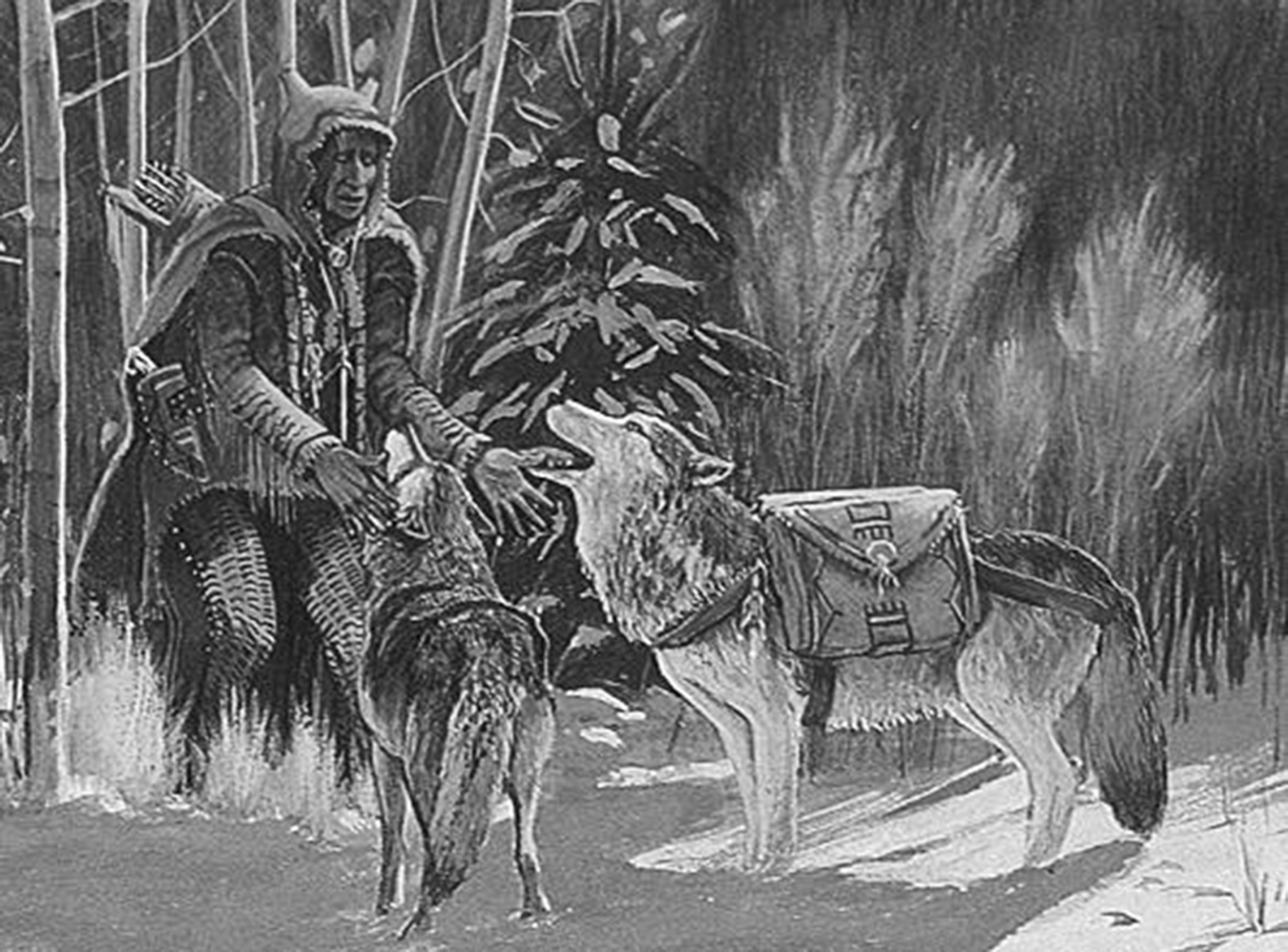
Detail from Four Footed Allies by Cheyenne artist Merlin Little Thunder. This painting, based upon historical Cheyenne tradition, shows relationship between a Cheyenne hunter and his wolflike companions. The image shows the style of packs carried by these animals, which are similar to descriptions in Hyde (1968) and Loendorf and Stone (2006).
This provides some sense of “The Time of the Dogs.” Cheyenne pack animals were large, strong beasts that howled at the approach of the morning like their relatives the wolves (Powell 1979). Given the quotes from Audubon and Bachman, and Maximillian (above), there is a tendency to describe canids that live with people as “dogs” rather than “wolves,” even when the people themselves do not make this distinction (Descola 2013:33). For example, both the Gros Ventres and Oglala Sioux formed warrior societies they called Wolf Societies (Cooper 1957); however, whites mistranslated the latter's name as “Dog” Society (Hampton 1997:48). The original warrior society of the Cheyenne was the Bowstring or “Wolf” Soldiers, even though the later formed “Dog” Soldiers are better known (Hampton 1997; Schlesier 1987).
This relationship between Cheyenne and wolves persisted until quite recent times. After the Sand Creek Massacre (November 1864), two Cheyenne women and their children escaped and took refuge in a cave under a bluff. After nightfall, a male wolf entered the cave and lay down beside them. Afterwards the wolf travelled with them, stopping to rest whenever they did, showing that its behavior was not simply coincidental. One woman addressed the wolf, telling it of their need for food, after which the wolf led them to a freshly killed buffalo. For several weeks the wolf remained, catching food and protecting them from potential human and nonhuman enemies. Finally it found a Cheyenne camp on the Republican River. After delivering them and being fed in return the wolf left (Grinnell 1926:149–53; Hampton 1997).
The Tsitsista felt that some people could “understand the speech” of wolves. Listening to wolves howl they could anticipate events, and warn or prepare others. It is said they gained these skills after living with the wolves. When they were lost, hungry, or near death wolves would rescue them. This is similar to the Lakota story The Woman Who Lived with Wolves (Hassrick 1964:138–39; Marshall 1995). Given the way these people were treated by some fellow humans, these stories about events only 150 years ago reveal that wolves can be better friends and companions than some humans.
Blackfeet (Siksikaitsitapi)
Blackfeet identified with wolves. Brings Down the Sun (boyhood name Running Wolf) made this statement after hearing a wolf howl:
We consider the wolf a friend of man, and do not believe it is right to shoot him. We have a saying, “the gun that fires upon a wolf or coyote will never again shoot straight.” Did you ever know of a wolf who did not wander? They never stay long in one locality. They raise their young in one place and then go to another. They are continually roving over the country and are always on the move. My father named me Running Wolf, and…I am like the wolf, for I love to roam over the prairies and among the mountains. I cannot stay still very long (McClintock 1910:434).
Blackfoot people credited wolves with teaching them to hunt using buffalo drives before they had horses. The wolves selected a single bison, cut it out from the herd, running it until exhaustion or driving it up a steep slope, harassing it until it succumbed or jumped to its death, at which time the wolves circled down and fed upon the dead bison. Early accounts described this:
Here is the rendezvous par excellence of the wolves, those animals so cruel, but timid and cowardly at sight of [white] man. They will attack together a calf or a cow, which they have managed to separate from the herd; they watch for buffalo to cross the river and try to climb steep and difficult places; the poor animals get mired in the mud, and often entire herds perish. The wolves throw themselves on them and devour them (Chittenden and Richardson 1969:1372).
Blackfeet duplicated this behavior in their own drives, down to the smallest details (Hernandez 2013). Another story from the Blackfeet describes how a family on the verge of starvation was provided with food by a pack of wolves until they could hunt on their own (Hernandez 2013).
Scholars have made a great deal of the tribal use of “Buffalo Jumps” or driving bison off cliffs. The origins of this practice are found in the following description of wolves:
They display much boldness and sagacity…and…act in concert and…by understanding. First they post themselves at proper distances in a line in the direction the victim is supposed to take; then two or three charge into the middle of the herd, cut out the fattest and drive it toward the spot where their companions are waiting. The victim then runs between two ranks of wolves. As it goes on, fresh bands join in the chase, until at last, exhausted…it stops and becomes their prey. They hamstring it first to prevent its escape, and then devour it alive. At other times they practice a still more cunning stratagem; they urge their prey up some steep place, beyond which lies a deep ravine or precipice. There they form a half circle about it, closing in continually and redoubling their threats and howls. The poor buffalo, placed between two fires, hesitates a moment at sight of the abyss; but soon, bewildered by the yelping and baying, it attempts the only way to escape from its assailants, jumps off and falls crushed at the bottom of the ravine (Chittenden and Richardson 1969:603).
In the days before they had horses, Blackfeet, like other tribes travelled on foot accompanied by their canid companions, following buffalo over the grasslands, copying the methods used by wolves. It is said that traditional Blackfeet will never shoot a wolf, believing them to be “good medicine” (Yetter 1992:5–6).
Blackfeet were fond of wolves as companions. In preparation for hunts they slept on wolf skins and sang songs encouraging wolves to join them. As McClintock (1910:243) notes:
There is a legend that the Wolf Song first came to the Indians through a warrior who took pity on a dying wolf…the chief of all the wolves and endowed with…power. The spirit of this wolf followed the warrior throughout his life…became his protector and guardian spirit and gave to him the Wolf Song…which he could invoke…in time of danger.
If while travelling, a wolf howled nearby, the hunting party would sing: “No I will not give you my body to eat, but I will give you the body of someone else, if you will join us” (Grinnell 1892:260–61). The following is a traditional Blackfeet story about hunting:
Once there was a Siksikaitsitapi (who)…had but one horse…on this day he had a kill. He cut up the meat and packed it on his horse (and) left enough for a good meal for…the wolves. On the way back home he ran into a pack of wolves…on their way to the remains of his kill…later, he ran into an Old Wolf…having a hard time keeping up with the pack. The hunter stopped and offered the choicest cut to the Old Man (Wolf) and told him, “By the time you get there, there may be nothing left for you to eat”…(the Old Wolf) replied, “I am in a hurry, those ahead are hungry. I need to get there…they will not start without me. You see, I am the Grandfather. You will receive a gift for your generosity.” Later the hunter was very fortunate in his hunting (Bastien 2004:35–36).
Blackfeet identify a historical period called the Era of the Dog (Iitotasimahpi Iimitaiks), also described as the time of the ancestors, referring to the period from the origin of the culture until contact with Europeans (Bastien 2004:8–14). This preceded the time of the horse, when people depended upon their dogs (wolves) as beasts of burden, who could drag a load of 75 pounds, and were given great respect because they were companions of humans possessing spirit and consciousness (Bastien 2004).
Blackfeet retain traditions stemming from “Wolf Man,” an ancient story describing direct instruction and teachings wolves gave humans, some regarding behavior and social structure, others specific to hunting practices (Hernandez 2014). Wolf Man outlined specific protocols, limitations, and expectations of human behavior. Originating in a hunting context, these are integrated into Blackfoot social and spiritual life (Hernandez 2014). An example of this is the traditional story The Legend of the Friendly Medicine Wolf:
This…happened many years ago. The Blackfeet were moving camp…While passing through a hill country, a large party of Crow Indians…hiding in the ambush, attacked the line…Before the Blackfeet warriors came to their defense, the Crows…carried away some women prisoners…a young woman named Itsa-pich-kaupe (Sits-by-the-door) was carried on horseback…over two hundred miles…(where) she was (taken to) his lodge and gave her into the care of his wife, an older woman. Itsa-pich-kaupe was so closely watched she could find no chance of escape…One day, when the Crow man was away…the Crow woman conversed with Itsa-pich-kaupe in the sign language, saying, “I overheard my husband say they are planning to kill you. I feel sorry and will help you to escape tonight when it is dark”…She loosened the bottom of the lodge covering from the pegs and, giving Itsa-pich-kaupe a pair of moccasins, a flint and small sack filled with pemmican, and pushed her outside. Itsa-pich-kaupe traveled all that night…When daylight came she hid in some underbrush. The Crows tried to follow her but they could find no tracks…One day when her feet were bruised and bleeding, she saw a large wolf following her. At first she was frightened and tried to run, but her strength was gone and she sank down exhausted. The wolf stood watching her, and then crept nearer and nearer until he lay at her feet. When Itsa-pich-kaupe arose to walk, the wolf followed and when she sat down again to rest. He lay down by her side. She besought…; “Pity me brother wolf! I am so weak for food that I must soon die. I pray for the sake of my young children that you will help me.”
When she finished…the wolf trotted to the summit of a high butte, where she sat watching. He disappeared, but soon came back, dragging a buffalo calf he had just killed…After roasting and eating some of the meat, she felt stronger and started on, but her feet were so bruised and torn that she could scarcely walk. When the wolf drew near, she placed her hand on his broad back, and he seemed glad to bear her weight…the wolf helped Itsa-pich-kaupe, hunting every day and kept her supplied with food, until he brought her safely home. When they entered camp together, Itsa-pich-kaupe led the friendly wolf to her lodge, where she related to her family the story of her escape…(and) besought the people to be kind to the wolf, and to give him some food…The faithful wolf…came every evening to the summit of a high butte, where he sat gazing down at the lodge where she lay. Her relatives continued to feed him until he disappeared, never to return (McClintock 1910:473–76).
One theme should be obvious from these stories: when the wolf performs its service, guiding and providing for people, it is always fed in return. Some scholars of European ancestry contend that the first wolves associated with humans had to scavenge or hang around camps waiting for scraps (e.g., Coppinger and Coppinger 2001; Crockford 2006; Russell 2011). In contrast, according to stories told by Indigenous Americans, humans voluntarily fed or shared food with the wolves with which they associated. Such traditions go back millennia to a time closer to the initiation of friendly relationships between humans and wolves. These stories represent more accurate descriptions of the beginning stages of this relationship than do speculations by scholars like the Coppingers, who are limited by assumptions of fear and dominance-based relationships between humans and nonhumans. Euroamericans see the world in small time scales, and also think in these terms. The origin of dog breeds in the last few centuries are sometimes considered equivalent to the beginnings of domestication, when in fact we are looking only at the most recent stage of an ancient tradition.
One example of the confusion of European explorers concerning dogs and wolves among the Blackfeet during the mid-nineteenth century is a description by James Carnegie, The Earl of Southesk, from Fort Edmonton in 1859:
There are more dogs here than at any place I know. They are mostly of the ordinary Indian kind, large…long-legged and wolfish, with sharp muzzles, pricked ears, and thick, straight, wiry hair…Most…are very wolfish in appearance, many being half or partly or all but entirely, wolves in blood (Carnegie 1875:152–53; emphasis added).
Sioux (Lakota, Dakota)
The Lakota tell a story of an injured woman saved by wolves (Hassrick 1964:138–39; Marshall 1995:12–13). Once healed she returned to her people with a valuable set of skills taught by wolves. Lakota have a brotherly relationship with the wolf because they learned their hunting skills from the wolf (Marshall 1995). This habit of learning and being instructed by wolves is demonstrated in the story by the instructions the pack leader gives the woman regarding her return to her people. The wolves provide everything the woman needs, indicating the respect Lakota have for wolves as hunters. At no point does the woman take a leadership role in the pack, which is often assumed to be an essential component of the domestication of wolves as they changed to dogs (e.g., Coppinger and Coppinger 2001).
This tradition is reinforced by a story by Joseph Marshall III from On Behalf of the Wolf and the First Peoples:
The hunter waited in ambush and shot a buffalo with several arrows…the buffalo did not immediately die, so the hunter had to follow…the wounded animal. The buffalo finally collapsed, and as the hunter hid and waited at a safe distance…a wolf appeared and warily approached the buffalo. Displaying…patience and caution, the wolf moved only a step at a time. Finally, she reached the downed buffalo, which by then had died. The wolf's demeanor and posture told the hidden hunter that the buffalo was dead and…safe to approach…out of curiosity he waited to see what the wolf would do, fully expecting her to begin tearing at the flesh with her fangs. Instead, she went around and around the carcass until she saw the arrows protruding from the buffalo's side. She sniffed the arrows then sat back on her haunches to carefully test the wind. After a time she looked directly at the hunter's hiding place with a long penetrating stare, and then nonchalantly walked away from the dead buffalo and disappeared over a rise. Later…the hunter made sure that they left behind some choice portions to share with the wolf and her family (Marshall 1995:11–12).
Close relationships between wolves and Lakota emerge from parallel aspects of the lives the species share (Marshall 1995). Wolves live naturally in complex social groups, making it easier for wolves to be absorbed into the human society. Both humans and wolves are respected as hunters and warriors. Finally, the family structure of a pack of wolves is similar to that of humans:
The people of that time learned the ways of the wolf because they understood the reality of their existence. Among them it was the hunter and the warrior who followed most closely the path of the wolf. As a hunter the wolf had no equal-with his sharp sense of smell, keen eyesight, and powerful jaws. Those were formidable weapons, but the first peoples saw that they were of little use without endurance, patience, and perseverance. They were even more important weapons of the wolf, and were qualities the first peoples could develop in themselves (Marshall 1995:6).
Pawnee (also Paneassa, Pari, Pariki)
Pawnee dogs were nearly pure wolf (Hyde 1968). The Skidi (pronounced Skiri, Pawnee for Wolf) are the largest band, living upon the Loup (Wolf) River in present-day Nebraska. Members of this band personified and emulated wolves, and were respected for their ability to travel all day and night, living by scavenging carcasses or not eating. The Plains tribal language for wolf, basically a Peace Sign held beside the right shoulder, moved forward and upward, was also the sign for Pawnee, who called their war parties araris taka (‘white wolf gangs’; Hampton 1997).
These traditions from four major Plains peoples exemplify the reciprocal relationship between humans and wolves through the sharing of the spoils from successful hunts (Hampton 1997:30–62). The protector spirit of a species mentioned earlier is considered to be an individual that has the power to punish hunters for abuse of animals under his protection by withholding game or by inflicting injury on the offender (Schlesier 1987:4), so this offering served as a way to show respect to the protector species of the wolf (Pierotti 2010, 2011a).
Intermountain West: Sheep Eaters (T'ukudeka Newana)
One of the best documented examples of the relationship of a people with wolflike dogs comes from T'ukudeka Newana (Sheep Eater or Mountain) Sosoni (Shoshoni), who lived in the higher elevations of the intermountain west, including the area today known as Yellowstone (Corless 1990; Loendorf and Stone 2006). Sheep Eater dogs were large, robust animals—“Their coloring revealed…wolves in their family tree, not only long ago but also more recently” (Loendorf and Stone 2006:103). Resemblance to wolves was described by John Richardson (1836 cited in Loendorf and Stone 2006): “wolves and the domestic dogs of the fur countries are so much like each other that it is not easy to distinguish them at a small distance…The offspring of the wolf and the Indian dog are prolific, and are prized by the voyagers as beasts of draught, being stronger than an ordinary dog.” Frederick Kurz, travelling in Yellowstone in 1851, noted that these dogs “differ very slightly from wolves, howl like them, do not bark, and not infrequently mate with them” (cited in Loendorf and Stone 2006).
These accounts describe recently domesticated wolves, rather than animals domesticated several thousand years earlier, as indicated by lack of barking, combined with the overall physiognomy. They differ from wolves only in size and may simply represent one aspect of naturally occurring variation (Figure 2). As Allen (1920:436, emphasis added) has noted, “in less modified breeds of dogs, e.g., the American Indian dogs, the free posterior palate ends on a line passing transversely through the middle of the last molar,” a trait also found in wolves, but not in large breeds of European dogs. These animals were stronger in the shoulders, necessary to haul travois loads of 70 pounds and to carry packs weighing as much as 50 pounds. In recent times, these animals have died out, replaced by more mundane “dogs” (Loendorf and Stone 2006).
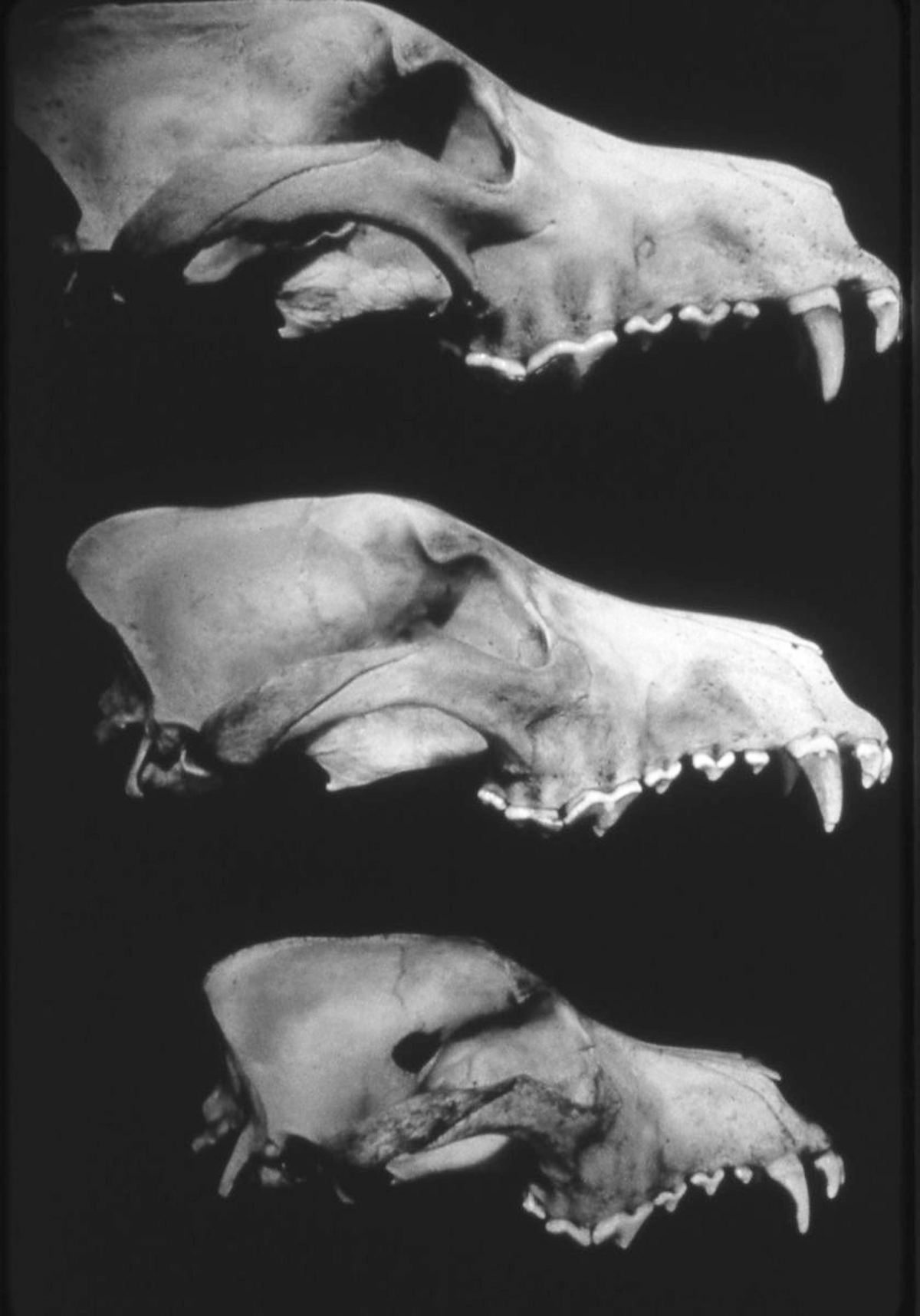
Comparison of skulls of wolf (top), Shoshone “Dog” from Yellowstone dig (middle), domestic dog (bottom). Note the overall similarity of top and middle skulls, with similar proportions, pronounced sagittal crests, enlarged craniums, and teeth, especially canines. From Yellowstone Photo Collection, http://www.nps.gov/features/yell/slidefile/history/indians/Page-3.htm. NPS photo by Larry Loendorf.
Shoshone intentionally made their dogs accessible to wolves for breeding (Allen 1920; Loendorf and Stone 2006). Examination of skeletons found in Yellowstone Park established that, in life, the dogs ranged in height from medium to tall, between coyotes and wolves in stature with a robust frame, supporting a large head comparable to that of wolves (Haag 1956; Walker 2000; Walker and Frison 1982).
The lifestyle of a group of Shoshone consisting of six men, seven women, and ten children, accompanied by thirty dogs, was described in Yellowstone in 1835 (Russell 1914). Sheep Eaters customarily fed their dogs before they ate. There must have been enough food to satisfy all. This reflects the theme that Indigenous Americans made an effort to see wolves they encountered and their wolves/dogs treated as equals, even to the extent of being fed before the humans, a sign of respect among Indigenous Americans. It is said that wolves saved Eastern Shoshone during a bad winter by catching deer. Although horse-riding, bison-hunting Indians on the Plains suffered from starvation during this time period, Sheep Eaters were able to survive comfortably, residing primarily in the mountains and exploiting a hunting niche focused on bighorn sheep with the help of their dogs (Loendorf and Stone 2006).
Dog travois were unsuitable for rough mountain terrain. As gradients increased, travois were unhitched and the load transferred to a pack (Loendorf and Stone 2006). For families without horses, dog transport was an alternative. Dogs were more adept than horses moving in heavy winter snow, and could add body warmth to the family bed on cold nights. Packs consisted of rawhide parfleches, lashed directly to a dog's back with rawhide binding strapped across the chest and under the belly (Figure 1; Shimkin 1986). Another strap went under the tail to secure the pack. Descendents of Sheep Eaters describe rawhide booties for dogs to wear in the winter to protect feet from frostbite and prevent ice buildup between toes. T'ukudeka controlled these animals entirely by voice commands (Loendorf and Stone 2006).
The respect T'ukudeka had for their dogs is exemplified by two canine skeletons buried with an adult male human, and another accompanying the burial of an adult female (Haag 1956; Loendorf and Stone 2006). Both men and women were interred with dogs, suggesting strong bonds with their nonhuman companions, who were essential in the afterlife (Walker and Frison 1982). T'ukudeka children played with pups and raised them as friends whom they loved throughout their lives (Loendorf and Stone 2006).
Comanche (Nuhmuhnuh) are closely related to the Shoshone, but lived on the high plains. They believed that “practically all animals and insects were attributed powers by someone” (Wallace and Hoebel 1948). The only animals not considered to provide power were the horse and the dog, because “they were everyday parts of the Comanche household” (Wallace and Hoebel 1976). Humans had control over these animals so they couldn't give powers: “givers of power had to be outside the (human) realm of dominance” (Wallace and Hoebel 1976). In contrast, “Comanche believe Wolf could grant power to walk barefoot on the cold snow” (Wallace and Hoebel 1976).
Nuhmuhnuh (Comanche) and Newana (Shoshone) were one people until Europeans arrived, bringing both horses and domestic dogs in the late sixteenth century. Nuhmuhnuh lack traditions in which dogs and horses were not important parts of their culture, and emphasize horses over dogs in stories (Kavanagh 2008; Wallace and Hoebel 1986). This difference between closely related peoples, sharing a common language, provides insight into the way various tribes saw relationships between wolves and dogs. Relatedness between wolves and dogs was recognized by Nuhmuhnuh, who were unusual among Plains peoples for their adamant refusal to eat dog, one does not eat the Creator's brother, even when starving, although they would readily eat horse when conditions required (Kavanagh 2008:486; Wallace and Hoebel 1986).
Wolves, as representatives of their creator figure, were not beings over which Nuhmuhnuh people considered themselves dominant. Even though humans were living and working closely with dogs/wolves, the beginnings of domestication from the tribal perspective, wolves were not tame creatures dependent upon of humans like dogs. Only when wolves functionally changed into dogs, did humans see themselves as the dominant species.
Other Indigenous American Peoples
An Arapaho story tells of a young boy engrossed in playing who did not realize his tribe was breaking camp. He was left behind, wandering in the wrong direction. As night fell he began to cry. A wolf appeared and told him not to be afraid, he would help him. Three more wolves appeared. They raised the boy (Shoshone and Arapaho Tribal Fish and Game Department 2007).
Such relationships are not restricted to peoples of the Plains. The Ojibwe (Anishinaabeg) of the north woods have connections with wolves that go back to their earliest stories. When Original Man first walked the earth, he complained to the creator that all other animals are paired yet he was alone. The Creator provided a companion, Ma-en’-gun (Wolf) who roamed the world with him, until they separated: “What shall happen to one of you will also happen to the other. Each of you will be feared, respected and misunderstood…” (Benton-Banai 1979).
Discussion
One of the biggest problems in determining when domestication of wolves actually took place is that for much of history dogs kept by Indigenous peoples were impossible to differentiate from wolves through physical remains (Derr 2011; Morey 2010; Schleidt and Shalter 2003; Shipman 2011). Derr (2011:37) argues:
Early animals called dogs are…phantoms…there were no dogs at that time…although there may have been socialized wolves, they were not dogs…lack of physical evidence is due to many reasons, not the least of which is that the dog existed genetically before it did phenotypically…the dog is fundamentally a wolf still capable of looking like a wolf.
This process lasted longer in America than in other parts of the world, an idea supported by canid scholar Ronald Nowak, who argues that gray wolves did not live in the central areas of the United States until around 10,000 yrs BP (pers. comm.). This means that wolves arrived around the same time as did ancestors of many contemporary tribes (Schlesier 1987).
Stories told by Indigenous American peoples about their relationships with wolves are consistent in stating that through much of the evolution of human hunting practices, wolves took the lead in initiating hunts. Humans served as pupils in need of instruction, casting different light on the idea of how domestication may have proceeded, in that humans are at best partners, or students, of wolves. The Lakota still recognize the wolf as an independent animal, and that humans who lived with them might be forever changed (Marshall 1995), which introduces the idea that the wolf/human relationship involves cooperation and coevolution (Morey 2010; Schleidt and Shalter 2003) rather than competition, dominance, or exploitation.
The family structure of a pack of wolves is similar to that of a human nuclear family (Mech 1999), which is the subject of a Marshall essay discussing wolves (2005:35):
The (wolf) family was led by a bloka, or “male,” and a winyela or “female,” labeled “alpha” by non-native observers. The bloka and winyela had a litter of young usually every year. Those young stayed after they were weaned and grew to young adulthood. So the core family was several generations of offspring, but only the bloka and winyela mated and bore young. Usually, as the offspring grew into adulthood, they went off to form their own families.
Wolves are among the very few mammals that live in monogamous family groups. Human family structure is different from other anthropoid species. Social sharing within families may be a trait that early humans learned from wolves (Schleidt and Shalter 2003). Wolves and dogs readily recognize the social structure within human families, and seek a place for themselves within the family. It is not uncommon for dogs to form pair bonds with their owners when there are no other dogs present (Thomas 1993, 2000, 2006).
In contrast, canid species that do not show complex social groups (e.g., coyotes, jackals) do not adapt well to life among humans. Indigenous Americans took wolf puppies from dens and raised them in their villages as recently as 1770 (Hearne 1958:224). Despite being raised by humans, some wolves probably chose to leave the human groups and return to the wild once they reached social maturity (Meggitt 1965), especially if there were no other wolves in the human group with whom they could establish bonds. A choice must be made between two family groups: human or wolf. Wolves that chose to remain with human families would eventually give rise to what would later be recognized as domestic dogs.
Indigenous Americans marked wolf puppies with ochre (Hearne 1958:240). These may have been the most social individuals, likely to establish relationships with humans. Wolf behavior expert Benson Ginsburg stated:
It is my experience that if you put your hand into a pen with newborn wolves, a certain percentage will come immediately and never want you to leave…Other pups will run away and still others will be stuck in avoidance-approach. As adults, the social ones can become sociable to humans (Derr 2011:86).
Sociable characteristics would be valuable to humans who wanted to establish long-term relationships with wolves after the pups were weaned. Marking pups increases the ability to identify individuals more likely to accept regular interactions with humans. Behavioral variation among littermates can be seen today in determining which puppies can be socialized for public outreach and education (Pierotti 2012b). Puppies that are dominant within their litters show such inclinations, whereas less dominant pups from the same litter (full sibs) are less likely to be socialized. Variation within a single litter suggests it is incorrect to think these animals had a genetic predisposition to join humans (Coppinger and Coppinger 2001). Derr (2011:85–86) observed:
[T]he fault line created in the Anglo-European world between wild and domestic…underlie(s) many of our assumptions and attitudes despite having been well exposed and discounted in recent years. Until all preconceived notions are laid aside…we will not gain a clear understanding of the nature of the animal (dog) who fills so many different, frequently contradictory roles in quite different human societies.
No matter what their ‘dogs’ look like today, the process of domestication in all human societies involved long-running respectful relationships with free-living wolves.
The overall theme within all Indigenous American stories we discuss is that the relationship between wolf and human involved respect and cooperation, especially in hunting. Although it is clear that attitudes concerning wolves vary among tribes, many shared themes are present, and all credit the wolf with being a figure from which the human can learn.
Important contributions wolves and dogs made to the lives of Indigenous peoples were assisting with hunting, as sentinels, and as beasts of burden, augmented by companionship. The most obvious reason to domesticate any species is to increase the amount or quality of food that can be obtained (Hemmer 1990). For most species this means the domesticated form is changed to make it easier to handle so it can be controlled and eaten when needed, providing a predictable source of food. In contrast, “the first dogs probably helped human hunters find or track prey and protect their home territory and their social group (including humans), behaviors that are common among living canids such as wolves” (Shipman 2011:9). Shipman argues that associating with wolves empowered humans by removing their fear. With wolves as companions humans could take on any other creature, including mammoths (Shipman 2015).
Wolves are “pre-adapted to domestication”; more appropriately “predisposed to live closely with humans,” the precursor to domestication, because they live naturally in complex social groups, and are intelligent, highly adaptable, loyal, form pair bonds, and hunt cooperatively (Morey 2010; Schleidt 1998; Schleidt and Shalter 2003). These reasons led to a beneficial situation whose rewards could be reaped by humans. Wolves (and dogs) were able to help with hunting in ways other humans could not. The canid sense of smell is much stronger than that of humans; therefore, hunters employing help from wolves while hunting were able to track game over larger areas. Wolves could run down prey that humans could not, or grab and distract prey while humans made the kill (Shipman 2015). It is much easier for an animal to hide from a hunter relying solely on vision, than to hide from one with a powerful nose, combined with good hearing and keen eyesight.
Wolves served as sentries, as symbolized by Cheyenne artist Merlin Little Thunder (Figure 3), which illustrates a common goal of wolves and humans; to protect the village at night. This picture emphasizes equality between the species, because the human is located centrally rather than in the top position as if looking over the dogs. It is often assumed that early humans lived in fear of nature, especially at night, where they huddled around their campfires. Recall that descriptions from both the Shoshone and Cheyenne highlighted that their social groups often contained more “dogs” than humans. Imagine how relaxed you might feel sleeping in a village guarded by hundreds of wolves as described in Hyde (1968:9).
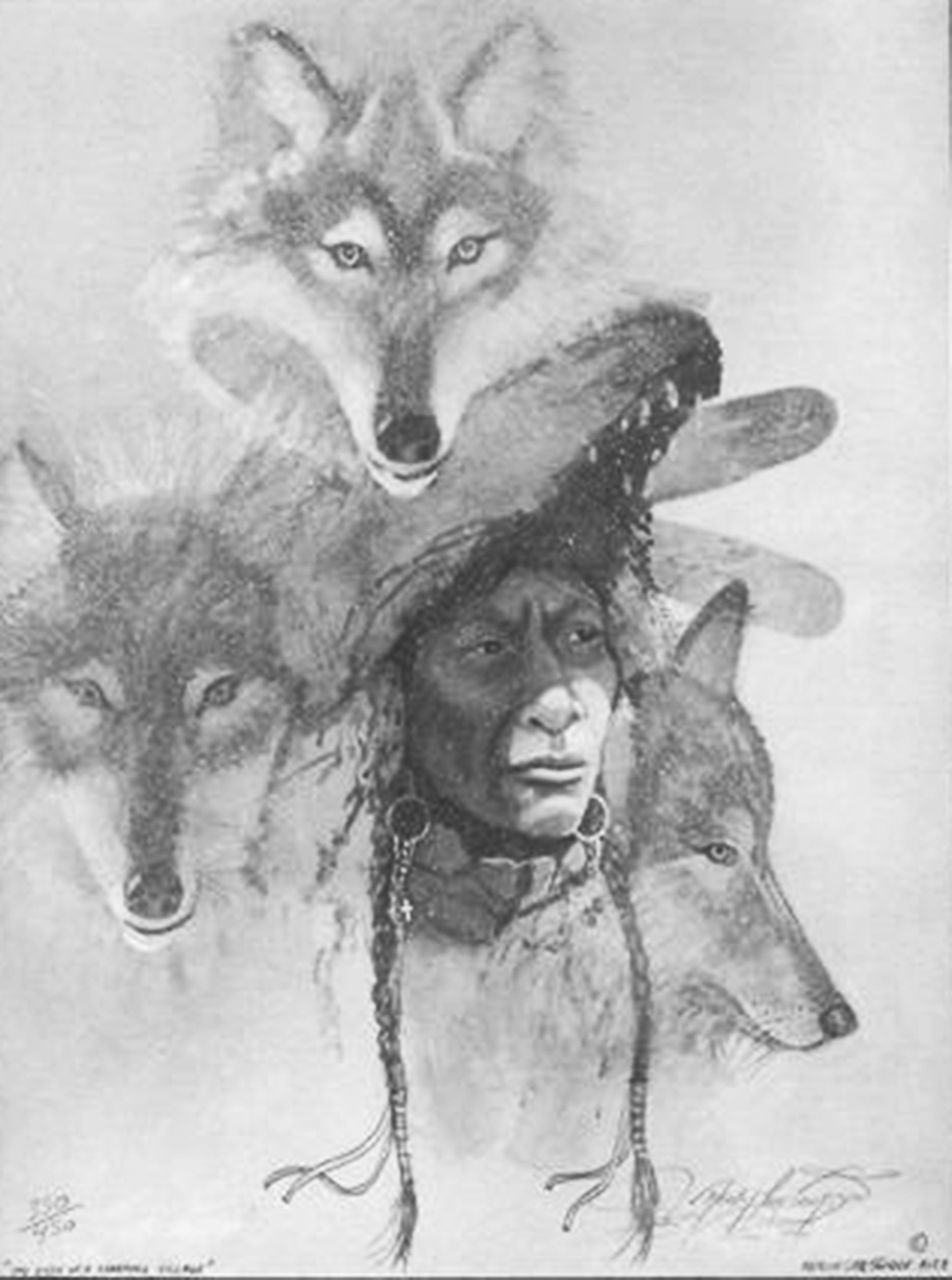
Eyes of a Sleeping Village, by Cheyenne artist Merlin Little Thunder. In this image a wolf is at the top of the picture with the human below. The human is dressed as a wolf and the wolves in the image are arranged in somewhat of a circle, all of which represent how the humans saw themselves within this relationship. The humans had to learn from the wolves, which is why the human is imitating the wolf. Guarding the village was something the wolves could do much better than the humans but the human in the picture is working cooperatively with the wolves. He dresses like them to symbolize the respect he has for the abilities of the wolf.
Indigenous peoples felt safer when living with wolves. In contrast, hostility and hatred directed towards wolves characterize the primary historical attitudes displayed by Europeans (Coleman 2004; McIntyre 1995; Pierotti 2011a). This contrast in attitudes is clear from an account provided by a professional “wolfer” during the winter of 1861–62 in Western Kansas:
In the days of the Buffalo, wolfing was a recognized industry. Small parties…used to go to the Buffalo range, establish a camp, and spend the winter there, killing buffalo and poisoning the carcasses with strychnine…the Indians were bitterly opposed to the operations of these wolf hunters (Grinnell 1892; emphasis added).
Recent efforts by the United States Federal Government to remove protection from wolves have generated similar responses. Chippewa tribes in Wisconsin, Minnesota, and Michigan requested the Wisconsin Department of Natural Resources to prohibit the killing of wolves in the ceded territory of northern Wisconsin. Jim Zorn, executive director of the Great Lakes Indian Fish and Wildlife Commission, said tribes believe the Wisconsin hunt is biologically reckless and would be culturally harmful to Chippewa, for whom wolves are culturally important. Zorn noted that “tribal reps have expressed it as, ‘How should we sanction the killing of our brother?'” He also adds that ‘there's a level of discomfort that makes it difficult to talk about in these terms of legalese and biology that we usually use.’ In addition:
The Voigt Intertribal Task Force of the Great Lakes Indian Fish and Wildlife Commission passed a motion unanimously opposing the killing of (wolves) and claiming all wolves in the Wisconsin ceded territory as a necessary prerequisite to a population that would fully effectuate the Tribes’ rights’ (August 2, 2012; Knight 2012).
Tribes were not consulted before these measures were instituted and have requested that no wolf hunts take place and no hunters are allowed to kill wolves on tribal lands (Lewis 2013).
In retaliation for wolf hunts, six bands of Chippewa in northern Wisconsin declared their intention to spear a near-record number of walleyes during the annual spring harvest, terminating a 1997 agreement with the state. These declarations resulted because the relationship between the state and tribes has become increasingly strained, primarily because the tribes strongly opposed wolf hunting and trapping season, starting in 2012 (Smith 2013). Wolves feature prominently in origin stories and legends of the Chippewa, and are associated with courage, strength, and loyalty. Chippewa bands living in Wisconsin were allotted several “slots” of the total wolves allowed to be killed; they did not kill a single wolf last year (Lewis 2013). Despite 500 years of colonization, some Indigenous Americans are still trying to protect wolves, which they still view as companions.
Footnotes
Acknowledgments
We thank those who provided commentary on this paper, including several Blackfeet elders interviewed by NH. RP would like to thank several anonymous reviewers, along with Joseph Marshall, Pat Shipman, and Steve Wolverton who provided commentary on earlier drafts. BF would like to thank the members of her MA thesis committee, Stephanie Fitzgerald and Kelly Kindscher, who provided comments on an early draft.