






Abstract
This article presents cases of three young people who represent the “New Mainstream” of the 21st-century classroom as they engaged in a year-long research and writing project. Focal students were classmates who represented the linguistic and cultural diversity of today’s New Mainstream: a transnational Mexican-origin bilingual female, an immigrant Mexican-origin bilingual female, and a Caucasian English-speaking male. Cases focus on the young people’s language and literacy histories and key patterns related to their language use in school as examples of the complexity of students who represent the New Mainstream. Findings suggest the need for a reframing of the notion of “mainstream” and expanded definitions of academic language to better address the realities of New Mainstream classrooms.
To change the world, one has to change the ways of world-making, that is, the vision of the world and the practical operations by which groups are produced and reproduced.
As K–12 classrooms in the United States become increasingly diverse, the categories by which we traditionally have described students grow less useful to examine and support their academic progress. The achievement gap between students of different linguistic and ethnic backgrounds persists in spite of a broad base of research that focuses on this problem, and some interventions that promise to raise all students’ achievement do so in a way that exacerbates the achievement gap between groups (Ceci & Konstantopoulos, 2009). This begs the question: Is the way in which we ascribe categories and labels to students part of the problem? Are the ways in which we understand and respond to student diversity responsible in part for the unequal achievement that is “produced and reproduced” (Bourdieu, 1989, p. 23) between groups as we currently understand them?
The purpose of this study was twofold. First, I sought to understand academic language and literacy within the context of a year-long 12th-grade research and writing project by examining the language and literacy practices of young people engaged in their Senior Exhibitions. Equally important, I wanted to attend to the problem of unequal achievement between groups by incorporating into the study the linguistic diversity that is increasingly becoming the norm in U.S. classrooms. To this end, the focal question guiding this study became, How did young people from different language backgrounds use language and literacy throughout the planning, researching, drafting, and presenting of their year-long Senior Exhibition projects?
Focal students for case study analysis included classmates from the same English and social studies class: a transnational Mexican-origin bilingual female, an immigrant Mexican-origin bilingual female, and a Caucasian English-speaking male. This study is timely given present-day circumstances in schools and society, with linguistic diversity growing in classrooms across the country. As such, these cases provide a unique opportunity to examine how the categories we ascribe to students interact with their experiences and our understanding of their academic performance, especially with regard to the language and literacy demands of secondary classrooms.
In the next section, I note the potential and limitations of traditional and contemporary conceptions of academic language in the fields of literacy studies and second-language learning with regard to linguistically diverse classrooms. This is followed by the theoretical framing of the analyses, drawing primarily from Bourdieu’s (1989, 1991) notions of language and power and recent calls for a recasting of teaching and learning to meet the needs of a new cosmopolitan workforce (Gee, 2004a; Luke, 2004). After an explanation of the research design and method, case studies of three students are presented with a focus on their language and literacy histories and key patterns related to their language use in school. I close by discussing the implications of the study’s findings for redefining conceptions of “mainstream” and reframing scholarship on academic language and literacy.
Academic Language: Masking and Mediating Classroom Learning
Why should we care about academic language and literacy? In linguistically diverse classrooms, students’ academic proficiency in English masks and mediates their learning across content areas and instructional contexts (Abedi, 2004; Valdés, Bunch, Snow, Lee, & Matos, 2005), making notions of academic language and literacy important for any scholar or teacher interested in the performance of young people on academic tasks. As classrooms become increasingly diverse, however, our understanding of how home and school language interact has not improved, particularly in “mainstream” classrooms that serve students from a variety of language backgrounds, where English is the sole language of instruction.
This review of the literature considers the evolution of traditional and contemporary notions of academic language and literacy in secondary classrooms to situate this research project within these scholarly traditions and to note the literatures and fields to which the study’s findings may contribute. In this section, I articulate why contemporary notions of academic language and literacy have the greatest potential to inform the current study on academic language and literacy. Also in this section, I describe the limitations that traditional definitions impose on our understanding of the experiences of linguistically diverse students in contemporary classrooms. Attention to the limitations of these definitions is important because our definitions of key constructs in education affect the labels, categories, and identities available to students with regard to these constructs, as illustrated in the findings section of this article. Noting the impact of these definitions and labels addresses the concerns underlying the second purpose of this study, the fact that students from different language backgrounds were perceived as achieving different levels of competence in academic language and literacy at the research site and nationally.
Definitions of academic language and literacy are not uniform across disciplines or professions, and theoretical and research approaches to its study are just as diverse (Valdés, 2004). While notions of academic language and academic literacy have developed as separate literatures in education research, the fact that they are related is unquestionable. However, the nature of that relationship is often unstated or vaguely defined. In this section, I describe how approaches to academic literacy and language have evolved over time. I note how traditional definitions and approaches to both constructs encouraged dichotomies and tightly circumscribed definitions. Finally, I note how contemporary work in these areas broadens the scope of the constructs in ways that make them more inclusive and consequently less distinct from one another. This section concludes with the definitions of academic literacy and language that are operationalized in this study. Throughout this review, I note the relationship between definitions and constructs, and the labels and categories (mainstream, bilingual, English learner) that they encourage for students in secondary classrooms (Harklau, 2003), an issue that is further explored later in the article. In this article, I use the term academic language to refer to the general construct of the language of schooling; I use academic English to refer to contexts or studies that specifically examined English as the language of instruction.
Traditional Notions of Academic Literacy and Language
Definitions and approaches to academic language and literacy can be described along a continuum with precise, narrow, and circumscribed approaches on one end and broad, flexible, and dynamic approaches on the other. In their reviews of other literacy scholars, Newman (2006) and Snow (2006) capture elements of this continuum as they describe literacy work that focuses on discrete skills versus holistic approaches, formal instruction versus informal learning, classroom contexts versus home and community contexts, and other factors that situate scholars as belonging to more traditional cognitivist or positivist paradigms or broader social approaches to literacy learning. Both ends of the continuum are necessary. Precise definitions are essential for issues of measurement and assessment; in these cases, constructs must be reduced to objective indicators that have shared meanings across an audience of specialists who make decisions based on assessment findings. Historically, research on academic literacy and language has had its foundations in these approaches, with attention to discrete skills and benchmarks to identify aspects of learners’ language and literacy development and to identify classroom practices and interventions that move students forward along an established trajectory of skills development. Many contemporary academic literacy scholars have roots in this paradigm. Such scholars focus on issues such as vocabulary acquisition (Kamil & Hiebert, 2005) and assessment (Pearson, Hiebert, & Kamil, 2007), effective practices for struggling readers (Guthrie & Davis, 2003), the relationship between a first and second language in learning to read (Fitzgerald, 2003; Genesee & Geva, 2006), and instructional techniques to promote particular literacy skills in reading and writing (Graves & Fitzgerald, 2006; Snow & Juel, 2005).
The most influential scholar of traditional notions of academic language is from the field of second-language acquisition. Jim Cummins’s (1984) definition of cognitive academic language proficiency (CALP) as distinct from basic interpersonal conversational skills (BICS) led to several dichotomies in teachers’ and researchers’ understanding of how language works. The first dichotomy is that there is such a thing as distinct types of language: language within classrooms and specialized professions versus language for everyday informal interactions. The next assumption is that there is a developmental relationship between these languages, such that BICS are acquired first and are less sophisticated due to their reliance on the presence of contextual cues, and CALP is developed later, relies on a foundation of well-developed interpersonal language (BICS), generally with the help of formal instruction, and is more cognitively demanding due to its engagement with decontexualized and abstract content and concepts (Cummins, 1984, 2000). While most contemporary scholars reject such stark dichotomies between “academic” and “conversational” language (e.g., see Bunch, 2006; Schleppegrell, 2004; Valdés, 2004), these same scholars do adhere to the notion that the language of schooling—or academic language—is in some ways distinct from language used outside of school, requires formal instruction, and presents unique challenges for students who are learning it while they are still developing a second language. One such researcher with a focus on assessment is Abedi (2004, 2008), whose attention to the linguistic demands of standardized assessments has significant implications for the placement and schooling of English learners. Other scholars suggest that academic language involves this measurable stage of English language proficiency but also mastery of content knowledge and learning strategies that promote ongoing language and curricular learning (Krashen & Brown, 2007). Still others expand notions of academic language to include factors that are linguistic, cognitive, and social, as noted by Scarcella (2003) as well as Fillmore and Snow (2000).
Historically, then, notions of academic literacy and academic language have been somewhat distinct from one another. Academic literacy focused on particular skills involved in decoding and composing text-based curricular materials, whereas academic language involved measurable aspects of language proficiency (speaking, listening, reading, and writing) along a developmental trajectory. In research exploring issues of academic literacy from cognitivist perspectives, native speakers of English were historically the population of interest; however, there has been a significant increase in the number of studies that include or focus on second-language populations from the scholars who do this work. While there is a general acknowledgement in the field that academic language is important for both first- and second-language speakers of English, research from a developmental perspective in this area has focused much more on bilingual learners, particularly those who are still learning English as a second language. Of course, research paradigms and definitions of constructs that focus on issues of development, proficiency, and the measurement of general and discrete skills encourage particular kinds of labels for students in K–12 classrooms. As such, entire curricula and instructional programs are designed around students considered “struggling readers,” “English Learners,” and “basic writers.” Most of these programs focus on remediating students for deficits noted by their performance on standardized tests in comparison to “effective readers,” “native English speakers,” and “proficient or competent writers.” In other words, the circumscribed nature of these definitions of academic literacy and language result in circumscribed categories by which we understand the experiences and performances of students in our classrooms. While this may be helpful to identify learning needs and monitor progress, it also blinds teachers and researchers to the full repertoires of their students’ experiences and backgrounds. More recent work in academic literacy and academic language responds to this dilemma with expanded definitions and research approaches (e.g., see Bartolomé, 1998; Bunch, 2006; Schleppegrell, 2004; Valdés, 2004; Villalva, 2006a).
Pushing Boundaries, Expanding Definitions
Many contemporary scholars have recognized the need to push against the constraints of traditional categories and dichotomies to expand definitions of academic language and literacy and to develop a more nuanced understanding of the language and literacy demands of school-based tasks. Researchers such as Schleppegrell (2004), Christie (1986), and Biber (Biber, Conrad, Reppen, Byrd, & Helt, 2002) examine language and literacy as “linguistic activity” (Colombi & Schleppegrell, 2002), focusing on the unique linguistic features and demands that typical classroom texts place on learners from any language background. This approach moves away from traditional notions of literacy that focus on the learner and the observable or measurable processes and skills that the individual learner demonstrates. Even broader are social approaches to academic literacy that embrace a “multiple literacies” perspective, which considers academic literacies to be only one aspect of an individual’s repertoire of literacy practices, with critical, personal, or community literacies also informing one’s understanding of text and of the world (Gallego & Hollingsworth, 2000; Maybin, 2000). Researchers such as Moje and colleagues (Moje et al., 2004) and Villalva (2006a) examine content area literacy as a social practice, focusing on mainstream classroom settings in an effort to understand how students from diverse backgrounds engage with traditional notions of content area literacy from the perspective of their own unique language and literacy backgrounds. Literacy research from a language socialization lens, such as Heath’s (1983, 1986) work and Zentella’s (2005) edited volume, is often closely aligned with these school-based studies but with an emphasis on exploring the language and literacy practices of the home and noting the implications of these practices for the schooling of children from various linguistic backgrounds.
Similar to social literacy paradigms, studies that claim “academic language” or “academic English” as their focus often emphasize the social nature of language use and examine classrooms as socializing contexts in which students are apprenticed into specialized uses of language to perform academic tasks within particular curricular areas or disciplines. Scholars who do this work often combine a variety of research approaches from anthropology, sociology, and applied linguistics. Many consider institutional, political, and curricular factors that constrain or enable particular kinds of language use and development for different populations of students (Valdés, 2001; Villalva, 2006b). Some studies (Bunch, 2006; Harklau, 2002) have combined social and linguistic approaches to note how bilingual learners are prepared for and navigate the various demands of mainstream classroom settings, while others attempt to clarify how language actually is used in real classrooms—in general, as in the case of Duff’s (2002) classroom ethnography, or for particular types of classroom activities, like the oral presentation (Bunch, 2009).
The greatest advantage of these expanded notions of academic language and literacy is that they generally resist starting with firm categories and definitions, allowing a careful examination of the research context, participants, and activities to suggest locally defined understandings of which language and literacy practices do or do not “work” toward school success. As a consequence of the focus on social interaction, context, and observed practices of language and literacy, however, it becomes more difficult to define academic literacy as distinct from academic language within this paradigm. Social approaches to literacy and language share the premise that the language that one produces, orally or in print, relies on an understanding of the discourses, rules of interaction, and genres or registers that mediate that language (Barton, 1994; Dyson & Genishi, 2005; Heath, 1983). Likewise, understanding language, aurally or via print text, relies on these same social, discourse, and linguistic skills. In essence, then, the distinctions between academic language and academic literacy become fairly arbitrary, which may be why so many scholars of this work resist precise definitions in the first place. In practice, most “academic literacy” research from a social or multiple literacies perspective prioritizes young peoples’ interactions with print texts but considers the oral language use around print text to be an essential aspect of academic literacy. Likewise, most research into “academic language” raises the status of oral language as a unit of study itself but also as a medium by which students are socialized into practices with print text.
For this study, I define academic literacy as the skills and strategies used by young people engaged in academic work that involves reading, writing, and other formal school-sanctioned modes of representation. As such, academic literacy involves a broad repertoire of skills—linguistic, literate, social, and inquiry oriented—drawing from a young person’s experiences and development both within and outside of school. Perhaps better understood in the plural, academic literacies involve some general skills and dispositions that support learning across curricular contexts but also include skills and knowledge specific to particular disciplines or subject matter areas. An important aspect of this repertoire of academic literacies involves the linguistic and social aspects of language used for academic purposes. These uses of language are referred to here as academic language. In other words, in this article, academic language refers to particular uses of language in the service of the broader goals of academic literacy.
Breaking Dichotomies and Building Glocal Literacies: A Theoretical Framework
To inform analyses of academic language and literacy for linguistically diverse classrooms, I draw from the theories of Bourdieu (1989, 1991), Luke (Albright & Luke, 2008; Luke, 2003, 2004), and scholars who expand on work in New Literacy Studies. This framework allows for deep engagement with the issues of language, diversity, and equity underlying the central purpose of the study. These theories have explanatory power in analyzing how labels and categories meant to identify and support students’ academic and linguistic needs have ultimately constrained their opportunities to acquire the new, more flexible literacies required for success in a world where the lines between local and global are constantly shifting. In this section, I draw from these theories to demonstrate how language functions as a mechanism to perpetuate long-standing inequities in education and how language has the power to challenge these inequities in linguistically diverse, New Mainstream classrooms. These theories connect the context and problems of language and literacy examined in my study with the broader concerns of equity and diversity reflected in discussions of the “achievement gap.” Ultimately, these theories articulate a need to prepare students and teachers for contemporary times that demand new kinds of literacies that are more hybrid, transportable, and cosmopolitan in nature. Gee (2004b) describes this as the need to prepare “shape-shifting portfolio people.”
Their set of skills, experiences, and achievements, at any one time, constitutes their portfolio. However, they must also stand ready and able to rearrange these skills, experiences, and achievements creatively (that is, to shape-shift into different identities) in order to define themselves anew (as competent and worthy) for changed circumstances. (p. 105)
Consider, for example, the high school teacher who is able to ease smoothly into a corporate human resources department as a specialist on employee training or the physicist who reframes her expertise to secure a high-level project management position with a software company, each reframing a skill set for the needs of the current market. As the new economy becomes more “glocalized”—responding to situated local circumstances as well as ubiquitous forces of globalization (Luke, 2003)—this need for flexible literacies, drawing from and responsive to greater diversity, becomes more pressing.
Language as Problem and Promise
Language represents problems and potentials as conventional categories and definitions collide with the dynamic, fluid nature of groups and realities in contemporary classrooms and society. Language is a mechanism by which inequities are maintained in two significant ways. First, the language we use to talk about students in New Mainstream classrooms can potentially reproduce long-standing inequities, since the language used to identify and demarcate groups and phenomena enables and constrains particular visions of the world and the power relations associated with those visions. Also, the language used by students in New Mainstream classrooms becomes an object of inquiry and a mechanism for injustice when it is examined through conventional dichotomous lenses that privilege a mythical “standard” while neglecting the resources inherent to any child’s home language experience.
According to Bourdieu’s (1989) theory effect, “Symbolic power is the power to make things with words” (p. 23), and the essence of political struggle is to manipulate this theory effect in “a struggle to impose the legitimate principle of vision and division” that is then taken for granted as truth in the everyday life of society’s members. More specifically, Bourdieu explains that “objective relations of power tend to reproduce themselves in relations of symbolic power” (p. 21). As a result, as members of society gain symbolic capital and the power associated with that capital, they also acquire the power to name and label, which in turn lends officially sanctioned support for their ways of understanding and describing the world around them. Albright and Luke (2008) respond to this dynamic by noting a need for a “social science that names and explicates, that ‘re-objectifies’ the systems of classification that are taken as natural and organic, scientific and logical in teachers’ and students’ everyday lives” (p. 9). Warriner (2007) also reminds scholars of literacy and transnationalism of the dangers of applying dichotomous explanations and labels to the study of complex contexts, individuals, practices, and events (p. 207).
Classroom studies that investigate notions of “academic language,” “academic literacy,” or the “language of schooling” are likely to perpetuate dichotomies in definitions of language and dichotomies in definitions of speakers of language, because these studies require definitions that, by their very nature, privilege some phenomena as “academic” and others as less so, while describing some young people as proficient in this “academic” construct while others are less so. Bourdieu explains how speakers of nonstandard languages and varieties participate in their own subordination as they are socialized into state-endorsed norms for language use in public school classrooms. Bourdieu’s theories of linguistic economy and symbolic domination suggest that language is indeed instrumental in the struggle for power in a society and that the dominant hegemonic discourse encourages the subordinate groups to believe a distorted vision of society, such that it induces “the holders of dominated linguistic competences to collaborate in the destruction of their instruments of expression” (Bourdieu, 1991, p. 49). This interaction between language, marginalization, and educational failure is nothing new. What is new, however, is the opportunity of the present moment, when the lines between local and global are shifting and malleable.
Preparing Students for New Times: Glocalized Education
Luke (2004) describes contemporary society as a time when “human subjectivities and their varied life narratives and patterns are changing, with shifting and risky life pathways to and through schooling to insecure employment prospects and markets” (p. 1425). He notes that an increasing diversity of cultures, languages, media, and technologies present challenges to institutions that are ill prepared for this diversity. While these varied forms of diversity are often perceived from deficit perspectives, they persist and “seem to morph and shift” while schools’ responses to these changes have not kept pace. Scholars from a variety of fields have begun to examine language and literacy within these flexible and ever-changing contexts. According to Warriner (2007), “Recent work in linguistic anthropology critiques the constraints inherent in theoretical orientations that dichotomize the local and the global, the micro and the macro, the ideological and material, or structure and agency” (p. 205). Addressing school-based research and the need to reframe teaching as “cosmopolitan” work, Luke (2004) calls for the need to explore these interactions of global and local forces within the actual local conditions of contemporary classrooms (p. 1441). Luke suggests that this would “be an attempt to continually push the boundaries of the social fields of teaching,” in response to the dynamic changes he described. In other words, local practices of teaching and learning would reflect and respond to the global nature of everyday life in contemporary society. This is especially important with regard to the teaching and learning of academic language and literacy, since “new literacies” are required to navigate a successful path amid forces that are local, global, and dynamic (Albright & Luke, 2008, p. 4).
Luke (2004) notes that these new times and contexts demand a “transcultural and cosmopolitan teacher” who is able to engage with the local and the global and facilitate students’ trajectories “to shunt between the local and the global, to explicate and engage with the broad flows of knowledge and information, technologies and populations, artifacts and practices that characterise the present historical moment” (p. 1438). I would argue that this is precisely the vision we need for students as well, particularly in contemporary classrooms where “a plurality of different transnational and diaspora flows intersect” (Warriner, 2007, p. 205), where diversity of languages and literacies and hybridity, or a blending of different experiences and traditions within the experience of one individual, contribute to the potential for “high levels of local meta-cultural learning and awareness” (p. 205). In other words, the diversity of contemporary New Mainstream classrooms may present challenges, but it also represents potential for unique knowledges and literacies that are well suited for the cosmopolitan demands of these new times.
The conceptual and theoretical concerns underlying this project, then, involve questioning definitions and categories that have become reified in education research and practice without regard to the changing demographic of K–12 classrooms. As such, the research design, implementation, and interpretation of data were extensive and recursive, as deeper engagement with participants and early analyses of data prioritize the participants’ perspectives on language and literacy. Likewise, data analyses prioritized inductive approaches prior to the use of deductive categories so that initial patterns would be grounded in the particular experiences of each participant; later analytical passes attended more deliberately to theory and trends suggested in the literature. More detail on the method and design of the study are described in the next section.
The Study
My initial involvement at Cerro Vista High School 1 was as a doctoral student coordinator responsible for supporting student teachers in linguistically diverse teaching placements. In this role, I met with the principal and several teachers and learned about widespread concern among school staff regarding the ability of many students from linguistically diverse backgrounds to meet the academic demands of the Senior Exhibition. As a result, this investigation into academic language and the New Mainstream sought to examine the language and literacy practices of English-speaking monolingual and bilingual students in response to the research and writing demands of the year-long Senior Exhibition project. In this article, I specifically respond to the question, How did young people of the New Mainstream use language and literacy throughout the planning, researching, drafting, and presenting of their year-long Senior Exhibition projects? Examining this question can inform ways in which notions of academic language should be challenged or expanded to better address the needs of New Mainstream classrooms.
Context of the Study
Cerro Vista High School, in the San Francisco Bay Area, is one of three high schools in the city of Toledo. Although statewide performance data and student report both indicated that Cerro Vista is not the best academically compared to neighboring schools, its reform-minded leadership and staff and its professional development partnership with a local university had made it the site of various innovative programs and reform efforts for several years. Located along a residential hillside about a mile from the local shopping mall, Cerro Vista served an ethnically and linguistically diverse population of 1,215 students of which 60% were White, 16% Hispanic, 15% Asian, 4% Filipino, and 3% Pacific Islander. Almost a third of Cerro Vista’s students in 2000 came from homes where a language other than English was spoken. Bilingual students were of Hispanic, Asian, Pacific Islander, and Filipino ethnicities. Two thirds of these bilingual students were still officially designated as having limited English proficiency.
The Senior Exhibition
The Senior Exhibition became the focus of this study because initial interviews with school leadership and teachers indicated that there was widespread concern about the involvement of many bilingual students in the project. Even teachers who helped to develop the project at Cerro Vista suspected that students without advanced academic proficiency in English might struggle to navigate the year-long project. The Senior Exhibition was integrated into the English and Social Studies curricula and involved students in investigating a topic of their choice (pending teacher approval) through library, Internet, and interview sources; drafting an essay of 15 pages or more; and presenting their findings to a panel of teachers, students, and community members at the end of the year. The Senior Exhibition was an ideal context to explore issues of academic language and literacy related to New Mainstream students. The long-term nature of the project allowed for depth and breadth of data and allowed me to observe and question students at various points in their inquiry and writing processes. The combination of oral and print text types demanded by the project allowed me to explore various aspects of academic language and literacy for each student within the context of a similar overall project and genre. Finally, the flexibility of topic choice, year-long duration of the project, and required “mentor” selection meant that this particular assignment might provide windows into the connections between students’ home language and literacy experiences in a way that shorter, more traditional writing assignments might not.
At the time of this study, the Senior Exhibition was in its 4th year at Cerro Vista, and many seniors had friends and relatives who had already gone through the process. All seniors had seen Senior Exhibition presentations prior to their senior year, since the presentations were built into the schoolwide schedule, and most teachers of junior classes, in particular, released their students to observe and take notes on various presentations. Seniors received extra credit on their presentation grade if an underclass student agreed to be a panel member for their presentation.
Method
This 9-month qualitative study used case study methods (Dyson & Genishi, 2005; Merriam, 1998; Yin, 2003) to examine the language and literacy experiences of bilingual and monolingual high school seniors throughout the planning, researching, drafting, and presenting of their year-long Senior Exhibition projects. Cross-case analysis (Yin, 2003) allowed me to examine trends in the data within and across each student’s experience of his or her project. In the following sections, I describe the research participants, including criteria for their selection; the data collection process; and methods of analysis.
Participants
The initial pool of students for potential inclusion in this study were Latino bilingual seniors who had been officially designated as limited English proficient at some point in their schooling but were now schooled exclusively in mainstream classes. I chose to limit the bilingual pool of students to Latinos for personal, practical, and policy-related reasons. Personally, Latino students were the population with whom I had had the most contact during my years as an English-as-a-second-language (ESL) and bilingual high school teacher. Practically, I am a second-language speaker of Spanish and would be more likely to identify first-language patterns in the English use of Latino students than in other language groups. Also, Hispanics composed the largest minority population at the school, establishing a strong group of potential participants. Finally, the history of K–12 classrooms underserving Latinos in the United States (President’s Advisory Commission on Educational Excellence for Hispanic Americans, 2003) and the continued growth of the Latino population across the United States (U.S. Department of Education, 2003; Wainer, 2004) make attention to this group critical.
Of the 35 to 40 Latino seniors at the school site, only 7 met the selection criteria of being Spanish/English bilingual, officially fluent in English, with a history of prior “official” limited English proficiency. Five of these 7 students had self-selected into Mr. Quinn’s English class. Since Mr. Quinn was among the four teachers who developed, initiated, and coordinated the Senior Exhibition at the school, he was interested in my research. He was concerned about students for whom the project and paper were a challenge or gatekeeper and was eager to discuss the project and his own observations.
Once Mr. Quinn’s classroom was identified as the site for the study, I asked him to help me identify five native speakers of English who represented a range along a continuum in their abilities to independently and successfully complete a rigorous, linguistically and academically demanding project like the Senior Exhibition. Since Mr. Quinn had taught the same class of students the previous year, he had sufficient experience with them and their work to guide his decision making.
As a White native speaker of English doing research about and for Latinos, it was important to me to include native English speakers in the study for two reasons. First, I hoped that including native English speakers would prevent me from exoticizing Latino students or finding cultural and linguistic explanations for patterns that were actually evident among Anglo students too. I also wanted to remedy a trend in many studies that include ethnically diverse samples without treating the language and culture of the majority as explicitly as that of the minority (Harklau, 2002; Moje et al., 2004; Valdés, 2001). I did not initially intend to reframe notions of “mainstream” with my study; the study’s findings moved me in that direction. Ultimately, 10 students agreed to participate in the study, as noted in Table 1.
Seniors Who Participated in the Study
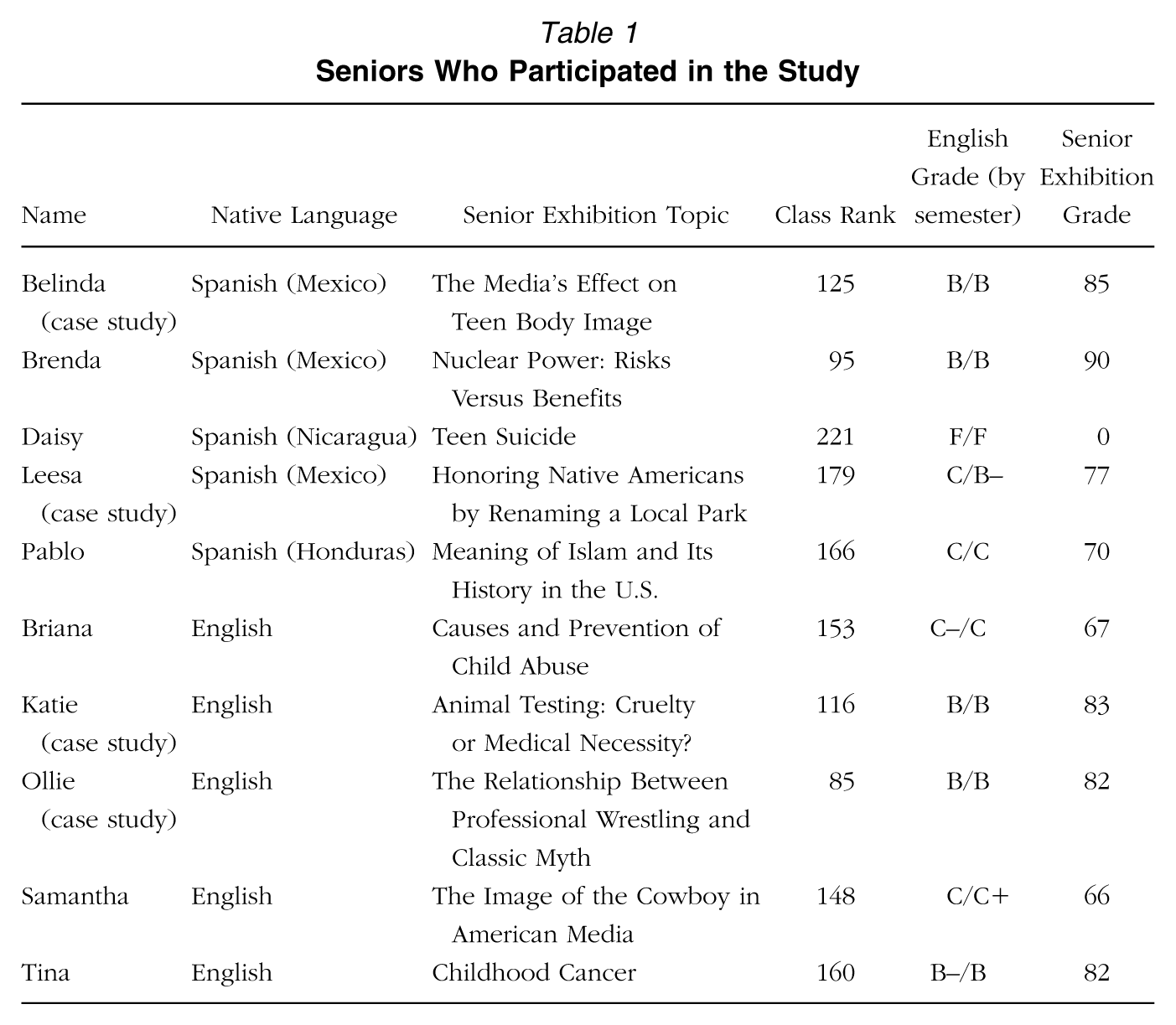
Data from all 10 participants were included in the early stages of data analysis to note initial patterns across participants’ experiences and to contribute to the coding scheme. I selected a subset of 4 students—2 native English speakers and 2 native Spanish speakers—based on the richness of the data for each participant and the degree to which the data suggested representativeness of dilemmas or trends noted in the literature with regard to academic writing. To illustrate the most salient language and literacy patterns of linguistically diverse mainstream students, details are presented in this article from the cases of three students: Ollie, Belinda, and Leesa. In this section, I describe each young person’s background in terms of his or her language and literacy experiences, as described in their interviews and questionnaire data.
Ollie
Ollie was raised in a monolingual Caucasian English-speaking family in Toledo, California. He had relatives on the East Coast and in Canada as well as in California. Ollie’s brother was a student at a state university about two hours away. Before Ollie’s brother left for college, the males in the family, as well as male friends of Ollie’s brother, often gathered to watch professional wrestling matches on television. In fact, Ollie was still watching wrestling and discussing it with his brother in real time during their weekly telephone calls, as he noted in an interview: “When we usually watched wrestling on weekly shows, we’d speak to each other while we were watching it.” Outside of school, Ollie’s time was also spent mostly around other males, with football practices and games during the school year and work as a camp counselor during the summer. Mrs. Godkin, Ollie’s mother, was a fifth-grade teacher in the same school district, and according to Ollie, she had always been very involved in his schooling and school-related projects. He resisted her help at times, though, especially in preparing presentations, explaining,
I remember all through elementary school and middle school, she always helped me with, I always do well, but she’s always helped me, with presentations and you get frustrated because she’s like no, you gotta do it this way, blah blah blah blah.
His frustration with her was mingled with admiration, however, as he added, “She’s so good at it, it’s ridiculous. She’s not afraid. I admire that.”
In spite of his mother’s involvement, Ollie struggled with academic reading and had been placed in a remedial reading class in the ninth grade. In describing his early high school English instruction, Ollie explained,
Like you know how you take the test at the beginning of the year tells you what reading level you’re at? My class wasn’t considered grade level so we did a whole a lot of reading and trying to comprehend, so by the end of the year when we took the test at the end, we were all past high school.
Despite struggles with reading, Ollie’s grades were good, averaging Bs in most of his classes, including English. Of the 10 focal students in the study, his class rank was the highest, at 85 out of 227 (compared to Belinda’s 125 and Leesa’s 179). Still, Ollie avoided reading and found tricks to meet academic requirements without doing the requisite reading. The strategies that Ollie used in place of required reading became apparent over the course of his Senior Exhibition project.
Belinda
Having emigrated as a small child from Mexico with her mother to Toledo, California, Belinda had attended Toledo schools in English-only classrooms her entire life. She lived with her mother and younger sister, settling near other bilingual relatives in Toledo. Belinda could not recall seeing her mother read or write in English or Spanish, and she reported that her own experience with reading and writing had been almost exclusively in English, since the daycare and school-based summer programs she attended were all English-only. Although she did not own books, Belinda said that she brought home storybooks in English from the after-school programs, especially liking the Sweet Valley High series. She wrote at home infrequently: She never kept a diary or wrote letters, but she drew occasional pictures for her mother that might have had a few words of affection. At the time of the study, Belinda’s mother did not speak English and relied on her daughters to interpret when English was required. Although she could not recall ever seeing her mother read or write in Spanish, Belinda learned Spanish literacy skills as a by-product of her Catholic catechism classes, which her mother insisted she take in Spanish.
In kindergarten, Belinda’s teacher referred her for nearly every type of special service: ESL classes, Chapter 1 (services for low-income students), and RSP (resource specialist program for students with learning disabilities). Although notes in her cumulative file say that she “didn’t qualify” for RSP, Belinda repeated kindergarten with ESL support and was designated as fluent English proficient by the end of the following year. From 1st grade forward, Belinda was in regular English-only mainstream classes, although her 8th-grade mathematics teacher noted in her cumulative file that she might need a “sheltered” mathematics class, with instruction designed for students who are not fully proficient in English. This notation indicates that even though Belinda had been in mainstream classes since kindergarten, her bilingualism was still noted at times as a source of academic struggles. While Belinda never remarked specifically on the relationship between her own language proficiency and school performance, she did comment on how bilingual education programs could “really hold you back” academically. She compared her sister’s experience in the district’s well-respected bilingual program to her own experience in English-only classrooms, attributing her sister’s greater struggles in English-only classrooms to her earlier bilingual instruction. Belinda’s 12th-grade English teacher, Mr. Quinn, identified her as a student needing a lot of help with writing but one who was persistent in seeking that help.
Leesa
Leesa’s language and literacy experiences were influenced by several unique factors related to family, immigration, and schooling. The daughter of rural Mexican parents, Leesa’s upbringing was transnational and bilingual. She was born in a small rural town in Mexico not far from a tourist area. Although her father was illiterate, her mother could read in Spanish. As a small child, Leesa was mostly in a Spanish-only environment. When Leesa was 4, her mother remarried an English-speaking American who understood some Spanish but encouraged English in the home. Although they were undocumented, Leesa’s stepfather moved the family to Texas, where he was ultimately incarcerated. Literacy activities in the home involved letters to and from her stepfather and her mother’s Spanish Reader’s Digest and Watchtower magazines. During her 4 years in Texas, Leesa attended a bilingual school and was awarded prizes for her English reading abilities. At age 8, Leesa returned to Mexico with her mother, with schooling in Spanish and classes in English as a foreign language. At 14, Leesa moved with her mother and a second English-speaking stepfather to Toledo, where she enrolled as a newcomer immigrant student at Cerro Vista High School. Leesa’s mother insisted on concealing their former undocumented status; therefore, school personnel were unaware of Leesa’s former bilingual schooling in Texas. Leesa described her stepfather as “this really Republican” who rarely shared her liberal political views. However, she admired his verbal skills, wishing she “could just have half of his persuasion.”
Leesa was the first student referred to me by the teacher, and the only student specifically nominated for inclusion by the principal. The Cerro Vista faculty believed that Leesa was a newcomer to the United States when she began high school. As such, Leesa’s arrival and rapid transition into mainstream classes was seen as remarkable. Leesa’s questionnaire and interview data corroborated the school’s assumptions that she spent her childhood and early adolescence in Mexico, arriving in Toledo at the beginning of ninth grade. Although the school initially enrolled Leesa in English language development classes, she enrolled in mainstream classes by the second semester of ninth grade. She was perceived as a quick learner, and she mastered a high degree of English proficiency far more quickly than most newcomer immigrant students from Mexico. From the school’s perspective, Leesa was a case of an “exceptional” English learner. No one voiced concerns about Leesa’s skills, performance, or potential since she outperformed all other newcomer students at the school. According to Leesa, “ESL kids . . . have their own little world. The way the school is set up doesn’t get them into CP [college prep] classes. They’re in their own little box.” She also noted the remedial classes that many were enrolled in, in spite of their previous mastery of the same content and skills, albeit in a different language.
Data Collection
Data collection included micro- and macroethnographic approaches (Heath, Street, & Mills, 2008), including participant observation, semistructured interviews, audiorecording of one writing conference per student, 2 and the collection of a variety of documents and artifacts. Throughout the year, I observed the participants in Mr. Quinn’s English class one to three times per week, and I interviewed teachers who had helped to develop and implement the Senior Exhibition at Cerro Vista. I also included in my analyses every draft of the Senior Exhibition essay that each student submitted to his or her teacher, with the required 4 drafts as a minimum and 11 drafts from Belinda as the maximum.
In my role as cross-cultural, language, and academic development coordinator for the university’s secondary licensure master’s program, I also observed participants in other classrooms, since Cerro Vista was the placement site for many of our student teachers. This meant that Cerro Vista students were accustomed to seeing me and other university personnel informally taking notes in a corner of the room in a variety of classrooms. I visited the school site 68 times during the course of the academic year. During each visit, I observed and took field notes in the English classroom; additionally, I often observed focal students in other classrooms and school locales, took field notes on meetings with eight teachers and administrators who were involved in the original design and implementation of the Senior Exhibition at the school site, and formally interviewed three teachers and the principal. I audiorecorded two interviews (45–90 minutes in duration) with each focal student—one in October or November as they completed the first six pages of their essay for submission to the teacher, and another in May after their final drafts had been graded. Harklau (2001) and Pope (2001) have both commented on the lack of student perspectives in much of the research on adolescents and schools, so interview data were crucial to the study’s design, with questions at the end-of-year interviews informed by analyses of earlier interviews, observation data, and review of students’ written drafts. Their Senior Exhibition presentations, which were delivered before a panel of teachers, students, and at times, community members, were videotaped and audiotaped for inclusion in the analysis. My intention was to capture the particularities of the young people’s experiences related to the Senior Exhibition, since, as Harklau (2001) noted, the strength of case studies is not in their ability to generalize but in capturing the trends and patterns unique to specific people, events, and contexts.
Language socialization data
Although the field-based data collection efforts focused on capturing the experience of focal students as they engaged in their Senior Exhibition projects, many questionnaire and interview questions were designed to elicit information about the young people’s home language socialization and prior school-based socialization into academic language. This was essential to understand students’ prior language and literacy skills and dispositions that were interacting with school-based notions of language and literacy throughout the project. Questions in the initial student questionnaires, for example, asked students to contribute information about the types and “tracks” of classes in which they had participated in the past. Bilingual students were also asked to select which language they primarily spoke with a variety of family and nonfamily members. All students were asked to answer questions about the ease with which they engaged in different types of language activities in English and, if applicable, Spanish. While questionnaire data provided an overview of students’ schooling and language use, interview questions and informal interactions with students elicited rich data concerning their use of language inside and outside of school historically and at the time of the study. Some interview questions were directly focused on eliciting such information, for example, “When do you talk to your family about your Senior Exhibition? What kinds of things do you talk about?” and “What special talents, abilities, or interests do you have outside of school? How do they relate in any way to this project?” Follow-up questions focused more deeply on language socialization issues. For instance, Belinda said that she was not planning to invite her mother to her presentation because her mother would not understand anything. This prompted questions about how her mother gets the information she needs, who in the family has interpreted for her, and how these experiences have affected Belinda.
Analyses
Analyses were informed by qualitative approaches in sociolinguistics, drawing from methods in ethnography of communication (Duff, 2002), discourse analysis (Gee, 1999), and rhetorical analysis (Hatch, 1992) within case studies exploring the multiple literacies of each focal student (Dyson & Genishi, 2005). Initial analyses of the data began through a recursive process during the data collection period, with ongoing review of the data throughout the study so that incipient patterns could be explored by refining future interview questions and reshaping next steps in data collection. Final data analyses were conducted the summer and fall after students graduated; the students and the teacher were available to answer brief clarification follow-up questions when necessary during that period. Ultimately, data analyses involved open, axial, and selective coding (Strauss, 1987) of transcripts, field notes, and student texts. In the tradition of Dyson and Genishi (2005), sociolinguistic concepts were used to guide the analysis of how the learning and performance of language and literacy practices were “socially organized and enacted” (p. 110). In this way, language data were analyzed not only for content but also for linguistic features such as lexicon and syntax and sociolinguistic constructs such as literacy events, participation structures, communicative acts, and functions (Dyson & Genishi, 2005, p. 87). In order to confirm or contradict patterns that emerged in preliminary analyses of data from initial interviews, field notes, and students’ written texts, I conducted “member checking” (Creswell, 2006) by embedding questions in the final interviews to elicit students’ perspectives on these patterns. Many of these questions also evolved from changes that I noted as I analyzed each draft of the essay for changes in content, organization, development of argument, and language use (syntax, lexicon) and tried to trace the origins of these changes to influences from the teacher’s feedback, other print resources (the handbook, friends’ papers), and human resources (mentor, friends, siblings, parents, other teachers).
Although I initially conceptualized the project as a “writing study,” the analytic process revealed patterns far broader in scope, requiring more attention to the social aspects of literacy and more layers of analysis than originally intended. According to Strauss (1987),
Often in contemporary qualitative research the emphasis on interactions (and on immediately contextual aspects in relation to interactions) is so strong that it overwhelms or prevents attention to the larger structural conditions. . . . Minimizing or leaving out structural conditions, whether more immediately contextual or “further away” . . . short-circuits the explanation. Doing the reverse, overemphasizing structural conditions, does not do justice to the rich interactional data that put life and a sense of immediacy . . . into the analysis. (p. 78)
Initial patterns in the data called attention to this dilemma and made me recognize two needs in terms of analyzing data with attention to depth and breadth of the young people’s experiences and literacy practices. First, I needed to use patterns noted in the initial analyses to reduce the number of participants whose data would be analyzed in depth for full case studies. Next, I would need a framework that could capture texts, interactions, and contexts in ways that highlighted the language experiences of the young people involved in the study.
Based on trends and patterns from the initial analyses, I selected a subset of students for deeper analyses based on the depth and breadth of data from each case, their representativeness and uniqueness of experience, and their availability for follow-up consultations through the analysis stage. Of this subset, three are presented here to illustrate three distinct cases of academic language and literacy in the New Mainstream. As a bilingual Latina student, Belinda was considered to be typical of many Generation 1.5 (Harklau, Losey, & Siegal, 1999) students—children who grew up in homes where another language was spoken but who were schooled almost exclusively in the United States. As such, her case illustrates how former English learner status affected learning opportunities and framing of her educational successes and struggles, by the school and by Belinda herself. Leesa, on the other hand, was considered by school personnel to be atypical in a number of striking ways. Leesa defied categories, and a number of factors allowed this to facilitate her access to important opportunities for learning and development. Leesa’s case reveals the potential for learning and growth that is available to young people when traditional categories and dichotomies no longer constrain their opportunities or conceal their strengths and skills. Ollie was nominated for participation in the study because, according to the teacher, he was a strong student with some fairly typical challenges with regard to academic literacy. While his case might initially appear to represent one “typical” White native-English-speaking student’s experience of academic language and literacy, it ultimately exposes the ways in which traditional categories also limit our understanding of these students’ learning, skills, and needs. These three cases, then, offer evidence to argue that traditional categories and dichotomies do not serve any students in New Mainstream classrooms but instead constrain teachers’ and researchers’ understanding of their performance and limit the students’ opportunities for growth and learning.
Findings and Interpretation of Data
Each of the following cases illustrates a unique approach to language and literacy from the experiences of a student in the New Mainstream. In this section, I describe patterns related to language and literacy that emerged in the data from each focal student’s case, illustrating these patterns with excerpts from interviews and brief selections of writing from the young person’s final written draft of the Senior Exhibition essay. This is followed by a response to the question “What is this a case of?” to consider how these patterns might be interpreted within traditional lenses on academic language and literacy, as well as more contemporary New Mainstream conceptions.
Language and Literacy Experiences of Ollie
Ollie’s Senior Exhibition
The teacher thought Ollie’s Senior Exhibition topic was one of the most creative, “The Relationship Between Professional Wrestling and Classic Myth.” Actually, Ollie had combined a personal interest with a friend’s Senior Exhibition topic to arrive at his topic choice:
Well, I like professional wrestling. And since my brother is two years ahead of me . . . so I knew that they are gonna—he found out they are going to have a Senior Exhibition. So I figured when I become a senior I am going to have it so, for five years I have been thinking about how I can connect it to professional wrestling. And then last year a friend of mine did his on the graphic novel, The Watchman, and how it relates to classic myth, so I just took his idea into the professional wrestling and just started it.
By incorporating professional wrestling into his Senior Exhibition topic, Ollie was able to discuss the project with his older brother regularly. In their phone calls, Ollie explained,
Then he will ask me a question I’ll refer to a match that happened a week before and I’ll explain how it related to one of my things. Like, I wouldn’t tell him specific ones that I used on my paper, because some of them are from like 1980 matches or whatever, but I’ll talk to him about uh, we get in like a two-hour conversation about a match that’s happening now and how it relates to a certain myth.
Since his brother had experience with professional wrestling and with the academic demands and expectations of the Senior Exhibition, this provided Ollie with ongoing informal support to make connections and develop ideas.
The academic literacies that Ollie used to complete his Senior Exhibition successfully all demonstrated creative ways to meet the teacher’s standards without engaging in deep academic reading. Although Ollie’s lack of reading for the project may have stemmed from disinterest or his own admitted laziness, the fact that he had been enrolled in a remedial reading class, together with comments in his interviews, suggests that reading might still have been a source of struggle for Ollie. For example, Ollie told me that for his project he read “nothing complicated. I’m not into reading as much as people that I know and it was fairly simple reading.” When I asked him how he met the assignment’s requirement of including a book as a source, he told me he had a “book of Greek myth. It has myths in it, but it’s a children’s book. It’s a simplified book, which is good for me.” First, he found print texts that were nonstandard sources readily accessible. He noted, for example, that “I really didn’t do any book readings. I haven’t done any actually for my report—mostly the Internet.” The children’s book on Greek myth was actually from his mother’s fifth-grade classroom, but this would not be obvious to his teacher, who saw only the title in Ollie’s list of references. For other sources on mythology, Ollie relied on two sources. The “Internet” sources that he referenced above were not actually the result of his own Internet searches. Instead, he pulled Internet quotations from his friend’s Watchmen paper, citing the URL as his friend did so that it appeared he had done the Internet research. Other quotations, from Joseph Campbell’s books, actually came from the teacher, either from handouts distributed in class or from helpful hints that the teacher supplied to Ollie during writing conferences. Ollie was skilled at eliciting from the teacher exactly what the teacher would require in a successful paper. For example, when the teacher wanted more direct quotations from Campbell’s books instead of Internet sources, Ollie explained evasively,
But, oh no, but uh, I type the website in and it does the e-mail, the URL thing and it’s all messed up. I got this from a friend of mine who, uh, found that. I’ve been trying to find like, ya know like type in like hero’s journey and I can’t find? quotes or anything? that would be like . . .
The teacher responded by saying,
My guess is it’s from the Hero’s Journey, his book the Hero’s Journey. And my guess is that it’s gonna be in the first chapter of the Hero’s Journey, just from what it’s saying [reads aloud again] . . . or maybe in the introduction.
He then pulled a copy of the Hero’s Journey from his bookshelf, found an equivalent quotation in the introduction, and told Ollie where to include it in his paper. Rather than include the exact quotation in his paper, however, Ollie chose to paraphrase and cite a different Campbell source.
Ollie’s first Campbell citation appears in paragraph 8 of his 24-paragraph (16-page) essay. According to the handbook, which adapted this heuristic from the school’s AVID program, students were to apply different sorts of typeface to sentences that served different functions in a paragraph in order to make sure that the paragraph was complete: boldface for topic sentences; underlining for evidence and analysis; italics for sentences that tie back to the thesis statement. Although Ollie reassigned the text conventions in his paragraph below, he adhered to the purpose of the heuristic. The full paragraph illustrates how Ollie cited Power of Myth where the teacher called for a primary source citation in his previous draft, discussed during their writing conference.
When a story is passed from one generation to another, the costumes or images change along with the details, but the original message of the story is always the same.
In his list of works cited, Ollie listed “Campbell, Joseph,
Ollie, a case of . . .
Ollie is an interesting case that could be understood from a number of perspectives. In some ways, he appears to be a classic case of a mainstream student “doing school” with strategies noted by Pope (2001) and others, facilitated by linguistic and interactional norms and skills that he acquired at home as the son of a teacher. In other ways, he presents the case of the “remedial” student working very diligently at school to show what he knows and hide what he has not learned (Varenne & McDermott, 1999). Social reproduction theorists would also view Ollie as a case of mainstream White middle-class male entitlement, shepherded through the system toward good grades in spite of evidence that his conventional academic skills were no greater than those of his Latina classmates. The behaviors he engaged in throughout the Senior Exhibition process could be seen as deceptive or creative, lazy or strategic, depending on the lens of the observer or evaluator. In fact, different “official” lenses evaluated Ollie’s Senior Exhibition quite differently. In order to make the workload of 12th-grade English language arts teachers more manageable in light of the extra Senior Exhibition demands, the final essays were distributed to teachers across content areas schoolwide for grading with the standardized rubric. Ollie told me that his final draft was assigned a grade of D by a physical education teacher but that Mr. Quinn disagreed and changed the grade to a B before grades were submitted. On one hand, Ollie’s case can be explained by literatures on White privilege and social capital; however, the particular experiences of Ollie are not easily captured by only one lens. Most literature on “mainstream” literacy would suggest that this middle-class White male student—a native speaker of English and the child of a teacher—would have internalized many of the literate behaviors and skills necessary to complete the Senior Exhibition project successfully without the kinds of subterfuge Ollie employed. How helpful, then, are the labels of mainstream, White, or native English speaker, if there is a possibility that these labels masked Ollie’s learning needs and prevented him from acquiring important aspects of advanced language and literacy?
Language and Literacy Experiences of Belinda
Belinda’s Senior Exhibition
The title of Belinda’s Senior Exhibition project was “The Media’s Effect on Teen Body Image.” When I asked her how she chose her topic, Belinda said she had not considered any other topics, adding,
Actually, one of my friends last year, her sister did her Senior Exhibition on like, I think it’s something similar. I’m not sure, it’s the same or something similar and I went to go and see hers—because at the end you have to give that big presentation, with the teachers and stuff—and I went to see hers. And it was really good and I also, I liked it.
With 11 drafts, Belinda produced more iterations of her Senior Exhibition essay than any other student in the study, seeking written and oral feedback from her teacher and mentor (another English teacher) at regular intervals beyond the required 3-draft feedback schedule. Belinda referred to herself as a writer only once in the interview data, and even then indirectly and in comparison with friends whom she felt had more natural talent for writing. She described how she planned her writing time to avoid procrastination, explaining,
But my friend, see it’s all about how good of a writer you are, you know? I think, me, personally I need so much time to get things done, right? Some of my friends know, you know, they stay up all night and they get like, ten pages done. I can’t do that, I need time.
Certain words and constructs related to academic language and literacy were common in the data from Belinda’s case, including structure/format (both terms she used to talk about expectations for organizing her paper), correctness, and plagiarism. With regard to her inquiry process, consensus and typicality were the principles that guided her choices about how to choose a topic, how to evaluate sources and select information for inclusion in her essay, and how to approach next steps in her writing process (see Villalva, 2006a for more information about Belinda’s inquiry and writing process). In general, Belinda’s writing reflected a commitment to following the precise rules provided by her teacher and the handbook. Her final draft was 18 pages long (excluding bibliography) with 22 paragraphs. We see an example of the boldface/underlining/italics heuristic in Belinda’s paragraph below. This is paragraph 11 of Belinda’s final draft, selected for inclusion here because it is halfway through the paper and is typical of later paragraphs in terms of the use of the heuristic as well as development of ideas, stance, or argument:
By adhering so tightly to the prescribed heuristics, Belinda was able to draft an essay that met the evaluation criteria in the schoolwide rubric. However, this approach also prevented her from developing an idea or argument beyond the one- or two-paragraph level since the tie-back sentences at the end of each paragraph returned her to the basic idea of the thesis statement on the first page. In this paragraph, like most others, Belinda includes one new source-based idea—that the diet industry is a lucrative one—and builds around it with restatements of her thesis from paragraph 2 (“The media affects a teenager’s self image through advertisements and magazines which portray beauty as the single and most crucial element necessary to thrive in our society”) and restatements of the new source-based idea.
When asked what she thought her teachers knew about her topic, she noted that it was a typical topic and that they had read other papers on the same subject. Then she responded, “But maybe not much. I mean, I’m sure after they’ve read the whole paper, they get an idea, you know?” Overall, though, Belinda was most concerned with fixing the “corrections” that her teacher and mentor asked her to make. Her concern with “structure” and correctness motivated Belinda to select another English teacher as the outside mentor for her project, even though students were encouraged to choose adults from outside the high school, preferably experts in their topics. Belinda explained her choice by saying,
I felt like I wanted an English teacher because that way, writing my paper, she can help me a lot in my structure and stuff, so I know exactly what I need to do. And yeah . . . that some teacher can also help but I think it would be more appropriate for an English teacher.
Belinda, a case of . . .
So what, exactly, is the experience of Belinda a case of? What and whom does she represent? Clearly, when she entered the school system as a kindergartener, Belinda was identified as a student outside the mainstream as her teacher sought any number of services and their corresponding labels to find instructional supports based on Belinda’s various differences or deficiencies. Ultimately, language services were the only supports for which she qualified, and after one year of pull-out ESL classes, Belinda was officially designated as fluent in English. However, simplistic notions of language remained the reasons cited for Belinda’s struggles in school. Her 8th-grade mathematics teacher noted her bilingualism and “limited” English proficiency as the reason for her struggles in his class, even though she was not “limited” in her English according to standard school-based criteria. In her 12th-grade English class, the teacher noted Belinda’s writing as an area of struggle, saying that “she writes like she talks.” To help Belinda write more coherently, the teacher focused on issues of text organization in ways that emphasized “structure” over argument or message. During a writing conference, for example, Belinda asked Mr. Quinn a question about “paragraph structure” to clarify a notation he made in a margin comment that said, “Eating disorders all together.” Belinda pointed to the comment and said, “There we go! That paragraph’s all together.” The teacher noted her misunderstanding and replied, “Oh, what? Good. Let’s make sure we understand what that means. When I said eating disorder paragraphs all together, I don’t mean to put them all into one big paragraph.” The emphasis in their discussion of her writing, then, was less on the message and argument and more on how to chunk the text and where to place each chunk. In other words, the emphasis was on the structure of the text. Likewise, their discussions of citing expert sources also revolved around structure over meaning. Belinda reported that Mr. Quinn noted her copying from sources by telling her, “‘Belinda, you need to fix this plagiarism!’ Blah, blah blah. He was a little upset. And I’m like, ‘I’m sorry,’ I’m like, because I did cite them like, right after every paragraph.” Academic language and literacy in Belinda’s experience, then, were rooted in English-only contexts and involved understanding the rules and following them appropriately. Features of text were more important than the underlying meaning of the text, and experts were required to avoid mistakes and make necessary “corrections.” Belinda’s case, then, was the case of a Generation 1.5 student whose experiences with academic language and literacy emphasized form over function, product over process, and gist over argument. Like many Generation 1.5 students, her bilingualism was flagged in her earlier years as the primary obstacle to school success; by her senior year in high school, however, her bilingualism had been made invisible. Her teacher described Belinda’s writing by saying, “She writes like she talks,” without acknowledging that she also talked in Spanish and that her experiences in Spanish might inform her development of academic language and literacy in English if acknowledged and explored in school contexts. Neither approach, then, captured the nuances of Belinda’s language and literacy repertoire, nor did either approach help teachers to identify and address her specific needs. Her final draft was a product of instruction that emphasized following prescribed rules, and it followed these rules quite successfully, to the detriment of cohesion and argument. Many of her writing patterns were illustrative of the needs of monolingual English-speaking “basic writers” (Emig, 1997; Shaughnessy, 1977) rather than issues related exclusively to bilingualism and English proficiency. Like the writing of many basic writers, Belinda’s texts contained “common errors” (Shaughnessy, 1977) such as issues of subject-verb agreement, problems with proper citation, and issues of syntax and punctuation. Many monolingual English-speaking students struggle with these issues in high school and college classrooms. No label, then, was adequate to identify and meet all of Belinda’s strengths and learning needs.
Language and Literacy Experiences of Leesa
Leesa’s Senior Exhibition
The focus of Leesa’s Senior Exhibition project was to research the history of misnaming and stereotyping Native Americans in the U.S. while also documenting her social action group’s efforts to change to the name of “Indian Springs Park” to more accurately reflect the actual tribe that had once inhabited local lands. She explained that she felt the Senior Exhibition should be “something that people can do” and remarked, “I don’t think it should be like, ‘Oh, go and do some research on something.” As an exceptional English learner, Leesa often benefited from relaxed deadlines on her assignment in ways that drew attention and complaints from her classmates. Mr. Quinn did not relax deadlines for Leesa’s bilingual classmates who were known to have been in the country since early childhood. Belinda quoted a mutual friend of the girls as saying, “I don’t understand how Leesa turns things in way after they’re due and she gets good grades on it, and I don’t understand it.” She also noted that Mr. Quinn did deduct points for lateness but that Leesa still did very well considering her tardiness.
Leesa’s profile of academic language and literacy around the Senior Exhibition was exceptional in many ways. She embraced the “personalization” aspect of the project in a way that excited the teacher, who abandoned the formulaic approach of heuristics (as in Belinda’s writing conference above) that he usually used to scaffold writing, perhaps partly because Leesa already had a purpose and argument in mind as she drafted her paper. Also, the nontraditional approach of her paper—which focused on a real social outcome—did not lend itself to the traditional forms that teachers (and district standards) had in mind when the rubric was designed. The connections between research, writing, and action facilitated a focus on research and writing for a specific purpose and goal. Rather than focus exclusively on the composition process as he did with other students, Mr. Quinn focused equal or greater attention to Leesa’s inquiry process: Whom should she approach for information on city processes? Would involvement of local media support or hurt her cause? Leesa welcomed complexity and differing perspectives in her research and wove these into her text. She mentioned a local historian whom she interviewed for her project, saying, “Without him, I’d be further along, but I wouldn’t know as much.” In talking about various interviews for her project, Leesa said, “I think I really learned a lot from seeing different views.” She explained how her own position on the naming and protection of the park changed based on each interview, ending with one interview that “totally changed my viewpoint . . . so, talking to people is definitely important.” For this particular type of project, Leesa was able to produce sophisticated academic English in writing, with occasional nonstandard conventions and flaws in mechanics. Her writing was coherent, and her argument was well supported with details and the integration of expert sources, both print and interview. Still, Leesa said, “I have a lot of problems writing essays . . . it’s definitely not my strongest point. . . . I’m not good at writing.” She explained, “I don’t know like verbs and adjectives . . . it’s kind of like you skip over all the basic stuff which is really important to build on for that next level.” Leesa’s greatest writing challenge was spelling, although her word-processing program’s spell-checking tool corrected most of her mistakes on her Senior Exhibition drafts (homonyms remained a problem).
Although Leesa did attempt to mark most of her paragraphs according to the typeface heuristic suggested by the teacher and handbook, her essay was unconventional in many ways and unlikely to fit the standard expectations of the rubric. Since her project had a real-world social outcome—to promote changing the name of a local park—her paper synthesized literature and expert opinion on her topic but also reported on her firsthand experiences of learning how to have the name officially changed by the city. Her written draft reflects this shift from the first half of the paper into the last half; the traditional portion of the paper reflects more standard expectations for academic writing, while a style closer to her oral discourse is evident in the later portion. In paragraph 6 of her 17-page, 20-paragraph final draft, Leesa develops her argument, provides local and national examples, and integrates citations from three Internet sources. She opens her argument with a broad claim, inviting her audience into the “problem” of her project with a rhetorical question about racism and ignorance. She continues to develop her argument about school names reflecting stereotypes of Native Americans by referencing a local high school as well as a local but nationally recognized university. Although the writing has minor flaws, such as the typo of the word “from” (written as “fro”) or the slightly awkward placement of the Squaw Valley example amid a discussion of schools, the paragraph is sophisticated in its synthesis of ideas and development of argument and reflects traditional norms for academic writing of argument in expository text.
A school is supposed to be a place where lives take shape, where people grow and learn and have the opportunity to become better people, but how are they do that if the representation of their school is based on racism and pure ignorance? Just as there are sports teams named after Native Americans, there are also many schools that are named in “honor” of indigenous people. Some of them are within the Bay Area.
In paragraph 10, however, the voice and style of the text change as Leesa reported on her inquiry process into changing the park’s name. The text in this section of the paper approximates Leesa’s oral discourse style much more closely. This paragraph includes the following sentence: “Mr. Russell was able to provide us with great ideas and he helped the group get started in the right direction.” Other sentences began with, “So we decided that since our goal was to educate the community” and “So we are going to write a friendly informative letter to the community.” Leesa was not penalized for this shift in her writing, however, since there were no established norms for writing up this type of process within the Senior Exhibition.
Leesa, a case of . . .
The case of Leesa reminds us how dangerous it can be to try to capture the history, performance, or experience of a student within a particular category or label. School personnel unequivocally identified Leesa as a case of the exceptionally successful English learner, building all conceptions of her student identity and performance from her earliest identification as a newcomer immigrant student. Many researchers would consider Leesa a case of a transnational young adult, transporting and extending literacies learned from one context into another. Even if one acknowledges the incredible heterogeneity of transnational Mexican migrants, Leesa’s case is still unique among them, however, due to her bilingual upbringing with American, English-speaking stepfathers; her access to several years of bilingual schooling; and the attention to developing biliteracy throughout her childhood and young adulthood. Ultimately, then, Leesa is an extreme case of exceptionality and hybridity in terms of her schooling, her language development, and her literacy experiences, and the transnational label is insufficient to capture the nuances of this hybridity. While it is easy to note how her transnationalism and hybridity may have contributed to the development of remarkable language, literacy, and inquiry skills, it is also important to consider how the unpredictable and varied nature of these experiences could also have been blamed for school failure had she been less successful. In fact, her misrepresentation of her newcomer status—which her mother required in order to conceal their previous years as undocumented residents in the United States—was most likely a key factor in Leesa’s success since it allowed her to “use cultural resources during local social interactions in ways that contribute to the on-going production of categories like success and failure” (Bartlett, 2007, p. 217). In Leesa’s case, this subterfuge allowed her to interact with the teacher and school officials as a model of the successful newcomer student in situations where her tardy assignments might have framed her as an unmotivated or lazy student, an ill-prepared Latina student, or any number of other undesirable forms of school failure. It is also remarkable that Leesa chose, with her teacher’s enthusiastic support, a nontraditional approach to the assignment by selecting a topic with an actual community outcome as its goal. This choice resulted in a written draft that pushed the limits of standard expectations for writing of a Senior Exhibition essay. For Leesa, this resulted in extra flexibility and a chance to move beyond the constraints of the prescriptive writing “supports” given to other students.
The New Mainstream as Diversity and Hybridity
The cases reported here involved young people’s diverse responses to the language and literacy demands of academic research and writing as each student’s home and community language and literacy experiences interacted with the labels and categories of a more tightly defined school-based life. While some patterns that emerged in each young person’s Senior Exhibition experience were clearly attributable to membership in a particular linguistic community, home language socialization, or academic track, many patterns were much more particularistic in nature, requiring insights into the multiple memberships and hybrid experiences of the students’ histories and communities. Leesa and Belinda, as Latina second-language speakers of English, both shared concerns about the basic writing conventions of spelling and grammar. Both had educational trajectories that were, at some point, determined by their English learner status. Their particular experiences and specific trajectories were quite different, however. In many ways, Leesa and Ollie shared many characteristics, as each young person’s awareness of the educational system and his or her position in it allowed for more strategic maneuvering and more deliberate sharing and eliciting of information to manage their own trajectories. On the other hand, the cases of Belinda and Ollie also had similarities. Both young people had been identified as somehow deficient during their educational careers, and while neither assumed a permanent labeled identity of English learner or remedial reader, these earlier identifications affected what they learned, how they engaged with texts and information within and beyond school, and how they saw themselves as learners and students.
The case of Leesa is especially revealing because the absence of aptly fitting labels and categories allowed her to develop, transport, and extend skills acquired from one context into another in remarkable ways. While not all transnational literacy practices are “emancipatory or resistant” (Warriner, 2007, p. 210), in Leesa’s case these literacy practices interacted with school expectations in a way that supported her unique ability to cross borders, both figuratively and literally, and to make conscious choices about how to draw from learning in one area to promote further learning in another. Luke (2004) makes a compelling argument that teachers must prepare all students for such border crossings in this era of ever-expanding global media, technologies, and economies. Even within a “traditional” school day, each time a young person moves from home to school, from mathematics class to English class, from an athletic activity to a workplace, he or she is crossing a border into a new domain with new demands for language and literacy use and new opportunities to acquire more advanced portable, extendable language and literacy skills that prepare him or her for the demands of the new cosmopolitan work (Luke, 2004) of learning beyond the classroom. Attention to the multiple group memberships and individual particular experiences of young people in contemporary classrooms may facilitate more successful border crossings so that all students can experience the kind of learning demonstrated by Leesa.
The Merriam-Webster Online Dictionary (2008) defines “mainstream” as “n. a prevailing current or direction of activity or influence.” Increases in linguistic diversity across the country suggest that traditional educational notions of mainstream that normalize White, middle-class, English-speaking experiences (Lee & Luykx, 2007) are outdated. The students in our classrooms are members of a New Mainstream. The cases of Ollie, Belinda, and Leesa suggest that this New Mainstream will be best understood in terms of both diversity and hybridity. Notions of diversity within the New Mainstream assume that a mainstream classroom is likely to have the presence of students from different cultural and linguistic groups, with their respective language and literacy traditions and the multiple literacies that reflect these traditions. Hybridity is also an essential concept in understanding the New Mainstream, however, since it acknowledges that each individual student’s experience can reflect a dynamic movement across and within multiple communities. Indeed, young people are socialized into many norms as they participate in various domains and communities; each student is likely to have a complex repertoire of language and literacy practices as potential resources to support academic development and success. As noted by Ferdman (1990), “Literacy . . . involves facility in manipulating the symbols that codify and represent the values, beliefs, and norms of the culture—the same symbols that incorporate the culture’s representations of reality” (p. 187). As such, an individual can be functionally literate in one cultural setting while being perceived as illiterate upon entering a setting with different cultural norms. Ferdman argues, then, that students from the dominant culture are likely to find greater alignment between the norms of their cultural identity and the literacy norms promoted at school, whereas students from a nondominant culture may have a more difficult time navigating these differences, feeling compelled to choose between core aspects of their identity and essential values transmitted by school literacy curricula. While this is likely to be the case still, 20 years after Ferdman’s article we find that the constant flows between global and local in today’s societies, economies, and classrooms require a more dynamic, multiple, and flexible lens on literacy, even for members of the dominant culture who are consumers and producers of vast amounts of information from a broad range of media and technologies.
In order to support the academic language and literacy development of all New Mainstream students, then, a well-prepared teacher must have some knowledge of the language backgrounds and cultural experiences of groups within his or her classroom but must also learn to attend to the heterogeneity within each group and, indeed, within each individual student. As teachers of the New Mainstream capitalize on the diversity and hybridity of students in their classrooms, they will generate a hybridity at the level of group and practice, a space that allows students to use their own language and literacy repertoires in the service of purposeful learning (Gutiérrez, 2008; Gutiérrez, Baquedano-López, & Tejeda, 1999).
Academic English of the New Mainstream
Early conceptions of academic language and literacy, such as Cummins’s (1984) distinction between BICS and CALP, attempted to distinguish academic language as more “cognitive” than the “social” language used in informal interactions. Some scholars, such as Bunch (2006), note that even rudimentary social language can be used to do the academic work of content classrooms. Many contemporary scholars often discard the “cognitive/social” distinction in favor of linguistic (Hammond, 2006; Schleppegrell, 2004) or social (Canagarajah, 2003; Gee, 2004a; Heath, 1983, 1998) approaches to exploring advanced language and literacy uses in schools. While these approaches are especially helpful in exploring how language realizes academic contexts and how contexts influence or elicit particular uses of language, their emphasis on language artifacts or social context sometimes disguises the incredible linguistic diversity represented by the New Mainstream of today’s K–12 classrooms. This diversity is evident not only in the number of primary languages spoken by students within one classroom but also by the variety of ways in which students from the same primary language, including English, have been socialized into using language and literacy.
In this age of accountability, teachers and administrators are required at various points during the school year to reflect on the performance and progress of students according to preestablished categories of race, gender, or English language proficiency. As we engage young people in the everyday work of “doing school,” however, it is important to challenge these categories and learn as much as possible about the experiences and abilities of students as individuals. What is needed is a lens that draws from theories of language socialization at group and individual levels, that recognizes the power of labels to influence trajectories, and that encourages and builds on hybrid literacies as the foundation of learning for the demands of a cosmopolitan society and market. Such a perspective would focus on the experience of the individual, shaped by history and negotiated through language within myriad dynamic social contexts and interactions. Students of the New Mainstream who now fill America’s classrooms not only challenge traditional teaching practices that assume a uniform set of backgrounds and skills from our students but also open up new possibilities by bringing into the classroom a wealth of unexpected talents, perspectives, and unique experiences. Rather than trying to reframe academic language and literacy for the New Mainstream, adapting a mythical standard for students who defy standard categories, perhaps we need to reframe academic language and literacy of the New Mainstream, noting young people’s unique skills and resources and examining how these skills and resources can be and are taken up and engaged for sophisticated work within and beyond classroom walls. While it is important to understand and articulate the linguistic and academic demands of classroom tasks, it is also vital to identify the linguistic and social skills that young people are ready to bring to bear on these tasks. Otherwise, all students of the New Mainstream are underserved in our classrooms.
Research that uncovers the understandings, skills, and needs of students of the New Mainstream must explore the nuances of how a young person’s personal history with language and literacy affects his or her understanding of and engagement in different types of school tasks across classroom contexts. Such research needs to capture the language and literacy uses of young people, not only in the classroom but also outside the classroom, to have a better sense of the full linguistic repertoire in which members of the New Mainstream engage.
Practitioners, as they struggle to meet accountability requirements, must also learn to adapt standards-based instruction in ways that elicit from young people more about their lived experiences, with particular attention to their uses of language and literacy at home and in their communities. Again, it is important to avoid essentializing and oversimplifying what is learned from and about young people. Instead, teachers and researchers must recognize that most young people, regardless of race, gender, or language background, live hybrid experiences, participating in and across multiple communities and domains. More than a superficial attempt to learn about their experiences will be required to understand their experiences and build on them in the classroom. Many curricular approaches have potential for this kind of engagement. The Senior Exhibition held such potential, and it was realized in the case of Leesa. Long-term projects that allow for personalization will still require support from teachers to elicit students’ interests, help students to identify their unique skills and resources, and build on those skills in ways that expand students’ language and literacy repertoires. Inquiry-based learning rooted in students’ lived experiences also holds such potential, although again there are risks in building curricula around assumptions of students’ local knowledge (see Moje et al., 2004, for an example). Rather, instructional practices that take advantage of the resources offered by New Mainstream students must be flexible, adaptable, dynamic, and responsive. In other words, they must share many of the characteristics of hybridity and portability that we find in New Mainstream students themselves.
Footnotes
Acknowledgements
The author thanks Shirley B. Heath, Andrea Lunsford, Rachel Lotan, and George Bunch for their valuable suggestions and support throughout this research project. Early revisions of this manuscript were informed by seminar discussions with Shannon Cannon, Flori Centeno, Cirilo Cortez, Nancy Ewers, Karolyn Reddy, and Betsy Gilliland. Finally, the anonymous reviewers provided remarkably detailed, constructive feedback that significantly improved this manuscript.
1
Names of the school site and participants are pseudonyms.
2
Only one formal writing conference was required of each student, and this formal writing conference was recorded. Informal, unscheduled, oral feedback from the teacher was not audiorecorded but was accounted for in interviews and field notes.