






Abstract
The authors report insights, based on annual site visits to elementary and middle schools in three states from 2004 to 2006, into the incentive effect of the No Child Left Behind Act’s requirement that increasing percentages of students make Adequate Yearly Progress (AYP) in every public school. They develop a framework, drawing on the physics concept of an attractor basin, to relate to theoretical literatures in economics and psychology the experiences that teachers, principals, and parents are having with the law. The authors anticipate—and find evidence of—very different incentive effects of the AYP requirements on schools of different initial achievement levels.
The No Child Left Behind Act of 2001 (hereafter, NCLB) aims to raise all students’ academic performance to, at minimum, a uniformly high standard. However, there is much uncertainty and disagreement over whether the law achieves this goal. Many have anticipated problems with the law due to the nature of the incentive structure as implemented by NCLB: The mismatch between a complex task and a simple incentive mechanism causes distortions in behavior toward the rewarded aspects of the task and away from the ignored aspects (see, e.g., Goldhaber, 2002; Linn, 2000). Preliminary data analysis of test scores in the years following the introduction of NCLB shows that test scores have generally risen in the years since 2002 and that achievement gaps have narrowed somewhat (Center on Educational Policy, 2008; Fuller, Wright, Gesicki, & Kang, 2007). But there is much to question about what exactly these top-line results mean about the success of the law: There are concerns about whether test scores will adequately capture the effects of the law (Hamilton, 2003; Hamilton, Stecher, & Yuan, 2008; Koretz, 2008) and whether test score gains can be attributed to NCLB (Cronin, Kingsbury, McCall, & Bowe, 2005; Fuller etal., 2007; Lee, 2006).
Our article contributes qualitative confirmation, gleaned from elementary and middle school visits in three states from 2004 to 2006, that while some schools are making significant and positive changes, NCLB distorts others’ behavior in undesirable ways. Particularly, it highlights some areas of concern that are unlikely to be picked up in larger scale, quantitative studies. We saw signs that the law distorted behavior (or reinforced preexisting distortions) in schools across the spectrum of scoring levels, albeit in different ways.
Theoretical Problems Arising From the Incentive Mechanism of Adequate Yearly Progress
The purpose of NCLB is stated in its introduction: “to ensure that all children have a fair, equal, and significant opportunity to obtain a high-quality education and reach, at a minimum, proficiency on challenging State academic achievement standards and State academic assessments” (NCLB, 2001, § 1001). To achieve this purpose, the law relies on a single pass/fail vehicle, the Adequate Yearly Progress (AYP) measure, to deliver its core accountability and incentive mechanisms. The disconnect between the broad goals of the legislation and the narrow nature of the incentive mechanism means that the reform effort is limited both in who it reaches and in the extent to which it promotes a real improvement in the education of the students who are affected by the law.
We illustrate the problems that arise with an incentive system such as the one employed by NCLB by using a framework that helps predict the ways in which the system might fail and the contexts in which that failure is most likely. To this end, we use the metaphor of a “basin of attraction,” taken from physics (Milnor, 1985). In dynamic systems, an “attractor” is a set or point toward which all entities “close enough” to the attractor converge. Under NCLB, the AYP cutoff mark creates a basin of attraction that captures the schools most directly affected by the law. An attractor can be two sided or, as in this case, one-sided, attracting particles from one direction only.
If one were to array schools from lowest to highest “native” achievement levels—the percentage of a school’s students that would score as proficient or above on the state test if the school made no changes to its curriculum or behavior—the AYP cutoff score would segment the population of schools into three distinct groups (see Figure 1). Schools in the middle with a native achievement level ranging from somewhere below the AYP cutoff to just above the cutoff fall within the basin of attraction. They are defined by the active role the AYP cutoff plays in their decision making and strategies. The other two groups are only indirectly affected by the presence of NCLB. The group performing below those in the attractor basin consists of schools that see AYP as unattainable, 1 whereas the group performing above is composed of schools that are already comfortably achieving AYP. Both of these groups will gain nothing by changing their behavior, since they either are never going to be good enough or are already good enough.
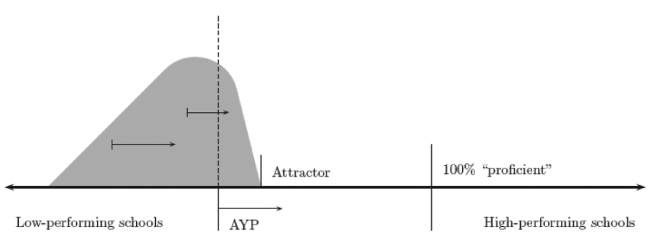
The basin of attraction created by Adequate Yearly Progress (AYP).
The NCLB system has an additional complication, however, because the AYP cutoff also moves over time, shifting the attractor basin and, potentially, the composition of the three groups with it. The moving attractor causes two potential outcomes. If schools are improving as fast or faster than the attractor is moving, those schools that start within the basin will stay there and will continue to be motivated by the law. If, as is more likely, some schools progress more slowly than the AYP cutoff itself moves, then schools will slip out of the attractor basin. They will then join the group of failing schools that lack incentives from NCLB to improve, since sufficient improvement seems impossible and partial improvement will reap no rewards.
States have some control over how fast the AYP cutoff moves and how far it moves over the years to 2014. Different states have chosen to define proficiency differently as well as setting different paces in the increase in interim AYP targets. Defining proficiency at a fairly low standard will ensure that more of the schools at the left end of the spectrum will fall within the basin of attraction and that the distance the AYP mark moves will be smaller. The cost of such a strategy, however, is that a larger group of schools remains to the right of the basin and is never challenged to raise its sights beyond a relatively unambitious standard. States that define proficiency at a high standard achieve the reverse: Better performing schools are challenged to improve the rigor of their curricula, while low-performing schools are more likely at some point to fall too far behind to have hope of catching up (Costrell, 1994). This has led to a situation in which some states achieve high proficiency results by grading their students against low standards, and others suffer poor proficiency rates only because they have high standards (Peterson & Hess, 2006, 2008; Stecher et al., 2008, chap. 2).
The composition of these three groups created by the AYP attractor and the way schools move through the groups matter because NCLB has very different effects on these three groups. Table 1 summarizes the taxonomy. For those schools within the attractor basin, the economics literature on incentives offers insights into the types of behavior we might expect to see. In general, motivating the multifaceted, difficult-to-prescribe type of work that teachers do has long been recognized as a particularly difficult incentive design challenge (see, e.g., Baker, 1992; Baker, Jensen, & Murphy, 1988; Lazear, 2006). In settings where a worker has both measured and unmeasured tasks and where those tasks are substitutes, not complements, it can be counterproductive to impose strong performance-based incentives (Baker, 1992; Holmstrom & Milgrom, 1991).
Taxonomy of the Attractor Basin Framework
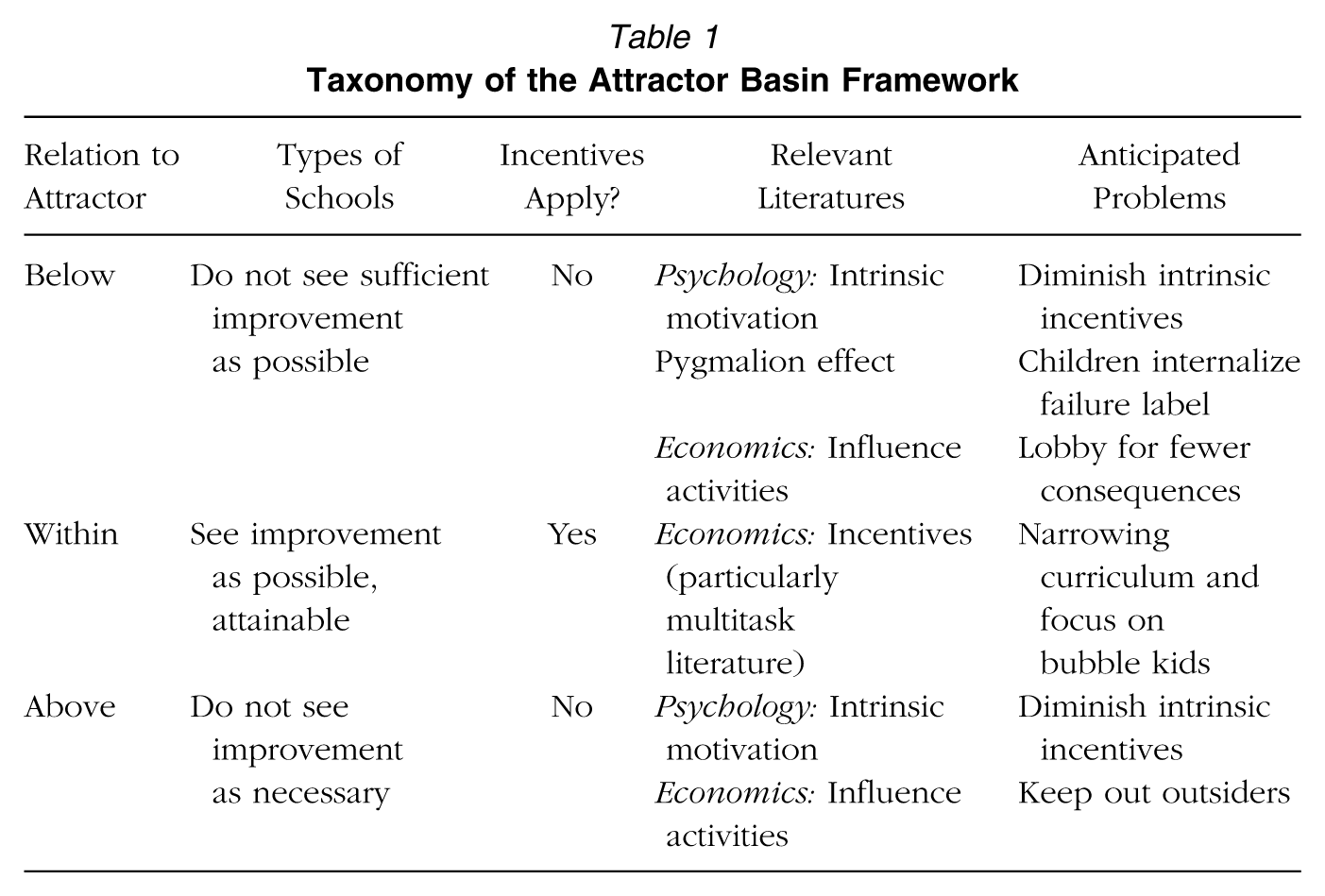
The incentives literature has less to say about the schools outside the attractor basin, but that does not mean that the presence of the attractor has no effect on their behavior. Work in psychology and economics suggests that the presence of an incentive scheme could actively demotivate people in schools not motivated directly by the challenge of meeting AYP (see, e.g., Deci, 1975; Gneezy & Rustichini, 2000; Kreps, 1997; Kruglanski, Friedman, & Zeevi, 1971). This research suggests that the presence of explicit, extrinsic incentives can crowd out intrinsic incentives that might otherwise have motivated the members of the school community to strive for school improvement. In failing schools, this might take the form of hopelessness, and in the better schools, complacency.
While failing schools that are below the basin of attraction may not be directly motivated to increase effort by the AYP requirements, nonetheless they are motivated to mitigate the consequences of their failure. Here, the law’s allowance for discretion in the punitive consequences of failure plays a role. Where there is the opportunity for discretion, workers—in this case, district superintendents and principals—may invest some of their effort or actions into lobbying for favorable treatment or other “influence activities” that divert attention and resources from the main purpose of educating students (Milgrom & Roberts, 1988). In addition to NCLB’s effects on adults at failing schools, social psychology research suggests that children are very sensitive to the expectations of authority figures, such as their teachers, and will, in some instances, mold their performance to match expectations, a phenomenon often called the “Pygmalion effect” (Babad, 1993; Rosenthal, 1994; Rosenthal & Jacobson, 1968). NCLB’s emphasis on public labeling of schools’ and groups’ performance could, therefore, have the effect of further entrenching the failing students’ self-perceptions as failures. Papay, Murnane, and Willett (2010) find related evidence that the category a student achieves on the state tests can have significant long-run effects on the student’s choices to remain in school and go to college, particularly if the student is urban and low income.
The schools above the basin of attraction may also respond with “influence activities,” albeit of a different variety. Being above the basin of attraction is a desirable location, and schools lucky enough to be unaffected by either the incentives or the punishments of NCLB hope to stay that way. The schools will therefore have incentives to insulate themselves from the possibility of slipping into the basin of attraction by using any political clout they have to limit the size of difficult-to-teach subgroup populations entering the school, who could cause the school to fail a subgroup requirement. This reinforces the common tendencies of parents with resources to try to ensure that their children are not overly exposed to “problem” kids.
The attractor concept applies at the individual level as well as at the school level. All the accountability measures are tied to the individuals reaching the proficient level. Therefore, across the student body, NCLB motivates teacher attention only to the students who are within the basin of the proficient mark. Furthermore, the extra attention will not necessarily go to the topics a marginal student is weakest in. Instead, the teacher will focus on those areas most amenable to easy remediation. This leads to the “bubble kid” phenomenon discussed in more detail below. Those students and those topics that do not fall within the basin of attraction are in danger of being ignored.
Data Sources
This article is based on the interview transcripts from annual visits over 3 years to 20 schools in three states, California, Pennsylvania, and Georgia, in a total of six districts. The case studies were part of a larger data collection project funded by the National Science Foundation to investigate how teaching practices at the elementary and middle school levels have changed as a result of the implementation of NCLB, particularly in math and science (Stecher et al., 2008). 2
The idea for this article arose during the data collection process when we saw that the schools we visited responded strategically to the incentives provided by NCLB rather than with the more general improvements in teaching quality and effort the law intended to stimulate. Since the visits were not designed specifically to investigate this question, the material presented here from the school visits is offered as evidence of the behaviors’ existence, not their prevalence.
Our school visits were conducted in the springs of 2004 through 2006. Our intent was to visit for a day the same schools—one middle and two elementary schools in each of our selected districts—in each of the 3 years, with two researchers conducting interviews with a selection of each school’s teachers, subject coordinators, and principal. While we requested what types of teachers we would like to speak with (i.e., math, science, language arts teachers from various grade levels, etc.), the school was responsible for recruiting the teachers for the interviews. Principals may have attempted to select teachers who would give a particular perspective on the school, although we also had many frank conversations where teachers did not hold back in their criticisms of the school and district administration. We also tried to conduct a focus group at each school with parents who volunteered to come speak with us. We followed protocols in all of our semistructured interviews. 3 Unfortunately, in some instances we were not able to visit the same schools in each year, and not all schools were able to arrange parent focus groups for all of our visits. Overall we visited eight middle schools, 11 elementary schools and one K–8 school. Over the 3 years of the study, we conducted more than 350 interviews with teachers, principals, and other staff members.
The schools provided us with opportunities to see each of the three categories of schools grapple with reform over the 3-year period. As outsiders, we cannot definitively categorize schools as below, within, or above the basin of attraction. For comparison purposes, therefore, we assume that schools that have missed AYP the year prior in all 3 years of our study are below the basin and schools that have made AYP in all 3 years are above the basin. 4 While there is no doubt our classification system is imperfect, the definition of group status on the basis of the number of years meeting AYP did seem to match the tone of the schools we visited, and it is strongly predictive of future performance. 5 Table 2 summarizes the distribution of AYP performance of our case study schools and compares them with the state results in the same period. Our sample of schools is drawn slightly more from the bottom of the performance distribution in Pennsylvania and Georgia. California has a larger fraction of schools already slipping out of the NCLB basin of attraction, and therefore, our sample matches the state outcomes more consistently.
Distribution of Elementary and Middle Schools in the Case Study and in the Entire State as Related to the AYP Attractor Basin
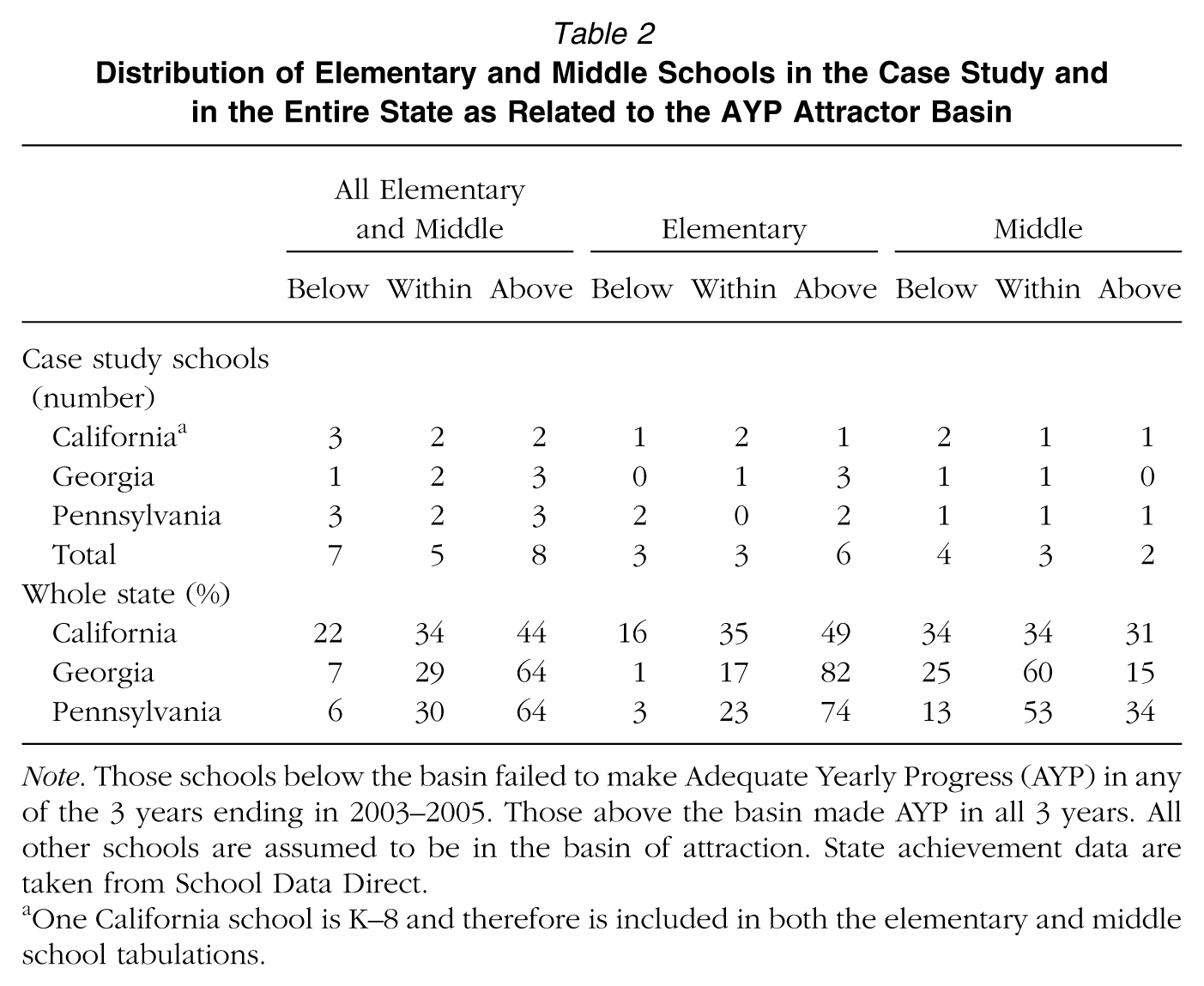
Note. Those schools below the basin failed to make Adequate Yearly Progress (AYP) in any of the 3 years ending in 2003–2005. Those above the basin made AYP in all 3 years. All other schools are assumed to be in the basin of attraction. State achievement data are taken from School Data Direct.
One California school is K–8 and therefore is included in both the elementary and middle school tabulations.
We visited schools with somewhat more minority and poor students than is typical, particularly in Georgia and Pennsylvania (see Table 3). Breaking down the demographics by where a school falls in the attractor basin, rather than by geography, tells a clear story of the achievement gap. Both schools within and below the attractor basin have an approximately 80% minority student body on average, with 75% of the student body on free or reduced-price lunch. In contrast, the schools above the attractor basin are almost always predominately White and much wealthier on average.
Demographic Distribution of Public School Children, 2004–2006, in Percentages
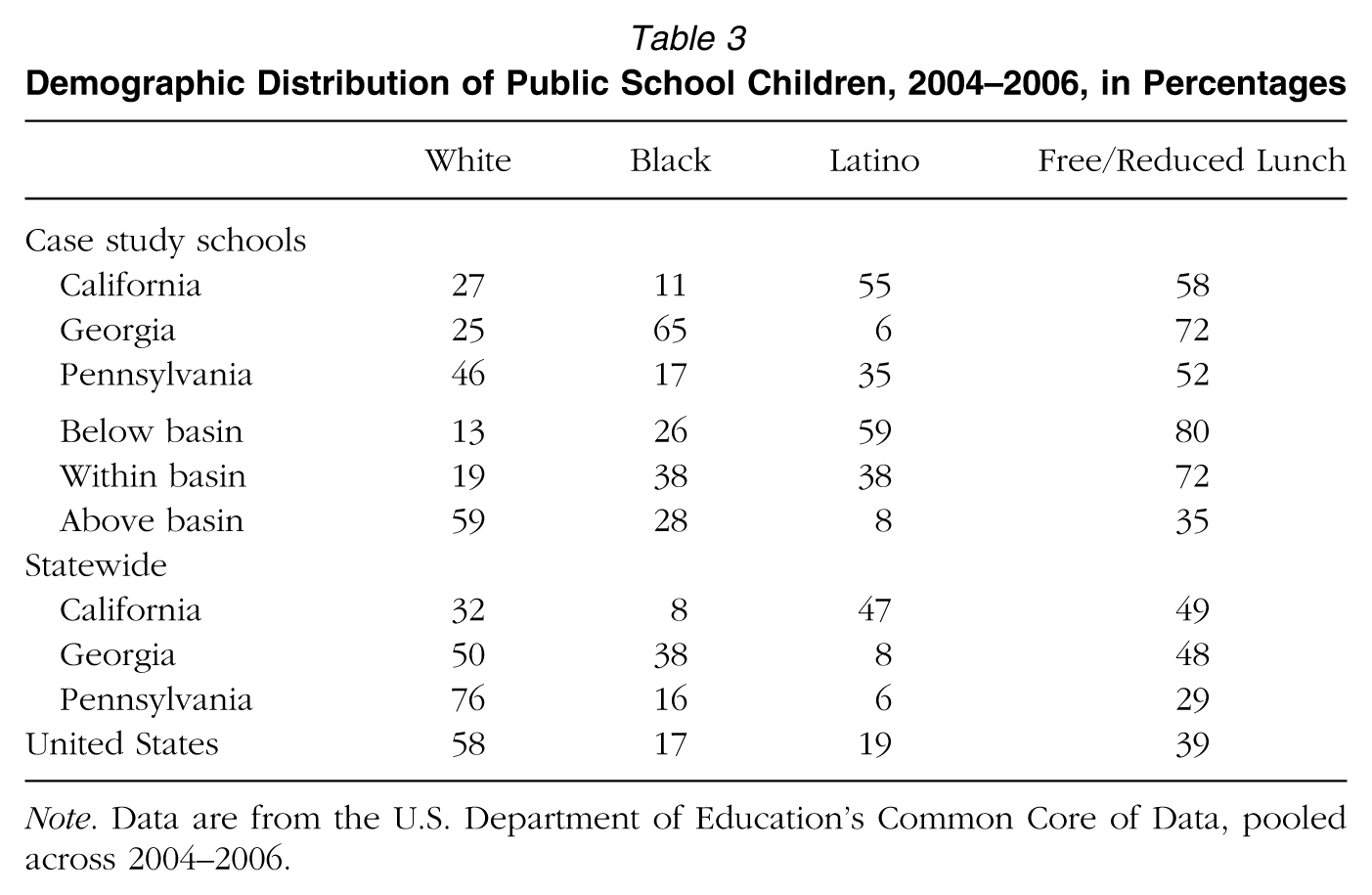
Note. Data are from the U.S. Department of Education’s Common Core of Data, pooled across 2004–2006.
Schools in the Attractor Basin of NCLB
Several of the schools that we visited were either narrowly passing or failing their AYP goals—thereby falling within the basin of attraction of their states’ AYP cut marks. These schools were actively responding to their precarious status. A lot of the response took the form most likely intended by the law’s authors and predicted by the basic theory of incentives: schools were searching for better curricula, investing more time in teacher professional development, and trying to find ways to reinforce the lessons learned in math and language arts in the other lessons (Hamilton et al., 2007; Stecher et al., 2008). We also saw evidence of more strategic responses: shifts in the curriculum toward tested areas and in choices regarding which students receive teachers’ attention. These shifts are ones our attractor basin model predicts: The law encourages extra attention on the topics and students that are weak enough that they may not measure up but strong enough that they can be remediated with reasonable effort.
Curricular Responses
In response to NCLB, some districts had developed a centralized curriculum with pacing plans, which gave teachers little or no discretion over what to teach or how long to take teaching it. Several people we spoke with thought the curriculum was a positive development because they thought that, absent intervention, some teachers wouldn’t cover all of the material they should:
And they developed a . . . school calendar, [which] the math teachers had to follow, that [was] based on the [state] standards. Prior to that, it was helter-skelter. The problem [prior to NCLB was that] if a teacher didn’t like to do a particular math area, they wouldn’t do it. (Teacher, Radner Middle School)
6
In a district with high student mobility rates, the centralized calendars also allowed children who switched schools in the middle of the year an easier transition:
I had a new student come from another school, totally out of the area. But they were using the same [curriculum] now, and she just fit in. She knew what I was talking about. . . . Whereas, before, it took at least three weeks for a kid to catch on to what you were doing. (Teacher, Murray Elementary School)
Students who change schools in contexts other than through normal school-level promotion are associated with worse educational outcomes than students with more stable school environments (Alexander, Entwisle, & Dauber, 1996; Government Accountability Office, 1994; Kerbow, 1996; Rumberger & Larson, 1998), so alleviating some of the challenges these students face may improve learning for the disadvantaged.
The effects of these central teaching calendars and pacing plans are not entirely salutary, however. Several teachers we spoke with felt that the pacing was too fast and did not allow them enough flexibility to ensure their students gained mastery of the topic. Many voiced similar complaints as this kindergarten teacher: “Sometimes keeping up with the pacing chart, for reading in particular, I know I’ve lost two thirds of them, but I’ve got to do the next lesson the next day, so I have to go ahead and do it” (teacher, Rickles Elementary School).
Schools’ responses have gone beyond the alignment of their curricula with the tests and standards. Quite a few schools are also spending significant resources and time on test preparation that addresses the form of the test, not its substance:
There’s more pressure because of what’s on these tests. . . . I find a lot of people teach to the test. And if you don’t do that, then your students do poorly. So I find myself having to do the same thing. Not just to the standards, but to the actual test. (Teacher, Murray Elementary School)
At one middle school we visited, the principal was encouraging a shift away from open-ended work that is designed to encourage higher level thinking and toward a much greater emphasis on the use of multiple-choice questions in the classroom: “You really want students to be involved and engaged in thinking and then you have that balanced with the fact that 90% of the [state test] is multiple-choice” (principal, Ball Middle School).
From a broader public policy perspective, there are also reasons to worry about the uniformity of curriculum that NCLB encourages. One teacher humorously extended the logic of NCLB to a basketball team to make this point:
[A joke I saw was] comparing No Child Left Behind to [NCAA basketball]: “All players must perform at the exact same level. All players need to know how to play every single position exactly the same. If your team does not perform at this level, all of your players can move to whatever team they want.” (Teacher, Sandler Middle School)
The needs of the modern labor force are far more diverse even than the different skills needed by different positions in a basketball game, so this joke points to a deeper truth. One of the schools we visited that was in danger of not making AYP was a magnet school for language immersion. We frequently heard parents and teachers marveling at the children’s fluency in a foreign language, regardless of their performance on the state tests and despite the economic disadvantages many of them face. Parents told us that they were willing to sacrifice some level of mathematical competency, for example, for the advantages of raising a bilingual child. They were afraid that as the AYP requirements increased and the school fell behind, the school would be forced to abandon its language programs to focus on math and English language arts.
Teacher Attention Responses
NCLB’s incentives may also alter the distribution of the teacher’s attention across students. There has been worry among many educators about educational triage, a term for paying significant amounts of attention to the so-called bubble kids, those students on the cusp of scoring at the proficient level (Booher-Jennings, 2005). These are the children who provide the most payoff for the least effort in a single cutoff incentive system such as NCLB.
In the survey of principals that was part of the larger data collection effort of which these site visits were one part, Stecher et al. (2008) found that a clear majority of principals reported encouraging teachers to “focus their efforts on students close to meeting the standards.” 7 There have been several empirical studies investigating the effect on children’s test performance across the ability spectrum of incentives to focus on bubble kids (Center on Educational Policy, 2009a; Krieg, 2008; Neal & Schanzenbach, 2007; Reback, 2008; Springer, in press). The studies consistently find disproportionate gains in bubble kids’ scores, although there is mixed evidence as to whether their gains come at the expense of the rest of the class. Our site visits gave us a sense of how this approach might play out in different classrooms.
In one struggling school, a large group of children, almost half the class in some grades, were “sitting at basic” in both English and math. The previous principal had directed all the focus on kids struggling the most, and the current principal could see that for the children sitting at basic “in certain ways that large group’s set of needs was almost abandoned. . . . They taught what they need to teach but focused specifically on what [the children furthest behind] needed to move” (principal, Farrell Primary School). So the principal decided to direct teachers to focus on the group of children on the cusp of proficiency, and not only did many of them pass into the proficient group, but some became advanced. Even the students who had previously been the subject of such intense focus from their teachers actually did better too, according to the principal, despite the decrease in attention they received.
Not all educators thought focusing on their bubble kids had such uniformly positive effects. Several teachers spoke of how their bubble kids were given extra resources, in and out of class, which focused on their “bubble areas”—those areas most readily remediated:
If you want to make some gains, you look for the students that have the best chance of making a gain in the least amount of time as far as AYP is concerned. . . . I would get them into my morning tutorial. I would target them for my informational classes. I would try to get them into the after-school tutorial programs. I would specifically work on their weak domains, not necessarily their weakest domain levels, but the domain where they could make some progress and get to that passing level. (Teacher, Burnett Middle School)
This practice may be effective in getting enough students to pass the proficient mark, but several teachers were uncomfortable with the students who were getting left out, voicing concerns like this teacher: “You know, it may not be fair to Tom because Tom is [at a] first-grade level but Sue is almost there, so I’m going to spend the extra time with Sue” (teacher, Burnett Middle School).
Several teachers were also concerned with the lack of challenging material for those students who had already mastered the material needed to bring them up to the proficient level: “I found myself letting the other children go. Which isn’t always fair, because the advanced kids should be getting challenged and doing more things. Same with proficient [kids]” (teacher, Martin Middle School). In this way, the content covered on the state test acts as a curricular ceiling for schools that are susceptible to the incentives of the law, despite the intention for the tests to be a floor for the rigors of the curriculum.
For schools in the attractor basin, the increased effort and attention that NCLB has stimulated comes at a cost of a narrower curriculum and uneven attention across students in the classroom. The exact nature of the responses and how they are balanced within a school varies significantly from school to school, and therefore the net benefit or cost to students’ learning also probably varies significantly. As one teacher we spoke with put it:
For teachers that are marginal, it does give them a plateau—you’ve got to get to this level—but for those of us that feel that we’ve already achieved that, it really focuses on “you’ve got to teach this, this and this because that’s on the test.” (Teacher, Farrell Primary School)
Schools Left Behind by the AYP Basin of Attraction
The schools we visited that were falling far behind in their attempts to make AYP were responding to NCLB differently from the schools still within the direct pull of the AYP incentives. These schools do face NCLB-related incentives, just not the ones intended.
Rather than a serious focus on improving students’ learning enough to meet AYP, these schools were more likely to focus on ways to mitigate the consequences of their failure to make AYP. Teachers and administrators felt pressure to appear to be making changes even if they did not believe such changes would make a difference. Furthermore, the adults at these schools might be passing on to their students the belief that the endeavor is hopeless. In schools where the failures of one or more subgroups are the cause of the school failing, failure was linked in the eyes of the school community to a racial or ethnic identity or to disability status. In these cases, it appeared that NCLB was reinforcing negative stereotypes rather than succeeding in closing the testing gap.
There is some early empirical evidence to support the intuition developed here that schools beginning from particularly low starting points are below the basin of attraction: Failing schools and districts may not be improving. According to one report, no California district has exited restructuring except by being reconstituted, and the few schools that exit restructuring as the same institution do so by meeting safe-harbor provisions, not by meeting proficiency levels required by the state (Center on Educational Policy, 2009b).
Schools’ Responses
Our visits found a very different tenor at schools that had failed to reach AYP for several years from that at the schools wherein teachers and administrators felt they had a chance of passing. Rather than responding with increased motivation to the incentives imposed by the law, teachers and administrators at failing schools were more likely to express hopelessness and resignation.
Teachers and administrators at failing schools expressed a willingness to try new approaches to improve their schools, but they considered the distances they needed to cover an impossibly large barrier to achieving AYP. Many spoke of how they thought the disadvantages of children’s home lives made proficiency an unrealistic goal:
When you say that a certain percentage of your kids must be proficient or advanced, regardless of looking at where those children are coming from, that sometimes is an unattainable expectation. . . . When you are looking at children who are walking into your building with the lack of experiences, the lack of language, some of them not knowing where they’re going to sleep tonight, eat breakfast, those are challenges that No Child Left Behind leaves behind. (Principal, Levy Elementary School)
One can argue that this is an example of the “soft bigotry of low expectations” that NCLB was designed to fight against. However, these teachers and administrators often do not know how to teach severely disadvantaged children successfully at the level expected. As one teacher put it succinctly, “How is this going to be doable?” (teacher, Radner Middle School).
One failing middle school had a significant score deficit to make up, largely due to the performance of disadvantaged, English-language-learner students, many of whom were bused in from outside the neighborhood. The level of improvement necessary to start making AYP with the students currently enrolled in the school would not be possible in the time frame available under NCLB, so the principal’s school improvement efforts were almost exclusively focused on changing the school’s student body.
The school is located in a wealthy, predominately White community, but many of the local children attend private or magnet schools. The principal was launching an attempt to lure them back by implementing the International Baccalaureate (IB) program, which she thought would be viewed by local parents as a draw for the school. The IB program at the middle school level, according to the school, consists mainly of a community and service requirement for the students and an approach to teaching that will ensure that the kids will become open minded and tolerant.
When asked what it was about the IB program that would help the school meet the state standards, the program coordinator told us,
First and foremost, [it brings us] reputation. . . . Because it’s so well known, it brings people immediately. And as we know, a lot of times our scores are relative to the kind of student that we attract. So as a way to get our student population up or even more balanced, we began the IB program. (Administrator, Curtin Middle School)
The hope was that by filling seats with easy-to-teach local children, the school would be brought within reach of AYP through demographic changes. A math teacher at the school put it bluntly:
But the idea was, yeah, let’s get rid of the dumb ones, then we don’t have scrutiny and they leave us alone at our school. And for that, they brought in something called the IB program. . . . The whole idea was let’s get rid of the ones who are making us look bad. In other words, don’t bus so many kids from the other side of town, and then we avoid scrutiny that way and we get off this bad list. (Teacher, Curtin Middle School)
The pace at which the later stages of NCLB sanctions progress also hampers failing schools’ efforts to improve. While the timeline for schools entering corrective action is relatively generous—schools miss AYP for 4 years before they enter corrective action—there is far less time to show a turnaround before the school enters mandatory restructuring, encouraging panicked implementation of an overhaul:
There’s just no time to phase in. You can’t afford—because usually you would phase in [the new approach] in kindergarten and first so that they would have it all along, but the tested years are the higher level, so you can’t phase in because then you lose them. . . . It’s been very hectic on the teachers. (Principal, McKean Elementary School)
This elementary school was in corrective action or restructuring for each of the three years we visited. The school’s experience demonstrates how the pressure and fast pace of the latter years of corrective action can undermine even promising reforms. In each year of our visits to the school, the principal was instituting new plans to turn the school around, each year speaking about how exciting the new reform was—the only problem is that each year it was a new principal speaking about a new program (and the school has changed principals again since our last visit). Over the course of our visits, the district, which was also failing to meet AYP, had replaced its superintendent as well, increasing the churn in leadership.
The third principal we spoke with in 2006 suggested that the reforms in 2004 had been promising: “We started doing very well. And then, midstream, we got a new superintendent. And just by the nature of whatever change in leadership, that [reform effort] kind of [ended]” (principal, McKean Elementary School). Each plan adopted by this school may have had significant merit, but by making constant changes, no reform had the opportunity to take root (Elmore, 2003).
Another approach to school improvement we saw at our failing schools was to take the strategies of a narrowed focus to an extreme. One failing school had implemented an educational triage approach that appeared to be more extreme than the less formal approaches we saw at schools within the attractor basin:
The high-basic child that is almost proficient [is in] our target group. . . . Every teacher got a printout of their target group. Every teacher has about four to five [target] kids in their class. We went over strategies on how to make sure you involve them and you get them involved. We talked about seating. These children should be closer up to you. Whenever another child answers a question, refer back to that student and [say,] “Can you tell me what the answer was or what did Johnny say?” and always keep those four to five kids questioning and making sure they’re the target. They’re the kids that we need to push up to proficient. So, that’s our AYP strategy. (Math coach, Sykes Middle School)
Students are keenly aware of their teachers’ differential behavior toward students of differing abilities: That awareness can play into students’ self-perceptions and how they are perceived and treated by peers. The social stigmatization from being an obvious target of such attention and the potential for teachers to unconsciously convey that they expect these target children to struggle could undo the benefits that the target children receive from increased attention. The rest of the class, feeling ignored, could also become disengaged (Babad, 1993).
Students’ and Parents’ Responses
School accountability designations, while targeted at the adults responsible for their education, do not go unnoticed by children. Quite a few teachers and administrators we spoke with mentioned how some of their students were struggling to cope with the failing label: “Our kids feel bad that [a higher performing school] gets these accolades. . . . The kids feel it. They go, ‘Oh yeah, well, we’re not really that good, we’re not as good as them’” (principal, Curtin Middle School).
An instructional support teacher from one of the failing elementary schools linked the intense scrutiny her school was receiving with an increase in behavioral problems:
This year we’ve had an awful lot of behavioral referrals, more so than before. And for a good chunk of them it’s . . . because the kids don’t have the academics and it’s gotten to the point where they’d rather be the bad apple than the stupid one. So if I act up, then it’s just because I don’t want to, not because I can’t. (Teacher, McKean Elementary School)
The parents at this school also noted an increase in behavioral problems. They identified as causes the loss of a focus on socialization, the academic struggles some of the children had, and the loss of all of the fun activities that used to leaven the school day:
And sometimes I think they’re concentrating more on the work than just regular manners, childhood. . . . Everything is thrown at them: that there are different levels of education for each and every classroom, that they can’t grasp everything right away. . . . They’re not allowed to have parties, anything . . . enjoy childhood. . . . I think this disrespect sometimes comes out; they’re angry. (Parent, McKean Elementary School)
Other students reportedly responded with resignation or depression: “So for some of our kids it’s just really an exercise in failure” (teacher, McKean Elementary School). A middle school teacher worried about an increase in children dropping out: “This way, I see a huge dropout rate. Kids are getting very frustrated, they are very tired. And they just give up. Many kids give up because they don’t understand” (teacher, Sykes Middle School).
The children’s response does not just come from the failing label. The narrowed focus of the curriculum on tested material has the side effect of taking away the aspects of the school day that help many students stay engaged. Several parents from a failing school felt that the pacing plans and curriculum alignment had left out opportunities for enrichment and fun—the activities they felt were important for keeping students engaged. They were quite concerned about what was missing from the classroom, both in academics and in the ability for kids to just be kids. One parent spoke about the lack of academic breadth at her daughter’s school:
I just felt like [NCLB] took the fun out of school. All of a sudden they were constantly doing math, constantly doing reading and I understand they needed to meet some standards . . . [but] there were no parties. Plus, then they don’t get a widespread education. There was no reading on geography, there was no history involved. . . . They became, to me, not all-around students. (Parent, Levy Elementary School)
Parents in the same focus group were upset about the use of music and art for more time to push standards rather than to develop creativity: “Now they’re doing standards in music class.” “Yeah, my child now hates music because the teacher just talks and talks and talks” (parents, Levy Elementary School). These quotes also suggest that the modest reduction of untested subjects that has been documented in school surveys (Stecher etal., 2008) may be underestimating the true narrowing of curriculum occurring at some schools.
One insight of the authors of NCLB was that in too many instances the failures of schools were hidden from the community, and in particular, those hidden failures often fell most heavily on racial minorities and the poor. NCLB, through its testing and reporting requirements and particularly its requirement to disaggregate results by subgroup, does shine light on the problem. It tries to force communities to face their failure to serve their children and to generate the political will necessary to find better solutions. But this comes at a real cost. Children previously ignored are not better served by having their inadequacies displayed on the front page of the local paper.
Particularly in the instances where a subgroup, not the entire school population, failed to make AYP, the publicity surrounding the failure did not always spur parents to rally the school and district to begin teaching these children more effectively. Instead, the failure of a school to make AYP threatened their image as good parents:
They’re also very frustrated because our name is listed in the paper as a failing school. When they tell their neighbors, “Oh, my kid goes to [our school],” “Oh, you mean that bad school?” . . . There’s a lot of perceptions that go along with that, so the parents who are very frustrated and very angry that they have to almost validate why their kid goes here with their neighbors. (Principal, Curtin Middle School)
In seeking to validate their decision to continue sending their children to the local school, some parents we talked with or heard about from administrators fixate on the role of subgroups in their school not making AYP. In these instances, the parents tended to blame the subgroups for “bringing our school down.” One school principal saw parents’ upset over the school’s failing designation slip quickly into racial tension:
[We aren’t making AYP because of] our subgroup. Our overall scores, we were fine . . . but it was our Hispanic English-learner subgroup that pulled us down. . . . We do [school site council] and parent meetings, we talk about it. When you have to put the data up there, it’s like then they go, “Well, see, it is the Mexican kids that are pulling our school down.” (Principal, Curtin Middle School)
By placing the standards out of reach of the lowest performing schools, NCLB as implemented is arguably leaving behind exactly those children it most intended to serve. The perception of teachers and administrators at failing schools that it would be either too difficult or impossible to improve scores enough to meet AYP causes a cascade of reactions, none of which serves the children at these schools well.
NCLB provides no positive incentives to work harder or more creatively to teachers and administrators under these conditions. It may even depress morale and therefore motivation. The sense of the impossibility of meeting the standards of NCLB may also serve as an excuse for teachers and administrators to avoid striving for improvements that are attainable. Once a school enters the latter phases of restructuring, the school loses its ability to implement a long-term strategy to build lasting success. Instead, because of the higher risk of leadership turnover, the school administration is likely to jump from tactic to tactic, never giving any one approach time to take root.
Children are aware of the labels their schools receives, and in some cases may absorb the reality that the adults around them have given up hope for them. It may be the case that many of these children would receive that message even in the absence of NCLB—the stressors caused by the law are hardly the only ones operating against these children’s success—but the law is adding to the difficulties of those to whom it had most hoped to provide opportunity.
Schools Ahead of the AYP Attractor Basin
The pressures of NCLB were less evident in the highest performing schools we visited, and it appears that the law has the least effect on behavior there. Most teachers and principals reported being relatively unconcerned with the law, at least in the short run, although a number expressed skepticism that even their schools could reach 100% proficiency. At these schools, we heard things like “It seems kind of off in the distance” (teacher, Meyers Elementary School), “Nobody’s panicking yet” (teacher, Meyers Elementary School), and “I don’t personally feel the pressure” (teacher, Carrey Elementary School). The state standards did not exert the same pressure on the class pace either: “I feel like the state standards are really just kind of a guideline as to what topics they need to know. I’m much more interested myself in getting the kids to really become thinking mathematicians” (teacher, Stewart Middle School).
There are two areas where NCLB has the potential to adversely affect the incentives of high performers. First, it invites complacency among those who are passing the test. Second, some high-performing school communities are afraid of the negative effects that the choice provision in NCLB will have on their schools’ performance. We saw evidence of community pressure to protect high-performing schools from an influx of new, lower performing students.
Individuals’ Response
The bulk of our experiences at the highest performing schools were marked more by an absence of a response to NCLB than the presence of any efforts to respond to the law. This may not be a problem, but if the authors of NCLB had hoped to encourage an increase in the ambitions of all schools, this does not appear to be happening. While we did not evaluate the rigors of a school’s curriculum beyond whether it made AYP, we saw several hints that higher performing schools would benefit from additional incentives to continue to push for still higher standards. Particularly in states that designed their standards and definition of proficient with an eye toward keeping low-performing schools within the basin of attraction, the lack of motivation for schools performing above comparatively low proficiency standards to improve further is unfortunate.
In a couple of instances, the problems of a low cutoff score were evident at the individual-student level. Teachers complained of parents refusing to allow their child to be held back because they took their child’s proficient score as evidence that their child was truly proficient. This was particularly evident in Georgia, the state in our study with the lowest standard of proficiency (Stecher et al., 2008), which conditions children’s promotion to fourth grade on passing the third-grade tests:
See, there was a couple of children in my room last year that I hoped wouldn’t pass it, because they didn’t need to move on. But, you see, when you’ve got a test and they pass it by one point, or right on the button . . . that’s all the parent wants to hear. . . . I did want to retain that child, but when she passed that test, it wouldn’t have mattered what I said. They would have moved that child right on, which they did. And, she’s having difficulties this year. (Teacher, Sandler Elementary School)
More generally, there were several teachers who acknowledged that their school’s success was due largely to the types of students they have, not their teaching skill. One teacher we spoke with had made a move from a low-performing school to a high-performing school and saw his students’ scores jump more than 50 points without changing his teaching style. The students’ socioeconomic advantages were the sole change: “It’s handed to me on a platter, as long as I cover the standards” (teacher, Sandler Elementary School). This illustrates that, in at least some cases, the cause of the test gap is not a consequence of disparities in teacher diligence and, therefore, that performance-based incentives may not be the route to effective change. Furthermore, by inviting complacency from all those performing safely above the AYP proficiency mark, NCLB is falling short of its aspirations to provide the most rigorous education that students can handle. To the extent that education policy is concerned with educating the next generation of innovators in an increasingly technical and complex marketplace, allowing slack at the top end of the spectrum is a lost opportunity.
Communities’ Response
The most visible effect of NCLB at the highest performing schools was noticeable anxiety among parents and, to a lesser extent, teachers about the potential effects on the school’s standing of children from failing schools taking advantage of choice provisions to attend their school. Administrators we spoke with talked about being under significant pressure from parents to ensure that not too many disadvantaged children move to the school through NCLB’s choice provisions.
A typical example of this sentiment was voiced by this parent:
I think sometimes some parents leave poor schools. They know their school is poor; they bring their kid to a school that is strong in [the state test] and AYP, expecting the school to do all the job and fix their ills as well. Not everybody who is an AYP transfer student is wanting really to academically succeed. And, I think that there’s no policy then to stop those types of situations. (Parent, Sandler Elementary School)
Parents at a high-performing middle school were very anxious about the fate of their school once it moved to a brand new campus. The school had, to date, avoided accepting many children from failing schools because the school was overcrowded with local children as it was. The high school in the community was accepting significant numbers of bussed-in children, so the local parents already had some experience with a school with a large transfer population. One parent seemed to think the NCLB transfer program was good in theory—as long as the “right” children took advantage of it:
I don’t think there’s any doubt that for that unique child that needs the right environment and can really thrive, it is a wonderful program. And, of course, everybody wants to save those children—not “save,” that’s the wrong word—but to give them the opportunity to be successful. But I think that, as with any big program, you end up with all the other cases where it’s hard to find the ones that really work amidst all the issues that it causes. (Parent, Stewart Middle School)
Other parents were more upset about the transfer program. As one of the parents told us, she had worked hard to move to a community that met her definition of the right kind of community, and NCLB was thwarting her intentions:
I’m very angry because we moved to [the community] the year before [the] high school opened. . . . So the problem with me, you know, you work hard, you want to live in a nice community so your kids can go to nice schools. And it’s kind of unrecognizable. I don’t feel like I’m in my community. (Parent, Stewart Middle School)
She was planning on pulling her child from the public school system for high school as a consequence.
A couple of the teachers had a very different perspective on the role these bussed-in children were playing in the school:
I think [NCLB has] introduced a different population to our school, which has been positive. I think you take kids that have come from a background with very minimal things in schools, where it’s a battleground every day, you stick them here and all of a sudden, we’ve got kids that are getting 3.5 to 4.0s that are kids that never knew they had it in them. That’s why I have to be out at the bus, those are my kids. It’s just really rewarding. (Teacher, Stewart Middle School)
This same teacher noted the way parents and some teachers jumped to conclusions about the bussed population:
We’ve had . . . teachers or parents making comments, somebody gets excited, “Oh, it’s one of those bussed kids!” Strangely enough, no it’s not. And we have these [remedial study skills] classes you’ve probably heard about, that have 60 kids: Out of those 60 kids, there are only 3 of them that ride the bus. It’s neighborhood kids. (Teacher, Stewart Middle School)
The principal was not sure that the school would be very successful in improving the performance of the children coming in from failing schools. In addition to the challenge of bringing the new students up to speed, he recognized the potential for a negative effect of placing children who are struggling to begin with in an environment where they are more glaringly behind and out of their element:
You let a kid out of a poor performing environment—your poorest performer in that environment—and then put him up in a rarified environment and he somehow is supposed to do better. Now what happens is that the gap is much farther for him to do well than it is where he was. (Principal, Stewart Middle School)
He seemed to think that it would be better for the disadvantaged students to stay in their own communities: “I’d rather see them really get highly qualified strong teachers and let them go to school and work in their own neighborhoods” (principal, Stewart Middle School).
There are life experience differences that schools like this one will need to learn to navigate if the choice provisions are widely used. One teacher made this clear:
I have a sense that they don’t integrate well in the school. I have a sense that they are different and they hang together. Most of them really work hard; some of them don’t. . . . I have one girl that’s very bright, but she has to go home and take care of the younger brothers and sisters. She doesn’t have time to do any of the work basically. What she gets done in class is what she gets graded on. . . . Most of my students have a lot of free time. . . . Their reason for not getting things done is because “I’m playing soccer” and “I’m playing baseball.” . . . They’re really very different populations. But [the transfer students] do well in the classroom. . . . They integrate well into the classroom. They do. They get along. They participate. Kids like them. (Teacher, Stewart Middle School)
It was not clear from our visits how aware districts were of the need to manage the integration of these new students. To the extent that it is not already being done, our work highlights the need to take community relations into account when districts work to make transfers successful.
The highest performing schools are not likely to change significantly their operations in response to NCLB, at least as long as they are easily meeting AYP requirements. These schools are less likely to narrow their curricula or focus disproportionately on one group of children, but they are also not particularly stimulated by the law to search for still more effective ways to teach their children.
Even if the law seems to be having a fairly neutral effect on the academics of these schools, there is evidence of negative consequences to the school community when there are transfer students who are perceived as a threat to the school’s AYP standing. This will not be an issue at high-performing schools in a homogeneously high-performing district, since the transfer threat is not an issue. But for schools in large, heterogeneous districts, it may be an issue, and NCLB may help trigger another round of affluent families’ flight from the public school system.
Conclusion
Designing policy around simple models of complex dynamics always runs the risk of creating unintended consequences, and NCLB is no exception. The AYP measure creates highly uneven effects on schools across the spectrum of starting ability and capacity. Our model of the AYP attractor basin helps to make sense of how and why those effects might vary.
Despite the emphasis on accountability in the law’s language and perceptions, it actually provides clear incentives to only a subset of schools—that group in the basin of attraction created by the AYP cut score. Furthermore, it may not be eliciting consistently the kind of behavior desired even from those schools that are motivated by the law. The pass/fail nature of the NCLB scheme plays a major role in its inability to exert pressure on a wider spectrum of schools. The limits to what a single test, produced and administered at reasonable cost, can measure exacerbate the problem. Finally, NCLB does not address the lack of know-how and/or capacity to effect change.
Some of the children who the authors of the law were most intent on serving—those from disadvantaged backgrounds attending the nation’s worst schools—are still getting left behind since they and their schools are treated by the teachers and administrators charged with their education as lost causes, below that basin of attraction. In pernicious ways, they may even be actively harmed by the law. The vast majority who stay in their failing schools are faced with the challenge of coping with a public label of failure. They are also more likely to get teachers with low morale; test-centric, unengaging classes; and potentially the upheaval and uncertainty of a school going through the corrective action and restructuring phases. Those few who do exercise their rights to choose better schools potentially face hostility due to the perceived threat they pose to the status of the receiving school.
The designers of NCLB were responding to real failures of the U.S. public education system, and the focus of the law on closing the testing gap, holding schools accountable, and forcing school systems to remain focused on student learning are all laudable public policy goals. But through its pass/fail design, NCLB fails to consistently correct the failures it intended to address. Hopefully as the details of the law are reconsidered, we will find more effective ways to incentivize the entire spectrum of school capacities and in such a way that attends to both the academic and civic consequences of the program.
Footnotes
Acknowledgements
Thanks to Brian Stecher, Laura Hamilton, Scott Naftel, Hilary Rhodes, Cassie Guarino, Omar Wasow, and three anonymous reviewers for helpful comments on previous drafts.
This work was sponsored by the National Science Foundation under Grant No. REC-0228295. Any opinions, findings, conclusions, or recommendations expressed in this article are those of the authors and do not necessarily reflect the views of the National Science Foundation.
1
The boundary between schools that fall within and below the basin is unknown and is probably not uniform across schools. In general, the boundary between groups is defined by schools’ or districts’ perceptions of what is feasible.

3
Interview protocols are available from the authors upon request.
4
The Adequate Yearly Progress (AYP) score earned the previous year is the one that informs the “failing” or “passing” identity for the school year. Therefore, we are interested in the tests taken in the school years ending in 2003–2005 for our visits in 2004–2006.
5
Ninety-four percent of schools that were above the basin and were still open in 2007 made AYP that year, whereas only 22% below the basin and 65% within made it.
6
All school names have been replaced with pseudonyms to protect the confidentiality of those interviewed.
7
The percentage of principals reporting using this score improvement technique ranged from 57% in Pennsylvania middle schools in 2005 to 99% in Georgia middle schools in 2006 (Stecher et al., 2008, p. 117).