





Abstract
This article presents findings from a year-long multilevel comparative case study exploring the characteristics of effective urban high schools. We developed a comprehensive framework from the school effectiveness research that guided our data collection and analysis at the four high schools. Using value-added methodology, we identified two higher and two lower performing high schools in Broward County, Florida. We found that the two higher performing high schools in the study had strong and deliberate structures, programs, and practices that attended to both students’ academic and social learning needs, something we call Personalization for Academic and Social Emotional Learning. Because of the study’s inductive focus on effectiveness, we follow our findings with a discussion of theories and prior research that substantiate the importance of schools’ attention to the connection between students’ academic and social emotional learning needs in high schools.
Keywords
Over the past 30 years, educational researchers have identified the instructional core—teachers’ curricular and instructional activities in classrooms—as the primary activity of schools (Barr & Dreeben, 1983) and critical to school effectiveness (Hallinger 2005; Luyten, Visscher, & Witziers, 2005). Researchers have also found other factors to be associated with school effectiveness, factors that have received less attention from policymakers and practitioners. These factors include a school-wide culture of learning and a sense of community in which students feel connected and have strong relationships with adults in their schools (Lee & Smith, 1995; Phillips, 1997; Uline, Miller, & Tschannen-Moran, 1998). These latter studies draw our attention toward elements of schooling that are arguably of equal importance to the instructional core, namely, social emotional learning and its role in student success. They underscore that learning in schools is a social process, in which both adults and students benefit from environments that cultivate and encourage their social emotional well-being. Yet despite this research, the importance of both the academic and social dimensions of schooling and their complementary and interdependent nature remains poorly understood, as do the conditions necessary for educators to link them effectively in schools and classrooms.
It is in the context of this empirical evidence that we present findings from our own study, one that aimed to identify the programs, policies, and practices used by schools that successfully improved student achievement among English language learners (ELLs) and poor and minority students. We conducted a year-long, multilevel comparative case study of four socioeconomically and racially diverse high schools in Broward County, Florida, with the goal of contributing to understandings of how to improve school outcomes for urban youth. The four schools had similar student populations demographically speaking but differed in terms of student achievement—two of the high schools were higher and two were lower performing—allowing us to study what differed between them. We found that unlike the two lower performing high schools, the two higher performing schools had strong and deliberate structures, programs, and practices that attended to students’ academic and social emotional learning needs. We call this systemic and intentional recognition of and attention to the interdependency of the instructional core and social emotional activities Personalization for Academic and Social Emotional Learning, or PASL. Academic learning refers to the processes through which people learn to read, write, compute, analyze, understand, and apply lessons from science, history, and the arts. Social emotional learning has been defined as:
the process through which children and adults acquire and effectively apply the knowledge, attitudes, and skills necessary to understand and manage emotions, set and achieve positive goals, feel and show empathy for others, establish and maintain positive relationships, and make responsible decisions. (Weissberg & Cascarino, 2013, p. 10)
This article describes the empirical and theoretical foundations for PASL and makes the argument that instructional quality is not the defining feature of highly effective schools.
We begin by describing the conceptual framework that guided our study. It was a framework that included both the academic and social aspects of schools but not one that acknowledged their interdependency. While the framework proved useful for revealing some of the more and less discrete components of effectiveness, it was only when we looked across the components that we identified critical organizational structures and routines that supported the integration of academic and social emotional learning in the higher performing schools. After describing our guiding framework, we explain our sample selection, data collection, and data analysis processes. We then present our findings, describing first the results for each of the framework’s eight components before moving onto a second findings section that shows the ways in which higher performing schools systemically supported interdependent academic and social emotional learning. We discuss our findings within the context of the major theories and prior research and call for appropriate policy responses.
Conceptual Framework
This study is part of a larger research project. The National Center for Scaling Up Effective Schools (NCSU) is a seven-year initiative aimed at developing, implementing, and testing processes to scale up practices that are present in higher performing, urban high schools. 1 The framework we used to look for effective practices builds from research that finds that successful high schools work as systems of essential components rather than rely on specific programs or structures (Bryk, Sebring, Allensworth, Luppescu, & Easton, 2010; Dolejs, 2006; Goldring, Porter, Murphy, Elliott, & Cravens, 2009). Specifically, we drew from the work of Goldring and colleagues (2009) that identified six components of school effectiveness. We then conducted a review of research on each component, paying particular attention to studies conducted in diverse, urban high schools. Adding two components to Goldring and colleagues’ original six, we designed our data collection instruments around these eight components.
The first component, quality instruction, is grounded in research that finds that teachers who provide quality instruction and are able to meet the needs of their students use individualized pedagogy (Newmann, Marks, & Gamoran, 1996; Simon, 1995), collaborative learning strategies (Flynn, 2009; Staples, 2007), and an emphasis on “higher order” thinking skills through rigorous and challenging content (Boaler & Staples, 2008). In their investigation of effective schools in New York City, for example, Darling-Hammond, Ancess, and Wichterle Ort (2002) highlight the importance of “‘authentic pedagogy’—instruction focused on active learning calling for higher-order thinking, extended writing, and an audience for student work” (p. 642). Studies also find that teachers who use strategies that draw on students’ culture, language, and lived experiences have more engaged and motivated students (Nieto, 2003). Others have found that quality instruction incorporates activities that are real, active, and relevant to students’ lives (Darling-Hammond et al., 2002; Secker, 2002).
Research on rigorous and aligned curriculum, our second component, points to the importance of a rigorous curriculum with ambitious content, regardless of academic track (Darling-Hammond et al., 2002; Gamoran, Porter, Smithson, & White, 1997). In a study of rigor in math courses in two urban districts in California and New York, Gamoran and colleagues (1997) found that standardizing content coverage fosters higher achievement growth in math achievement among low-achieving, low-income, and minority students. Other studies find that effective schools align curriculum to state and local standards and assessments (McTighe & Brown, 2005) and implement the curriculum with integrity to the standards (L. W. Anderson, 2002).
The third component of the framework, personalized learning connections, is informed by research finding that students who feel a sense of belonging to the school as a whole and experience meaningful, positive connections with adults and students are more likely to persist and be motivated academically (Walker & Greene, 2009). Benefits of positive student-teacher relationships accrue at both the individual and school levels. When teachers and students know each other well and adults express care and concern for students’ well-being and educational success, a positive, motivating school climate is created and student engagement is enhanced (Fredricks, Blumenfeld, & Paris, 2004; Lee, Bryk, & Smith, 1993; Lee & Smith, 1999).
Component number four, culture of learning and professional behavior, is based on studies showing that effective high schools have school cultures defined by a shared focus on high expectations for students and adults (Arroyo, Rhoad, & Drew, 1999; Wilcox & Angelis, 2011). Adults and students internalize these cultural values (Pierce, 2005; Rhodes, Stevens, & Hemmings, 2011), values that encourage students to assume responsibility for their own learning (Domina, Conley, & Farkas, 2011) and teachers to promote a collaborative culture around academic success and collective efficacy (Hoy, Tarter, & Hoy, 2006; Louis, Marks, & Kruse, 1996). These studies reinforce others that have found that a school’s success derives in part from the extent to which adults take responsibility for events in the school and their students’ performance and the degree to which they align their professional activities toward these efforts (Quint, 2006). Schools with weak cultures tend to be characterized as having “silos of individuals or small isolated groups” and a “single leader who directs the work of others from a position of authority;” in contrast, strong cultures have high commitment, motivation, and cooperation among members toward achieving shared goals, a community of learning among adults, and a culture of learning among students (Wahlstrom & Louis, 2008).
Connections to external communities, the fifth component, derives from research finding that effective schools establish sustained connections between the school, parents, and the larger community (e.g., Shaver & Walls, 1998). These schools have high parental involvement and are attuned to the socioeconomic, cultural, and language needs of parents and students (Espstein & Sheldon, 2002). Research has shown that greater parent involvement in their secondary students’ education relates positively to both higher attendance rates (Epstein & Sheldon, 2002) and student achievement (Fan & Chen, 2001; Jeynes, 2007).
Research on the framework’s sixth component, learning-centered leadership, shows that leaders who hold and enact a vision in the school for student learning, facilitate continued school improvement, and hold high expectations for all students and staff (Leithwood & Riehl, 2005) see higher faculty satisfaction as well as higher student achievement (Heck & Hallinger, 2009). Effective school leadership is foundational to the components of effective schools related to quality of instruction, curricular coherence, and the culture/communities of professional practice (Goldring et al., 2009). According to Murphy, Goldring, Cravens, and Elliott (2007), “learning-centered leaders facilitate the creation of a school vision that reflects high and appropriate standards of learning, a belief in the educability of all students, and high levels of personal and organizational performance” (p. 9).
Systemic use of data, component number seven, draws from research showing that effective high schools operate in a culture of data use aimed at improving the learning experiences of all students (Schildkamp & Visscher, 2010; Wilcox & Angelis, 2011). Administrators, instructors, and staff draw on multiple sources of data and are well trained in the use of data systems (Spillane, 2012). In addition to monitoring students, data are also being used to hire teachers (Rutledge, Harris, & Ingle, 2010), assign students (Osborne-Lampkin & Cohen-Vogel, 2014), staff classrooms (Cohen-Vogel, 2011; Cohen-Vogel & Osborne-Lampkin, 2007), and allocate teachers’ instructional time (Au, 2007).
Finally, systemic performance accountability highlights the internal and external structures that hold schools responsible for improved student learning (Elmore, Abelmann, & Furhrman, 1996; Goddard, LoGerfo, & Hoy, 2004). Internal accountability refers to the “individual and collective responsibility among leadership, faculty and students for achieving the rigorous student academic and social learning goals” set by the districts and schools themselves (Goldring et al., 2009, p. 9). Schools exercise internal accountability by setting local expectations and individual responsibilities. External accountability refers to the expectations and benchmarks set by state and national bodies (Adams & Kirst, 1999; Murphy, Elliott, Goldring, & Porter, 2006).
We used this conceptual framework with its eight components to guide our design. With this as our frame, we explored whether and how each component was enacted at each of the case study schools.
Study Design and Methods
Sample Selection
We applied our framework to four schools in one district under the assumption that they would share many of the same critical characteristics, resources, and policy contexts. Broward County Public Schools (BCPS), the sixth highest enrollment school district in the United States, as well as the four high schools in our study—two higher and two lower performing—were selected using a value-added achievement model (VAM) estimating the relative performance of the state’s high schools (Sass, 2012). We chose to use a VAM to identify our higher and lower performing schools 2 in order to measure the impact of educational inputs (e.g., teachers or schools) on student achievement holding constant prior test scores and observable student characteristics. In this way, VAMs help identify schools’ contributions to student learning.
We recognize that VAM is controversial, particularly when the analysis is conducted at the individual teacher level and used for high-stakes decisions such as teacher evaluation (Amrein-Beardsley, Collins, Polasky, & Sloat, 2013; Bracey, 2006). We believe we avoided many of the critiques of VAM, however, through a school-level analysis that produced VAM estimates of each school’s contribution to student achievement (Grissom, Kalogrides, & Loeb, 2014; Meyer, 1997). As this is a study comparing schools, we believe that this approach represented the best available way to evaluate the relative performance of schools. Most school accountability systems are based largely on proficiency benchmarks and thus may conflate school performance with the ability and resources of the students they serve. Because value-added models control for observable student characteristics, they account for differences in student populations across schools. Since school value-added estimates are based on the performance of tested students, they are more precise than teacher value-added estimates that are derived from a few scores of those students taught by an individual teacher.
Florida is a good state in which to conduct this kind of analysis due to its comprehensive administrative data system. We used the data system to calculate school-level VAMs for several years prior to the beginning of our study in 2010. To identify our case study district, we generated VAM scores for all Florida high schools for the 2004–2005 through 2008–2009 school years. BCPS had a number of both higher and lower performing schools with similar demographic profiles. To choose the case study schools, we ranked the high schools in BCPS by their overall VAM scores and by their VAM scores for different subgroups of students (free and reduced priced lunch [FRPL], ELL, Black, Hispanic, White). Separate analyses were conducted in math and reading. We chose two higher and lower performing schools from the ranked list; where there was variation in the overall and subgroup rankings, the subgroup rankings took priority because NCSU was particularly interested in schools making gains with ELLs, low-income students, and students of color. 3 We crosschecked the high and low schools with their graduation rates and found that the higher performing schools had rates higher than the district average. We confirmed that the schools in the higher and lower performing groups had similar enrollments and proportions of students qualifying for FRPL and represented the racial and ethnic diversity of the county. We shared the identified schools with the district, which gave approval to ask principals. Four principals agreed to have their schools participate.
BCPS serves large proportions of low-income and minority students as well as ELLs. During the 2010–2011 school year, when the fieldwork data were collected, the student population in the district was 38% African American, 28% Hispanic, 27% White, and 7% other, and 48% of students were eligible for FRPL. Ten percent were classified as ELL. 4 In Table 1, we provide the demographic and performance profile of each case study school, using pseudonyms and rounding to protect schools’ identities.
Description of Case Study Schools During the 2010–2011 Academic Year
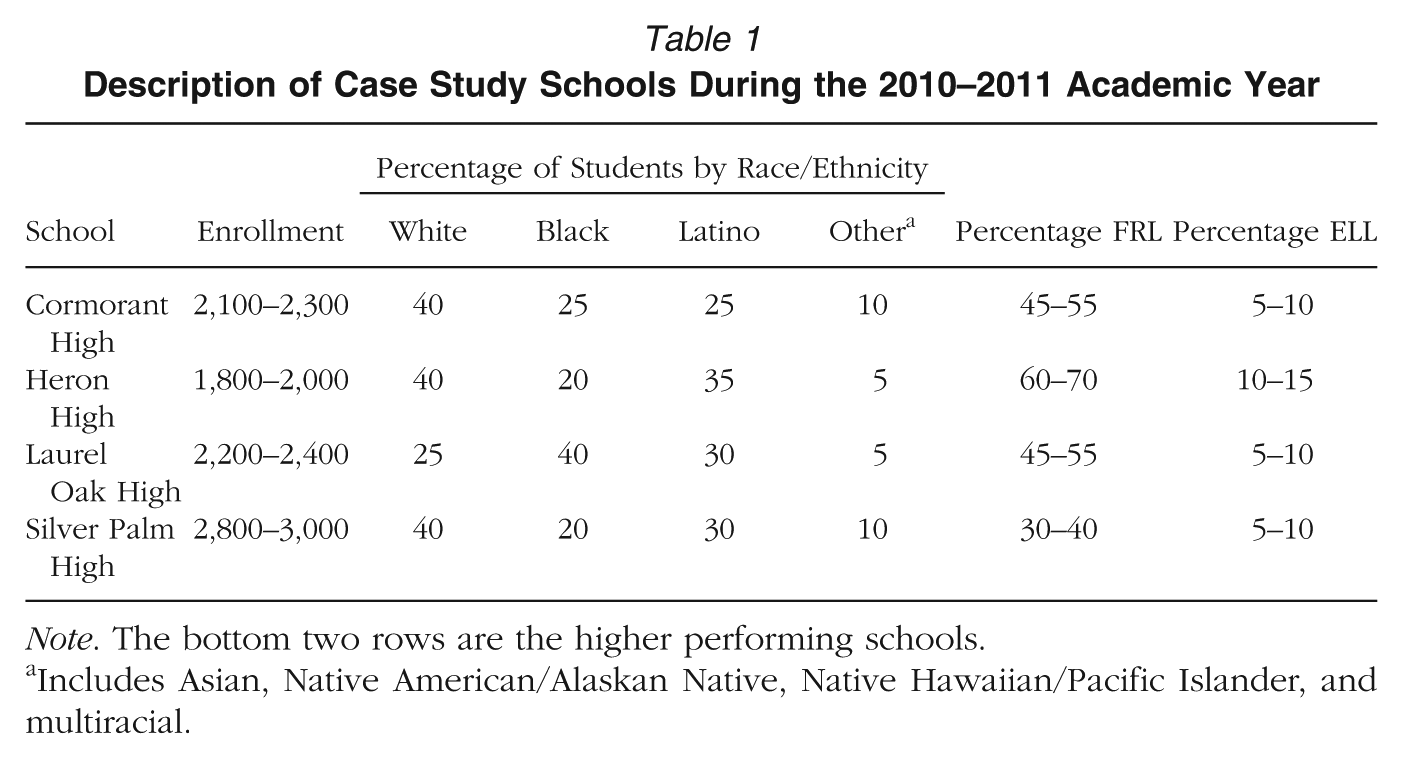
Note. The bottom two rows are the higher performing schools.
Includes Asian, Native American/Alaskan Native, Native Hawaiian/Pacific Islander, and multiracial.
Data Collection
In teams of three, we conducted three weeklong visits to each of the four case study high schools during the fall, winter, and spring of the 2010–2011 school year. At each school, we conducted semi-structured interviews lasting between 35 and 120 minutes with principals; assistant principals; guidance counselors; department heads for English/language arts (ELA), mathematics, and science; and coordinators for the Exceptional Student Education (ESE) and ELL programs. We also interviewed and observed 18 teachers—6 in science, 6 in mathematics, and 6 in ELA—chosen because they taught 10th grade. We chose Grade 10 because it is the last year that students were required to take the Florida Comprehensive Assessment Test (FCAT), and we believed that it was better than 9th grade for understanding how well students were integrated into the school. We observed teachers of Advanced Placement (AP), honors, regular, and remedial courses to look for differences in our framework components across tracks. In each school, we conducted three focus groups with teachers—chosen at random from other departments and grades—and another three focus groups with 10th-grade students in three course tracks: high, medium, and low.
Interview protocols were designed around the eight components in our framework. To help understand schools’ data use routines, for example, we asked teachers, “How do you use data in your classroom?” As findings emerged between visits, we added questions to clarify practices we wanted to understand in more detail, such as advising. 5
In addition to interviews and focus groups, we also conducted classroom observations, shadowed students, and collected documents such as School Advisory Committee minutes and lists of extracurricular offerings. We used the Classroom Assessment Scoring System for Secondary classrooms (CLASS-S) on which all researchers were trained and certified to observe the 18 teachers we interviewed in each school. In total, we scored 706 classroom observation segments. We shadowed six students at each of the case study schools. In addition to representing all three tracks—AP/honors, regular, and remedial—students were selected in an effort to achieve gender and racial/ethnic diversity. We shadowed students one whole day, observing during instructional and noninstructional times alike (e.g., passing time between classes and lunch). After shadowing, we conducted a semi-structured, reflective interview that focused on the student’s academic and social experiences at the school.
Data Analysis
Interviews and focus groups were recorded and transcribed verbatim. Pattern coding of interview and focus group transcripts and documents were used to identify central constructs in the data (Miles & Huberman, 2013; Yin, 2014). We began by coding our data with the a priori codes from our conceptual framework, allowing other codes to emerge during analysis. We conducted two rounds of data analysis. In the field, we completed Post Interaction Forms and School-Level Case Analysis Forms (Miles & Huberman, 2013) to capture preliminary findings and emerging themes. We also created matrices of preliminary findings by component. These analyses served as the basis for the development of subsequent interview and focus group guides.
The second round of data analysis occurred when data collection was complete. After achieving interrater reliability using both kappa scores and discussions of coded text, pairs of researchers actively coded 103 files for two of the eight components. The files were chosen to represent all four schools and data types (e.g., focus group transcript). Coders read the remaining files for contradictory or competing evidence. After all coding was complete, each pair wrote annotated and summative memos aimed at identifying properties and dimensions within their two components (Corbin & Strauss, 2008).
Added to the analytic memos were scores from the CLASS-S analysis and student shadowing logs. Scores from the CLASS-S were analyzed (Smith, Preston, Taylor Haynes, & Neergaard, in press). We used the student shadowing logs to calculate the proportion of time students were engaged during their observation day (Cannata, 2013). During the coding and memoing process, the entire research team met to compare findings across the framework components and schools and to identify key findings.
Findings
In this section, we present findings from our analysis of the interview, focus group, and documentary data before moving onto the results from the CLASS-S and student shadowing log. We then turn to a more detailed description of our major finding to understand how it works as a system of deliberate programs, policies, and practices.
Findings Across the Essential Components of School Effectiveness
Having analyzed the data using our eight-component framework, the largest differences between the higher and lower performing schools appeared in the components that were closely associated with the social emotional side of schooling. In this area, we found evidence that the higher performing schools made deliberate efforts to connect with students; at the lower performing schools, these efforts were less purposive and less of a priority. Under personalized learning connections, adults at the higher performing schools identified personalization as an explicit goal, and students there were more likely to describe teachers as “caring” and “involved” than students in the lower performing schools. As the principal at Laurel Oak, one of the higher performing schools, explained, “I keep coming back to personalization: Knowing the kids, knowing their background[s], and creating a sense of family, I think goes a long way.” Adults at the second higher performing school, Silver Palm, described an intentional effort there to get all students involved in at least one extracurricular activity. Students at Silver Palm seemed to appreciate and value their extracurricular involvement. In a focus group, one student elicited strong agreement from her peers when she said: “If you sit around, come to school for seven hours, and go home and do nothing, you are not going to enjoy yourself as much someone who is involved.” In the lower performing schools, adults were less likely to name personal connections as a priority and instead talked about barriers to those connections. A guidance counselor at Cormorant explained that due to her large student load, “You get to know a lot of the upper level kids [achievement-wise] and a lot of the lower level kids. The middle level—you keep your fingers crossed and hope they make it.” At Heron, guidance counselors placed the onus on students rather than the school for students’ involvement in extracurricular activities, and a department head said that the school “did nothing” to help the students become involved.
In terms of culture of learning and professional behavior, we found that while faculty across all four schools had strong professional norms of practice within their subject matter departments, administrators, guidance counselors, and faculty at the higher performing schools were more likely to describe a positive overall school culture. A student explained about Laurel Oak’s academic culture, “You learn a lot here. The teachers are really good. It’s a good school.” Adults at Silver Palm described mixed levels of motivation by students. At the lower performing schools, adults described frustration with students’ lack of motivation. A teacher at Comorant expressed a similar sentiment at the school’s efforts to increase student motivation and involvement, “I think the school tries, but I don’t think we have really been able to come up with a plan.” At Heron, adults expressed frustration with students’ attitude and behavior. A teacher explained, “When I look at my students, it’s true behavioral problems. Sometimes I have to sit and pray, but I have to keep on going.” Participants at the higher performing schools also described a culture of learning that was strong across all student academic levels, whereas at the lower performing schools, the culture of learning was most strong with the highest performing students and less strong for students in the middle and lowest academic tracks.
There were also some, though somewhat fewer, differences between higher and lower performing schools in the other six components. With regard to connections to external communities, efforts to improve parental involvement were similar across all four schools. However, we found that the two higher performing schools pursued a targeted strategy of parental involvement, offering different orientations for parents of students classified as ESE and ELL students, for example, at Laurel Oak. Participants at Silver Palm also described extensive partnerships with approximately 50 different organizations in the community, providing services from motivational speakers to locales for culinary students to provide catering.
For learning centered leadership, we found that the principals and assistant principals at the higher performing schools consistently articulated high expectations for all students, and those expectations extended beyond performance on the state high-stakes assessments. Laurel Oak administrators established school-wide cultures wherein postsecondary expectations were set for all students. Silver Palm set different expectations for “college-bound” and “career-bound” students, but those expectations were high and shared widely by all. At the lower performing schools, students reported “pockets” of adults who held high expectations for them. Administrators at the higher performing schools also implemented systemic efforts to personalize the learning experience for students through specific school-level initiatives.
In terms of systemic use of data, all four schools worked in a data-rich environment, and adults regularly drew on student data to inform administrative and instructional practices. While we found no major differences between the four schools in general data use, we did find differences in people’s attitudes about data. Participants at Cormorant, Laurel Oak, and Silver Palm tended to see the culture of data use as positive, whereas participants at Heron described it as negative. As a teacher at Silver Palm, for example, said, “[Members of the administration] have data. . . . Students who have had one or two F’s, they will pull them out. There is counseling available. . . . I mean, we try, we really do.” Guidance counselors in the higher performing schools reported using student data to review course schedules before the beginning of the school year and in the case of Silver Palm, meeting with each student in the first nine weeks.
In the area of systemic performance accountability, administrators and teachers across all four schools described strong external and internal accountability systems. Educators at all four schools identified intensive efforts by their schools to meet federal and state accountability mandates and felt pressure to perform. In addition, participants at Laurel Oak described practices that reflected a sense of internal accountability, as when the principal met regularly with students to inquire about their classroom experiences. Those at Heron, however, the most sanctioned school, appeared to feel the most pressure out of all student participants to improve student performance. They described regular classroom visits by administrators and a deep frustration at the lack of useful feedback.
Unexpectedly, we found the fewest differences between the higher and lower performing schools for rigorous and aligned curriculum and quality instruction. Participants across all four schools described curricula and pacing guides that were highly aligned to state and district standards and assessments, such as the FCAT. Consistently, they reported that they were expected to deliver a rigorous curriculum. For quality instruction, participants in the higher performing schools were more likely to name classroom strategies that aligned with our definition of quality instruction, like making real-world connections, building relationships with students, and emphasizing collaborative learning. But, we did not observe differences in the use of those strategies between the two types of schools.
Findings From the CLASS-S and Student Shadowing Logs
Specifically, we found that all four schools had overall scores in the midrange of the CLASS-S scale, suggesting that none of the schools had particularly high or particularly low levels of instructional quality. The CLASS-S measures instructional quality along four domains—emotional support, classroom organization, instructional support, and student engagement. For each of these four domains, we again found no significant differences between higher and lower performing schools. No differences emerged even after controlling for the track, grade level, subject, and time of year of the observation (Smith et al., in press).
There was, however, evidence that instructional quality differed significantly among tracks in higher and lower performing schools alike. In all schools, we found that the AP/honors courses had statistically higher overall instructional quality scores than regular classes (with differences of approximately half a standard deviation). In the domain of emotional support, teachers of honors courses in all four schools had significantly higher scores than teachers of regular courses. In the classroom organization domain, Laurel Oak had a higher average score than Silver Palm. For instructional support, the gap between honors and regular courses was widest in Laurel Oak and Silver Palm, the two higher performing schools. For student engagement, the widest gap between honors and regular courses was at Cormorant.
Similarly, in our analysis of student shadowing logs, there were no major differences regarding students’ time on task between the higher and lower case study schools. As with the CLASS-S analysis, we found significant between-track differences but no significant school-to-school differences (Cannata, 2013)
Overall, our findings from our interview, focus group, and documentary data; classroom observation scores; and student shadowing logs suggest that differences between the higher and lower performing schools were not in instruction but rather in the ways in which they built personal connections and school cultures that set high expectations for students and staff.
Personalization for Academic and Social Emotional Learning
We call this systemic and intentional attention to the interconnection of the instructional core and the social emotional activities Personalization for Academic and Social Emotional Learning or PASL. In this section, we describe the components of PASL and how it worked (or did not work) as a system of deliberate structures at both the higher and lower performing schools. With extensive existing research on the instructional core, we seek here to make a contribution to how the social structures of schools work both independent of and interdependently with the instructional core. We do this with attention to the three elements of PASL—organizational structures, academic supports, and social emotional supports. We begin with organizational structures as they provide the overall system for PASL. We then turn to academic and social emotional supports. For each of these three elements, we present the findings from the higher performing schools, followed by findings from the lower performing schools. It is worth noting that our higher performing schools help to illustrate PASL, but we do not seek here to present our higher performing schools as ideal types.
Organizational Structures
In this context, organizational structures refer to deliberate systems that the higher performing schools had in place to enact PASL. We found that the complementary organizational structures found in the higher performing schools enabled personalization that leveraged both academic and social emotional supports. Specifically, these organizational structures supported meaningful conversation and interactions among adults and students at the higher performing schools from ninth grade through graduation. At the higher performing schools, these structures included targeted looping, comprehensive and consistently enforced behavior management systems, and coherent data driven practices.
Looping
Both higher performing schools organized administrators, guidance counselors, and students in ways that facilitated sustained adult-student relationships. Specifically, the schools used “looping” whereby students were assigned to the same administrators, guidance counselors, and other school personnel over multiple years. All study schools had guidance counselors who looped with students from 10th through 12th grade; only the higher performing schools included administrators. At Laurel Oak, an assistant principal, guidance counselor, and secretary looped with an incoming 9th grade class through graduation. At Silver Palm, an administrator and a guidance counselor shared students from 10th grade through senior year. At Laurel Oak, participants reported that looping supported and sustained personal relationships among faculty, staff, students, and parents, contributing to a culture of learning among the adults and students. For example, an assistant principal at Laurel Oak explained, “All of us stay with a cohort of kids until they graduate; this is to increase the level of personalization not only with the students, but the parents as well . . . it is invaluable to our success.” At Silver Palm, when asked about looping, a guidance counselor explained, “I guess we try to get to know them [students] as individuals. We develop a relationship. That’s a plus. There are some kids I feel like are my own kids.”
At both Laurel Oak and Silver Palm, administrators and teachers described looping as a way for adults to integrate students’ academic and social lives, particularly in the area of behavior management. Participants reported that when a student was brought to the office for a disciplinary issue, the infraction was treated as a social and academic problem. An administrator at Silver Palm explained:
I wear the hat of the guidance counselor many times, even though I have a guidance counselor who takes care of the ninth graders. . . . We work well together, but you find that the discipline is not the sole reason to meet with a child. I address the academic needs and then go into the disciplinary, which they are always interrelated. (Assistant Principal 4, March 10, 2011)
At higher performing schools, looping was an important way to institutionalize personalization.
Comprehensive and Consistently Enforced Behavior Management Structures
The behavior management structures at the higher performing schools were well established. Participants reported a positive learning environment at these schools and identified strong and reliable disciplinary and support systems as mechanisms for facilitating these positive settings. A student described adults at Laurel Oak as having the following expectations: “Behavior wise, good behavior and staying out of trouble basically. Getting good grades.” Several participants described the behavior management system as one that encourages trust among students, teachers, and administration. Participants at the higher performing schools noted that when a student received discipline referrals, administrators saw them not only as an opportunity to address the disciplinary infraction in question but also to discuss the student’s academic standing and check in on their home or social life. Participants at the higher performing schools reported behavior management systems that functioned effectively and addressed students’ academic and social emotional needs.
Systems That Facilitated the Use of Data
BCPS is a data-rich environment in which administrators, guidance counselors, students, and parents have access to multiple kinds of student data. All four schools in our study had coherent systems in place around data analysis and use. Administrators and guidance counselors had students’ grades, test scores from state- and district-mandated assessments, and attendance and disciplinary data. Administrators across all four schools described using data with faculty to set school-wide goals for improving student achievement. Students and parents also had access to an online system that kept students and parents apprised of student assignments and course grades.
While participants across all four schools described data-rich environments, the administrators, guidance counselors, and teachers at the higher performing schools were more likely to describe using data for personalization and culture building and not just as an instrumental tool for goal setting and monitoring. At Silver Palm, administrators used data, such as grades, attendance records, and discipline referrals, to address student problem areas on an individual basis. At Laurel Oak, an assistant principal reported, “We learn through benchmark testing, and ACT scores, and AP scores, and then we also use that information to develop staff development.” While all schools used district software to schedule students, participants at Laurel Oak and Silver Palm described deliberately reviewing student course placements prior to school opening in the fall. The Laurel Oak principal said, by “the first 15 minutes, the first day of school, every kid is in a classroom in this school.”
Findings at the Lower Performing Schools
In our lower performing schools, we found that the same organizational structures were weak or nonexistent. In the case of looping, for example, while both schools had student-counselor looping from 10th through 12th grades, neither included the assistant principals. At the lower performing schools, participants did not use looping to facilitate personalization. As a guidance counselor at Cormorant explained:
We speak to the kids who are failing classes. We work with the upper level students. When you have so many kids, that’s a little bit unfortunate, you get to know a lot of the upper level kids and a lot of the lower level kids and middle level you keep your fingers crossed that they make it. That’s what you do when you have 750 apiece. (Guidance Counselor 1, March 8, 2011)
The assistant principals at the lower performing schools reported primarily spending time addressing disciplinary infractions with students, not with building relationships.
Contrary to descriptions of coherent structures aimed at addressing student discipline in the higher performing schools, participants at the lower performing schools expressed frustration and dissatisfaction with the behavior management systems at their schools and conveyed a weak sense of trust among administrators, teachers, and students in the area of behavior management. At Heron, a lower performing school, all five administrators identified student behavior as a major challenge. Teachers complained that administrators and security personnel were not responsive with student referrals, taking days to process referrals through the system. While participants at Cormorant did not describe the behavior management system in as dire language, they still identified shortcomings in administrators’ and students’ behavior that impeded academic learning. Administrators attributed students’ poor behavior on teacher incapacity, while teachers identified students’ low academic ability. Participants at the lower performing schools also reported inconsistent follow-through with behavior infractions, time delays, and a low level of trust between participants around behavior management.
In the area of data use, participants at the lower performing schools described a culture of data use targeting the lowest performing students and for evaluating student and teacher performance. Participants at both Cormorant and Heron reported that the most common use of data was to identify and target students for intervention. Administrators and teachers, particularly at Heron, but also at Cormorant, also described a strong administrative use of data to monitor teachers’ assessment scores as well as student behavior referrals. While they used data to monitor students, they did not use it to be proactive with scheduling. Instead, counselors relied on the district-assigned schedule, choosing not to personalize students’ schedules prior to school starting, leading to changes in the course rosters well into the fall.
Academic Supports for PASL
Academic supports refer to the efforts by adults in the higher performing schools to personalize the academic experience for students both in and outside of the classroom. We found that at both higher performing schools, administrators made efforts to have personalization permeate the classroom through explicit supports to classroom teachers. As discussed earlier, teachers at the higher performing schools were more likely to report using strategies aimed at personalizing instructional practices. Given the lack of findings of instructional quality on the CLASS-S analysis, the ways in which participants described supporting the instructional core of their schools is important.
Culture of Learning/College-Going Culture
The administrators at Laurel Oak and Silver Palm described promoting an academic culture. Multiple participants in these higher performing schools identified a targeted focus on academics and a college-going culture as priorities. The principal, an assistant principal, and the college advisor at Laurel Oak agreed that for students, “It’s cool to be smart.” A similar culture was present at Silver Palm. In the vocational programs at Silver Palm, a teacher explained, “It’s more of an academic environment than a vocational environment.”
Advanced Course-Taking as a Way to Institutionalize Rigor
Both higher performing schools in the study encouraged students to enroll in advanced courses, specifically honors and AP courses. In the academic year prior to our study, the district implemented a standardized computerized course assignment process that placed students in honors and AP courses if they showed high performance on grades or standardized assessments. From our interviews with participants, we found that the higher performing schools had placed students in honors or AP courses prior to the implementation of the district policy. Administrators, teachers, and guidance counselors alike explained that if students were enrolled in a regular or honors level course but their grades and/or test scores suggested that they might perform in an honors or AP course, respectively, they would place the students in those higher level courses the following year.
Adults in the higher performing schools explained that they took three elements into consideration when assigning students to higher level courses: grades, test scores, and the level of motivation of the student. The principal of Laurel Oak explained, “We push [students] forward.” A guidance counselor at Silver Palm said, “We have always pushed rigor. We have always said, if you really feel you can do it, sign this paper and have your mom say you can do it. Guess what? Ninety percent of those kids are successful.” A student at Silver Palm, similarly, explained, “I know one of the teachers offered [for me] to go up to AP because I had such a high grade in their class.” The focus group and students we shadowed and interviewed described their schools as putting everyone on the college track and were almost universally positive about being placed in a higher-level course, explaining they learned the most in those courses.
Guidance Department as “Hub”
At Laurel Oak and Silver Palm, the guidance departments played a critical role in providing academic support. Guidance counselors at both schools described deliberate, comprehensive, and inclusive practices aimed at all students, starting at ninth grade orientation through postsecondary school plans. A guidance counselor at Silver Palm explained that they conducted “a class visit in every grade level. Most schools don’t, but we do it prior to December. Every class has been visited, 9th, 10th, 11th, and 12th, to make sure they are aware we are here for them.” Students at these higher performing schools were more likely to identify guidance counselor’s role as helping with course assignment than students at the lower performing schools. Guidance departments took pride in their offices, describing them as “hubs” of academic and social interactions that went beyond remediation.
Explicit Teaching of Academic and Social Emotional Skills
A district-sponsored program, modeled after the national Advancement Via Individual Determination (AVID) program, was used to support students. At Silver Palm, this program was specifically aimed at increasing students’ sense of belonging at the school and academic skills. To participate in the program, administrators identified students who scored either a two or three on the FCAT, which has a scale of one through five, and provided them with additional support in the form of tutoring, extra guidance toward higher education, and an extra course on academic and social skills. One administrator described the depth of the ties between students and teachers participating in the program and the benefits gained:
It was like a team and family. They feel like a family. They all work together. They go to classes together. And the teachers commonly plan together, so they do things together in order to help all of them be successful. (Assistant Principal 3, March 9, 2011)
A student explained, “It’s a program, it’s usually open to smart kids so they can pay more attention to school work and get things done. It’s like a huge family.” This program targeted the middle students and complemented resources already going to high-performing students enrolled in higher-level courses as well as remedial students enrolled in mandated reading courses. In this way, adults at Silver Palm sought to focus on the needs of all students at the school.
Findings at the Lower Performing Schools
As with the organizational supports, we identified many of the same academic support activities at Cormorant and Heron. However, again, we did not find the practices to be systemic and deliberate. Individual teachers discussed efforts to differentiate instruction and personalize the learning experience. While we observed the guidance offices providing services to students, efforts were targeted less toward proactive personalization and more toward reactive processes, supporting students in crisis. Neither faculty nor students identified the guidance office as a “hub” for academic and social interactions. While these schools had implemented the district-mandated course assignment matrix, it had only been in place for a year. Students were also permitted to move out of higher-level courses (i.e., honors and AP) if they were deemed too difficult. Both Cormorant and Heron also had the AVID-like district program in the recent past; however, participants reported it had not been implemented as intended, and its impact was weak. Although the program at Heron reportedly provided “some personalized attention” to minority students and succeeded in encouraging many to take higher-level courses, it suffered the same fate as Cormorant’s program and was closed.
Social Emotional Supports for PASL
As with organizational and academic structures, the higher performing schools also intentionally sought to provide social emotional supports for students. The focus here was on the nature of the interpersonal connections between adults and students and personalization practices as part of the schools’ culture.
Language of Personalization
“Personalization” was an explicit part of the higher performing schools’ language, with a number of participants discussing the concept without being prompted. When discussing looping, a counselor remarked at Laurel Oak, “They personalize the education. . . . We try to take a big school and break it down to a small school.” Similarly, a Laurel Oak teacher explained, “We personalize education” such that “there is a sense of community that is palpable. You can feel it.” Data use to identify and monitor students in need was viewed as an important “personalization piece.” A teacher at Silver Palm explained, “Personalization is what matters in this job, the key component to having success.” Teachers at both schools reported making a concerted effort to having personal knowledge of their students’ names, cultural and academic backgrounds, and academic aspirations. Some school personnel were also conversant with or made efforts to understand students’ home life. A Laurel Oak counselor reported, “You get to know your kids. Teachers get to know the kids as well. . . . It’s close knit family because everybody wants the kids to do well.” A student in a focus group at this same school explained that the teachers “actually care.” A Silver Palm teacher described asking a student about his participation on the basketball team. Adults at both schools consistently described personalization as a priority.
Formal and Informal Adult-Student Connections
Administrators at both higher performing schools described leading by example to foster formal and informal personalized learning connections with all students. They reported being present during lunch period in the cafeteria and intentionally checking in with students. Students reported a high degree of social and interpersonal support. Yet, there were different emphases at each school on the ways to forge connections between students and adults. At Laurel Oak, the adults held high expectations for all students in the areas of academics and behavior. Students at Laurel Oak perceived and described the administrators as caring because they had a visible presence and “they talk to us [students].” They agreed emphatically that “administrators really go to the extreme to help out each individual club and to help every student get to what they need and what they want, and we always see them walking around and in the classes.” By and large, students reported that the teachers and counselors were also accessible, stating, “You can talk to anybody if you have trouble or something.” Participants at Silver Palm, in turn, described more of an emphasis on preparing students for “the real world,” as a teacher put it, and acknowledged that this might be different for each student. There was more of an emphasis on the individual interests and needs of each student. Students at Silver Palm described an expectation to become involved in extracurricular activities. One explained the philosophy: “If you sit around, come to school for seven hours and go home and do nothing, you are not going to enjoy yourself as much someone who is involved, and like getting into different things.”
Findings at the Lower Performing Schools
While, again, we found that some participants at Cormorant and Heron reported isolated efforts to personalize the experience of students, we did not find that the activities permeated throughout the school. Neither school provided a formal structure to develop positive connections between school personnel and students. At Cormorant, participants gave mixed reviews about school-wide adult-student connections. The assistant principals and counselors explained that while they tried to promote school-wide connections, they were not always successful. Adults at both lower performing schools tended to describe adult-student relationships as the students’ responsibility, not the adults’, reflecting a more passive approach to forging relationships with students. Participants at both schools explained that students’ connections with adults were shaped by their individual involvement in extracurricular activities and their personal levels of motivation.
Discussion
This comparison of the higher and lower performing schools suggests that the contrasts appear to be an outgrowth of the ways schools work (or fail to work) to institutionalize supports and cultures that personalize academic and social emotional learning for students. While the design of the study does not allow us to make causal claims, our findings suggest PASL may play an important role in the comparable successes of the higher performing schools.
Two main theories—one from organizational theory and another from psychology—provide support for PASL. The first is research on the social organization of schools (Dornbusch, Glasgow, & Lin, 1996; Rowan, 1990). The second is Bandura’s work on social cognitive theory (Bandura, 1989, 2001). After describing these theoretical foundations, we turn to empirical studies of the main policies and programs we observed in the higher performing schools: looping, strong behavior management systems, data use, and personalization. We then turn to the implications of our findings for understanding school effectiveness.
Theoretical Foundations for PASL
Building from organizational theory generally (Burns & Stalker, 1968; Scott, 1978) as well as early theorists of the school organization (Bidwell, 1965; Weick, 1976), Rowan (1990) argues that schools employ two types of strategies for organizational design and effectiveness: control strategies and commitment strategies. Control strategies highlight the hierarchical top-down control of schools by administrators over teachers and the classroom (Rowan, 1990). They represent efforts to regulate the technology of teaching through prescribed curricula and instruction and administrative oversight. This perspective embodies the idea that student learning will be maximized by clear and focused attention and accountability on classroom instruction and technology and the means to convey it to students. Commitment strategies, on the other hand, rely on organizational structures that motivate administrators and teachers to engage in collective problem solving and collaborative practices that in turn improve student outcomes (Rowan, 1990). These strategies focus on activities such as professional development, small learning communities, and networks of communication among stakeholders. Most of this work has focused on the behavior of adults in schools and the role that collegial networks and collective decision making play in supporting teaching, learning, and school reform (Gallimore, Ermeling, Saunders, & Goldenberg, 2009; Spillane & Healey, 2010).
Educational researchers have drawn on control and commitment strategies to explain school effectiveness (Ingersoll, 2003; Lee et al., 1993). These studies focus on the supports to the learning agenda of schools as well as supports to the affective relationships in schools. For example, in their literature review of the characteristics of effective high schools, Lee et al. (1993) discuss the importance of schools attending to the affective and cognitive dimensions of schooling and note: “‘Good’ or ‘effective’ schools must couple concern for social relations with an appreciation for the structural and functional aspects that instrumentally affect instruction and academic learning” (p. 228).
From the perspective of organizational theory, PASL represents an empirical enactment of control and commitment strategies. Strong disciplinary structures, attentive leadership, and curricular alignment were some of the comprehensive control strategies employed by both higher performing schools. Looping, explicit personalization, and courses on study skills and social emotional competencies build commitment. These schools were effective in deploying programs and practices that attended to students’ complementary academic and social emotional needs.
Theoretical grounding for personalization for academic and social emotional learning can also be found in Bandura’s work on social cognitive theory, specifically as it relates to the concepts of triadic reciprocal determinism (Bandura, 1978), efficacy beliefs (Bandura, 1977, 2000), and human agency (Bandura, 1989). Triadic reciprocal determinism suggests that individuals’ functioning in schools is “a product of a reciprocal interplay of intrapersonal, behavioral, and environmental determinants” (Bandura, 2001, p. 165). Efficacy beliefs can be both personal and/or collective. Perceived self-efficacy refers to a student’s or a teacher’s belief in his or her ability to accomplish particular school-related goals (Bandura, 2001; Pajares, 1996; Tschannen-Moran, Woolfolk Hoy, & Hoy, 1998; Zimmerman, 2000). With collective efficacy, school personnel (or students) have shared beliefs/judgments about their collective capacity to produce desired academic and/or social emotional outcomes (Bandura, 2000; Goddard, Hoy, & Woolfolk Hoy, 2000). Human agency refers to the process by which adults and students intentionally take responsibility for influencing student behavior and future life circumstances.
Social cognitive theory suggests that when schools attend to PASL, adults engage in practices that enhance students’ self-efficacy beliefs, sense of belonging, and the development of agency. Through these practices, administrators and teachers promote a culture of high expectations for students’ academic success, which may be especially beneficial for struggling learners (Margolis & McCabe, 2003). Students are encouraged to pursue challenging goals. Teachers may bolster students’ self-beliefs via positive and appropriate “verbal and social persuasions” and as “social models” (Bandura, 1977; Pajares, 1996; Usher & Pajares, 2008). Encouragement and affirmation from adults in the school can boost students’ academic motivation and efforts to achieve. Research on teacher efficacy suggests that teachers’ perceptions are likely to have powerful motivational and socializing effects on both teachers and students (Goddard, 2001; Hoy, Sweetland, & Smith, 2002; Tschannen-Moran et al., 1998).
When adults in schools provide positive personalization experiences, they include not only instructional approaches that target students’ interests, experiences, and learning needs (Jenkins & Keefe, 2002) but also a personalized school environment that reflects what Noddings (1988) refers to as “an ethic of caring” or “a relational ethic.” Through intentional efforts to form meaningful teacher-student relationships, schools bolster students’ sense of belonging and engagement in their own learning (McLaughlin, Talbert, Kahne, & Powell, 1990). As Hallinan (2008) argues, “The way that teachers interact with students is of considerable importance in shaping how students feel about themselves and their surroundings” (p. 273). Social cognitive theory therefore explains PASL in terms of the relational processes that may aid (or check) students’ development and underscores the value of high academic attainment as well as positive adult-student relationships as an end in themselves.
These theories provide insight into why the higher performing schools in our study were successful at providing systemic and deliberate opportunities for personalization. Specifically, administrators and teachers created positive school climates through their expressed care and concern for students’ well-being, intellectual growth, and educational success both academically and social emotionally. Consistent behavior management systems with clear and fair disciplinary structures also supported school cultures where students felt safe and a sense of belonging.
Empirical Foundations for PASL Practices
In addition to identifying the theoretical underpinnings of PASL, we also found the empirical basis for the practices employed effectively by the higher performing schools in the study. In particular, we focus on the practices identified earlier that attend to both academic and social learning needs and promote personalization: looping, behavior management systems, use of data, and advanced course taking. We pay particular attention to the ways in which these practices attend to and complement the academic and social emotional elements of schooling.
Looping is a practice that employs social and academic resources in the service of personalization. In the research, looping has been generally understood to be between students and teachers. In a review, Burke (1997) identified a number of studies that present evidence of positive outcomes associated with looping. These studies, among others, suggest that adults (Hargreaves, 2000) and students (Cistone & Shneyderman, 2004) benefit from sustained and formal relationships in schools.
Researchers also identify coherent behavior management systems as important structures in effective schools. Findings from these studies reveal that confidence in the school’s behavior management system engenders feelings of safety and trust among administrators, faculty, students, and parents (Akey, 2006; Gottfredson, Gottfredson, Payne, & Gottfredson, 2005). Schools that have strong social emotional supports in place, including those that promote student engagement, high expectations of student behavior, and positive school climates, see decreases in the number of disciplinary infractions (Elias, 2006; Galloway & Lasley, 2010). Administrators and teachers in effective schools have discussions about challenges facing their students, including discipline issues, attendance, and academic performance (Copeland, Lambert, Wallach, & Ramsey, 2010). Effective behavior management systems facilitate and attend to students’ academic and social emotional needs, enabling personalization.
Data use is another practice that serves interrelated academic and social functions that promote personalization. Administrators, guidance counselors, and teachers are increasingly drawing on students’ data to inform decision making in schools (S. Anderson, Leithwood, & Strauss, 2010). They use student grade and test score data to track students’ academic progress (Cohen-Vogel & Rutledge, 2009), assign students to teachers (Cohen-Vogel, 2011), and determine student course taking and remediation (Firestone & González, 2007). They also draw on student surveys and career inventories to tailor students’ interests to their course taking and extracurricular activities (Anderson et al., 2010).
Another strategy facilitated by data use is advanced course taking. Placing students into honors and AP courses has been found to positively affect student achievement. Course differentiation in high schools leads students to follow different academic pathways that have implications for high school outcomes such as performance on statewide standardized and end-of-course exams, increases the likelihood of graduating within four years, and provides opportunities for postsecondary education. While academic pathways created by course differentiation have been consistently found to reinforce socioeconomic and racial segregation (Kalogrides & Loeb, 2013; Lucas & Berends, 2002; Oakes, Gamoran, & Page, 1992), other studies find that higher-level course taking signals college-level readiness (Iatarola, Conger, & Long, 2011; Stein, Kaufman, Sherman, & Hillen, 2011) and that even one honors or AP course increases 10th grade standardized test scores, the likelihood of graduating from high school, and the likelihood of attending a four-year college (Long, Conger, & Iatarola, 2012). By encouraging students into at least one advanced course, the higher performing schools challenged the rigid stratification associated with the high school course tracking system.
As illustrated here, there is theoretical support for PASL. There is also empirical support for the distinct practices employed by the higher performing schools in our study.
Implications for School Effectiveness
We now turn to the implications of our PASL findings on research, policy, and practice. Taken together, the theoretical and empirical research base for PASL confirms understandings of school effectiveness, generally, and our findings, in particular. Our findings in the case study schools suggest that practices that comprehensively address the academic and social emotional needs of students through personalization are a viable and promising approach to improving the outcomes of high school students. These theoretical and empirical findings further point to the importance of attending to the dual academic and social purposes of schools.
In this era of standards and accountability policies, federal, state, and district policies have focused on the instructional core as the primary lever for school improvement. Federal and state high-stakes standards and assessment policies of the past 20 years center school improvement around improving teachers’ curricular and instructional practices and student academic performance. Yet, in the high-stakes accountability context of Florida, we found that personalization for academic and social learning, not instructional quality, was what differentiated our higher and lower performing schools. This points to the need for greater attention from policymakers, researchers, and practitioners to address the elements of students’ high school experiences that not only target the instructional core but also the social emotional supports that enable students to succeed. Standards and assessment policies, with their focus on improving school, teacher, and student performance on standardized assessments, have succeeded in focusing attention on instructional practices (Au, 2007). Yet, these policies have given little credence to the social emotional supports that foster student performance.
One explanation for the lack of focus on the social emotional side of schooling is the lack of understanding of how it works as a system within schools. Decades of research have explored how the instructional core works in schools (Barr & Dreeben, 1983; Bidwell, 1965; Oakes, 1986; Weick, 1976), with research illustrating the ways in which standards and assessment policies shape not only instructional practices but also administrators’ and teachers’ support of the instructional core (Au, 2007; Cohen-Vogel & Rutledge, 2009; Rutledge, 2010). Yet, there is little comparable evidence on the social emotional side of schooling. While studies have identified the social side of schooling to be critically important, little empirical research has explored the mechanisms of social emotional practices in schools.
In our study, PASL represented the unified control and commitment strategy that differentiated the higher and lower performing schools. Taken together, it provides a framework for understanding the deliberate and intentional personalization practices in schools. It also emphasizes the importance of schools developing coherent systems that draw from the academic, social emotional, and behavioral activities in schools. It is possible, however, that the ways in which control and commitment strategies work in schools differs. Our study suggests that schools enact PASL differently, with organizational routines and priorities specific to each school’s site and needs. Future research should examine the ways in which control and commitment strategies function in different schools. The field would also benefit from large-scale studies that explore high schools as academic and social systems.
We identify one area of academic and social emotional supports that is underrepresented in PASL and thus represents a limitation of our study. In our conceptual framework, we take the view that an effective school proactively attends to the needs of its diverse student body and provides equitable opportunity in regards to coursework, instruction, extracurricular activities, social identity, and school identification. Furthermore, all students are exposed to fair disciplinary policies and practices. Yet, we recognize that there is an additional component identified with personalization and effectiveness that is explicit about addressing an element of the social emotional needs of students, namely, multicultural education and cultural responsiveness. Studies in this area find that effective schools are developmentally responsive (Felner, Seitsinger, Brand, Burns, & Bolton, 2007; Waters, Cross, & Runions, 2009) and culturally sensitive (Gay, 2002; Howard, 2003). While we did find that some teachers at the higher performing schools reported personalizing their instruction to students’ interests and backgrounds, it is clear that these practices are intentional and direct in effective schools (Ladson-Billings, 2004; Nieto, 2003) and that the higher performing schools could have made this more intentional. This speaks to the importance of adults in schools using information about students’ home culture and engaging in culturally relevant pedagogy to create a learning environment necessary to ensure student success (Keefe & Jenkins, 2002). The assumption is that “when academic knowledge and skills are situated within the lived experiences and frames of reference of students, they are more personally meaningful, have higher interest appeal, and are learned more easily and thoroughly” (Gay, 2002, p. 106). There is a basis for including multicultural education and culturally responsive pedagogy into PASL.
Practitioners are well aware that the purposes of schooling extend beyond the instructional core. Yet, our study suggests that it is challenging to mobilize deliberate, purposive, and systemic activities aimed at attending to the complementary academic and social emotional realities of schooling. External factors such as state and district pressure to improve school performance send signals to focus exclusively on improving academic performance. Internal factors such as weak leadership or weak professional communities may undermine systemic approaches to promote social emotional components of schooling. High school organization, with multiple-course teachers who often identify first with their subject matter over their connection with their students (Siskin & Little, 1995), may further reinforce the academic purpose of schooling over the social. Too often in high schools, administrators and teachers forget that the needs of high school students extend beyond academic preparation to their social emotional needs and skills.
Conclusion
While studies of school effectiveness have identified academic and social emotional components of schools to be critical, this study describes how these components of high schools are interdependent and work as a system. It also provides the theoretical foundation and empirical basis for specific strategies that support social emotional growth and show promise for improving high schools as well as outcomes for low-income students and students of color. With policy efforts so clearly focusing on improving and controlling academic components of schooling, we would be well served to understand the social emotional elements of schooling and their relationship to academic activities. This is particularly true in high schools that remain understudied as social systems.
This attention on the intersection between students’ academic and social emotional experiences in school comes at a critical juncture. With policymakers’ and researchers’ continued focus on the instructional core of schools through the promotion and study of policies such as standards and assessment and the Common Core, the ways in which high schools attend to students’ social emotional needs and how this complements academic learning continues to be overlooked. This study highlights the importance and potential of high schools attending to the academic and social components of schooling.
Footnotes
Notes
S
L
L
R