






Abstract
Recent research on the relationship between standards and teachers’ practice suggests that teachers are unlikely to make changes to practice without extensive opportunities for learning about standards with colleagues. This article extends this line of research, using a comparative case study of three high-poverty urban schools to examine the nature of teachers’ collaborative work around the Common Core State Standards and the conditions that support this work. It argues that collaborative practices that encourage joint examination of instruction and student learning against standards support teachers in noticing and attending to differences between their current practice and standards. In addition, it examines the role of teachers’ instructional knowledge and principals’ leadership in supporting teachers’ collaboration around standards.
The Common Core State Standards (CCSS) were designed to set ambitious expectations for what students should know and be able to do in grades K–12. Beginning in the 1980s, the standards movement sought to foster excellence and equity in student learning outcomes by institutionalizing high expectations for all students while allowing teachers to have professional discretion in deciding how to support students in meeting these goals (Payne, 2008). As explained in the introduction to the CCSS, By emphasizing required achievements, the Standards leave room for teachers, curriculum developers, and states to determine how those goals should be reached. . . . Teachers are thus free to provide students with whatever tools and knowledge their professional judgment and experience identify as most helpful for meeting the goals set out in the Standards. (Common Core State Standards Initiative, 2010, p. 4)
Helping students meet these standards presents a major challenge for teachers since they ask students and consequently teachers to learn to work in new and challenging ways.
Research suggests that previous standards failed to produce widespread improvements in teaching and learning because teachers had few opportunities to fully understand the ideas behind standards and their implications for practice (Cohen & Ball, 1999; Cohen & Hill, 2001; Spillane, 2004). Decades of educational reform reveal that policies calling for ambitious change on the part of teachers have frequently been paired with limited support for learning (Cohen & Barnes, 1993; Elmore, 2004). One explanation is that deep divisions in American politics led policymakers to adopt vague policy goals and learning supports. Although still politically divisive, standards have gained broad support by institutionalizing high expectations for all students without dictating the methods that would be used to meet standards (Rothman, 2011). Notably, urban districts have struggled to respond to standards-based accountability policies (Payne, 2008), and the ineffective implementation of standards in urban districts threatens the potential for common standards to enhance educational equity.
I conducted a comparative case study of 26 teachers in three high-poverty schools in a large urban district in the Northeastern United States. Educators in these schools were some of the first in the country to begin teaching to the CCSS; thus, learning from their experience presents a timely opportunity as teachers across the country seek to respond to these new standards. My goal was to understand in some detail the collaborative practices and school conditions that support teachers in learning how to support students in meeting the CCSS. Despite a long history of teacher isolation (Lortie, 1975), opportunities for teacher collaboration have become prevalent in schools since the introduction of standards-based accountability policies (Earl & Timperley, 2009; Wei, Darling-Hammond, & Adamson, 2010).
My findings suggest that collaborative practices that encourage joint examination of instruction and student learning support teachers in noticing and attending to differences between their current practice and standards. All teachers in the study worked with colleagues to plan instruction, select resources, and use data on student learning; however, the degree to which this collaboration supported teachers in understanding the gap between current practice and the expectations of the CCSS varied greatly across and within schools. I examine the collaborative practices of teachers and the conditions that support these practices in three high-poverty schools: Bay, Park, and Sunnyside Elementary. 1
Theoretical Framework: Policy Implementation as Teacher Learning
There is growing agreement among scholars that educational policy is better understood as a challenge of teacher learning than as a challenge of “implementation” since the success of any policy is largely determined by the individual and collective capacity of teachers to meet the policy’s goals (Cobb & Jackson, 2012; Gallucci, 2003; Little, 1999; Spillane, Reiser, & Gomez, 2006). The policy logic behind the CCSS presumes that teachers will produce superior and more equitable student outcomes if expectations for student learning are clear at each grade level, build progressively toward career and college readiness, and all students are held to these same high expectations. However, many teachers may not know how to support students in reaching these standards or may not believe that their students are capable of meeting these expectations. Recent research suggests that teachers fail to align their instruction with standards because they misunderstand the underlying principles behind policy and their implications for practice (Spillane, 2004; Spillane, Reiser, & Reimer, 2002). This misunderstanding of policy is unsurprising. Meeting new standards requires teachers to comprehend the meaning of the standards themselves, the way their instruction would need to change to support students in meeting these standards, and ultimately, they must learn how to work in these new ways.
Opportunities for teacher learning are essential because the expectations outlined in the CCSS require students to engage in more critical thinking and less routine learning than previous state standards and thus represent a major shift for teachers’ instructional practice. Porter, McMaken, Hwant, and Yang (2011) conducted a comparative analysis of the CCSS and state standards, assessments, and teachers’ reports of their instructional practice from 31 states, including the state in which these three schools were situated. Their findings revealed that the CCSS placed more emphasis on cognitively demanding processes than previous state standards and assessments. For example, a higher proportion of the CCSS required students to “demonstrate understanding” in mathematics and “analyze” in English language arts and reading (ELAR) than prior state standards. Teachers may lack the knowledge and skills needed to engage in more complex practices. Researchers find that teachers’ practice is weakest in areas that involve more complex tasks, such as problem solving and asking high-level questions (Kane & Staiger, 2012; Sartain, Stoelinga, & Brown, 2011). Thus, teachers will need not only to adjust to the higher level of cognitive demand of the standards but also learn how to effectively lead high-level instruction.
Framing the standards as a challenge of teacher learning runs counter to recent federal “turnaround” efforts. So-called turnaround policies call for firing and replacing principals and teachers in low performing schools. This approach is based on questionable evidence, disproportionately affects low-income communities of color (Trujillo & Reneé, 2012), and alienates the very people who must solve the challenge of improving student performance. Supporting students, particularly children living in poverty, in meeting the demands of the CCSS requires much more than hiring new personnel. It requires changing the way teachers think about instruction and how they carry out their work with students each day.
Making Sense of Standards, Transforming Practice
Scholars have applied a cognitive framework to understand how teachers engage in “learning,” “interpretation,” or “sensemaking” about policy (Coburn, 2005; Spillane et al., 2002). This line of research reveals that teachers’ understanding of and actions related to policy are influenced by their prior knowledge, beliefs about instruction and students’ abilities, social interactions, and connections with messages about policy (Coburn, 2004, 2005; Cohen & Ball, 1999; Spillane et al., 2006; Stosich, 2016; Weick, 1995). Standards and the curriculum, assessments, and professional development (PD) that are designed to align with these standards communicate information about what teaching to these standards would look like in practice. Cohen and Hill (2001) surveyed teachers about their experiences with new mathematics standards in California. The teachers they surveyed were more likely to report implementing standards-aligned practices, and students achieved at higher levels in schools that provided substantial opportunities for teachers to learn about standards-aligned curriculum and assessments. However, only a small proportion of schools—about 10%—fostered these intensive and practice-based opportunities for learning. Further research is needed to identify the specific learning experiences that support teachers in revising their instructional practice in ways that lead to improvements in teaching and learning.
Research that examines the experience of individual teachers with educational policies suggests that teachers are likely to ignore, misunderstand, or only superficially adopt policies that depart from their current practice (Coburn, 2004; Spillane, 2004). Teachers make sense of policies through the lens of their existing knowledge and beliefs, “supplementing” rather than “supplanting” existing knowledge and practice (Cohen & Weiss, 1993, p. 227). In fact, teachers may layer new practices on top of existing practices in ways that do not fully address the goals of policy or that conflict with policy principles (Coburn, 2004; Spillane, 2004), which Cuban (1984) calls “conservative progressivism.” For example, Cohen (1990) described a teacher who adopted new topics but taught them using a traditional pedagogical approach, which failed to encourage the deep conceptual understanding that the mathematics policy was designed to foster.
The process of learning to teach to standards is challenging because it requires “developing new understandings of familiar ideas such as problem solving” (Spillane, 2004, p. 157). Teachers must forsake previous practices and beliefs and develop alternative ones to meet the goals set by new standards (Strike & Posner, 1992). Teachers who accept the logic behind new and higher standards risk harming their self-concept (Spillane et al., 2002) because these standards imply that current practice is inadequate for reaching expectations for student learning (Cohen, Moffitt, & Goldin, 2007). Instead, teachers may attribute the challenge of meeting reform goals to their students’ characteristics, including students’ abilities, socioeconomic status, or English learner status, rather than their own instructional practice (Anagnostopoulos & Rutledge, 2007; Coburn, 2005; Gallucci, 2003). Moreover, teachers often view new policies as similar to their existing practice (Cohen, 1990; Hill, 2001; Spillane & Callahan, 2000; Spillane et al., 2006). Viewing reforms as familiar can lead to misinterpretation and rejection of information that conflicts with current beliefs about instruction or students’ abilities and consequently make restructuring knowledge and practice all the more difficult. This presents a paradox: Teachers are both the targets of policy and the ones tasked with determining how to meet policy goals.
Intensive and ongoing collaboration with colleagues around standards may be essential for translating abstract standards into explicit changes in instructional practice (Coburn, 2001, 2008; Cohen & Hill, 2001). Spillane (2004) found that teachers whose practice most closely aligned with ambitious mathematics standards all described learning about standards as a social endeavor. The teachers he studied engaged in ongoing collegial deliberation about standards, such as conversations about standards-based curriculum and ideas from PD. However, this collective sensemaking process does not guarantee that teachers will adopt practices that align with policy goals. In fact, teachers who collaborate with colleagues who hold beliefs and practices that conflict with policy goals may be more likely to reject policy than teachers who work in isolation (Gallucci, 2003). Coburn (2001) found that teachers in a school serving mostly poor and minority students dismissed policy messages about reading that they viewed as too difficult for their students when working with colleagues. Thus, collaboration among colleagues has the potential to reinforce teachers’ deficit views of students.
Nonetheless, Spillane (1999) argues that teachers are unlikely to “notice opportunities for learning, or stimuli for change in their environment” when working in isolation (p. 169). To date, however, scholars have not closely examined the collaborative practices that support teachers in learning how to teach to new standards. Little (1990) argues that interactions among teachers exist along a continuum from complete independence to interdependence. Teachers’ practice becomes public and differences in beliefs and practices are more likely to surface when teachers work interdependently with colleagues, what Little describes as “joint work.” However, widespread norms of autonomy and privacy among teachers (Donaldson et al., 2008; Lortie, 1975; Stosich, 2016) make engaging in interdependent work challenging. Instead, teachers are likely to engage in “sharing” when they collaborate (Little, 1990), openly exchanging information and materials while maintaining individual autonomy over instructional decisions.
Coburn and Stein (2006) describe “policy implementation as a process of learning that involves gradual transformation of practice via the ongoing negotiation of meaning among teachers” (p. 26). Working with colleagues to select instructional approaches and materials, try them out, and reflect on their effectiveness in supporting students to meet standards may be an important part of identifying and beginning to bridge the gap between policy and practice. Correspondingly, research on teachers’ professional learning suggests that engaging in sustained inquiry with colleagues encourages teachers to question underlying assumptions and current practices (Earl & Timperley, 2009; Gallimore, Ermeling, Saunders, & Goldenberg, 2009). This line of research has generally explored whether using particular protocols for investigating instruction with colleagues leads to improvement in teaching and learning over time. However, requiring teachers to use particular inquiry protocols can result in what Hargreaves (1994) calls “contrived collegiality,” which does not lead to any meaningful change in practice. I explore teachers’ collaborative practices more broadly to understand the specific processes and conditions that support teachers in learning about standards and how to support all students in meeting these expectations. Specifically, I seek to answer the following questions:
Research Question 1: How do teachers come to understand the CCSS?
Research Question 2: How do teachers enact practices related to the CCSS?
Research Question 3: How, if at all, does teachers’ collaboration with colleagues relate to the way teachers say that they come to understand and enact practices related to the CCSS?
Research Design and Methods
I conducted a comparative case study of three schools, using a nested design in which I consider individual teachers’ responses within their school context. I examined teachers’ work with standards using direct observation as well as ex situ accounts in interviews, assuming that teachers actively make sense of messages about the CCSS in the context of their school environment and in collaboration with colleagues. Although their experiences are not generalizable, close examination of teachers’ experiences has the potential to contribute to theory about how teachers learn about standards (Yin, 2009).
Context of the Study
At the time of the study (January–December 2013), teachers in all three schools had been teaching to the CCSS for three years. The district in which these schools were situated adopted the CCSS in 2010, required teachers to begin integrating the CCSS in their instruction in fall 2011, administered the first CCSS-aligned assessments in spring 2013, and adopted CCSS-aligned curriculum in fall 2013. The district’s instructional expectations stated that collaboration in teacher teams was a central process for teachers to learn about the new standards. On these teams, they would: (1) analyze student work to adjust teaching practice and instructional planning, (2) plan CCSS-aligned curricular units, (3) plan for changes in instruction based on the CCSS, and (4) adjust lessons, units, and classroom assessments to address the gap between what the new standards required and what their students knew and were able to do.
In addition, the district formed the Common Core Innovation Network (CCIN), a network of 35 schools that volunteered to be early adopters of the CCSS and receive additional support in teaching to the new standards. The CCIN was led by central office administrators who worked with teachers from each school to develop shared expectations for instruction and student performance through discussions of student work and collaborative development of curriculum units aligned with the CCSS. The work of the CCIN reinforced and extended the district’s focus on professional learning in teacher teams. The district had supported teacher teams in engaging in collaborative inquiry for the five years prior to the beginning of the study. The inquiry team process called for teachers to work with colleagues to analyze student and teacher work, identify a learning challenge, select a research-based instructional approach to address this challenge, implement the approach, and evaluate its success.
Sample
I used purposive sampling (Seidman, 2006) to select schools with a history of success in supporting student achievement, comparable student populations, and membership in the CCIN. Three of the four schools that met these criteria chose to participate. All three schools performed the same or higher, on average, on previous state assessments than schools in the district with similar student populations; thus, they may have been more likely to meet the goals of the CCSS than schools that had made little progress in meeting prior state standards. Nevertheless, meeting the high expectations set by the CCSS presented a major challenge for teachers in these schools since about half of students in each school failed to meet previous state standards in mathematics and ELAR, as measured by the state assessment (see Table 1). More than 95% of students at each school were Black or Latino, and more than 80% of students received free or reduced-price lunch; thus, all three schools were considered high-poverty schools where at least 75% of students were low-income (Aud et al., 2010). Growing gaps in achievement and college attainment between low-income and high-income students (Bailey & Dynarski, 2011; Reardon, 2011) make the need for understanding how educational policies can support high achievement among low-income students all the more pressing.
School Demographics and Performance Profiles

Note. ELAR = English language arts and reading; CCSS = Common Core State Standards.
Source. State Education Data 2012–2013.
To better understand teachers’ opportunities for learning about standards, including opportunities for learning in grade-level teams, I invited principals and teachers in Grades 3, 4, and 5 to participate in the study. These teachers faced pressure from state testing to meet the new standards, taught similar content, and met regularly in grade-level teams. Study participants included regular and special education teachers who worked in self-contained classes as well as special education teachers who co-taught with regular education teachers. Most (81%) teachers who were invited chose to participate in the study. However, the purposive sampling of teachers and schools precludes me from generalizing about all teachers in any one school, the district, or elementary educators more broadly.
Notably, almost all teachers who participated in the study were highly experienced, most teachers were people of color, and all principals were people of color who had been in their position 10 or more years. Teachers participating in the study had from 2 to more than 25 years of teaching experience; half had more than 15 years of experience, and most had taught at the same school for more than 10 years. Thus, this study examines how experienced teachers working in stable organizations respond to new and higher standards for students’ learning.
Data Collection and Analysis
Teacher interviews and observations were the primary focus of data collection. In total, 26 teachers, 3 principals, and 1 assistant principal participated in the study (see Table 2). I conducted 36 teacher interviews, 8 principal interviews, 17 classroom observations, 10 teacher meeting observations, and 5 PD observations. I interviewed third-, fourth-, and fifth-grade teachers in each school using a semi-structured interview protocol (Seidman, 2006) to examine how they learned about and enacted practices related to the CCSS. Specifically, I asked teachers about how they made instructional decisions and how the CCSS, students, resources, colleagues, administrators, and opportunities for learning influenced their instructional practice. In addition, I interviewed principals to learn how they influenced teachers’ opportunities to learn about new standards, including how they provided instructional feedback, selected resources, organized opportunities for learning and collaboration, or connected teachers with external support.
Data Collection
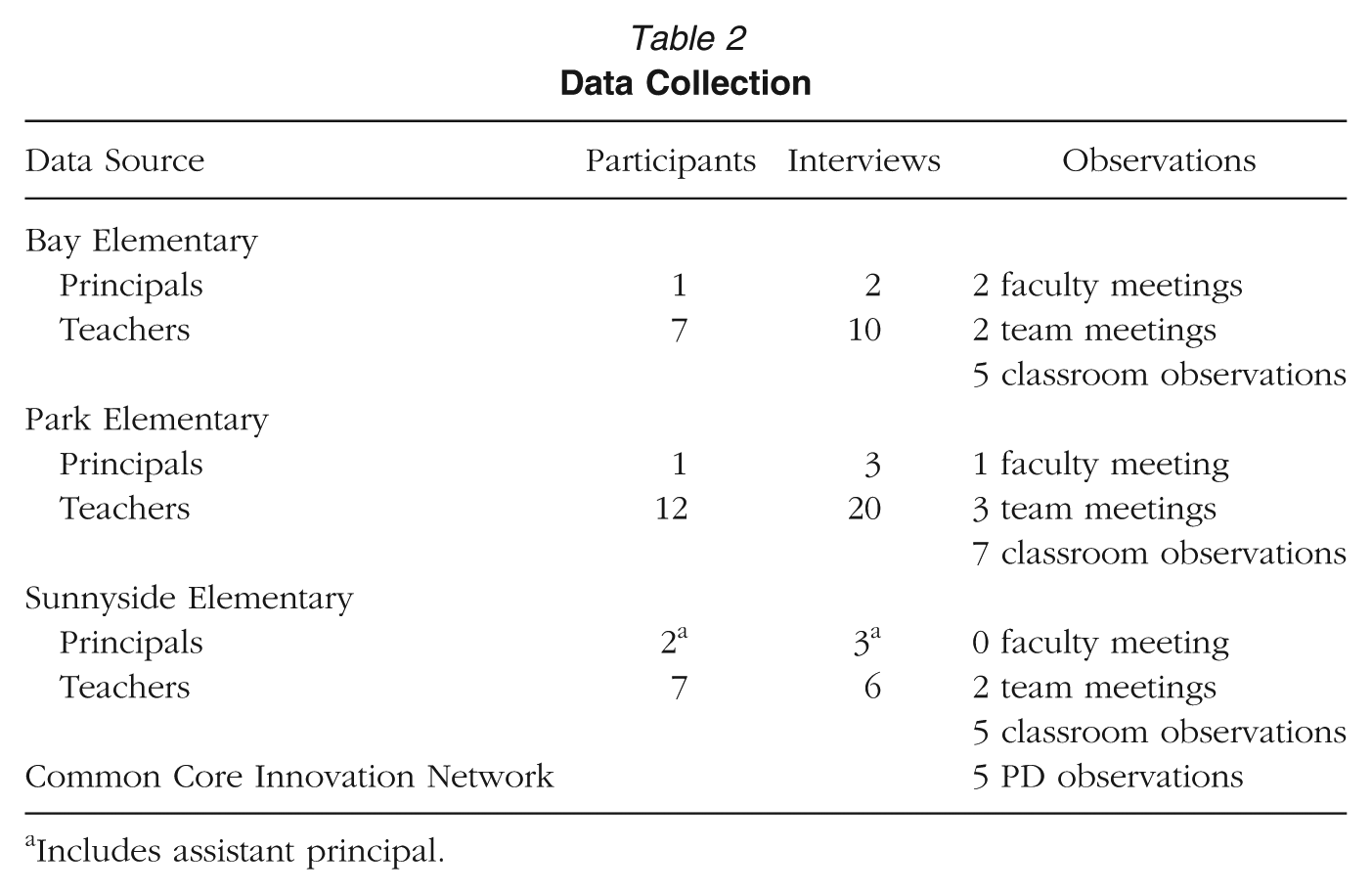
Includes assistant principal.
Research suggests that opportunities for learning about policy include both formal structures for collaboration, such as team meetings and PD, and informal conversations with colleagues (Spillane, 2004). Therefore, I spent five days in each school observing formal and informal opportunities for teacher collaboration and professional learning. I also observed five half- or full-day PD opportunities hosted by the CCIN. Additionally, I observed participating teachers’ instruction to better understand how the practices they reported employing related to the CCSS. I supplemented interviews and observations with the collection and review of documents related to standards, professional learning opportunities, and instruction, including but not limited to instructional plans, students’ work, protocols, and meeting agendas. Most interviews were audio recorded and transcribed verbatim, detailed field notes were taken during observations, and major themes were captured in interpretive memos.
I engaged in data collection and analysis concurrently (Miles & Huberman, 1994). During initial readings of transcripts, field notes, and interpretive memos, I used Dedoose qualitative data analysis software to code the data for teachers’ opportunities to learn about standards, including learning about standards-based curriculum and assessments, formal PD, collaborative team processes, and principals’ support for teachers’ collaboration. As part of this, I included codes for the specific collaborative practices that district policy and the CCIN encouraged teachers to carry out, including developing curricular units, using curricular units and tasks provided by the district, and using inquiry team protocols.
Additionally, I used weighted codes from 1 (not at all) to 4 (completely) to analyze the level of described and observed alignment of practice with the changes in practice recommended by the district for meeting the CCSS. The district communicated the increased level of cognitive demand emphasized in the CCSS through policy documents that highlighted the following instructional changes in ELAR and math: balancing informational and literary texts, reading and writing grounded in text evidence, building academic vocabulary, fluency with calculations, deep focus on conceptual understanding, and application of mathematical concepts to “real-world” situations. I used these descriptions to code teachers’ self-reported and observed practice. For example, during an ELAR lesson observed at Park, the teacher asked students to use evidence from a literary text to support their arguments and then accepted a student’s response that was based on general information about the plot. Thus, the teacher’s question was rated as completely aligned to the CCSS (4) because it called for reading grounded in text evidence. However, the student’s response was rated as somewhat aligned (3) with the CCSS because it was based on the text but not specific evidence. I calculated an average CCSS-alignment score for each lesson observed based on all lesson segments (e.g., teacher question, teacher description of assignment, student response) coded.
I analyzed cross-case patterns, looking for themes, comparisons, and variation in how teachers reported learning about the CCSS and how their learning related to their collaboration with colleagues (Miles & Huberman, 1994; Yin, 2009). For example, I created graphs to visualize how variation in teachers’ opportunities for learning about standards related to the observed alignment of teachers’ practice with the CCSS. I then used matrices to develop codes inductively, examining how teachers described their collaborative practices and how this collaboration related to teachers’ practice (Miles & Huberman, 1994). I engaged in an iterative coding process, revisiting data, emergent themes, and my initial hypothesis about the relationship between collaborative practices and teacher understanding and enactment of the CCSS.
I sought to reduce the risk of systematic bias and enhance the validity of my findings by drawing on multiple data sources and collection methods (Maxwell, 2012) to understand how teachers came to understand and enact the CCSS. I collected data from teachers and principals to analyze teachers’ experiences with the CCSS and the context in which they occur from multiple perspectives. I used multiple data collection methods, including interviews, observations, and document analysis, to understand teachers’ experiences. While coding, developing matrices, and writing memos, I remained attuned to disconfirming evidence and evaluated my findings against rival explanations (Yin, 2009). Finally, I conducted a member check (Merriam, 1995) by sharing initial findings with participants to allow for input and further verify the accuracy of my interpretations.
Findings
As teachers made sense of the CCSS, they turned to their colleagues for resources, expertise, and partnership in inquiry. All three schools included in this study had basic structures and processes in place to support the work of teacher teams, including a weekly meeting time, a team leader on every grade-level team, student assessment data available to inform instruction, and training in inquiry practices. On the surface, teachers all engaged in similar collaborative work. They planned curricular units, shared resources and ideas, and used assessments to monitor student learning. However, their collaborative practices appeared to differ in the extent to which they encouraged the interdependent decision making described by Little (1990) as “joint work” or more superficial forms of information and resource “sharing” that allowed teachers to retain individual authority for making instructional decisions. Figure 1 illustrates the specific collaborative practices teachers engaged in at each school and how these practices varied in the degree to which they encouraged more independent or interdependent instructional decision making among teachers. I find that teachers who worked more interdependently, all Bay teachers and four fourth-grade teachers at Park, were observed enacting practices that were more aligned with the CCSS shifts, on average, than teachers who worked more independently, including all Sunnyside teachers and most Park teachers (see Table 3). In the sections that follow, I analyze these distinct approaches to collaboration to better understand the nature of teachers’ collaboration and its implications for their learning about and enactment of policy. I describe the collaborative practices and school conditions that supported or constrained teachers’ learning about standards in each school.
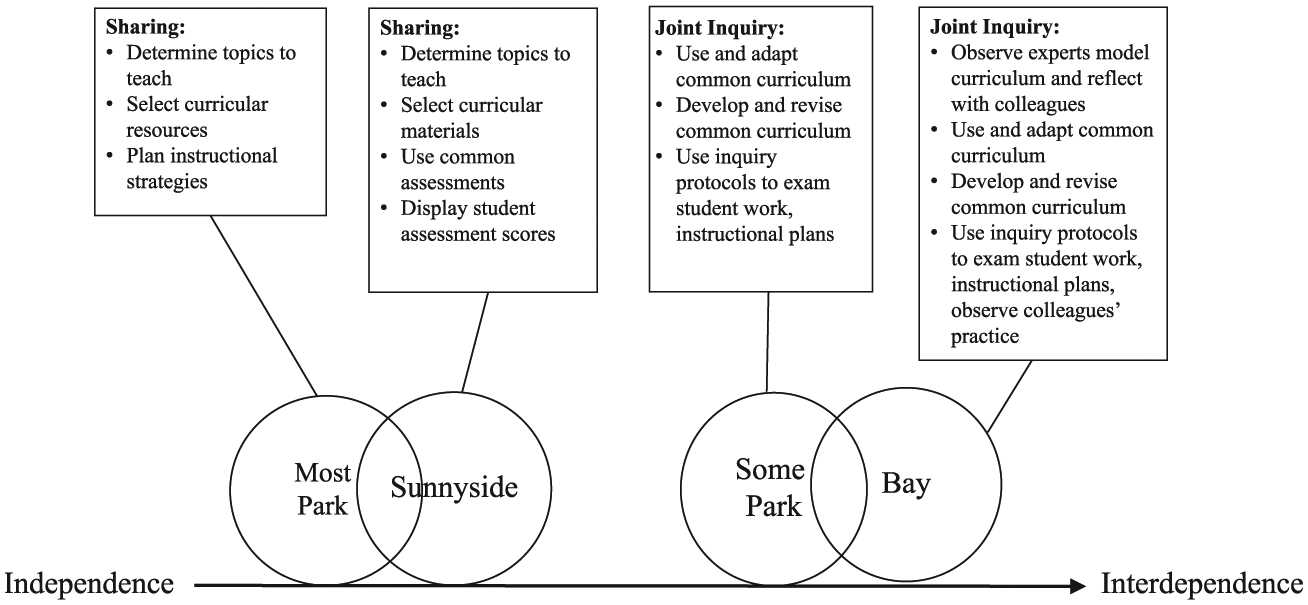
Continuum of collaborative practices. Adapted from “The Persistence of Privacy: Autonomy and Initiative in Teachers’ Professional Relations,” by J. W. Little, 1990, Teachers College Record, 91(4), 512.
Average Alignment of Teachers’ Instructional Practice With Common Core State Standards
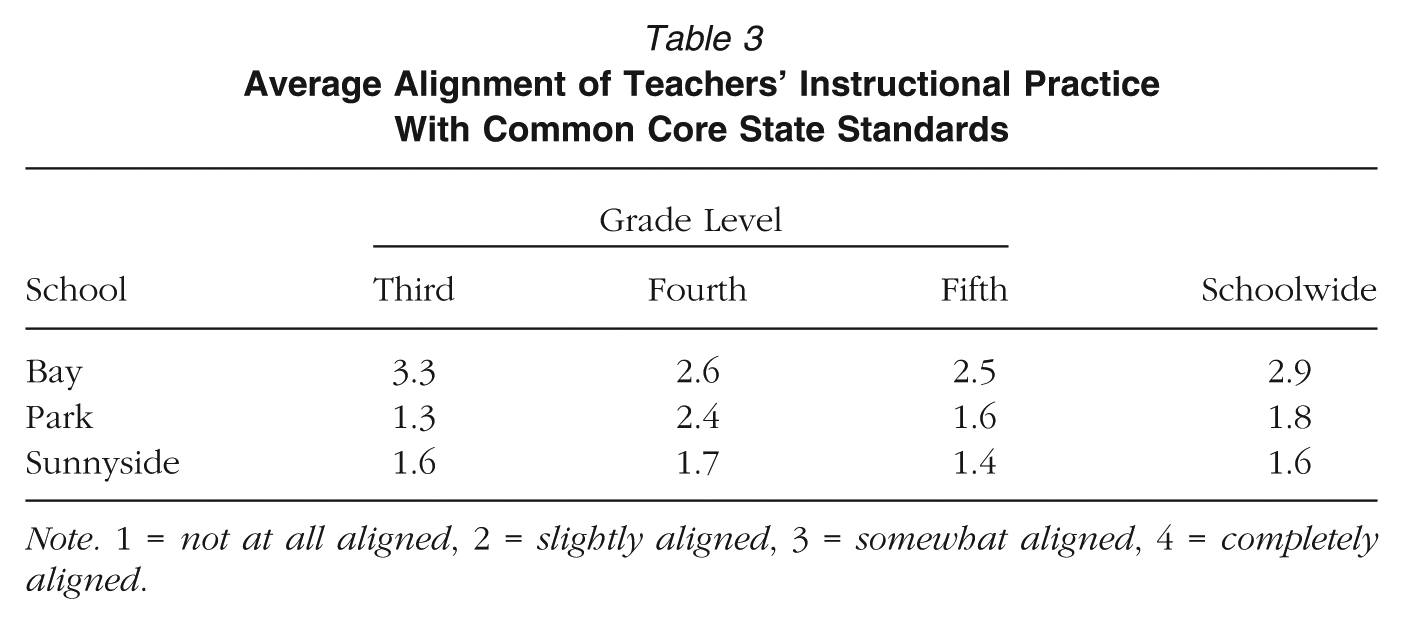
Note. 1 = not at all aligned, 2 = slightly aligned, 3 = somewhat aligned, 4 = completely aligned.
Joint Inquiry
All teachers at Bay Elementary and four fourth-grade teachers at Park Elementary engaged in what I call joint inquiry, working with colleagues to investigate their instruction and students’ work and determine the changes they would need to make to support students in meeting standards. These collegial interactions combined the collective action described by Little (1990) as “joint work” with an orientation toward improving instructional practice. Specifically, engaging in joint inquiry included analyzing curriculum with support from experts and colleagues, developing or revising curriculum to meet the new standards, and using inquiry protocols. Teachers at Bay Elementary and the small group of teachers at Park Elementary described viewing the new standards as similar to their current practice initially; however, they reported that engaging with colleagues in close analysis of curriculum, instruction, and student work led them to view the new standards as requiring, as one said, “a really different way of teaching.” In the following sections, I describe the collaborative practices that involved joint inquiry and how they influenced teachers’ instructional beliefs and practices.
Using Standards-Based Curriculum With Support From Colleagues and Experts
The teachers at Bay and the fourth-grade teachers at Park described analyzing and experimenting with curricular materials as experiences that changed their instruction and in many cases their fundamental beliefs about what they and their students could do. Five of the seven Bay teachers interviewed reported that having models—model curricular units, student work based on these curricular materials, and observing experts demonstrate the use of curricular materials—helped them understand the changes they needed to make in their practice to meet the CCSS. In fact, two teachers described the opportunity to observe models of standards-based practice with colleagues as their most meaningful opportunity for learning about the CCSS. A fifth-grade teacher said that when curricular units were “explained and student work was shown,” she and her colleagues “had an idea of what the standard would be.” Similarly, a fourth-grade teacher described observing an expert use the new math curriculum with students as “extremely beneficial” because he had not been using the curriculum very effectively initially. This teacher said that he had witnessed improvement in his students’ performance as a result of this learning experience. I observed him ask students to explain and justify their approach to solving multistep problems and assign questions in the newly adopted math textbook that reflected the balance of procedural fluency and conceptual understanding called for in the CCSS.
The Bay principal supported teachers in learning from standards-based curriculum by bringing in leaders from the CCIN to demonstrate how to use these curricular materials with students. A teacher explained that she and her grade-level colleagues had looked at the new mathematics standards and thought they were “doing it right.” However, seeing an expert demonstrate how to use the new standards-based curricular materials made her realize that she and her colleagues had to “totally revamp” the way they planned instruction.
Instead of . . . just trying to impose all your knowledge, you have to really question [students] and get them thinking. . . . You have to be trained and you have to reflect on yourself as a teacher. “What do I do that’s maybe not so conducive to Common Core?” I think a lot of us, when we sat back and reflected, realized that we had it all wrong. . . . When you saw how really deep the questions were, then you realized you have to really start planning the questioning into your lesson plan rather than just going with the flow. . . . In this community . . . you just want to do the GPSing—guide them all the way—but you have to step back and give [students] a chance to be independent and be accountable for their thinking.
Notably, the experience of observing an expert demonstrate how to use the standards-based curriculum with students supported this teacher in changing the way she thought about instructional planning, the kinds of questions she asked, and the role of students in learning. Specifically, this teacher shifted from viewing students as the recipients of knowledge to viewing students as independent thinkers. According to Bay teachers, opportunities for learning from models of instruction, curriculum, and student work were especially helpful for learning about the CCSS when paired with opportunities to reflect on how these models related to their current practice with colleagues.
At Park Elementary, four fourth-grade teachers reported that witnessing the success of their students in doing work that they had not thought possible changed their beliefs about what they and their students could do. These four teachers described working together to teach a standards-based curricular unit on child labor, which they all viewed as too difficult for their students initially. Nonetheless, they agreed to try it and then worked together to adapt it to meet their students’ needs. A special education teacher on the team described how the experience changed her beliefs: We did a [curriculum unit] last year on child labor that was based on the Common Core. . . . The students had to look at political cartoons. They had to read articles. My first thought was, “This is way too hard for my students.” But [our grade-level team] spent months on it. We just picked apart every article. . . . We used graphic organizers. Then [my students] were able to meet those Common Core Standards of writing opinion pieces using evidence from the articles. I was very shocked at how well my students did. I feel like the Common Core holds you to these high standards and these high expectations. You’d be surprised what you can do and what your students can do if you stick to these standards.
This example illustrates the intense collaborative work—months determining how to support students in comprehending specific texts—that went into learning how to support all students in meeting the ambitious new standards. This process assisted teachers in enacting practices related to two core elements of the CCSS: reading complex texts and using text evidence.
One Park teacher said that working with her colleagues made them less “fearful” of experimenting with new standards-based curricular materials. When teachers view messages about reform as being too difficult for their students, they are likely to reject or ignore these messages (Coburn, 2001). Team norms of experimentation and mutual responsibility appeared to support these teachers in trying out and persisting with standards-based curricular units, even when they initially viewed them as “too difficult” or “too much” for their students. Their collective commitment to experimentation was particularly important since using these new materials was a choice made by the individual teachers in this grade level rather than a systematic practice at the school.
Developing and Revising Standards-Based Curriculum
Teachers at Bay and most fourth-grade teachers at Park used standards-based curricular materials to learn how to meet standards, but they also worked with colleagues to revise these materials or develop new materials to more effectively support students in meeting standards. The Bay principal regularly asked teacher teams to revisit and revise their curricular plans. Correspondingly, teachers called their curricular plans “living documents” and described the process of revising unit plans as one of integrating new learning from experience, PD, inquiry team work, as well as student needs into their shared plans. For example, one grade-level team used Webb’s (2007) Depth of Knowledge framework to evaluate whether their curricular plans included the high-level questions necessary for students to do the kind of thinking called for by the standards. Much like the Bay teachers’ joint observation of an expert’s model lesson, using Webb’s framework provided a shared framework for evaluating the rigor of their curricular plans in an effort to more closely align their plans with new and higher standards.
The results of shared decision making in teacher teams were evident in classrooms at Bay. For example, three third-grade teachers decided to use informational videos to model how to draw conclusions from evidence and use this evidence in informational essays to prepare students for drawing conclusions from complex texts, a focus of the new standards. I observed all three teachers using this instructional approach in their classrooms. Similarly, three fifth-grade teachers described working together to design a social studies unit that required students to use evidence from videos and text in their informational essays. During classroom observations, all three fifth-grade teachers asked questions and assigned tasks that required students to interpret evidence from videos and develop written arguments based on this evidence. A fifth-grade teacher described the team’s instructional planning process: “One teacher is not allowed to do it. . . . Everything is collaborative to meet the needs of students.” This process reflected the sense of mutual accountability (Katzenbach & Smith, 1993), or shared responsibility, for the work of the team described by all teachers at Bay.
Fourth-grade teachers at Park credited the experience of using standards-based curricular materials for helping them learn how to develop and adapt curriculum to support their students in meeting the new standards. A teacher on the team explained, “Learning how to scaffold, learning how to break things down and ask these questions of the students as they’re reading to get them to understand it, all of that came from the child labor unit.” Through their collaborative analysis, adaptation, and development of curriculum, teachers were better able to understand the actions they could take to teach to standards. Unlike Bay, joint development and revision of curricular plans was not a regular practice at Park. In fact, the principal required each grade-level team to work together to develop and use one common CCSS-aligned curricular unit as part of their involvement in the CCIN.
Nevertheless, the fourth-grade teachers’ learning from their experience with the child labor unit appeared to transfer to the development of additional shared curricular units and their instructional practice more broadly. For example, two teachers displayed student work from a recent unit the team had created on the pros and cons of homework. Students had read multiple articles on the topic and used evidence from the articles to support their views, a focus of the CCSS in ELAR. Similarly, a third teacher asked students to infer what a fictional character’s actions revealed about his feelings and regularly prompted students to go back to the text to identify evidence to support their responses. All four teachers reported that they were committed to continuing to support students with the higher level learning called for by the new standards because they had witnessed the impact of their efforts in their students’ daily work and on the state test. The fourth-grade students had outperformed, on average, the other grade levels in the school and schools in the district despite serving a higher proportion of students living in poverty than most other schools.
With the support of their shared commitment to their colleagues, these four Park teachers worked together to improve their instruction and students’ learning by analyzing, developing, and adapting standards-based curricular materials. However, the changing focus at the school site and the principal’s limited attention to team work seemed to make sustaining their work difficult. For example, the teachers continued to use some of the units they had developed the following school year, but they did not teach the unit on child labor despite the great influence this unit had on their understanding of the new standards. One reason for this was that the teachers were beginning to use new ELAR and math curricula adopted by the school and had received little or no training in how to use these materials. When the school adopted new curricula and stopped requiring teachers to plan curricular units, these teachers continued to use and develop new standards-based units because they viewed them as important for meeting the new standards; however, there was no longer dedicated time in faculty or team meetings for working on unit plans. Their experience suggests that teachers who engage in collaborative efforts to design and adapt standards-based curriculum in schools with weak supports for this work may find it difficult to sustain and build on their learning over time.
Engaging in Inquiry Protocols
When teachers at Bay and fourth-grade teachers at Park worked with colleagues to revise curriculum and instructional practices or respond to student needs, they often used inquiry protocols from the district or CCIN. Inquiry protocols encouraged teachers to ask questions about their goals for instruction and compare them with the goals of standards. Bay teachers asked, “What do we want them to get out of the curriculum?” and “How can we get them there?” For example, a Bay teacher said that the curriculum required students to write their own informational book, but she had found that her students were not prepared to meet the standards for writing informational essays after this experience. She shared her students’ work with her colleagues in order to investigate what it would take to support students in meeting the writing standards as part of their inquiry team work.
I brought my work to the [table]. We sat. We did an inquiry about—What are [students] doing? How much work do we need to really get to where we need to go? We actually evaluate each other’s students. We just come with our students’ [essays]. . . . We look at each other’s work. And then we say, “This is what we need to work on, just getting the introduction.” We might do another cycle of writing an essay. Then we come back the following week and we say, “We still need to work on it.” Half way through, we realize—okay—we’re not going to worry about the book. We’re just going to try to [have students write] . . . maybe 2 or 3 more essays because that’s where we really need to focus. That’s what the students need.
Inquiry team protocols called for teachers to come together to examine student work, try out an instructional approach, and circle back to revise their approach based on their analysis of students’ work. Inquiry team protocols focused teachers’ attention on the specific actions they could take to support students in meeting standards. In this case, for example, they found that their students made more progress toward meeting writing standards when they had many opportunities to write informational essays with direct support on different aspects of writing (e.g., introductions) rather than writing an informational book, as called for in the curriculum. Teachers at Bay credited the inquiry team processes with supporting their understanding of how curricular materials could be used to best promote students’ learning.
At Bay, teachers received direct support and feedback on how they used inquiry team protocols in their grade-level teams. During a third-grade team meeting, for instance, the grade-level leader shared the “warm” and “cool” feedback the team had received on their inquiry work from the administrators and teachers on the leadership team. All the teachers had their packets documenting their inquiry work, which included the team’s focus question, their timeline for collecting student work and adjusting instruction, and the graded samples of student work they had collected to track students’ progress. The team’s focus question asked whether they had seen evidence of growth in essay structure in students’ writing. The leadership team’s feedback suggested that their focus question should probe into specific challenges that students faced in writing and how to address them. In response, the third-grade teachers discussed how to improve their focus question and, specifically, how to tailor it to address the needs of their English learners. This meeting highlighted the great attention given to the inquiry process at Bay.
All Bay teachers said that protocols for examining instruction and student learning, including inquiry team protocols, were helpful for learning how to teach to the new standards. Notably, only at Bay did teachers use inquiry protocols to observe their colleagues’ practice, a practice that directly challenges norms of privacy and autonomy over instructional decisions. Two teachers described using a fishbowl protocol with support from an expert from the CCIN as a meaningful learning experience that occurred during faculty meetings. The fishbowl protocol required a teacher to set a goal for the lesson (e.g., ask high-level questions), present the lesson in front of colleagues, listen to warm and cool feedback from their colleagues on how well the lesson met the goal, and identify next steps for improving the lesson. One teacher described this experience: We had a fishbowl where we all just had to say something positive, and then we’d have to say something negative. So you have to hear it all. There were some tears, but we learned from it. That was the intention, for us to do better and to improve our craft. I think it helped. It really did.
Another teacher noted, “We don’t want to be critical, but we want to be honest. . . . We’re cautious in how we talk—professional—but we give constructive criticism.” The design of the protocol was intended to create a safe space for giving improvement-oriented feedback to colleagues. As described in greater detail below, the use of this fishbowl protocol for observing colleagues was made possible by the strong relationships among the faculty and the principal, who created opportunities for learning from colleagues during whole-faculty meetings.
The fourth-grade teachers at Park used protocols from the district’s inquiry team initiative and the CCIN to support them in analyzing whether their instructional plans and the work of their students met the expectations of the new standards. Unlike Bay, however, decisions about whether and how to use these protocols were made by individual teachers rather than a schoolwide expectation set by the principal. In fact, the fourth-grade teachers described inviting a leader from the CCIN to attend several of their grade-level meetings to share new protocols and support them in using these protocols. Protocols from the CCIN focused the teachers’ attention on the gap between students’ work and the expectations of the CCSS and the actions teachers could take to close this gap. For example, one protocol asked them to consider the following questions when reviewing students’ work: (1) To what degree does the student’s work present evidence of meeting the CCSS? (2) Does the task provide the opportunity for students to present evidence of meeting the CCSS? If not, what improvements need to be made? (3) What pedagogical strategies can a teacher (or teacher team) employ to address the gaps between current student performance and the performance required by the task/CCSS? Through systematic discussions of instructional plans and student work, teachers developed shared expectations for student performance and determined instructional practices for promoting student mastery of the new standards.
Although these teachers believed that meeting the CCSS presented a major challenge, the four Park teachers viewed the assistance of their colleagues as essential for responding to this challenge. For example, one teacher described using a protocol for analyzing student work in an effort to get ideas from her team about how to address a student’s challenge with academic vocabulary.
A case that we had last meeting, I had a student who was struggling with some vocabulary words. I pulled the Tuning Protocol where I spoke first and explained the situation. Then my colleagues were able to ask me clarifying questions about the student. . . . They were able to give me some feedback about what I should try out with the student to see how that would help whatever issues he was having. After I try those out, I come back to the team and say, “This worked, and that didn’t work.” Then we take notes on that, and they can make more suggestions. . . . You feel like you’re not alone.
The protocol assisted her and her colleagues in analyzing the student’s challenge with vocabulary, determining an instructional approach, and following up as a team to see if the approach was effective.
Sharing Information and Resources
In contrast to the interdependent work of teachers who engaged in joint inquiry, all teachers at Sunnyside Elementary and the eight other teachers interviewed at Park Elementary described engaging in what Little (1990) characterizes as “sharing.” These teachers discussed instructional ideas and exchanged resources with colleagues in ways that made their practice public. Yet they still maintained professional norms of individual autonomy over instructional decisions (Lortie, 1975) and, in doing so, constrained the influence of their colleagues. These teachers viewed teaching to the CCSS primarily as a challenge of figuring out what to teach rather than how to teach, and their collaboration with colleagues reflected this focus. In fact, most teachers characterized the challenge of supporting students in meeting the new standards as one that could be met without substantially altering their existing beliefs or practice. In the words of one Park teacher, “It’s really not that different from what we were already doing. It’s just another name.” Unlike teachers who engaged in joint inquiry, these teachers worked more superficially with colleagues to select topics to teach, resources to use, and instructional strategies to employ. I describe in the following the limited influence that these collaborative practices had on teachers’ beliefs and practices.
Choosing Topics to Teach
For most teachers at Park and Sunnyside, instructional planning was viewed through the lens of existing practice and beliefs. To illustrate, four third-grade teachers at Park all described starting with a lesson they wanted to teach and then “plugging in” or “matching” the new standards to their lesson objectives. A teacher described their planning process: The Common Core, the way it’s laid out—we know what to do, what topics we must cover for the entire school year. So we break down the topics according to months for the ten months. . . . It’s not really how they teach. We can make our [own lesson] plans, and your teaching style may be different from mine when you get to your room. . . . It’s what to teach. It’s not how.
This description highlights how teachers maintained norms of autonomy by focusing on what to teach rather than how to teach. Teachers at Park all described their colleagues as being willing to share ideas and materials. This openness to sharing can encourage the open exchange of ideas but also maintains teachers’ individual autonomy over instruction (Little, 1990).
Similarly, almost all Park teachers described working with colleagues to develop at least one curricular unit aligned to the new standards; however, their unit plans included little information about what would actually occur in each classroom. For example, the third-grade team’s unit plan about mystery literature in ELAR included a list of the standards students would meet and broad objectives about making predictions and identifying the elements of a mystery. However, it lacked any description of the lessons teachers would carry out, the texts students would read, or the tasks students would complete. This unit plan revealed the limited effort put into creating unit plans by many teachers but also reflected the limited knowledge and experience of Park teachers with unit planning.
After participating in classroom observations at Park, one third-grade teacher noticed, “Even though teachers plan on grade, they don’t normally teach what they are asked to teach.” She viewed this as a problem because it led teachers to “blame” students for poor performance rather than teachers’ instruction. For example, she and her colleagues agreed to work on opinion writing, but one of her colleagues did not follow through with their plans, and thus, the students in her colleague’s class received little support in writing an opinion piece.
We give that monthly writing piece where they were to do it by themselves, on-demand writing. I might look at my class—they’ve done well. I might look at another class—it’s not done well. I’m blaming the students: “These students are not learning anything.” I should be blaming the teacher. It doesn’t give you a true reflection of what the students can or can’t do because the students were not taught how to write that opinion piece.
The superficial nature of collaboration—focused on what topics to teach—seemed to foster little accountability to peers for following through with team decisions. Consequently, collaboration seemed to lead to little change in teachers’ practice or beliefs about students.
At Sunnyside, teachers described working with colleagues to select topics to teach or “re-teach.” Using student assessment data to make instructional decisions was a major focus at the school. Teachers described revisiting lessons, re-teaching skills, or spending more time on topics that they identified as challenging for students. Each of these approaches to using data with colleagues focused on matching lessons and topics to student scores rather than examining the underlying causes for students’ performance. Nevertheless, re-teaching standards with which students struggled was challenging because students’ scores were very low. In fact, most students scored 1 out of 4, the lowest possible score on the interim assessments designed to mirror the state’s CCSS-aligned end-of-year assessments. Thus, teachers would need to re-teach nearly every topic if they were to simply re-teach topics that students failed to pass on the test.
Selecting Curricular Resources
Park teachers looked to newly adopted curriculum described as aligned to the CCSS, online resources (e.g., worksheets) labeled as CCSS-aligned, and questions that mirrored those in standards-based assessments as they planned instruction. Teachers said that they had little PD preparing them to use the new curricula, but they did not view this as a problem. As one teacher explained, “They just gave us the program. This is it. Just open it up. Read it on your own, and try to figure it out on your own. . . . It’s pretty self-explanatory, I think.”
Classroom observations, however, revealed that Park teachers often used the curriculum in ways that failed to meet the goal of these standards. These teachers broke down multiple-step problems for students, neglected to ask questions requiring students to explain their answers, divided text into small chunks, focused on lower-level recall questions about text, and asked questions that required information about students’ personal experience rather than text evidence. At times, teachers appeared to ignore aspects of curriculum that conflicted with their existing beliefs about instruction. For example, one teacher said the CCSS-aligned math curriculum was “not really different” from her existing practice. However, she broke down complex problems into discrete steps during a classroom observation, reducing the challenge of the task. In addition, she failed to ask questions in the textbook that required students to explain their thinking, which was part of the focus on conceptual understanding in the CCSS.
Sunnyside teachers also described working with colleagues to decide what they would teach from their newly adopted CCSS-based curriculum, how long they would need to teach the material, and to select additional resources to supplement the curriculum. Two fourth-grade teachers described the CCSS-based curricular materials as “too much” for their students. These teachers decided to use the resources over a longer period of time than the curriculum suggested. On the other hand, these same teachers reported that the curriculum was not “enough” to prepare their students to meet the standards. These teachers were observed using supplemental workbooks purchased by the school, which seemed to focus on low-level recall and execution tasks. For example, they were observed asking students to identify and underline the narrator and examples of dialogue in a passage in the workbook. Decisions about what to teach were influenced by teachers’ beliefs about their students’ abilities and often focused on breaking down the CCSS-aligned curriculum that the school had adopted or using simpler materials, which failed to meet the more ambitious demands of the new standards.
All teachers at Sunnyside described using the CCSS-based ELAR and math curricula adopted by the school during instruction, but some teachers were more successful than others in using them to meet the more demanding goals set by standards. In contrast to Park, classroom observations at Sunnyside suggested that teachers in grade-level teams did follow through with decisions about what to teach; thus, they worked more interdependently than most Park teachers. Nevertheless, the way in which teachers used curricular materials differed in important ways. For example, three third grade-teachers were observed using the same lesson from the ELAR curriculum on using text evidence to determine a character’s motivation. In one class, the two co-teachers planned to ask questions about character motivation and had written these questions on the board. However, they never asked them because their students struggled to simply recall what happened in the chapter they had read. In contrast to the two fourth-grade teachers described previously, these two teachers described their students as capable of engaging with the new and more challenging curriculum. However, they did not seem to know how to use the curriculum effectively given their students’ current abilities.
In a different third-grade class at Sunnyside, the teacher asked students to quickly reread the chapter and then begin discussing the following prompts with others at their table: “Describe Doyle’s traits, motivations, and feelings. What do these details reveal about his character?” As students discussed the character, the teacher walked around the room asking students to explain their ideas and prompting them to look back at the text. She asked, “Why is he angry?” Then she prompted students to look in the text where it described him as angry. With some support from their teacher, students in this class learned how to use text evidence to develop arguments about the character. The questions and text from the curriculum and the questioning of the teacher in this class reinforced the goal of using text evidence to support an argument, a central focus of the new standards in ELAR. Yet this teacher was the only one whom I observed engaging in practices that reflected the goals of the CCSS at Sunnyside. During classroom observations, all six other teachers asked questions or assigned tasks that required almost exclusively low-level recall of information, such as defining terms from the textbook, answering questions based on personal experience, or executing simple arithmetic procedures.
Planning Instructional Approaches
Similar to their use of curriculum, teachers at Park and Sunnyside applied instructional strategies intended to support students in meeting the new standards in ways that conformed to their existing beliefs about students’ abilities. For example, three third-grade teachers at Park described learning about techniques for higher-level questioning and choosing complex texts and agreeing to use these approaches in their classrooms. However, these teachers all believed the approaches were inappropriate for students they all described as “low functioning.” Instead, these teachers described matching students they viewed as less academically capable with lower level questions and texts. Thus, instructional approaches designed to increase the level of learning for all students were implemented in ways that contradicted policy goals.
As part of the school focus on using assessment to drive instruction, Sunnyside teachers at each grade level worked together to create and administer weekly assessments to monitor students’ progress in meeting standards. However, the content of these assessments did not reflect the changes in student learning called for by the new standards. For example, a third-grade assessment included eight items, all but one of which required simple recall of information or using single-step procedures. The test included a spelling test, dictation, and two questions about a text to measure their performance in ELAR. Students were asked: How does Jessie feel about Evan? How do you know this? Students could use text evidence to support their answer to the second question, which was a focus in the CCSS; however, the question did not explicitly require students to use text evidence to justify their response.
Regularly scheduled grade-level meetings at Sunnyside had the potential to support teachers in developing a shared understanding of effective approaches for teaching to the new standards. However, observations of team meetings and interviews with teachers suggested that there was little discussion of instruction during these meetings. Although teachers, the data specialist, and administrators all described the work of grade-level teams as “inquiry team work,” they did not seem to use inquiry protocols or other processes for structuring their work with student data. For example, one week the data specialist reported that the grade-level meetings focused on improving the performance of “target groups,” students who scored in the bottom third of students in the school on the CCSS-aligned state test. During two grade-level team meetings that week, I observed the data specialist give teachers a list of students who scored in the bottom third and communicate the expectation that teachers were to improve their scores. When a teacher asked the data specialist to help him use the new online system to find examples of the problems his students got wrong on the test, the data specialist agreed to look into this. This interaction ended with a commitment from the data specialist to locate additional problems that were similar to the ones frequently missed by students but no discussion of why these problems might be difficult for students or how the concepts were taught.
At Sunnyside, teachers shared openly about the topics they would teach, the resources they would use, and the performance of their students on assessments. They shared this information by coming together to plan and posting their instructional plans and student assessment scores on bulletin boards inside and outside of their classrooms. Although their instructional plans and student outcomes were public, their specific instructional practices remained private. The privacy surrounding teachers’ instructional approaches protected teachers’ practice from scrutiny but also appeared to prevent the spread of effective approaches for teaching to the new standards among colleagues.
School Conditions
Overall, my findings suggest that three school conditions influenced the nature of teachers’ collaboration around standards: the level of principal support for collaboration, the use of particular processes or protocols to structure collaboration, and relationships among colleagues. Notably, the conditions in each school varied greatly, and these differences appeared to influence whether all, some, or no teachers in each school described engaging in joint inquiry around standards.
Bay Elementary
At Bay, teachers described collaboration among colleagues as central to their learning about standards and described the principal as the “driving force” behind this emphasis on collaboration. As I describe in greater detail in Stosich (in press), the principal at Bay made inquiry work a priority by sitting in on inquiry team meetings, using team and whole-faculty meetings for teams to engage in the inquiry team process, providing feedback on each grade-level team’s inquiry work during team leader meetings, and setting school goals focused on inquiry. The school goals, which were posted in classrooms and referenced by teachers, made clear that all teachers were expected to use the district’s inquiry team process: “By June 2014, 100% of teachers will be involved in inquiry work around the Common Core in ELA and math.” In addition, the principal brought in leaders from the CCIN to model how to use new CCSS-aligned curriculum and support teachers in engaging in collaborative protocols for developing curricular plans and critiquing their colleagues’ instructional plans and practice.
At Bay, the use of protocols to structure difficult conversations and the collegial relationships among the staff supported teachers in speaking honestly about how to improve their practice. Two teachers said that they were able to give critical feedback on each other’s practice because the faculty was a “family” of educators who were committed to getting better. Another teacher noted that they had “been working on the culture of [their] school for a long time.” This teacher was the union chapter leader and a member of the school’s social committee, which had been “trying to have the staff be more of a family” by organizing staff lunches, retirement parties, baby showers, and pulling together resources when there was a death in a family. She explained, “If we can all play together, we can all work together.”
Importantly, the level of knowledge and skill of the faculty also contributed to teachers’ collective learning about standards at Bay. As teachers analyzed curricular resources, revised instructional plans, solicited feedback from colleagues, and engaged in inquiry protocols, they relied significantly on the knowledge and skills of their colleagues to improve their instructional practice. All teachers at Bay described the feedback of their colleagues as an important and useful resource for learning to teach to the new standards. In schools with teachers with lower levels of instructional capacity, feedback from colleagues may be viewed as less valuable for improving instruction, which would limit the usefulness of joint inquiry.
Park Elementary
The principal at Park described his strategy for meeting the new standards as “forming teacher teams at every grade level and building . . . a community of learners. Inquiry process at every level.” In contrast to Bay, however, the principal at Park was not directly involved in teachers’ work in teams and, consequently, had little influence on how teachers worked together. According to the principal, one challenge for teacher collaboration was that meeting with colleagues more than once a month was “voluntary,” according to the union’s contract. However, he encouraged teachers to meet weekly, and many did. In fact, the four fourth-grade teachers described meeting almost daily. To encourage other teachers to work closely with colleagues, the principal invited the fourth-grade teachers to share about how they collaborated around curriculum and students’ work during faculty meetings.
The principal at Park held all teachers accountable for following through with district policies, including working in grade-level teams to develop a curricular unit that aligned with the CCSS and using standards-based curriculum in instruction. Accordingly, all teachers described developing at least one curricular unit aligned with the CCSS, and student work from these units was displayed on teachers’ bulletin boards. Unlike Bay, however, developing curriculum was not a regular practice, and the principal had little influence on the processes teachers used during collaboration. A fourth-grade teacher explained that the “administrators were there to push” unit planning. Teachers would “do the work, but they were not really doing it as they should.” According to this teacher, the superficial nature of some teachers’ efforts to develop curriculum units limited the value of this collaborative process.
The strength of personal relationships among teachers varied greatly in the school, and this had direct implications for teachers’ work with colleagues. Almost all teachers described their colleagues as “friendly” and willing to share resources or ideas. The four fourth-grade teachers, by contrast, described themselves as a “connected” and “close-knit group” that was committed to working together to improve their practice and students’ learning. Interestingly, one fourth-grade teacher said that his negative personal relationships with colleagues left him working mostly in isolation. A teacher on the team said that they would “let him know” what they were teaching, but they did not plan curricular units or engage in inquiry work with this colleague. His colleagues may have excluded him from their joint work due to his low level of teaching skill. Although his colleagues did not describe him as incompetent, he was concerned about receiving an unsatisfactory performance rating from the principal. He explained, I’m not going to be able to write the lesson plan effective enough for what [the administrators] expect. I don’t want them to give me a U rating. . . . We should be exposed to [information about new instructional approaches] from another colleague. I think it’s unfair that I’m struggling. I have to run around asking [colleagues] instead of being told.
In contrast to Bay, decisions about how teachers worked together, with whom they worked, and whether they followed through with the decisions made by the team were left to the discretion of individual teachers, leaving some teachers to fend for themselves.
Sunnyside Elementary
Unlike Bay and Park, teachers and administrators at Sunnyside did not describe collaboration among colleagues as a central aspect of their strategy for meeting the expectations of the new standards. Although grade-level teams were scheduled to meet weekly, these meetings were often cancelled or ended early. Instead, the principal and assistant principal described the focus of the school as using data on students’ performance to inform instruction. The principal held teachers accountable for using data to guide instruction by requiring teachers to administer weekly assessments, posting the results of these assessments in their classrooms, and grouping students based on their performance during instruction. In every classroom, teachers had data boards with student scores from assessments, including reading levels and scores from assessments in ELAR, math, social studies, and science. Every Friday, teachers assessed students and used their scores to change student groupings during instruction. The school even had one teacher who acted as a “data specialist” and facilitated all grade-level team meetings.
Notably, the principal and assistant principal both expressed uncertainty about whether the CCSS were “developmentally appropriate” for their students. According to the principal, the new standards required them to teach material that was too difficult for students: “Basically, we were told to expose children to material two grade levels above their level.” Interviews with teachers and classroom observations suggested that most Sunnyside teachers viewed the new standards and the standards-based curricula as too difficult for their students. The school adopted challenging, new math and ELAR curricula from a list of choices approved by the district. In response to teachers’ input, the school also purchased “practice” workbooks and test preparation materials. By purchasing these materials, the administrators endorsed their use in classrooms in addition to or in place of the more rigorous core curricula. In fact, the principal did not hold teachers accountable for closely following the new curricula and described these resources as providing “merely a suggestion” for how to teach to the new standards. Correspondingly, attention to how teachers could use the more rigorous curricular materials to support their students in meeting the CCSS was limited.
Despite the lack of principal support for collaboration, all teachers interviewed described working with their colleagues in their grade level and, in many cases, across grade-level teams to develop assessments, plan instruction, select curricular resources, or share best practices. As one teacher explained, “We are not in isolation. As a grade-level we share best practices, information. . . . Teachers learn from each other.” The lack of close collaboration around standards at Sunnyside did not appear to be related to a lack of collegial relationships among teachers. Instead, the superficial level of collaboration among teachers seemed related to the absence of specific processes for supporting collaboration. For example, teachers and administrators described weekly grade-level team meetings as “inquiry team work,” but they did not describe and were not observed using inquiry team protocols for structuring these meetings. Instead, discussion among colleagues seemed to have little structure and focused primarily on sharing information and resources.
Discussion
This study aims to explain how teachers come to understand new and more ambitious academic standards, how they enact these standards in their classrooms, and how their understanding and enactment of these standards is influenced by opportunities for collaboration with colleagues. Similar to previous research (e.g., Hill, 2001; Spillane et al., 2006), I find that teachers’ initial reaction to the new standards was to view them as similar to current practice. However, I find that teachers were more likely to revise their instructional beliefs and practices in ways that reflected the goals of standards when their collaborative work was focused on designing, adapting, and improving specific instructional plans, curricular resources, and students’ work rather than more superficial discussions of practice. These findings connect prior research on the collaborative practices that support changes in teachers’ instructional practice and beliefs about students (e.g., Earl & Timperley, 2009; Gallimore et al., 2009) to the unique challenge of learning to teach to standards.
Most teachers in the study came to understand the new standards as similar to their current practice, and their collaborative practices failed to challenge these beliefs. All teachers at Sunnyside and most teachers at Park shared information with colleagues about the topics and resources they would use in instruction, leaving individual teachers to figure out how to integrate these ideas and resources in classroom practice. Consequently, these teachers adopted new practices and resources in ways that reinforced rather than contested their existing beliefs about what was appropriate for their low-income students. They were observed and described simplifying complex problems, assigning tasks that required merely recall of information, and matching low-level questions and texts to low performing students. Without working with colleagues to critically evaluate their practice against the expectations of standards, teachers may be more likely to enact practices that reinforce their beliefs about the abilities of their low-income students and are constrained by their existing pedagogical knowledge.
By contrast, all teachers at Bay and four fourth-grade teachers at Park approached their work together as joint inquiry, a shared investigation of what it would take to support students in meeting standards. This inquiry-oriented approach to collaboration seemed to support teachers in understanding the ways in which the new standards differed from their current practice and how to bridge the expectations of the new standards to the current abilities of their students. Specifically, these teachers analyzed standards-based curricular materials, developed and revised curricular units, and engaged in inquiry team protocols. All of these collaborative practices supported teachers in analyzing and adapting instruction to better meet the goals of the new standards and their students’ needs. During classroom observations, these teachers carried out instruction aligned with the goals of the CCSS; they asked questions and assigned tasks that required students to use evidence from texts and videos to support their ideas orally and in writing, build procedural fluency in mathematics, and justify their mathematical reasoning.
Strong principal leadership, collegial relationships among teachers, the use of protocols for guiding their work, and the valued instructional knowledge and skills of their colleagues acted as enabling conditions for joint inquiry. Joint inquiry in teams is not something that can be mandated by principals because it requires a collective commitment to action among teachers. Nevertheless, principals can influence whether and how teams collaborate (Coburn, 2005; Stosich, in press). The principal at Bay provided explicit direction for how teachers were expected to collaborate, which focused on using specific protocols to engage in inquiry cycles to improve instructional plans and student performance. In contrast, neither the Park principal nor the Sunnyside principal provided direction for how teachers worked with colleagues. Without explicit attention to teachers’ collaborative work from the principal, joint inquiry may occur in small pockets of volunteers but may be unlikely to become widespread.
Teachers at Bay and Park described detailed protocols for structuring their collaboration as essential for engaging in difficult conversations about the changes they would need to make to their instruction for all students to meet the new standards. By contrast, no teachers at Sunnyside described or were observed using protocols during collaboration. Notably, all teachers had been trained in using inquiry protocols by the district and CCIN, but only those teachers with strong relationships with colleagues and support from the principal or a leader in the CCIN used these protocols to make significant changes to their practice. Only at Bay did the faculty describe actively cultivating the relationships among teachers by celebrating and supporting important life events (e.g., weddings, family death) and carefully focusing opportunities for feedback from colleagues on constructive criticism (Bryk & Schneider, 2002).
Furthermore, teachers are unlikely to choose to collaborate with colleagues whom they view as unknowledgeable about instruction. For example, one fourth-grade teacher at Park described himself as “struggling” to teach to standards and said he was excluded from his team’s collective work. Additionally, teachers may avoid collaborating with colleagues around academic content about which they are less knowledgeable. Although some teachers worked with colleagues to develop and adapt curricular units in ELAR, no teachers in the study described engaging in this deep collaborative work in mathematics. Instead, Bay teachers described the opportunity to learn from an expert modeling the use of the new math curriculum as beneficial. High-poverty schools typically employ higher proportions of teachers with weak levels of mathematical knowledge for teaching than schools serving more affluent students (Hill & Lubienski, 2007). Thus, efforts to enhance teachers’ instructional capacity, particularly in mathematics, may be necessary for joint inquiry to flourish in high-poverty schools.
There are several important limitations to these findings. By design, the study focused on a limited number of teachers in three high-poverty schools to understand differences in teachers’ collaboration around standards in some detail. These schools all had highly experienced and stable faculties who had volunteered to be early adopters of the new standards. High-poverty schools are more likely to have large concentrations of inexperienced educators (Goldhaber, Lavery, & Theobald, 2015) and experience high rates of teacher turnover (Simon & Johnson, 2015) than schools serving more affluent students. Thus, weak instructional knowledge among novice teachers and instability among the faculty may make it difficult for joint inquiry to take root in many high-poverty schools. Furthermore, teachers may be more resistant to teaching to the CCSS in schools that have not made an early commitment to meeting these new standards.
Implications for Research, Policy, and Practice
These findings raise questions about how we can foster collective commitments among teachers to transform instructional practice to meet new standards. Specifically, the collaborative practices of the teachers at Bay and the four fourth-grade teachers at Park reflected Hargreaves and Fullan’s (2012) conception of professional autonomy as a collective commitment to shared knowledge, standards of practice, and ongoing improvement. Notably, these teachers said that they chose to make shared decisions about instructional practice based on close collaboration with colleagues because of their sense of commitment to colleagues, the value they placed on the input of their colleagues, and the improvements they witnessed in their instructional practice and students’ work as a result of their efforts.
Schools and districts can foster meaningful learning about standards among teachers by providing substantial support for teachers’ collaborative practices. When teachers adopt new practices and resources without engaging in systematic inquiry into the effectiveness of the new approach, it is unlikely that teachers will experience the success that might change their beliefs about practice (Spillane et al., 2006). Specific protocols, such as the inquiry team protocols used in this district, can support the learning process. However, my findings suggest that productive engagement in inquiry-oriented collaborative practices is unlikely without direct support from school leaders and external partners. Given the important role of principals in setting the direction for teacher collaboration, districts should consider providing training and support for principals in leading the work of teacher teams. Future research can explore whether this approach to teacher collaboration as joint inquiry could become more widespread with targeted professional development and support from school leaders.
Supporting learning about standards through teacher collaboration requires strong collegial relationships among teachers and sufficient instructional capacity to support teachers in productively responding to information about standards. Direct support for collaborative practices in conjunction with opportunities for building productive relationships with colleagues may be sufficient for fostering joint inquiry among experienced educators. However, efforts to support collaborative learning around standards may be more successful when paired with explicit training in pedagogical content knowledge. As states adopt new standards, including the Next Generation Science Standards, researchers may identify additional areas of weak instructional capacity for intervention.
As was the case at Sunnyside and Park, teachers’ collaboration often has little influence on practice (e.g., Gallucci, 2003; Little, 1990). Nevertheless, the work of the teachers at Bay and fourth-grade teachers at Park presents a promising vision for the ambitious teaching and learning that can take place in high-poverty urban schools when teachers engage in joint inquiry around specific curriculum, instructional plans, and student work. Their students were learning from complex texts, using evidence from text to support their arguments, solving multiple-step mathematical problems, and explaining their reasoning with limited support from teachers. At the same time, findings from this study provide additional evidence that the success of ambitious educational policies depends on the degree to which schools and districts foster meaningful teacher learning (Cohen & Barnes, 1993; Cohen & Hill, 2001; Elmore, 2004). This district’s focus on collaboration in teacher teams and support for the use of inquiry team protocols made it a promising context for teacher learning about policy. Nevertheless, the experience of these teachers reveals the need for training in collaborative practices that foster shared inquiry, explicit efforts to foster collegial relationships among teachers, investments in teachers’ instructional capacity, and support from principals for collaboration among teachers to influence teachers’ understanding of standards and their implications for practice.
Footnotes
Notes
E