






Abstract
An extensive theoretical and qualitative literature stresses the promise of instructional practices and content aligned with minority students’ experiences. Ethnic studies courses provide an example of such “culturally relevant pedagogy” (CRP). Despite theoretical support, quantitative evidence on the effectiveness of these courses is limited. We estimate the causal effects of an ethnic studies curriculum, using a “fuzzy” regression discontinuity design based on the fact that several schools assigned students with eighth-grade GPAs below a threshold to take the course. Assignment to this course increased ninth-grade attendance by 21 percentage points, GPA by 1.4 grade points, and credits earned by 23. These surprisingly large effects suggest that CRP, when implemented in a high-fidelity context, can provide effective support to at-risk students.
The racial and ethnic gaps that exist across a variety of important student outcomes in the United States are both disturbingly large and stubbornly persistent. For example, data from the recently released 2015 National Assessment of Educational Progress (NAEP) indicate that on average, the mathematics knowledge of eighth-grade Black and Hispanic students in public schools lags behind that of their White peers by an amount equivalent to roughly two to three full years of learning (i.e., .84 and .59 standard deviations, respectively). 1 Black and Hispanic students are also substantially overrepresented among students diagnosed with specific learning disabilities relative to their White peers (Aud, Fox, & KewalRamani, 2010). Furthermore, while roughly 14% of White students in public high schools fail to graduate on time, the corresponding dropout rates for Black and Hispanic students are roughly twice as large (Stetser & Stillwell, 2014).
Awareness of such disparities is not new; concerns about unequal educational opportunities and outcomes have been documented over several decades in national policy reports, including the Coleman Report and A Nation at Risk (Coleman et al., 1966; National Commission on Excellence in Education, 1983). Recent work using nationally representative data sets over several decades suggests that while racial achievement gaps narrowed, they remain sizable (Reardon, 2011). The striking patterns identified by this work have motivated a broad array of aggressive federal, state, and local policies that have shaped the governance and operations of public schools over the past several decades. These contentious reforms have included new resources, different forms of school accountability, and choice (e.g., the Elementary and Secondary Education Act, its subsequent reauthorizations including No Child Left Behind, the Standards-Based Education Reform in the 1990s, vouchers, and charters) as well as initiatives to promote effective teaching through performance-based compensation systems.
Over the same period, historians and social scientists advocated for teaching the histories of specific race-ethnic groups to combat the harmful effects of segregation and a neglect of diverse histories (Banks, 1993). One prominent example was the development of “ethnic studies” (hereafter, ES) programs of study, which expanded in the wake of the U.S. Civil Rights Movement. ES refer to interdisciplinary programs of study that focus on the experiences of racial and ethnic minorities with a particular emphasis on historical struggles and social movements. The development and expansion of ES contributed to the contemporaneous development of multicultural education and its influence on school pedagogy.
More recently, a fast-growing (and largely qualitative) research literature in education has focused on classroom pedagogy and stressed the importance of “culturally relevant pedagogy” (CRP) as a compelling way to unlock the educational potential of historically marginalized students (e.g., Ladson-Billings, 1992b, 1994, 1995; Ladson-Billings & Tate, 1995). The fundamental theoretical argument for CRP is that instructional practices are substantially more effective when differentiated to align with the distinctive cultural priors that individual students experience outside of school and when they also affirm both cultural identity and critical social engagement (e.g., Gay, 2010). Modern ES courses provide a particularly prominent example of CRP. Apart from the relevance of ES content for students who are racial and ethnic minorities, ES courses often incorporate other elements of CRP through their emphasis on cultural identities and conscious engagement with social and political issues (Banks, 1997, 2012; Cammarota & Romero, 2009; Sleeter, 2011; Yosso, 2002, 2005). 2 While some school districts are currently experiencing sustained political controversy over their use of ES curricula (e.g., Tucson), other major urban school districts (e.g., Los Angeles and San Francisco) have begun implementing new ES courses in hopes of supporting the academic achievement of their diverse student populations. In September 2016, Governor Brown of California signed a bill that will require the state to develop a model ES curriculum for high schools and encourage every school district and charter school in the state to offer the course beginning with the 2020–2021 school year (Wang, 2016).
Although ES courses are proliferating, the available quantitative evidence on the causal effects of ES courses (and culturally relevant pedagogy in general) on student outcomes is limited, particularly for larger-scale field settings. This study provides such evidence through examining the effects of a ninth-grade ES course piloted over several years in the San Francisco Unified School District (SFUSD). Specifically, using data on 1,405 students from five school-by-year cohorts, we examine the effects of ES participation for students on the margin of assignment to the ES course on several proximate academic outcomes (i.e., attendance, grade point average, and credits earned) that are highly relevant for high school persistence. Our research design identifies the causal effects of taking the ES course on key ninth-grade outcomes by leveraging an institutional feature that was unique to SFUSD. High school students in our study cohorts were assigned to take the ES course if they were identified as at risk of dropping out (i.e., an eighth-grade GPA below 2.0). We estimate the effects of ES participation through a “regression discontinuity” (RD) design that effectively compares outcomes among students whose eighth-grade GPA placed them just below versus just above this threshold condition. RD designs such as this can credibly support causal inferences because they are based on the “as good as randomized” assignment to treatment that exists for students proximate to this threshold (D. S. Lee & Lemieux, 2010).
We find that ES participation had large positive effects on each of our student outcomes. Specifically, ES participation increased student attendance (i.e., reduced unexcused absences) by 21 percentage points, cumulative ninth-grade GPA by 1.4 grade points, and credits earned by 23 credits. 3 These GPA gains were larger for boys than for girls and higher in math and science than in English language arts (ELA). We find that these large effects are robust to a variety of model specifications as well as checks for possible confounds related to the treatment contrast we study (e.g., unobserved teacher effects, the possibly independent effects of an at-risk designation, “heaping” of the assignment variable). We also argue that these large effects are consistent with the hypothesis that participation in the course reduced the probability of dropping out in addition to possibly improving the performance of enrolled students. Overall, our findings indicate that a culturally relevant curriculum implemented in a strongly supportive context can be highly effective at improving outcomes among a diverse group of academically at-risk students. We also note that the effectiveness of this ES course may reflect other theoretical mechanisms (e.g., buffering students against “stereotype threat”), and that there are potentially serious challenges of successfully replicating and scaling up this curriculum.
Cultural Relevance and Ethnic Studies in Theory and Practice
Both academic and popular discussions have long emphasized the role that a community’s culture may play in amplifying or ameliorating achievement gaps. For example, an older and largely discredited literature from the 1960s (e.g., Bereiter & Engelmann, 1966; Deutsch, 1967; Hess & Shipman, 1965) suggested that achievement gaps reproduce themselves in part because racial and ethnic minorities enter school with a deficit of “cultural capital” (e.g., skills and dispositions related to the dominant culture) that could otherwise support student success. A more contemporary literature based on an influential article by Fordham and Ogbu (1986) has advanced the related argument that in response to discrimination, minority communities develop an “oppositional peer culture” that effectively devalues educational effort and success as “acting White.” Several qualitative studies have strongly disputed this cultural characterization (e.g., Horvat & Lewis, 2003; O’Connor, 1997). Moreover, quantitative studies (e.g., Ainsworth-Darnell & Downey, 1998; Akerlof & Kranton, 2002; Cook & Ludwig, 1997; Downey & Ainsworth-Darnell, 2002; Tyson, Darity, & Castellino, 2005) have found little evidence to support the conjectured existence of an “oppositional” culture that contributes to achievement gaps.
Another body of qualitative studies has shifted the focus to evidence that school and classroom practices are frequently misaligned with the cultural priors and out-of-school experiences of minority students (Banks, 1991; Gay, 1988; Ladson-Billings, 1992a; Valenzuela, 1999). Specifically, several anthropological and sociolinguistic studies (e.g., Au & Jordan, 1981; Mohatt & Erickson, 1981) have provided evidence that teachers who are highly effective with minority students adopt culturally “appropriate” or “congruent” methods to engage their students (e.g., through their use of language and the design of classroom activities). In an influential body of work that drew in part on this earlier tradition, Ladson-Billings (1992b, 1994, 1995) examined and advocated for the practical and theoretical relevance of “culturally relevant pedagogy.” 4 One key element of CRP is the use of valid cultural referents in teacher practice. Ladson-Billings (1992b) argues that CRP does more than “fit” school culture to student culture; it also seeks to “use” student culture as a basis for classroom practice and enhance and affirm cultural competence, academic development, and social and political awareness. To support these developments in students, Ladson-Billings identified three domains of CRP that are embodied by culturally relevant teachers: their conceptions of self and others, how they structure social relations, and what conceptions of knowledge they hold. Culturally relevant teachers conceive of all students as capable of academic success, contribute to the community, and draw out knowledge from their students. They develop a collaborative community of learners in their classroom, connecting with students and maintaining fluid relationships. They also scaffold and bridge learning for students and work with students to critically co-construct knowledge.
Independent disciplinary traditions can provide alternative theoretical frames for situating how CRP might be effective in improving theacademic performance of minority students. For example, the social-psychologicalliterature on “stereotype threat” suggests that minority students underperform in highly evaluative settings such as classrooms because of the anxiety created by the expectation of being viewed through the lens of a negative stereotype (Steele & Aronson, 1995). Several field-based randomized trials of interventions that “buffer” students against stereotype threat have shown promise in reducing achievement gaps, though their efficacy appears to be context dependent (Aronson & Dee, 2012; Dee, 2015; Yeager & Walton, 2011). Interestingly, the active ingredients in these stereotype threat buffers (e.g., forewarning about stereotypes, values affirmation, external attribution for experiencing challenges, and growth mindsets) closely parallel the defining elements of CRP. The theoretical logic for CRP can also be understood in a microeconomics framework in which students have imperfect information about their own suitability for academic pursuits. Benabou and Tirole (2003) argue that in these circumstances, individuals adopt a “looking-glass” perspective in which they come to understand their own place in the world based in part on the cues they receive about themselves from others (e.g., schools and teachers). In such a setting, CRP may be effective because both cultural congruence and an emphasis on cultural affirmation and integrity create positive signals about belongingness in school.
As commonly conceived and implemented, ES courses provide a prominent and controversial example of CRP. ES courses focus on the experiences, perspectives, and histories of traditionally underrepresented ethnic or racial groups and have several specific features. They are typically organized around the principal that CRP better engages underrepresented students and meets their needs by drawing on their cultural competencies to promote academic success. That is, ES courses are theorized to positively affect student outcomes through the creation of a relevant and meaningful curriculum that affirms students’ identities, draws from their funds of knowledge, and builds students’ critical intellectualism (Banks, 2012; Cammarota & Romero, 2009; Giroux & Simon, 1989; Sleeter, 2011; Tintiangco-Cubales et al., 2015). To support this type of curriculum, ES courses often adopt alternative organizational and pedagogical structures following central lessons from CRP. For example, many ES courses utilize a classroom structure in which teachers promote engagement by structuring collaborative, equitable, reciprocal relationships between themselves and students; scaffolding student learning; and drawing on students as a source of knowledge (Duncan-Andrade & Morrell, 2008; Ladson-Billings, 1995; Sleeter, 2011; Tintiangco-Cubales et al., 2015). In addition to content that engages with students’ cultural identities and a student-focused classroom structure, ES courses also draw from critical pedagogies, using an educational praxis to provide students with tools for identifying, reflecting on, critiquing, and acting against systemic racism and other forms of oppression (Freire, 2000; Giroux & Simon, 1989; Sleeter, 2011; Sleeter & Bernal, 2004). Recent examples of ES coursework guide students in exploring their own identities and engaging with their community, often incorporating assignments that require repeated engagement with community and family members and some type of social activism (Ladson-Billings, 1995; Tintiangco-Cubales et al., 2015). Proponents of ES also stress the positive effect that these courses will have on standard educational outcomes, such as students’ grades, test scores, and school completion, as well as student attitudes and behavior (Cabrera, Milem, Jaquette, & Marx, 2014; Kisker et al., 2012; Matthews & Smith, 1994; Tintiangco-Cubales et al., 2015).
The first formal ES course was created at San Francisco State University in 1968, growing out of the civil rights and anti-war movements. Some argue thatES as an idea has a longer history, tracing back to Freedom Schools, Blackindependent schools, and tribal schools, among others, and builds on thework of African American luminaries, including George Washington Williams, W. E. B. DuBois, and Carter G. Woodson (Banks, 1993; Begay et al., 1995; C. D. Lee, 1992; Sleeter, 2011). Since their formalization at the postsecondarylevel, ES programs and curricula have spread to universities across the country but are still relatively uncommon in secondary schools (Hurtado, Engberg, Ponjuan, & Landreman, 2002). Recently, several school districts have or are considering adopting ES courses as graduation requirements (Gilbertson, 2014; Tucker, 2014).
In spite of growing interest in ES, the expansion and implementation of ES programs is often highly contentious. Critics frequently characterize ES programs as divisive, nonacademic, and detrimental to students of color because they are substituting courses that promote the development of ethnic pride in place of the development of mainstream academic skills (Sleeter, 2011). When schools, colleges, and universities offer such courses or programs of study, they often become a contentious political flashpoint. For example, the school district in Tucson, Arizona, that had offered courses in Mexican American studies was recently found in violation of a new state law preventing the teaching of such courses as they “promote the overthrow of the United States government,”“promote resentment toward a race or class of people,” and “advocate ethnic solidarity instead of the treatment of pupils as individuals” (formerly Arizona HB 2281, 2010; Arizona Revised Statute § 15-112, 2010) and subsequently eliminated this programming under threat of losing state funding (Billeaud, 2011). Student protests of the school board meeting debating this policy and the ensuing controversy were covered by a diverse segment of the national media, including Fox News, The Daily Show With Jon Stewart, and the New York Times (Cabrera, Meza, Romero, & Rodríguez, 2013).
At the same time, a growing number of other districts have expanded or are considering expanding their ES offerings. For example, the Los Angeles Unified School District, the El Rancho Unified School District, the Montebello Unified School District, the Sacramento Unified School District, the San DiegoUnified School District, the Oakland Unified School District, and the Coachella Valley Unified School District have all recently included ES courses in their high school course offerings or graduation requirements, and several others are considering motions to do so (Ethnicstudiesnow.com, 2016; Gilbertson, 2014; Tucker, 2014; Wang, 2015). Multiple legislative efforts, including a bill requiring all California high schools to offer ES courses, were vetoed by Governor Jerry Brown (Ceasar, 2015; Clark, 2015; Tucker, 2014). However, in September of 2016, Governor Brown signed a bill mandating the development of a model ES program for California’s public schools to utilize in creating their own programs (Wang, 2016). The Texas State Board of Education also recently approved legislation allowing school districts to develop courses on Mexican American studies (Isensee, 2014). In addition, the Berkeley Unified School District has offered a freshman ES course for over 20 years, requiring it for high school graduation during nearly all of this time (Artz, 2003; Levin, 2009; Noguera, 1994; Rubin et al., 2006; Veale, 2015). As we describe in the next section, the motivating context for this study is that the San Francisco Unified School District was considering scaling up access to a pilot ES curriculum and possibly designating it a graduation requirement.
While the expansion of ES courses illustrates both their appeal and concerns, the quantitative evidence on their effects is relatively limited. Furthermore, the evidence that is available relies on research designs that cannot necessarily support credible causal inference. 5 For example, a small-scale descriptive study by Cammarota (2007) focused on the “Social Justice Education Project” (SJEP), a “sub-curriculum” fielded among 17 at-risk Latina/o students in a Tucson high school over four semesters between 2003 and 2005. Cammarota reports that these students were successful both in completing high school and in engaging with advanced courses. A study by Lewis, Sullivan, and Bybee (2006) examined the effects of an “Emancipatory Education” course fielded over one semester among 65 eighth-grade students in an urban, predominantly Black school. They randomly assigned one of the two participating classes to receive this intervention and found positive effects on communal orientation, school connectedness, and achievement motivation, though not on achievement itself. The availability of only two assignment units within the same school (and the lack of evidence on balance at baseline) makes it difficult to differentiate the true effects of the course from the effects of other unobserved traits that may have differed across these two classrooms or spillovers of content and pedagogy between the two classrooms.
Two other studies have relied on regression analyses of administrative data from the larger-scale implementation of ES in Tucson, Arizona. First, a brief report from the Arizona Department of Education (Franciosi, 2009) compared the test performance of Hispanic students in Tucson who took one or more ES courses in the 2008–2009 school year with Hispanic students statewide in regressions that controlled for other student traits (e.g., prior performance, mobility, and English learner status). This analysis found no evidence that course participation improved student performance. A more recent study by Cabrera et al. (2014) relied on administrative data from roughly 8,400 students over four cohorts (i.e., the graduating classes of 2008–2011) to examine the Mexican American studies (MAS) program offered in four schools in Tucson. 6 In regression analyses that control for student demographic characteristics (race/ethnicity, gender, free/reduced price lunch eligibility, census block median income, English language learner designation, special education identification, GATE status, and number of school transfers), prior academic achievement (ninth- and tenth-grade weighted GPA, tenth-grade standardized test scores), and school-level context (school fixed effects), they find evidence that MAS participation improved student outcomes. 7 In particular, participation in MAS was associated with an increase in the probability of graduation of 9.5% across all cohorts. Among the subsample of students who initially failed the exit exam, MAS participation was associated with a 6.6% increase in the probability of passing all three exit exams (the reading, writing, and math AIMS tests), on average across all cohorts. 8
A central challenge to these empirical studies is that participation in the MAS program was voluntary. Thus, regression-adjusted comparisons among those who did and did not enroll may suffer from omitted variable biases of an uncertain direction. For example, if students who have a latent and unobserved capacity for school engagement are more likely to enroll in these courses, naïve regressions may overstate the program’s benefits. In contrast, if at-risk students are more likely to be enrolled in MAS courses, their effect is likely to be understated. Cabrera et al. (2014) discuss these methodological challenges and acknowledge the limitations of their study, noting, “our results may suffer from omitted variable bias and should not be considered true causal effects” (p. 1094).
In sum, the theoretical arguments and public enthusiasm for ES curricula have not been matched by convincing quantitative evidence on their efficacy. Our study contributes to this gap in the literature by employing a research design that can credibly support a strong causal warrant. Specifically, we rely on an explicit student assignment rule to identify the causal effects of a year-long ES course for students on the margin of participation in a regression discontinuity (RD) design. Our study is also unique in that it focuses on a mature, developed course situated within a novel setting (i.e., high schools in the San Francisco Unified School District). We describe our study context and research design in more detail in the following.
Ethnic Studies in the San Francisco Unified School District
The genesis of the SFUSD ES curriculum was in 2007 when the district’s Board of Education Curriculum Committee urged the district to create a high school ES curriculum. The district’s Office of Learning Support and Equity, in collaboration with faculty from the College of Ethnic Studies at San Francisco State University (SFSU), subsequently initiated the curriculum design. Specifically, 10 SFUSD social studies teachers formed the Ethnic Studies Curriculum Collective with SFSU faculty support. This group created a course framework drawing from ES curricula used in other districts and postsecondary programs across the country during the 2007–2008 school year. Over the next two years, the Collective created lesson plans, piloted the lessons in three high schools, and met twice a month for lesson critique and development (SFUSD Ethnic Studies Curriculum Collective, 2012).
On February 23, 2010, the SFUSD school board unanimously approved a resolution to implement an ES pilot program in SFUSD high schools, explicitly referencing the promise of ES courses to contribute to closing achievement gaps. Five high schools participated in the pilot, offering a year-long, ninth-grade ES course from the 2010–2011 to 2012–2013 school years. The program continued into the 2013–2014 school year. In December of 2014 (i.e., after our study window), the school board voted to expand the program to be offered at all 19 of San Francisco’s high schools. It is also being considered as a ninth-grade graduation requirement (Dudnick, 2014).
The design of SFUSD’s ES course stressed the use of CRP as a way to engage with students that had previously felt marginalized by the traditional curriculum. Units focused on themes of social justice, discrimination, stereotypes, and social movements from U.S. history spanning the late 18th century until the 1970s. Unlike a curriculum that is specific to the history of one particular race/ethnic group (e.g., Tucson’s Mexican American Studies program), the SFUSD curriculum incorporated elements of histories and political struggles from multiple race/ethnic groups, many of which are not traditionally represented in U.S. social studies content. These units included examinations of the genocide of American Indians in California; portrayals of Asians, Latinos, and African Americans in the media; community resistance in historical Chinese and Latino neighborhoods in California; labor organizing during the Great Depression and World War II among African Americans and Filipino Americans; and social movements and educational reforms contributing to and stemming from the Civil Rights Movement.
The course also encouraged students “to explore their individual identity, their family history, and their community history” and required students to design and implement service-learning projects based on their study of their local community. The designers of this curriculum hoped that these lessons and projects would increase students’ commitment to social justice and improve self-esteem. In addition to the civic and psychological goals of the ES program, the program’s stated intent was to close achievement gaps and reduce dropout rates (Office of Learning Support and Equity/Humanities, Academics and Professional Development, 2009; SFUSD Ethnic Studies Curriculum Collective, 2012).
An additional component of the course, which cannot be disentangled from the content but is itself an integral piece of CRP, is the pedagogical style and method utilized in the ES courses. Drawing from CRP, ES teachers used methods designed to build on and honor students’ cultural assets, experiences, and perspectives; develop their critical consciousness; and create authentic, caring academic environments. This type of teaching was intended to ensure an environment that valued and encouraged the success of the students both within and outside of the classroom. ES teachers worked to help students bridge their academic, home, and community environments, creating assignments that connected home and school, and required students to engage with their communities (Tintiago-Cubales et al., 2014). Through these methods, ES classrooms became spaces for reflexive, critical, empowered conversation in which students helped to co-create the content.
While the ES curriculum was under development for several years and across several different high schools in San Francisco, the assignment of students varied. Some of the pilot schools chose to offer the ES course to all incoming ninth graders, while other schools used the program as an intervention for students identified as at risk for academic failure through an early-warning system. The early-warning indicator (EWI) flagged students who in eighth grade had either an attendance rate below 87.5% or a GPA (excluding physical education) below 2.0. Prior research had shown that in SFUSD, these binary variables were highly predictive of dropping out of school. In our data, very few students had an attendance rate below the 87.5% threshold, so the relevant assignment variable in our RD design is the eighth-grade GPA. 9 Students whose eighth-grade GPA was below 2.0 were encouraged but not compelled to take the ES course. This partial compliance implies that our RD design is “fuzzy” and that there may be external validity caveats to our inferences if the effect of taking the ES course is heterogeneous and that the estimand may not be valid for all students at the discontinuity (Imbens & Angrist, 1994). We take up this and other related issues after describing our data and methods in the following.
Data
We examine the effect of SFUSD’s year-long ninth-grade ES course on student outcomes, primarily using data from three of the five high schools that piloted the curriculum. These three high schools assigned only some ninth-grade students to the ES course, while two other schools chose to offer the ES course to all ninth-grade students. These schools typically offered two and four sections of the course in each year, although the course was not offered in all schools in every year. Our primary study sample draws from five unique school-year cohorts in these three high schools. In these five cohorts, enrollment in ES was encouraged but not required for students whose eighth-grade GPA was below 2.0. Students identified by the EWI as at risk of high school failure were automatically enrolled in the ES course when they received their course schedule at the start of their ninth-grade year. 10 Students could opt out of the course after consulting with their academic counselor but needed to actively select out of the course to do so. 11 One school used this rule over three years (i.e., AY 2011–2012 through AY 2013–2014), while two other schools used this in AY 2011–2012 only. Critically, only four unique teachers taught the ES courses in these schools and years. We discuss, along with our other robustness checks, evidence indicating that our results are not simply due to effects unique to the effectiveness of these teachers. 12
Our initial sample consists of ninth graders in these five school-year cohorts. Among these cohorts, we exclude those who are missing our assignment variable: a recorded eighth-grade GPA (n = 226). We also exclude 128 students with eighth-grade GPAs that are distant from the threshold and clustered at a perfect 4.0 GPA. Similarly, we exclude a small number (n = 27) of additional students with extremely low eighth-grade GPAs (i.e., less than 1.25). 13 These sample edits imply a final “intent-to-treat” (ITT) sample of 1,405 students. Our data on these students include several measures of baseline (eighth grade) traits, all of which we include as controls in our regression models. These include binary indicators for gender and for whether the student was Black, Hispanic, or Asian 14 (with White serving as the reference category). We also include eighth-grade data on whether the student was in special education, ever suspended, or identified as an English language learner (ELL). In addition, we utilize data on each student’s attendance rate in eighth grade, the value of their assignment variable (i.e., eighth-grade GPA exclusive of P.E. and centered on 2.0), and a binary indicator for our ITT variable (i.e., an eighth-grade GPA less than 2.0).
Table 1 presents descriptive statistics on these students for each of the baseline control variables. Interestingly, 60% of these students are of Asian descent, and 23% are Hispanic. Only 6% of these students are Black. Eighteen percent of these students are identified as ELLs, and 12% have special education status. Among the cohorts in our sample, only 42% are female. This is due in part to the fact that there are fewer female students than male in the district overall (48% across all SFUSD schools) but particularly because female students are higher achieving than our sample (recall that we exclude students who receive a perfect 4.0, which drives most of the difference in female representation between the full district and our sample). Thirteen percent of students enrolled in the ES course and 8% of the sample had an eighth-grade GPA below 2.0 (i.e., an ITT as taking the ES course). 15 None of the students in our analysis sample are missing values for any of the baseline control variables.
Summary Statistics
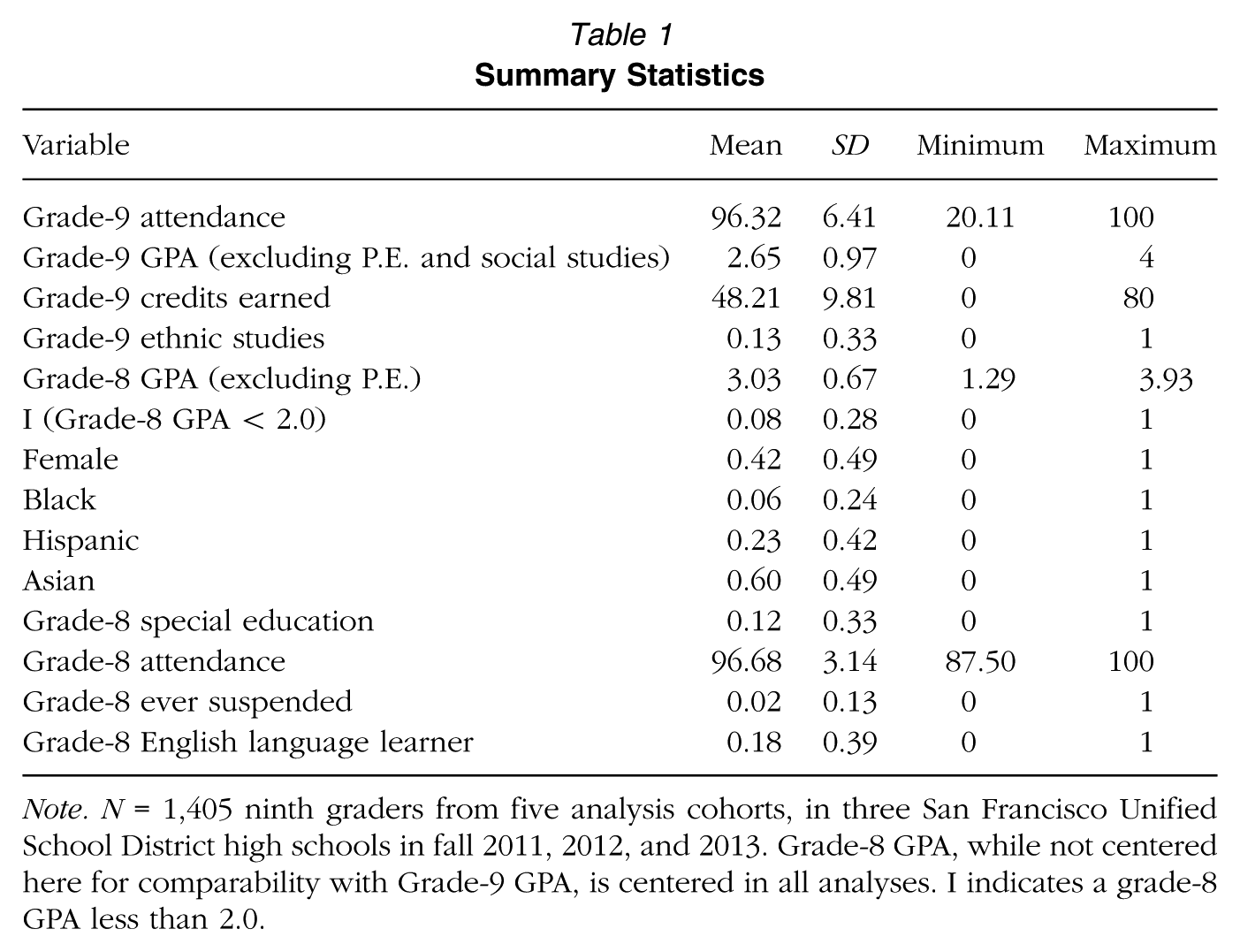
Note. N = 1,405 ninth graders from five analysis cohorts, in three San Francisco Unified School District high schools in fall 2011, 2012, and 2013. Grade-8 GPA, while not centered here for comparability with Grade-9 GPA, is centered in all analyses. I indicates a grade-8 GPA less than 2.0.
We examine three dependent variables in our analyses, ninth-grade attendance rates (which the district refers to as instructional time), ninth-grade GPA, and ninth-grade credits earned. The last two measures are defined exclusive of all social studies courses (i.e., like the ES course) and physical education. 16 We also control for eighth-grade attendance and GPA in our models. While the average attendance rate increases slightly between eighth and ninth grade (from 96.32% to 96.69%), GPA declines substantially during this important transition. The mean eighth-grade GPA is just above a 3.0 (a B on the four-point scale); by the end of ninth grade, the average GPA is 2.65 (a C on the four-point scale). Following the reporting conventions of the district for the purposes of grade promotion and retention, we use unweighted eighth- and ninth-grade GPAs that do not assign additional credits for honors or AP courses.
We measure these outcomes for all students observed at baseline in our intent-to-treat sample regardless of whether they completed ninth grade. 17 So, we view the variation in these measures as reflecting both the academic progress of enrolled students and the probability a student has dropped out of school. For students to advance from ninth to tenth grade, they must complete at least 55 credits. Because we exclude physical education (which would account for 10 credits) and social studies (which would account for an additional 10), students should complete at least 35 credits by our measure in order to advance to tenth grade. In our sample, we find that 7.3% of students have fewer than 35 credits at the end of ninth grade (i.e., suggesting they dropped out or were required to repeat ninth grade). Furthermore, the students at risk of dropping out tend to be concentrated among those encouraged to take ES. Our results also appear to reflect changes in the performance of enrolled students. In particular, we find virtually identical results to those we report in the following when we rely only on GPA from the first semester.
Regression Discontinuity Design
Our research design effectively compares those who were just eligible for assignment to the ES course (i.e., eighth-grade GPA below 2.0) to those who were just ineligible for this assignment (i.e., eighth-grade GPA at 2.0 or above). Specifically, we use a regression discontinuity (RD) design, which can provide causal inferences that are “as good as random assignment” (D. S. Lee & Lemieux, 2010) in settings like this. An RD design asks whether, conditional on a student’s eighth-grade GPA, student outcomes “jump” at the threshold that defined treatment eligibility (i.e., assignment to ES). The RD design can be implemented by estimating reduced-form equations of the following general form:

where Yist is a student outcome (e.g., GPA) for ninth grader i in school s in year t. The variable, Gist, is the assignment variable in this RD design: eighth-grade GPA centered on 2.0. The variable, I(Gist < 0), is a binary indicator equal to 1 for students whose eighth-grade GPA is below 2.0. The parameter of interest, β, identifies the jump in outcomes when eighth-grade GPA is below 2.0, conditional on f(Gist), a smooth function of the assignment variable. We specify f(Gist) as linear but allow for different slopes above and below the threshold. We also explore flexibly nonparametric specifications (i.e., local linear regressions). The variable, Xist, refers to student-level controls, and η st refers to fixed effects unique to each year at a particular school. We use robust standard errors in all models shown in the following. 18
In Table 2, we present the RD results from examining whether actually taking the ES course does indeed jump at the 2.0 threshold. We find robust evidence that the likelihood of taking the ES course jumps roughly 27 percentage points at the threshold. Figure 1 illustrates this finding graphically by showing the probability of taking ES as a function of eighth-grade GPA. This figure organizes the data in bins of width 0.1 defined by eighth-grade GPA. The top panel uses the full sample while the bottom panel uses data within a 0.7 GPA bandwidth of the threshold. These figures consistently illustrate the jump in treatment status at the threshold. They also underscore that, as is common in RD and experimental settings, we have partial compliance with the intent-to-treat implied by an eighth-grade GPA below 2.0. Roughly 15% of students with eighth-grade GPAs of 2.0 or slightly higher took ES while just over 50% of students below the threshold did so. This partial compliance does not confound the internal validity of the RD design because the identifying variation is based on eighth-grade GPA rather than the decision to take the course. In other words, our reduced-form estimates identify the effect of being assigned to take the ES course (i.e., the “intent-to-treat” (ITT) effect) rather than the effect of taking the course. To recover the estimated effect of actually taking the ES course (i.e., the “treatment-on-the-treated” (TOT) effect), we divide our reduced-form estimates by the corresponding treatment uptake at the threshold (i.e., dividing our estimates by roughly .27). We calculate these instrumental variables (IV) two-stage least squares estimates (2SLS) following guidelines described in Angrist and Pischke (2014). 19
Regression Discontinuity Estimates, Determinants of Grade-9 Ethnic Studies Participation
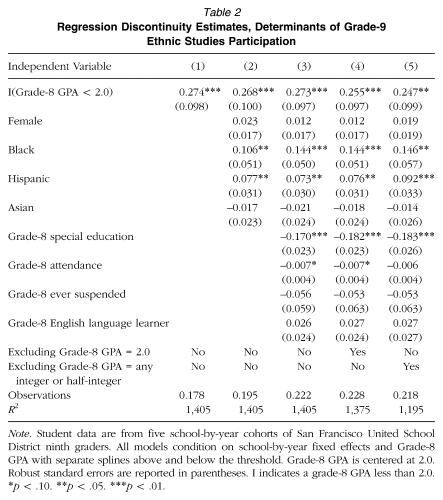
Note. Student data are from five school-by-year cohorts of San Francisco United School District ninth graders. All models condition on school-by-year fixed effects and Grade-8 GPA with separate splines above and below the threshold. Grade-8 GPA is centered at 2.0. Robust standard errors are reported in parentheses. I indicates a grade-8 GPA less than 2.0.
p < .10. **p < .05. ***p < .01.
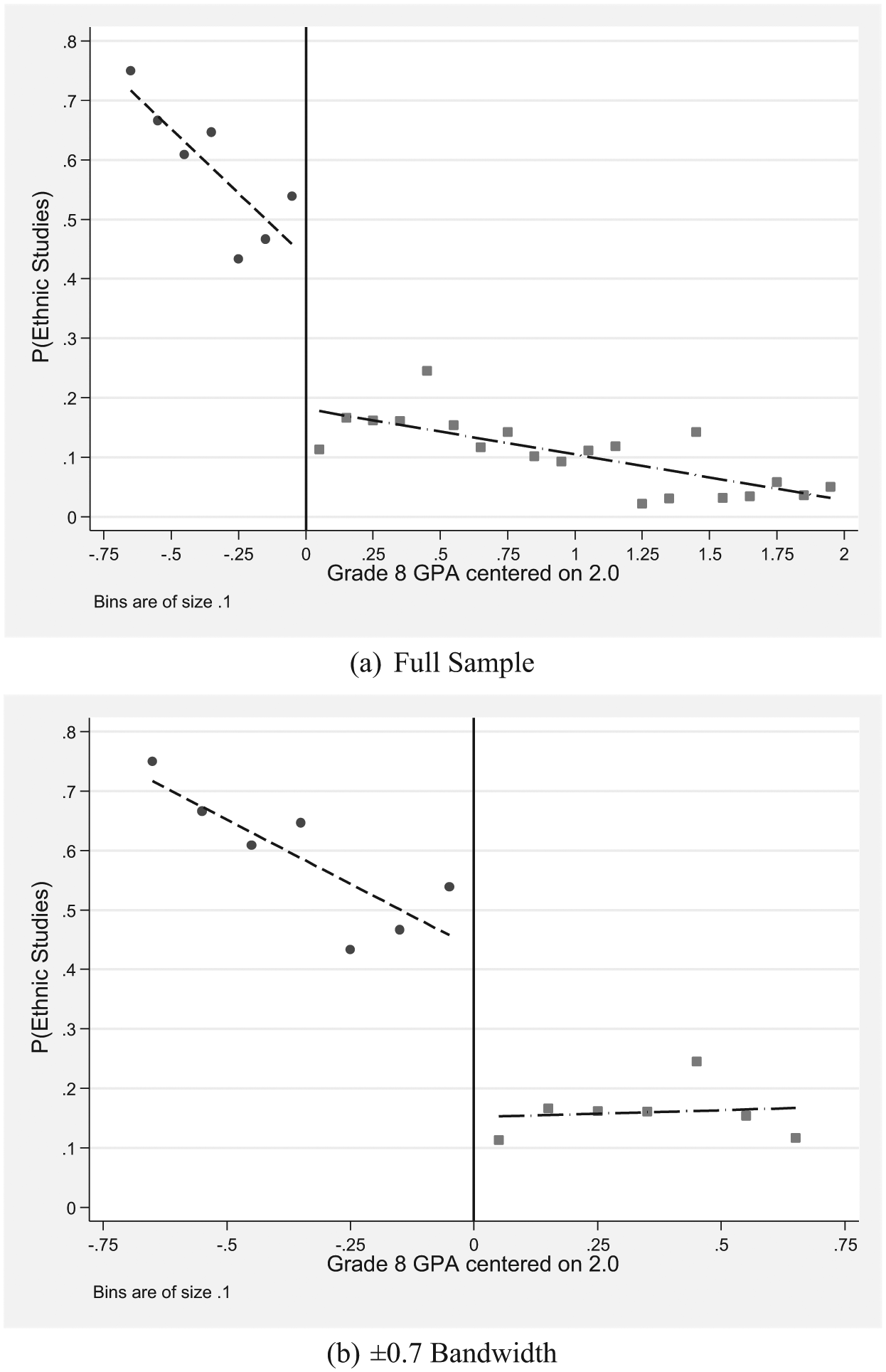
Ninth-grade ethnic studies participation by eighth-grade GPA.
The fundamental treatment contrast leveraged in our study is among students eligible for assignment to the ES course (i.e., those with eighth-grade GPAs below the 2.0 threshold) and those who were not. There are several potential threats to the validity of this contrast that we outline here before turning to our main results and to robustness checks. For example, to avoid any confounds related to different grading and attendance standards across the alternative courses students around this threshold took, we define our GPA and credits-earned measures excluding data from the ES course and all other social studies courses. A remaining concern is that taking ES may imply that a student takes different courses in other subject areas. In practice, the majority of students who do not take ES enroll in either an alternate social studies course or a variety of other elective courses, including art, music, foreign languages, and study-skills courses, among others. Although elective choice varies, we found that virtually all students were initially enrolled in math, ELA, and science courses and that course selection in these subject areas did not differ for students around the 2.0 GPA threshold. 20 We also present results using GPA measures specific to each of these three subjects.
The strong causal warrant of the RD design relies critically on the maintained assumption that students’ locations just above and below the 2.0 threshold are conditionally random. One compelling way to check this key assumption is akin to examining covariate balance in a randomized experiment (Schochet et al., 2010). That is, we examine whether outcome-relevant student traits “jump” at the threshold that defines the ITT. In Table 3, we present the key results from auxiliary regressions that make these comparisons. Specifically, we present the results from RD regressions where observed student characteristics are the dependent variables. The estimated jumps in these variables at the 2.0 threshold are consistently small and statistically insignificant. The balance of observed student covariates around this threshold is consistent with the causal claim of the RD design. However, as with randomized experiments, we cannot be entirely certain that this mechanism balances the unobserved determinants of student outcomes.
Regression Discontinuity (RD) Estimates, Covariate Balance
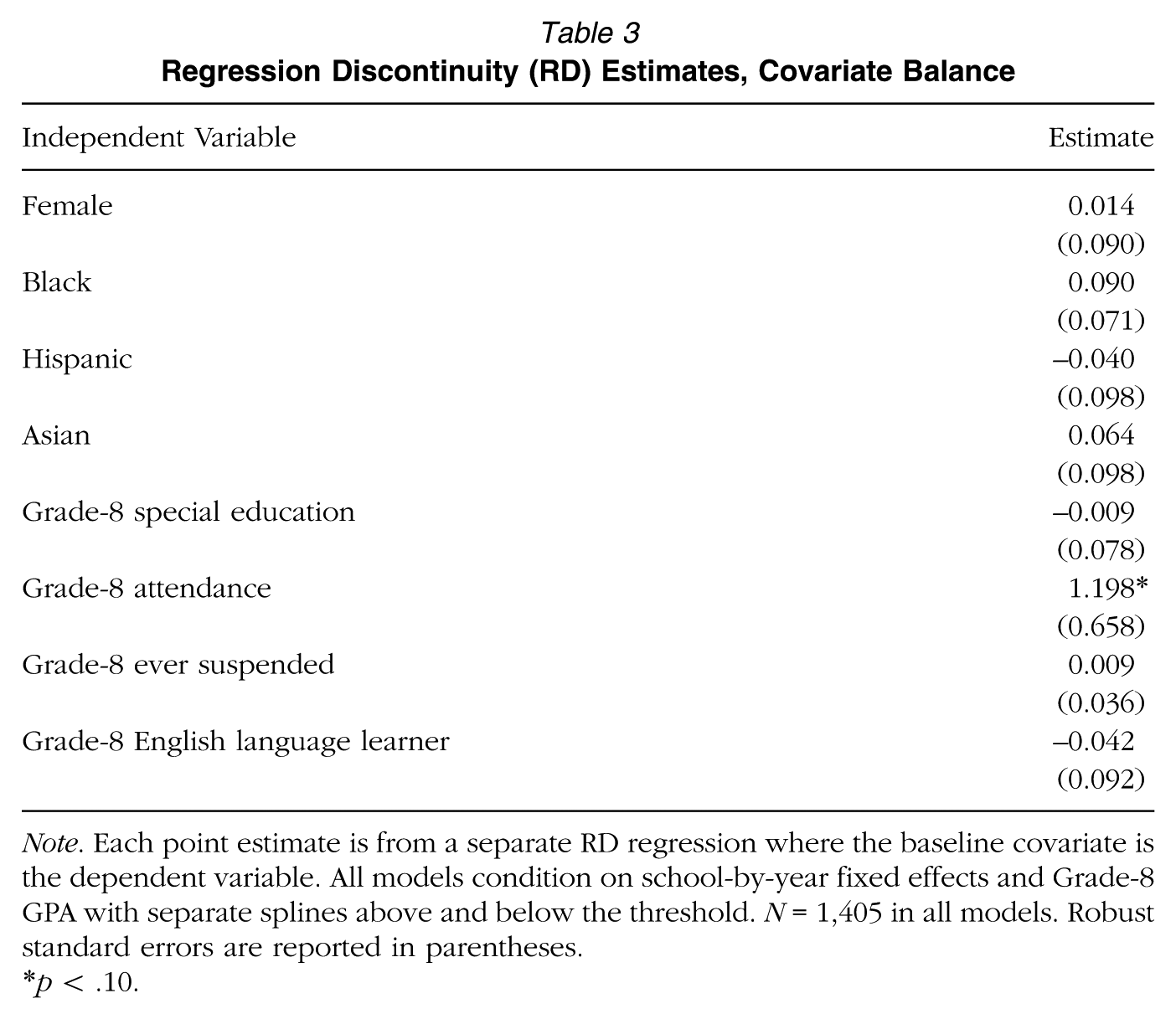
Note. Each point estimate is from a separate RD regression where the baseline covariate is the dependent variable. All models condition on school-by-year fixed effects and Grade-8 GPA with separate splines above and below the threshold. N = 1,405 in all models. Robust standard errors are reported in parentheses.
p < .10.
A related concern in RD designs is whether students differentially manipulate their eighth-grade GPA to place themselves on one side of the 2.0 threshold, potentially in response to something that is not observed by the researchers. In general, efforts to raise the value of a forcing variable do not invalidate an RD design (D. S. Lee & Lemieux, 2010). However, if individuals can systematically manipulate their position relative to the threshold, it can impugn an RD’s internal validity. This is a unique concern in this context because eighth-grade GPA scores “heap” at a value of 2.0 and other integer and half-integer values (see Figure 2a). Students who earn an eighth-grade GPA of 2.0 may differ from those just below this value in unobserved ways that are relevant to eighth-grade outcomes. The covariate balance at the threshold suggests that this is not an internal-validity threat. In addition, we report results based on samples where we eliminated heaped observations. We also see (Figure 2b) that when we eliminate these heaps, the distribution of observations is smooth at the threshold (McCrary, 2008).
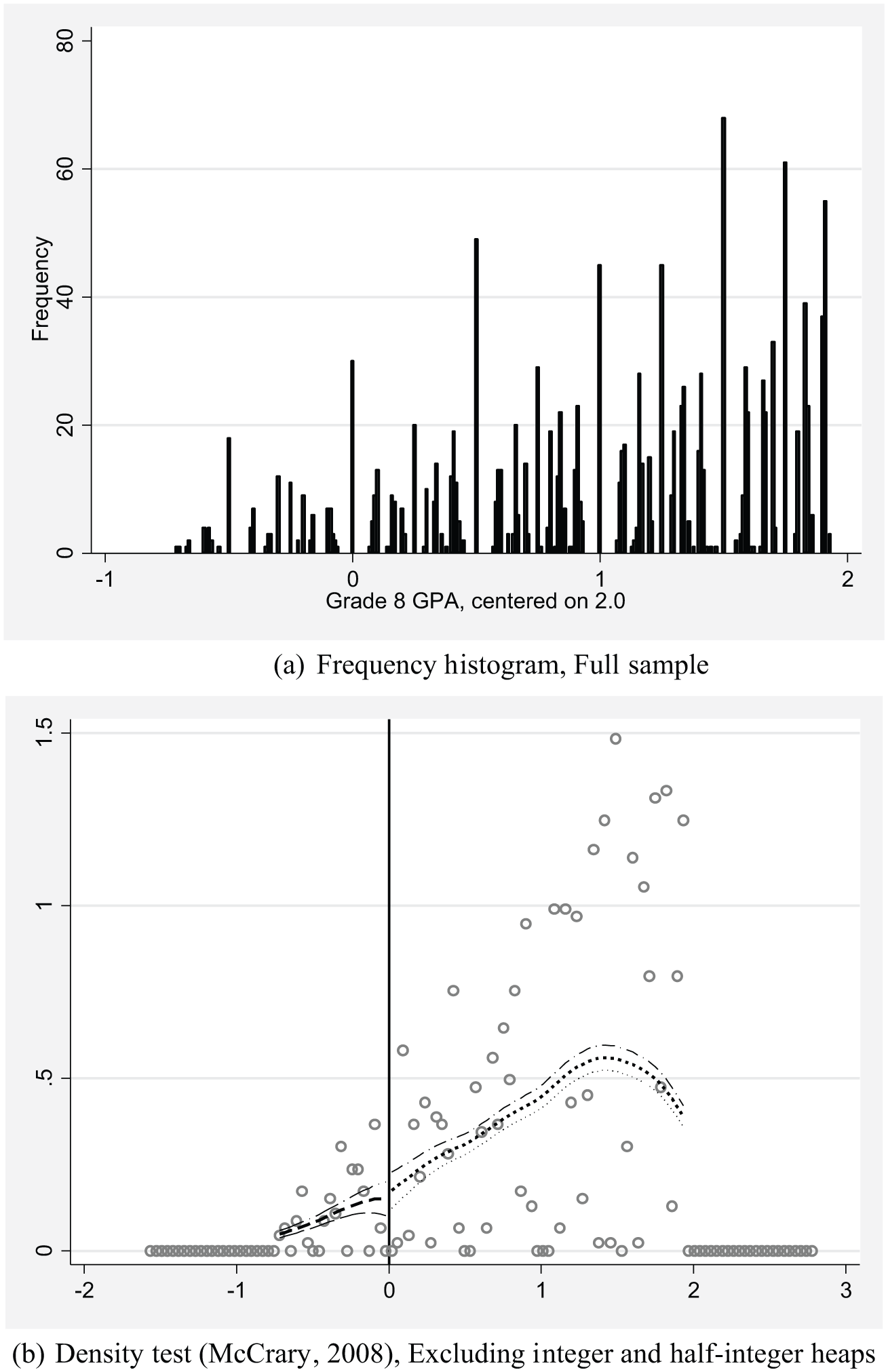
Distribution of grade-eight GPA centered on 2.0.
Two other internal-validity concerns are unique to our study context. One is that our RD contrast may also identify any effects related to being flagged by an early-warning indicator. One way we examine this concern is to estimate our basic RD design using data from the other San Francisco high schools that did not offer ES over this period. If our RD design is valid, we expect to find null results at the GPA threshold in these schools. In contrast, if early-warning status had independent effects, we would expect to find evidence in these schools. A second concern is that our RD framework may identify the effect of the four unique teachers in our study sample rather than the effect of the course per se. We investigate this issue by examining the comparative effectiveness of these teachers in the other courses they taught. We discuss these and other critical robustness checks as we outline our results in the following.
Main Results
Table 4 presents the main RD results examining the effects of ES eligibility on ninth-grade attendance, GPA, and credits earned for students at the threshold. The baseline specification (i.e., the first column for each of the three outcomes) controls for the variable of interest (i.e., a binary indicator for whether the student had an eighth-grade GPA below 2.0), eighth-grade GPA, and a linear spline that allows this assignment variable to have distinct effects above and below the threshold. The subsequent specifications introduce controls for gender, race/ethnicity, eighth-grade special education and ELL designations, eighth-grade attendance, and whether the student was ever suspended in eighth grade. These saturated specifications yield largely similar results, although the magnitude of the point estimates is reduced somewhat. Results from the most parsimonious to the most inclusive specifications consistently indicate that students with eighth-grade GPAs at the 2.0 threshold saw statistically significant improvements on all three ninth-grade academic outcomes. Drawing from the least restrictive model, we find robust evidence that attendance jumped by 5.6 percentage points for students at the 2.0 threshold, GPA increased by 0.39 points, and credits earned increased by 6.3 credits.
Regression Discontinuity Estimates, Grade-9 Outcomes
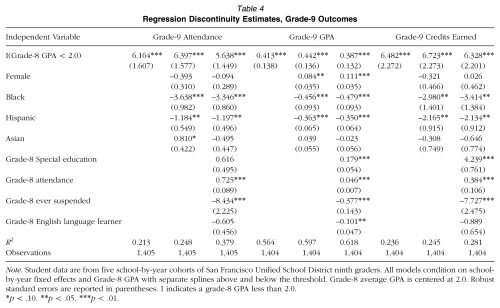
Note. Student data are from five school-by-year cohorts of San Francisco Unified School District ninth graders. All models condition on school-by-year fixed effects and Grade-8 GPA with separate splines above and below the threshold. Grade-8 average GPA is centered at 2.0. Robust standard errors are reported in parentheses. I indicates a grade-8 GPA less than 2.0.
p < .10. **p < .05. ***p < .01.
Figures 3, 4, and 5 provide graphical illustrations of these RD results. Figure 3 plots students’ eighth-grade GPA scores by their ninth-grade attendance, with a line indicating the 2.0 GPA cutoff. Figure 4 plots the relationship between eighth-grade GPA and ninth-grade GPA (excluding social studies and P.E.). Figure 5 plots the relationship between eighth-grade GPA and ninth-grade credits earned. Each of the figures shows a discontinuity at the 2.0 threshold, echoing the regression results shown in Table 4.
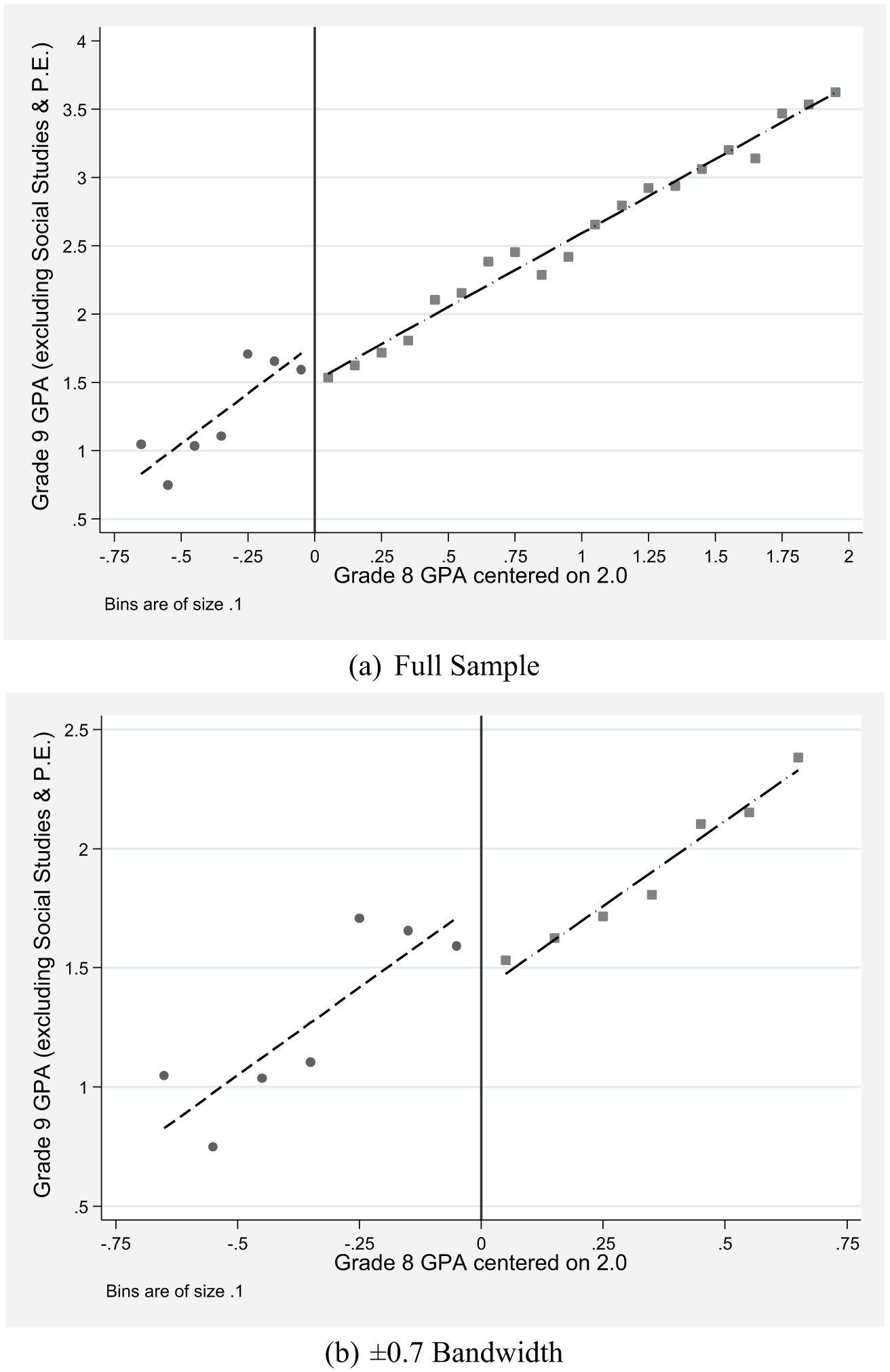
Ninth-grade GPA by eighth-grade GPA.
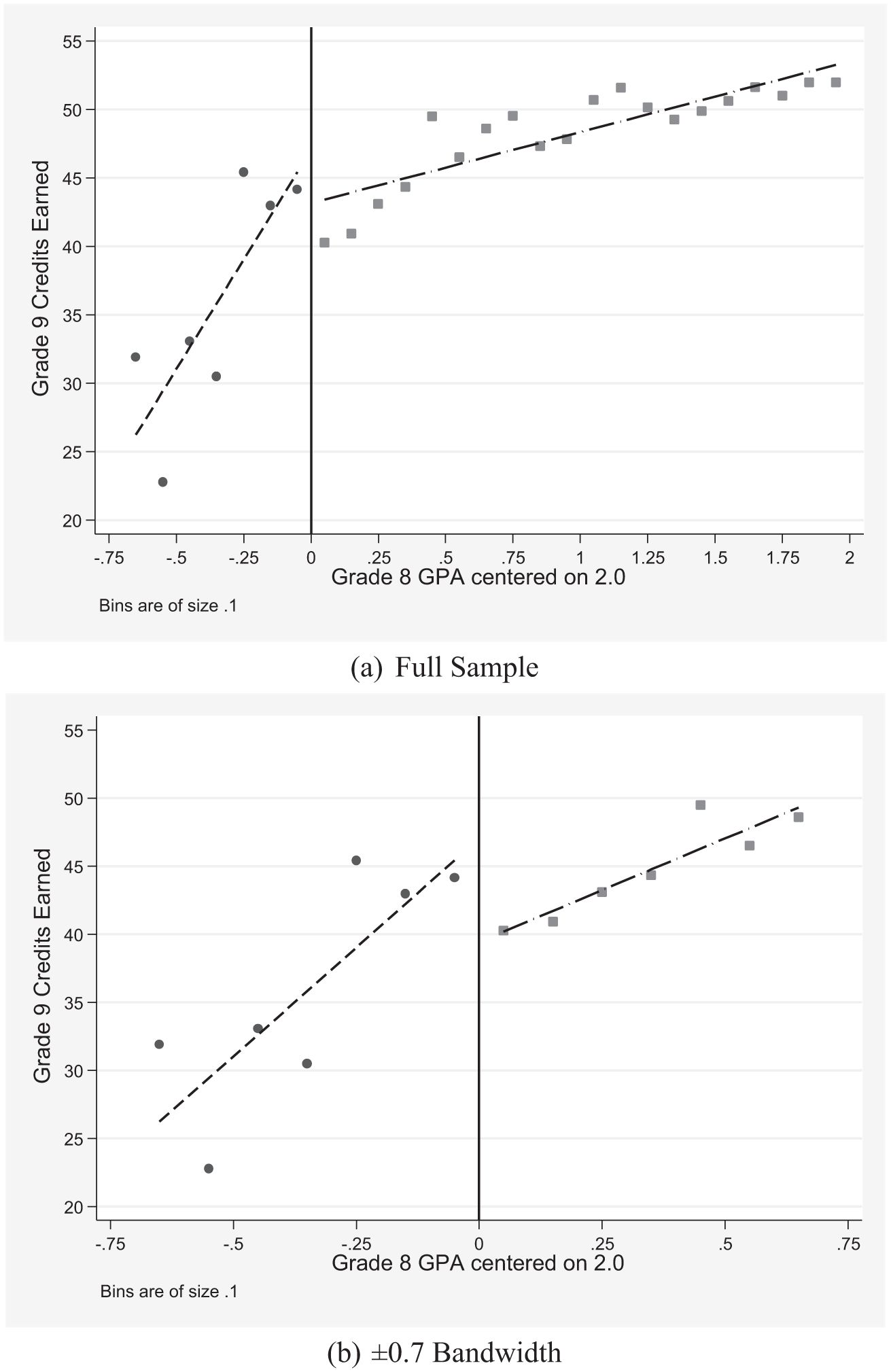
Ninth-grade credits earned by eighth-grade GPA.
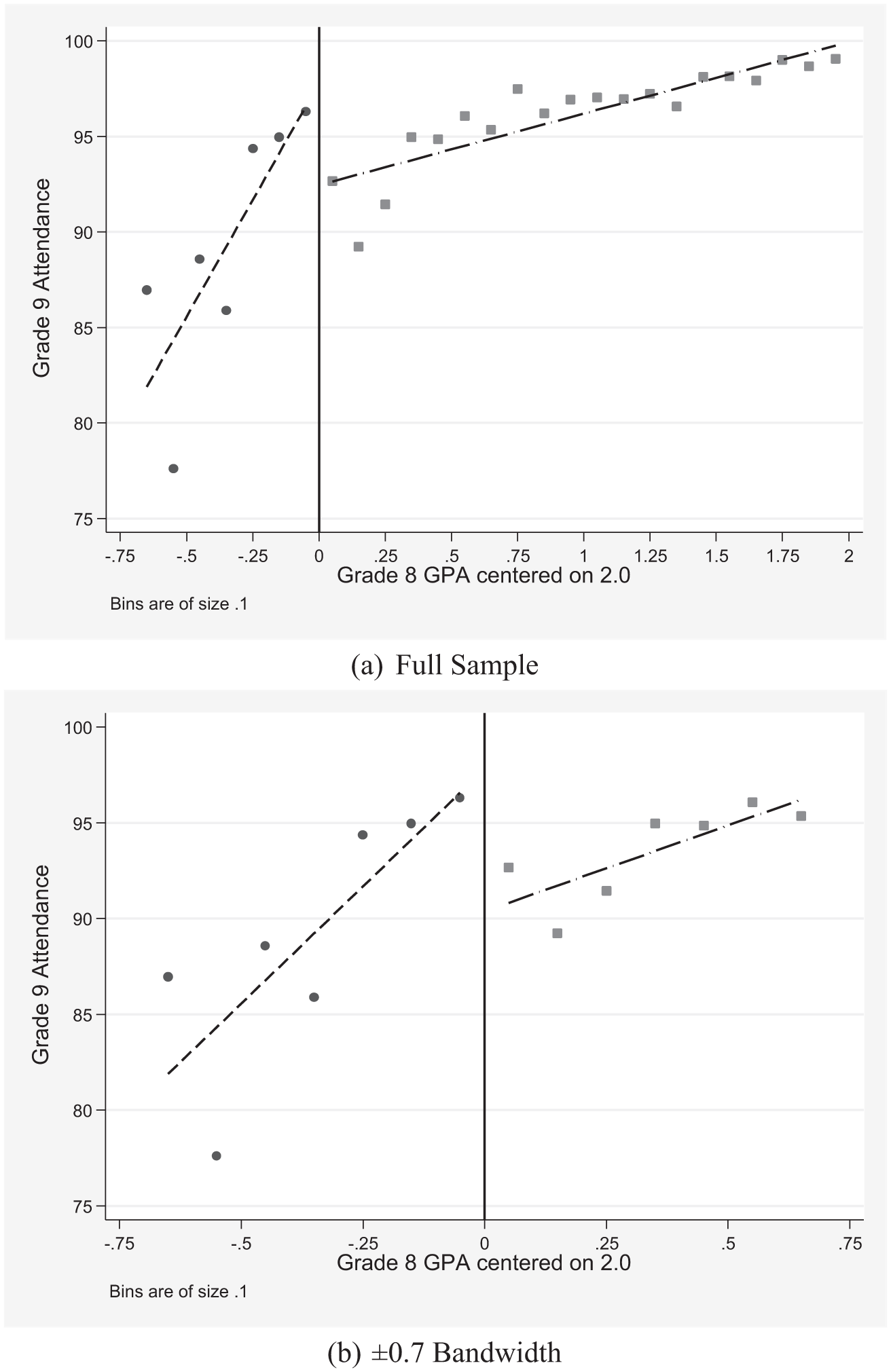
Ninth-grade attendance by eighth-grade GPA.
The instrumental-variable (IV) estimates imlied by these results indicate that taking ES increased attendance by 21 percentage points, GPA by 1.4 grade points, and credits earned by 23 credits (or roughly four courses). We calculate these estimated effects of taking ES by inflating the effects of ES eligibility on academic outcomes (Table 4) by the effect of ES eligibility on ES take-up, following Angrist and Pischke (2014). This amounts to dividing the reduced-form effects in Table 4, Columns 3, 6, and 9, by roughly 0.273, the coefficient reported in Table 2, Column 3, which represents the jump in ES uptake for students below versus above the 2.0 threshold (or multiplying by the inverse, approximately 3.7). For example, we obtain the effect of taking ES on GPA by dividing the coefficient for the jump in GPA at the 2.0 threshold shown in Table 4, Column 6 (i.e., 0.387) by 0.273 (i.e., the change ES uptake at the threshold). This estimate indicates that students who took ES had an average end-of-year GPA that was 1.4 grade points higher than students who did not take the ES course.
These effect sizes (e.g., roughly 1.5 times the size of the corresponding standard deviations in Table 1 for the GPA result) are quite large for interventions situated in field settings. As a result, several considerations should be noted. First and foremost, because we define these outcome measures for all students observed at baseline, some of these striking gains are likely to reflect reductions in dropping out as well as gains in the performance of enrolled students. Second, RD estimates like ours are effectively defined for students close to the 2.0 GPA threshold. These tend to be students who are at considerable academic risk, so larger gains in academic performance are possible. We take up such issues of treatment effect heterogeneity after first exploring the robustness of our main findings.
Robustness Checks
Given the consistent, large findings across a variety of ninth-grade outcomes, we next turn to examining the robustness of the apparent effects associated with the eighth-grade 2.0 GPA discontinuity. One possible confounding explanation for these findings is that they reflect the effects of the early-warning indicator rather than the ES course. In other words, students might be receiving other services and interventions as a result of the EWI identification, and this designation or these services might be driving changes in student outcomes rather than ES. To examine this concern, we estimated the same RD specifications using similarly constructed data from SFSUD high schools that did not offer an ES course. We present these results in Table 5. The small and statistically insignificant coefficients for each specification and for each of the three outcomes (i.e., there are no jumps at the 2.0 threshold in these schools) indicate that EWI did not have an empirically meaningful effect on ninth-grade outcomes. These null results are consistent with the hypothesis that the Table 4 results reflect the effects of taking ES rather than the effects of an EWI designation.
Regression Discontinuity Estimates, Grade-9 Outcomes in High Schools Without Ethnic Studies
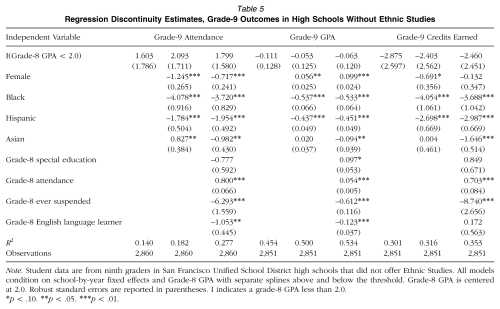
Note. Student data are from ninth graders in San Francisco Unified School District high schools that did not offer Ethnic Studies. All models condition on school-by-year fixed effects and Grade-8 GPA with separate splines above and below the threshold. Grade-8 GPA is centered at 2.0. Robust standard errors are reported in parentheses. I indicates a grade-8 GPA less than 2.0.
p < .10. **p < .05. ***p < .01.
An additional concern relates to the fact that student grades are reported in even grade points, leading to large clusters of students with GPAs at even-integer or half-integer GPA values (e.g., 3.0 and 3.5 rather than 2.99). As has been shown in other work using regression discontinuities to estimate causal effects, results can be biased by this heaping of the assignment variable (Barreca, Guldi, Lindo, & Waddell, 2011; D. S. Lee & Card, 2008). We present several robustness specifications in Table 6 to examine whether our results are being driven by the preponderance of even and half-integer eighth-grade GPAs by excluding students with several specific values. In these “donut RDs,” we first exclude students with eighth-grade GPAs of 2.0 exactly. In a second version, we exclude students with any whole- or half-integer value for their eighth-grade GPA. For each of the ninth-grade academic outcomes, the point estimates presented in Table 6 are from individual regressions for the variable eighth-grade GPA is less than 2.0, akin to the point estimates shown in Table 4 from models including student controls, with the first row replicating these estimates exactly.
Regression Discontinuity Estimates, Grade-9 Outcomes in High Schools With and Without Heaping
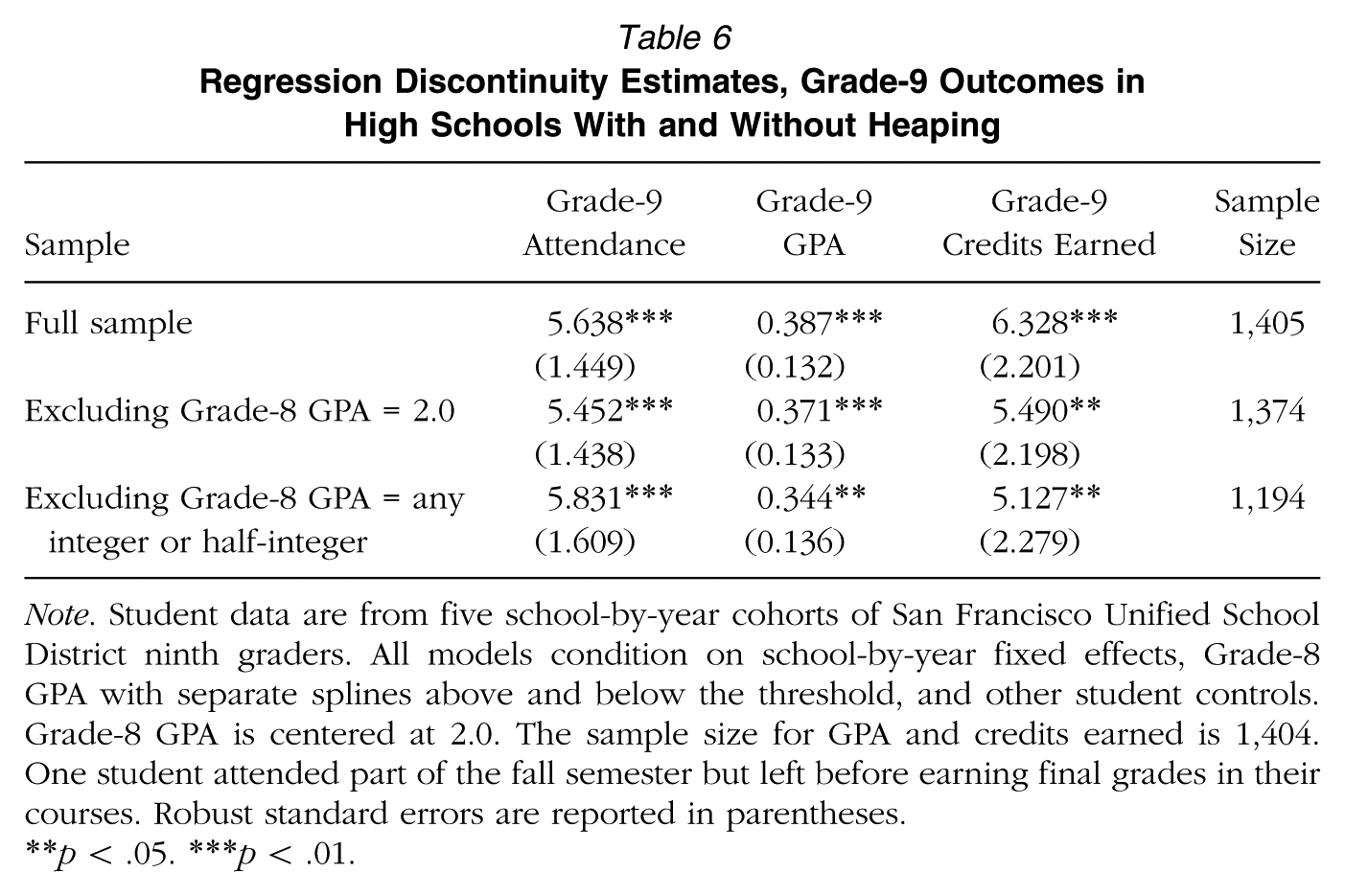
Note. Student data are from five school-by-year cohorts of San Francisco Unified School District ninth graders. All models condition on school-by-year fixed effects, Grade-8 GPA with separate splines above and below the threshold, and other student controls. Grade-8 GPA is centered at 2.0. The sample size for GPA and credits earned is 1,404. One student attended part of the fall semester but left before earning final grades in their courses. Robust standard errors are reported in parentheses.
p < .05. ***p < .01.
The results in Table 6 show that our inferences are robust in specifications that exclude students whose eighth-grade GPA fell on the heaped values of 2.0 as well as other integer and half-integer values. Each of the coefficients for all three of the ninth-grade academic outcomes is statistically significant at the 5% level, and the magnitude of the coefficients is fairly consistent whether or not the students with GPAs of 2.0 or any integer or half-integer value are included in the sample.
Table 7 presents another important robustness check based on restricting the estimation sample to observations in increasingly tight bandwidths around the threshold for both the first-stage and reduced-form effects. These results provide evidence about whether the estimates are biased due to functional-form assumptions or are unduly influenced by observations that are far from the 2.0 GPA threshold. The results in Table 7 indicate that both the first-stage and reduced-form estimates are robust as the sample shrinks with each of the progressively tighter bandwidths, including a bandwidth that is within half of a grade point from the 2.0 threshold. If anything, the first-stage and reduced-form estimates become larger as the bandwidth tightens.
Regression Discontinuity Estimates, Grade-9 Outcomes by Bandwidth Restrictions
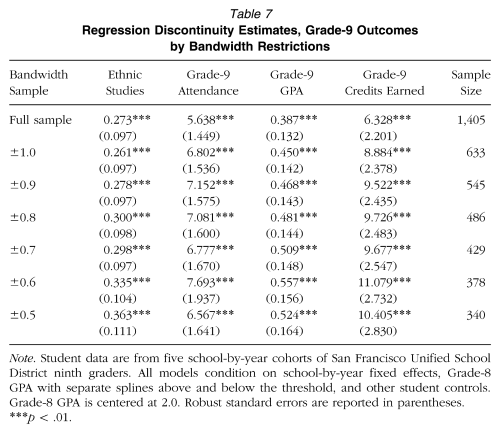
Note. Student data are from five school-by-year cohorts of San Francisco Unified School District ninth graders. All models condition on school-by-year fixed effects, Grade-8 GPA with separate splines above and below the threshold, and other student controls. Grade-8 GPA is centered at 2.0. Robust standard errors are reported in parentheses.
p < .01.
Table 8 presents another robustness check based on simultaneously estimating jumps at the GPA threshold that actually influenced assignment to the ES course, 2.0, and at other “placebo” thresholds that have no relevance. We examine six placebo thresholds at each quarter-integer interval between GPAs of 1.0 and 3.0. Across both the first-stage and reduced-form estimates, the only statistically significant effects are observed at the 2.0 threshold, with one exception. Students at the 2.25 GPA threshold, just below the 2.25 cutoff, earn significantly fewer ninth-grade credits than students on the other side of this cutoff. With this exception, the nearly universal lack of statistically significant effects at these false thresholds is consistent with the absence of specification error.
Regression Discontinuity Estimates, Placebo and Actual Discontinuity Thresholds
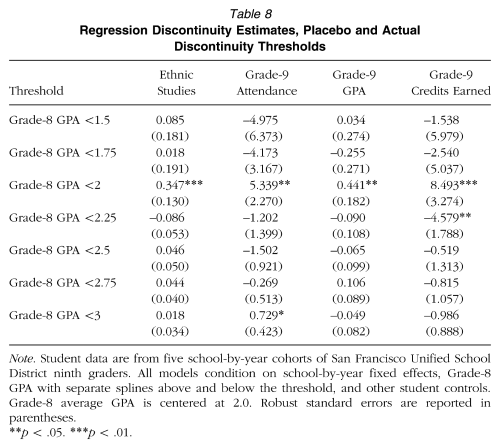
Note. Student data are from five school-by-year cohorts of San Francisco Unified School District ninth graders. All models condition on school-by-year fixed effects, Grade-8 GPA with separate splines above and below the threshold, and other student controls. Grade-8 average GPA is centered at 2.0. Robust standard errors are reported in parentheses.
p < .05. ***p < .01.
A final robustness check stems from the particular implementation of the ES curriculum in SFUSD. While ES was piloted at five high schools over several years, assignment to ES was based on the EWI in only five school-year cohorts at three schools. In each of these school-year cohorts, only one teacher taught ES, leaving us with a total of four unique teachers during our study window. This raises the possibility that the effects we observe are the result of effects unique to these teachers rather than the ES curriculum itself. To investigate this concern, we examined the effectiveness of ES teachers relative to their peers when teaching courses other than ES. We began by identifying all of the non-ES courses taught by our four ES teachers in any of the study years and then identified all of the other teachers of those same courses. The majority of these courses were social studies courses, such as U.S. and world history, but the list also included some college counseling and homeroom-type courses, which we chose to exclude from the analysis. We focused on students in these social studies courses who had not taken ES. We then recovered teacher fixed-effect estimates from regression models predicting each of our ninth-grade student outcomes (ninth-grade overall and subject-specific GPA, credits earned, and attendance), conditional on eighth-grade student controls and school-by-year fixed effects. For each of our outcomes, we examined the relative rankings of the teacher fixed effects to determine if the ES teachers were overrepresented among teachers who had the largest fixed-effects estimates. Across each of the outcome measures, we found the ES teachers to be spread throughout the distribution of teacher fixed-effect estimates. 21 Wilcoxon rank-sum tests further suggest that the fixed effects of ES teachers are not differently distributed from those of non-ES teachers in the same subjects. Of the four ES teachers, one fairly consistently had the largest fixed-effect estimate. To ensure that this generally more-effective teacher was not driving our results, we reestimated our key ES results without this teacher. Doing so did not qualitatively alter the previously reported findings.
Treatment Effect Heterogeneity
Our main results may obscure several forms of treatment effect heterogeneity that are worth noting and exploring. For example, one well-known caveat about external validity involves the “localness” of RD estimates. That is, because our research design leverages the targeting of ES courses to at-risk students, our resulting estimates do not speak to the effects these courses might have on students with high performance in eighth grade. 22 Second, the effect of taking the ES course could conceivably vary across students with different demographic traits. In Table 9, we present evidence on this issue by showing the first-stage and reduced-form estimates in samples defined by gender and race/ethnicity. The point estimates show that there are consistently positive effects across male, female, Asian, and Hispanic groups of students. While generally positive overall, the improved outcomes are particularly concentrated among boys and statistically insignificant for girls. For Hispanic students, the estimated effects are consistently large and statistically significant across all ninth-grade outcomes. For Asian students, while each of the point estimates is positive, they are only significant for the first-stage and ninth-grade instructional time effects. This suggests that while the ES course is on average not harmful for any of the enrolled students, it is particularly good for male students and Hispanic students.
Regression Discontinuity Estimates by Student Traits
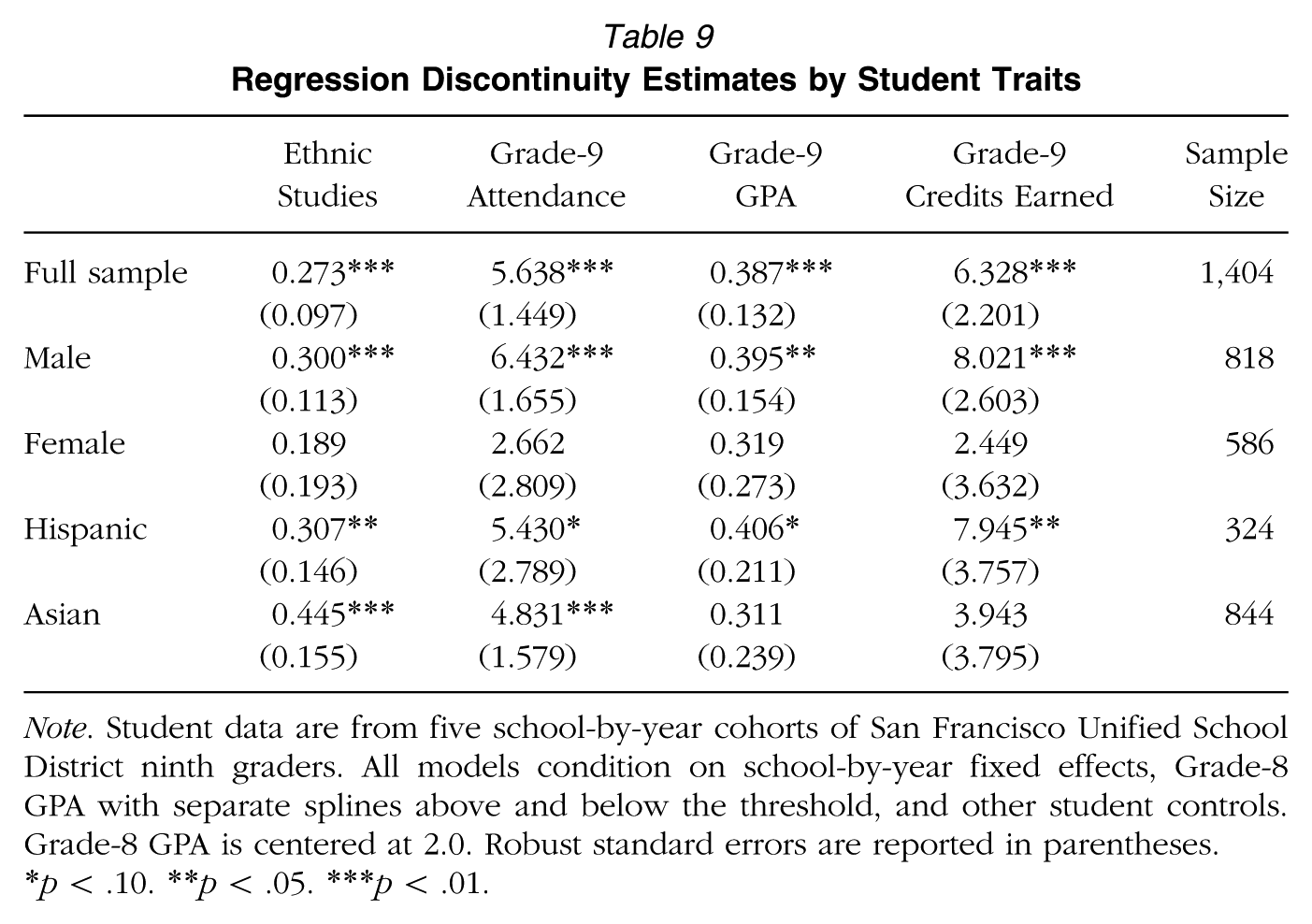
Note. Student data are from five school-by-year cohorts of San Francisco Unified School District ninth graders. All models condition on school-by-year fixed effects, Grade-8 GPA with separate splines above and below the threshold, and other student controls. Grade-8 GPA is centered at 2.0. Robust standard errors are reported in parentheses.
p < .10. **p < .05. ***p < .01.
In Table 10, we examine whether there are heterogeneous effects on student GPA by subject. Each cell in this table reports the key RD estimate (i.e., the estimated “jump” at the 2.0 threshold) from a unique regression. The first column presents point estimates conditional on linear splines of the assignment variable and on school-by-year fixed effects. The subsequent models introduce student and eighth-grade covariates. The point estimates show that there are consistently positive, statistically significant effects on GPA specific to math and science, despite the distal nature of their respective content to that of ES. In English language arts, however, while the point estimates remain positive, they are smaller and statistically insignificant.
Regression Discontinuity (RD) Estimates, Effect of Ethnic Studies Eligibility on Subject-Specific GPA
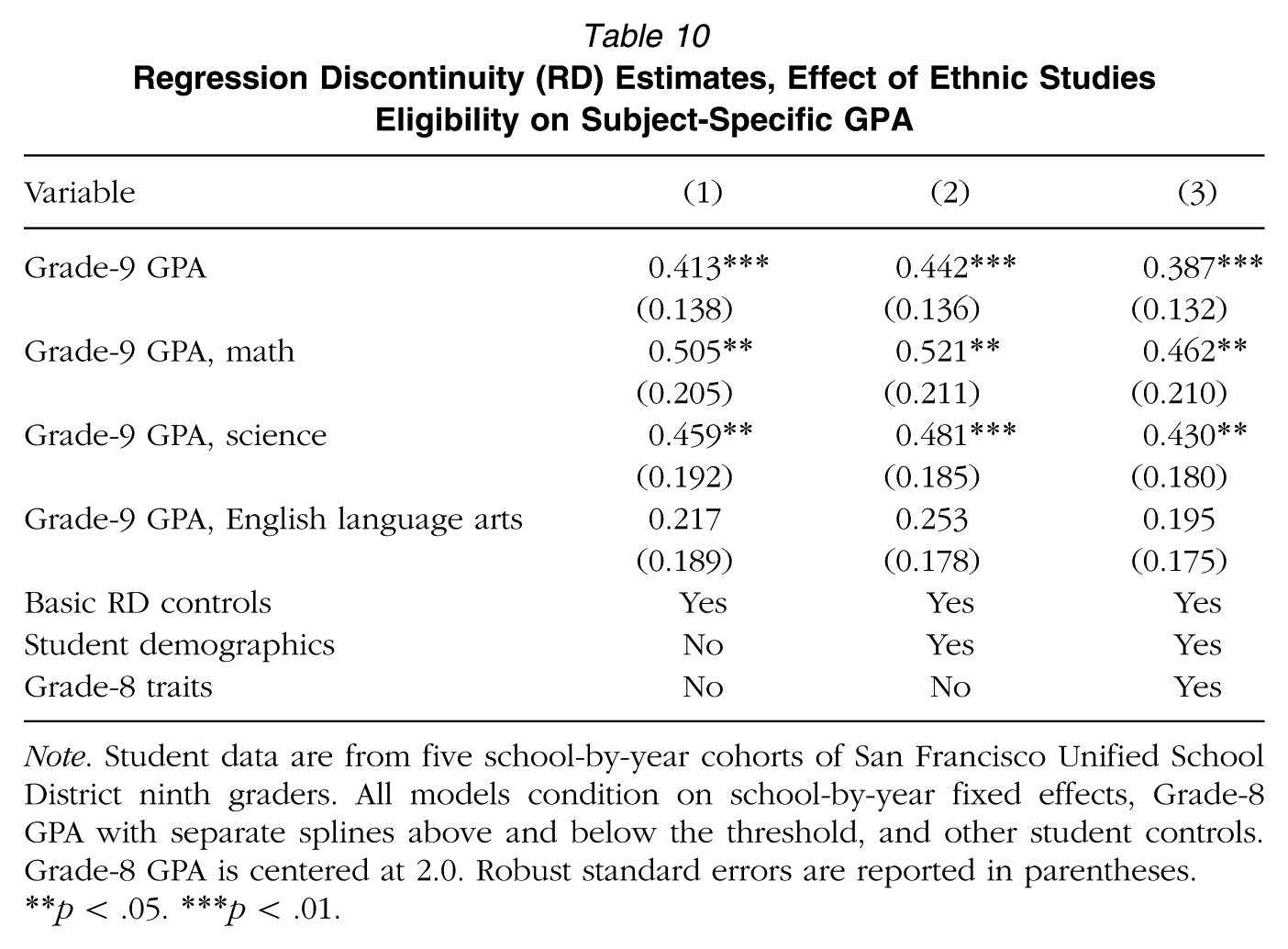
Note. Student data are from five school-by-year cohorts of San Francisco Unified School District ninth graders. All models condition on school-by-year fixed effects, Grade-8 GPA with separate splines above and below the threshold, and other student controls. Grade-8 GPA is centered at 2.0. Robust standard errors are reported in parentheses.
p < .05. ***p < .01.
The literature on causal inference has also recently emphasized another possible (and subtler) form of treatment heterogeneity based on the potential outcomes framework and how individuals respond to their intent-to-treat (i.e., as “compliers,”“always takers,” and “never takers”). Specifically, Imbens and Angrist (1994) show that when treatment effects are not homogenous across these groups, and assuming monotonicity, estimates like ours are “local average treatment effects” (LATE). Such LATE estimates correspond to the effect of the treatment for those who comply with their intent-to-treat but will likely differ from that for those who always (or never) take up the treatment regardless of the intent-to-treat. A recent study by Bertanha and Imbens (2014) provides straightforward guidance on assessing the empirical relevance of this possible treatment heterogeneity in “fuzzy” RD applications like ours. Specifically, they recommend estimating the reduced-form RD specifications for separate samples defined by whether the student took up the treatment (i.e., ES ∈ {0, 1}). We report these results in Table 11 using our saturated model (i.e., Column 3 in Table 4). In the first row, we repeat our full sample results as a point of reference. In the second row, we show the estimated “jump” in outcomes using only data from students who did not take ES (i.e., ES = 0). In this subsample, the threshold separates never takers (i.e., to the left of the threshold) from the population of never takers and compliers who are to the right of the threshold. The fact that outcomes are higher to the left of the threshold (i.e., for at least two of the three outcomes) indicates that never takers have unobserved traits that predispose them to better student outcomes relative to compliers. Intuitively, this finding suggests that students who insist on taking a health or college preparation/study skills course in lieu of ES have unobserved traits that imply better academic outcomes.
Regression Discontinuity Estimates by Complier Status
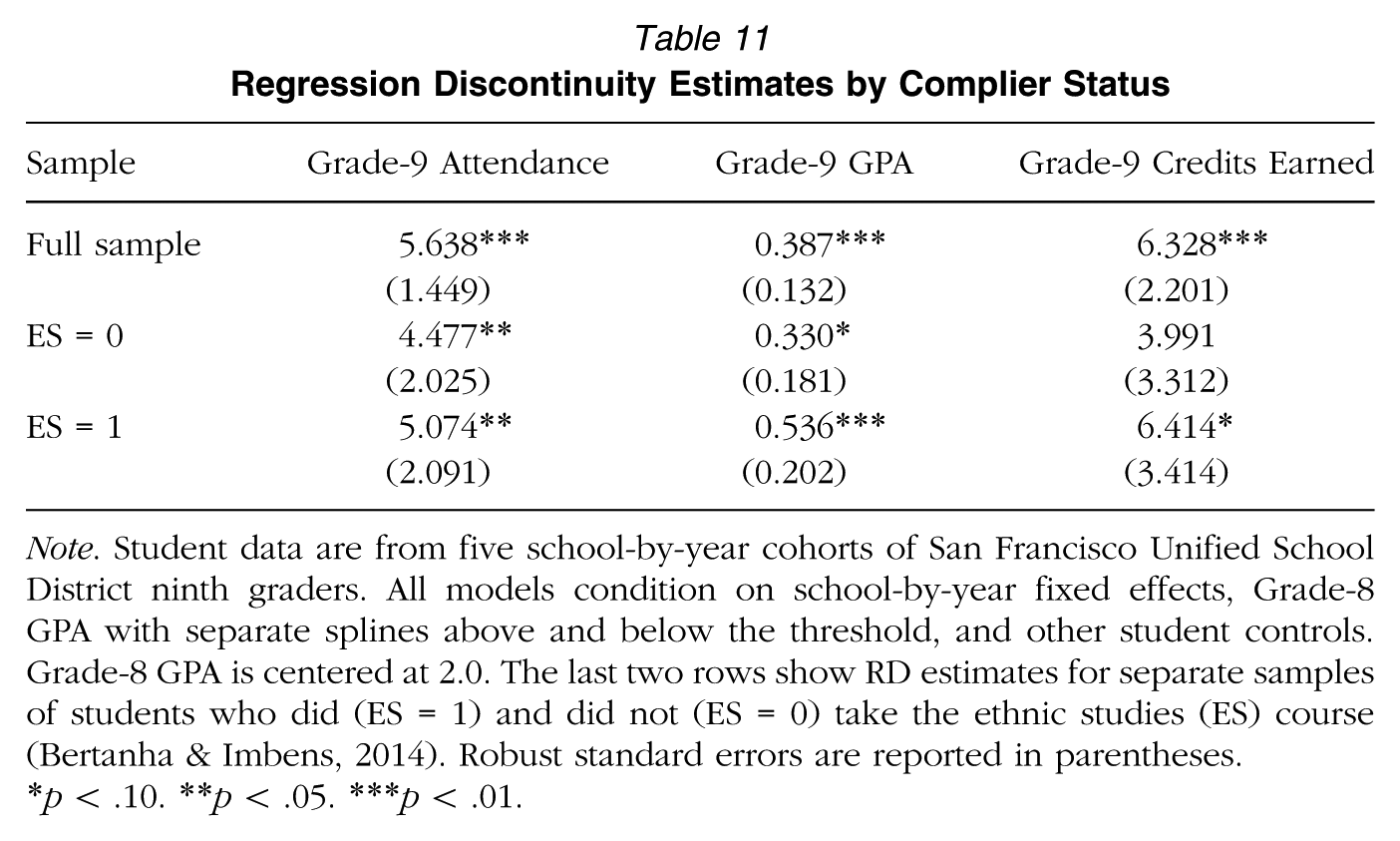
Note. Student data are from five school-by-year cohorts of San Francisco Unified School District ninth graders. All models condition on school-by-year fixed effects, Grade-8 GPA with separate splines above and below the threshold, and other student controls. Grade-8 GPA is centered at 2.0. The last two rows show RD estimates for separate samples of students who did (ES = 1) and did not (ES = 0) take the ethnic studies (ES) course (Bertanha & Imbens, 2014). Robust standard errors are reported in parentheses.
p < .10. **p < .05. ***p < .01.
The next row identifies the jump at the threshold for each outcome measure using only data on students who took ES (i.e., ES = 1). The population to the left of the threshold consists of compliers and always takers while the population to the right only contains always takers. Our evidence that each student outcome jumps significantly at the threshold could indicate that taking the course is more effective for those who only take it when assigned relative to those who insist on taking it. This could occur, for example, if the ES course is less novel and relevant for the types of students who insist on taking it. Overall, these findings are consistent with the type of heterogeneity implied by the LATE theorem. As a practical matter, this evidence of treatment heterogeneity has salience for the external validity we might expect when scaling up access to this course. In particular, these findings suggest that taking the course is less necessary for the type of student who refuses to take the course (i.e., never takers) and less effective for students who insist on taking it when available (i.e., always takers). We revisit issues of scalability in our concluding remarks.
Discussion
The results presented in this study indicate that the ninth-grade ES curriculum implemented in SFUSD led to large and statistically significant improvements in ninth-grade GPA, attendance, and credits earned for compliers at the 2.0 eighth-grade GPA threshold. To our knowledge, this is the first study to examine the effect of any type of culturally relevant pedagogy (CRP) in a quantitative study that supports credible causal inferences. Specifically, our “regression discontinuity” (RD) design leveraged a class assignment rule that encouraged academically at-risk students (i.e., those with eighth-gradeGPA below 2.0) to take the course. We present several forms of evidence that affirm the validity of this discontinuous assignment rule as a quasi-experimentas well as evidence on the robustness of our main findings. We note evidence that these large effects appear to reflect both reductions in the probability of dropping out as well as improvements in the performance of enrolled students. We also find that the effects of this course were concentrated among males, Hispanics, and to a lesser degree, Asians.
Taken at face value, these findings provide a compelling confirmation of an extensive literature that has emphasized the capacity of CRP to unlock the educational potential of historically marginalized students. We also stress that our results are consistent with other theoretical frames as well. In particular, a field experimental literature in social psychology has shown that quite modest interventions that buffer students against stereotype threat can, under the right circumstances, dramatically improve student outcomes. ES courses combine several of the active ingredients of these interventions (e.g., affirmation, external attribution for difficulties, forewarning about stereotypes) and expose students to them in an exceptionally intense and persistent manner (i.e., through a year-long course rather than a brief exercise). Furthermore, SFUSD’s ES course was also targeted in a manner consistent with such “buffering” interventions (i.e., at the beginning of the school year and during a possibly difficult transition to high school). Further research that can measure alternative mediators can provide insight into the relevance of different theorized mechanisms.
As a matter of policy and practice, this study’s findings should be interpreted in light of several important caveats related to external validity and scalability. First, as in all RD studies, our results focus on localized comparisons between students who are just above and below the eligibility threshold for ES enrollment. It is thus an open question whether the effects of this or any other ES curriculum would generalize to higher-performing students. Furthermore, we also find evidence that the benefits of taking such a course are larger among those who comply with the encouragement to take the course (i.e., relative to students who would always take it when available).
The effects of ES identified by this study are large, and there are several reasons why such large effect sizes are credible. First, the effects we estimate are specific to at-risk students who have indications of low performance in eighth grade (i.e., those close to the GPA threshold). These are students for whom large ninth-grade gains may be feasible following a renewed engagement with school. Second, our sample includes students regardless of whether they dropped out during the course of their ninth-grade year. This includes the 7.3% of students who obtained fewer credits than needed to qualify for promotion to tenth grade by the end of the school year. The improvements we observe in attendance, GPA, and credits earned are likely to reflect, in part, the gains among students who otherwise would have dropped out and had very low values for these measures. Third, the interpretation of effect sizes in a fuzzy RD setting relies in part on understanding the counterfactual, which is not straightforward. Roughly 15% of students above the threshold took up ES. If these students also benefitted from the course, the relevant counterfactual outcomes for students below the threshold who took the course would be even lower. Fourth, our estimates can be understood as “local average treatment effects” (LATE). The LATE interpretation implies that our estimates identify the effects of taking ES for “compliers” (i.e., those who take ES when their eighth-grade GPA is below 2.0 and do not when it is above). Our investigations into this treatment effect heterogeneity suggest that effects are larger for this group than among those who always or never take the course. Finally, if our measure for taking ES (i.e., based on administrative data for the fall semester) is characterized by measurement error, it would imply a bias toward zero that is corrected by the IV procedure.
In spite of the robustness of the findings in the present study, there are several reasons to be cautious about the likely effect of scaling up or replicating this ES course. The implementation of ES in SFUSD was arguably conducted with a high degree of fidelity, forethought, and planning. In particular, it appeared to draw on the work of a core group of dedicated teachers, engaging in a regular professional learning community, with outside support from experts in the subject to create and sustain the program. Scholars from a number of disciplines have noted that the effects of such smaller-scale interventions are often very different when the same policies are implemented at scale (Dodge, 2011; Welsh, Sullivan, & Olds, 2010). The broader school, district, and community contexts in which this course was situated may also be relevant. For example, the literature on stereotype threat stresses that the success of buffering interventions depends critically on settings that can enhance and encourage positive “recursive” processes related to student engagement and success (Yeager & Walton, 2011). Nonetheless, SFUSD’s ES program appears to constitute an important proof of concept, indicating that culturally relevant pedagogy can be extraordinarily effective in supporting the academic progression of struggling students.
Footnotes
Notes
T
E