






Abstract
Understanding the relative impacts of part-time adjuncts in community colleges is highly policy-relevant, partly because community colleges rely on part-time faculty heavily and partly because community colleges assume a critical role in addressing the national equity agenda by disproportionately serving underrepresented groups. This study uses individual transcript data to explore how initial exposure to a particular field of study with part-time adjuncts influences student performance in current and subsequent course performance in community colleges. To address selection bias, I use two empirical strategies, a two-way fixed effects model and an instrumental variable approach. The results consistently suggest that part-time adjuncts are associated with higher grades in contemporaneous courses but have negative impacts on subsequent course performance.
Keywords
Because of its potential to adversely affect institutions, the extensive use of part-time faculty should be carefully re-examined.
Introduction
The demand for higher education has escalated over the past few decades and has been accompanied by a decline in public financing (Kane & Orszag, 2003). Public postsecondary institutions have responded by raising tuition, increasing class sizes, cutting programs, and otherwise seeking to reduce costs and improve efficiency. One such cost-saving measure has been the increasing reliance on adjunct instructors, most often hired through part-time and temporary appointments (Leslie, 1998; Wagoner, Metcalfe, & Olaore, 2004). At community colleges in 2003, part-time faculty earned an average of $2,836 per course compared to $10,563 per course for full-time faculty (National Education Association Higher Education Research Center, 2007); the compensation difference is even wider considering that these part-time adjuncts typically receive minimal benefits from their employers (Adamowicz, 2007).
The low costs and flexibility associated with part-time adjunct instructors have resulted in substantial changes in faculty composition in higher education at both 2- and 4-year institutions. A recent National Center for Education Statistics (NCES) report indicates that the number of part-time faculty in all postsecondary education institutions increased by 104% in degree-granting postsecondary institutions from fall 1993 to fall 2013, compared with an increase of 45% in the number of full-time faculty (NCES, 2016). As a result, the ratio between part-time and full-time faculty changed from 2:3 to 1:1 during this period. The increased reliance on part-time faculty has been even more pronounced in open-access 2-year colleges: The ratio of full-time to part-time faculty, roughly a 2:1 ratio before 1970 in community colleges, reversed to 1:2 by 2003 (NCES, 1990, 2001, 2008), with some community colleges reporting closer to 80% part-timers (Balch, 1999).
The increased reliance on part-time faculty in colleges has been under the radar of the public critique. Since teaching is a demanding profession, instructors’ commitment to the institution and active engagement with the students have been identified as critical factors for the education process (Day, 2004; Elliott & Crosswell, 2001; Fried, 1995; Nias, 1996). Critics of the reliance on part-time faculty cite several potential problems typically observed among temporary labor force, such as insufficient engagement with the department; lack of experience, professional training, and institutional support; limited availability to the students; lack of time to prepare for a course adequately in advance; and the possibility of teaching commitments at more than one institution (e.g., Benjamin, 2002, 2003; Schuetz, 2002; Umbach, 2007). Due to low compensation, minimal benefits, and absent job security (Adamowicz, 2007; Friedlander, 1980; Jacoby, 2005; Schmidt, 2008), part-timers at community colleges were also found to hold “scant loyalty for the institution and an increasing sense of frustration with their circumstances” (Brewster, 2000, p. 68), which may in turn negatively impact the quality of instruction and their interactions with the students.
Despite researchers’ concerns about the implications of overreliance on part-time faculty for student learning outcomes, there is inadequate evidence regarding the relative impacts of part-time instructors on student outcomes in higher education. Although some researchers have explored potential differences between part-time and full-time faculty in their instructional approaches and interactions with students (e.g., Benjamin 2002, 2003; Schuetz, 2002; Umbach, 2007), they did not link the type of instructor to student academic outcomes. Among the studies that directly measure adjuncts’ impact on student outcomes, the majority relied on aggregated data (e.g., Bettinger & Long, 2006; Ehrenberg & Zhang, 2005; Jacoby, 2006). While an emerging literature has used student transcript data and experimental or quasi-experimental designs to explore the connection between teacher quality and student outcomes at the postsecondary level (Bettinger & Long, 2010; Carrell & West, 2010; Figlio, Schapiro, & Soter, 2015; Hoffmann & Oreopoulos, 2009), these investigations were carried out exclusively in the 4-year university setting, which is substantially different from community colleges in terms of both student population and the role of part-time instructors.
Are students likely to receive the same quality of instruction from part-time faculty relative to full-time faculty while attending community colleges? This question has high relevance to policy, and important implications for education equality: On one hand, community colleges rely substantially more heavily on part-time faculty than do 4-year institutions. As Figure 1 shows, the proportion of part-time faculty is noticeably and consistently higher in 2-year colleges than the share of adjuncts in 4-year universities in the past two decades. On the other hand, community colleges disproportionately serve low-income, first-generation, and historically underrepresented groups, and therefore the faculty hiring policy in this setting and the extent to which it may differ from other higher education settings (e.g., public 4-year institutions) may have a profound influence on the national equity agenda.
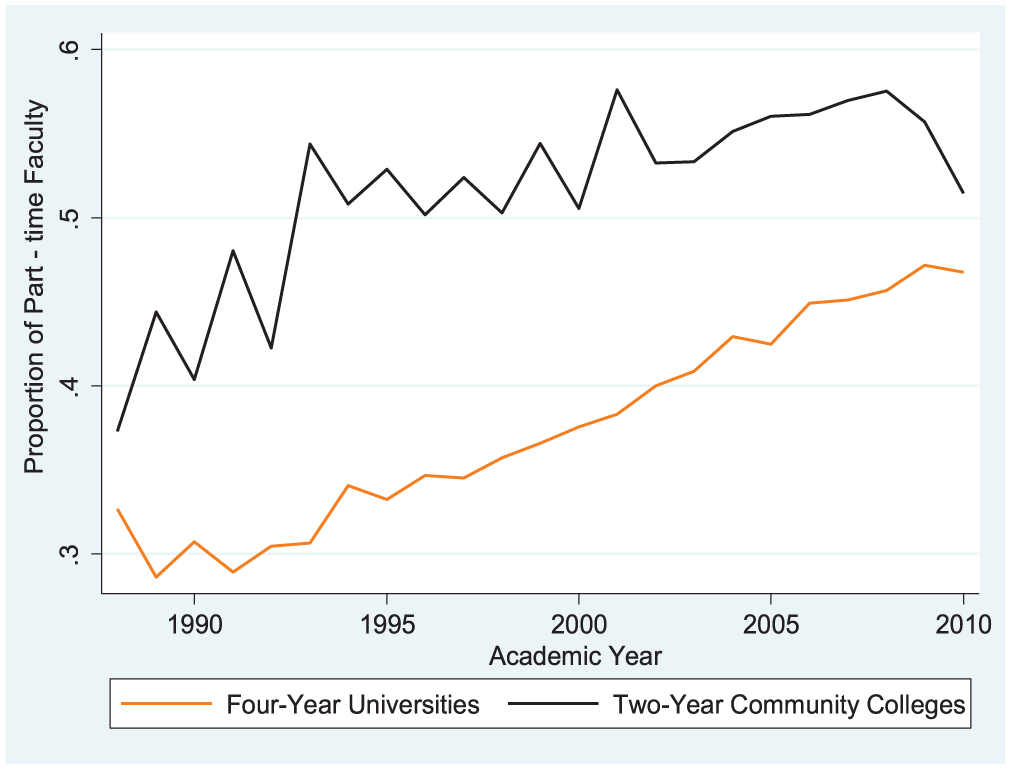
Changes of the proportion of part-time faculty in 4- and 2-year public higher education institutions between 1988 and 2010.
Ran and Xu (2018) is the only study to date that uses quasi-experimental designs to examine the impacts of instructors’ contractual form on student academic outcomes at the community college setting. Based on data from 2-year and 4-year colleges in an anonymous state, they found that non–tenure track faculty negatively influence student subsequent course enrollment and performance in both settings. However, the non–tenure track faculty in their study consist of both full-time and part-time instructors. Therefore, it is unclear how part-timers are different from full-time instructors in their impacts on student performance.
This article builds on the existing literature on teacher effectiveness at the postsecondary level and examines the impacts of part-time adjunct faculty relative to full-time faculty on students’ academic outcomes in the setting of community colleges. Based on an administrative data set that includes six cohorts of students initially enrolled in one of the 23 community colleges in a large state community college system between 2004 and 2009, I examine how taking one’s first course in a particular field of study with a part-time adjunct instructor influences the student’s concurrent course outcomes, as well as subsequent course enrollment and performance in the same field of study. 1
I focus on the first course that a student takes in a field of study for both applied and methodological reasons. From an applied standpoint, instructional quality in introductory courses can not only affect students’ interest and success in subsequent learning in the same field, but may also influence important academic decisions such as major choice or even early college withdrawal. As a result, community colleges tend to be particularly concerned with instructional effectiveness in entry-level courses and potential means of improving them. From a methodological standpoint, entry-level courses typically have very high enrollments compared to more advanced courses, yielding a large sample size for analysis. In addition, most students take these courses in an early stage of their college career, when they are less likely to have preexisting knowledge regarding available instructors in a particular field in their college. Accordingly, focusing on these introductory courses (rather than more advanced courses) should reduce self-selection bias.
To minimize bias from student self-selection into courses taught by different types of instructors, I use a two-way fixed effects model, adapted from Figlio et al. (2015), which controls for both individual-level fixed effects and course-level fixed effects. I also implement a version of the instrumental variable strategy used by Bettinger and Long (2010) to cross-validate the results, using term-by-term variation in departmental faculty composition as an instrument of students’ likelihood of taking a course with different types of instructors in their initial term in a certain field of study.
Both analyses show robust estimates of positive impacts of part-time adjuncts on contemporaneous course grades but negative impacts on subsequent course enrollment and performance. In addition to the overall difference between part-time and full-time faculty, the capability of colleges in attracting high-quality adjunct instructors also partly depends on the job opportunities and compensation in the alternative nonteaching job market for each field. For example, STEM graduates who elect nonteaching, industry jobs will find an eagerly hiring job market and higher earnings on average than those who pursue adjunct teaching jobs. Indeed, additional analysis by field of study reveals strong heterogeneous effects, where the negative impacts associated with part-time adjuncts on subsequent course outcomes are particularly strong in STEM and health fields. Finally, considering that students with different levels of academic preparedness may also differ in the extent to which they are susceptible to alternative instructors, I further examine possible heterogeneity by academic preparedness and find that the negative impacts on subsequent outcomes are particularly strong for students who are academically better prepared.
Although future work is still needed to fully understand the specific mechanism through which part-time faculty influence the learning process, this article makes an important first step in understanding the impacts of part-time adjuncts on student course-taking behavior and success in community colleges. The consistent negative impacts of taking one’s introductory course with a part-time faculty on community college students’ subsequent enrollment and performance are worrisome from a policy perspective: If the negative impacts of part-time faculty on student field persistence and performance identified in the current study hold true in other state community college systems, it would imply that the continued increase and heavy reliance on part-time adjuncts in community colleges could harm the education outcomes of these students who are already disproportionately from historically disadvantaged groups.
Literature Review
Differences in Teaching Approaches and Student Evaluations
Earlier studies comparing the effectiveness of part-time and full-time faculty have typically used student evaluations as a measure of teaching quality and essentially demonstrated no difference between student evaluations of part-time and full-time faculty (Hellman, 1998). However, undergraduate students, particularly those with little exposure to college coursework, are not skilled evaluators of faculty or instruction quality; furthermore, student evaluations are not designed to be comparative and are thus of little use for such analyses (Leslie & Gappa, 2002).
A few studies (Benjamin, 2002, 2003; Schuetz, 2002; Umbach, 2007) have explored potential differences between part-time and full-time faculty in terms of their instructional approaches and interactions with students. Benjamin (2002, 2003) suggested ways that reliance on part-time faculty may undermine successful student integration. He found that part-time faculty were less accessible to students outside of the classroom, and that exams were less rigorous and required less writing from students. Based on surveys of more than 1,500 faculty respondents from over 100 community colleges nationwide, Schuetz (2002) also found substantial differences between part-time and full-time faculty in terms of both teaching methods and extracurricular involvement with students, colleagues, and institutions. Specifically, she found that part-timers tend to “have less total teaching experience,”“use less innovative or collaborative teaching methods, and interact less with their students, peers, and institutions”; they also tend to “express less knowledge of students’ need for or use of support services” (p. 44). Based on these findings, she concluded that students are unlikely to receive the same quality of instruction from part-time faculty in community colleges.
Impacts of Part-Time Adjuncts on Student Outcomes
While successfully raising questions about the instructional effectiveness of part-time faculty in higher education, none of the studies mentioned above directly link the type of instructor to student academic outcomes, thus failing to address the central question of whether heavy reliance on part-time faculty indeed significantly affects student outcomes. This issue was directly assessed in some more recent studies, starting with institutional-level or individual-level aggregate data (Bettinger & Long, 2006; Eagan & Jaeger, 2009; Ehrenberg & Zhang, 2005; Harrington & Schibik, 2001; Jacoby, 2006; Jaeger & Eagan, 2009). Overall, these studies report a negative correlation between reliance on part-time adjuncts and aggregated student outcomes. For example, using data from Integrated Postsecondary Data System (IPEDS), Jacoby (2006) found that community college graduation rates decrease as the proportion of part-time faculty employed increases. Using individual semester-level aggregated data, Harrington and Schibik (2001) obtained similar results: When freshmen took a higher percentage of their courses with part-time faculty, they were less likely to persist toward their degree.
With the increased availability of administrative course-level data linking student transcript information with the instructor teaching each course, a small but growing literature has used experimental or quasi-experimental designs to explore the causal connection between teacher quality and student outcomes at the postsecondary level (Bettinger & Long, 2010; Braga, Paccagnella, & Pellizzari, 2014; Carrell & West, 2010; Figlio et al., 2015; Hoffmann & Oreopoulos, 2009). Two additional studies focus on comparing adjuncts and regular faculty and are therefore particularly relevant to the current study.
Based on eight recent cohorts of first-year students at Northwestern University, Figlio et al. (2015) used a two-way fixed effects model to explore the impacts of adjunct instructors, defined as contingent faculty who were not hired in tenure track positions, on students’ subsequent course enrollment and success. They identified a sizable positive impact of adjunct instructors on students’ subsequent performance; notably, the benefits of taking courses with non–tenure track faculty appear to be stronger for least academically prepared students. However, the authors also noted that the majority of adjuncts in their study had a longer term relationship with the university than is typical of part-time faculty, and many might be hired on a full-time basis.
At present, only one study has focused on comparing part-time faculty versus full-time faculty, albeit not at the community college level (Bettinger & Long, 2010). Based on an administrative data set of over 43,000 students who began at a public, 4-year college in Ohio during fall 1998 or fall 1999, the authors used term-by-term changes in departmental faculty composition as an instrument for students’ likelihood of taking a particular course with a part-time adjunct rather than full-time instructor. The results indicate that part-timers on average have a small, positive effect on students’ subsequent course enrollment in a field of study. In addition, their subsequent by-field analyses reveal clear heterogeneous effects: While part-time adjuncts in students’ introductory courses have positive effects on subsequent course enrollment and major choice across both academic (e.g., Humanities, Social Sciences, and Math) and professional/vocational subjects (e.g., Business, Education, and Computer Science), the effect sizes are consistently larger in subjects more closely tied to a profession. The authors theorize that the positive effects of part-time adjuncts on student interest in a subject may be due to the fact that adjuncts do not need to balance research simultaneously and therefore are able to specialize in teaching. In addition, part-time adjuncts in professional fields may also have important industry knowledge that they bring into the classroom, to the benefit of students.
While these studies have taken initial steps toward understanding the impacts of adjuncts on student learning outcomes, they were exclusively carried out in the 4-year university setting and their results thus may not speak to the community college setting, which is substantially different from 4-year institutions in both student population and the role of part-time faculty. For example, tenure track faculty in 4-year institutions assume substantial research responsibilities, while full-time faculty in 2-year institutions are able to specialize in teaching, making the relative advantage of adjuncts untenable in the community college setting. In addition, although full-time instructors are more likely to receive higher degrees than part-time faculty in both the 2-year and 4-year settings, this gap is substantially wider in 2-year colleges, especially in Engineering and Health Sciences (see Appendix A for the distribution of highest degree by employment status and by field of study) 2 ; as a result, the impacts of part-time adjuncts relative to full-time faculty in 4-year universities may not be the same as those in community colleges. The lack of evidence regarding part-time faculty in community colleges is surprising considering that these 2-year colleges enroll half of all students attending public postsecondary institutions and assume a critical role in addressing the national equity agenda by disproportionately serving low-income, first-generation, and historically underrepresented groups.
Implications for the Current Study
The existing literature on part-time adjuncts in postsecondary institutions provides several important implications for the current study. First, since different courses vary substantially in content, required workload level of difficulty, and grading criteria, students’ course grades alone are unlikely to capture fully actual learning outcomes from a course. Current course grade may in fact be a problematic measurement of part-time instructors’ effectiveness, based on evidence from qualitative studies that part-time adjuncts, due to job insecurity, might reduce the difficulty of course content, lower course expectations, or relax grading criteria in order to earn better student evaluations. Thus, it is important to look beyond current course outcomes and take into account subsequent academic interests and performance. This study seeks to provide novel evidence within the community college setting regarding the impacts of adjunct instructors on a comprehensive set of student academic outcomes, including contemporaneous course outcomes, follow-on course-taking patterns, and subsequent course performance.
Second, college students select courses and professors based on their own preferences, which makes it difficult to separate the causal effects of instruction quality from the aptitudes and attitudes of their students. The current literature of quasi-experimental designs has employed two identification strategies to address student self-selection: fixed effects models that control for any bias at either the student level or course level, and an instrumental variable strategy that takes advantages of the exogenous fluctuations in faculty composition. In this study, I draw on both methodological approaches and cross-validate the results.
Finally, the capability of colleges in attracting high-quality adjunct instructors partly depends on the job opportunities and compensation available to adjuncts in the alternative nonteaching job market. For example, in fields that are closely tied to an occupation with greater demands in the labor market and high earnings on average, it might be particularly difficult to recruit high-quality adjunct instructors given the appeal of nonteaching alternatives. I therefore systematically explore the possibility of heterogeneous effects by discipline in the section “Heterogeneous Impacts by Fields of Study.”
Data and Research Context
Data and Institutional Context
Analyses were performed on a college administrative data set containing more than 150,000 first-time college students who initially enrolled between the fall of 2004 and the fall of 2009 in a large community college system (hereafter referred to as LCCS) and are tracked till the summer of 2014. The data set contains information on student demographics, institutions attended, each student’s intended major at college entry, and student placement test scores in reading, writing, and math. 3 It also includes detailed transcript data on each course taken, grades received, course section number, course subject, whether it was a developmental or college-level course, whether it was a distance-education or face-to-face section, and the type of instructor teaching a specific section.
During the period of this study, LCCS divides faculty into two categories of academic rank based on type of employment contract: “full-time faculty” who are employed on a full-time basis within the institution, and adjunct faculty, who are employed on a part-time basis. According to the college administrators of LCCS, full-time faculty in this system have long-term contracts with the institution and are also provided with benefits and fixed offices. Meanwhile, colleges have set limits on the hours for adjuncts, to prevent eligibility for institutional health plans under the state health care law. Therefore, all the adjuncts are hired exclusively on a part-time basis (hereafter referred to as “adjuncts” or “part-time faculty” interchangeably). These instructors teach no more than two courses per semester, typically do not have fixed offices, are not provided with benefits, and do not participate in academic services or department decision-making processes. In the student transcript data, type of instructor was flagged as either “part-time adjunct” or “full-time instructor”; one shortcoming of this data set, however, is that it does not provide information on instructor ID or other instructor-level characteristics (e.g., gender, ethnicity, years of teaching experiences, highest degree, etc.).
One great advantage of this data set is that students can be tracked across colleges within LCCS. Therefore, even if students transfer to or take courses in a college other than the one of their initial enrollment, I am still able to note subsequent course-taking patterns and grades. Students who dropped the course early in the semester (prior to the course census date) are not included in the data set. Thus, in this data set, course “dropout” means that a student paid full tuition for the course but did not persist to the end of the course.
The community colleges in this system vary widely from one another in terms of institutional characteristics. The system comprises a mix of large and small schools, as well as institutions located in rural, suburban, and urban settings. For example, the system contains a large, multicampus institution with a high proportion of minority students located in the suburbs of a major metropolitan area but also contains several small, rural, predominantly White schools. Table 1 shows key characteristics of the study sample in LCCS, compared to characteristics of a nationally representative sample of community college students. Overall, students in this community college system seem to be demographically similar to typical community college students across the country, except that LCCS enrolls a higher proportion of African American students.
Key Characteristics of Study Sample Compared to Nationally Representative Sample of Community College Students
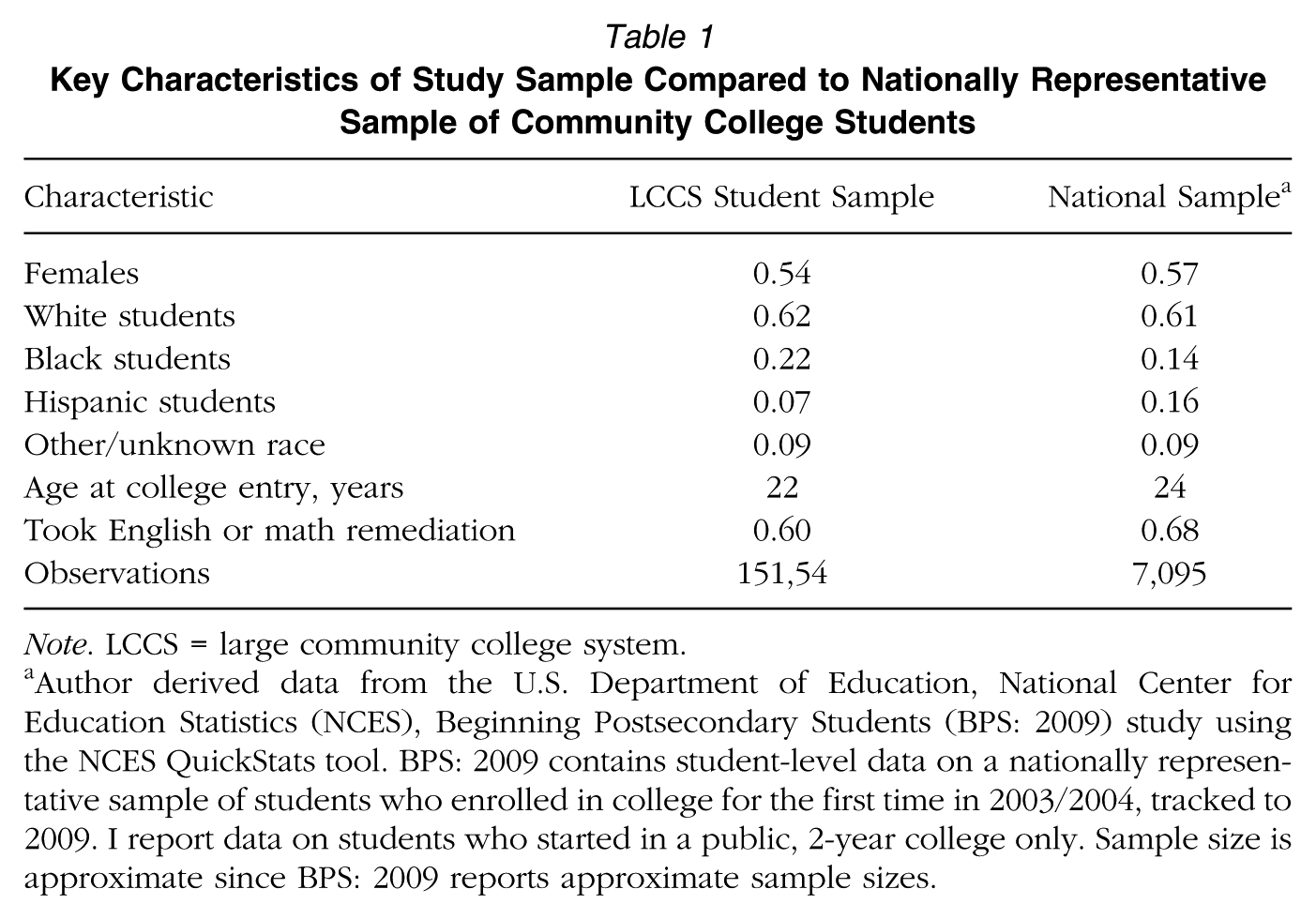
Note. LCCS = large community college system.
Author derived data from the U.S. Department of Education, National Center for Education Statistics (NCES), Beginning Postsecondary Students (BPS: 2009) study using the NCES QuickStats tool. BPS: 2009 contains student-level data on a nationally representative sample of students who enrolled in college for the first time in 2003/2004, tracked to 2009. I report data on students who started in a public, 2-year college only. Sample size is approximate since BPS: 2009 reports approximate sample sizes.
Outcome Measures
This study examines the impact of taking one’s first course in a field with an adjunct instructor, on both the current course outcomes and subsequent course enrollment and performance. The analyses of current course outcomes include two outcome measures: (a) the impact on early course withdrawal, and (b) the impact on course grade (using a 0–4 grading scale) among those who persisted to the end of the course.
However, results of current course performance are difficult to interpret without additional information. For example, a significant positive impact from taking introductory courses with adjunct instructors might be explained by more effective instruction or different grading patterns. Therefore, I include measures of later persistence/performance, beyond the first course students took: (c) whether the student took any additional course within the same field of study after the initial exposure and (d) students’ probability of passing the next class within the same field of study.
Sample Description
Because the aim of this article is to understand how type of instructor (i.e., part-time or full-time) during students’ initial exposure to a field of study affects their current and later academic outcomes in that same field, the analysis focuses on the first college-level course taken by each individual student in a field of study. 4 Given that students usually take introductory (entry-level) courses during their initial exposure to a particular field of study, these courses are referred to as “introductory courses” hereafter. If a student attempts an “introductory course” multiple times, only his first attempt is considered.
Among all the introductory courses, 42% of the courses (taking up 90% of the course enrollments) had variations in type of instructor, either due to multiple sections offered in a particular semester or to variations in which instructors taught the same course over time. In addition, a handful of courses were taken at a school that was not the student’s primary college. This raises the concern that students may enroll in another college to take a course with a particular type of instructor. However, in the data set, students demonstrated a strong pattern of taking all courses at their home college; less than 5% of the course sample was taken at a school that was not the student’s primary college. These courses are kept in the main analysis; yet, in a separate robustness check, I exclude those courses and the results are almost identical.
The final analytical sample includes 999,252 introductory course enrollments among 151,541 students. It is worth noting that for analysis on subsequent course enrollment in the same field, I collapse the introductory course sample so that each student has only one observation in each field of study, yielding 939,164 observations in total. This is meant to address the concern that the same subsequent outcomes would be observed more than once for students who took multiple courses during their initial exposure to a field. For these students, the key explanatory variable “adjunct” is defined as the proportion of credits taken with adjuncts during their initial exposure to the field.
Table 2 provides summary statistics of the student-course-level data. The first panel uses information from each student’s college transcript and summarizes characteristics of course sections taken by each student. In addition to the full college-level introductory course sample (column 2), I also divide the sample into courses taught by adjuncts and courses taught by full-time faculty, and present summary statistics for the two subgroups, respectively, in column 3 and column 4. Across all of these introductory courses, about half (53%) are taught by adjunct instructors. Compared to course sections taught by full-time faculty, sections taught by adjuncts are less likely to be delivered through an online format and more likely to be taken by students with slightly lower credit load in the current semester.
Summary Statistics of the Student-Course-Level Data
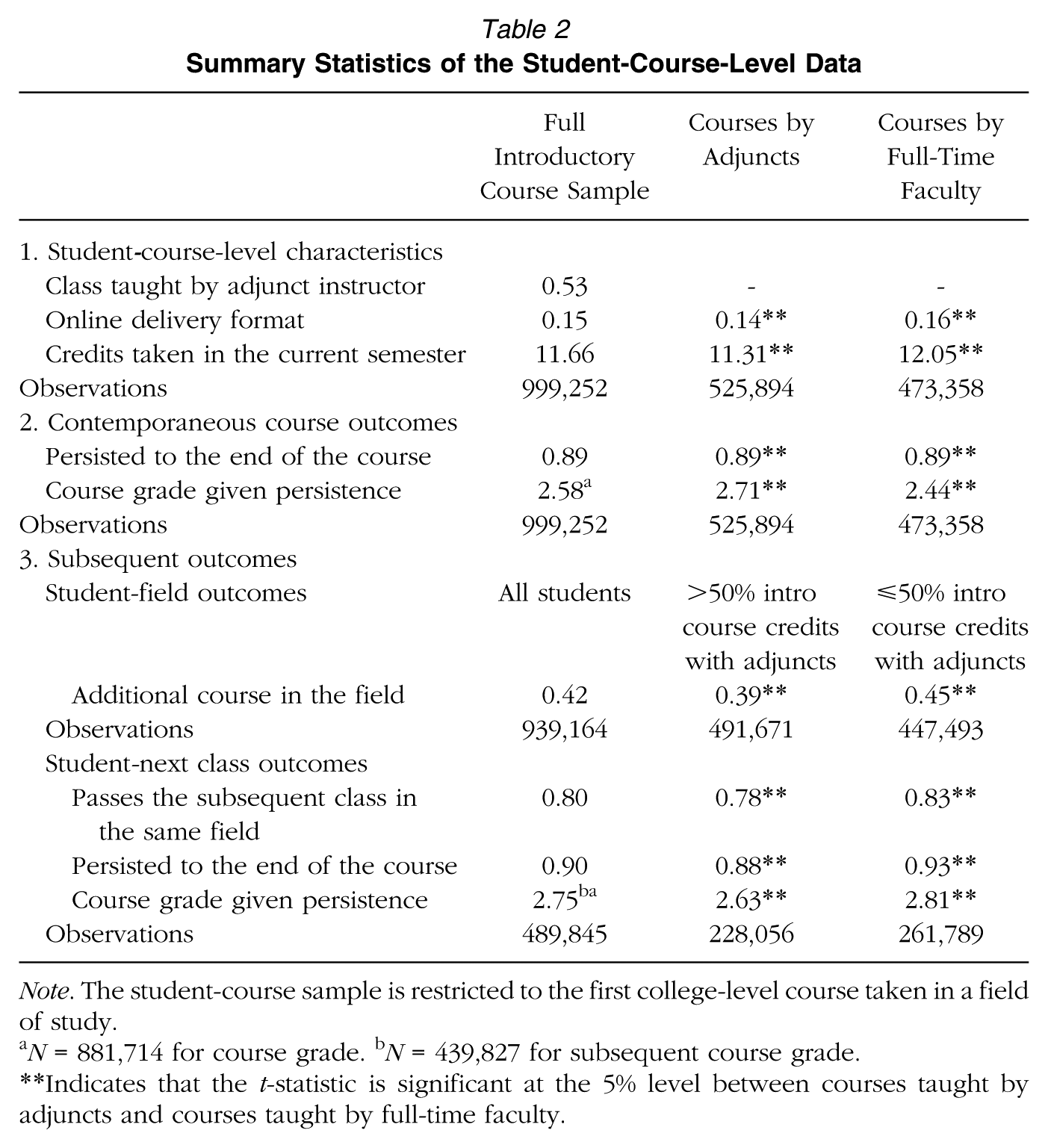
Note. The student-course sample is restricted to the first college-level course taken in a field of study.
N = 881,714 for course grade. bN = 439,827 for subsequent course grade.
Indicates that the t-statistic is significant at the 5% level between courses taught by adjuncts and courses taught by full-time faculty.
The next two panels in Table 2 summarize key outcome measures. Both contemporaneous course outcome measures favor adjuncts. Among the 999,252 introductory courses, the overall course withdrawal rate is 11%, with slight difference between those taught by adjuncts (10.6%) and those taught by full-time instructors (11.4%); yet the difference is much more noticeable in terms of course grades among those who persist to the end of the course (N = 881,714), 5 where the average grade is 2.71 in courses taught by adjuncts, compared to 2.44 by full-time faculty. This 0.27 difference approximates one letter-grade boundary (e.g., the difference between a B+ and an A−). Therefore, on a descriptive basis, it seems that introductory courses taken with adjunct instructors are associated with better course outcomes (i.e., higher grade in current course, reduced withdrawal rate).
In terms of subsequent course enrollment and success within a particular field of study, the overall probability that a student takes any additional course within the same field of study is approximately 42%. In contrast to the positive association between adjunct instructors and immediate course outcomes, students who had greater exposure to adjuncts in a field of study on average had a lower probability of attempting additional courses in the same field of study descriptively (39% vs. 45%). Among students who did enroll in another course in the same field, an adjunct instructor is associated with a lower probability that the student passes the next course by 5 percentage points (78% vs. 83%). 6 For performance in the next class, Table 2 further separately shows course withdrawal and course grade among those who persisted to the end of the subsequent course. Both outcomes favor full-time faculty. However, as mentioned previously, these effects are raw comparisons that could reflect student self-selection.
Heterogeneity Across Colleges and Fields of Study
There are noticeable variations across colleges in their reliance on part-time adjuncts at LCCS, where the proportion of total course enrollments with adjuncts between 2004 and 2014 varies between 37% and 64%. To examine what type of colleges are likely to rely more heavily on adjunct faculty, I aggregate all the student-course observations at the college level and merge the aggregated data with IPEDS institutional characteristics averaged across the years between 2004 and 2014; I then run a simple regression that relates the proportion of total course enrollments delivered by part-time adjuncts at each institution to institutional and student population characteristics—including proportion of female students; ethnic composition of the student population; proportion of students receiving need-based financial aid; average placement test scores in reading, writing, and math; total education and general expenditures per headcount; and degree of urbanization. The results presented in Appendix B indicate that none of the student and institutional characteristics mentioned above seem to significantly relate to the use of adjunct faculty in an institution, but colleges that rely more heavily on adjuncts produce worse student outcomes. 7
There are also substantial variations across academic areas in the proportion of course enrollments with adjunct instructors. Appendix C presents enrollment patterns across various fields of study and indicates that adjuncts are most actively involved in teaching health-related courses. Yet, even in fields where adjuncts are least involved in teaching (e.g., Math and Technology), more than 42% of the course enrollments are with adjuncts, almost double the proportion of course enrollments with adjuncts compared with previous studies focusing on 4-year institutions (e.g., 23% in Bettinger & Long, 2010; 24% in Hoffmann & Oreopoulos, 2009).
Empirical Framework and Methodology
Current Outcomes: Student and College-Course Fixed Effects
The primary identification for current outcomes relates student outcomes, i, in section s of course c within field k at campus j during semester t to the type of instructor that the student has in his introductory course: 8

The key explanatory variable is the type of instructor with whom a student takes the first course in a particular field of study. In cases where a student takes multiple introductory courses in a particular field during his initial exposure, each course would represent one observation in the analyses on current course outcomes. Here ρ ckj represents college-course fixed effects, 9 π t represents fixed effects for the semester of enrollment in the course, and Xcstk includes information at the level of course section (e.g., number of total enrollments in the course section, whether the course section is online or face-to-face, and whether the course is within the student’s declared major). The remaining source of selection after controlling for course and term fixed effects is students’ differential sorting by types of instructors within courses. For example, more academically motivated students might prefer the perceived accessibility and potential research opportunities associated with full-time faculty. I directly explore the extent of this behavior by relating a rich set of student-level characteristics and course-section-level attributes to whether the course is taken with an adjunct or full-time faculty.
Results based on ordinary least squares suggest that students taking a course with an adjunct on average seem to be different from those with a full-time faculty in terms of several characteristics (Table 3, column 2). Column 3 adds college-course fixed effects into the model to account for variations across colleges as well as among different courses within a college, and column 4 further adds college-course-term fixed effects to take into account the possibility that the sorting across sections within a particular course might vary across time. Results presented in column 3 and column 4 indicate that while there is no consistent relationship between types of instructors and indicators of student previous academic performance, students taking a course with adjuncts tend to be older, are less likely to be Asian, are attempting fewer credits during that semester, and are more likely to enroll in a course section that is delivered online. Yet the significance of these estimates might be sensitive to clustering. I therefore conduct an additional balance check where I aggregate the data to the course-section level and compare the average characteristics of students taking a particular course-section with part-time versus full-time faculty controlling for college-course fixed effects. Results are presented in column 5 of Table 3 and indicate that all of the above mentioned individual-level differences are no long significant except for the age of the students.
Probability of Taking the First Course in a Field With an Adjunct Instructor
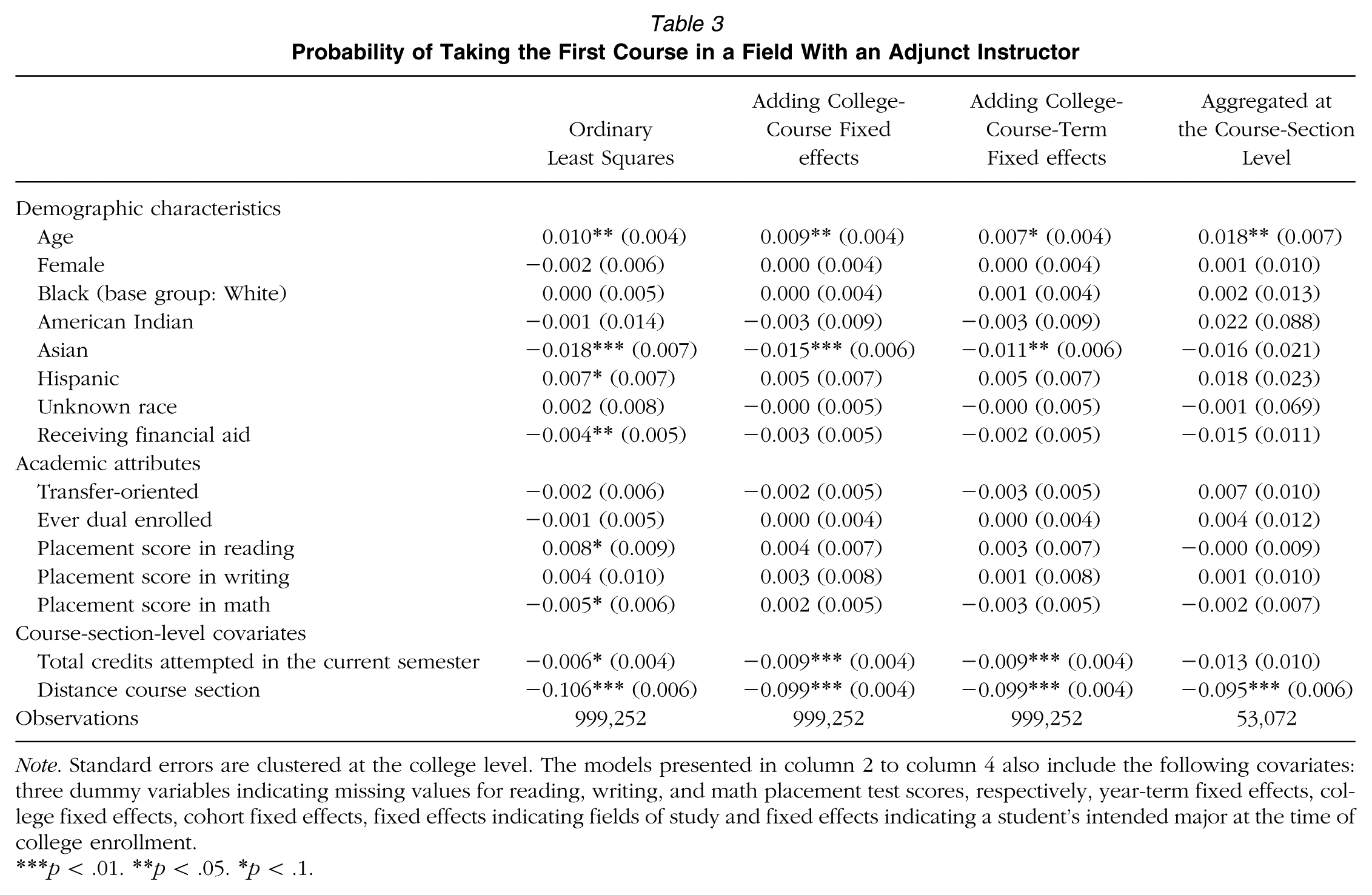
Note. Standard errors are clustered at the college level. The models presented in column 2 to column 4 also include the following covariates: three dummy variables indicating missing values for reading, writing, and math placement test scores, respectively, year-term fixed effects, college fixed effects, cohort fixed effects, fixed effects indicating fields of study and fixed effects indicating a student’s intended major at the time of college enrollment.
p < .01. **p < .05. *p < .1.
That said, I further include student fixed effects into Equation (1), σ i , thus controlling for any unobservable student-level characteristics that are constant across courses. The key assumption underlying this identification strategy is that preference for different types of instructors in one’s introductory courses is consistent across subject areas. This is a reasonable assumption given that students typically have limited knowledge about instructors during their initial exposure to a field of study and are therefore unlikely to sort between adjuncts and full-time faculty in different ways across courses, if at all. That being said, in a separate robustness check, I also focus exclusively on courses taken during a student’s initial term in college, which is the time when students are least likely to sort between instructors based on their knowledge about different instructors. The results of this robustness check are consistent with the results from the full sample analysis presented in Appendix D). 10
This identification thus draws on two sources of variation. The first is student-level variation, where a student takes introductory courses with adjuncts in some fields of study and with full-time faculty in others. The majority of the students (79%) take a mixture of introductory courses taught by adjuncts and full-time faculty; 8% of the students take their introductory courses only with full-time faculty and the other 13% take courses only with adjuncts. 11 The second source of variation comes from within-course differences in the type of instructors teaching a specific section, which could be either due to multiple sections offered during a particular term in a college (60% of the enrollments are from courses with such within-semester variation) or due to changes in the type of instructors teaching the same course over time. As mentioned previously, 90% of the course enrollments are from courses with variations in the type of instructors. This setup facilitates the use of both student fixed effects and college-course fixed effects, so that the estimates reflect whether introductory courses taught by adjuncts lead to different concurrent course outcomes from those taught by full-time faculty, holding constant course-specific characteristics as well as student attributes that are constant over time.
Subsequent Outcomes: Student and Next-Course-Section Fixed Effects
For subsequent course performance, I draw on Figlio et al. (2015)’s model, which controls for both student-level fixed effects and next-class fixed effects:

where student i’s outcome in the next class section s in course c in field k at campus j in time t + 1 are related to the type of instructor that the student has in his introductory course (adjunct icskjt ). For analysis of subsequent course outcomes, the introductory course sample is collapsed so that each student only has one observation in each field of study. Among all the introductory courses, approximately 17% of the courses were taken by students who attempted multiple introductory courses in a particular field. For analysis on subsequent course enrollment in the same field, I follow the approach used by Bettinger and Long (2010) and collapse the introductory course sample for these multicourse takers by calculating the fraction of introductory course credits they took with an adjunct instructor. I then randomly choose a course for introductory course fixed effects (ρ ckj ) in Equation (2). In a separate robustness check, I also restrict the sample to students who only attempted one introductory course in a particular field; the patterns of results remain the same.
Since the course-section fixed effect ρ cskjt+1 is a combination of college, course, time, and specific section and σ i controls for student-level fixed effects, this model specification compares student performance in exactly the same course section, holding constant all individual-level characteristics that are invariant over time. Additionally, ρ ckj further controls for course-level fixed effects for students’ introductory courses. This term would take care of potential between-course bias arising from students shopping across different introductory courses within a field. In the field of economics, for example, some students took Introductory Microeconomics as their first course while some others took Introductory Macroeconomics. Suppose that we examine students’ subsequent course performance in a particular section in Intermediate Microeconomics in spring 2009 at a particular college, and suppose that Introductory Microeconomics prepares students better than Introductory Macroeconomics. The estimated effect of β would be biased in favor of full-time instructors if better students are more likely to choose Introductory Microeconomics as their first economics course and if full-time instructors are more likely to be assigned to teaching Introductory Microeconomics than Introductory Macroeconomics.
By adding fixed effects for introductory courses, Equation (2) now controls for any between-course selection bias. The remaining concern then is that students may still sort between adjuncts and full-time faculty within a particular introductory course based on considerations that are also correlated with their academic performance. For example, a student may take more important courses with full-time faculty and less important courses with adjuncts; a student who tries to avoid adjuncts might also choose to take a course in another semester if all of the sections are taught by adjunct instructors in the semester when he took his introductory courses in this field. To address these concerns, I conduct a separate robustness check by limiting the sample to introductory courses taken during one’s initial term in college (results presented in Appendix D). Analyses on this subsample could help address student self-sorting, since this is the time when students are least likely to sort between type of instructors based on their existing knowledge about different instructors in a department.
Empirical Results
Current Course Outcomes
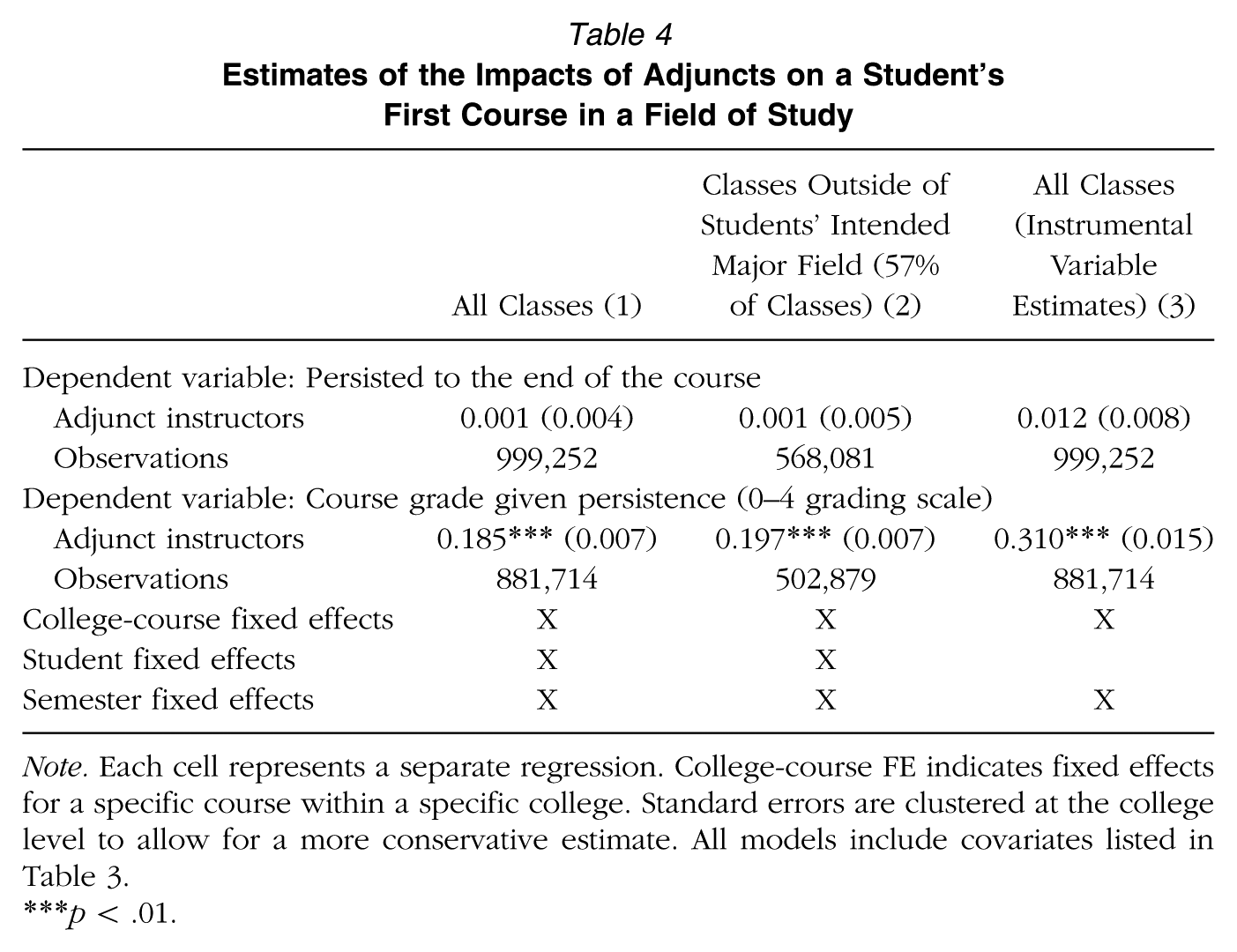
Table 4 presents the estimated effects of adjuncts on a student’s first course in a field of study based on Model Specification 1 that controls for both student fixed effects and college-course fixed effects. In addition to the analysis based on the full introductory course sample (column 2), column 3 also presents estimates based on courses outside of a student’s intended major as declared on college enrollment. The out-of-major analysis focuses on fields where a student’s academic decisions, such as course withdrawal and enrollment in additional classes, are most plausibly affected by instructors during initial exposure to a field.
Estimates of the Impacts of Adjuncts on a Student’s First Course in a Field of Study
Note. Each cell represents a separate regression. College-course FE indicates fixed effects for a specific course within a specific college. Standard errors are clustered at the college level to allow for a more conservative estimate. All models include covariates listed in Table 3.
p < .01.
The results suggest that students taking courses with adjuncts are equally likely to persist to the end of the course compared with those taking the same course with a full-time faculty. However, the average grade in courses taken with an adjunct is significantly higher, by approximately 0.2 grade points. Considering that the average course grade for all the introductory courses is 2.58, 0.2 grade points represent an 8% higher grade, which is fairly sizable in magnitude.
Subsequent Course Enrollment and Performance
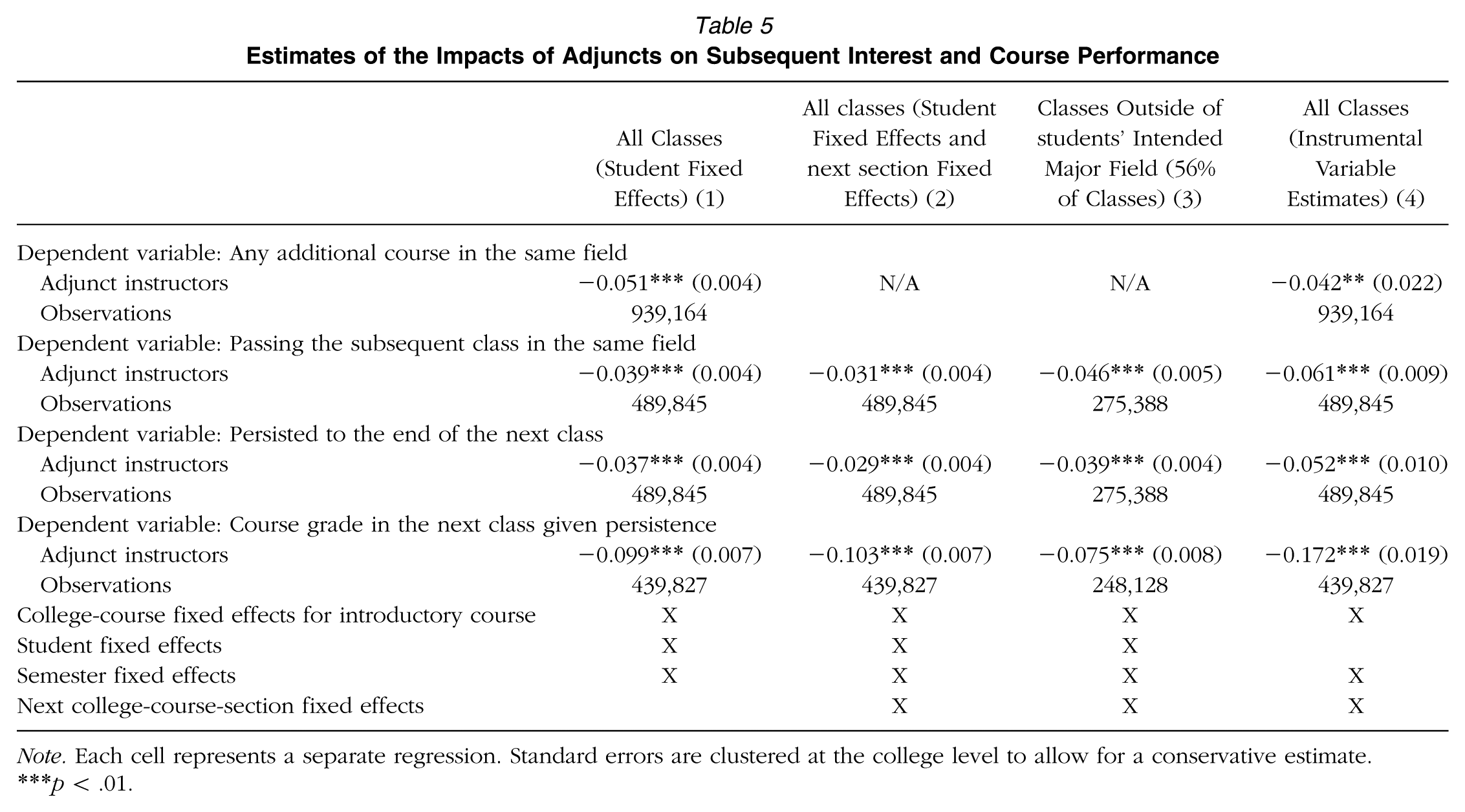
Table 5 presents the estimated effects of adjunct instructors on subsequent course enrollment and performance based on two model specifications: a model with student fixed effects and introductory course fixed effects (Column 2), and the preferred model based on Equation 2 that further controls for next course-section fixed effects (column 3). 12 The estimates are consistently significant and negative across all model specifications in all subsequent outcomes measured: students who had their initial exposure to a field of study with an adjunct instructor are less likely to attempt another course in the same field by 5 percentage points, and among students who did enroll in another class, adjunct instructors have a negative effect on students’ likelihood of passing the next class by 3 percentage points. When separately looking at course persistence and course grade among those who persisted to the end of the next class, having an adjunct instructor in one’s initial course in a field has negative impacts on both persistence and grades in the subsequent course attempted: Adjuncts increase the likelihood of course dropout by almost 3 percentage points and decrease course grades by 0.103 based on the preferred model specification. Taking into account the average course grade in students’ next classes (2.75), a negative effect of 0.103 represents a 4% lower grade. 13
Estimates of the Impacts of Adjuncts on Subsequent Interest and Course Performance
Note. Each cell represents a separate regression. Standard errors are clustered at the college level to allow for a conservative estimate.
p < .01.
All of the estimated effects are fairly consistent and in most cases larger in magnitude when I restrict the sample to classes taken outside of a student’s intended major (column 3 in Table 5). These results, taken together with those on contemporaneous course outcomes, suggest that adjunct instructors excel in promoting contemporaneous course performance but are comparatively less effective in inspiring students’ interest in a particular field and preparing students for follow-on learning in the same field.
Instrumental Variable Estimate and Robustness Checks
One potential threat to the two-way fixed effects model is that sorting between adjuncts and full-time faculty during a student’s initial exposure to a field of study varies across subject areas. For example, a student may take more important courses with full-time faculty and less important courses with adjuncts. Although the available evidence thus far suggests that there is no systematic sorting of students into classes taught by adjuncts versus full-time faculty once controlling for course fixed effects, I further use an instrumental variable strategy to cross-validate the results.
Specifically, I adapt Bettinger and Long’s (2010) instrumental variable approach and use the proportion of course sections offered by adjuncts within a particular department in a college during a particular semester for the student’s likelihood of enrolling in a course with an adjunct instructor rather than full-time faculty. In other words, I use the semester-by-semester fluctuations of sections offered by adjunct instructors within a department as an instrument for students’ varying probability of taking a course with an adjunct. The logic behind this strategy is that a department is often subject to term-by-term variations in retirement and sabbaticals of regular faculty employed on full-time basis, as well as temporary shocks in demand for course offerings. To deal with these fluctuations, departments often use part-time adjuncts to make up the difference, which might be plausibly idiosyncratic once controlling for course and term fixed effects.
To address possible seasonality of using non–tenure track faculty, I first compute three steady states corresponding to the three semesters (i.e., fall, spring, and summer) by averaging the proportion of course sections with part-time adjuncts within each department between 2004 and 2014. I then construct the instrumental variable as the deviation in the proportion of course sections offered by adjuncts in a specific department during a certain term. Using the de-seasoned proportion of course offering by adjuncts as the instrumental variable, I run the following first-stage equations to explain the probability of taking a particular course with an adjunct:

The term “pctAdjunctst” represents the proportion of variations in course sections taught by adjuncts in a particular department k during term t. The coefficient β measures the effect of having more sections offered by adjuncts on the likelihood that student i takes her first course within a field with an adjunct instructor during that term. To ease interpretation, I multiply the proportion of sections taught by adjuncts by 10; therefore, a 1-unit change in the key predicting variable indicates a 10–percentage point change (instead of a 100–percentage points change) in the proportion of sections taught by adjuncts. Similar to Equation (1), I also control for college-course fixed effect as represented by ρ ckj .
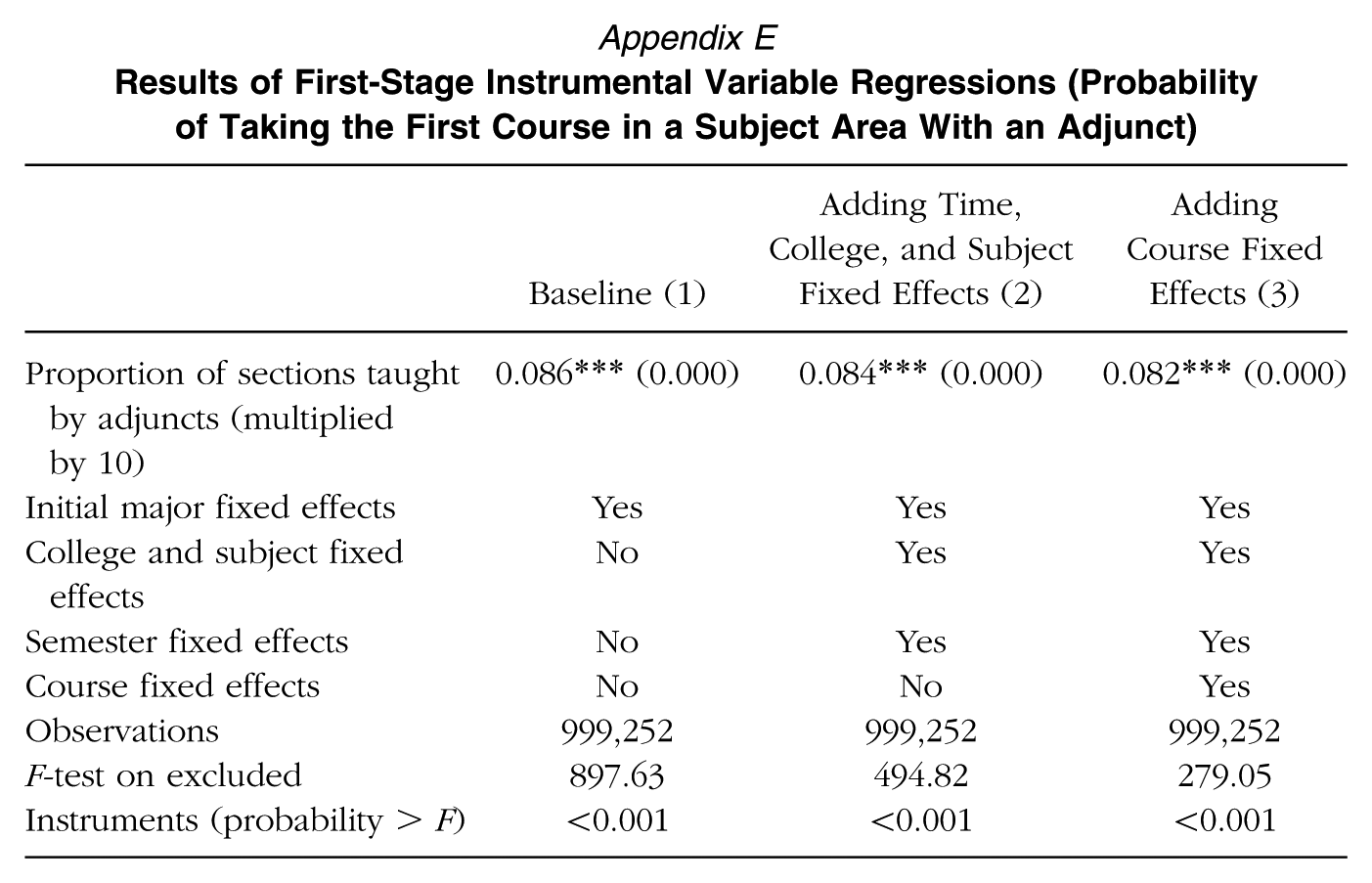
Appendix E shows the first-stage results. The F-statistics on the excluded instrument are all substantially higher than 10, thus ruling out the possibility of weak instrument. The estimates indicate that the proportion of sections taught by adjuncts is a significant and positive predictor of a student’s probability of taking a course with an adjunct across all models specifications. Focusing on the preferred model specification (column 4), the coefficient suggests that a 10–percentage point increase in the proportion of sections taught by adjuncts is associated with an increase in a student’s probability of taking a course with an adjunct by 8 percentage points.
Based on results from the first stage, the second-stage instrumental variable estimates for alternative instructors are presented for each immediate (column 4 of Table 4) and subsequent outcome measure (column 5 of Table 5), controlling for both college-course fixed effects and semester fixed effects together with all available covariates. These instrumental variable estimates echo the estimates based on Equations (1) and (2), though with somewhat larger effect sizes.
In addition to the instrumental variable approach, I conduct a series of robustness checks to address several remaining concerns, including that the results may be susceptible to different follow-up windows, that the analysis may not capture students who transfer out of LCCS, and that the results may be driven by certain institutions or particular cohorts of students. Detailed explanations for these robustness checks and a summary of findings are presented in Appendix F.
Heterogeneous Impacts by Fields of Study
The results so far suggest that, overall, having one’s first course in a field with an adjunct instructor has negative impacts on both the student’s probability of attempting another course in that field and her course performance in the next class. Are such negative impacts consistent across all fields of study or are they mainly driven by adjunct instructors in certain fields? Average instructor demographic characteristics from the national survey presented in Appendix A indicate that while part-time instructors are generally less likely to receive terminal degrees than their full-time counterparts in community colleges, the gap is particularly pronounced in Engineering and Health Sciences. In Health Sciences, for example, 40% of part-time instructors have not obtained a baccalaureate degree, which is more than 4 times the percentage (9%) among full-time faculty. In some ways, this is not surprising: In fields that are closely tied to an occupation with greater demands in the labor market and high earnings on average, it might be particularly difficult to recruit high-quality adjunct instructors given that the typical salary and benefits offered to adjunct instructors are comparatively less attractive.
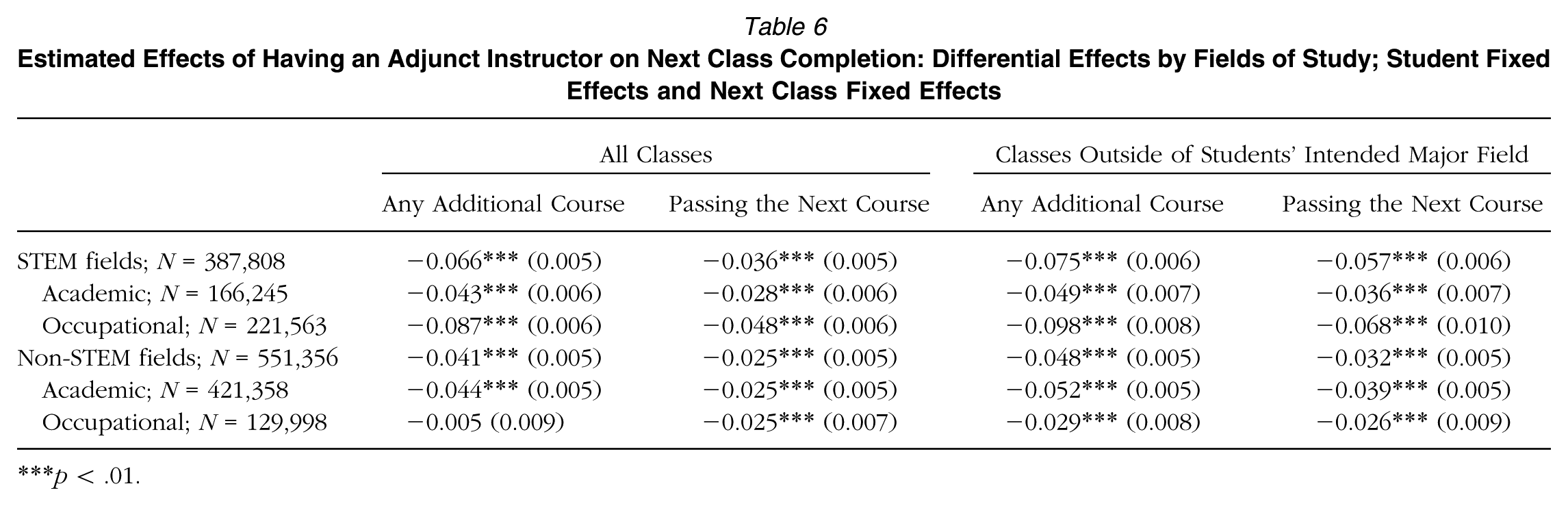
To explore how the average impacts of adjuncts may be driven by particular fields, I divide the fields into STEM (including Health Sciences) and non-STEM categories to capture the overall differences between STEM and non-STEM fields in labor market demand and average earnings. Considering that academic-oriented fields (e.g., History) may have different labor market connections and implications than fields that are more closely tied to an occupation (e.g., Performing Arts), I further divide the fields based on the extent to which each is closely linked to an occupation, which results in four categories: Academic STEM fields—STEM fields that are more closely tied to academic studies (e.g., Natural Science, Math), occupational STEM fields—STEM fields that are more closely tied to an occupation (e.g., Health Sciences, Technology, Engineering), Academic non-STEM fields (e.g., Humanities) and occupational non-Stem fields (e.g., Performing Arts). I first run the analyses separately for STEM and non-STEM fields, and then separately estimate the coefficient for adjuncts in each of the four categories. Results are presented in Table 6, with each cell representing a separate regression analysis.
Estimated Effects of Having an Adjunct Instructor on Next Class Completion: Differential Effects by Fields of Study; Student Fixed Effects and Next Class Fixed Effects
p < .01.
Overall, nearly every field category shows a negative coefficient for adjunct instructors in terms of both additional courses attempted and probability of passing the next course in the same field. However, when comparing estimates across fields of study, a contrast is clear between STEM fields and non-STEM fields: The estimated negative effects of adjunct instructors are noticeably larger in magnitude in STEM fields. When further differentiating between fields based on connection to an occupation, it seems that the negative effects of adjunct instructors are strongest in occupational STEM fields, where the estimates are at least twice as large as the estimates of the other three field categories.
One possible explanation for the somewhat smaller effects of adjuncts in academic-oriented fields is that these courses consist of a greater proportion of students who intend to transfer to a 4-year college and many such transfer-oriented students may take only one course in most academic fields, for example, one Sociology or one Psychology course to fulfill the general education requirement or choosing to take additional courses in a particular field once they transfer to a 4-year university. If that were the case, the type of instructor during the initial exposure to a field of study for transfer-oriented students would have limited impact on subsequent course-taking behaviors within the community college system, as these students tend not to take additional courses in a field of study in LCCS anyway. To address potential bias introduced by data limitation in tracking course-taking patterns by transfer-oriented students outside of the community college system, I conduct two robustness checks. In the first one, I explore the potential heterogeneous impacts of adjuncts on subsequent course taking behaviors among career-tech students only. In contrast to transfer-oriented students (41% of the student sample) who may save some of their courses for after transfer, career-tech students usually take all of their courses within the community college system. In a second robustness check, I limit the sample to students who never transfer out of the LCCS (62% of the student sample). Both analyses yield similar pattern of results: The estimated effects of adjunct instructors are negative across all fields and strongest in occupational STEM fields.
Heterogeneous Impacts by Student Academic Preparedness
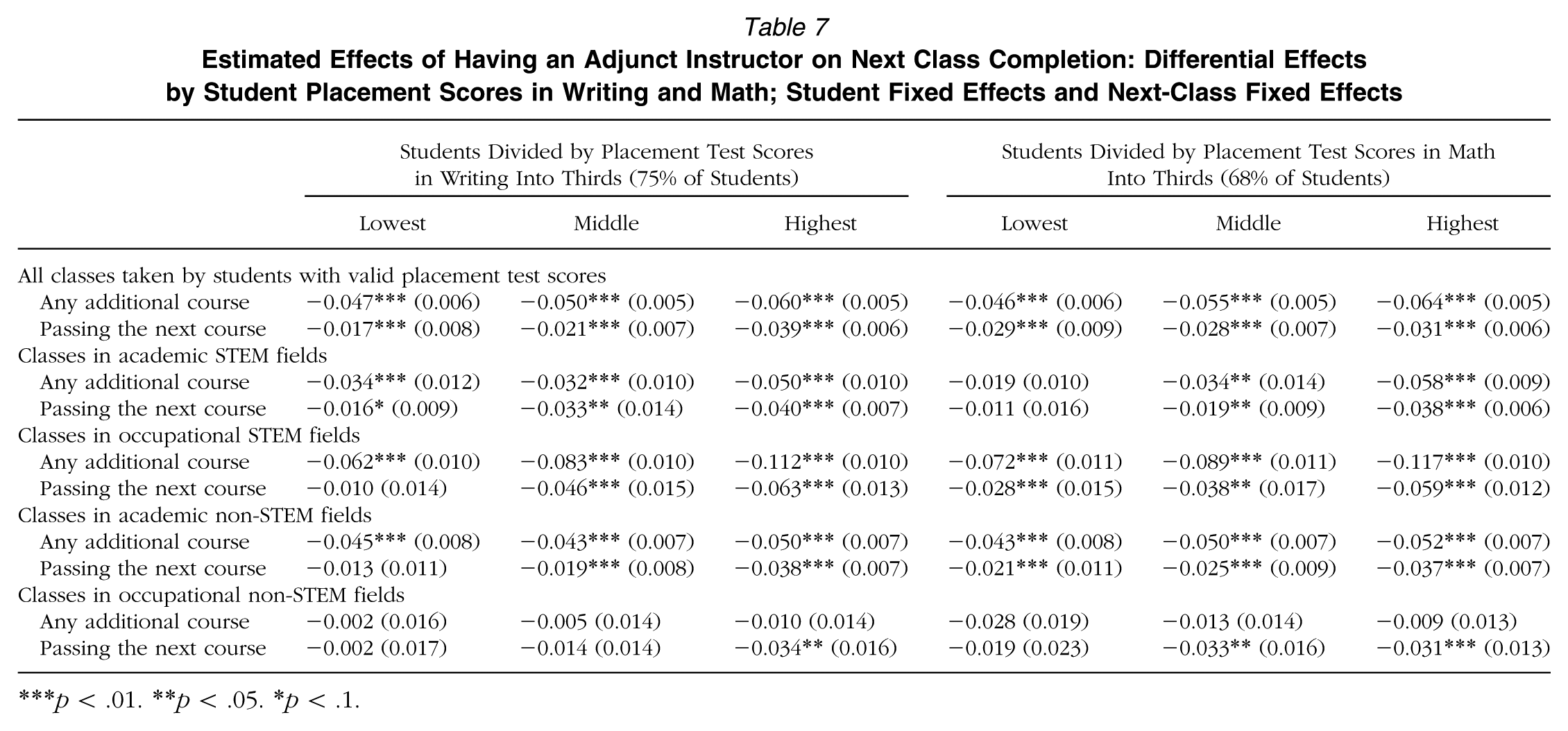
Finally, Table 7 explores whether the impacts of adjuncts vary by student academic preparedness. During the period of this study, LCCS has a centralized system where all colleges use a standardized test (COMPASS) to assess incoming students’ college readiness in reading, writing, and math and then place them into the appropriate English and math coursework. According to LCCS, the majority of colleges rely on the writing test scores to decide students’ English level. The writing score is also highly correlated with reading score (Pearson correlation = .62, p < .001; the correlation between math and writing is .30, p < .001). Therefore, I use writing placement test scores to determine students’ academic preparedness in literacy and split students into thirds based on their writing and math scores, respectively. 14
Estimated Effects of Having an Adjunct Instructor on Next Class Completion: Differential Effects by Student Placement Scores in Writing and Math; Student Fixed Effects and Next-Class Fixed Effects
p < .01. **p < .05. *p < .1.
One potential concern with the student subgroup analyses is that heterogeneity in estimates could be due to subgroup differences in field selection. For example, students who are academically more capable in math may be more likely to choose a STEM field than students who are less prepared in math. Therefore, a stronger impact of adjunct instructors among academically better prepared students in math could be due to their higher probability of enrolling in a course that happens to have the least qualified adjunct instructors. Accordingly, I separately examine the heterogeneity of adjunct instructors by student academic preparation within each category of field.
The pattern is fairly clear: While the estimated impacts of adjuncts on students’ subsequent course completion are significantly negative for all students, such effects are strongest for students with better academic preparedness. This pattern is generally consistent across all fields of study no matter whether math or writing placement test score is used as the indicator for precollege academic preparedness. When compared across fields of study, the most pronounced estimates are among best academically prepared students in occupational STEM fields, where having an adjunct instructor reduces the probability of successfully completing the next course in the same field by approximately 6 percentage points. 15
Discussion and Conclusion
Understanding the impacts of part-time adjunct faculty relative to full-time faculty in the setting of community colleges is of particular importance, in part because community colleges rely much more heavily on part-time adjuncts than 4-year institutions, and in part because of the critical role community colleges assume in addressing the national equity agenda by disproportionately serving low-income, first-generation, and historically underrepresented groups.
This study provides causal evidence regarding part-time adjuncts on student course enrollment and performance in the community college setting by analyzing a large swath of introductory and follow-on courses across key fields of study using a statewide community college data set. To address student-level and course-level selection, I use two identification strategies, a two-way fixed effects approach and an instrumental variable approach. The results are robust across different models and indicate that part-time adjuncts are significantly different from full-time faculty in their impacts on both contemporaneous and follow-on course outcomes: While having one’s initial exposure to a field of study with an adjunct is on average associated with higher grade in course, these students are less likely to attempt another course in the same field of study, and among those students who do, part-time adjuncts have negative impacts on follow-on course completion and grade. Analyses by field of study and student academic preparedness indicate that the negative impacts of part-time adjuncts on subsequent course performance are particularly strong in those STEM fields that are more closely tied to an occupation and for students who are better prepared on college enrollment.
The observed consistent negative impacts of part-time adjuncts on follow-on course enrollment and completion rates across all categories of fields warrant policy attention: If this pattern holds true across community colleges in other states, it would imply that the continued increased reliance on part-time adjuncts in 2-year colleges could harm these students’ educational outcomes. This echoes and partly explains the consistent findings based on aggregated data (e.g., Eagan & Jaeger, 2009; Jacoby, 2006; Jaeger & Eagan, 2009) that community college student graduation rates decrease as the proportion of part-time adjunct instructors employed increases. Considering that optimizing students’ college retention and completion is imperative when it comes to economic opportunity, the negative impacts of part-time adjuncts on student college persistence may potentially harm the labor market opportunities of this population, many of whom are from economically disadvantaged background.
These results are in contrast with recent findings from studies conducted in 4-year universities (e.g., Bettinger & Long, 2010; Figlio et al., 2015) that identified either null effects or positive effects associated with adjuncts on student subsequent outcomes. One possible explanation for the diverging results regarding adjunct instructors may be due to different support for adjuncts across sectors. For example, the majority of adjuncts in the study by Figlio et al. (2015) had a longer term relationship with the university and many might even be hired on a full-time basis. These instructors, though hired through non–tenure-contingent positions, may still have fixed offices and office hours; they may also be familiar with the institution and available student services, and understand well the contents and requirements of other courses offered by the department. In contrast, adjuncts in community colleges, hired through transitory positions, may face more challenges in maintaining worker quality and production, as cited in existing studies with qualitative evidence for the working conditions for adjuncts in community colleges (e.g., Green, 2007). Similarly, the diverging results between sectors could also be partly due to the different reference groups. Tenure track faculty in 4-year colleges, especially in research institutions such as Northwestern, often have to balance teaching with other job demands, and therefore well-supported contingent faculty may benefit students by specializing in teaching. In contrast, in settings such as community colleges where teaching is the primary job demand, the limited resources and support for part-time adjuncts may negatively influence their teaching effectiveness compared to full-time teaching faculty.
The particularly large negative impacts of adjunct instructors on students’ subsequent course enrollment and performance in STEM fields warrant special attention. To cope with the escalating demand for STEM workers in the labor market, increasing college graduates in STEM fields has been recognized as a national priority in the past few years. Yet results from the current analyses suggest that reliance on adjunct instructors has a particularly large negative impact on a student’s interest and success in STEM fields, especially those closely tied to an occupation (e.g., Engineering and Technology), whether or not the STEM field is the student’s intended major on college enrollment.
Finally, the patterns of heterogeneous effects by student prior academic capacity found in this study are opposite to the patterns found by prior work in a 4-year institutional setting. Specifically, Figlio et al. (2015) found that students who are among the lowest one third in SAT scores in Northwestern are most susceptible to alternative instructors, whereas part-time adjuncts at the community colleges in the current study have a larger negative effect on subsequent student outcomes for students who are academically better prepared. Contradictory results regarding the heterogeneous impacts might be partly due to the different types of students in these two settings. The population in Figlio et al.’s study comes from an elite 4-year institution where a large proportion of students have very high academic motivation and capacity (as captured by SAT scores); in contrast, the majority of the community college students examined in the current study are academically underprepared on college entry. If we assume that the marginal students who are most likely to be influenced by the effectiveness of college instructors fall within a certain range of academic preparation, these are the students whose performance and persistence are most sensitive to variations in context. As such, it is not surprising that the impacts of alternative instructors are found to be largest on the lowest achieving one third of students in Northwestern, and the highest achieving students in the LCCS.
A major limitation of the current study is the lack of detailed instructor information and classroom observation data, which prevents me from identifying the specific mechanisms that drive a positive association between part-time faculty and current course grade and a negative association between those same faculty and subsequent course performance. One potential explanation for this result is that adjunct instructors, due to job insecurity, might reduce the difficulty of course content, lower course expectations, or relax grading criteria to earn good student evaluations. This type of story suggests that colleges should consider using multiple measures to assess instructors rather than solely relying on student evaluation scores.
Another possibility is that adjuncts, who on average are less likely to hold advanced degrees, may be less capable of helping students build the skills required for success with more advanced content (e.g., deeper understanding of the current content and critical thinking). A related possibility is that while adjuncts may excel in imparting the knowledge in introductory courses, their relatively diminished involvement in more advanced coursework and in curriculum design may limit their capacity in broadening introductory course content such that it prepares students for follow-on learning. Indeed, as shown in Table 2, the proportion of adjuncts in entry-level courses is higher than the proportion in college-level courses overall in almost all fields of study. As a result, adjunct instructors may lack both the awareness and knowledge of how to integrate introductory course content into the full spectrum of learning.
One way for colleges and departments to engagement faculty and improve their teaching is through professional development. However, part-time adjuncts are typically not compensated for participating in professional development, and even if they are interested, campus workshops or programs are often offered during regular working hours on weekdays when many part-time adjuncts are not available. If full-time faculty are supported, encouraged, and rewarded to improve their teaching, but adjuncts are not, this might drive differences in the learning outcomes of their students.
Another limitation of this study is that all the adjunct instructors at LCCS were hired through short-term contracts without any benefits, typically on a term-by-term basis. Hence, this study is not able to tease out the “adjunct-effect” from the effect of being employed part-time. Future studies carried out in settings where adjunct faculty are hired through both part-time and full-time employment may wish to tease out the impacts of being an “adjunct” from the impacts of working on a part-time basis. Nevertheless, this article takes an important first step in understanding the effects of part-time adjunct instructors on students’ course-taking behavior and performance in the particular setting of community colleges.
Footnotes
Appendix
Results of First-Stage Instrumental Variable Regressions (Probability of Taking the First Course in a Subject Area With an Adjunct)
| Baseline (1) | Adding Time, College, and Subject Fixed Effects (2) | Adding Course Fixed Effects (3) | |
|---|---|---|---|
| Proportion of sections taught by adjuncts (multiplied by 10) | 0.086*** (0.000) | 0.084*** (0.000) | 0.082*** (0.000) |
| Initial major fixed effects | Yes | Yes | Yes |
| College and subject fixed effects | No | Yes | Yes |
| Semester fixed effects | No | Yes | Yes |
| Course fixed effects | No | No | Yes |
| Observations | 999,252 | 999,252 | 999,252 |
| F-test on excluded | 897.63 | 494.82 | 279.05 |
| Instruments (probability > F) | <0.001 | <0.001 | <0.001 |
Appendix F
Notes
D