






Abstract
Despite the benefits of educators of color to various outcomes for students of color, large-scale research has not explored these educators’ on-the-job interactions with colleagues outside of large urban districts. Using social network analysis, this study examined the work-related social interactions of staff (teachers and administrators) of color in two mid-sized school districts. Where staff of color were likely the only faculty members of color—and where math professional development and curricular change were district-wide foci—staff of color were less likely to seek out colleagues for math advice. Staff of color were generally not sought for advice any more or less than White colleagues. Implications for policy and practice related to staff of color are discussed.
The declining percentages of Black and Latinx educators in U.S. public schools are an increasing source of concern for researchers, policymakers, and educational practitioners (Carver-Thomas, 2018). One reason for this concern is that teachers and administrators of color can have positive impacts on students of color by serving as role models to these students (Quiocho & Rios, 2000; Thomas & Warren, 2017; Woodson & Pabon, 2016) and by holding higher expectations for students of color than White teachers (Gershenson, Holt, & Papageorge, 2016; Lara & Fránquiz, 2015; Lucero, 2015; Newcomer, 2018). Higher expectations are particularly critical because some White teachers in schools serving low-income students of color perceive those students through a “deficit” framework and have lower expectations for them (Carey, 2018; Nelson, 2016; Wallace, 2017). Given these impacts—as well as the positive impacts on student academic and disciplinary outcomes when students of color are taught by teachers of color (Dee, 2004; Gershenson, Hart, Lindsay, & Papageorge, 2017; Lindsay & Hart, 2017)—retaining teachers and administrators of color has become an increasing focus for education policymakers (Bristol & Goings, 2018; I. Jackson & Knight-Manuel, 2018).
The social aspects of the school workplace—what S. M. Johnson, Kraft, and Papay (2012) call the “social context” (p. 6) of teaching—matter strongly to teachers of color as they decide whether to remain in or leave their schools and teaching (Bristol & Mentor, 2018; Ingersoll & May, 2011; Kohli, 2009; White, 2016). While a growing number of large-scale quantitative studies have examined the workplace experiences of Latinx (Lopez, 2016) and Black teachers (Eddy & Easton-Brooks, 2011; Lindsay & Hart, 2017), less research has explored the variations in these experiences across schools and districts. Indeed, much prior work on teachers of color has focused on large urban school districts (Goings & Bianco, 2016; Lynn, 2006; Madkins, 2011)—an important setting to examine, given the substantial number of teachers of color that work in these settings (Frankenberg, 2008; I. Jackson, Sealey-Ruiz, & Watson, 2014). However, our understanding of the experiences of educators of color in small- and medium-sized districts remains limited.
Small- and medium-sized districts are important settings in which to examine the school-based experiences of educators of color, as these districts have growing numbers of Black (Hall, Tach, & Lee, 2016) and Latinx (Marrow, 2011) students—a trend that is likely to continue given the increasing gentrification in urban centers and the growing demand for manufacturing jobs in small- and medium-sized cities (Farrell, 2016; Frey, 2018). Yet while a growing body of research examines the school-based experiences of Black and Latinx students in smaller districts, we know little about the social contexts in which these students’ Black and Latinx teachers and administrators work (Duke & VanGronigen, 2018; Valdés & Castellón, 2011).
In this article, we use social network analysis to explore how staff of color (both teachers and administrators) in small- and medium-sized districts are situated in their schools’ work-related social networks. Social networks are crucial aspects of school working conditions, and the social supports offered by the school workplace play a key role in teachers’ decisions about remaining in or leaving their schools or teaching (S. M. Johnson et al., 2012; Ladd, 2011; Ronfeldt, Farmer, McQueen, & Grissom, 2015). Peer interactions in the school workplace are also important predictors of teacher learning (Coburn & Russell, 2008; Little, 1993; Parise & Spillane, 2010; Spillane, 1999) and teacher effectiveness (C. K. Jackson & Bruegmann, 2009; Ronfeldt et al., 2015; Sun, Loeb, & Grissom, 2017). Here, we examine the extent to which staff of color in elementary schools are sought for work-related advice by their colleagues, seek advice from others, and “broker” advice relationships between colleagues. In addition, we examine three distinct types of social networks: networks cited by staff members as close colleagues, as well as advice and information networks in both English Language Arts (ELA) and mathematics. Our data are drawn from two mid-sized school districts in one Midwestern state: In one district, a staff member of color was generally the only educator of color in their schools, while in the other district several staff members of color often worked in the school. This variation enables us to explore how work-related social networks of staff of color differ across these contexts. We also use variation in curricular initiatives across the two districts to examine whether these initiatives are associated with differences in work-related social networks of staff of color. Given that our sample includes both teachers and administrators of color, we also address the similarities and differences in these groups’ work-related social networks.
We expand on prior work in several ways. First, we characterize the networks of educators of color in a relatively large number of schools; to our knowledge, no prior work has yet examined the work-related social networks of staff of color on such a scale. Second, we look at staff of color in two mid-sized urban districts in the Midwest, a context that differs significantly from previous studies, as prior work has not extensively examined the school-based experiences of educators of color outside of large urban districts. Third, we compare the work-related social networks of staff of color in several distinct types of networks, particularly their schools’ close colleague networks and instructional advice networks in ELA and mathematics. Finally, we explore the networks of both teachers and administrators of color. Our findings contribute to efforts to build practices and policies that support educators of color and retain them in the field of education.
This article proceeds as follows: first, we review the literature on teacher learning, social capital, and social networks, framing our examination of work-related networks of staff of color using Kanter’s (1977) theory of numbers and group composition and Bristol’s (2018) theory of loners and groupers. We then describe our data and analytic methods, focusing on social network analysis. In our findings, we show that in a school district focused heavily on reforming mathematics instruction, and where a staff member of color was often the only staff member of color in the school, staff of color were less likely than White staff to seek advice and information from colleagues about mathematics. We return to prior literature to theorize why this may be the case, and conclude with implications for research, policy, and practice.
Literature Review: Social Capital and Social Isolation in Organizations
Since we use social network analysis to examine the work-related social networks of staff of color, we first review the literature on the relationships between teacher learning, social capital, and social networks. Since we examine staff of color who were both isolated and grouped in their schools, we then review Kanter’s (1977) theory of numbers and group composition, along with Bristol’s (2018) theory of loners and groupers, both of which explore how group representation impacts individual outcomes within organizations.
Teacher Learning, Social Capital, and Social Networks
Teachers and administrators learn when they interact with each other in formal learning communities organized by school administrators (Darling-Hammond, 2006; Grossman, Wineburg, & Woolworth, 2001). Such learning happens when teachers turn to trusted colleagues to solve dilemmas of practice (Bryk & Schneider, 2002; Bryk, Sebring, Allensworth, Luppescu, & Easton, 2010). While learning opportunities for teachers occur at allocated times during the school day, such as grade and content-level meetings or school-based professional development (Daly, 2010; Parise & Spillane, 2010; Spillane, Shirrell, & Hopkins, 2016), teacher learning also occurs in unstructured moments (S. M. Johnson & The Project on the Next Generation of Teachers, 2004; Louis & Marks, 1998). These interactions, taking place outside of district- or administrator-organized learning opportunities, occur during informal interactions between teachers (Hoekstra, Beijaard, Brekelmans, & Korthagen, 2007; Marsick & Watkins, 2001).
One potential benefit of these on-the-job social interactions is the development of “social capital,” which refers to the benefits and resources individuals derive from social relationships (Bourdieu, 1986; Coleman, 1988). Social capital can provide professional advantages, including increased trust, information sharing about how to complete and carry out tasks effectively, and insight into acceptable behaviors (Inkpen & Tsang, 2005; Nahapiet & Ghoshal, 1998). Social capital differs from other types of capital such as human, cultural, and financial capital because the benefits of social capital are derived from relationships among individuals (Coleman, 1988; Spillane, Kim, & Frank, 2012).
In schools, social capital is an important component of continuous school improvement (Bryk et al., 2010; Gamoran, Gunter, & Williams, 2005; W. Johnson, Lustick, & Kim, 2011). Social ties are the building blocks of social capital; teachers’ social capital increases as the number of peers in their social networks increases (Brass & Krackhardt, 1999). School performance is positively associated with the amount of information sharing both within and outside of schools (Leana & Pil, 2006; Pil & Leana, 2009), as well as characteristics of colleagues who comprise teachers’ social networks (Ibarra & Andrews, 1993; Siciliano, 2015). A significant portion of teacher effectiveness (i.e., improving students’ mathematics and ELA standardized test scores) can be attributed to the peers in teachers’ networks, as lower-performing teachers improve when working with higher-performing peers (C. K. Jackson & Bruegmann, 2009). Recent work suggests that when higher-performing teachers join a teacher team, the performance of all team members improves (Sun et al., 2017). One explanation for this spillover effect is the development of relational resources that emerge as teachers work together to plan lessons and provide feedback to one another (Daly & Finnigan, 2011). What teachers learn, the depth of their learning, changes to their practice, and school organizational culture are all influenced by their social networks (Bridwell-Mitchell & Cooc, 2016).
In organizations, the individuals in one’s social network often share similar demographic characteristics (McPherson, Smith-Lovin, & Cook, 2001); indeed, individuals are generally more likely to interact with others who are similar to themselves in such characteristics as gender and race, a tendency that is referred to as homophily (Ibarra, 1992; Lazarsfeld & Merton, 1954; McPherson et al., 2001; Mollica, Gray, & Trevino, 2003; Monge & Contractor, 2003). Homophily of race and gender has a small but statistically significant relationship with work-related advice and information interactions among school staff (Spillane, Hopkins, & Sweet, 2015; Spillane et al., 2012). Because of this tendency to interact with similar peers, the over-representation of White teachers in the profession may influence not only the day-to-day experiences of teachers of color (Gist, 2016) but also their opportunities to increase their social capital. While a growing research literature has examined teachers’ advice-seeking from colleagues, the empirical literature has not illuminated how those decisions vary by teachers’ race/ethnicity.
Theoretical Framework: To Be Alone or in a Group
Workers’ self-identification with a particular social group, such as one based on a common racial or gender identity, and their proportional representation within the organization can both influence their workplace experiences (Niemann, 2017; Rossi, Cebula, & Barth, 2018). Kanter’s (1977) theory of numbers and group composition explores the relationship between the ratio of members who belong to a social group and those members’ attachment to the organization. For Kanter, when social group members account for 85% or more of the population, they wield the greatest influence in shaping the organizational culture. Kanter (1977) referred to a group whose ratio of composition is 85:15—for workers in the numerical majority and minority, respectively—as a skewed group.
In response to being in the numerical minority (or less than 15% of the organizational population), the participants in Kanter’s (1977) study described three perceptions of their job-embedded roles in relation to their colleagues in the numerical majority: (a) performance pressure, or enacting tasks with the burden of believing that one’s social group identity influences how colleagues in the numerical majority will assess the merits of the product derived from the work; (b) boundary heightening, or the perception that each interaction with colleagues in the numerical majority is shaped by one’s social group identity; and (c) role encapsulation, the belief that some organizationally assigned tasks reflect stereotypes held in the larger society about the social group. For workers in the numerical minority, the culminating effect of these organizational dynamics is higher rates of job dissatisfaction and turnover, compared to colleagues in the numerical majority (Fairchild et al., 2012; G. M. Flores, 2011).
While research is growing on the organizational dynamics of performance pressure, boundary heightening, and role encapsulation, as well as their impacts on work-based experiences for those in the numerical minority (Floge & Merrill, 1986; Krimmel & Gormley, 2003; Young & James, 2001), relatively little empirical work has explored workers’ perceptions within a skewed group and the potential variation in those experiences. Kanter (1977) noted, however, that differences in skewed groups of just a few individuals could be significant: “A mere shift in absolute numbers, then, as from one to two tokens, could potentially reduce stresses in a token’s situation” (p. 238).
Bristol (2018) examined the school-based perceptions of 86 Black male teachers in one urban district and found confirmation of Kanter’s theory. Specifically, experiences varied between Black men who were the only Black male teachers in their schools (whom Bristol termed loners) and Black men in schools with multiple Black male teachers (whom Bristol termed groupers). Loners, for example, perceived that teachers of color had fewer opportunities than White teachers to influence school policy; loners also believed that being Black was a source of fear for people in their school, and often wanted to leave their schools. Groupers, however, reported that teachers of color had more opportunities to influence school policy than White teachers; did not believe that people feared them for being Black; and intended to stay at their schools the following academic year. The numerical composition of Black male teachers on the faculty, then—whether alone or in a group—significantly shaped these teachers’ perceptions of their organizations. Although the present study does not explore how those in the numerical minority (in this case, educators of color) experience their workplaces, the present study does examine whether relatively small differences in minority representation—such as differences of one or two additional educators of color—are associated with differences in these educators’ social networks. The present study builds on prior qualitative work by using quantitative methods to explore the social networks of loners and groupers, and by extending this work into mid-sized school districts.
To fill the empirical gap in prior work, this study addresses the following research questions:
Research Question 1: How, if at all, do school staff of color differ from White staff in the degree to which they seek, are sought out, or broker work-related interactions with their colleagues in various school subjects?
Research Question 2: Do any differences in advice seeking, advice giving, and advice brokering between staff of color and White staff vary between school districts and between schools within districts? If so, what district and/or school characteristics are associated with this variation?
Methods
Our analysis draws on data from a longitudinal study that examined school staff interactions about instruction in elementary schools in several school districts in one Midwestern state. The two districts focused on in this analysis, Lakeview and Oakton (pseudonyms), are mid-sized urban school districts that serve approximately 20,000 and 30,000 elementary school students, respectively. These two districts differ in several important respects. One difference is that Oakton has a more diverse student population than Lakeview: In Oakton, 58% of students are of color (31% Black and 27% Latinx), while in Lakeview 18% of students are of color (10% Black and 8% Latinx) (Table 1). Oakton also has a greater percentage of low-income students (67%) than Lakeview (42%) (Table 1).
District Descriptive Statistics: Lakeview and Oakton, 2010
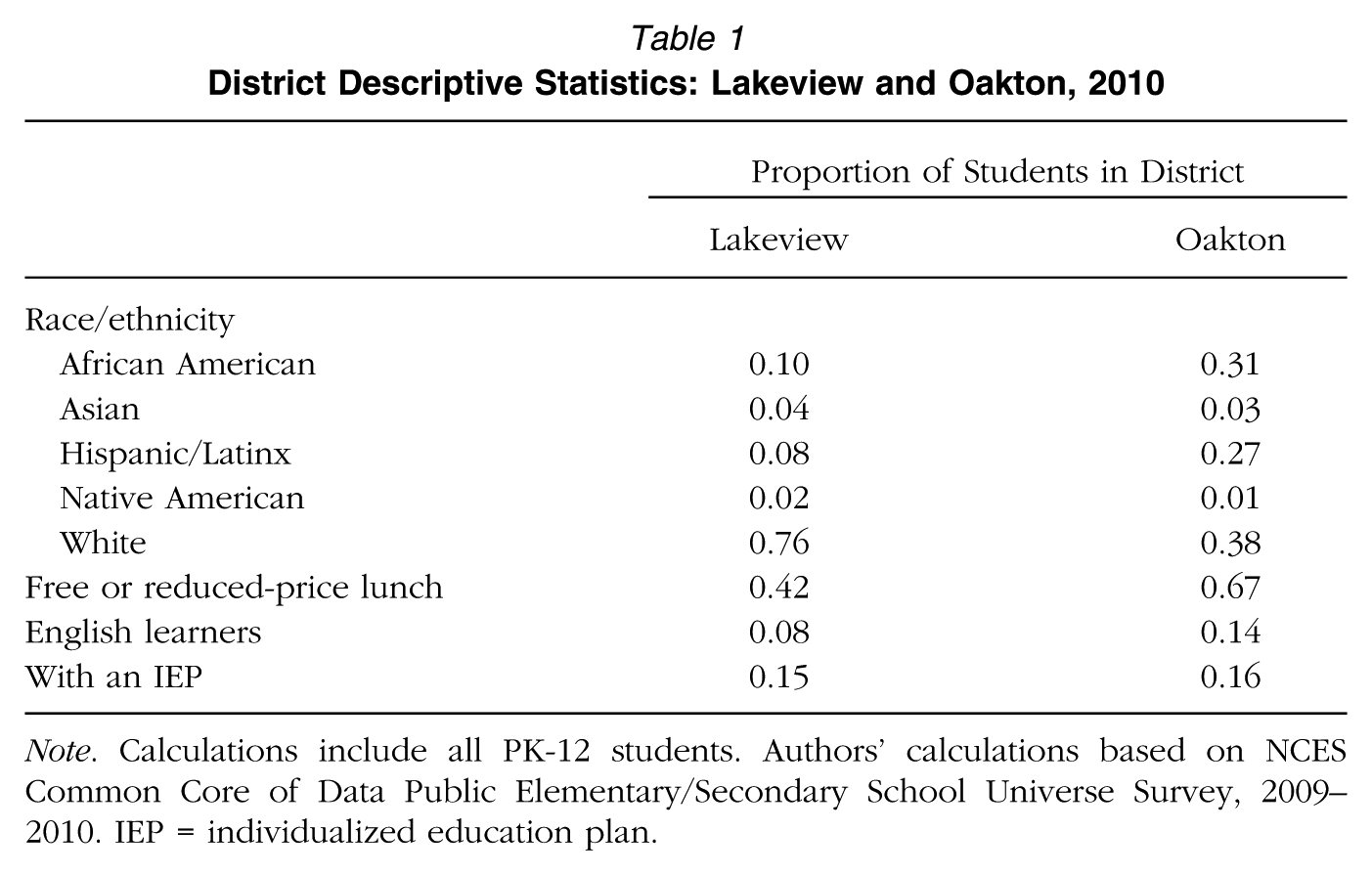
Note. Calculations include all PK-12 students. Authors’ calculations based on NCES Common Core of Data Public Elementary/Secondary School Universe Survey, 2009–2010. IEP = individualized education plan.
Another important difference between the two districts concerns the reforms to teaching and learning undertaken during the time of our study, particularly in mathematics. Our study drew on data from 2010 to 2015, during which time Lakeview, but not Oakton, undertook significant changes in its approach to teaching mathematics. Specifically, in 2010, Lakeview elementary schools adopted a new math curriculum for the early grades (K-2) and engaged school staff in extensive professional development around this new approach. The new math curriculum, Math Expressions (Houghton Mifflin Harcourt, 2015), focused on inquiry, discussion, and representation, a significant shift from the district’s prior approach to teaching mathematics, which focused largely on teaching mathematical procedures (Spillane, Hopkins, & Sweet, 2018). As part of this reform, a K-2 teacher from each Lakeview elementary school was selected as a teacher liaison to support teachers in implementing the new curriculum, while selected elementary school teachers participated in additional professional development in mathematics through a master’s degree program at a local university. Oakton did not undertake similar changes at this time, although in 2013, the district did adopt a new elementary school math curriculum. During the period of our study, a great deal of change was taking place in Lakeview’s approach to teaching mathematics, and school staff in the district were devoting significant time to collectively developing their knowledge about reform-oriented approaches to mathematics teaching and learning; this was not the case in Oakton. We raise this issue again in our discussion of results.
Data Sources
Elementary school instructional staff—which we defined as principals, administrators, and teachers with direct instructional roles—were surveyed in Lakeview in spring 2010, 2011, and 2013, while elementary school staff in Oakton were surveyed in spring 2010, 2011, 2013, 2014, and 2015. The surveys asked school staff about their day-to-day work, perceptions of their schools, backgrounds, and work-related social interactions. District-wide response rates were low in both districts, particularly in Oakton, but a subset of schools each year had higher response rates; for our analysis, we limited our sample to staff in schools with response rates above 70%, as generally required for social network analysis (Wasserman & Faust, 1994). Between 2010 and 2013, 21 different Lakeview elementary schools had survey response rates above 70%, while in Oakton, 14 elementary schools had response rates above 70%. The numbers of schools, and the particular schools in the sample, changed in each year. Although our sample was limited to staff in schools with relatively high response rates, we found no patterns of significant differences in either district between the student demographics of schools included in these analyses and those that were not included. Still, since there could be unmeasured differences between the schools included in these analyses and other schools in each district, we caution against generalizing our findings to these districts as a whole.
Relatively few staff of color worked in Lakeview or Oakton schools. In 2010, for example, there were 17 staff of color (out of 535 total staff) in the Lakeview sample (3%), and nine staff of color (out of 108; 9%) in the Oakton sample (Table 2) (Other years were similar). Characteristics of these staff of color differed in several respects across the two districts. In terms of ethnoracial composition, most Lakeview staff of color were Latinx (71%), while in Oakton the majority of staff members of color (67%) were African American (Table 2). The job assignments of staff of color in the two districts also differed, with Lakeview staff of color more likely to hold administrative positions than staff of color in Oakton (Table 2). In Lakeview, most staff members of color (65%) worked with students in more than one grade, while in Oakton, only 22% of staff members of color taught students in multiple grades (Table 2). Lakeview staff of color were also more likely than Oakton staff of color to hold advanced degrees; were slightly older; and had more years of experience in education (Table 2). Although these statistics are not included in Table 2, Lakeview staff of color were more likely than White staff to teach English as a Second Language (ESL) in 2011 and 2013, the only years for which data on ESL teaching assignments were available. 1
Descriptive Statistics on Sample: Lakeview and Oakton, 2010
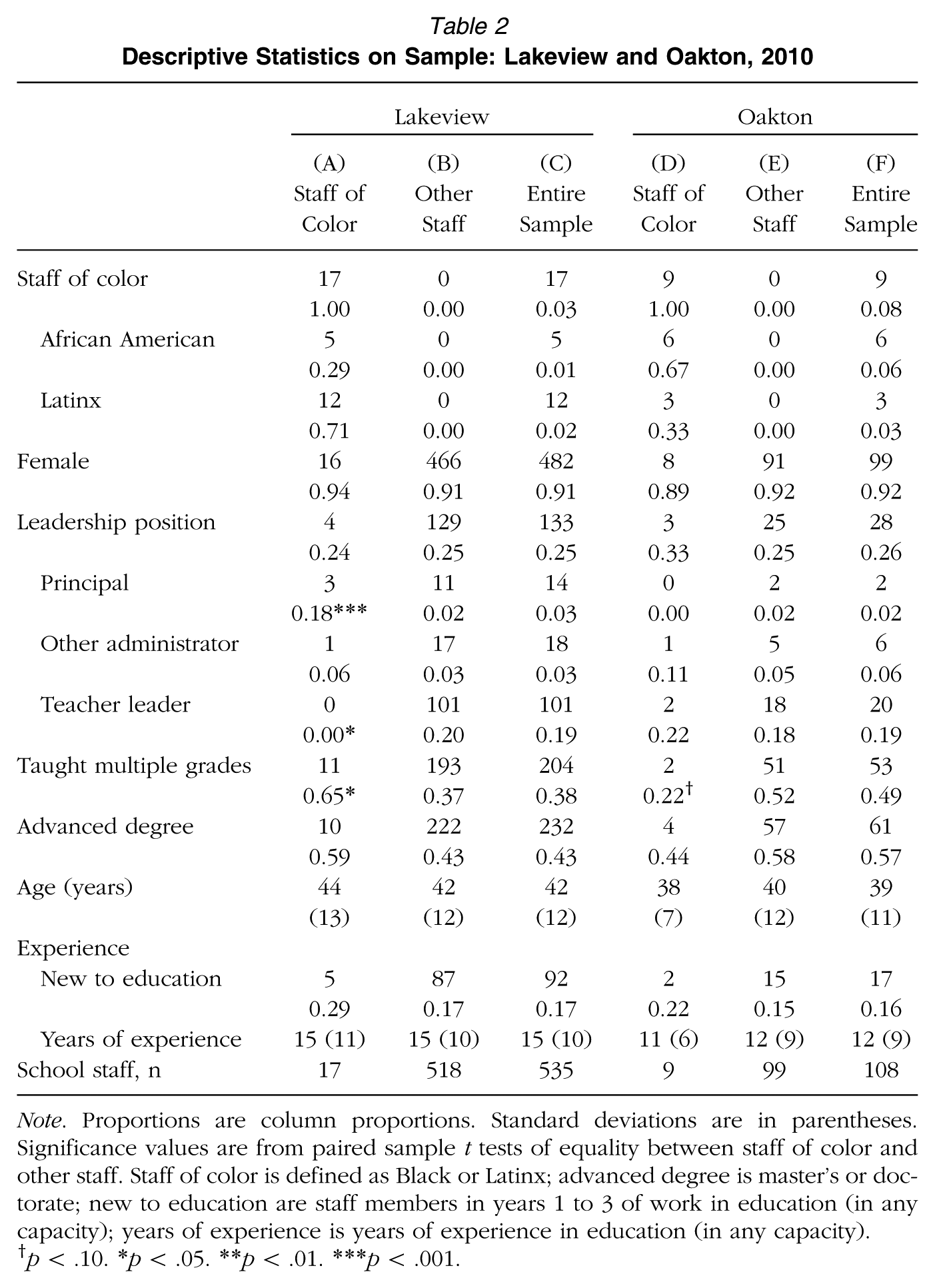
Note. Proportions are column proportions. Standard deviations are in parentheses. Significance values are from paired sample t tests of equality between staff of color and other staff. Staff of color is defined as Black or Latinx; advanced degree is master’s or doctorate; new to education are staff members in years 1 to 3 of work in education (in any capacity); years of experience is years of experience in education (in any capacity).
p < .10. *p < .05. **p < .01. ***p < .001.
Staff of color were also distributed differently across schools in the two districts. Compared to staff of color in Oakton, Lakeview school staff of color were more likely to be isolated as the only staff member of color in their school—or “loners” (Bristol, 2018) (Table 3). In 2010, for example, Lakeview staff of color were most likely to be the only staff member of color in their school, or to work alongside one single other person of color (Table 3). In Oakton, however, there were an average of two persons of color on the faculty of the schools included here (Table 3). (In one year, 2014, one Oakton school had seven staff of color.) We explore the implications of these differences in our analysis.
School-Level Distributions of Staff of Color and Other Staff: Lakeview and Oakton, 2010
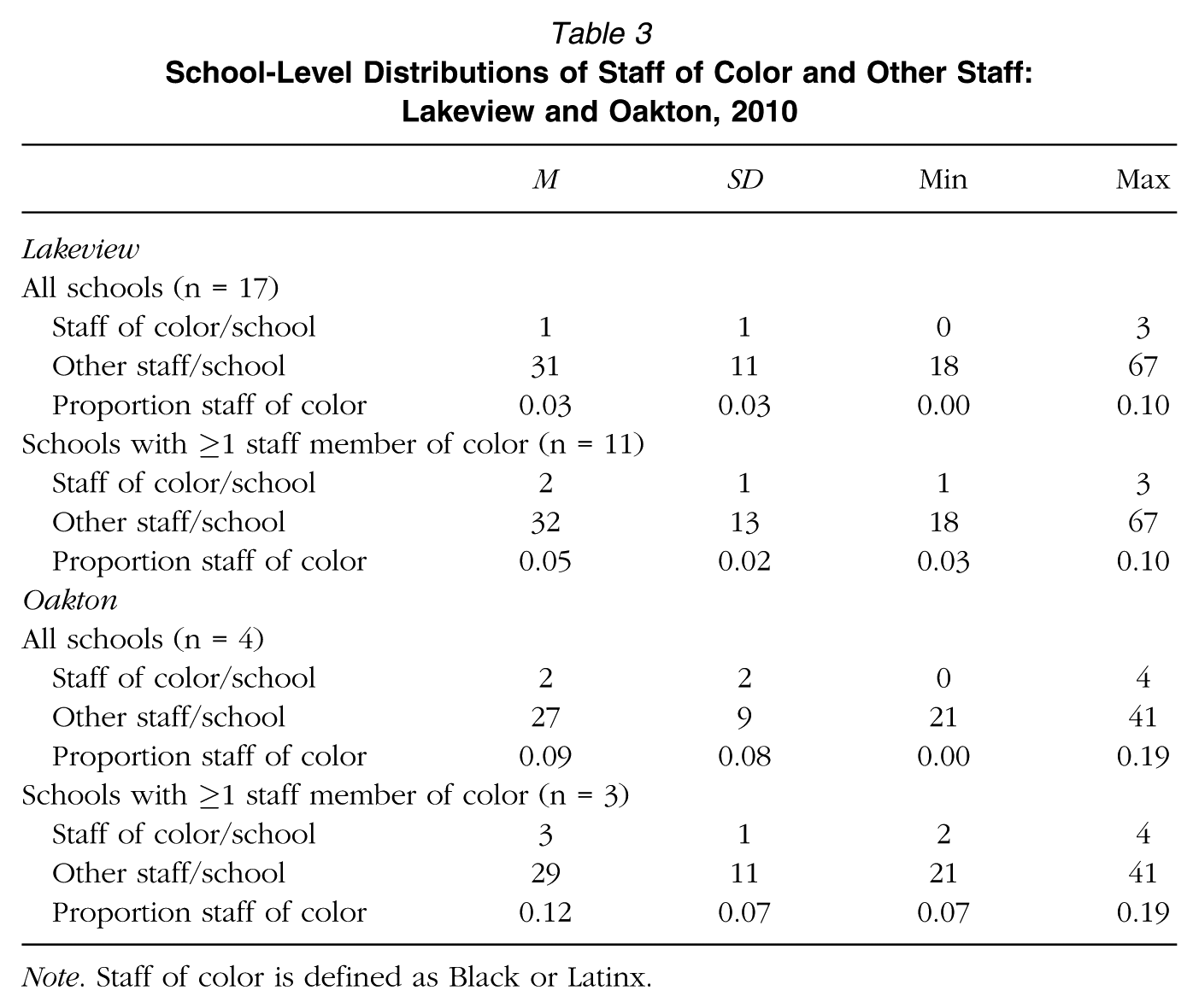
Note. Staff of color is defined as Black or Latinx.
Social Network Data
In both districts, surveys asked school staff about two overlapping yet distinct types of work-related social networks: “close colleague networks,” and work-related advice and information networks. To elicit school staff’s close colleague ties, the surveys asked, “Who are your closest colleagues in your school?”; to elicit school staff’s instructional advice and information ties, the surveys asked, “During this school year, to whom have you turned to for advice and/or information about curriculum, teaching, and student learning?” Both questions allowed respondents to list up to 12 individuals. Follow-up questions asked respondents to indicate the specific content area(s) for which they sought advice and/or information from each person (ELA and/or mathematics). The survey measures were developed and validated in prior studies (see Pitts & Spillane, 2009; Pustejovsky & Spillane, 2009).
In both districts, network density—or the proportion of possible ties in the network that were actually present—varied by network type, with close colleague networks the most dense, followed by ELA and math networks (Table 4). This indicates that school staff in both districts sought out more colleagues for advice about ELA than math, a finding that concurs with findings from other settings (Spillane et al., 2012; Spillane et al., 2015; Spillane, Hopkins, et al., 2018).
Descriptive Statistics on Networks: Lakeview and Oakton, 2010
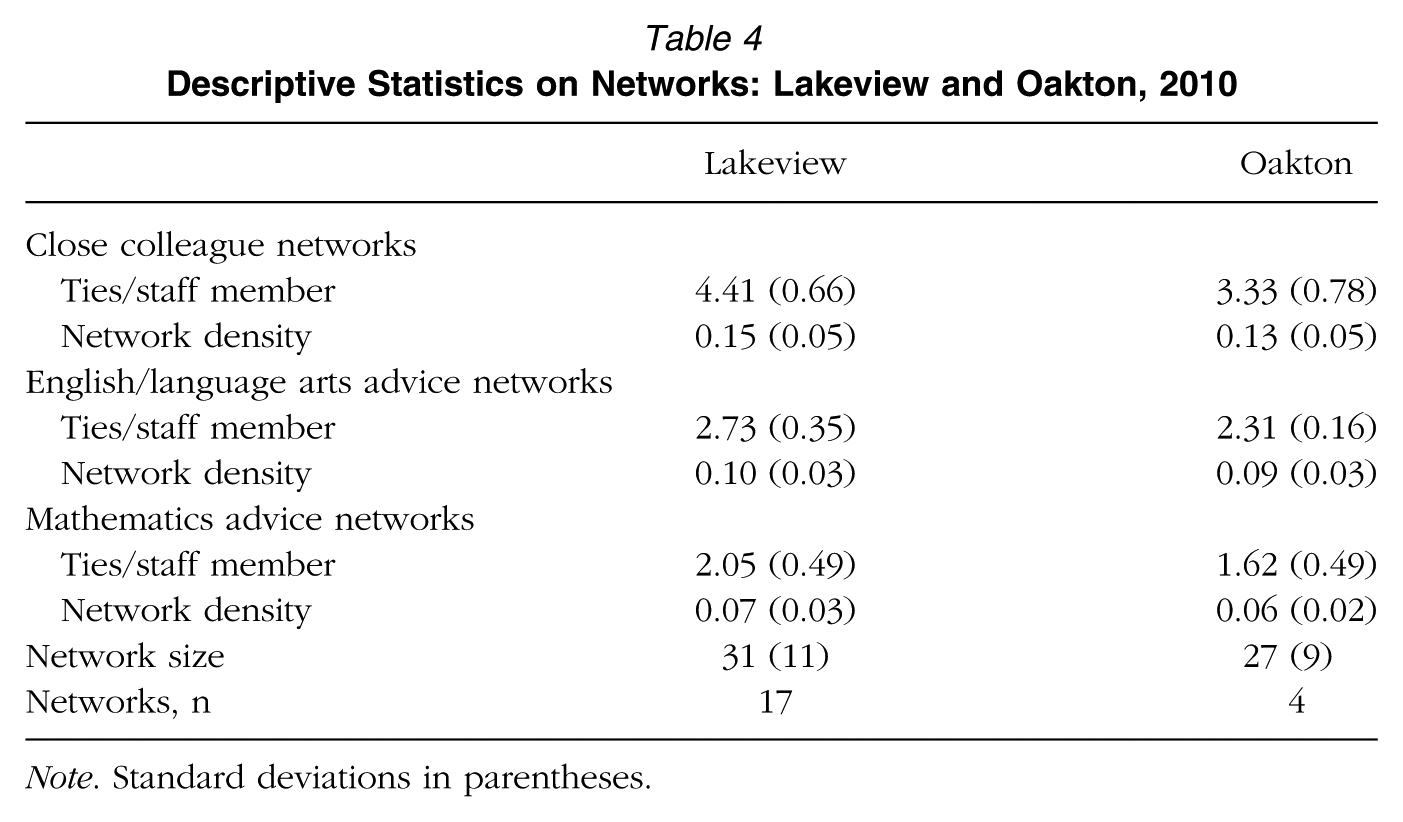
Note. Standard deviations in parentheses.
Analytic Methods
To measure the centrality of staff of color in their schools’ work-related social networks, we used degree centrality measures, which are commonly used descriptive measures of the extent to which individual entities are connected to their surrounding networks (Borgatti, Everett, & Johnson, 2013). In-degree centrality measures the number of advisors seeking an individual for advice; for example, if two staff members seek out Staff Member A for advice, Staff Member A has an in-degree of two. Out-degree centrality similarly measures the number of individuals a particular staff member seeks out for advice, while betweenness centrality measures the degree to which an individual serves as a “broker” connecting other people in the network (Borgatti et al., 2013). Since the amount of interaction in a social network is also impacted by the network size (with smaller networks generally having more interaction), we standardized our network centrality measures by dividing each by the number of interactions available to an individual (network size minus one), to facilitate comparisons between teachers in different-sized schools.
In our analyses, we compared the degree centrality of staff of color to that of their White colleagues; in separate analyses, we also compared the degree measures derived from staff’s local (egocentric) networks (which are defined as the staff member, his/her connections (both in-ties and out-ties), and the ties between those connections). It was important to examine degree centrality in both overall school networks and local egocentric networks because staff members could be relatively peripheral to their schools’ overall networks but more central to the smaller networks of those with whom they had connections. We also examined whether staff of color were more or less likely to have a tie with another staff member of color than were White staff members, as well as their likelihood of being isolated (i.e., without ties).
Simple comparisons of network centrality between staff of color and White staff, although useful, could be influenced by underlying differences between those two groups. For example, if staff of color generally had more experience in the field of education than their White colleagues, other staff members might be more likely to seek out staff of color for advice, not because of their ethnoracial identity, but because of their experience. To control for such differences, we used social network models to examine whether the work-related social networks of staff of color differed from those of White staff, while controlling for characteristics of staff members, pairs of staff, and their schools’ networks. Since ties between individuals do not satisfy the assumption of independence of observations necessary for standard regression methods (Wasserman & Faust, 1994), we used social network methods to compare the degree to which staff of color sought out and provided advice. Specifically, we used hierarchical latent space models (HLSMs) (Sweet, Thomas, & Junker, 2013). Unlike ordinary regression models, individual covariates can be incorporated into HLSMs in three ways: (a) associated with a tie sender, in order to estimate the association of that variable with the likelihood of “sending” a tie (in this case, seeking advice); (b) associated with a tie receiver, in order to estimate the association between that variable and “receiving” a tie (in this case, being sought out for advice); or (c) with the pair, measuring, for example, the similarity of two individuals on a given variable such as grade level taught. Along with covariates, HLSM models also include node positions in a latent space (Sweet et al., 2013). HLSMs have been used in a number of studies of social networks in schools (Spillane, Hopkins, et al., 2018; Spillane & Shirrell, 2017).
HLSMs were ideal for our analyses for several reasons. First, they allowed us to estimate parameters across all schools simultaneously; further, like multilevel models, HLSMs allowed us to pool information across schools, assuming that the covariates included in the models have similar impacts across schools. Finally, the latent space positions included in the models implicitly control for structural aspects of networks such as reciprocity and centrality, allowing for estimation of covariate effects (Hoff, Raftery, & Handcock, 2002). One limitation of HLSMs is that they allow only cross-sectional analysis of network data, so we analyzed each year’s networks separately.
We implemented our HLSMs as follows:

In this model, the dependent variable Yijk indicates a tie directed from staff member i to staff member j in school k. Zik and Zjk are the latent space positions for staff members i and j, which control for structural aspects of each school’s network that might affect the likelihood of a tie. The Xijk are node-, edge-, or network-level covariates; of these, the key independent variable in our analyses is an indicator for whether a school staff member self-identified as a person of color (Latinx or Black). This indicator was included as both a sender and a receiver covariate.
The Xijk in our models also included a number of covariates that control for individual or dyad attributes known to predict the likelihood of ties between school staff. At the individual level, we controlled (for both tie senders and receivers) for whether a school staff member taught students in multiple grades; held a leadership position (principal, assistant principal, coach, or grade-level leader); was new to education; held an advanced degree; and number of years of experience in education (standardized within years). At the pair level, we controlled for whether the pair taught the same grade level, which has previously found to be a strong predictor of work-related ties among school staff (Spillane et al., 2012; Spillane, Hopkins, et al., 2018); in some analyses, we also controlled for whether both members of the pair taught ESL. At the network level, we controlled for network size, since it is associated with the likelihood of ties between members (Wasserman & Faust, 1994). Although other work has suggested that higher-performing teachers generally seek advice from more colleagues than do lower performers (Spillane, Shirrell, & Adhikari, 2018), we did not have access to measures of teacher performance in either district, so we were unable to include such measures in our analysis.
Results
Differences by District
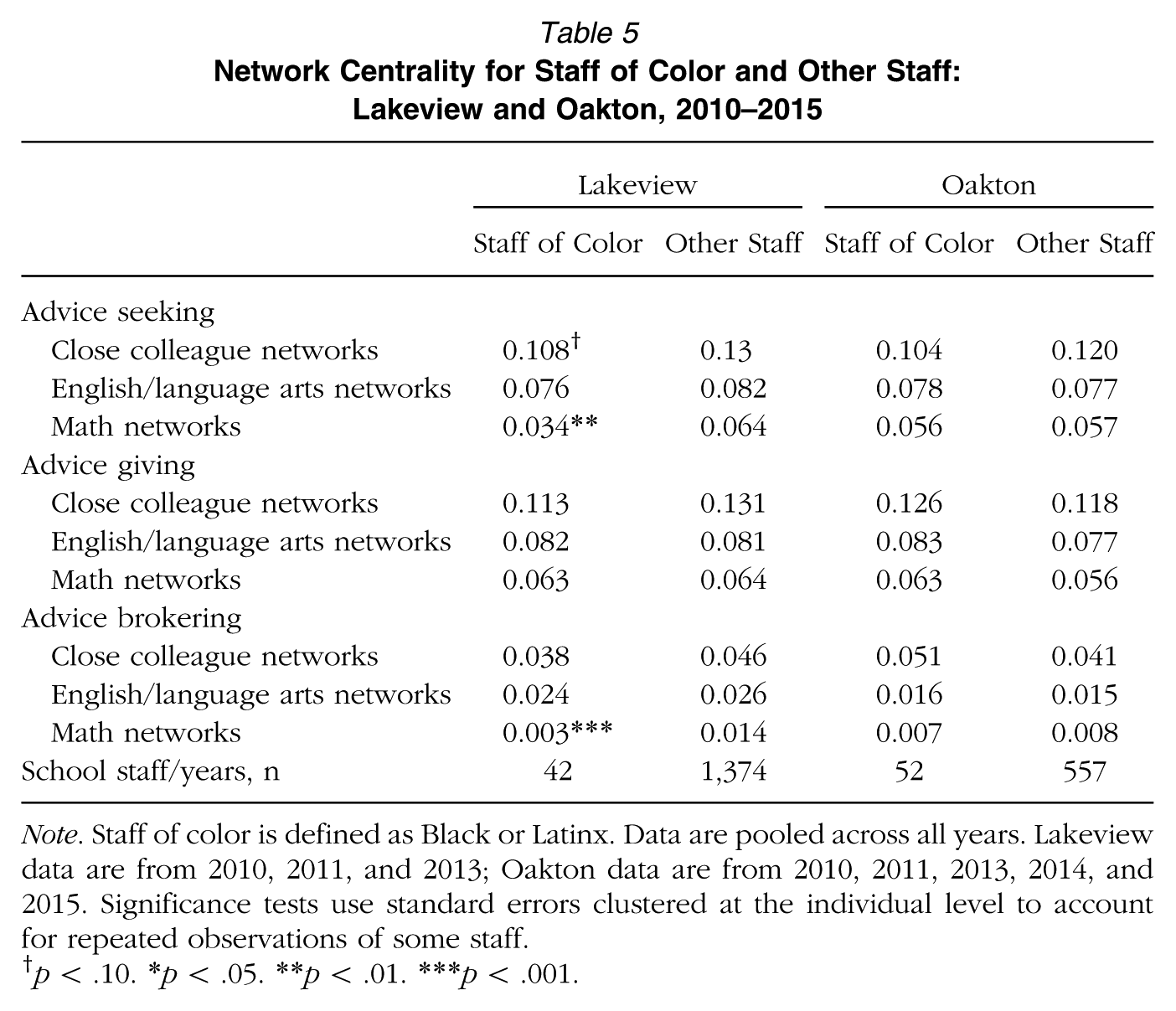
In Oakton—where staff of color were less likely to be the only member of their ethnoracial group in their schools, and where the district did not engage in extensive professional development or the adoption of a new math curriculum—staff of color did not differ from White staff in the degree of seeking, being sought for, or brokering advice (Table 5). In Lakeview, however— where staff of color were more likely to be the only staff member of color in their schools, and where the district had recently adopted a new math curriculum and was engaging staff in extensive math professional development— there were significant differences between the math network centrality of staff of color and White staff, but no significant differences in close colleague or ELA networks (Table 5). In particular, Lakeview staff of color were significantly less likely to seek out advice about math than White staff (Table 5). Pooling data across all years, the average out-degree in math networks for Lakeview staff of color was 0.034, while the average out-degree in math networks for White staff was 0.064 (p < .01). This suggests that, given the average network size of 31 staff members in Lakeview schools, Lakeview staff of color sought out an average of one colleague for math advice, while White staff members sought out two. Although not a large difference, Lakeview math networks were sparse, making the difference of a single connection significant from both a practical and statistical perspective.
Network Centrality for Staff of Color and Other Staff: Lakeview and Oakton, 2010–2015
Note. Staff of color is defined as Black or Latinx. Data are pooled across all years. Lakeview data are from 2010, 2011, and 2013; Oakton data are from 2010, 2011, 2013, 2014, and 2015. Significance tests use standard errors clustered at the individual level to account for repeated observations of some staff.
p < .10. *p < .05. **p < .01. ***p < .001.
Lakeview staff of color also did less brokering of math ties than White staff, as indicated by their lower betweenness centrality in math networks—a highly statistically significant difference (p < .001). This finding suggests that staff of color were generally in more peripheral positions in their schools’ math networks than White staff.
Despite the differences in math advice seeking and brokering between Lakeview staff of color and White staff, Lakeview staff of color were not sought out less by their colleagues for advice in math or ELA, nor were they cited less often as close colleagues (Table 5). These patterns remained when analyses were limited to schools with more than one staff member of color or were limited to teachers.
Differences by Leadership Position
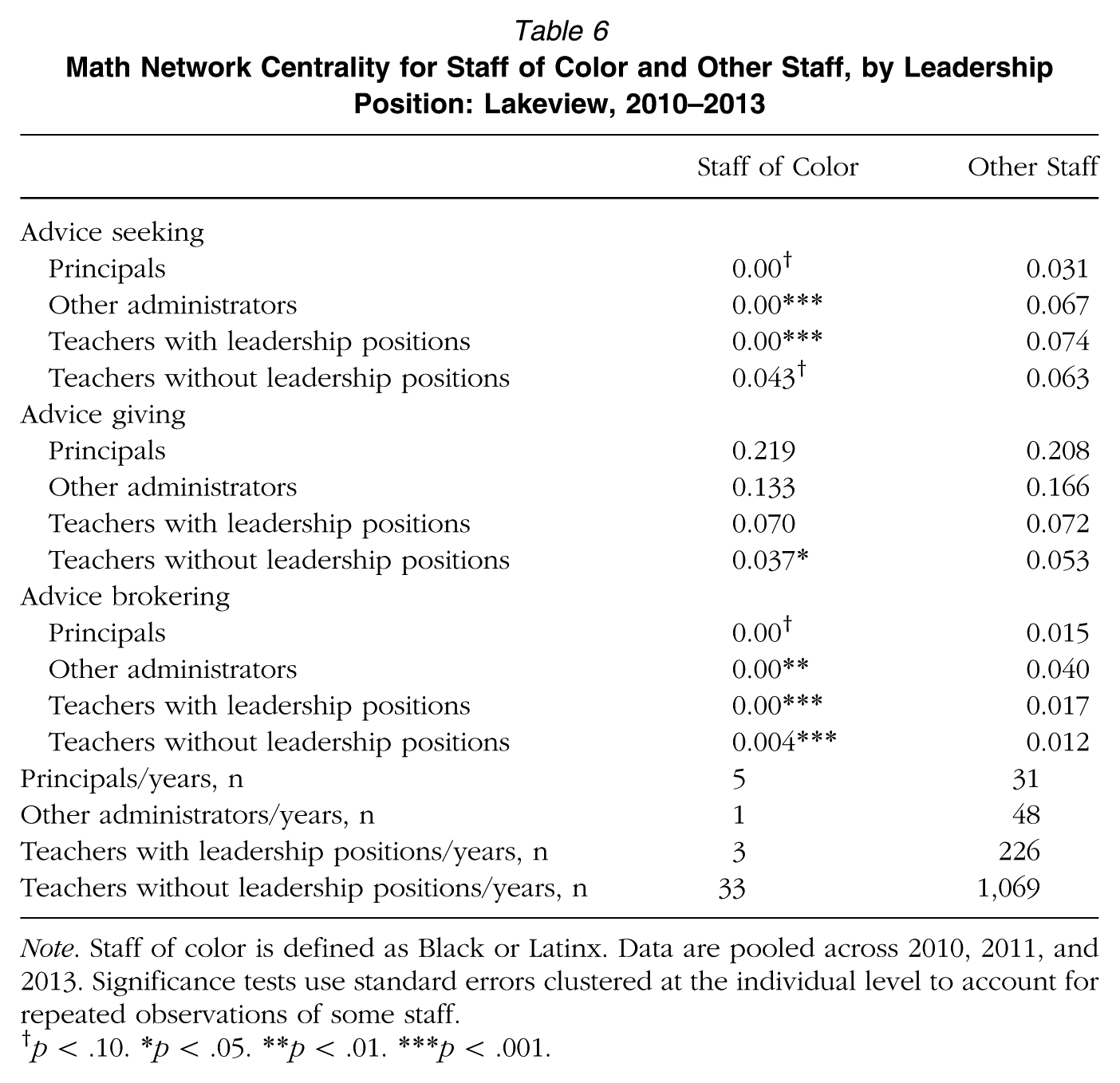
School administrators and teacher leaders such as grade-level leaders are often more central to their school’s advice and information networks than staff members who do not hold leadership positions (Spillane et al., 2012). To examine whether the differences in math network centrality were similar for staff that held various leadership positions, we separated Lakeview staff into principals, other administrators, teachers with leadership positions, and teachers without such positions, and compared the math network centrality of staff of color and White staff for each of these groups separately (Table 6). These analyses showed that, no matter the leadership position they held, Lakeview staff of color sought math advice from fewer colleagues, and brokered less advice between colleagues, than did White staff members (Table 6). Analyses not presented here also showed that Lakeview staff of color were less likely to seek and broker math advice than their White colleagues regardless of whether they taught multiple grades or were new to the field of education.
Math Network Centrality for Staff of Color and Other Staff, by Leadership Position: Lakeview, 2010–2013
Note. Staff of color is defined as Black or Latinx. Data are pooled across 2010, 2011, and 2013. Significance tests use standard errors clustered at the individual level to account for repeated observations of some staff.
p < .10. *p < .05. **p < .01. ***p < .001.
In analyses not presented here, we also disaggregated Lakeview staff of color into African American and Latinx staff, and we compared the math network centrality of each group with that of their White colleagues. Both African American and Latinx staff sought math advice from fewer colleagues than their White colleagues; however, this difference was particularly pronounced for Latinx staff, whose out-degree centrality was 0.028, compared with 0.064 for White staff (p < .01). Although African American staff sought math advice from fewer colleagues than did White staff (out-degree centrality for African American staff was 0.051), the difference was not statistically significant at conventional levels (p = .43).
Differences Over Time
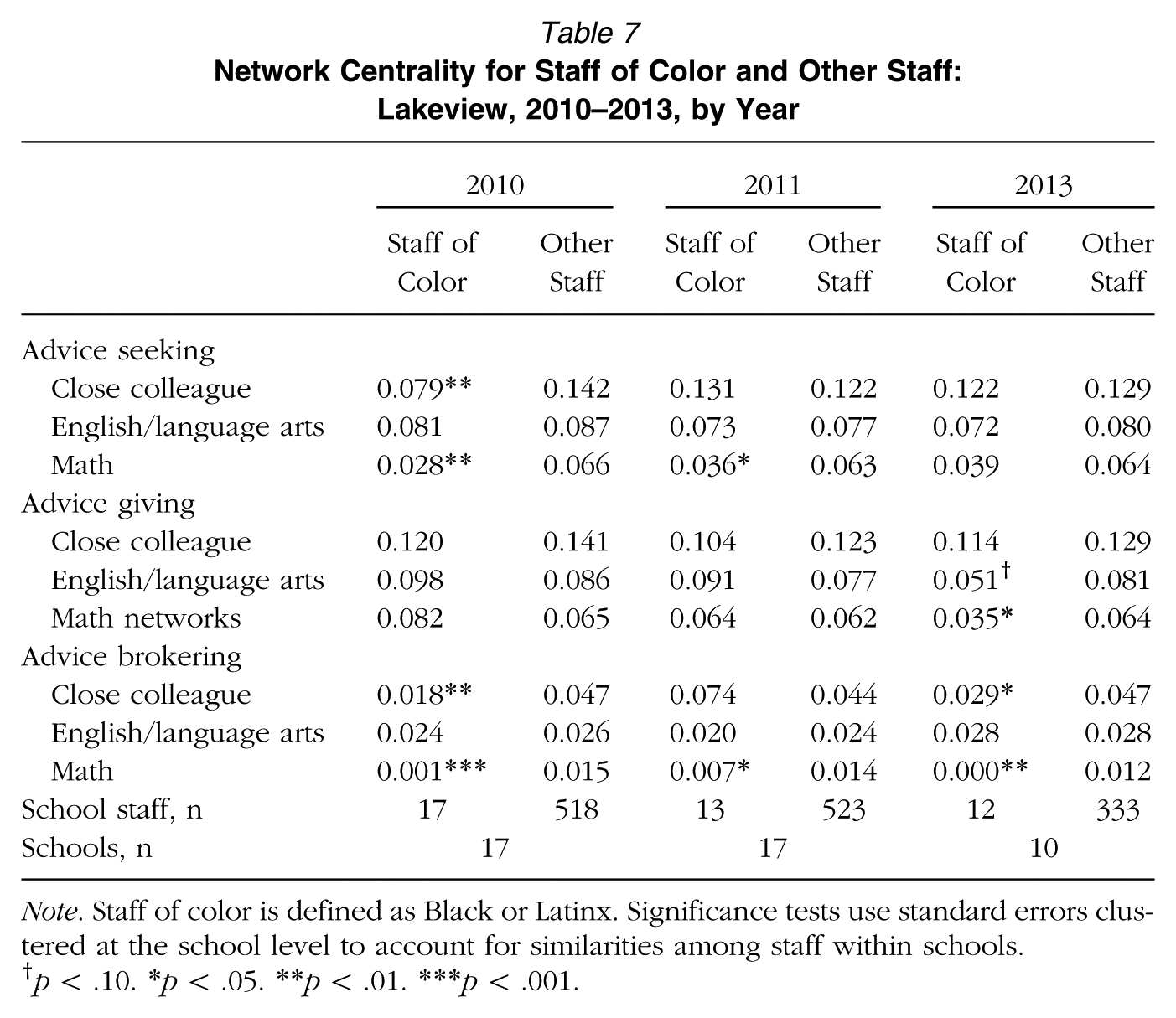
To explore the consistency of our findings across years, we examined differences in network centrality between Lakeview staff of color and White staff for each year separately (Table 7). In all three years, Lakeview staff of color sought out fewer colleagues for math advice, and did less brokering of math advice and information, than their White colleagues. The magnitude of this difference was greatest in 2010, slightly less in 2011 (although still statistically significant), and similar in 2013, although not statistically significant for math out-degree (p = .16). There were no clear patterns of differences between the network centrality of staff of color and White staff in close colleague or ELA networks. These results were consistent when analyses were limited to schools with more than one staff member of color, or were limited to teachers.
Network Centrality for Staff of Color and Other Staff: Lakeview, 2010–2013, by Year
Note. Staff of color is defined as Black or Latinx. Significance tests use standard errors clustered at the school level to account for similarities among staff within schools.
p < .10. *p < .05. **p < .01. ***p < .001.
The positions of staff of color and other staff in their schools’ math networks are illustrated in Figure 1, which shows math networks from two Lakeview schools in 2010. In both schools, the figure shows that the staff of color (solid shapes) are more peripheral to their schools’ math networks, and are engaged in less connecting of colleagues, than their White colleagues (other shapes). (Staff that held leadership positions are shown as squares, while staff without such positions are shown as circles.) The positions of the teachers of color in these two schools’ networks are typical of the other Lakeview schools we examined.
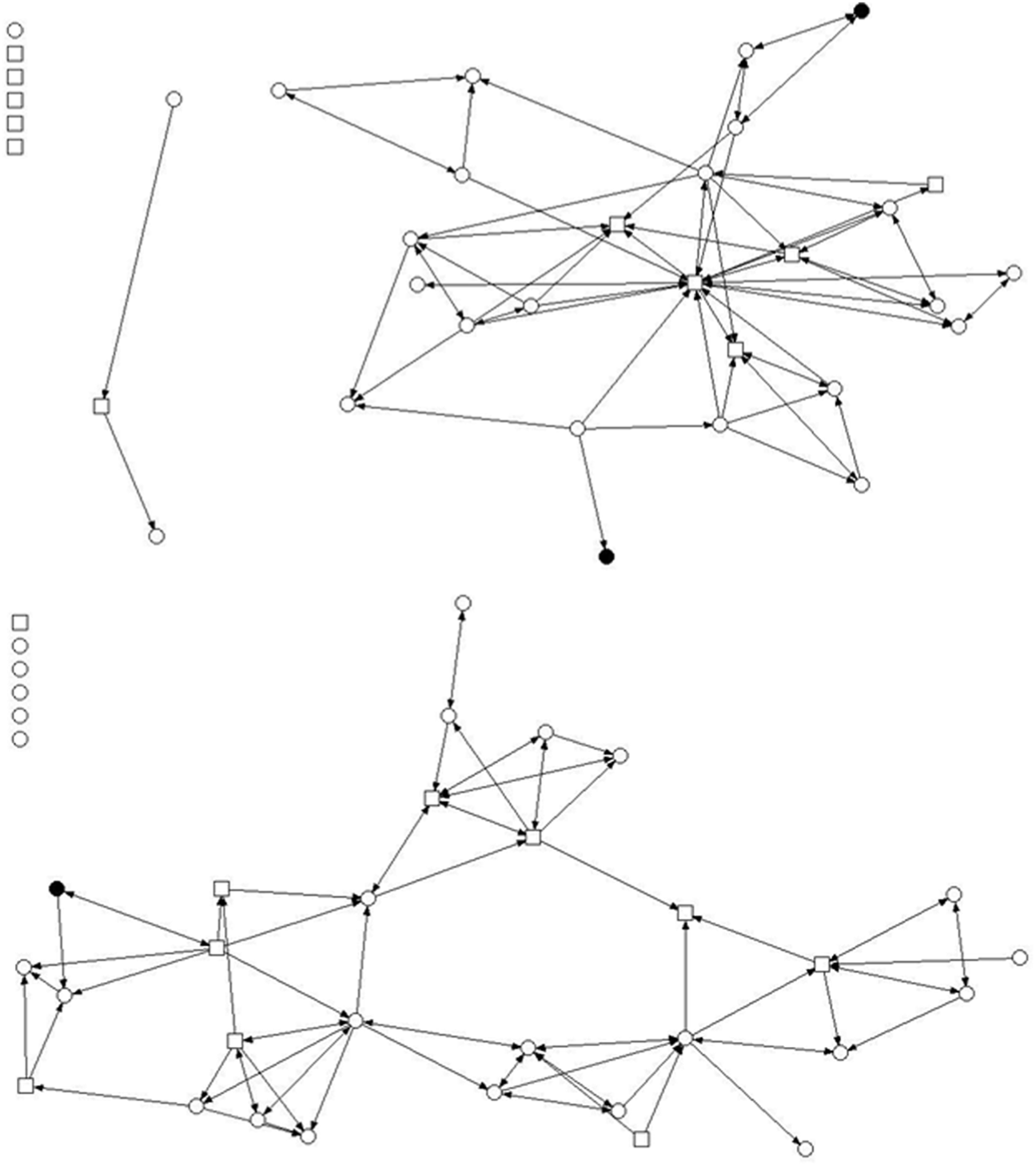
Positioning of staff of color in two Lakeview schools’ math networks, 2010.
Further Investigating the Differences
Further analysis showed that the differences in math advice seeking between Lakeview staff of color and White staff could be explained in two ways. First, a larger proportion of staff of color sought out very few colleagues for math advice, compared with White staff; this difference is illustrated in Figure 2 by the solid line that rises above the dashed line at the left of each plot, indicating that staff of color were more likely than White staff to have low values of math out-degree. A second explanation for the difference, also apparent in Figure 2, is that few staff of color sought math advice from large numbers of their colleagues; in Figure 2, this is indicated by the dashed lines, which extend toward the right of each plot, while the solid lines do not, demonstrating that White Lakeview staff—but not staff of color—sought math advice from large numbers of their colleagues.
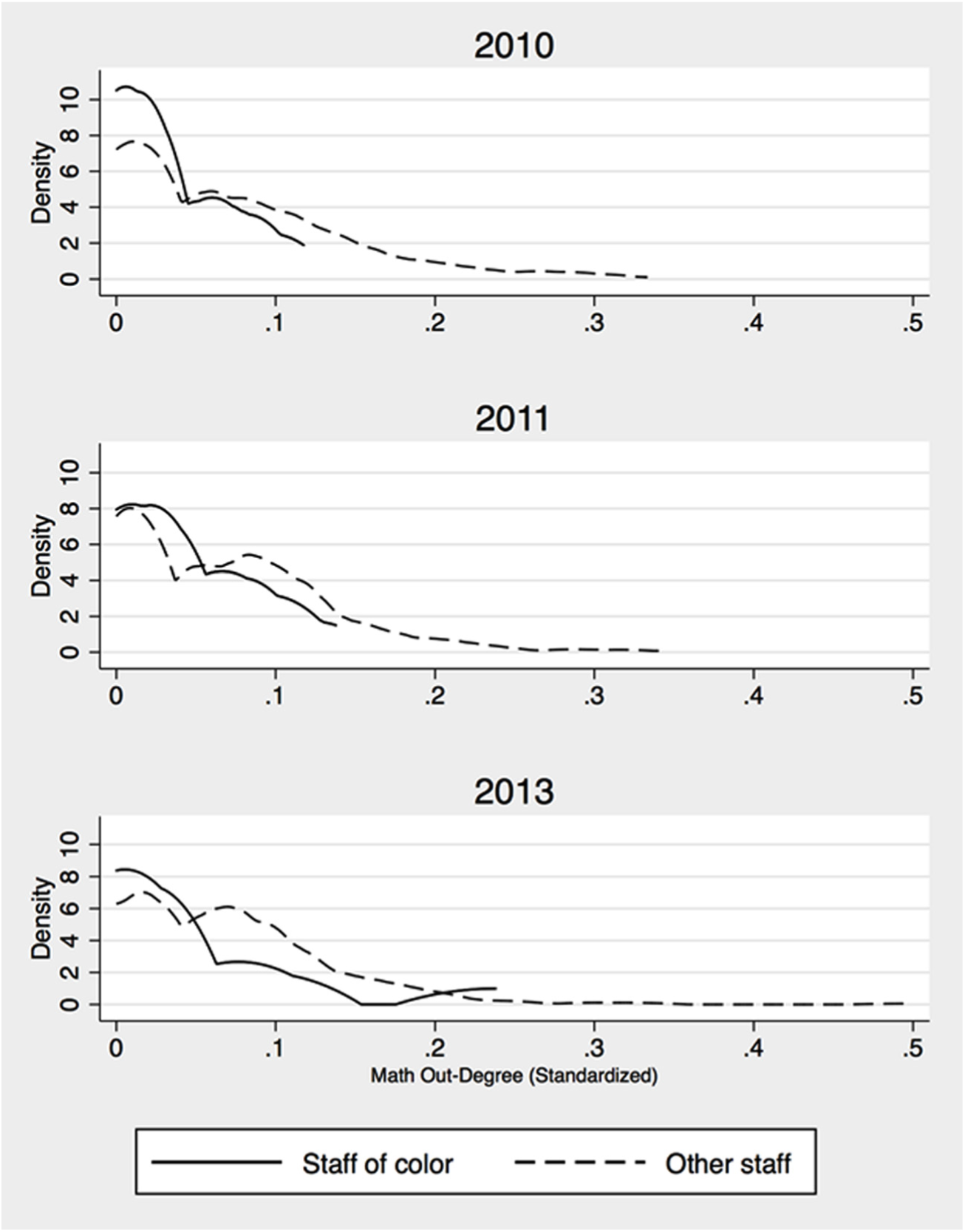
Math advice-seeking for school staff of color and other staff: Lakeview, 2010–2013.
Network Model Results
HLSM results confirmed the results of the descriptive analyses presented above, finding that even after controlling for a variety of staff, pair, and network covariates, Lakeview staff of color were less likely to seek math advice from their colleagues (Table 8) (the coefficient for 2011 was negative and large, although not statistically significant). Adding a control for whether both members of the pair taught ESL did not affect these results. The indicator for both teachers teaching ESL was a positive and significant predictor of ties in both close colleague and ELA networks in 2011 and 2013; this covariate did not predict math ties, however, in either year. These findings demonstrate that differences in math advice seeking between Lakeview staff of color and White staff remained after controlling for holding an advanced degree, leadership position, years of experience in education, teaching multiple grades, teaching the same grade, and network size. HLSMs limited to schools with at least one staff member of color found similar results.
Hierarchical Latent Space Model Estimates of the Association of Staff of Color With Ties in Close Colleague, English/Language Arts, and Math Networks: Lakeview, 2010–2013
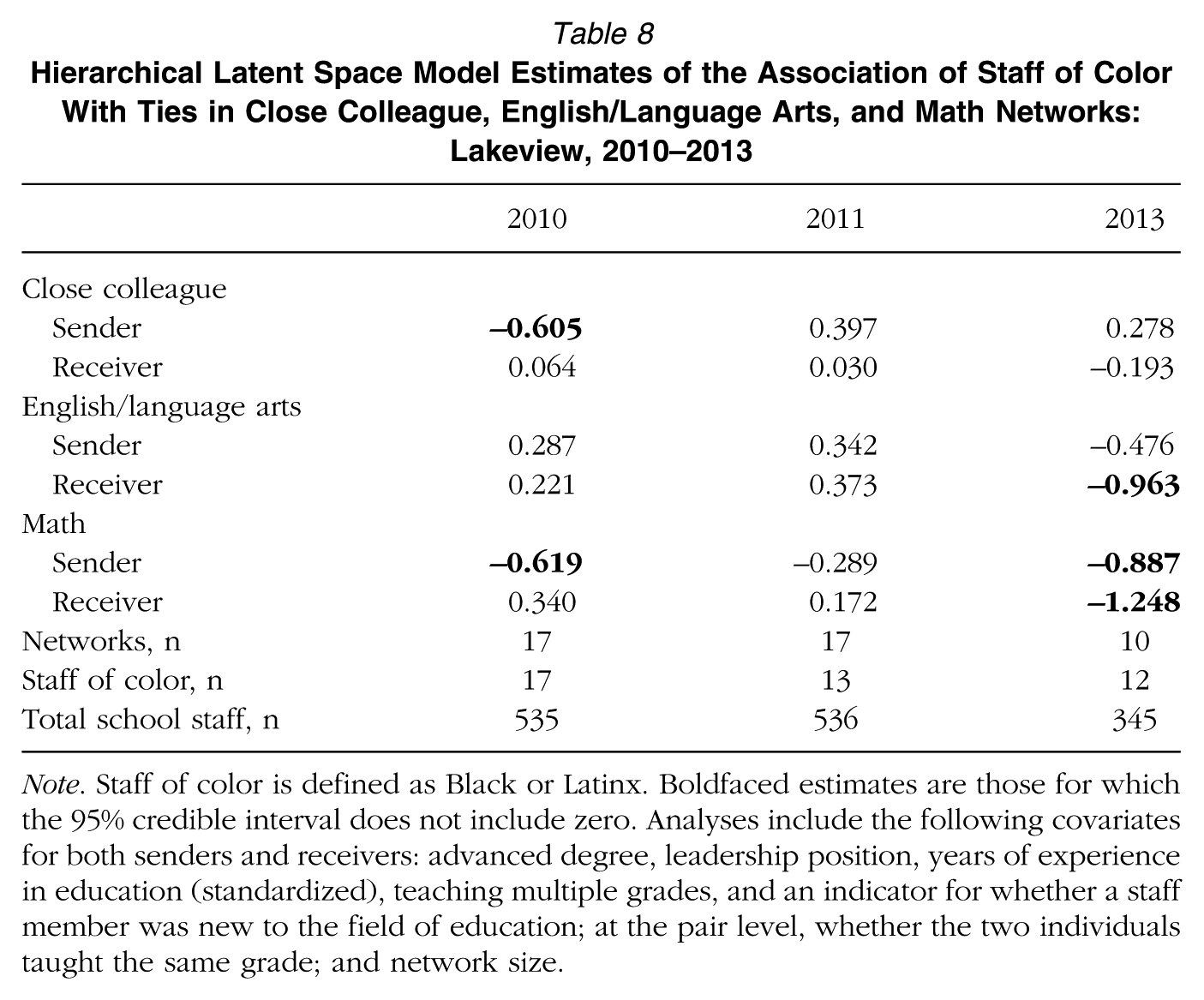
Note. Staff of color is defined as Black or Latinx. Boldfaced estimates are those for which the 95% credible interval does not include zero. Analyses include the following covariates for both senders and receivers: advanced degree, leadership position, years of experience in education (standardized), teaching multiple grades, and an indicator for whether a staff member was new to the field of education; at the pair level, whether the two individuals taught the same grade; and network size.
Egocentric Networks
Analyses not presented here found that even in smaller, local, egocentric networks, staff of color were less likely than White staff to broker relationships between colleagues in both close colleague and math networks, although these findings were somewhat inconsistent across years. These differences suggested that staff of color were less central to even their local egocentric networks than their White colleagues and remained when the analyses were limited to teachers. However, we found no patterns of differences between staff of color and White staff in the likelihood that they had a tie (either sender or receiver) with a colleague of color or were isolated in their networks.
Between-School Differences
To examine whether there was significant variation between Lakeview schools in the centrality of staff of color to their schools’ math networks, we calculated the within-school difference each year between the average math out-degree (or math betweenness) of staff of color and White staff; we then regressed these school-by-year differences on school indicator variables, and conducted post hoc tests to determine which, if any, schools had within-school differences that were significantly different from the overall across-school mean. For both math out-degree and betweenness, two schools differed significantly from the overall mean; however, we found no clear patterns of differences in staff reports of the working conditions of these two schools on our 2010 survey, and our results remained unchanged when we excluded either or both of these schools from our analyses. Our overall conclusion, then, was that there were few if any meaningful between-school differences in Lakeview in the centrality of staff of color to their schools’ math networks.
Discussion
Drawing on Kanter’s (1977) theory of numbers and group composition and Bristol’s (2018) theory of loners and groupers, this study employed social network analysis to explore the centrality of staff of color to their schools’ work-related social networks in elementary schools in two mid-sized public school districts in the Midwest. In both districts, staff of color were, on average, sought out for advice at the same rate as their White colleagues; in Lakeview, however, staff of color sought out less advice and did less brokering of math advice relationships than their White colleagues.
As noted above, the distribution of staff of color across schools differed in the two districts, which may explain the different findings in the two settings. In Oakton, where there were no significant differences between the network centrality of staff of color and other staff, staff of color comprised a larger percentage of all staff across the district (9%) and often worked in schools alongside other staff of color. In contrast, Lakeview had a much smaller percentage of staff of color (3%) who tended to be the only faculty members of color in their schools.
Interestingly, the centrality of Lakeview staff of color to their schools’ work-related social networks differed by school subject. Compared with White colleagues, Lakeview staff of color sought fewer colleagues for math advice, but the same difference was not apparent in close colleague or ELA networks. In Lakeview, the differences between staff of color and White teachers were also more pronounced in 2010 than in other years. As noted above, Lakeview introduced a new math curriculum in 2010 and began extensive math professional development efforts that year, one possible explanation for both the focus and the timing of the strongest differences we observed. One possibility is that Lakeview’s adoption of the new math curriculum and the increase in math professional development may have encouraged staff to increase interactions overall, perhaps exacerbating the isolation of staff of color in those schools. Bristol’s (2018) finding that Black male teachers who were loners in their schools often avoided interactions with their colleagues suggests that such an explanation may be plausible; it is important to emphasize, however, that given our data, it is impossible to determine definitive cause(s) of the differences we found. It is also important to emphasize that schools’ professional climates and cultures likely play crucial roles in determining how much staff members interact and are particularly important for those who are the only representatives of their social group within the organization. As such, it would be incorrect to conclude that workers who are the only members of their social group—in this case staff of color—should be solely responsible for seeking interactions with majority colleagues. Instead, the organization’s culture and climate likely play a significant role in determining how much staff members interact across racial/ethnic (and other) lines.
Future research should explore how organizational conditions in schools affect the degree to which staff of different ethnoracial groups interact in the school workplace. Moreover, new examinations of relationships between school staff of color and other staff in times of changing curricular demands may also provide further insight into this possibility. An additional area of research is the social experiences of principals, other administrators, and teacher leaders of color, whose work-related social networks may differ in important ways from those of teachers of color who do not hold leadership positions. As efforts to diversify teacher and administrator workforces become more pronounced, understanding the social dynamics among teachers and administrators of various race/ethnicities will be key to ensuring that school staff interact and collaborate in ways that benefit students.
Finally, while one shortcoming of the social network analysis employed here is its inability to capture the voices of the study participants, prior qualitative research has suggested that the school-based experiences of teachers of color are shaped by the numbers of other teachers of color (or lack thereof) on the faculty (Bristol, 2018; Cheruvu, Souto-Manning, Lencl, & Chin-Calubaquib, 2015; B. B. Flores, Clark, Claeys, & Villarreal, 2007; Kelly, 2007). In particular, the growing body of qualitative research on teachers of color working in small- and medium-sized districts makes clear the increasing perceived isolation these teachers feel based on being the only members in their ethnoracial group on the faculty (Lee, 2012; Mabokela & Madsen, 2003). Thus, previous qualitative research supports this study’s quantitative findings about the advice seeking of staff of color in these settings, and the impacts of being the only staff members of color in their schools.
Implications for Policy, Practice, and Research
The differences in the work-related social networks of staff of color in the two mid-sized districts we examined have important implications for policy, practice, and research. For policy, our work suggests that diversifying the educator workforce is critical, not only for students but also for school staff. Ongoing national, state, and local policy efforts to increase the ethnoracial diversity of the educator workforce have presented these efforts as primarily benefiting the growing number of students of color in U.S. public schools. Given that being the only staff member of color on a school’s faculty was associated with staff of color being less central to their schools’ work-related social networks, policymakers should also consider framing the importance of diversifying the educator workforce as critical for supporting staff of color—both teachers and administrators—who already work in public schools.
Our findings also suggest that policies decreasing the isolation of staff of color in their schools could be an important lever for improving the retention of staff of color. Although more research on the positioning of staff of color in their schools’ social networks is warranted, our findings suggest that decreasing the likelihood of a staff member of color being the only person of color in school—by increasing the overall number of staff of color or by strategically grouping staff of color in schools—could better connect staff of color to their schools’ advice and information networks. This increased connection could, in turn, better develop those staff members’ social capital and improve their retention. Policies seeking to recruit staff of color and decrease their isolation in schools are already being implemented in many districts, including San Francisco (O’Connor, 2015), Minneapolis (McGuire, 2015), and New York City (Layton, 2015). Studies of how these interventions alter (or do not alter) the work-related social networks of staff of color would be valuable contributions to understanding best ways to build social capital and improve the retention of staff of color. Taking the lessons of this work, policymakers could build policies and programs that better connect staff of color to other staff in their schools.
Moreover, our work suggests that programs and policies should look beyond large urban settings to diversify the educator workforce. Although large urban districts are important because of their sheer numbers of educators of color, mid-sized urban districts, as well as suburbs and rural districts, also employ nontrivial numbers of educators of color. Our study suggests that in mid-sized districts—and perhaps elsewhere—there may be important differences between the positioning of staff of color and White staff in their schools’ work-related social networks, which could explain the differences in retention between these two groups. Before policies and programs target school staff of color in these settings, however, more research into their experiences and networks should be conducted to illuminate their experiences.
Our work also has implications for practice in individual school buildings. In particular, our findings suggest that school administrators and other school leaders should attend to the social dynamics between staff of various ethnoracial groups, particularly when implementing new curricula and engaging in intensive professional development. School leaders should especially focus on whether and how teachers’ background characteristics—including but not limited to ethnoracial identity—influence their positions in their schools’ social networks. School districts should also consider how administrators’ characteristics impact their positions in networks of advice and information interactions, a challenge that may be salient for administrators of color who are loners on their schools’ faculties. School and district leaders should also proactively ensure that negative ethnoracial dynamics beyond the organization are not reproduced as administrators and teachers from diverse backgrounds work together. To do this, district leaders should develop the capacity of principals and other school leaders to manage conflicts that may arise between adults because of their racial/ethnic differences. These dynamics should be acknowledged, especially when schools and school districts alter curricula and engage teachers in extensive efforts at professional development.
Regarding research, the isolation of staff members of color in their schools’ math networks also deserves attention. In elementary schools, math instructional practices and curricula are often undergoing significant change, shifting from more procedural to more principled approaches (Lampert, 1986; Leinhardt & Smith, 1985; National Governors Association Center for Best Practices & Council of Chief State School Officers, 2010; Spillane, Hopkins, et al., 2018). Given the demands of these changes on teachers and other school staff (Spillane, 2006; Wilson, Peterson, Ball, & Cohen, 1996), it is important to understand how elementary school staff of color (both teachers and administrators) are particularly affected by these changes and how these changes impact their relationships with colleagues.
More generally, future research—likely qualitative—should explore how school staff on ethnoracially diverse faculties work to implement new curricula. Researchers should explore how staff of color seek (or do not seek) advice from White colleagues under these circumstances, and how they experience and understand their relationships with White colleagues during times of curricular change. To build on these findings, it is particularly important to compare teachers of color who are loners with those who teach with larger numbers of teachers of color. Exploring the experiences of teachers and administrators of color will also be important.
Finally, it may be fruitful to expand this exploration of the work-related social networks of staff of color to other school settings, such as middle and high schools, as the relational dynamics among school faculty in those settings may differ from the elementary schools studied here. A better understanding of the work-related social networks of school staff of color can inform future policies and practices that better connect staff of color to their colleagues, improve their social capital and retention, and ultimately support positive outcomes for their students.
Footnotes
Notes
T
M