







Abstract
Cynthia Coburn, in her 2016 article in the American Journal of Education—“What’s Policy Got to Do With It?”—states that the field of policy implementation suffers from the propensity to learn the same lessons over and over again. This repetition of mistakes, I argue, stems from a failure to account for predictable patterns in how policies become unpopular. Through an analysis of 52 interviews with state, regional, and district officials in California, Texas, Ohio, Pennsylvania, and Massachusetts, I investigate the decline in the popularity of K–12 standards-based reform. I consolidate existing policy implementation theories and describe three important dimensions—detail, drive, and durability—for understanding how standards and associated policies “succeed” or “fail.” Using these dimensions, I reveal how policy design and implementation choices can strengthen or weaken standards-based education policies.
Introduction
Overall support for the Common Core State Standards (CCSS) has fallen from 64% in 2013 to 44% in 2018 (Cheng, Henderson, Peterson, & West, 2018). States continue to drop out of CCSS-related organizations, such as the Partnership for Assessment of Readiness for College and Careers, which once boasted 24 member states but now has only 6 (Jochim & McGuinn, 2016; Sawchuk, 2018). The reasons for the declining support for national standards, from unaligned curricular resources to rushed implementation timelines, to the difficulty of new tests, are well established (Cohen, Spillane, & Peurach, 2018; Polikoff, 2017). In addition to implementation challenges, political conflict expanded in the midst of a coordinated social media campaign, and former Education Secretary Arne Duncan became a polarizing proponent of the CCSS. The growing unpopularity of the CCSS ultimately led to a reduction of the federal government’s involvement in standards-based reform (Jochim & Lavery, 2015; Saultz, Fusarelli, & McEachin, 2017; Supovitz, 2017).
As the political battles subsided, quantitative education researchers turned to the difficult question of determining the impact of the CCSS on student outcomes. The econometric approaches they used, while important to building an empirical foundation in the literature, fail to account for the important political lessons learned from the CCSS, including how states and districts have adapted standards-based policies. Since the passage of the Every Student Succeeds Act (ESSA) in December 2015, states and districts have both enhanced and subverted (see Donaldson & Woulfin, 2018, for one such example) the original intent of the CCSS as well as the policies affiliated with Race to the Top (RttT) (McGuinn, 2012).
The focus of this work, which is part of a larger study of standards-based reform implementation, is to understand these adaptions. Using interviews with state and district officials conducted in 2018, I reveal how the latest College and Career Readiness (CCR) standards are being implemented in ways that both learn from the CCSS and repeat its mistakes. I define “CCR standards” as the current K–12 standards existing in every state as of 2018, the year of data collection for this study. I use “CCSS” to refer to the math and English Language Arts (ELA) standards as originally conceived in 2009. In four out of the five states in this study, these standards began as the CCSS and then morphed into state-specific CCR standards. Texas never adopted the CCSS, though its standards are quite similar in substance. Thus, while I do not attend to the specific content of each state’s CCR standards, several studies have demonstrated that they are not substantively different from the CCSS (Carmichael, Martino, Porter-Magee, & Wilson, 2010; Kaufman, Opfer, Bongard, Pane, & Thompson, 2018; Norton, Ash, & Ballinger, 2017; Porter, McMaken, Hwang, & Yang, 2011; Sawchuk, 2018).
The standards-based policies discussed throughout this article include not only the standards themselves but also the associated tests, curricula, professional development (PD), accountability systems, and evaluations. When researchers uncover null effects of these standards-based policies, they may be pointing to implementation issues instead of fully considering the political factors that caused the policy to “succeed” or “fail.” Through a new theoretical framework based on dozens of interviews, I argue that future research would benefit from analyzing the initial policy design, and its inherent political ramifications, in order to better understand the complex and ongoing relationships between design and implementation.
This complexity, both theoretically and on the ground, is itself an obstacle to a shared understanding of policy among designers, implementers, and researchers. This lack of common understanding, combined with the unusually diffuse education governance structures in the United States, results in what Spillane (2009) calls “standards deviation,” where policy is implemented in a thousand different ways. I reveal that the subversion or enhancement of standards-based policies is dependent on larger trends in public opinion, which are subject to partisan influences. Through interview analysis, I describe the ways in which state and district officials construct and modify policy in order to mollify different constituencies. And I suggest a path forward for future and current attempts at standards-based reform, using the lived experiences of practitioners as guideposts.
A Very Brief History of the Common Core State Standards
The CCSS were the latest nationwide attempt at implementing standards-based reform, which has operated for decades under the assumption that standardizing instruction would improve outcomes for students (Smith & O’Day, 1991). While initially supported by large swaths of teachers and the general public, the CCSS became much less popular during their implementation, according to national polling (Cheng et al., 2018). The partisan opinion gap between Republicans and Democrats also widened, and it is this partisanship that proved ultimately toxic.
The harsh reality of the current partisan climate necessitates a politically minded theoretical framework for future policy design and research. Polikoff, Hardaway, Marsh, and Plank (2016) established that, at least in California, support for the CCSS was related to respondents’ approval of then president Obama. Certainly, partisan divides widened as President Obama and his Secretary of Education, Arne Duncan, became the public face of the CCSS (Supovitz, 2017). Thus, what is often described as a “misconception” of the CCSS (Polikoff, 2017, p. 3) may be a product of families’ experiences with testing comingled with partisan political calculations. Rather than turn a blind eye to political problems with implementation, I make them the focus of this work.
I summarize today’s opposition to the CCSS by touching upon three core critiques: (1) the lack of empirical evidence as to the effectiveness of the CCSS, (2) a loss of local control and a privileging of elite influence, and (3) political partisans cynically using the CCSS as a wedge issue. In short, support declined over time among the general public, leading to a collapse in support among policy elites of both parties, who in turn sent cues to partisan voters to abandon the policy (Campbell, Converse, Miller, & Stokes, 1980; Cheng et al., 2018).
The first critique is perhaps more salient for these policy elites. Polikoff (2017) demonstrates that the question of the impact of the CCSS remains unresolved and will require creative solutions, on top of further implementation studies. Quasi-experimental research thus far has yielded small negative results (Song, Yang, & Garet, 2019). Regardless of their effectiveness, those with positional authority, such as the current secretary of education, have already declared that the “Common Core is dead” (U.S. Department of Education, 2018).
The second and third critiques concern broader public opinion across the political spectrum. The design and funding of the CCSS came from the top down, not the bottom up, clashing with democratic notions of local control (Tampio, 2016). Scholars such as Tampio (2016) argue that the CCSS have prepared students for the global economy, not democracy, and that educational standards must be determined locally. The financial capital required to develop the CCSS originated from the philanthropic community (see Kornhaber, Barkauskas, & Griffith, 2016) and later the federal government through RttT. RttT provided grants via a competition to states that adopted the federal government’s policy preferences, a design decision that created winners and losers (McGuinn, 2012). Finally, RttT bundled the CCSS with teacher evaluations and assessments, leading to a conflation of these policies in the minds of the general public. All these factors laid the groundwork for partisan polarization. Anticipating this polarization based on existing partisan preferences is key to furthering the study and construction of education policy. I describe the framework for doing so, which guides this interview analysis, in the next section.
Theoretical Framework
The field of implementation research can be agnostic concerning who is constructing the policy and for whom. Taylor (1997) describes policy research that is “managerial, technicist and uncritical in approach” (p. 23); a robust field of critical policy studies has emerged in response to her critique. But rarely do these two camps of education policy research speak to each other—one remains focused on econometric techniques and effect sizes, complemented by qualitative implementation work, while the other focuses on sweeping critiques of neoliberalism (e.g., Au, 2016). I explicitly aim to bridge these divides for future policy construction, implementation, and analysis. These three policy dimensions move beyond discussions of political pragmatism, policy windows, and policy streams (see Kingdon & Thurber, 1984) and strive to be clear and understandable to researchers and practitioners alike.
In developing my theoretical framework, I draw upon prior policy implementation frameworks by Porter (1994; Porter, Floden, Freeman, Schmidt, & Schwille, 1988) and Cohen et al. (2018). The policy attribute theory argues that the specificity, consistency, authority, power, and stability of a policy determine its effective implementation (Porter, 1994; Porter et al., 1988). Specificity describes the level of detail, while consistency is the extent to which policies are aligned. Power reflects how policies are reinforced through rewards and consequences. Authority reflects a policy’s legitimacy, which can be achieved through laws, institutional norms, and charismatic leaders. Stability is the extent to which policies change or remain constant over time. While Porter and colleagues’ (1988) policy attributes are meant to be applied broadly, Cohen et al. (2018) focus more specifically on the competing pressures within standards-based reform. They identify four activity domains: (1) consensus on appropriate educational outcomes (or a lack thereof), (2) infrastructure to connect outcomes with instruction, (3) recruitment and preparation of teachers that are aligned with outcomes, and (4) competing environmental pressures.
I embed both the attributes and the activity domains into three simplified dimensions, which I am calling detail, drive, and durability. As shown in Table 1, “detail” captures the attributes of specificity and consistency, as well as the infrastructure and recruitment domains. “Drive” captures the attributes of authority and power (rules, leaders, and accountability), as well as the domain of environmental pressures. And “durability” captures other aspects of authority (including cultural values) and a consensus on outcomes—in short, the oft-contested purpose of schooling.
Crosswalk Among Dimensions, Sins, Attributes, and Domains
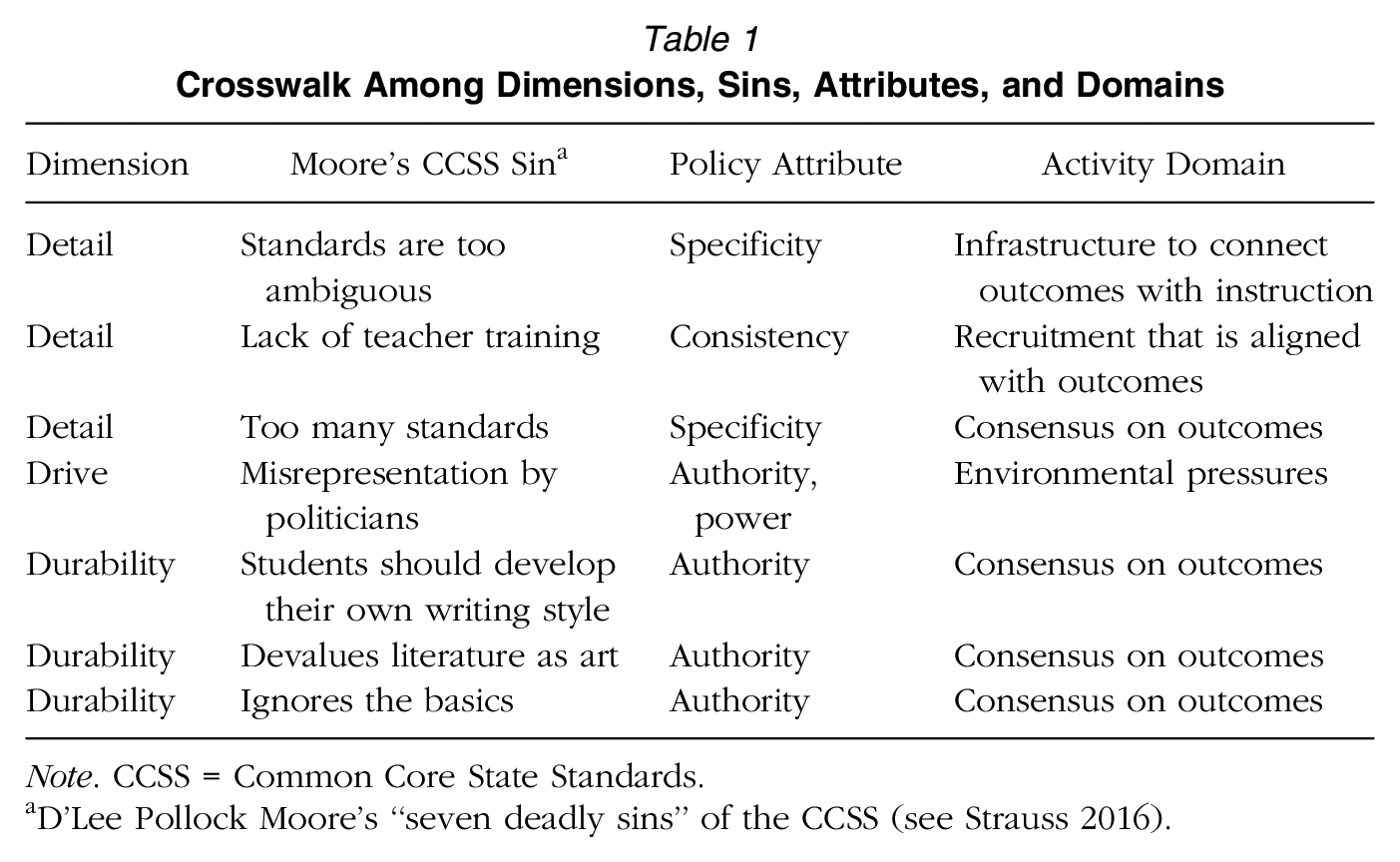
Note. CCSS = Common Core State Standards.
D’Lee Pollock Moore’s “seven deadly sins” of the CCSS (see Strauss 2016).
I also contextualize prior theory with practitioner knowledge and experience, relying on what English teacher D’Lee Pollock Moore describes as the “seven deadly sins” of the CCSS (Strauss, 2016). Using a strongly negative outlook (“sins”) on the CCSS to develop a theoretical framework may seem to skew my findings, but the inclusion of the attributes and the domains is meant to place Moore’s critiques within a broader theoretical framework. Moore’s criticism is also not an outlier among teachers, who on average no longer support standards-based reforms, according to the most recently available national opinion polling (Cheng et al., 2018) and other media sources, in particular public teacher resignation letters (Dunn, Deroo, & VanDerHeide, 2017; Edgerton, 2012). Despite limitations, this approach foregrounds a forceful example of practitioner concerns, and including Moore aims to address the lack of teacher voice in the study’s data collection.
Table 1 provides a crosswalk among the sins, domains, attributes, and dimensions. The majority of Moore’s criticisms center on the lack of consensus on outcomes, as well as conflicts with cultural values, including local historical context and basic skills, as well as the environmental pressures enacted by political elites (Cohen et al., 2018). To put Moore into conversation with Porter (1994), the implementation of the CCSS was sorely lacking in specificity, consistency, and authority.
I argue that the current state of the CCSS, which have devolved into dozens of similar state variations, was predictable through the proper analytic lens and that analyzing a policy’s detail, drive, and durability can help prevent future political backlash. Prior frameworks understate the importance of political acumen (Greene & McShane, 2018). It is not merely that there were unintended backlashes thanks to individual gaffes, such as the comment by Secretary Duncan about “white suburban moms who—all of a sudden—their child isn’t as brilliant as they thought they were” (Strauss, 2013). The primary issue, I argue, is what Mehta (2013) calls the “allure of order.” It is not enough to standardize and rationalize. In a democracy, popularity matters, as does the political process that allows policies to be “enacted with real support” (Greene & McShane, 2018, p. 50).
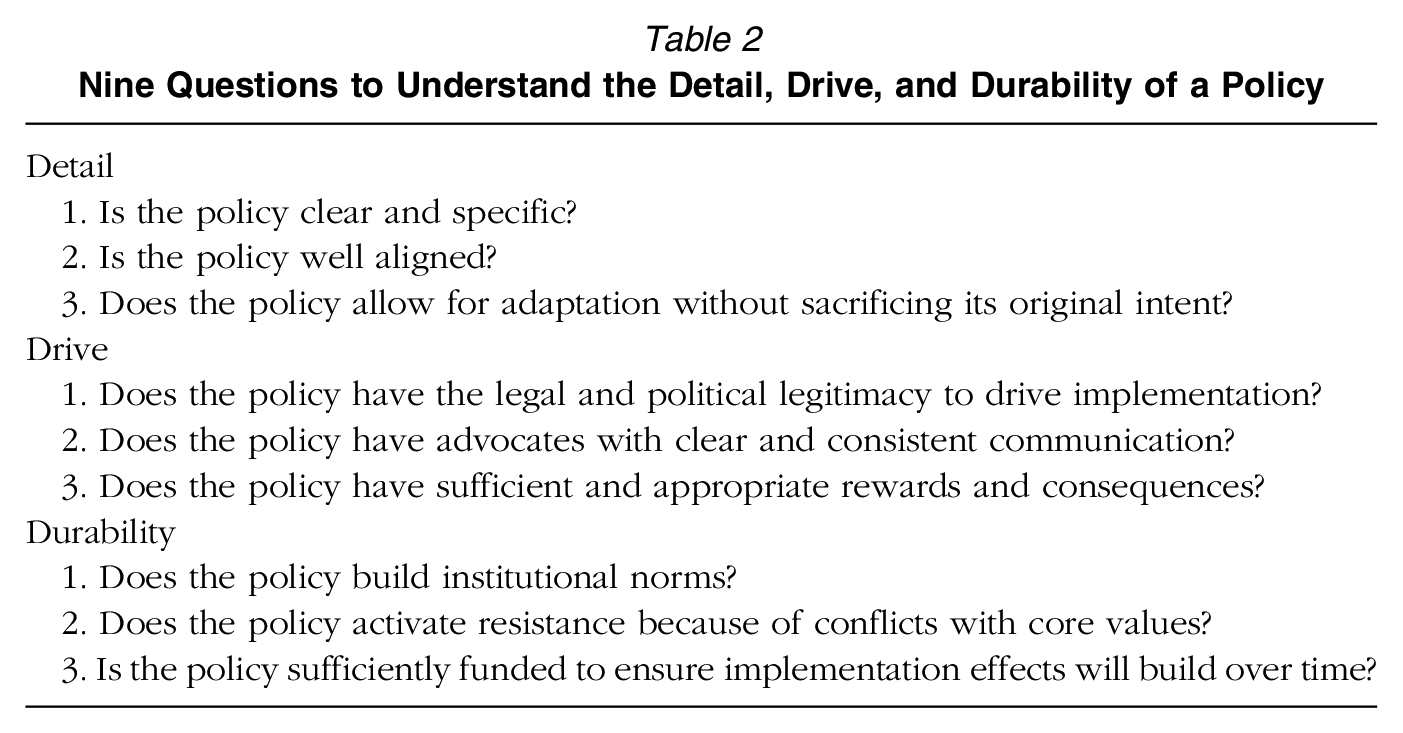
I developed the questions listed in Table 2 to guide this analysis; they are tailored to CCR standards but are intentionally general for future application to a range of education policies. To make the questions more transferable to future research, I use the phrase “the policy” in these questions instead of referring to a CCR standards–based reform specifically. I ask and answer each question in turn as it relates to CCR standards, using direct quotes from participants in 2018, which are drawn from a larger, 5-year study of standards-based reform implementation. As these participants are from partner states in an ongoing study, I avoid naming specific states in order to guard against negative overgeneralizations. But I do document the prevalence of certain attitudes.
Nine Questions to Understand the Detail, Drive, and Durability of a Policy
In addition to presenting findings, I offer alternative designs or implementation decisions that might have created a more popular regime of national standards and associated policies. I argue that these changes, some large and some small, could have altered public opinion about the CCSS. Hindsight is 20/20, but it is useful to imagine how public opinion might have been shaped to bolster the common standards movement rather than weaken it.
Methods
During 2018, a research team of faculty and graduate students conducted 52 interviews with state, regional, and district officials as part of a 5-year study of standards-based reform implementation at The Center on Standards, Alignment, Instruction, and Learning. We conducted 9 interviews in Massachusetts (MA), 12 in California (CA), 12 in Pennsylvania (PA), 10 in Ohio (OH), and 9 in Texas (TX). We selected these states because (a) they were willing to partner with us in exchange for tailored research briefs and funding to participate in multistate conferences and (b) represented a compellingly diverse portrait of the United States in terms of size, regions, policies, and demographics.
We conducted the interviews in a semistructured format, whereby we developed a protocol collaboratively but allowed ourselves to deviate from specific questions in order to ask relevant follow-ups as the study progressed. Semistructured interviews are the most common type in qualitative research (Maxwell, 2012; Ravitch & Carl, 2016; Weiss, 1995). Considering that these interviews occurred during Year 3 of a large study, this format also allowed for follow-up questions (Kvale & Brinkmann, 2009) based on the interviewers’ knowledge of the prior years’ findings (Desimone et al., 2019). This approach relies on process theory, which “deals with events and the processes that connect them” (Maxwell, 2004, p. 248) and allows for a closer understanding of the implementation of standards-based reform. By selecting individuals with positional authority (superintendents, state curriculum directors, and others), we were able to examine the thinking of leaders at the highest levels of state and local government.
The format also attempts to compensate for the reality that these conversations occurred around the country and over the phone, and across individuals with vastly differing levels of knowledge of specific standards-based policies (Cachia & Millward, 2011). To address these knowledge gaps, we also created separate protocols specifically tailored to those responsible for overseeing English language learner (ELL) and students with disabilities (SWD) policies. All the questions are provided in the appendix.
The quotes presented in this text are not meant to be representative of any state or district; they are designed only to illustrate lived experiences with standards-based policy (Ravitch & Carl, 2016). We chose respondents who were knowledgeable about standards implementation in their district or state according to our e-mail inquiries, and we selected three districts in each of our four partner states—one rural, one suburban, and one urban, in order to capture a range of geographies. In Pennsylvania, we were only able to interview in one urban district.
In the other four states, we developed a list of preferred districts that also participated in a contemporaneous survey of teachers, principals, and district administrators. We worked our way through this list, giving preference to those districts with significant numbers of ELLs and SWDs, as these student groups have too often been an afterthought within the context of standards-based reform policies. We also interviewed participants from a regional educational service center (ESC) in each state.
Data analysis took place across three stages. First, after the interviews were transcribed, the researchers coded the transcripts in Dedoose using inductive and deductive coding (Saldaña, 2015). The a priori thematic codes were the policy attributes. Additionally, second-tier codes that highlighted areas related to standards implementation (e.g., curriculum, assessments, PD, SWDs, ELLs) emerged. Over time, the research associates identified new codes that emerged from the data, and we collaboratively refined these into third-tier codes (e.g., leadership, instructional shifts). Interrater agreement was reached through a process of paired coding and group discussion (Ravitch & Carl, 2016).
The second stage of analysis involved reading across these codes to identify overarching patterns and arrive at major themes and, ultimately, a new theoretical framework. In working with the five attributes, I began to theorize reconceptualizations of them within the more recent literature. I built upon findings from a prior interview analysis conducted in 2016 (Desimone et al., 2019) and began to consider how changes have emerged over time as states and districts adapted their CCR standards policies.
After many months of discussion with colleagues on the research team and considering the frequent co-occurrence of power and authority in the coding process, I condensed the attributes into the three dimensions of detail, drive, and durability. After reading through all of the interviews (including the ones that I conducted), I examined each of the existing codes for evidence to answer the policy-relevant questions in Table 2. I frame the findings below using these subquestions to maximize accessibility to academic and nonacademic readers, to highlight findings of greatest policy relevance, and to clarify the lessons that future standards-based reform designers and implementers can learn.
First Dimension: Detail
Q1: Is the Policy Clear and Specific?
The failures of the CCSS to provide the proper amount of detail are well documented, stemming primarily from a reluctance to specify the curricula that teachers could and should use in their classrooms (Polikoff, 2017). This ambiguity is Moore’s first sin (Strauss, 2016), but many of the interviewees spoke of this lack of specificity as politically necessary. One state education agency (SEA) official stated, “We are kind of loathe to say here’s what you need to do, here’s the program you need to have, here’s what it should look like.” Across all five states, SEA officials prioritized “local control” over curricula and left these decisions to individual districts. Said one SEA official, “We’re very much a local control state, so curriculum and instruction are really local decisions.” In no SEA did officials describe a more prescriptive approach to curriculum policy.
The reasons for this hands-off approach are historical, structural, and political. Historically, battles over curricular content doomed prior efforts, such as the national history standards (Ravitch, 2001). The architects of the CCSS may have overlearned this lesson by ensuring that standards, particularly in ELA, were vague enough to avoid political opposition. According to a comprehensive review of state websites (available at c-sail.org/maps), in addition to these interviews, states provided little curricular guidance outside of a handful of model units. In fact, one SEA official was sensitive to “the long history” of being “a compliance machine,” a sentiment that appeared across interviews in every SEA. Across these states, officials were hesitant to provide curricular guidance that might be seen as too prescriptive or compliance oriented.
Because of this lack of specificity in the initial implementation of the CCSS, district-level participants described how they were still struggling to vet and implement curricula. One district official believed that the standards themselves discouraged the use of specific curricula: For ELA standards, I would say the biggest shift has been moving away from a specific curriculum guiding us and delving much deeper into the framework, and how that strategy or kind of shift in teaching is affecting not only our teachers but our students.
Here, a participant argued that the standards are decreasing, rather than increasing, specificity, which is needed to properly implement the standards, according to the policy attribute theory (Porter, 1994; Porter et al., 1988), and to connect outcomes with instruction (Cohen et al., 2018). Other district interviewees did not, however, express this extreme aversion to specific curricula. But across interviews, participants described curricular work as time intensive and requiring several years of extra effort. While one SEA did not even address curricula because of political concerns, the four others were more willing to offer some guidance, such as model units and textbook recommendations.
High-quality curricular materials are not the only means by which standards-based policy can be made clearer and more specific. Understanding the details of a multipronged policy such as standards-based reform also requires adequate and ongoing PD (Desimone, 2009). Participants revealed that during the CCSS era, there was inadequate lead-up time to the reforms and inadequate PD. As one district official put it, “There’s no preparation and no lead up to it, so it was like . . . teachers that first year had no idea what the questions were going to look like themselves, because there were no sample questions.” Another district official said, “Our teachers would want to learn by doing” as opposed to sitting in lectures. District-level participants described a desire to provide more collaborative, practice-based PD, where teachers could receive quick feedback on standards-based instruction. But while these officials remained committed to learning from prior mistakes, they seemed in many cases to lack the capacity to do so. One state-level official understood this, stating, “I think there’s one group of districts that purely does not have district-level capacity to build. They need someone to do that building for them.” Across states, these lower-capacity districts were “tiny,” meaning that they had five or fewer schools.
In these districts lacking in capacity, PD was often one-shot in nature, or it was delivered at a large state convening. One participant at an ESC said, “We also realize that those single, one-day PD sessions are not necessarily showing how to change and truly support those teachers, in terms of long-term impact to the classroom.” SEAs, ESCs, and districts with lower capacity have not been able to conduct the intensive follow-up PD needed for successful implementation of CCR standards (Kaufman, Cannon, et al., 2018). Within the context of this study, four SEAs seemed to have invested significant resources in sustained PD, but one had only recently required its districts to develop standards-aligned PD in partnership with their ESC.
In response to capacity issues, one SEA developed online PD to implement its CCR standards, including microcredentialing incentives for teachers to participate. These online courses sought to clarify how teachers should change their instruction. But the requirements for teachers of SWDs and ELLs in this state remained somewhat obscure. District officials wanted more online training for teachers of SWDs; the state offered PD primarily for general educators. One district official said, “The [PD website] does have some coursework for teachers involved, and some resources for students with disabilities, but frankly, it’s not something that we have taken full advantage of in special education.”“Taking full advantage” would mean creating a sequence of online courses specifically for teachers of SWDs. Across states, district leaders felt that they needed better PD to help teachers scaffold grade-level content for SWDs.
On average, SEA and district officials felt that they were better equipped to meet the needs of ELLs. One state made its CCR ELA standards more specific than the CCSS, which may have made the newer standards more popular. One district official stated, “What I love about the new [state] standards . . . is that they actually call out the language demand. In the past, that wasn’t done. And it really makes it very explicit that it’s everyone’s job to educate and meet the needs of English learners.” This state’s revision added clarity, compared with the relatively vague CCSS, which did not explicitly address the needs of diverse learners, according to a criticism raised by at least one ELL or SWD specialist in every state.
Not every state, however, has moved to make the CCR standards clearer and more specific. In one instance, the revisions may have had the opposite effect on their popularity. The standards in this state became too detailed; there were simply too many of them, leading to complaints in all three of this state’s districts where we interviewed. One SEA official summarized his thoughts by saying that while districts want more specificity, “it’s a very wide continuum in terms of how districts respond to the department in terms of the work that we do.” This official worried about the backlash to additional detail. Considering these varying responses, there was no consensus across the states on whether their current CCR standards were an improvement over the CCSS. SEA participants in the more politically conservative states reported some continuing resistance to standards-based reform policies, which suggests that a partisan political divide lingers.
Q2: Is the Policy Well Aligned?
A policy can be appropriately specific and yet completely unaligned with prior initiatives. The CCSS emerged in the wake of the No Child Left Behind Act of 2001 (NCLB), which mandated that all states implement relatively basic tests in English and mathematics (Mehta, 2013). RttT and the CCSS did not address the testing regime imposed by NCLB but rather focused on the rigor of the standards and, by extension, the tests. Tweaking NCLB, rather than modifying it wholesale, would seem at first glance to increase alignment over time. But in one state that changed its math and ELA tests frequently, the alignment concerns remained. The four other states, in contrast, seemed to have more faith in the alignment of standards, tests, and curricula.
Standards-based reform demands extensive alignment at multiple levels of the policy system, particularly among curricula, assessments, and tests (Cohen et al., 2018). During the initial phase of CCSS implementation, teachers had good reason to be suspicious as publishers marketed outdated books as CCSS aligned when they were not (Polikoff, 2015). One district administrator, reflecting on the past years, said “[In] our district, there really weren’t any instructional materials that were particularly Common Core aligned at that particular time. Lots of things that had a sticker on it, that said Common Core, but nothing that really helped the teachers with the shift, with pedagogy, and things of that nature.”
Most of the districts in this study, however, had moved beyond these initial problems, with the exception of the state that had frequently changed its standardized tests. A district participant in this state remarked, “We’re hearing from students and parents, ‘Well, I don’t know what I’m supposed to be studying for this test.’” Parental concerns can create political problems since families often associate standards-based reform solely with testing, even though there are many other moving parts (Supovitz, 2009). Fortunately, these alignment concerns were not present in the other SEAs, ESCs, and districts where we interviewed.
Alignment also demands the recruitment of teachers who are trained in the standards, which requires standards-aligned teacher preparation programs (Cohen et al., 2018). Some states have invested millions in teacher recruitment, according to participants. But teacher preparation requirements remain loose and undefined (Drake, Pomerance, Rickenbrode, & Walsh, 2018). Once in the field, teacher PD can be similarly vague and unaligned. To combat this problem, one SEA provided 3 years of intensive PD and on-site training to districts in need. Another SEA, however, only provided workshops using a train-the-trainer model, which is less effective than intensive coaching (Kraft, Blazar, & Hogan, 2018).
Within the context of PD, clarity, specificity, and alignment concerns consistently emerged across SEAs. These concerns were more acute when discussing standards-based instruction for ELLs and SWDs. At least one participant at every SEA stated that they were not providing enough support for SWDs in particular. If the intent of the CCSS was to craft standards that were general enough to be politically popular, this generality may have caused uneven alignment and, paradoxically, made differentiation more difficult (Edgerton, Fuchs, & Fuchs, in press). I next describe how interviewees had adapted the details of standards-based policy to suit competing interests, and whether this resulted in too much “standards deviation” (Spillane, 2009).
Q3: Does the Policy Allow for Adaptation Without Sacrificing Its Original Intent?
A policy can be clear, specific, and well aligned while remaining adaptable to local contexts and the needs of all students, in particular ELLs and SWDs. Adaptability in the case of CCR standards implementation would involve providing some curricula that teachers could also supplement. Teachers value this autonomy according to contemporaneous interviews from one of the partner states in this study (Polikoff & Campbell, 2018).
Two district administrators, however, viewed this supplementation as a negative adaptation that undermined the intent of standards-based reform. As one district official put it, “Teachers were like, ‘Well, I teach a lesson on dinosaurs, and I like my dinosaur lesson. Don’t take it away from me,’ but it didn’t match any of the standards. You know?” Rather than help teachers integrate the standards into existing lessons, the official here wanted to upend the existing curricula. Another anecdote occurred in a different state, where a district administrator expressed frustration with teachers’“clinging” to traditional practices. Though not widespread, these sentiments occurred when central office administrators felt that teachers were not responsive to new pedagogical knowledge—a common concern with standards implementation (Goodson, Moore, & Hargreaves, 2006; Spillane, 2009). According to these administrators, the two districts’ teachers were more concerned with what Moore calls “the basics” (Strauss, 2016), as opposed to the more challenging CCR-aligned instruction.
In these two instances, modifying rather than disparaging teachers’ favorite prior lessons might have helped build greater teacher support. Teacher buy-in is important to achieving a consensus on learning outcomes, according to teacher surveys, particularly among ELA teachers, where there is less consensus on what should be taught (Edgerton & Desimone, 2018). But in two of these interviews, concerns about administrative compliance subsumed teachers’ curricular preferences—in contrast to the many SEA interviews seeking to move away from compliance and toward a more supportive philosophy. This difference suggests that while these five SEAs have learned important implementation lessons, not all districts have.
Crafting adaptable standards-based policy also means adequately supporting the needs of ELLs and SWDs, particularly considering that teachers of SWDs are significantly less likely to believe that the CCR standards are appropriate (Edgerton et al., in press). The interviews revealed that this attitude may also reflect a lack of training. One participant at an ESC said, We’re not actually teaching our practitioners how to do that [differentiation]. And they’re coming, from no fault of their own because of the way things have shifted from learning how to teach from a scripted lesson plan book, to saying, the script’s out. You’re the experts. You’re going to modify; you’re going to accommodate. And they don’t know how.
This ESC official saw her work as undoing prior attempts at scripted standards-based reform under the original CCSS in order to make the CCR standards relevant for ELLs and SWDs. An official in another state lamented that differentiation for ELLs typically involved saying simply, “Here’s a bilingual dictionary.” However, an official in a different state pointed to revisions that made the CCR standards more accessible for ELLs. Thus, the SEAs had vastly different infrastructures and policies for helping ELLs and SWDs reach grade-level expectations.
I turn last to the question of whether the original intent of the CCSS has been lost through the state-level permutations of the CCR standards. I define the purposes of the CCSS using its own website: (1) “establish clear, consistent guidelines for what every student should know and be able to do in math and English language arts from kindergarten through 12th grade”; (b) “ensure students are prepared for today’s entry-level careers, freshman-level college courses, and workforce training programs”; and (3) “provide a way for teachers to measure student progress throughout the school year and ensure that students are on the pathway to success in their academic careers” (Common Core State Standards Initiative, 2019).
Though the content of some standards may have changed, the institutional logic (see DiMaggio & Powell, 1983) of standards-based reform was prevalent across all the interviews. Interviewees frequently emphasized all three of the goals listed on the CCSS website. The CCR standards have become an ever-adapting bureaucratic invention, with 5-year staggered revision timelines and multiple feedback loops. SEAs and district offices may have moved on from the CCSS-era math and ELA standards debates, but they have engaged in expanding the standards-based mind-set to other subjects. For example, one district administrator described their strategy: We’re always looking at technology [standards]. We’ll be doing more science. We have a rolling plan of what our focus is. We always have a very heavy focus one year, and then we try to circle back to some of those things every year.
The use of the term rolling frequently occurred across interviews; districts were continually “rolling out” curricula, models, new policies, procedures, and standards revisions. The CCR standards are now “dynamic and generative,” in the words of one SEA official, making them a perpetual project rather than a one-and-done policy.
Second Dimension: Drive
After attending to the importance of clear, specific, well-aligned, and adaptable details, I suggest that the drivers behind policy implementation are legal and political legitimacy, appropriate rewards and consequences, and sustained advocacy at multiple levels of the policy system. Those engaged in standards-based work can attend to these three drivers in current efforts, which participants suggested are now more focused on science and social studies than on math and ELA.
Q1: Does the Policy Have the Legal and Political Legitimacy to Drive Its Implementation?
Over the past several decades, local district authorities have been squeezed into a smaller education policymaking space, as federal and state governments impose more requirements upon them (Kirst & Wirt, 2009). This reality necessitates both a strong legal foundation and political legitimacy on the ground level. In the case of the CCR standards, legal legitimacy now must come from the state. The CCSS had the full weight of the federal government behind it thanks to RttT funding, but there remains a constitutional inability to mandate national standards (McGuinn, 2012). As RttT was not a reauthorization of the Elementary and Secondary Education Act, the CCSS and RttT lacked a long-term legal foundation while simultaneously requiring a shift from the basic numeracy and literacy tests mandated under NCLB. To secure RttT funding, states still adopted the CCSS, new assessments, and teacher evaluation laws (Bleiberg & Harbatkin, 2018). As the funding evaporated, these federally driven laws became less popular (Cheng et al., 2018).
It is no accident, then, that four of the five states in this study no longer mention “Common Core” in the name of their CCR standards. While many have pointed to this change as being more rhetorical than substantive (Coburn, Hill, & Spillane, 2016), including several participants in this study, the name change relocated the drive for standards-based reform from the federal to the state level. Presumably, the removal of the phrase “Common Core” would attract less partisan attention. As one state official said, “The political climate at that time [of repealing the CCSS] was . . . we needed to be on our own.” State-led reforms may have more legitimacy in the minds of voters, particularly among ideological conservatives and Republican voters (Kirst & Wirt, 2009; Tetlock, Vieider, Patil, & Grant, 2013).
This strategy, however, has not worked in every state, where standards remain a hot-button issue lacking in support, even without the perceived involvement of the federal government. One district interviewee said, “I can’t imagine working at the state department, especially, under our current political climate.” Another state official commented when comparing the CCSS with the state’s current standards, “I think part of the Common Core, I guess, ‘theatrical’ would be the word I would use, is that they [parents and teachers] didn’t see who was really involved. They didn’t see that it was for the benefit of [state’s] students.” A mere rebranding was not able to shift public perception in these more conservative areas.
These comments should remind reformers that political legitimacy stems from driven, charismatic advocates (Porter, 1994; Porter et al., 1988) who the public perceive to be acting on behalf of students’ best interests, above the partisan fray. For example, one superintendent was described as “one of the best [state CCR standards] advocates I know, who is out there engaging with our families and with community members to better support our students and families.” In this district, leaders built political legitimacy for standards-based reform through careful groundwork. This legitimacy took time to build. One district participant stated that it took years to “have seen the kids benefit in what they’re able to do.” One SEA official understood that building this legitimacy required at least 3 years of intensive state support for the most underresourced districts. Many states, however, did not pair support with strategic communication efforts, a shortcoming I detail in the next subsection.
Q2: Does the Policy Have Advocates With Clear and Consistent Communication?
In contrast to the individual district success stories, at the federal level, the unpopularity of Secretary Duncan may have contributed to the CCSS implementation woes. President Obama’s popularity among Republicans and certain conservative groups also nose-dived after successful partisan attacks that used the CCSS as a wedge issue (among many others) (Druckman, Levendusky, & McLain, 2018; Polikoff et al., 2016; Supovitz, 2017). In addition to the federal role, successful CCR standards implementation requires consistent advocates at lower levels of the policy system. Those with positional district leadership, including superintendents, can make or break the implementation of standards-based policy (Marsh & Wohlstetter, 2013; Sharratt & Fullan, 2009; Supovitz, 2006). In analyzing these interviews, I uncovered how advocates at state and regional levels have learned to create communication infrastructures that outlast themselves. Robust communication among administrators, teachers, students, and parents was key to building public support for the CCR standards. This finding is not all that surprising, but it does highlight the limitations of even the best-designed policy without sustained communication at all three levels—state, regional, and district. Federal communication concerning educational standards, in contrast, may be more harmful than helpful, as it has carried the threat of compliance since NCLB (Desimone, 2013).
While three SEAs in this study learned from their mistakes and created clear and consistent messaging through regular communication, two SEAs appeared mired in the past. Some still had not developed communication plans for their state’s CCR standards. One SEA official said, “But as soon as we have a communications strategy, I’ll be happy to share that with you and let you know how we’re going to do it.” Communication infrastructures also remained unidirectional in many instances. For example, no SEA official could speak to organized data collection analyzing which curricula districts chose to adopt. This communication breakdown prevented states from effectively driving policy details. One official said, “So everybody uses, there could be 1,000 different ones [curricula] out there. I don’t know.” A district official in the same state described the SEA as a “black hole” where information vanishes, never to return. Also in this state, officials realized that practitioners did not have a common working definition for what constitutes “curricula.” One official said, “We need to define this better” so that curricula would be more than “a scope and sequence from Pearson.” These were the two most damning instances of poor communication.
Not at all participants, however, felt that there was poor communication around CCR standards. Others highlighted how they have improved stakeholder feedback mechanisms and included more teachers in policy conversations. New communication strategies in these states ultimately sought to highlight the benefits of CCR standards policies to students and families, especially when it came to accountability plans. One SEA official stated, “The public campaigns to revise our accountability system were pretty comprehensive,” and they included “other public menus and presentations and feedback sessions that were open to anyone.” SEA officials across states attributed these changes to the feedback requirements under ESSA, NCLB’s replacement.
ESCs seemed more adept than SEAs at service-oriented communication as they were already acting as intermediaries between SEAs and districts. One ESC participant described this infrastructure: We have [state] work groups that are ongoing, and the service center is able to participate in those work groups in order to understand the changes to the standards, and then how that applies because of a deep understanding of those standards . . . then be able to communicate that out regionally to all of our customer districts.
The use of “customer” here reflects a service, or supportive, mentality toward CCR standards implementation. The final drive question confronts this central issue of how to incentivize implementation.
Q3: Does the Policy Have Sufficient and Appropriate Rewards and Consequences?
Though many have sought to separate the question of accountability from K–12 standards, the two are inextricably linked in the minds of most because of RttT and partisan political media that conflate multiple education policies (McGuinn, 2012; Supovitz, 2017). The research team asked all the participants how they were rewarded or punished for implementing standards. Across the district interviews, the participants did not describe positive rewards, but a few referred to negative consequences for teacher and school performance on state CCR tests, which narrowed their focus. One district official said, “We don’t have time for that [cultural competency] because what we’re rated on are our academic scores.” Punitive consequences, however, have diminished over time (Desimone et al., 2019; Edgerton, in press), and only two district administrators brought up accountability concerns.
RttT encouraged states to create rewards and consequences around teacher evaluation systems, which four out of the five states in this study adopted (California being the exception). Across the country, states followed the lead of major urban areas in adopting rewards and consequences for student achievement measures (Bleiberg & Harbatkin, 2018). The unintended consequences of holding teachers accountable for student achievement are well documented and researched (e.g., Booher-Jennings, 2005; Coburn, Hill, & Spillane, 2016; McNeil & Valenzuela, 2000; Supovitz, 2009). On the other hand, proponents point to some student achievement gains during the RttT and CCSS era (e.g., Alexander, Jang, & Kankane, 2017), though few studies found similar positive results (see Polikoff, 2017, for a review; Song et al., 2019). In short, the appropriateness of test-based accountability is an ongoing debate, but a clear majority of the general public remain supportive of it, according to national opinion polling—which stands in stark contrast to teacher opinion (Cheng et al., 2018).
Less discussed is how the drive to use accountability to incentivize CCR standards implementation has not always increased standards-based practices around assessment data. This concern surfaced across the districts’ interviews in one of the states. A district participant said, So we get tons of data, we get a horrible report card, and then they [the SEA] don’t speak to you about it for another year unless you have schools on a list. And then your schools are put on a list. But I never feel like they actually talk to us about what does the data say? What are we noticing? Here’s some feedback for you around the data. I don’t see it that way.
In this case, the consequences were not effective at boosting support for standards-based policy because they were not paired with substantive feedback. Clearly, this SEA had not learned the lessons of the NCLB era, much less the CCSS era.
However, district officials in other states described more positive experiences with accountability. One rural district in particular welcomed the supports provided through the state turnaround process. And two states have responded to accountability concerns, specifically an overemphasis on student proficiency, by introducing multiple measures such as student growth and chronic absenteeism (Edgerton, in press). By using more comprehensive measures of school quality, advocates of multiple measures hope to build greater consensus on educational outcomes (Cohen et al., 2018; Schneider, 2017). Despite some concerns about making accountability too complex for families to understand, multiple measures seem to be popular, according to the limited state polling on the issue (Policy Analysis for California Education, 2018). These new systems may lead to a perception that rewards and consequences are more appropriately designed in the CCR standards era, which can build policy durability.
Third Dimension: Durability
Q1: Does the Policy Build Institutional Norms?
Even when policies have sufficient drive in the beginning, policy durability depends on multiple individuals willing to sustain implementation, a requirement that can be particularly difficult in organizations with high staff turnover. Policies that endure and build institutional norms require constant check-ins, modification, and collaboration (Bryk, Sebring, Allensworth, Luppescu, & Easton, 2010; Elmore, 2000; Spillane, 2009). I found encouraging evidence of norm building across interviews, particularly at the regional level. ESCs in all states wielded institutional knowledge of CCR standards implementation to design active, ongoing PD in order to foster building-level and district-level norms.
At the district level, results were again more dependent on capacity. Larger districts with higher capacity (fiscal resources, human capital, or strategic capacity) were better able to cultivate new standards-based norms. For example, one urban district official said, “I have an expectation, and I require the follow-up. Any time we deliver professional development, they have to have, within 10 days, a half-day check-in . . . either we’re going in to them, or they’re coming to us.” Sustaining reform beyond individual leadership requires the creation of these types of institutional norms, as standards implementation demands a lot of human capital. Another urban official said, “It’s a capacity issue of how do I now find the bodies who are normed to go in and see it, and to validate, ‘Yes, practice changed.’” There are no shortcuts to cementing this type of institutional durability.
The CCSS demanded more rigorous standards of all public schools; some pre-CCSS standards in our study states were far less rigorous (see Carmichael et al., 2010, for a comparison). Similarly, the sheer difficulty of the newer CCR-aligned tests challenged some institutional norms. One regional official commented on their new state test: “I mean, I had a graduate student who gave it to all of her third graders and none of them passed it. They’re all native English speakers. . . . It is a difficult test.” In addition to the difficulty of achieving the more rigorous standards, current CCR standards may still butt up against traditional notions of what should and should not be taught at certain grade levels. I discuss these culture clashes in the next section.
Q2: Does the Policy Activate Resistance Because of Conflicts With Core Values?
District leaders are continually reconstructing state education policy (Daly & Finnigan, 2011; Woulfin, Donaldson, & Gonzales, 2016) while they accommodate the institutional memories of their teaching force (Goodson et al., 2006) and navigate emotional networks (Fullan, 2016). Murphy (2004) states, “Wherever schools become battlegrounds for partisan moral and religious agendas, the whole ideal of common schooling loses public support” (p. 264). The idea of setting only academic standards, instead of specific curricula, is meant to circumvent this political dilemma. But for the reasons previously discussed, the CCSS still activated partisan political resistance. In many cases, state officials did want to provide more specific support but came into conflict with cultural values. In particular, there were significant urban-rural tensions. As one state official said, If we step in too much then we get that pushback to say, “You don’t know my district. You don’t know my community. You don’t know what the real causes of my failures are, my bad letter grades. You should stay out of it. My community knows best, and my local board, my local teachers.”
Considering these tensions, SEA officials were frequently engaged in a precarious balancing act.
When the CCR standards do challenge existing assumptions about students, teachers need to experience student success. Research frequently emphasizes that teachers respond to intrinsic rather than extrinsic motivation (e.g., Firestone, 2014). One district participant said, Because a lot of our students come from traumatized backgrounds, really tough home lives, and so I think in a sense teachers try to be empathetic, but in doing that they almost had been . . . lowering their expectations because of that. When in reality, once they heightened them, the students rose to the challenge. And they realized they [students] could do a lot more than what they initially thought.
Meaningful learning outcomes, in this case, allowed the practitioners to feel successful at implementing the CCR standards. These outcomes for the teachers were observable, in-class student learning. Understanding and accounting for these core motivators may help preserve policy durability and lessen backlash.
Finally, providing practitioners with choices may help diffuse some of these conflicts. When discussing PD, one participant said, “We responded to a lot of surveys that were taken and a lot of interview work that was done in the district that revealed that people want to have some choice and ownership over what they learn” about CCR standards. Successful districts provided a suite of PD options and opportunities for teachers to collaborate across subject areas.
Q3: Is the Policy Sufficiently Funded to Ensure Implementation Effects Will Build Over Time?
Even if resistance to change is overcome, a policy needs predictable funding to endure. Both states and districts have to determine funding priorities, and their cumulative funding commitments over time determine the durability of a policy. The implementation of state standards has often relied on one-time cash infusions to provide teachers with a large dose of PD in a single year (McGuinn, 2012). This theme appeared frequently across interviews and state lines. Participants knew that providing PD funding for a single year can be inefficient in an environment of high staff turnover. Many participants spoke positively about earlier experiences funded by the SEA. But in four out of five states, financial commitments faded over time, or they were reallocated toward new subject areas and priorities, including history and socio-emotional learning.
These shifts meant less attention paid to math and ELA—a trade-off that distressed participants in lower-performing districts. In one large urban district, an administrator described making budgetary decisions as having “to put a stake in the ground somewhere. I’m a middle school math teacher, so you can sell me all day, every day on why we need to do more math PD.” But math PD was not a funding priority in this district, and neither math nor ELA was the primary focus of recent initiatives. One SEA official in this state complained, “There’s zero funding for English language arts. That is our big frustration right now, so there is no statewide PD, there is no common body of knowledge that teachers in the state are learning.” It is alarming to hear this concern expressed nearly a decade after this state’s initial adoption of the CCSS.
Though other SEAs could point to a common body of knowledge, ongoing standards-based PD for math and ELA is now competing with other priorities. Time constraints present a major challenge in districts where PD is contractually limited to a few days by collective-bargaining agreements. An ESC participant who trained teachers on the CCR standards stated, “It’s not lightning quick progress, like, this takes time. We’re talking about human beings, and their brains, and this doesn’t just happen instantly.” Other districts were more successful at making use of limited funding without sacrificing durability. But most districts felt that they were receiving less PD funding for CCR activities.
Considerations in Interpreting the Results
I pause here to reemphasize the limitations of this study design: Only five states are represented and only 13 school districts. But these states do cover a range of policy environments (see c-sail.org/maps for a comprehensive review of these policies). These states also run the political gamut from those still willing to refer to their standards as Common Core (California) to those that were deeply suspicious of them in the first place (Texas). They represent states that have struggled with standards repeal and the ensuing confusion around rapid policy changes, and they include RttT winners and losers. We were not, however, able to include any states from the bottom tier of national achievement rankings according to Education Week (2018). Considering these limitations, these results represent perhaps a more positive outlook on CCR standards–based policy.
Another major limitation is that the original study design did not include teacher interviews, which are now being collected through targeted site visits in each state. I have attempted to compensate for this lack of practitioner perspective by incorporating Moore’s critiques (Strauss, 2016). Related survey analysis suggests that teacher attitudes across these states are quite similar, though there are significantly more negative perceptions of CCR standards in those states that have made more frequent policy changes (Edgerton & Desimone, 2018). But overall, the remarkable sameness of the perceptions of teachers, principals, and superintendents across these states is a testament to the power of social media and national political coverage to shape attitudes toward the standards (Cheng et al., 2018; Edgerton & Desimone, 2019; Supovitz, 2017). This nationalization of education policy makes a politically minded theoretical framework all the more important to future policy research, particularly when local actors are left alone to implement the CCR standards.
Conclusion
By using three dimensions to compare CCR standards policy implementation with CCSS-era efforts, I reveal how omitting key details—curriculum examples and long-term PD infrastructures—may have doomed the popularity of the CCSS from the start. These omissions compounded over time and were worsened by incoherent messaging. States and districts are now learning from these mistakes in fits and starts. This institutional learning depends on their leadership and capacity, making local decision making more influential (Marsh & Wohlstetter, 2013). The CCSS may have been successful at making individual state standards more similar over the long term (Porter et al., 2011) and at making teachers’ perceptions similar across some of the states in this study (Edgerton & Desimone, 2018). But the CCR standards certainly are not popular among teachers (Cheng et al., 2018). And one of the core problems that the CCSS was meant to solve for education researchers—the lack of a norm-referenced multistate test aside from the National Assessment of Educational Progress—has not been solved.
As for drivers, the CCSS also needed more charismatic individuals and more appropriate rewards and consequences. Here again, states are both learning from and repeating mistakes, as not all have embraced multiple measures or developed coherent communication plans. More recent CCR standards efforts have avoided designating a clear political figurehead in the mold of Secretary Duncan. Implementation work happens more quietly and behind the scenes. As for rewards and consequences, states and districts have avoided creating new incentives for new CCR standards, but many have left their existing RttT-era policies in place.
Standards-based reform is now driven at the state, regional, and district levels. This development carries both positive and negative consequences according to these interviews. Districts have had to pick up the slack as federal and state governments have withdrawn. Some have the capacity to do so, while others struggle or choose different priorities. Many have since turned their attention away from ELA and math and toward science and social studies, suggesting that the institutional logic (DiMaggio & Powell, 1983) of standards-based reform persists despite political challenges. It is hard to imagine “standard-less” education. The issue remains who or what has the legitimacy to impose standards? And who should construct them? Through interview analysis, I have described how states and districts have incorporated more stakeholders, diversified advocates, and simplified messaging. In short, they are sweating more of the details and avoiding sweeping rhetoric, and they are investing in new drivers for standards-based reform across a more diverse array of subject areas.
These improvements may bode well over time for each state’s CCR standards despite the instability of the 2010s. But the reliance of the CCSS on one-time RttT stimulus funding, used to sustain structures like the Partnership for Assessment of Readiness for College and Careers, was an initial design flaw. A sustained effort at standards-based reform is not compatible with a metaphorical shot in the arm or a flurry of PD in a single year, as participants repeatedly emphasized. Finally, the CCSS activated core cultural values about the purpose of education, over which Americans continue to disagree. Unlike NCLB, which focused on a basic adequacy standard (see Satz, 2007), the CCSS assumed a set of skills needed to compete globally. This mentality differs dramatically from that of much of rural America, as the CCSS are disconnected from rural realities and economic opportunities (Yettick, Baker, Wickersham, & Hupfield, 2014). The inclusion of a career focus in the CCR standards aims to address this deficit, but participants were not able to point to concrete examples of career readiness.
We will always be debating what is taught in our schools, how, and by whom. But we should be able to build a solid theoretical foundation for predicting what might sink future efforts by listening to the voices of policy designers, implementers, and practitioners. It is not that the federal and philanthropic architects of the CCSS and RttT did not consider the details, the drivers, and the durability of the reform. It is that they failed to anticipate the political backlash from each of their design decisions and make course corrections in response to changing political conditions.
When tasked with implementing the latest CCR standards, districts have stepped up to the plate, but they still must grapple with familiar capacity constraints and competing demands. In the current political environment, perhaps deference to local control is the only means by which to avoid backlash. In spite of these ongoing challenges, researchers can use this framework to help predict political backlash and advise policymakers accordingly. We can closely and explicitly examine these political factors instead of brushing them aside, which will add valuable context to future implementation studies. We do not have to learn “the same lessons over and over again” (Coburn, 2016, p. 473). Finally, should a policy window open at the state or federal level, policymakers can use these lessons to think more carefully about the appropriate level of detail and the drivers necessary to craft durable education policies.
Footnotes
Appendix
This appendix provides all the interview questions posed to the participants in a semistructured format. The research team collaboratively developed and internalized these questions prior to conducting the interviews in order to facilitate productive and authentic conversations. “SWDs” stands for students with disabilities, while “ELLs” stands for English language learners.

Notes
A