







Abstract
Scholars in distinct academic disciplines may examine the same or similar phenomena, often relying on concepts that are well known within each discipline. In this article, we examine two related sociological concepts—capital and adaptive preferences—each used to explain young people’s choices and aspirations. We make the case that integrating the philosophical concept of the “social context of choice” into analyses using “capital” or “adaptive preferences” provides an interdisciplinary approach to analyses of underrepresented students’ educational choices and aspirations in higher education, beyond what each concept provides alone. We ground our philosophical examination in data from a 2-year empirical study of an educational access and outreach program for low-income students.
Introduction
One thing that we are consciously, intentionally doing is teaching them [students] middle class culture. Because we don’t want to take away their original culture. We want them to be bicultural in that way, in a socioeconomic way; we are trying to teach them how to succeed in a middle-class culture so that they can succeed in our society . . . what they have to deal with when they’re not at school or with us is their biggest obstacle . . . It’s a whole approach . . . just understanding poverty, the culture of poverty, what are the typical obstacles that–or challenges–that keep people in poverty . . . They are going to examine their own poverty and figure out what it is that they want first of all and then what obstacles are there to getting what they want so and then they make their own personal choices . . . (Wendy, ASPIRE executive staff member)
Soft-spoken and caring, Wendy leads all programming for a regional branch of the “Achieving Success, Participation, & Independence through Relevant Education” (ASPIRE) program. 1 ASPIRE is a national outreach and college access program with independently run local organizations intended to increase academic achievement and expand higher education access and opportunities to low-income students, most of whom are also students of color, recent immigrants, or emergent bilingual learners. The ASPIRE program has three core areas of emphasis: (1) Academic Skills, (2) Emotional Intelligence and Relationships, and (3) Life Skills. It provides after-school and enrichment programming for cohorts of low-income students, ages 8–23 years, grouped in a certain school or residential community. The approach centers on building the student participants’ relationships and social skills, and partnering with families; high school graduation and postsecondary education are the program’s two main goals, making it a relevant context in which to study the concepts of capital, adaptive preferences, and social contexts of choice related to educational aspirations. In education settings, the three concepts are linked in that they each pertain to a student’s options, opportunities, and possibilities. The idea of capital is characterized by less tangible assets students may or may not possess. By adaptive preferences, we mean wants and desires that evolve to fit what a student sees as possible for their life. Similarly, the social context of choice focuses on the circumstances under which students learn about their life options. Given the context of our larger study and our interest in these three concepts, we were able to use an analytical approach known as empirically grounded philosophical inquiry to study the ASPIRE program (Wilson & Santoro, 2015).
ASPIRE is one of many access and outreach programs providing academic and social opportunities in the hopes of supporting student learning and persistence, reducing achievement and opportunity gaps, and improving educational attainment and student mobility (National Association of College Admission Counseling, 2018). Educational access and outreach programs generally exist to improve opportunities for students whose opportunities have been limited by social contextual factors such as underfunded and low-quality schools, though specific goals differ by program (Auerbach, 2004; Bowman, Kim, Ingleby, Ford, & Sibaouih, 2018; Granger, Durlak, Yohalem, & Reisner, 2007; Millett, Rojas, & Kevelson, 2018a, 2018b; Ng, Wolf-Wendel, & Lombardi, 2014; Stanton-Salazar, 1997, 2001). Research on outreach and college access programs has tended to describe factors such as participant characteristics, what services programs provide, and effects on academic achievement (Gándara & Bial, 2001; Granger, 2008; Millett, Rojas, & Kevelson, 2018a; Perna, 2002; Swail, 2000; Tierney, Corwin, & Colyar, 2005). In addition, research has addressed how relationships students forge in college access programs influence their educational outcomes. Indeed, such relationships have a strong, positive impact on participation in higher education (Auerbach, 2007; Ceja, 2006; Deil-Amen & Luca, 2008; Gándara, 1995; González, Stoner, & Jovel, 2003; López-Turley, 2006). These findings demonstrate the power of college access programs like ASPIRE that focus on social relationships as part of program goals for participants. Yet the relationships may also put pressure on young people in particular ways. Program staff may create dynamics in which students are forced to negotiate cultural identities and expectations in ways that could enable or constrain students’ choices and self-determination. This may be even more so the case when staff ideologies reflect savior or paternalistic helping orientations.
However, studies of college access programs often do not use interdisciplinary frameworks to conceptualize the research or help make sense of data on educational access and outreach, thus limiting the complexity of analyses of programs that may have conflicting aims or difficult contexts. In her study of an academic achievement–oriented after-school program geared toward Black young people, Baldridge (2014) provides an example of a program with complex aims and contexts. She examines how staff members negotiated complex tensions between helping and “saving” young people, that is, between expanding students’ opportunities and showing them the “right” way to behave in order to conform to school expectations. In our study, tensions surfaced between critiquing dominant notions of school reform and achievement gaps and holding students to dominant ideas of educational achievement and attainment so that they could access higher education. Baldridge shows how the staff negotiated such tensions in order to “reimagine Black youth as whole, gifted agents of change who need to be nurtured and supported” (2014, p. 465) despite the constraints of the program and the larger neoliberal politics of school reform and achievement gaps.
The Larger Study
Two research questions guided data collection and analysis in the larger study: “How do parents, students, and staff perceive the ASPIRE program and the program’s impacts?” and “How is ASPIRE doing with regard to its three areas of emphasis?” The study was primarily qualitative, drawing on interview and observational data sources. The dataset included observations from site visits and of staff training sessions and meetings; interviews (individual and focus groups) with ASPIRE students, families, and staff; and organizational documents and artifacts. 2 Our intention was to understand how different stakeholders perceive and experience the program. The five members of the research team conducted interviews with ASPIRE’s central staff, 3 program directors at each site, 4 volunteers at each site, and participants and their family members. Observations included a variety of ASPIRE program sessions, staff meetings, and training sessions. For example, we observed participants and staff at after-school programs, student recognition events, full staff meetings, and volunteer training sessions, totaling over 30 observations. Our analytical approach for this article—empirically informed philosophical inquiry—draws on empirical examples from the larger study to investigate and illustrate philosophical concepts and ideas (Wilson & Santoro, 2015).
Federal and state school reforms focusing on reducing achievement gaps through high-stakes testing shaped the social context for the ASPIRE program. Like in the program Baldridge studied, ASPIRE staff had to negotiate between dominant, middle-class social and cultural norms and the students’ home cultures. For example, the program director placed a high value on “middle-class culture” and felt that it was important that students make “personal choices” as a means to escape the “culture of poverty.” Wendy expressed the program’s desire to “teach students how to succeed in a middle-class culture,” suggesting that students came into the program lacking what was needed for educational success. Similarly, Chip, one of the staff members with whom we spoke, said that the program aims to build students’ life skills and appreciation for education so that they know that that is the best way to lift themselves up from the position as low-income students at this point, that they need to embrace education as the way to get out of that, to change their societal norms and what they believe in.
Such statements suggested that ASPIRE staff perceived students as in need of help and that students must divest themselves of their norms and beliefs in order to be successful in schools steeped in the dominant culture. Chip highlighted how ASPIRE helps the participants gain skills and focus on their education, yet he talked about this social position as one they have “to get out of . . . to change . . . what they believe in.” Chip was in his second year working for Wendy at ASPIRE.
In our 2-year study of a regional ASPIRE program, we came to know Wendy, her supervisor, and her program staff as well-intentioned, hardworking advocates for their ASPIRE students. Yet both Chip’s and Wendy’s comments above demonstrate their focus on “middle-class culture” and on “personal choices,” emphasizing that ASPIRE participants needed to change in order to succeed. These ideas, coupled with most of the staff members’ social location as White and middle-class, encapsulated a tension we examined in the larger study: How do staff at college outreach programs (often middle class and White) work with low-income students (often students of color) to help them succeed in school, while not imposing hegemonic values and practices as if those values were inherently superior to the ones students may learn at home and in their communities? It is against the backdrop of the larger empirical study that we endeavor herein to make the case for interdisciplinary conceptual foundations in order to study college access programs.
Understanding Conceptual Foundations
ASPIRE and other programs like it serve thousands of young people across the country (Bowman et al., 2018), yet the conceptual tools available for studying their impacts are limited. Two prominent social science 5 concepts—capital and adaptive preference—can be used to explain the choices and aspirations of students who have disproportionately low educational attainment. Scholars in distinct academic disciplines may examine the same or similar phenomena in policy and practice, often relying on concepts that are prominent within each discipline, yet possibly overlooking the ways in which concepts from other disciplines may enhance their analyses. Germane to the issue of students of color and low-income students’ educational choices, aspirations, and opportunities, for example, sociologists often use “capital” as a framing concept (Bourdieu & Passeron, 1977; Coleman, 1988; Lanford & Maruco, 2018; Lareau, 2011; Mullen, 2010; Yosso, 2005). Similarly, scholars focusing on international contexts use the concept of “adaptive preference” to help them analyze how and why members of marginalized communities might make certain choices (Hakim, 1998; Hallerod, 2006).
In a meta-synthesis of 12 qualitative studies on how nonparent family and community members may affect the (social) capital of students who are underrepresented within higher education, Mwangi (2015) noted that most of the studies used theories of social or cultural capital as a conceptual framework. She argued that researchers should also use conceptual frameworks that value nontraditional forms of knowledge and family engagement in students’ education and lives. The reason why some social locations—for example, being Latinx 6 or having low wealth—are less valued than others is because of the legacy of classism, racism, and unjust power relations (Bonilla-Silva, 2013). Historically, propertied, White men conferred value onto certain ways of being in U.S. society (Pease, 2010). Thus, in schools, arbitrary factors such as students’ race, ethnicity, culture, class, sexual orientation, gender identity, or native language may have a profound and pervasive effect on students’ social context of choice including their beliefs about value, educational aspirations, and views about the good life (Moses, 2002).
The concepts of capital and adaptive preferences offer educators and scholars a way of understanding how students’ individual decisions may be influenced by key networks and early proclivities; however, they do not emphasize adequately the social context within which students are developing their social networks or educational and career preferences, and consequently, their educational choices and aspirations. As such, we argue that there may be a need for an interdisciplinary perspective that integrates the concept of “social context of choice” from philosophy into analyses that also use “social capital” and “adaptive preferences,” but none have yet done so. A question thus remains as to how such an integration of key sociological and philosophical concepts might affect how scholars examine students’ educational choices and aspirations.
As ASPIRE’s executive staff member Wendy explained above, organizations working with low-income youth may be aware that by teaching their students how to act in dominant, “middle-class” ways, they may be threatening students’ connections to their home cultures. “We don’t want to take away their original culture,” Wendy said. Instead, she explained, staff members want to assist students with “being bicultural and helping them learn middle-class culture and rules and structures . . . shaking hands, looking in the eyes.” She was well aware of the first tension we described above— between teaching students the dominant skills and values that could foster success within an unjust system and raising up those skills and values as inherently better than what students may learn at home. Similarly, the chief executive staff member, Nora, exemplified how difficult it is to navigate this tension, as she acknowledged the reality of students’ families’ limited resources, while explaining how she thought those limitations affected the ASPIRE students: just the economic situation that they’re in and not having the resources at home, many of their, their parents have not—we were just so surprised when we asked the parents when they first signed up for the program how much education they had achieved themselves and how low that was, so a lot of their parents haven’t done that so (they don’t have) the role models and the parents aren’t able to support that at home so that’s one of the challenges that we’ve really tried to address.
Our data thus raised the issue of how educators can examine and understand students’ choices with this difficult tension in mind.
Motivated to tackle this interdisciplinary puzzle, we sought to understand how conceptual foundations of research within the social sciences (i.e., capital and adaptive preference) could be applied in the context of college access research in concert with a concept more often used in philosophy (i.e., the social context of choice). In particular, we wondered how integrating key sociological and philosophical concepts might affect examinations of students’ educational choices and aspirations. To situate these questions within the larger study, we drew on qualitative data we collected at an ASPIRE program during 2012 and 2013. As such, herein we engage in philosophical inquiry that makes liberal use of examples from empirical data that serve to ground the more abstract philosophy in real-world occurrences and situations. As a philosopher and a sociologist, we hope to provide new analytic tools for education researchers and practitioners to use in research and theory building related to educational outreach and college access programs. More broadly, we also hope to use philosophy to advocate for a richer way of framing and understanding how students from communities that are underrepresented within higher education develop their educational aspirations and make choices for their education.
In the next section, we lay out the theoretical perspectives that most often use the concepts of capital, adaptive preference, and the social context of choice, and define each concept. Then, we examine how these concepts function to explain students’ educational choices and aspirations, using the context of the ASPIRE program to illustrate our arguments. We conclude by offering several suggestions for using this theoretical framework.
Integrating Different Disciplinary Concepts
We bring together three distinct but related key concepts from sociology, international development (including economics and political science most prominently), and philosophy: capital, adaptive preferences, and social contexts of choice (Bourdieu & Passeron, 1977; Khader, 2011; Kymlicka, 1991; Moses, 2001). Each of these concepts is well known within its respective scholarly discipline, provides an important lens for examining inequalities, and is related conceptually to the kinds of opportunities people have in society. However, as is sometimes the case in education research and scholarship, philosophical concepts used in the social sciences may be less visible than their sociological counterparts. In addition, the three concepts highlighted herein rarely cross disciplinary boundaries. When they do, it is usually philosophers who integrate the social science concepts into their philosophical work and not vice versa (e.g., Bridges’ 2006 and Nussbaum’s 2001 use of “adaptive preferences”). Before proceeding any further, it is important to acknowledge that the disciplinary distinctions we draw here are not as tidy as this suggests. Rather, there are overlaps between disciplines and fluidity of concepts. In this article, we purposefully draw sharper distinctions between these concepts to make clear how we are integrating capital, adaptive preferences, and social contexts of choice together for greater analytical power.
There is a subtle difference between how scholars generally use each of the three concepts to explain the phenomena of students’ educational choices and aspirations. Specifically, the concept of the social context of choice emphasizes how social systems and structures affect what students see as possible for their education and their lives while moving beyond individualistic, deficit-oriented frames in which students and families may be blamed for “poor” educational choices or “deficiencies” in social or cultural capital (Kymlicka, 1991; Lareau, 2011; Michael, Andrade, & Bartlett, 2007; Moses, 2002). What counts as desirable capital may be characterized through a complex deficit perspective on students and families, one that raises up the individual (Rubin, 2007; Yosso, 2005). This was evident at ASPIRE, where Nora, the chief executive, noted, We really started saying, look we need to look at individuals and really develop those individual goals. And we have so many factors with the students you know their home life, their special education needs because we accept kids at all different—you know we just—we cast the net and all the kids in the grade level or living in a housing site, we have just ranges of kids, of their abilities and needs and resources and home life situations, so we then we started moving toward each year developing individual goals for each individual student in those three areas and so then we can report back and say, . . . success can look so different depending on the student and their abilities and their resources and all that, so we just want to make sure that each student rises to their abilities and their potential.
Yet beyond focusing on each individual student rising to “their abilities and their potential,” attention to systems and processes that may affect students’ abilities, potential, preferences, expectations, and meaningful opportunities (Anderson, 1999; Moses, 2002; Warnick, 2009) would provide conceptual resources for designing and evaluating effective outreach and interventions.
Capital
Sociologists commonly rely on the concept of capital to explain persistent inequality in educational access. Capital most centrally includes both social capital and cultural capital. Portes (2000) calls the concept of social capital in particular “arguably one of the most successful ‘exports’ from sociology to other social sciences and to public discourse” (p. 1). We define social capital as the social networks and information that persons can access readily through their family and community (Bourdieu, 1986; Coleman, 1988; Portes, 2000). In education, social capital is evident when students have the social networks to access opportunities and resources that are conducive to educational achievement and attainment (Coleman, 1988; Lareau, 2011). The concept refers to both accessing valuable opportunities and resources and to the activation of them (Lareau, 2011; Lin, 2001).
Cultural capital includes language, dress, behavior, and mannerisms that are important for students’ educational engagement and aspirations. We base this on Bourdieu’s (1977) definition of cultural capital as the ideas, capabilities, knowledge, and general ways of being that parents pass on to their children. Bourdieu’s classic work indicates that the development and use of both social capital and cultural capital are connected with power and privilege, invariably serving to benefit dominant groups and maintain the status quo (Bourdieu & Passeron, 1977). Portes (2000) challenges this argument, however. He posits that the benefits of social capital for children’s performance and success may be questionable when controlling for other relevant factors. Portes sees alternative explanations as equally plausible in bringing on those benefits. He notes that social capital can be intentionally built up. Indeed, this is one of ASPIRE’s expressed goals. Together, social and cultural capital affect individual students’ choices and aspirations in a way that both grows out of and reinforces students’ positions within educational opportunity structures (Bourdieu & Passeron, 1977).
Coleman (1988) expresses the more individualistic idea of social capital as social networks and ties that facilitate individuals’ access to valuable social resources. This interpretation is consistent with outreach programs like ASPIRE, which tend to operate from the assumption that absent some intervention, individual students’ lack of valuable and valued capital relegates them to diminished educational opportunity. At ASPIRE, staff seemed to embrace Coleman’s interpretation. Wendy’s comments suggested they viewed “middle class values” as encompassing both social and cultural capital, which they believed individual students could be taught to develop. Furthermore, they seemed to view success in individualistic terms as well. As Wendy described, ASPIRE “depends on the individual child—needs, skills, etc., to make academically successful students and addressing . . . programs, support, relationship, usually all of these; afterschool programs, fieldtrips, but all comes back to individual kids; what is the success plan for each kid?” Consider further that when we asked ASPIRE program staff to describe challenges facing the students in the program, they most often attributed challenges to qualities they perceived students lacked. They lamented students’ lack of linguistic knowledge, perceived family life difficulties, and perceived student psychological attributes, such as attachment and motivational issues (see Figure 1). For instance, Emilianno, a lead program staff member, talked about students’ lack of motivation, saying the participants had “challenges with keeping motivated and working hard, [because] some don’t see how working hard is going to pay off in the long run; that’s a challenge they face and we do too as a staff.” He continued, I don’t want them to come in and be like . . . oh, you know, I’m the only one in the class . . . I’m the only Hispanic and everyone else is Anglo so that’s why . . . I haven’t done well in that class . . . well, that’s a fact, but you haven’t done well because you haven’t done well, you haven’t studied for your test.
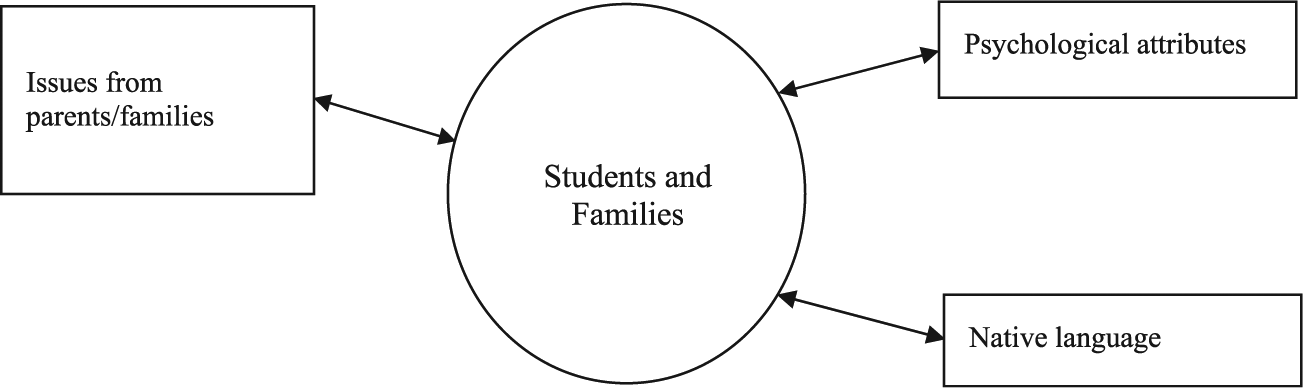
Staff assumptions about challenges facing students.
Program staff pointed to the challenges around language and communication, reporting that many students or the students’ families did not speak English, which limited communication between families and many staff because they themselves had limited to no fluency in Spanish. Program staff responses also perceived family financial instability or homelessness as both a challenge for student engagement and for their own effectiveness. We found that interviewees who had the most contact with the students located the blame for students’ challenges first and foremost on students themselves or on their families. Framed in this way, the characteristics of students and their families—both assumptions about problems they faced and perceived lack of social and cultural capital—were seen as the root issues hindering students’ success. Such assumptions affected the substance of the program. Consider that one ASPIRE student told us that ASPIRE staff had taken them on a field trip to a prison to help show them “what it could be like without education.” Of this, the program director explained, We just want them to have productive lives and not wind up incarcerated or wind up . . . you know, causing trouble with the law . . . or the courts or getting hurt, obviously . . . physically, running with wrong people, crowd, want them to be productive citizens and have productive lives.
Such perspectives indicated a deficit perspective common in the field of education that suggests that the cause for underachievement lies specifically within the individual or family culture rather than in broader contextual factors (e.g., from the way learning environments are organized to features of social and economic systems; Carter, 2013). Yosso (2005) defines deficit perspectives as those that position “minority” students and their families as personally responsible for the students’ academic performance due to two primary reasons: (1) students lack skills and knowledge valued within the dominant culture and (2) families do not value or support children’s education or encourage children’s educational attainment. Such deficit perspectives may excuse educators from having to consider the ways in which they may be implicated in students’ academic challenges. Carter (2013) explains this phenomenon well: Some of the most consistent and convincing research examining student culture and schooling suggests that when students’ cultural backgrounds are dissimilar to the backgrounds of their teachers and principals, the disadvantages experienced by those students are due to the educators’ lack of familiarity with their social backgrounds, which in turn hinders those educators to comprehend the social realities, cultural resources, and understandings of Black, Latino, Native American, and other nondominant groups is one of the main drivers of the opportunity gap in American education. (p. 147)
Moreover, perspectives that assume outcomes are based solely or primarily on individual effort distract from the relevant features of the social context and may lead to a misunderstanding of the contexts that students face. In such contexts, low-income youth and youth of color are vulnerable to hyper surveillance and criminalization in schools and to being placed into lower level coursework (Gamoran, 2010; Nichols, Ludwin, & Iadicola, 1999; Skiba et al., 2011), all of which have detrimental impacts on students’ educational and social well-being (Ansalone, 2001; Fabelo et al., 2011; Oakes, 2005; Werblow, Urick, & Duesbery, 2013; Wiley et al., 2018).
In contrast to the deficit discourses, we found that ASPIRE parents had very high expectations for their children, evidence we see as supporting the notion that parents often serve as aspirational resources for their children (Yosso, 2005). ASPIRE deficit discourses inaccurately emphasized individual rather than structural issues (e.g., social contexts of poverty, racism, access to health care, etc.) that families face and overlooked the very real structural obstacles students might encounter as a result of these issues in schools. In general, ASPIRE students’ parents had a strong desire to see their children succeed academically, providing a home resource ASPIRE’s staff could leverage. For example, parents expressed the desire for their children to have better lives than they themselves have, experience more and higher quality opportunities, and have fewer challenges and obstacles. As one parent of a high school student participant shared, [my goal is] only that she continues with her studies so that she can go on forward together with her [own] daughter, so that she doesn’t have to deal with so many problems the way I have to battle, working so hard and earning very little money, she needs to continually learn.
All parents expressed the desire for their children to succeed academically. Some referred to the goal of graduating high school, others referred to higher education goals. Some parents reported the ways in which they support their children in reaching these goals. Besides enrolling them in ASPIRE, this included a range of supports, including caring for grandchildren, attending meetings at school amid demanding work schedules, and encouraging the interests and passions of their children.
Our discussions with ASPIRE participants’ parents demonstrated that rather than being a source of hindrance, families can be a source of strength for students, particularly in their aspirations for their children. Historically disadvantaged communities remain able to provide their young people with a wealth of resources, such as aspirational capital, linguistic and resistance capital, and navigational capital (Yosso, 2005). Yosso argues that students’ cultural knowledge is indeed “valuable to the student and her/his family, but is not necessarily considered to carry any capital to the school context” (p. 76). The problem, then, is that educators often ignore these assets. Although these forms of capital may differ from advantaged children’s social and cultural capital, they remain rich resources that the program staff could use to help meet program goals. Drawing on these kinds of resources could be accomplished through implementing culturally relevant strategies (Darder, 2012; Delpit, 1988; Gay, 2000, 2002; Ladson-Billings, 1993, 1995) or using a funds of knowledge approach (Moll, Amanti, Neff, & Gonzalez, 1992).
Adaptive Preferences
The concept of adaptive preferences has most often been used in research on international development, especially as related to people in subjugated social positions, for example, those living in poverty. The concept has been most prominently theorized by sociologists and scholars from other social science disciplines (Alkire, 2005; Clark, 2003; Elster, 1987; Hakim, 1998; Parker, Stratton, Gale, Rodd, & Sealey, 2013; Sen, 2004). In the context of international development research, law and ethics scholars have applied the concept of adaptive preferences to the examination of autonomy and ethical issues that emerge when Westerners work in international contexts (Bruckner, 2009; Khader, 2011; Nussbaum, 1999, 2000, 2001). Until now, the idea of adaptive preference has not been applied to the experiences of students of color or students in poverty in U.S. education contexts. 7
We define adaptive preferences as follows: Individuals or groups may adjust or change their preferences or perceived options in relation to the social position in which they find themselves. To take an example from education, the notion of adaptive preferences may help explain how when college becomes an affordable option for students from groups historically underrepresented within higher education, they still may not perceive it as a viable option. The educational avenues students pursue may be characterized by them as desirable, even though their choices may have been limited by what they believe to be feasible, regardless of actual, tangible life possibilities (Bridges, 2006). In discussing choice and aspiration, Khader (2011) points out that those who exhibit adaptive preferences “experience deprivation partly as a result of their own behaviors or desires,” but—importantly— this is because they are “behaviors and desires that have been shaped by unjust social conditions” (p. 4).
Of course, it is not easy to determine whether or not people have made educational choices unconstrained by the unjust status quo. Mills (1995) discusses this related to people’s autonomy. Just because a choice may be constrained or limited, she argued, does not necessarily mean that people’s “fundamental autonomy” has been taken away. Although we agree with her larger point, the harm of constrained educational choices does not stem primarily from being deprived of autonomy; rather, it stems from the constrained circumstances that distort people’s aspirations and preferences (Raz, 1986). Accordingly, it is important to consider just how we are to judge whether a person’s choices are meaningfully autonomous, without attributing false consciousness to them or further marginalizing them. For instance, how do we judge whether the desires and preferences students articulate and act on transcend an oppressive social context or, instead, whether they are adapting their preferences to a subordinated societal position and internalizing connected messages of inferiority or powerlessness? We may not know for certain whether the social context of choice narrows low-income students’ aspirations.
Nevertheless, we do know from much research that low-income students and students in poverty may go to school with capital that is less valued than what middle-class students bring to school (Lareau, 2011; Moll et al., 1992; Yosso, 2005). We also know that at least partly as a result of unjust social circumstances, low-income students’ preferences may be limited by their perceptions of the possibilities open to them (Khader, 2011; Moses, 2002; Mullen, 2010). There is, then, compelling evidence that students’ educational aspirations and choices are embedded within—and in some cases, constrained by—their social contexts. As a development ethicist, Khader (2011) has examined the notion of adaptive preferences in the context of third world 8 women’s lives. Because all persons adapt their preferences in certain ways to their social conditions, whether unjustly constrained or not, she theorizes that “deprivation” may lead persons to do so inappropriately (p. 51). As such, her examination centers on “inappropriately adaptive preferences,” or preferences that are “inconsistent with basic flourishing” (p. 52). Borrowing from Khader, we contend that low-income students may make choices about their education that reflect constrained social contexts and, therefore, are inconsistent with their flourishing, in both basic (e.g., staying in school) and more expansive ways (e.g., pursuing postsecondary education or training).
Social Contexts of Choice
Along with Dewey (1930) and others, we believe that individuals can be understood only within their social and communal context (Howe, 1997; Kymlicka, 1991, 1995; Moses, 2002). Thus, people’s flourishing as individuals and social beings are inextricably linked. In that vein, philosopher Kymlicka (1991, 1995) conceptualizes the notion of a social context of choice as social and cultural circumstances under which persons learn about and come to understand life’s possibilities (Kymlicka. 1991; Rawls, 1971). If persons are in social environments within which they can conceive of what is possible, choose among good options, and visualize the consequences of their actions, then they have favorable social contexts of choice (Moses, 2001). For example, based on their study of a school-based outreach program focused on supporting “the whole child” (p. 708), which provided social-emotional, health, and family support services, Walsh et al. (2014) argue that students in poverty need systematic support not only in their academics but also in various out-of-school factors that shape the contexts of students’ lives.
Although it is inevitable for people to face certain constraints, those arising from systemic injustices such as racism and classism unjustly limit the context of choice (Moses, 2002). Such constraints limit not only students’ ability to do what they have decided to do but also their ability to see the possibilities for choice. In addition, it is important to note, as Kymlicka (1991) does, that when we say that people make certain decisions or choices, we must acknowledge, It is only plausible to assign beliefs and attitudes about the good life to the person, rather than to her circumstances, if she has the good fortune to have received a sufficiently broad education to be able to conceive the various options open to her. (p. 201)
Thus, a person’s social context of choice acknowledges the intersection between individual choices and social circumstances (Moses, 2002). Here, Kymlicka (1991) makes an especially relevant point: The distinction between choices and circumstances is in fact absolutely central . . . Differences between people in terms of their resources may legitimately arise as a result of their choices . . . Differences that are due to people’s choices are their own responsibility (assuming that they are freely chosen, with adequate information about the costs and consequences of those choices etc.). But differences which arise from people’s circumstances—their social environment or natural endowments—are clearly not their own responsibility. (p. 186)
We argue that the philosophical concept of the social context of choice is particularly relevant and useful to studies on higher education access because it centers the analysis on the context external to the individual student. That is, it focuses on the larger context in which students are socially embedded, within which they learn about and make choices about their education, and the social context within which they develop their educational aspirations. This is different from the analyses of college aspirations using social and cultural capital, which often focus on students’ aspirations and attainment without sufficient attention to relevant circumstances outside the home environment. Understanding the importance of a favorable social context within which to make significant choices about their lives prioritizes and emphasizes that the responsibility for oppression and disadvantage lies with hegemonic structures, rather than with individual students. It acknowledges as essential people’s social circumstances, within which a context of choice is framed by a society’s history and structures in interaction with a person’s cultural background (Kymlicka, 1991). Along these lines, social institutions such as public education are significant components in the formation (or lack thereof) of favorable social contexts of choice (Moses, 2002). Relevant to our examination here, the racial and class oppression people face can lead them to make choices within an impoverished “social context of choice” so that they can receive certain social advantages (Kymlicka, 1991, p. 166).
Even if choices are not coerced directly, they may not be as meaningful if made within an impoverished context. Take, for example, ASPIRE’s aim to teach their students middle-class values. Unless it is part of the program’s formal curriculum and critical pedagogy to discuss with students how “middle-class” values have come to dominate public education, then students are likely to receive the message that their own social and cultural capital are not valued within the dominant system and, subsequently, that they are not valuable. Such was the case at ASPIRE, where staff members focused on teaching students’ middle-class cultural practices, yet they did so without adequately examining the students’ social contexts. Students make choices within certain historical, cultural, and social contexts; these choices should represent not only who they are but also who they want to become, rather than who they may not be allowed to be as a result of oppression and injustice. Staff could have, for example, discussed with students information about how these practices are connected to broader oppressive histories, advantages, and power dynamics. This raises questions about the impact teaching middle-class cultural practices may have on students as they construct understandings of self and community in relation to ASPIRE’s curriculum. As we noted earlier (see Figure 1), interview data suggest that ASPIRE perpetuated individualistic and deficit-oriented ideas about its students. Staff tended to understand students’ obstacles and challenges as residing within the students themselves and within their families. For example, they criticized what they perceived as parents’ lack of formal education, inability to speak English, inability to help their children with homework or college planning, or lack of material resources; similarly, they complained that some ASPIRE students themselves were lazy, unmotivated, or unorganized. This suggests that students were exposed to messages idolizing middle-class culture simultaneous to being exposed to disapproving messages about their own lives and family circumstances.
Tackling the Tensions: A Rich Conceptual Framework for Examining Choice and Aspiration
As Moses (2001) has argued, individual students need a social context of choice that helps them understand “different views about the good life” as well as the ability to “intelligently examine and reexamine these views” (Kymlicka, 1995, p. 13). The idea is that students will be able to make choices from among options that are worth wanting, rather than bare, or empty, ones that may require them to disparage or deny the cultures within their families or communities (Dennett, 1984; Howe, 1997; Moses, 2002). Such denial or disparagement of the educational value of their family or community perpetuates the idea of the alleged superiority of dominant, middle-class ways of being in school. Even though this is not necessarily the lesson that ASPIRE staff are hoping to teach, the deficit framing gives students a strong negative message about where they come from (Dika & Singh, 2002; Lareau, 2011; Yosso, 2005).
Instead, low-income students’ choices for their education and their lives ought to allow them to be true to who they are and who they are becoming, from within a good range of options available within their social and cultural context (Moses, 2001; Raz, 1986; Taylor, 1994). That range of options must include meaningful ones, that is, options that are conceivable and known; the social context of choice must be expansive of their home cultures rather than diminishing (Moses, 2001). A range of options is thus adequate if it consists of a variety of acceptable alternatives from which to choose, including ones that honor students’ identities, expand their aspirations and ideas about long-term projects, commitments, and relationships. Such a range of options would allow for meaningful choices (Raz, 1986). The important point here is that these choices are more meaningful; they are not merely forced choices among limited options in order to increase social and cultural capital or change students’ preferences.
As we have tried to show in this article, the emphasis on the larger, external social context is different from the ideas of capital and adaptive preferences. Although both of these concepts do acknowledge the importance of social contexts and structures for students’ capital and preferences, the individual remains the focus. An individual student possesses social and cultural capital; those who are more privileged often are said to have more such capital, whereas students of color and low-income students often are described as lacking such capital. Similarly, individual students are the ones who may adapt—sometimes inappropriately (Khader, 2011)—their educational preferences to their family, cultural, or socioeconomic circumstances. There is a worrisome sense of determinism that may be inferred in such analyses (Apffel-Marglin & Marglin, 1996; King, 2000). For these reasons, integrating understandings of students’ social contexts of choice is important to shift the deficit orientations often present with capital or adaptive preference frameworks alone. Our hope is that the analysis we have put forward contributes to overcoming individualistic deficit perspectives of low-income students, as well as to encouraging college access and outreach programs to contribute explicitly to expanding students’ social contexts of choice respectfully and sensitively. Program participants should be supported to make informed choices that make their educational aspirations more meaningful and reachable.
Conclusion
Economic inequality remains a key challenge for the United States; indeed, issues of systemic and structural inequality have driven recent Democratic political campaigns, from Bernie Sanders to Alexandria Ocasio-Cortez (Barkan, 2018). Yet those with libertarian or conservative views still argue that it is people in poverty who have to change their individual choices and decisions in order to lower poverty rates (see, e.g., Haskins, 2014). As we have discussed herein, outreach programs like ASPIRE aim to help students gain the social and cultural capital needed to make better decisions. Yet with reference to Bourdieu’s notion of social capital in particular, Lareau (2011) noted, “any effort to spread an elite practice to all members of the society would result in the practice being devalued and replaced by a different sorting mechanism. In this sense, his model suggests that inequality is a perpetual characteristic of social groups” (p. 277). Bourdieu’s model resonates, given that various U.S. presidential administrations have pledged to fight poverty over the past 80 to 90 years, with President Lyndon Johnson’s War on Poverty as perhaps the most salient example, and yet U.S. families are dealing with poverty and low-income status in record amounts (Lowrey, 2014). This affects people of color disproportionately. Thirty-three percent of Native American and Black children are living in poverty, along with 26% percent of Latinx children, as compared with 11% of White children (Annie E. Casey Foundation, 2017). Students of color also face significant challenges related to racism and discrimination, both in school and in society (Allen, Scott, & Lewis, 2013; Bonilla-Silva, 2013). The analysis in this article rests against the backdrop of these national social conditions.
We have attempted to demonstrate how philosophy adds important aspects to distinct theoretical lenses from sociology, providing a more complete way for both scholars and practitioners to frame and understand students’ educational choices and aspirations. Our data highlight a narrative within the ASPIRE program of what it means for students to be “successful” in their education, reflecting characteristics consistent with neoliberal values and dominant cultural practices. This in turn highlights the tension between educational access and outreach programs that aim to mitigate social inequality by adding opportunities to expand capital, yet sometimes end up perpetuating inequality by further constraining students’ social contexts of choice. In addition, there is a larger tension in outreach programs between higher education goals and aspirations and the complexity that abounds for those educators, students, and researchers engaged in this work on the ground level.
Given the increase in college access programs, and the disagreements surrounding the reauthorization of the Higher Education Act, scholarship in this vein is increasingly important for the knowledge base if policymakers and educators are to base education policy and practice in theoretically well-grounded research evidence (National Association of College Admission Counseling, 2018). Over 20 years ago, President Bill Clinton’s administration started the federal GEAR UP program, modeled in part on programs like ASPIRE, to address achievement gaps by socioeconomic status and race and prepare more students to enter college. Yet there has been little attention to how educators and scholars frame and conceptualize the aims of such programs or how they understand participants’ educational choices and aspirations. We hope that this article begins a conversation about new, interdisciplinary theoretical perspectives that have greater explanatory power and, consequently, greater potential impact on education policy and practices related to increasing educational opportunities for students who are marginalized by hegemonic educational systems and opportunity structures.
Discussing the many constraints on women’s lives in 1952, de Beauvoir claimed that a person could live a life of immanence, passively accepting the roles into which one is socialized, or a life of transcendence, actively and meaningfully pursuing expansive possibilities for their lives. Conceptualizing students’ development of capital and preferences as inextricably connected with the social context within which they make their choices allows for a more profound understanding of just what “active and meaningful”—viz., transcendent—pursuit of life’s possibilities requires.
Footnotes
Notes
M
K