







Abstract
This study examines growth in language and math skills during the summer before kindergarten; considers variation by family income, race/ethnicity, and dual language learner status; and tests whether summer center-based care sustains preschool gains. Growth in skills slowed during summer for all children, but the patterns varied by domain and group. Non-White and dual language learner students showed the largest drop-off in language skills during summer. Lower-income students demonstrated slower summer growth in math skills than their higher-income peers. Students enrolled in summer center-based care had faster growth in math skills than those who did not attend care. Yet lower-income students who attended center-based care showed slower growth in language skills during summer than similar nonattenders. Implications are discussed.
Gaps in test scores between children from more versus less advantaged backgrounds are large (Reardon & Portilla, 2016), and emerge in the years before children start kindergarten (von Hippel et al., 2018). Supported by evidence that high-quality preschool programs may lessen gaps that disadvantage lower-income, racial/ethnic minority, and dual language learner (DLL) children (Yoshikawa et al., 2016), a number of states and cities across the country have made major investments to expand access to early childhood education in the year or two prior to kindergarten. Yet little is known about growth, loss, or maintenance of students’ academic skills during the summer between preschool and kindergarten, when most school-based preschool programs are on break (Friedman-Krauss et al., 2019). Given work showing that children’s readiness for kindergarten is predictive of later academic achievement (G. J. Duncan et al., 2007) and educational attainment (Jones et al., 2015), it is critical to understand the role that the summer prior to kindergarten plays in promoting children’s school readiness.
Prior research examining the elementary school grades has found that summer school breaks can contribute to income- and race-based gaps in test scores (e.g., Alexander et al., 2016; Heyns, 1978; McEachin et al., 2018). Such work has spurred policymakers’ interest in enhancing the quality of lower-income and minority students’ summer break experiences. For example, the Every Student Succeeds Act passed by the federal government in 2015 encourages states and districts to use flexible funds to support evidence-based summer learning programs. Given growing support for both preschool and summer programming (e.g., McCombs et al., 2019), it is important to better understand patterns of summer learning prior to kindergarten and the role that center-based care during the preschool summer can play in sustaining the academic gains that children typically make in early childhood programs (Condliffe et al., 2018; Yoshikawa et al., 2013).
To this end, the current study contributes to the literature in three key ways. First, we leverage student assessment data from the fall and spring of the preschool and kindergarten years in order to examine growth in preschool-attending students’ language and math skills during the summer between preschool and kindergarten, relative to the preceding and subsequent academic years. Next, we rely on a diverse sample of students recruited from both public and community-based prekindergarten 1 programs in the city of Boston in order to compare summer learning rates across family income, race/ethnicity, and DLL status for children who did attend formal preschool during the 4-year-old year. Third, we access information on children’s care during the summer prior to kindergarten in order to test whether enrollment in center-based summer care helps support kindergarten readiness by reducing income-, race-, and language-based gaps in summer learning rates. Results from the study will provide needed information on the role that early summer experiences play in influencing gaps in children’s kindergarten readiness among students who attend formal preschool.
Preschool and the Transition to Kindergarten
The majority of American 4-year-old children—68% in 2017—now attend either part- or full-time center-based preschool (National Center of Education Statistics, 2017). Expansion of preschool programming has been supported in part by a large literature demonstrating that children who enroll in early childhood education programs arrive at kindergarten more school-ready than children who do not (Lipsey et al., 2018; Weiland & Yoshikawa, 2013; Wong et al., 2008; Yoshikawa et al., 2013). Moreover, preschool programs have been shown to reduce income-, race-, and language-based gaps in school readiness (e.g., Bassok, 2010; Bloom & Weiland, 2015; G. J. Duncan & Sojourner, 2013; Magnuson & Waldfogel, 2005; Weiland & Yoshikawa, 2013). 2 Blair and Raver (2012) define school readiness as a multidimensional construct that includes cognitive ability, attention, language, executive functioning, and social-emotional skills—all competencies cited by teachers as critical for the transition to kindergarten. Yet the majority of studies have found that early academic skills—namely, language and math—are predictive of future school success (Claessens et al., 2009; G. J. Duncan et al., 2007; Goldstein et al., 2017; Nguyen et al., 2016). This body of work has spurred heightened interest in identifying how early childhood experiences—including those during the summer—can promote language and math skills in particular prior to children’s transition to kindergarten.
Summer Learning Between Preschool and Kindergarten
Although early childhood education is a promising approach for boosting school readiness (Gormley et al., 2008), it is unlikely that preschool programs on their own will be able to close the substantial kindergarten readiness gaps associated with family income, race/ethnicity, and DLL status (Park et al., 2017; Reardon & Portilla, 2016; Valentino, 2018). Indeed, children from different backgrounds are exposed to a range of learning environments outside of formal school settings and variation in these experiences can further contribute to differential growth in skills (Bailey et al., 2017). Data from elementary school contexts suggest that gaps in academic skills at kindergarten entry remain substantial, despite the proliferation of preschool programming in recent years (Reardon & Portilla, 2016). The learning experiences that children have in the summer between preschool and kindergarten are understudied influences that may affect the degree to which gaps in test scores are observed at kindergarten entry (Alexander et al., 2016; Pears et al., 2016).
Indeed, work examining samples in early elementary school suggests that income-, racial/ethnic-, and home language–based gaps in academic skills may grow slightly during the summer (e.g., Alexander et al., 2016; Downey et al., 2019; von Hippel et al., 2018). However, these studies are all limited to the postkindergarten period and we know of only one study that has examined learning in the summer after preschool. Using an item response theory approach and teacher reports of students’ language and literacy skills, Kim and Camilli (2014) demonstrated that preschool students’ skills grew across the school year but slowed during the summer, a similar trend to the ones documented in studies of elementary school students. Research on disparities in access to educational enrichment among families with young children would suggest that gaps in summer learning might be similar across preschool and elementary school samples. For example, outside of early childhood center-based care, lower-income children are less likely than higher-income children to be exposed to cognitively stimulating activities, such as reading, engaging in high-quality conversations with adults, discussing mathematical concepts with adults, and visiting libraries, historic sites or museums (Bassok et al., 2016; Bradley et al., 2001; Gershenson, 2013; Kalil et al., 2016; Rowe, 2012).
In addition, ecological theory (Bronfenbrenner & Morris, 1998) would suggest that the home- and school-based learning experiences of students from lower-income families may differ from students from higher-income families because lower-income parents may not be able to invest as much time or money in their children’s cognitive development (Bassok et al., 2016; Harding et al., 2015; Kalil et al., 2016), with variation in this exposure differentially predicting outcomes. Such income-based disparities might be exacerbated during the summer months when many children lack concurrent access to publicly funded school programming (Chin & Phillips, 2004; Condliffe, 2016). Given significant correlations between race/ethnicity and family income, this same pattern may also hold true for understanding differences in the summer learning experiences of racial/ethnic minority students compared with White students (Atteberry & McEachin, 2016; Downey et al., 2004; Johnson & Wagner, 2017).
Racial/ethnic gaps in test scores may be even more challenging to address, however, with recent work using nationally representative data (Quinn, 2015; Quinn et al., 2016) showing that race-based disparities favoring White students over Hispanic and Black students are substantial at kindergarten entry, and remain relatively consistent during the postkindergarten school-year and summer months. 3 The key takeaway from this recent work is that for race-based gaps in test scores, “nearly all of the inequality ‘action’ occurs prior to school entry” (von Hippel, pp. 348). Better understanding how students’ experiences and skills in the summer prior to kindergarten do or do not contribute to this school readiness gap will inform efforts to promote equity in outcomes for students from varied racial/ethnic backgrounds.
There have been fewer studies examining gaps in summer learning between DLLs and students who only speak English. This is a significant limitation in the extant literature because DLLs represent a sizeable and policy-relevant group of American children. Approximately 33% of children in the United States live in a household where a language other than English is predominately spoken (Child Trends, 2019) and DLL children tend to have lower levels of English-language skills than English-only speakers at kindergarten entry (Park et al., 2017; Reardon & Portilla, 2016). Although the causes of these gaps have not been explained in the literature, there are key differences in the early language experiences of DLLs compared to monolingual children that inform whether we would expect differential growth in academic skills across these groups
In early childhood, DLL students are heterogeneous in their experiences with their two languages (i.e., the amount and quality of language exposure, and/or whether they are simultaneous or sequential language learners; Branum-Martin et al., 2014), as well as in their language and literacy abilities at school entry (Hammer et al., 2014; Hammer et al., 2020). However, research shows that DLLs differ from their monolingual peers in language processing, vocabulary development, and oral comprehension. Studies with toddlers have found that DLLs are more efficient at processing their dominant language when engaging in language processing tasks (Conboy & Mills, 2006; Marchman et al., 2010). Further work has found that in preschool, monolingual children are able to process language faster than DLLs using their second language (Sevinc & Önkol, 2009). DLL students’ vocabulary and oral comprehension tend to be lower than monolingual students at the beginning of the preschool year, with these skills increasing substantially across a 2-year period where English was the language of instruction (Bloom & Weiland, 2015). Similarly, these skills develop differently for simultaneous and sequential learners, with the latter scoring within the typical monolingual range by the end of the preschool year (Hammer et al., 2014). In sum, despite differences in language processing, vocabulary, and oral comprehension in early years, the evidence suggests that by the end of preschool DLLs are likely to catch up to their monolingual peers. Notably, early gaps in math skills between DLLs and non-DLLs appear to be less stark after adjusting for family income (Lambert et al., 2017).
Yet even given data on differences in kindergarten readiness that exist by family income, race/ethnicity, and DLL status and data examining differential learning trajectories in elementary school, the field knows little about growth, maintenance, or reductions in test score gaps that exist across these groups in the summer between preschool and kindergarten. Although ecological theory would suggest that gaps across these groups may widen during the summer between preschool and kindergarten, further work is needed to understand differences in trajectories in order to inform research and intervention that aims to sustain the gains that students make in preschool programs.
The Role of Summer Care to Support Diverse Students’ Academic Gains
To this end, there is growing interest in how center-based care during the summer between preschool and kindergarten may help sustain the benefits of preschool programming and support children’s school readiness. Indeed, center-based care during the academic year—defined as enrollment in a formal preschool, Head Start, or child care setting (Chaudry et al., 2017)—has typically been linked with positive academic outcomes for students and reductions in skill-gaps favoring more advantaged students (Phillips, Lipsey, et al., 2017; Vandell et al., 2010). Expanding access to academically oriented summer programs targeted at lower-income, racial/ethnic, and DLL elementary school students is one mechanism that policymakers have supported to help quell growth in test score gaps during the summer months (McCombs et al., 2019). Center-based programs are currently available to rising kindergarten students over their summer break in a number of forms, ranging from Head Start programs that operate across the full calendar year, center-based preschool that operates year-round, or summer day camps that provide child care during the summer months, among other city-specific options. Yet access to center-based care during summer varies by family income. Although there are certainly options available to lower-income families through Head Start and state- and district-funded summer programs, private center-based summer programs can be costly, and access may be restricted to higher-income families with the resources to pay for them (Alexander et al., 2016; McCombs et al., 2011). In addition, Head Start only has the current capacity to serve 21% of low-income 4-year-old students and most cities with public preschool programs only provide funding during the academic year (Barnett & Friedman-Krauss, 2016). Transportation challenges and limited access to information about affordable care also constrain the summer program options for lower-income parents with young children (Condliffe, 2016). Yet little is known about whether there are income-, racial/ethnic-, and home language–based disparities in access to high-quality care during the summer.
At the same time, there is some evidence that high-quality center-based care during summer can boost children’s school readiness even after attending formal preschool, particularly among lower-income and minority students (e.g., Beach, 2004; Graziano et al., 2014; McCombs et al., 2019). For example, a randomized trial of the literacy-focused Kids in Transition to School summer program tested in a sample of children with developmental disabilities and delays who attended formal preschool found that the intervention had small positive impacts on literacy skills and reduced students’ risk of reading failure (Pears et al., 2016). Similarly, a randomized trial of the Stars Summer Program—an intensive, academically oriented 4-week summer program targeted at low-income children who had typically attended center-based care during their 4-year-old year—found that the intervention improved children’s readiness for kindergarten (Berlin et al., 2011). These findings suggest that center-based care during the summer may help support development of academic skills across the summer within low-income and at-risk samples of students who attended formal preschool. However, there is little work to date that has examined a broad conceptualization of center-based care in the summer taking into account variation across different program models, and comparing the effects of center-based care during summer by family income, race/ethnicity, and DLL status.
Taken together, there is a need to better understand variation in growth in academic skills across levels of family income, race/ethnicity, and DLL status during the summer between preschool and kindergarten and determine whether and how summer breaks affect kindergarten readiness for a diverse group students. There is some evidence to suggest that center-based care during the summer may help promote greater school readiness for lower-income, non-White, and DLL studies. Yet more work empirically testing this hypothesis is needed in order to guide policy and practice on the provision of center-based care in the summer after preschool.
The Current Study
We add to the literature on early childhood education and gaps in test scores by answering four research questions:
Research Question 1 : How does students’ growth in language and math skills differ during the preschool year, the summer between preschool and kindergarten, and the kindergarten academic year?
Research Question 2 : Does growth in language and math skills during these time periods vary by students’ family income, race/ethnicity, and DLL status?
Research Question 3 : Does growth in language and math skills during these time periods vary by students’ enrollment in center-based care during the summer between preschool and kindergarten?
Research Question 4 : Does enrollment in center-based care during the summer attenuate any differences in growth in language and math skills that exist by family income, race/ethnicity, and/or DLL status?
Collectively, findings will provide information on summer learning during a key period that may or may not contribute to the sizeable income-, race-, and language-based test score gaps that exist at kindergarten entry. The study will also help identify whether enhancing access to center-based care during the summer can promote children’s kindergarten readiness and help attenuate any income-, race-, and language-based gaps in summer learning that we may observe.
Method
Current Study Participants and Setting
The sample for the current study consists of N = 401 students attending the Boston Public Schools (BPS) prekindergarten program or a community-based organization (CBO) implementing the BPS prekindergarten curriculum and professional development model during the 2016–2017 school year. We recruited students from 41 public prekindergarten classrooms and 10 CBO classrooms, nested within 20 public schools and 10 CBO centers. The BPS prekindergarten program is free, full-day, and open to any age-eligible child in the city. 4 Ninety-two percent of prekindergarten teachers included in the current study sample reported using BPS’s Focus on K1 curriculum (McCormick et al., 2020), which uses an adapted version of the Opening the World of Learning (Schickedanz & Dickinson, 2004) language and literacy curriculum and Building Blocks (Clements & Sarama, 2007), an early mathematics curriculum for preschool children. Ninety-four percent of the participating kindergarten teachers reported that they implemented BPS’s Focus on K2 curriculum, an extension of the Focus on K1 model that aims to align with and build on the content and mode of instruction that children received in K1. See more information about these curricula in McCormick et al. (2020).
On average, 67% of the students in the schools and CBOs that participated in the current study were eligible for free or reduced-price lunch (FRPL), compared to 69% of students in schools served in the broader district. Thirty-three percent of students in participating schools were Hispanic, 34% were Black, 17% were White, 14% were Asian, and 2% were mixed race or another race. Fifty-one percent of students in participating schools were DLL. About 40% of third-grade students in participating public schools met or exceeded expectations on the 2015–2016 state ELA exam, while 45% met or exceeded expectations on the state math exam. The public schools in the sample are generally representative of the population of BPS elementary schools offering a prekindergarten program. 5 For example, at the district-level, schools were 35% Hispanic, 34% Black, 16% White, 12% Asian, and 3% other or mixed race. At the district-level, schools on average were 53% DLL, had 42% of third-grade students who met or exceeded expectations on the 2015–2016 state ELA exam, and had 43% of students who met or exceeded expectations on the 2015–2016 state math exam.
The team recruited non–special education students from participating prekindergarten classrooms in public schools (N = 312) and CBOs (N = 89) in the fall of 2016. Twenty-nine percent of students in the current study sample are Hispanic, 22% are White, 31% are Black, 14% are Asian, and 4% identify as another race or are of mixed race. Overall, 68% of the current study sample was eligible for FRPL at public school enrollment, 49% are DLLs, 51% are female, 37% attended center-based care during the summer of 2017, and 26% attended center-based care during the summer of 2016 (prior to preschool). Of the students who attended center-based care before kindergarten, 72% had also attended center-based care in the summer prior to preschool. Within the group of low-income students (those eligible for FRPL), 55% of students are DLLs, 39% are Black, 37% are Hispanic, and 92% are non-White. Among non-White students, 78% are lower-income, and among DLL students, 13% are Black, 45% are Hispanic, and 90% are non-White. On average, children in the current study sample were 4.64 years old (SD = 0.31) at the time of the Fall 2016 assessment and 5.60 years old (SD = 0.29) at the time of the Fall 2017 assessment.
Eighty-six percent of the students in the study sample had at least one parent who worked full time (classified as at least 35 hours per week), and 56% had a parent who was either married or living with a partner. The average student had 4.28 people living in their household (SD = 1.80), including themselves. Participating parents were 35.58 (SD = 8.10) years old in the fall of 2017 and diverse across educational backgrounds: 30% had a high school diploma equivalent or less, 29% had a 2-year degree, 17% had a 4-year degree, and 24% had some graduate school coursework or an advanced degree.
We were able to locate and collect data on 323 (80% of the original study sample) of these students in kindergarten. These 323 students were generally representative of the broader group of students who enrolled in the study in preschool on eligibility for FRPL, race (Black, White, Hispanic, mixed or other race), DLL status, and family/parent characteristics. However, the 80 students we could not follow into kindergarten were more likely to have attended prekindergarten in a CBO (37% of CBO attenders but only 15% of public school attenders were lost from the sample) and less likely to be Asian.
Generalizability of Current Study Sample
We were further interested in comparing the characteristics of the current study sample—students who had all enrolled in either the formal BPS prekindergarten program or a community-based preschool program implementing the BPS prekindergarten model—to the broader group of students who enrolled in the kindergarten classrooms of the study sample but had not participated in either of these early learning programs. Importantly, these descriptive statistics compare children who are enrolled in our study to the broader population of students who could have attended a public prekindergarten or CBO preschool program as a 4-year-old. We summarize these comparisons in the first three columns of the table in Supplemental Appendix A (available in the online version of the journal). We found that children in our analytic sample who attended public prekindergarten were significantly less likely than children enrolled in the nonpublic preschool program (i.e., CBO program) and children who enrolled in neither program to be eligible for free lunch and more likely to be White. Relative to children in the current study sample, nonpreschool attenders were more likely to be DLLs and Hispanic. In line with earlier work from Shapiro et al. (2019), these descriptive findings demonstrate that the children in the current study sample may be more advantaged than the broader population of all students who eventually enroll in kindergarten in BPS given disparities in access to the BPS prekindergarten program and the CBO program implementing the BPS prekindergarten model. Concurrent work is underway to explore the key drivers of these disparities.
Within our study sample, we then compared the characteristics of students who did and did not enroll in center-based care during the summer. These descriptive statistics are presented in the fourth and fifth columns of Supplemental Appendix A. As illustrated there, we found that students who attended formal preschool and then enrolled in center-based summer care were somewhat more advantaged than the students who did enroll in formal preschool but did not enroll in center-based summer care. For example, findings demonstrated that lower-income, Hispanic, and DLL students were less likely to enroll in center-based care during the summer, compared to their higher-income, White, and English-only speaking peers. On average, students who attended center-based care during the summer had higher levels of parental education than students who did not attend center-based care during the summer. This set of findings further confirms the importance of including a rich set of covariates in our predictive models and considering key selection issues into center-based summer care.
Procedure
The institutional review boards at the partner organizations for this study approved the human subjects plan prior to the commencement of study activities.
School and Classroom Recruitment
Public schools participating in the study were randomly selected from the 76 schools in the broader district offering the public prekindergarten program. We used this random selection process because we faced resource constraints in the number of schools that we had sufficient funds to enroll in the study. By selecting public schools randomly for inclusion in the study, we sought to create a sample that was representative of the broader population of BPS elementary schools offering a public prekindergarten program. As such, we randomly selected 25 public schools and 21 agreed to participate. The team used one school as a pilot school for developing new measures and the remaining 20 schools made up the public school sample. We also used a random process to select 10 of the 11 CBOs in Boston implementing the BPS prekindergarten model (which was supported by funding from the federal Preschool Development Grant program) to participate in the study, and they all agreed. We were unable to enroll all 11 CBOs in the study due to budget and administrative limitations.
We asked all prekindergarten teachers assigned to general education or inclusion classrooms in each of the 20 public schools and all the CBO teachers working with 4-year-old students to participate in the study in the fall of 2016. Ninety-six percent (N = 51) of teachers across public schools (N = 41) and CBOs (N = 10) agreed to participate in the study activities, including allowing children in their classroom to participate in direct assessments with the research team. We then followed sample children into public kindergarten and asked their kindergarten teachers to participate in the study. Ninety-five percent of kindergarten teachers agreed to participate in study activities.
Student Recruitment
After recruiting schools and classrooms, we attempted to collect active consent for all preschool students enrolled in participating classrooms. Research staff met with participating teachers to send home backpack mail providing an overview of the study and a blank consent for the parent to complete and return to the child’s classroom. Field staff then made regular visits to participating classrooms to pick up these consents and document them. Recruitment activities began in late September 2016 and were completed by late November 2016. Eighty-one percent of all children in participating classrooms consented to enroll in the study. Again, the research team faced significant resource constraints in the number of students we could enroll into the study from the total pool of consented students. This limitation was related to the team’s goal of collecting in-depth direct assessments of children’s academic skills across multiple time points, an activity that provides rich data but is also costly. In order to generate a student sample that fit within these constraints and was representative of the broader population of consented students, we randomly selected 50% of consented students (~6–10 per classroom) to participate in student-level data collection activities for a total sample size of 401 in the fall of 2016. We found that the students in the analytic sample were representative of the broader group of students who consented to the study (and to the broader group of prekindergarten students in BPS).
Direct Assessments
We trained a team of data collectors to complete direct child assessments of children’s school readiness skills in the fall of 2016 (October 1 through December 12), spring of 2017 (April 5 through June 16), fall of 2017 (September 27 through December 5), and spring of 2018 (April 4 through June 14). Each training lasted 5 days and was conducted by a master trainer with multiple years of experience conducting field-based studies. Data collectors needed to pass two reliability tests—a mock assessment with an adult and a test assessment with a child not enrolled in the study—in order to be allowed to collect data in the field. A field supervisor also observed 10% of field assessments directly in order to maintain high-quality data collection throughout each data collection period.
We used the Prelanguage Assessment Scale (preLAS; S. E. Duncan & De Avila, 1998) Simon Says and Art Show tests (S. E. Duncan & De Avila, 1998) as a warm up to the assessment battery and to determine the administration language for a subset of assessments (Barrueco et al., 2012). The preLAS assesses preliteracy skills and an individual’s proficiency in English. 6 Of the 401 children in the current study sample, 43 (11%) completed a subset of assessments in Spanish in the fall of 2016, 16 (2%) in the spring of 2017, 3 in the fall of 2017, and none in the spring of 2018.
Parent Survey
In the fall of both 2016 and 2017, we contacted the consenting parents of all students who were selected for the study sample to complete a 20-minute survey. Field staff first contacted parents via text message and email and asked parents to complete the surveys online. Parents received biweekly text message and email reminders to complete the survey. The team used a backpack mail procedure to collect remaining parent surveys, sending hard copy surveys home with children to be completed. The surveys were translated into Spanish, Vietnamese, and Mandarin in order to include the range of languages spoken by parents in the study sample. Parents provided demographic information about themselves and their child, and reported on a range of educational activities they engaged in with their child in the past month. Parents also reported on their child’s prior experiences in care and education, including their care during the summer between the prekindergarten and kindergarten years (Summer 2017). All parents received a $25 gift card to thank them for their time. Three hundred and forty-two parents completed the survey in 2016 (85% of the total sample), and 262 students’ parents (84% of the kindergarten sample) completed the kindergarten survey in the fall of 2017. Again, due to resource constraints we were unable to generate a 100% response rate for the parent survey. However, we did find that the parents who completed the survey were representative of the broader group of parents included in the analytic sample.
Measures
Language Skills
The team used the Peabody Picture Vocabulary Test IV (PPVT IV) to directly assess children’s receptive language skills in the fall and spring of the prekindergarten year. The PPVT IV is a nationally normed measure that has been used widely in diverse samples of young children (U.S. Department of Health and Human Services, 2010). The test has excellent split-half and test-retest reliability estimates, as well as strong qualitative and quantitative validity properties (Dunn & Dunn, 2007). It requires children to choose (verbally or nonverbally) which of four pictures best represents a stimulus word. In our primary analysis, we used the raw score total as our outcome measure. We assessed all children on the PPVT—regardless of whether they passed the preLAS language screener—in order to be able to describe an equivalent measure of receptive language skills in English across the full sample.
Math Skills
This study used the Woodcock Johnson Applied Problems III (Woodcock et al., 2001) subtest to directly assess children’s math skills in the fall and spring of the prekindergarten year. The team assessed Spanish-speaking children who did not pass the preLAS language screener using the equivalent Spanish language version of the assessment from the Batería III Woodcock Muñoz (Woodcock et al., 2005). The WJ/WM Applied Problems direct assessment is a numeracy and early mathematics measure that requires children to perform relatively simple calculations to analyze and solve arithmetic problems. Its estimated test-retest reliability for 2- to 7-year-old children is 0.90 (Woodcock et al., 2001), and it has been used with diverse populations (Gormley et al., 2005; Peisner-Feinberg et al., 2001; Wong et al., 2008). In our primary analyses, we present results using the W score of the measure, which is appropriate for examining growth in skills over time (Belsky et al., 2007). We combined scores from the English and Spanish versions of the assessments so the full sample could be analyzed together. As noted below, we conducted a robustness check by excluding assessments completed in Spanish from the math analysis to test whether the results were sensitive to this measurement decision.
Center-Based Care During the Summer Between Prekindergarten and Kindergarten
When completing the parent survey, parents reported on their child’s care during the summer between prekindergarten and kindergarten. Specifically, parents listed all locations where their child spent daytime hours during the summer of 2017, including a Head Start center, a private child care center, a summer camp, an in-home child care program, in their home cared for by a parent, cared for by a family member, friend, or a neighbor, or in their home or another home cared for by someone other than a member of their family (including a paid babysitter).
Parents then listed the location where their child spent the most time during daytime hours in the summer of 2017. We reviewed parents’ answers to both questions and hard-coded the location where the child spent the majority of his or her time during the summer of 2017. We then used online resources, existing work done for a complementary project in the BPS (see Shapiro et al., 2019), and confirmatory phone calls to code locations as center-based care (coded as 1) or not (coded as 0). Center-based care included enrollment in a public school summer program, a summer camp, or a private child care center. The team considered all other care—including care by a parent, friend, family member, neighbor, babysitter, or at a licensed or unlicensed home-based child care—as noncenter based.
Child Characteristics From Administrative Data
We accessed administrative data on child demographics from the school district in the fall of the prekindergarten year. We first created a series of indicators to describe children’s race/ethnicity (Black, Hispanic, Asian, or Other Race/Ethnicity, including mixed race children), coding 1 if the child fell into the indicated category and 0 otherwise. The reference group was White. Initial descriptive analysis demonstrated that trends in learning rates appeared fairly similar for non-White groups, while White students were qualitatively different from their non-White peers examined collectively. Given constraints on our sample size when examining interactions in models, we then also created one dummy variable for non-White to use in future subgroup analyses when considering variation in growth by race/ethnicity. We used similar indicators to describe children’s eligibility for FRPL (1 = eligible; 0 = not eligible) and gender (1 = female; 0 = not female). Throughout the article, we describe students as lower-income if they were eligible for FRPL and higher-income if they were not eligible for FRPL. We set a dummy variable for DLL equal to 1 if administrative data showed evidence that the child spoke a language other than English. We also included an indicator to describe whether the child had attended a CBO for prekindergarten (1 = CBO) or not (0 = public school for prekindergarten). Finally, we used the child’s birthdate made available by the school district to calculate age at each assessment time point. Child age at the time of each assessment was included as a time-varying covariate in order to account for variation in assessment dates across time and between-student differences in the length of each of the three time periods of interest.
Family Characteristics From Parent Survey
Parents reported on demographic characteristics in the fall of the prekindergarten year, and we used this information to create covariates for analyses. We coded variables as 1 if the characteristic described the parent and 0 if not. These variables indicated whether there was at least one parent in the home working full-time and whether the parent was married or lived with a partner. We used parents’ reports of their education to create mutually exclusive groups: (1) high school diploma/GED or less, (2) 2-year college degree or less, or (3) 4-year college degree or less. The reference group was more than a 4-year college degree/graduate degree. We used continuous variables to describe the age of the child’s mother at her first birth, the number of people living in the household, and the parent respondent’s age in the fall of the kindergarten year. We also included a covariate for the date that the parent survey was completed to account for some variation in the timing of the parent survey data collection across students.
Analytic Approach
Descriptive Analysis
We first examined descriptive statistics on students’ language and math assessment scores at each data collection time point for both the full sample, and then disaggregated between lower-income (eligible for FRPL) versus higher-income (not eligible for FRPL) students, non-White versus White students, and DLLs versus native-English speakers. We used independent samples t tests to examine whether assessment scores varied between subgroups.
Piecewise Individual Growth Modeling
Specific details on decision making related to our analytic approach are included in Supplemental Appendix B (available in the online version of the journal). Because our assessment time points were nested within students who were nested within prekindergarten/kindergarten settings, we considered a range of individual growth models in order to explore our study research questions. Students were initially grouped in prekindergarten classrooms but then transitioned to kindergarten classrooms in different combinations. To account for the change in classroom membership across years, we created a new group membership ID to represent students’ unique prekindergarten/kindergarten classroom combination. We then used a series of unconditional growth models with a linear effect of time to disaggregate variation in language and math skills explained at the student- and group-level.
We next fit piecewise individual growth models regressing time-varying outcomes (Yijt) on indicators representing the spring of prekindergarten, the fall of kindergarten, and the spring of kindergarten (Singer & Willett, 2003). This model allows the intercept to randomly vary across students, and for growth to vary randomly across students. The model also allows the intercept to vary randomly across the prekindergarten/kindergarten groups. Work by Quinn and McIntyre (2017) has shown that random effects models may produce less biased estimates when examining learning trajectories than gain score models with intercepts.
Examination of unconditional models showed that there was no evidence that growth over time varied by group, so we excluded random slopes for group. By including indicators for three time points, we were able to model distinct differences in growth rates between the prekindergarten academic year, the summer between prekindergarten and kindergarten, and the kindergarten year and answer the study research questions. Even so, we conducted further empirical tests to determine if a piecewise growth model was a better fit to the data than a model with a linear or quadratic growth trend (see Supplemental Appendix B for more details). The intercept in this model represents the mean score in the fall of prekindergarten and the coefficients on each of the time point indicators represent the difference in the outcome between that particular data collection time point and the fall of prekindergarten. By using these coefficients, we can calculate growth rates separately for the prekindergarten academic year, the summer between prekindergarten and kindergarten, and the kindergarten academic year. The full model is included in Supplemental Appendix B.
Our first research question was whether growth in vocabulary and math skills differed between three distinct time periods—the prekindergarten year, the summer between prekindergarten and kindergarten, and the kindergarten year. To answer this question, we fit separate multilevel random effects models for language and math skills. We added child- and parent/family-level covariates in conceptual blocks. As noted above, we included child age at the time of the assessment at Level 1 to capture variation in the timing of assessments. Using the resulting parameters from the fully controlled model, we then calculated separate growth rates for each of the three time periods and to test whether those growth rates were statistically significant. Importantly, the lengths of the time periods that we compared were fairly similar to one another. The average time period between assessments done in the fall and spring of preschool was 6.36 months, while the amount of time between the spring of preschool and the fall of kindergarten (the summer period) was 5.30 months and the time period between the fall and spring of kindergarten was 6.37 months. Finally, we used the resulting parameter estimates to calculate the difference in the growth rates between each of the three distinct time periods and test whether those differences were statistically significant. This result would inform whether children did exhibit slower growth in skills during the summer than during the preceding or subsequent academic year.
To answer our second and third research questions, we tested whether growth in language and math skills across these three distinct intervals varied for children who were lower-income, non-White, and DLLs, and for children who attended center-based care during the summer between prekindergarten and kindergarten. We built on our existing analysis and included interactions between the dummies for the subgroup of interest (lower-income, non-White, DLL, enrollment in center-based care) and each of the three indicators for time point (spring of prekindergarten, fall of kindergarten, spring of kindergarten). We fit a separate model for each outcome and subgroup combination and used the resulting coefficients to calculate the growth rate for each subgroup across the prekindergarten, summer, and kindergarten time periods. We further tested whether growth rates varied between subgroups, as well as whether the difference between growth in summer and growth during either academic year was larger for lower-income students compared to higher-income students, non-White students relative to White students, and DLLs compared to non-DLLs.
For our fourth and final research question, we tested whether associations between enrollment in center-based care during the summer and growth in language and math skills during the summer varied for lower-income, non-White, and DLL students. To explore this question, we added to our base model by including two-way interactions between enrollment in center-based summer care and the three time points, two-way interactions between the subgroup of interest and the three time points, and three way interactions between the three time points, enrollment in summer center-based care, and the subgroup of interest. Using the parameter estimates, we calculated growth in language and math skills across prekindergarten, summer, and kindergarten for the varied combinations of summer center-based attendance and subgroup. We compared growth rates across subgroup types and tested whether the differences in growth in summer and the academic years varied by attender/subgroup combination.
Missing Data
As summarized earlier, 401 students enrolled in the study in prekindergarten. We were able to locate and assess 323 of these students during at least one data collection time point in the second year of the study when students transitioned to kindergarten. The current study sample includes the 323 students who have at least one assessment during the prekindergarten year and one assessment during the kindergarten year. Because data were captured across four time points, this sample yielded a maximum of 1,292 unique person × period observations. A series of analyses discussed in further detail in Supplemental Appendix C (available in the online version of the journal) suggested that covariate data were missing at random. As such, we used multiple imputation (Enders, 2013) to impute child and parent covariates and assessment scores. We present the results using multiple imputation in the main text results section and the results from complete case analysis in Supplemental Appendix D (available in the online version of the journal). Substantive findings did not differ across the two approaches.
Results
Descriptive Statistics
Findings from descriptive analyses are fully displayed in Supplemental Appendix E (available in the online version of the journal). We found that, on average, students’ language and math skills increased over time for all groups. As further summarized in Supplemental Appendix Table 1 (available in the online version of the journal), the full sample of students improved in their language scores by 6.42 (SE = 1.67, p < .01) points during the prekindergarten year, by 8.76 (SE = 2.71, p < .01) points by the fall of kindergarten, and by 15.55 (SE = 4.14, p < .01) points by the spring of kindergarten. In addition, as summarized in the Supplemental Appendix Table 2 (available in the online version of the journal), the full sample of students improved in their math scores by 6.32 (SE = 1.69, p < .01) points during the prekindergarten year, by 8.60 (SE = 2.87, p < .01) points by the fall of kindergarten, and by 13.95 (SE = 4.17, p < .01) points by the spring of kindergarten.
However, there were substantial subgroup differences in language and math scores across time favoring higher-income, White, and monolingual students over lower-income, non-White, and DLL students on both language and math assessments. We found that the gap between lower- and higher-income students for language and math skills increased between the spring of prekindergarten and the fall of kindergarten for both language, δ = 1.03, t(321) = 4.84, p < .05, and math skills, δ = 1.98, t(321) = 5.53, p < .05, indicating differential rates of summer learning. Differences between non-White and White students grew for both language, δ = 5.12, t(321) = 12.85, p < .01, and math skills, δ = 1.54, t(321) = 3.95, p < .05, across the summer as well. The difference in language skills between DLLs and non-DLLs was larger in the fall of kindergarten than it was in the spring of prekindergarten, δ = 1.21, t(321) = 3.85, p < .05.
Variation in Growth in Language and Math Skills Across Prekindergarten, Summer, and Kindergarten
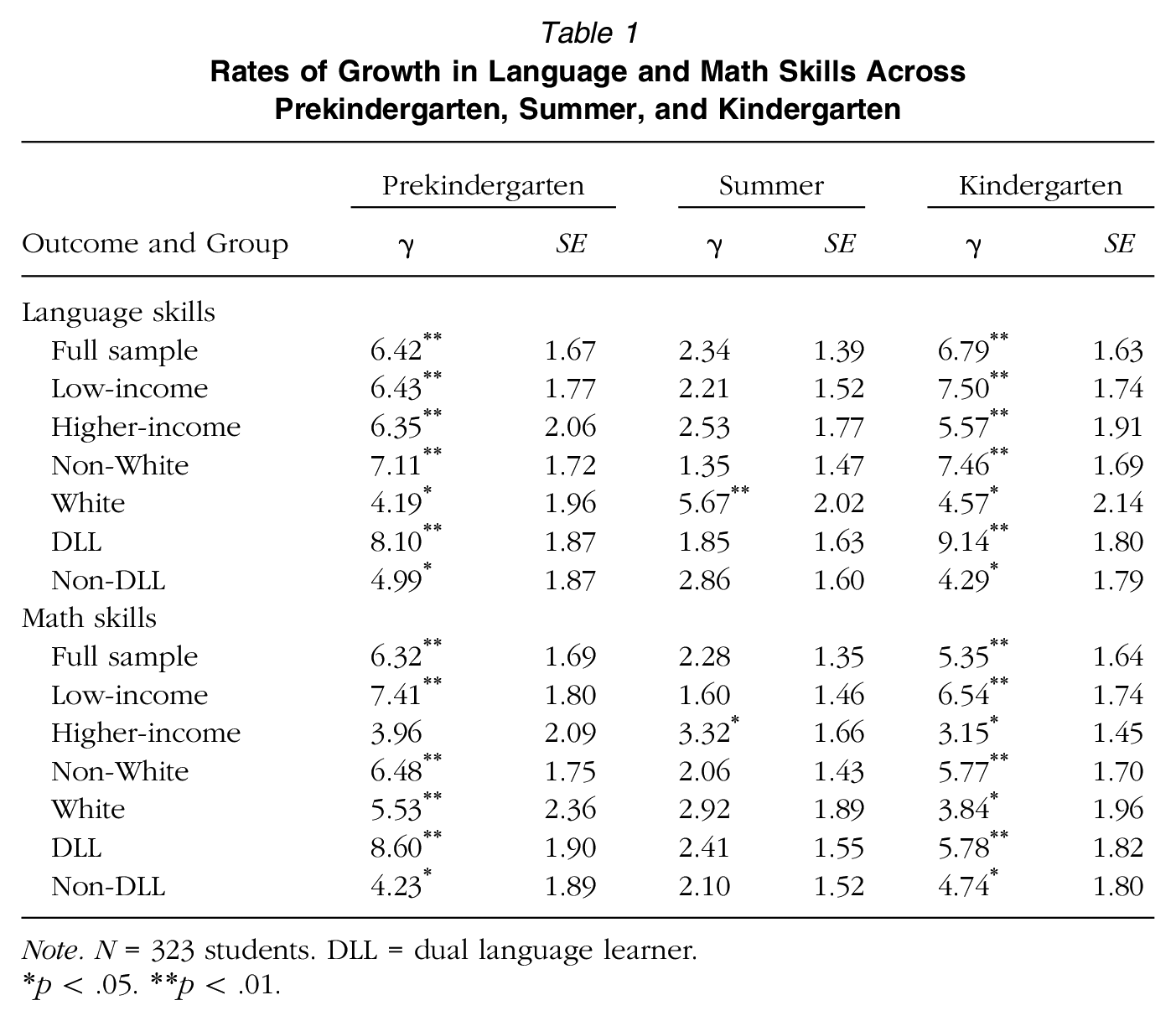
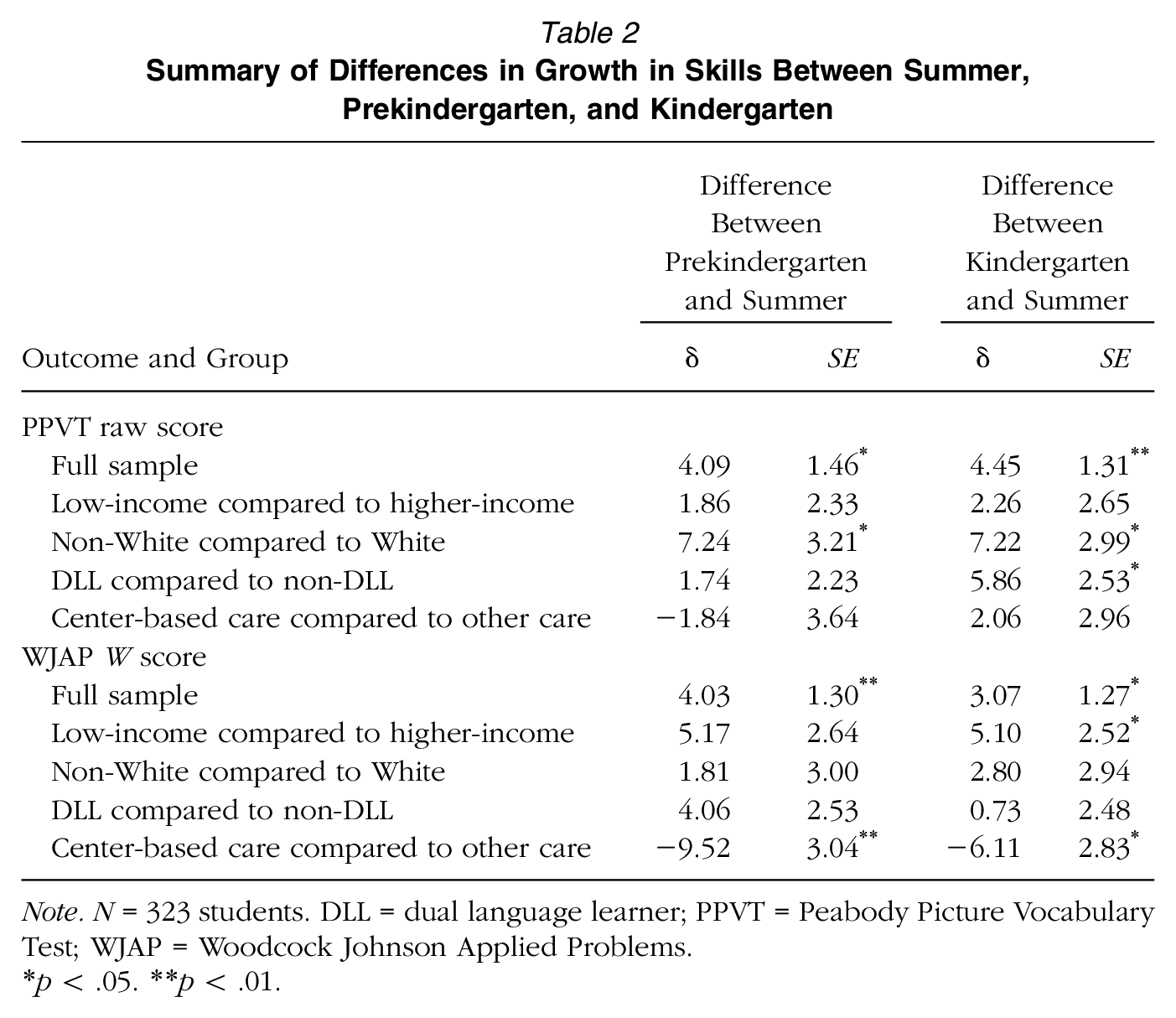
Estimated slopes used to answer the first research question are illustrated in the top (language) and bottom (math) panels of Table 1. Full model results with fixed and random effects and average growth rates are included in Supplemental Appendix Tables 1 and 2. When examining the model predicting language skills, we found that children grew in their skills during the prekindergarten (γ = 6.42, SE = 1.67, p < .001) and kindergarten (γ = 6.79, SE = 1.63, p < .001) years. The growth rate in language skills during the summer between prekindergarten and kindergarten was not statistically significant (γ = 2.34, SE = 1.39, p < .10). Further, as illustrated in Table 2 summarizing the differences in the slopes between each academic year and the summer, the summer rate of growth was significantly slower than growth during the prekindergarten (δ = 4.09, SE = 1.46, p < .05) and kindergarten years (δ = 4.45, SE = 1.31, p < .01; standardized difference = 0.15 SDs).
Rates of Growth in Language and Math Skills Across Prekindergarten, Summer, and Kindergarten
Note. N = 323 students. DLL = dual language learner.
p < .05. **p < .01.
Summary of Differences in Growth in Skills Between Summer, Prekindergarten, and Kindergarten
Note. N = 323 students. DLL = dual language learner; PPVT = Peabody Picture Vocabulary Test; WJAP = Woodcock Johnson Applied Problems.
p < .05. **p < .01.
In models predicting math, we also found that children grew in their skills during prekindergarten (γ = 6.32, SE = 1.69, p < .001) and kindergarten (γ = 5.35, SE = 1.64, p < .01), but the growth rate during the summer was not statistically significant (γ = 2.28, SE = 1.35, p = .09). We then found that the growth rate in math skills during the summer was slower than during the prekindergarten (γ = 4.03, SE = 1.30, p < .01; standardized difference = 0.15 SDs; see Table 2) and kindergarten (γ = 3.07, SE = 1.27, p < .05; standardized difference = 0.11 SDs; see Table 2) years. The differences in growth rates during the academic years were not significantly different from one another for either outcome.
Variation in Growth by Socioeconomic Status, Race, and DLL Status
To answer our second research question, we examined whether rates of growth in language and math skills varied by students’ family income, race/ethnicity, and DLL status. Results summarizing individual slopes for each group are presented in Table 1. Table 2 then summarizes the differences in the slopes between each academic year and the summer for each group and tests whether those differences are statistically significant. For language, we found that all groups demonstrated growth in language skills during the prekindergarten and kindergarten years. However, only White students exhibited statistically significant growth in language skills during the summer (γ = 5.67, SE = 2.02, p < .01). We further found that the difference in growth in language skills between kindergarten and the summer was larger for DLL than non-DLL students (γ = 5.86, SE = 2.53, p < .05; standardized difference = 0.20 SDs, see Supplemental Appendix F Figure 1 in the online version of the journal). In addition, the difference in growth in language skills between the prekindergarten year and summer was larger for non-White versus White students (γ = 7.24, SE = 3.36, p < .05; standardized difference = 0.24, see Supplemental Appendix F Figure 1) as was the difference between the kindergarten year and the summer (γ = 7.22, SE = 2.99, p < .05; standardized difference = 0.24, see Supplemental Appendix F Figure 1). The size of the differences in summer versus academic year growth rates did not differ for lower- and higher-income students.
With respect to math, we again found that all groups made progress during both the prekindergarten and kindergarten academic years (see bottom pane of Table 1). However, only higher-income students exhibited statistically significant growth in math skills across the summer (γ = 3.32, SE = 1.66, p < .05). We further found that the difference in growth in math skills between the prekindergarten year and summer was larger for lower-income students than for higher-income students (γ = 5.17, SE = 2.64, p < .05; standardized difference = 0.19, see Supplemental Appendix F Figure 2 in the online version of the journal) as was the difference between kindergarten and the summer (γ = 5.10, SE = 2.56, p < .05; standardized difference = 0.19, see Supplemental Appendix F Figure 2). Differences in growth in math skills between the summer and either academic year did not vary by race/ethnicity and DLL status.
Variation in Growth for Students Attending Center-Based Care in the Summer
For our third research question, we tested whether enrollment in center-based care during the summer attenuated the slowing of growth in children’s academic skills that we observed in our first research question. We found that students who attended center-based care during the summer exhibited statistically significant growth in math skills during the summer (γ = 3.13, SE = 1.48, p < .05). We further found that the drop in the rate of growth in math skills between the prekindergarten year and summer (γ = −9.52, SE = 3.04, p < .01; Figure 1) and between the kindergarten year and summer (γ = −6.11, SE = 2.83, p < .05; Figure 1) was smaller for children who did attend center-based care in the summer versus those who did not. Growth in language skills between summer and the preceding and subsequent academic years did not vary by enrollment in center-based care during summer (see full results in Supplemental Appendix Table 1).
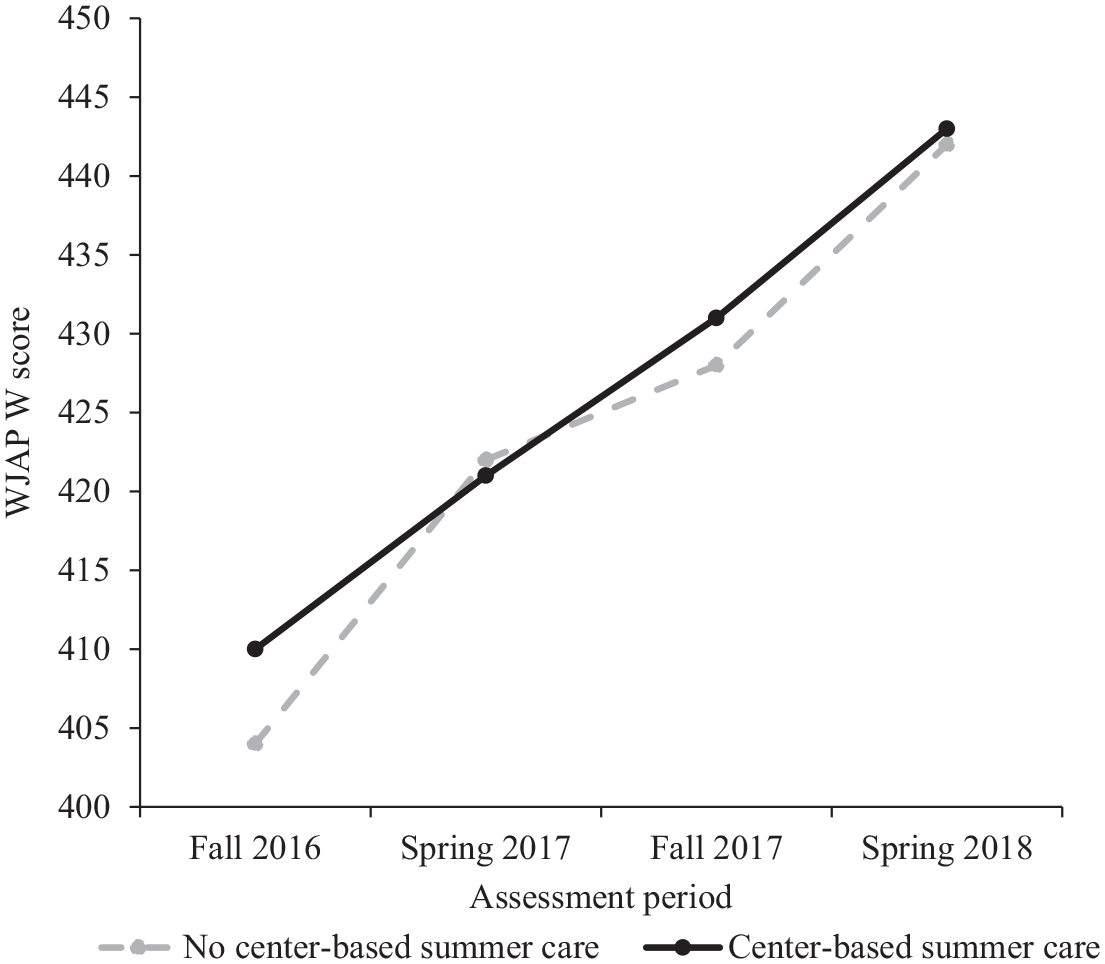
Growth in math skills across prekindergarten and kindergarten by enrollment in center-based care during the summer.
Subgroup Variation in Growth for Students Attending Center-Based Care in the Summer
For our fourth and final research question, we probed these models further and examined whether lower-income, non-White, and DLL students benefited more than their peers from enrollment in center-based care during the summer. We found that White students who attended center-based care in the summer were the only group to exhibit significant growth in language skills during the summer (γ = 6.61, SE = 3.24, p < .05). We found that differences in growth rates between children who attended center-based care in the summer and children who did not attend center-based care during the summer varied by family income (δ = −8.80, SE = 3.93, p < .05; Figure 2). Growth in language skills during the summer was faster for higher-income students who attended center-based care versus higher-income students who did not. Lower-income children who attended center-based care during the summer demonstrated slower growth in language skills than lower-income children who did not attend center-based care. The effect of center-based summer care on growth in math skills did not vary by race, DLL status, or socioeconomic status.
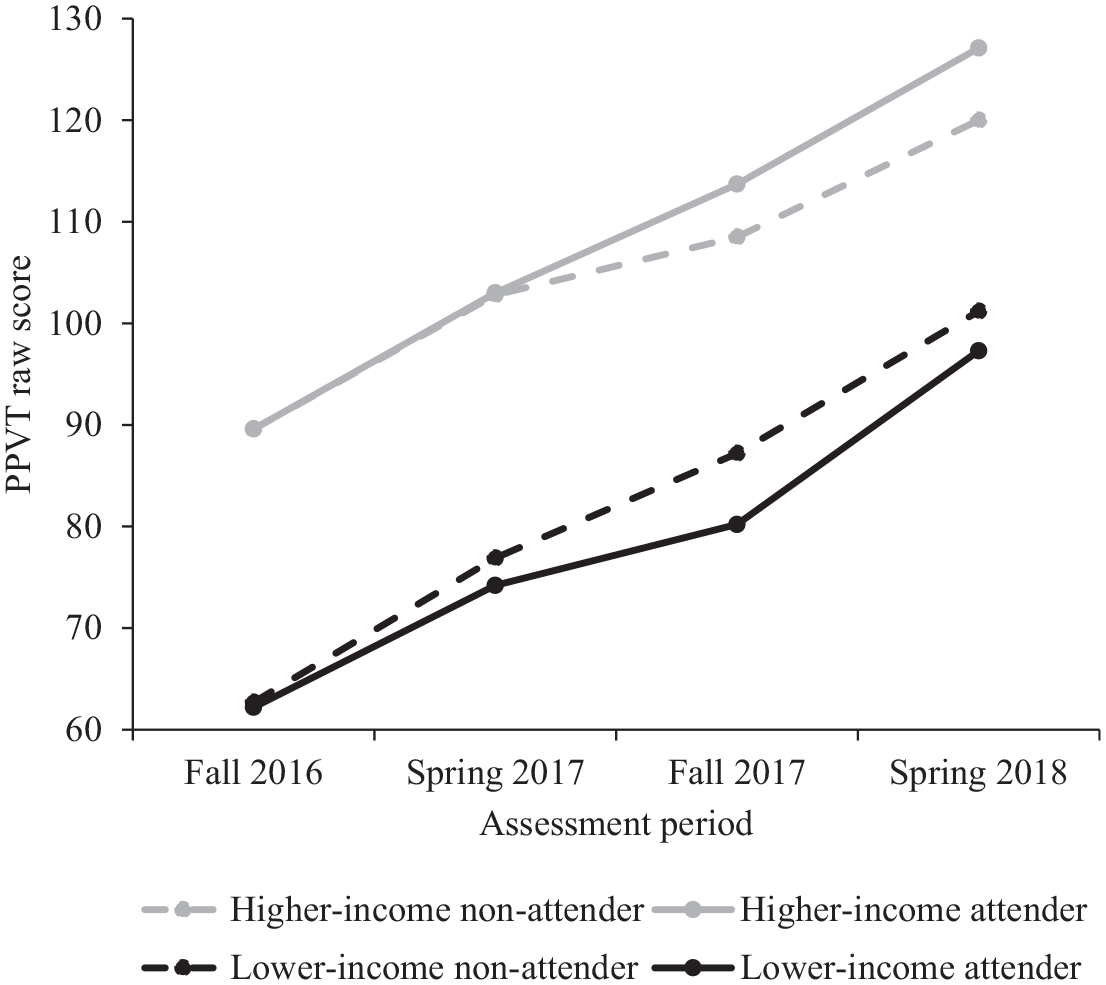
Growth in language skills across prekindergarten and kindergarten by family income and enrollment in center-based care during the summer.
Robustness Checks
We conducted three robustness checks to test the sensitivity of our results to different model specifications and potential threats to the validity of the analysis. As recommended by von Hippel et al. (2018), we considered how sensitive findings were to the number of days between assessments. Second, we tested whether results replicated when using complete case analysis. And third, we considered whether our findings were robust when we excluded math assessments done in Spanish. The full set of robustness check results is included in Supplemental Appendix D. As illustrated there, our results were robust across all three sets of checks.
Discussion
The current study sought to add to the early childhood and summer learning literatures by examining language and math skills in the summer between preschool and kindergarten for a sample of students who participated in a 4-year-old preschool program implementing the BPS prekindergarten model and then transitioned into BPS kindergarten. In contrast to some work on summer learning done in samples of elementary and middle school (Alexander et al., 2016; Allington & McGill-Franzen, 2018), we did find not find evidence of summer learning loss in this study. However, we did find that growth in children’s language and math skills in general did slow down during the summer, a result aligned with more recent work by von Hippel et al. (2018). This finding may reflect the fast speed with which learning occurs during this developmental period when children are enrolled in early childhood education and making significant gains in their ability to understand others and express themselves through language (Girard et al., 2017), to think abstractly (Aras, 2016), and to engage in complex thinking and problem solving through their interactions with adults and peers (Burchinal et al., 2015).
When we examined these trends by subgroup, we found that there appeared to be greater inequality in growth in English language skills during the summer for DLL and non-White students. Findings showed evidence that some early test score gaps did grow during the summer before kindergarten. These findings align with other work done in elementary school populations showing that gaps in language skills between these groups grow during the summer and are maintained or even contract during the academic year (Downey et al., 2004; Quinn et al., 2016; von Hippel et al., 2018). We cannot tell from our data whether there were qualitative differences in the environments that DLLs and non-White students were exposed to over the summer relative to their monolingual and White peers. However, prior work would suggest that DLLs were less likely to be spoken to and read to in English over the summer (Buysse et al., 2014; Lugo-Neris et al., 2010). The extant literature suggests that parents of non-White students—56% of whom were also DLLs—may have fewer financial resources than parents of White parents to access activities in and outside of the home to support language development during the summer (Bassok et al., 2016; Reardon & Galindo, 2009). Unfortunately, any increments in these students’home-language skills were not measured, as most students took the kindergarten assessments in English.
Interestingly, we did not see any differences in the summer drop-off in growth in language skills for lower-income versus higher-income students. This trend may reflect recent increases in parents’ engagement in home-based learning activities that support language and literacy development, across all socioeconomic levels (Bassok et al., 2016). For example, parents from all income brackets are reading to their children at higher rates than ever before (Kalil, 2015) perhaps in part due to large-scale efforts over the past 20 years to increase the frequency of home-based reading and children’s exposure to books (Roskos, 2017). However, given that we did find differences in summer growth between White and non-White students, it may also be that our indicator for family income in this study—eligibility for FRPL—is not capturing important variation in children’s home-based learning that we would be able to detect with a richer measure of family income.
In contrast, lower-income children showed larger drop-offs in math gains during the summer than higher-income children. This result aligns with past work finding that higher-income children are more likely than their peers to be exposed to more advanced math content (Vandermaas-Peeler et al., 2009) and math outside of school contexts (Verdine et al., 2014). In addition, while most children develop basic counting skills by the start of kindergarten, income-based differences are more likely to emerge in advanced number sense skills (e.g., numerical magnitude estimation) and in subsequent math skills measured with standardized assessments (Engel et al., 2013). Growing income-based gaps in math skills during the summer may reflect variation in the home math environments that higher- versus lower-income students are exposed to when not attending formal schooling.
As we hypothesized, we found that children who enrolled in center-based care during the summer showed less drop-off in growth in math skills than children who stayed at home with a parent or other informal care provider. Initially, findings reflected general trends in the field showing that school and center-based care are more likely to support growth in math skills than the home context (Berkowitz et al., 2015). For example, parents across socioeconomic backgrounds are less likely to participate in math and complex problem-solving activities with children at home than they are to read to their children and engage in activities like storytelling and discussion (Berkowitz et al., 2015; Sheldon et al., 2010).
However, in our sample, once we considered enrollment in center-based care jointly with family income, we found that higher-income children enrolled in center-based care demonstrated less slowdown in language skill growth during summer than higher-income children not enrolled in center-based care. In contrast, we found descriptive evidence that lower-income children showed the opposite pattern: Students who attended summer center-based care showed greater slowing of growth in language skills during summer than those who did not enroll in center-based care. This is an important finding that may reflect variation in the quality of center-based summer care that lower- versus higher-income students were exposed to. A large body of work has demonstrated that, in general, children from lower-income backgrounds have less access to high-quality child care than their more affluent peers (e.g., Bassok & Galdo, 2016; Hatfield et al., 2015). Further, research by Burchinal (2018) summarizes substantial variation in the quality of existing early childhood education programs that likely extends to center-based care during the summer. Accordingly, center-based care during the summer is likely not a monolith that can be examined as one type of program. Rather, there is a need to examine heterogeneous quality in summer-based care and consider how that quality does or does not vary by income, race/ethnicity, and DLL status. Indeed, lower-quality care is less likely to yield substantial impacts on students’ academic skills and decrease gaps in test scores (Valentino, 2018). Some work has demonstrated that lower-income families are constrained in their choice sets for care during the summer vacation, because low-cost options close to their homes may not optimally support students’ learning (McCombs et al., 2011). Thus, although past research suggests that summer-based programming can boost academic outcomes for lower-income students (McCombs et al., 2019), the quality of such programs is crucial if they are to substantially boost skills prior to kindergarten.
Importantly, work examining center-based preschool programming during the school year has shown that high-quality early childhood education can have larger benefits for children from lower-income, non-White, and DLL families (Bloom & Weiland, 2015; Phillips, Johnson, et al., 2017). Learning more about how to support quality improvements in summer center-based care serving these groups of students may yield substantial benefits, although more work focusing on enhancing quality and empirically testing this theory is needed. There is also important potential variation in the home-learning experiences during the summer that may exist between our subgroups of interest. Even when enrolled in center-based care, higher-income children are likely to be exposed to more home-based learning activities when they are not in care (Bassok et al., 2016). In contrast, lower-income children are more likely to have parents who work longer and nontraditional hours and may have less time to engage in home-based learning activities to supplement the activities children are exposed to in care (Kalil et al., 2016). These disparities in the home learning environment may further differentiate the trajectories of lower- and higher-income students enrolled in center-based care in the summer.
Notably, we did see significant growth in skills across all subgroups during both the prekindergarten and kindergarten years. This finding aligns with prior work by Downey et al. (2004) that was later expanded on by von Hippel et al. (2018) showing that gaps in skills do not typically emerge or grow during the academic year. Like this prior work, we found substantial income-, race-, and language-based gaps in language and math skills at prekindergarten entry and then some small growth in gaps during the summer prior to kindergarten. All children in this study, however, were enrolled in a prekindergarten program implementing the BPS Focus on Early Learning model, which is heavily based on an approach that has been shown in prior work to produce significant impacts on a range of school readiness outcomes (Weiland & Yoshikawa, 2013). 7 Children then transitioned into public school classrooms typically also implementing the BPS curriculum (McCormick et al., 2020). They were thus exposed to high-quality educational programming during two successive academic years that appeared to support gains in learning in a relatively consistent way across groups. Studies examining other samples with greater variation in the quality of programming that children are enrolled in for preschool and/or kindergarten may observe differences in learning gains during academic years, particularly if preschool experiences are more varied.
When interpreting results, it is important to consider some of the key differences we observed when comparing our study sample—students who all attended public and nonpublic preschool—to the population of students in BPS who did not attend a formal preschool program during their 4-year-old year. In general, we found evidence mapping onto prior work from Boston (Shapiro et al., 2019) that children who accessed formal preschool were more likely to be White, less likely to be a DLL, and less likely to be eligible for FRPL, compared to students who did not enroll in a public preschool program. Findings align with prior work demonstrating lack of access to formal learning opportunities in early childhood among lower-income, non-White (and particularly Hispanic), and DLL children, the groups perhaps most likely to benefit from education programs implemented prior to kindergarten (Phillips, Johnson, et al., 2017). These comparisons suggest that the subgroup differences we observed in growth in academic skills during the summer may actually be greater than what we were able to detect with our more advantaged sample of students who were all able to access formal preschool.
This same pattern of disparities emerged when we compared the characteristics of students within our study sample who enrolled in center-based care during the summer to those who did not. Moreover, we found that children who did not access center-based care during the summer evidenced more rapid growth in skills than their peers during the preschool year. This pattern may have emerged because students without access to center-based care during the summer tend to be more disadvantaged relative to students who do access summer care and thus enter school with lower skill levels and more room to grow. After evidencing rapid growth in skills during the academic year, our results suggest that low-income students who enrolled in center-based care during the summer actually showed slower growth in language skills than low-income students who did not enroll in center-based care during the summer. As noted above, this finding suggests that there may be additional disparities in the quality of summer programs that different groups of students are able to access, differences that would likely magnify if we were able to examine the summer learning experiences of all students in the district and not just those who had enrolled in formal preschool. More research is needed to understand disparities in students’ access to quality care across the year and identify strategies to address them.
Strengths, Limitations, and Directions for Future Research
This study has a number of key strengths, including the ability to examine growth in both language and math skills across four assessment time points as children moved from preschool to kindergarten, the use of a broad set of a covariates and analytic robustness checks, and a diverse study sample. However, there are also a number of limitations that we encountered. First, the study sample is limited to children in Boston who either enrolled in the public prekindergarten program or a community-based program implementing the BPS model. These results do not generalize to other cities or districts and future work should continue to build knowledge on this topic by conducting studies across a variety of localities and a broader set of samples. Moreover, the study does not illuminate what summer learning prior to kindergarten looks like for students who do not attend a formal preschool program. Although we were able to identify key characteristics differentiating students who enrolled in formal preschool versus those who did not, and comparing students who accessed center-based care during summer versus those who did not, future research that explicitly aims to evaluate disparities in access to early childhood education are needed to better address the issue of representativeness in this study.
Second, although we have a diverse study sample, the sample size is too small to be able to consider the range of three-way interactions that would be needed to disentangle intersectionality between race/ethnicity, language status, and family income. The current study does control for those potential confounders in the models but is unable to explicitly test differences between intersecting subgroups. Relatedly, we decided to dichotomize race/ethnicity in our models examining variation in summer skills by subgroup. Although we recognize that different racial/ethnic groups face unique challenges, the early descriptive work that we did in this study demonstrated that patterns of learning during the year and across the summer most substantially differed between White and non-White students examined together. As such, we decided to collapse across our non-White racial groups when examining subgroups. Future work should continue to explore differences between these groups.
Next, we have no data in the study examining the quality of students’ summer learning experiences, whether they occurred in center-based care, at home, or elsewhere. We are thus only able to hypothesize about variation in the quality of summer care across populations. Future research is needed that explicitly aims to measure variation in quality of summer care by family income, race/ethnicity, and DLL status. Finally, the study leverages longitudinal data to examine trends across time but is unable to make causal inferences about the role of summer learning in promoting gains in students’ learning. Future studies using experimental or quasi-experimental designs will be better poised to establish causal relationships—or the lack thereof— between center-based summer care and students’ gains in language and math skills prior to kindergarten.
Implications
To our knowledge, this study is one of the first to examine how growth in children’s language and math skills during the summer before kindergarten differs from growth in skills during the preschool and kindergarten academic years. Findings demonstrated some disparities in summer learning rates favoring more advantaged groups, depending on the subgroup and outcome examined. Initially, it appeared that students who enrolled in center-based care during the summer showed evidence of faster growth in math skills during the summer prior to kindergarten relative to their peers who did not enroll in this summer care. This finding initially suggested descriptive evidence that the provision of opportunities for center-based care during the summer may stand to benefit students’ math test scores at the start of kindergarten. Yet further work showed that lower-income students who enrolled in center-based care during summer actually demonstrated slower growth in language skills than lower-income students who stayed at home during the summer. Taken together, findings suggest that additional research examining the quality of center-based care during the summer is critical for learning more about the interventions that may stand to boost students’ kindergarten readiness and close gaps in test scores prior to the start of formal schooling.
In addition, it is important to conduct further research examining summer learning prior to kindergarten with a broader set of samples that includes students who did and did not attend formal preschool. The overarching goal of the current study is to inform strategies and interventions to reduce income-, race/ethnicity-, and language-based gaps in test scores at school entry for the full population of students served in the district. Yet if we were to make recommendations for policy and practice based on the current sample of students—who all attended preschool—such actions could introduce larger disparities in kindergarten readiness between those able to access formal early childhood education during the summer, compared to those who were not. As such, the field needs further research replicating this study using representative samples of students so that results can more directly inform policy and practice.
Supplemental Material
Summer_learning_appendix_July_2020 – Supplemental material for Can Center-Based Care Reduce Summer Slowdown Prior to Kindergarten? Exploring Variation by Family Income, Race/Ethnicity, and Dual Language Learner Status
Supplemental material, Summer_learning_appendix_July_2020 for Can Center-Based Care Reduce Summer Slowdown Prior to Kindergarten? Exploring Variation by Family Income, Race/Ethnicity, and Dual Language Learner Status by Meghan P. McCormick, Mirjana Pralica, Paola Guerrero-Rosada, Christina Weiland, JoAnn Hsueh, Barbara Condliffe, Jason Sachs and Catherine Snow in American Educational Research Journal
Footnotes
Notes
M
M
P
C
J
B
J
C
References
Supplementary Material
Please find the following supplemental material available below.
For Open Access articles published under a Creative Commons License, all supplemental material carries the same license as the article it is associated with.
For non-Open Access articles published, all supplemental material carries a non-exclusive license, and permission requests for re-use of supplemental material or any part of supplemental material shall be sent directly to the copyright owner as specified in the copyright notice associated with the article.
