







Abstract
A major area of critical scholarship within human rights education (HRE) aims to discover HRE’s revolutionary potential by questioning its relationship to the global human rights regime. However, the very concept of “human rights violations” remains underexamined. This article analyzes the use and function of human rights violations as pedagogical devices. Drawing from qualitative data collected in two public high schools in New York City (2014–2015), this study explores the limitations of teaching human rights through the legal definition of human rights violations. In doing so, HRE positions human rights violations primarily as manifestations of direct violence. We argue that to teach human rights violations also as expressions of structural violence can help students cultivate powerful and transformative forms of knowledge.
Keywords
Introduction
In the United States, discussions around social inequality and structural reform have emerged with new force. The confluence of the COVID-19 health pandemic, economic crisis, and racial injustice and police brutality has brought to light the unequal and structural inequalities along racial/ethnic and class lines (Pinsker, 2020). At the same time, these crises have led to a renewal in civic engagement and activism, as evidence by the mass protests around antiracism and policy brutality, such as the Black Lives Matter (BLM) movement (Buchanan et al., 2020). 1 Widespread access to information and renewed understanding about how oppression structures persist in U.S. society has mobilized millions to ask for previously unimaginable and radical demands, such as defunding the police, the abolition of prisons, imposing new wealth taxes, and dismantling the U.S. Immigration and Customs Enforcement (ICE) (Joseph, 2020; McMillan Cottom, 2020).
By nurturing and expanding these conversations, schools can play a vital role in transforming society. While scholars have illustrated the way that schools maintain the status quo and reproduce social inequalities across class and race (Apple, 1979; Bowles & Gintis, 1976; Ladson-Billings, 1995; Young, 1971), critical theorists explore the extent to which knowledge can also represent a site of possibility to activate critical consciousness and inform demands for social change (Freire, 1981; Giroux, 1983). Young’s (2008, 2013) theory of school curriculum claims that all students, regardless of their background, are entitled to powerful knowledge—a form of knowledge that transcends students’ everyday experiences, is grounded in subject communities that value evidence and argumentation, and is specialized and organized. From this perspective, providing students with powerful knowledge gives them a base to build a critical understanding of the world, dare to think the unthinkable, and propose alternatives to the big problems of our times (Young, 2013).
Since its inception, human rights education (HRE) has had the potential to produce knowledge that informs this kind of structural reform and systemic change. In a set of recommendations concerning the role of education for international understanding and cooperation published in 1974, UNESCO established for the first time a formal relationship between human rights and education (Coysh, 2014). These recommendations entrusted member states, including the United States, 2 to apply national policies that could orient education toward the establishment of social justice and the “eradication of the prejudices, misconceptions, inequalities and all forms of injustice, which hinder the achievement of these aims” (UNESCO, 1974). By highlighting education as a resource for collective action against injustices such as colonialism and racism, this legal instrument positioned HRE knowledge as a site to name, understand, and reject the same social forces that exclude the most marginalized groups.
Despite this radical past, recent HRE approaches have primarily equated human rights knowledge with a history of the United Nations and its legal instruments (Keet, 2010; Osler, 2016; Tibbitts, 2002, 2017). Responding to this trend, a significant body of critical scholarship within HRE aims to reveal HRE’s transformative potential by questioning its relationship to the U.N. global human rights regime. Aware of the many ways that imperialism, Cold War politics, and American exceptionalism have shaped the global human rights regime (Gibson & Grant, 2017), Ahmed (2017, 2018), Keet (2010, 2012, 2017), and Zembylas (2016) call for a detailed analysis of the problematic relationship between human rights and HRE. These critical perspectives encourage HRE to move away from a legally constrained understanding of human rights and turn toward more in-depth analyses of the social forces and mechanisms that produce and sustain such abuses in the first place. Likewise, Parker (2017) and Barton (2020) have noted the need to strengthen HRE’s knowledge base. Parker (2017) suggests that human rights knowledge “requires additional development and specification before it can secure a stable place in the school curriculum” (p. 476). Similarly, Barton (2020) underlines the need to shape students’ actions toward change by providing them with knowledge about the specific policies and institutional mechanisms that configure society in a particular way.
Our aim in this article is to contribute to the conversation about human rights knowledge and expand the way that HRE approaches the term human rights violations. To do so, we analyze the pedagogical uses of human rights violations in three HRE classrooms through the lens of structural violence. While we acknowledge the justiciable and enforceable dimensions of human rights, we approach human rights violations as manifestations of violence, including structural violence or the unequal distribution of power in society’s fabric (Farmer, 2003). Given that the concept of structural violence points to the connections between everyday interactions with violence and the large-scale social and economic structures that constrain individual and collective agency, structural violence used within HRE has potential to transcend simplistic interpretations of violent events and bring students closer to powerful knowledge (Parker, 2017; Young, 2013).
To understand how HR courses are organized around human rights violations and how this in turn mediates students’ relation to the class and understandings of their own surroundings, we conducted an in-depth analysis of an enacted human rights curriculum. We draw from six focus groups, 36 semistructured interviews, and more than 100 hours of classroom observations collected over an academic year (2014–2015) in three human rights classes in two public high schools in New York City. Against the backdrop of a series of extrajudicial killings of unarmed Black youth by the police—Eric Garner, Mike Brown, Akai Gurley, Miriam Carey, and Freddie Gray—as well as the rise of the BLM movement, students explored notions of human rights within their own lives. In this article, we ask, How is a HRE course structured around human rights violations? How does this affect students’ understandings and relation to the class material? What consequences does it have on learning more broadly about human rights, given their own experiences? We demonstrate that by the end of the academic year students understood human rights violations as emblematic events not necessarily connected to violence, either in general or as specifically experienced in their own lives. The erasure of history and the social and economic structures that shaped the human rights violations covered in the curriculum prevented most students from linking the social exclusion and institutionalized racism they experienced to broader debates about human rights. Our findings point to the limitations of prioritizing legal frameworks over forms of powerful knowledge, which students could use as tools to interpret their own realities more effectively. Here, we present structural violence as a complementary concept to be used to design curricula and educate students in issues related to human rights and social inequality. This is a crucial step that moves teaching and learning about human rights from the identification of human rights abuses by citing the relevant international human rights convention to a critical analysis of the internal workings of society within which political action could take form (see Love, 2019).
This study provides empirical evidence on how the emphasis on the normative legal terms through which students learn about human rights constrains them from examining the larger historical and structural dimensions that enable and perpetuate human rights violations. That is, students learned language that helped them identify particular violations as human rights abuses but were less likely to learn how to explain the systematic origins of such abuses. While we do not eschew the legal framework that sustains human rights globally (Tibbitts, 2018), we show that legal categories—specifically human rights violations—are limited in their ability to communicate more general knowledge about human rights.
Assessing the Transformative Potential of Human Rights Knowledge
In line with international frameworks that range from the 1948 Universal Declaration of Human Rights (UDHR; United Nations, 1948) to the four phases of the World Programme for Human Rights Education (2005–2024; United Nations Human Rights Office of the High Commissioner, 2005, 2011), 3 scholars have defined HRE as learning about, through, and for human rights (Bajaj, 2004, 2011; Russell, 2018). HRE aims to empower students ““to contribute to the building and promotion of a universal [human rights] culture”“ (United Nations Human Rights Office of the High Commissioner, 2019, p. 3). According to the World Programme for Human Rights Education, HRE includes three dimensions: the cultivation of knowledge about human rights and the skills to apply that knowledge; the development of values, attitudes, and behaviors to promote a human rights culture; and the impetus to take action to protect human rights (United Nations Human Rights Office of the High Commissioner, 2019).
These three dimensions—knowledge, skills, and action—have inspired various HRE models. Tibbitts (2002, 2017) coined the terms Values and Awareness model, the Accountability model, and the Transformative model. The Values and Awareness model aims to promote knowledge about human rights, the Accountability model focuses on training adults and professionals about HRE, and the Transformative model seeks to empower marginalized groups to ameliorate human rights violations and to bring about social change. Similarly, Bajaj (2011) focuses on the “ideological articulations”“ that underlie HRE, including HRE for Global Citizenship, HRE for Coexistence, and HRE for Transformative Action.
In line with HRE models that prioritize change in society, a growing body of literature is concerned with the possibilities HRE offers learners to engage in social justice efforts. Existing literature demonstrates that while human rights learning is mediated by broader political and social structures, human rights knowledge tends to orient students toward direct action and move them away from examining and acting upon broader societal inequalities. We review studies that discuss contextual factors, the international focus on human rights, and the engagement of students around HRE.
Recent studies demonstrate that contextual factors mediate the opportunities for change that students envision through HRE. For instance, in a study in two secondary schools in Hong Kong, Leung et al. (2011) show that the vertical power relations that prevail in schools between educators and students limit students’ opportunities to approach human rights as a transformative tool. In a qualitative study in India, Bajaj (2012) finds that household, school, and community values and practices shape students’ engagement with HRE content, as well as the opportunities available to students to apply what they learn in class. From a comparative perspective and drawing from more than 110 interviews with 14- to 17-year-olds in Colombia, Ireland, Northern Ireland, and the United States, Barton (2015) examines how students make sense of the location of human rights and human rights violations finding that students’ understandings are mediated by their social context and pragmatic considerations related to their personal experiences. Through ethnographic fieldwork conducted inside and outside school premises in Guatemala, Bellino (2014) finds that how young people interpret human rights’ transformative potential is linked to their understanding of the past, specifically Guatemala’s armed conflict. These studies show that beyond what happens in the classroom, students’ understanding of human rights and radical change possibilities are linked to broader social conditions that vary across contexts.
With some exceptions (see Bajaj et al., 2017; Hantzopoulos, 2016), a significant body of literature has demonstrated that HRE students tend to assume that human rights are an external issue rather than one that has relevance for their daily lives. This tendency has limited their capacity to undertake transformative actions. For example, Barton (2015) and Kim (2019), describe the tendency of students in countries such as the United States, Ireland, and Korea to assume that human rights are an international rather than a domestic matter. To explain this inclination, authors cite national human rights legislation (Branigan & Ramcharan, 2012); the messages propagated by learning materials, the media, and public discourse (Barton, 2015); and the interactions between students and those who facilitate their political socialization (Kim, 2019). With an emphasis on students’ reasoning, Kim (2019) interviewed 22 students at four high schools in Seoul, Korea. By comparing students’ interpretations of national and international human rights issues, this research reveals that students selectively applied causes to explain human rights violations depending on geographical location. Whereas in international settings, they opted to point to structural oppression, in discussions about domestic affairs, students emphasized individual responsibilities to the detriment of structural factors. Drawing on data from high school students in a human rights class in New York City, Russell (2018) demonstrates that students often mentioned examples of human rights violations from non-Western countries rather than examples of violations in the U.S. context. These studies encourage educators to develop more complex and comprehensive understandings of society in HRE classrooms. Yet they still fail to provide concrete pedagogical alternatives.
In instances where students glimpse human rights as a platform for change, studies show that they tend to prioritize direct action on their immediate environments and relationships. For example, Gaudelli and Fernekes (2004) find that while a 4-week HRE unit allowed students to develop empathy for victims of human rights violations in other countries, with few exceptions, their desire for action was limited to the classroom. Similarly, Bajaj (2004) illustrates that young Dominicans were more committed to finding peaceful alternatives to conflict resolution and more willing to intervene in quotidian abusive situations at the end of a 3-month human rights course. In another study conducted in different Indian provinces, Bajaj (2012, 2018) shows that a human rights curriculum based on discussions of children’s rights, discrimination, and examples of social mobilization prompted students to take action in their immediate environment. Through the same comparative study referenced above, Barton (2020) examines young adolescents’ understanding of human rights violations and their perceived capacity to protect human rights. This study finds that while students tend to recognize the relationship between human rights enforcement and certain social institutions, their analysis of how to protect human rights is limited to personal interventions; even in the realm of economic development, the prevailing solutions are those related to charity and volunteerism. In line with ’Keet’s (2007, 2015) critique of HRE’s tendency to organize a human rights curriculum around “declarations, conventions, and covenants,” Barton’s (2020) study explains that the emphasis on legal instruments over the procedures through which human rights are institutionalized limits the repertoire of transformative action that students manage to envision. Despite these important contributions, these studies do not investigate the pedagogical devices that give shape to HRE’s transformative potential.
In line with this line of inquiry, in this article, we reveal the limitations of teaching and learning human rights primarily through the lens of legal definitions of human rights violations. Instead, to enhance HRE’s potential, we propose an expanded definition of human rights violations, by seeing human rights as situated within their historical and social context. We claim that for HRE to become effective in the struggle for rights, we need to position HRE within a legal framework alongside a conceptualization of not only how human rights violations are produced and dismantled but also the historical and sociocultural contexts that foster these violations. By expanding the focus of human rights violations to incorporate structural violence, we lay the ground for an HRE that, based on rigorous historical and critical thinking, elucidates links between apparently disparate events to shape more complex understandings of human rights violations. By including discussions about structural violence through HRE, we seek to provide evidence of the importance of considering broader social and historical structures when teaching and learning about HRE. In the next section, we provide an overview of the discussions related to teaching and learning structural violence from the education field.
Structural Violence in the Classroom
Educational literature has demonstrated the pedagogical potential of incorporating the notion of structural violence in the classroom. The following studies illustrate the value when educators embrace it either as a theoretical stance to select and frame knowledge or as curriculum content developed in tandem with students.
Studies that account for students’ interpretations of race-based inequalities in the classroom show that the concept of structural violence supports students in situating daily experiences of racial discrimination and the social causes that motivate it historically. This body of research analyzes the interpretations that students of color make of their own reality through learning experiences that prioritize a critical understanding of race-based social inequalities. For example, Schensul and Berg (2004) draw from an eco-critical perspective—a critical interpretation of Bronfenbrenner’s (1979) ecological model that situates power differentials at multiple levels—to examine how students design plans for action that target the individual, the family, and broader societal arrangements through a Youth Participatory Action Research (YPAR) project. Hope et al. (2014) also combine an eco-critical perspective with YPAR methodologies to explore how Black high school students make sense of racial discrimination in their schools. Both studies highlight structural violence as a productive avenue to historicize exclusionary practices and decode personal experiences of racism and discrimination. In racial literacy workshops, McArthur and Muhammad (2020) examine how three young Black women make sense of racism in the United States. Among other points, the study finds that in a space where girls thought and wrote collectively about “power, oppression and privilege” (p. 9), they recognized racism’s historic and systemic dimensions and the direct implications it had over them and people who looked similar to them. In a different educational scenario and through a longitudinal, mixed methods research design with more than 400 adolescents, Seider et al. (2016) reveal that by the end of freshman year, students attending progressive schools with an explicit commitment to social justice ideals demonstrated an increased ability to analyze inequality in relation to race and socioeconomic status. Furthermore, the study shows that students were able to examine the causes of racial inequality, particularly the role of systemic factors in reproducing race-based inequality. Contrastingly, through in-depth interviews with 35 lower secondary school students and a critical discourse analysis of 20 popular textbooks used in the Republic of Ireland, Bryan (2012) finds that curricular silences about racism’s systemic nature create the conditions for students to assume racism results from individual attitudes and traits.
Aligned with current conversations about structural violence, studies have also analyzed the influence of structural thinking on curriculum. For instance, Lopez et al. (1998) investigate the ability of an undergraduate course, explicitly devoted to teaching first-year college students about the structural sources of group inequality and intergroup conflict, to increase students’ capacity to identify and think about structural causes. The authors show that course content that deals with historical patterns of inequality and engages with active learning enhanced students’ capacity to examine social inequality’s structural dimensions. Emphasis on structural thinking generated a decrease in individualistic thinking and an increase on students’ understandings of how structural arrangements reinforce social inequality. Furthermore, Seider et al. (2018) show that students attending schools where racism and racial inequality are central curricula goals tend to demonstrate positive increases in their sociopolitical consciousness.
This body of literature reveals that a structural violence framework has great potential to shape inquiry. Through guided and explicit conversations young people can delve into theoretical concepts and use them to make sense of society’s systemic arrangements and participate in society’s most crucial conversations (Bernstein, 2000).
Human Rights Violations, Structural Violence, and Powerful Knowledge
Our purpose here is to offer a conceptual framework that allows human rights violations to be analyzed through a structural violence lens and enter the powerful knowledge repertoire.
The term structural violence was coined in 1969 by Johan Galtung, in his article “Violence, Peace, and Peace Research.” Galtung defined the term as a form of indirect violence that “is built into the structure and shows up as unequal power and consequently as unequal life chances” (1969, p. 171). Galtung affirmed that structural violence could be observed in differential morbidity and mortality rates and in the lack of opportunities for the most marginalized groups. According to his definition—and unlike other direct forms of physical violence that are more easily identifiable—structural violence operates through frameworks that distribute resources unevenly in society. Because structural violence is embedded in how society is organized, it tends to be more stable than those forms of violence that result in bodily harm. Furthermore, because the ethical systems in place, such as the international human rights regime, are oriented toward intended violence, that is, violence targeted and inflicted with a purpose, the violence produced by societal arrangements tends to be overlooked.
More recently, critical anthropologists have expanded the analytical tools used to understand structural violence. Building on Galtung’s initial definition, Farmer (2004b) situates structural violence as a historical product enabling us to denaturalize inequality. In this way structural violence emerges from the decisions that social actors, mobilized by specific interests, make to design a society that serves their interests while at the same time inflicting pain on the bodies of others. By placing the blame and responsibility on individuals, structural violence erases the origins of social inequalities (Dutta et al. 2016). To counteract this effect, history is positioned as a tool to uncover structural violence as a human construct; ignoring it creates accomplices of the “hegemonic accounts” (Farmer, 2004a, p. 308) that eliminate the responsibility of those who have benefited from an unequal social order. In our study, we understand structural violence as a kind of violence that is systematically exerted over long periods of time by members of a particular social order over those made vulnerable and marginalized (Farmer, 2003, 2004a). This form of violence and its multiple manifestations—poverty, racism, and sexism, among others (Dutta et al., 2016; Farmer, 2003)—blocks individuals and groups from reaching their full potential. This definition unravels the relationships of complicity that consistently produce long-term winners and losers in society (Farmer et al., 2006).
To pay attention to structural inequality, HRE needs tools that help teachers and students comprehend but also critique the world. The need to address structural violence in HRE is evident in the four phases of the World Programme for Human Rights Education (2005–2009, 2010–2014, 2015–2019, and 2020–2024; United Nations Human Rights Office of the High Commissioner, 2005, 2010, 2015, 2019) established by the General Assembly in 2004. In the principles that outline human rights pedagogical activities, the four phases of the program explicitly encourage the “analysis of chronic and emerging human rights problems (including poverty, violent conflicts and discrimination), which would lead to solutions consistent with human rights standards” (p. 14, para. 8). For this reason, here we follow Farmer’s (2003) argumentative line and define human rights violations not as unanticipated events but as “symptoms of pathologies of power” intrinsically linked to the same social conditions that unequally distribute resources in society (p. 7).
To approach human rights violations through the lens of structural violence creates space for students to understand the historical conditions that produce human rights violations and move away from the disproportionate focus on legal aspects. More important, and in relation to the concept of powerful knowledge, by approaching human rights violations as manifestations of violence, including, crucially, structural violence, students gain the opportunity to cultivate knowledge that expands and helps them conceptualize their everyday experiences in relation to society. In line with the three central characteristics of powerful knowledge, structural violence is an abstract and generalizable concept not traditionally discussed in the family setting and transcending common sense (Young, 2009, 2013; Young & Muller, 2014). Even in contexts where human rights are not explicitly discussed, this concept allows students to identify, name, and explain the conditions that index human rights violations. Unlike the rote memorization of human rights legal instruments, this pedagogical approach creates the conditions for students to enter current discussions in the field of human rights and related disciplines. Finally, studying human rights violations in light of discussions on structural violence requires students to develop a network of concepts that captures more than merely the content of human rights legal instruments. Through this approach, students recognize human rights violations as the absence or abuse of human rights while also developing the tools to situate human rights violations historically, to identify key actors and the interests that guide their decisions, and to explain how these decisions privilege certain groups over others. In short, students will have the tools to explain why and how human rights violations prevail, thereby developing a critical awareness of the forces that structure their own lives (Parker, 2017).
Research Methods
A research team collected data during the 2014–2015 academic school year in two New York City public high schools participating in an HRE course led by a local nongovernmental organization (NGO). Founded in 2005, the NGO HumanRightsOrg 4 worked through direct partnerships with teachers from economically disadvantaged New York City public high schools to provide students with HRE classes and training around advocacy and community organizing. 5 The course aimed to teach human rights advocacy while at the same time providing students with opportunities to exercise their rights to participate in influencing change. Students were assigned to a human rights course, which met during a normal class period several times a week.
Human Rights Curriculum
HumanRightsOrg’s curriculum followed a Values and Awareness model, with some components of the Transformative model built in (Hopkins, 2011; Tibbitts, 2002, 2017). In general, the purpose of the curriculum was to inculcate basic knowledge and awareness among students of international human rights, as codified in the UDHR, in connection with local, national, and global issues. In addition, the curriculum incorporated experiential learning through an advocacy campaign, which is in line with the goals of a Transformative model to empower youth and build active citizens.
In particular, both the written and enacted HRE curriculum, similar to other HRE curricula such as those of Amnesty International and the United Nations, reinforced the linkage between human rights and human rights violations. The importance given to emphasizing human rights violations was manifested in the overall structure of the curriculum, the high number of classes devoted to covering human rights violations at the national and international levels, and the pedagogical practices that positioned the enumeration of specific human rights violations as learning. The importance of human rights violations was explicit in the curriculum’s definition of a human right: “the basic standards people need to live in dignity. To violate someone’s human rights is to treat that person as though she or he were not a human being” (HumanRightsOrg, 2014, p. 23).
Equating human rights knowledge with human rights violations is also illustrated by the large amount of time the HumanRightsOrg curriculum devoted to human rights violations. Curricular topics varied yearly based on current and relevant events. During the first term of the 2014–2015 academic year, the class spent 9 out of 14 weeks covering human rights violations, which included sex trafficking, child labor, and genocide. Class activities included, for example, matching human rights violations to five different scenarios or asking students about violations of human rights in their own neighborhoods. The second portion of the academic year was fully devoted to designing and carrying out an advocacy campaign based on a human rights violation selected by students. Two classes chose to work on projects related to police brutality, and one class focused on child abuse in foster homes. To design their campaigns students learned about CAIR (Credible Accurate Impartial Research) and SMART (Specific, Measurable, Achievable, Relevant, and Time-Bound) indicators. They also analyzed human rights advocacy campaigns designed by international organizations, such as UNICEF and Amnesty International, to inform their own advocacy strategies.
Human rights facilitators represented a wide range of ethnic backgrounds and nationalities. They were primarily upper-level college or graduate students with previous experience working with youth and with human rights. They taught the curriculum twice a week, with support from a teacher in the schools. While facilitators received an initial 3-day training on HRE before beginning the course, they generally followed the written curriculum closely. NGO managers and facilitators had weekly check-ins and monthly meetings to assess the program’s progress. Additionally, every 4 weeks, NGO managers observed a class and provided formative feedback on teaching and student interactions.
In the enactment of the curriculum in the classroom, facilitators introduced human rights and human rights violations as two sides of the same coin. Utilizing video clips, short readings, group discussions, quizzes, and mini-workshops, the HRE facilitators tackled global and local issues. In addition, the class hosted human rights activists working on different issues as guest speakers several times over the academic year. To promote hands-on learning and orient students toward social change, the class combined knowledge about human rights and human rights violations with advocacy tools.
This approach, which establishes a close relationship between human rights and human rights violations as justiciable, is in line with international human rights documents, particularly complaints, court judgments, and opinions from the Human Rights Council (see United Nations Human Rights Office of the High Commissioner) and other international human rights curricula. In a review of other HRE curricula, including several developed by Amnesty International (2009, 2018), one developed by Flowers (2000), and one created by the American Friends Service Committee (Ramey, 2010), we find that the other commonly used human rights curricula also include discussions of human rights violations in their content, methods, and activities and contain references to international human rights legal documents such as the UDHR. Existing HRE curricula generally follow the UN model of teaching about, for, and through human rights, with more of an emphasis on awareness than on transformative action.
Data and Method
Both schools in the study were composed of 99% minority students (primarily Black and Latinx), with more than 85% of the students categorized as economically disadvantaged (NYC Department of Education, 2015). Students participating in this research identified primarily as African American/Black (87% of students) or Hispanic/Latinx (10%); the school population included first- and second-generation students from Latin America and the Caribbean, the Middle East, Asia, and West Africa.
The data used in this study come from a larger sequential mixed-methods study (see Russell, 2018) that gathered survey, interview, and observation data over the academic school year. The research team, consisting of the primary investigator (second author) and three doctoral research assistants (including the first author), conducted six focus group interviews and 36 individual interviews across the three classrooms (see Table 1, for more details on participants). This article focuses on the qualitative interview and observation data.
Student Participants
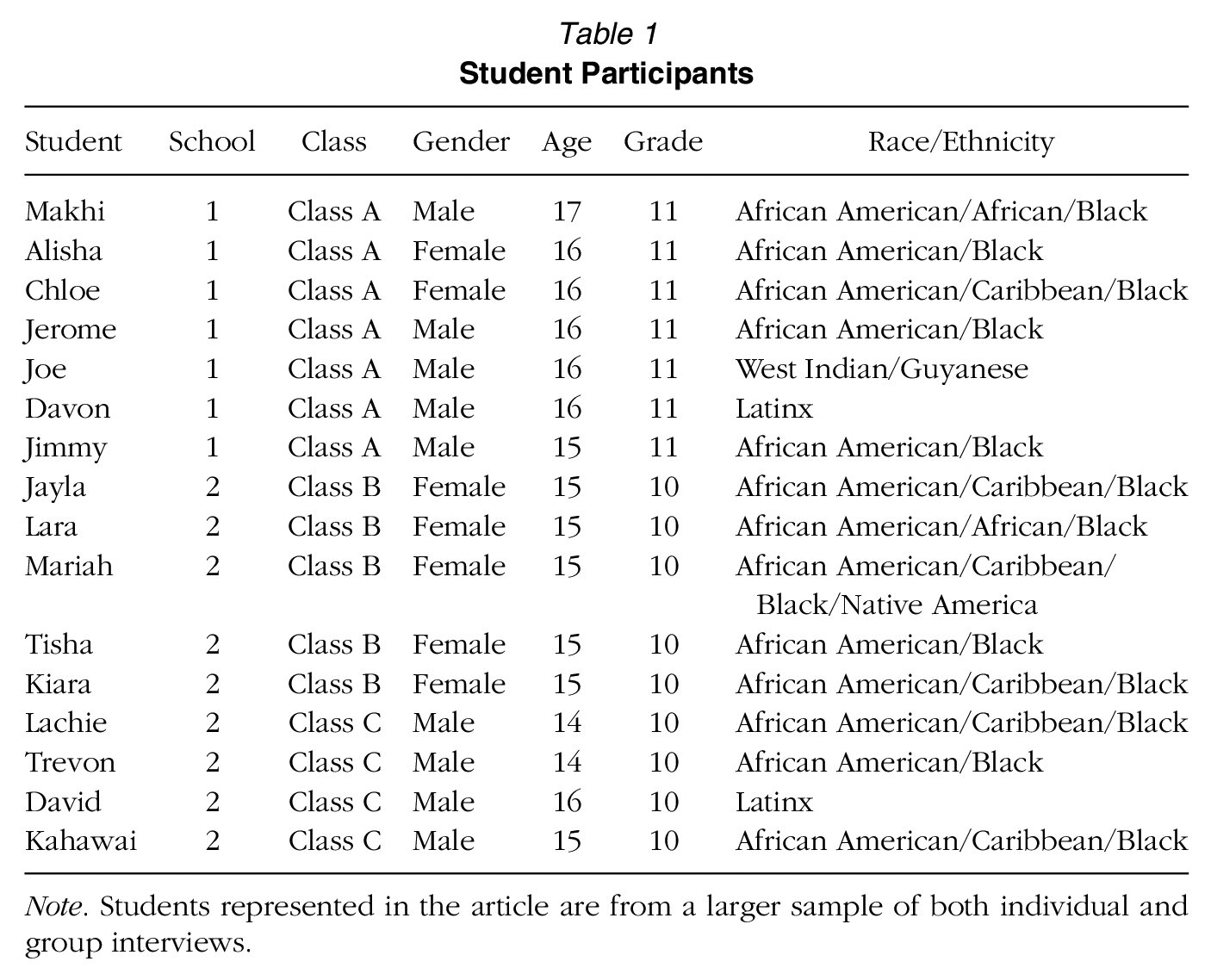
Note. Students represented in the article are from a larger sample of both individual and group interviews.
Each team member introduced herself as a researcher (PI) or student-researcher (RA) who wanted to learn more about students’ experiences in the human rights class. To bridge the distance between the research team and the students, the team deliberately asked to be called by their first names—some students still insisted on calling us “Miss”—and made a conscious effort to have our own chair and desk in the rear of the classroom, next to students, and to engage with them in one-on-one conversations and during group activities. However, the inherent power dynamics and positionality of the research team, which included white and Latina women from an elite university, likely influenced how students interacted with researchers or answered interview questions. To address the authors’ positionality and lived experiences, the research team reflexively examined their own racial and cultural awareness throughout the research process of data collection and analysis (Milner, 2007). Despite differences in backgrounds, the research team consciously sought to connect with the students and understand their lived realities. For example, one of the research assistants (first author) lived in the Bronx two subway stops away from the school at the time of the research and was thus familiar with the social context where the students lived and how it informed their narratives of everyday violence. Moreover, the research team focused on listening to and learning from the students and revised the interview protocol at multiple points during the project to address new ideas emerging from the initial interviews with students.
Usually the interviews were individual; however, on two occasions when students asked to participate in the interview with one of their peers, the interviewer agreed. During the interviews, students were asked open-ended questions about their knowledge of human rights issues, attitudes about human rights, opinions about other groups, and civic engagement. During the first round of interviews and in classroom conversations with students, violence emerged as a topic, so we subsequently added questions to address violence and its connection to human rights in the interviews conducted at the end of the year. We interviewed a purposively selected sample of boys (n = 10) and girls (n = 8; from students who participated in the survey) across different racial and ethnic backgrounds, grades, and family origins at both the beginning and the end of the year. Pseudonyms are used to protect students’ identities. 6 To complement the interviews, the research team observed the weekly HRE classes carrying out more than 100 hours of classroom observations during the academic year. By consistently attending classes with the students several times a week and interacting with them, the research team was able to gain trust and build a relationship with the students.
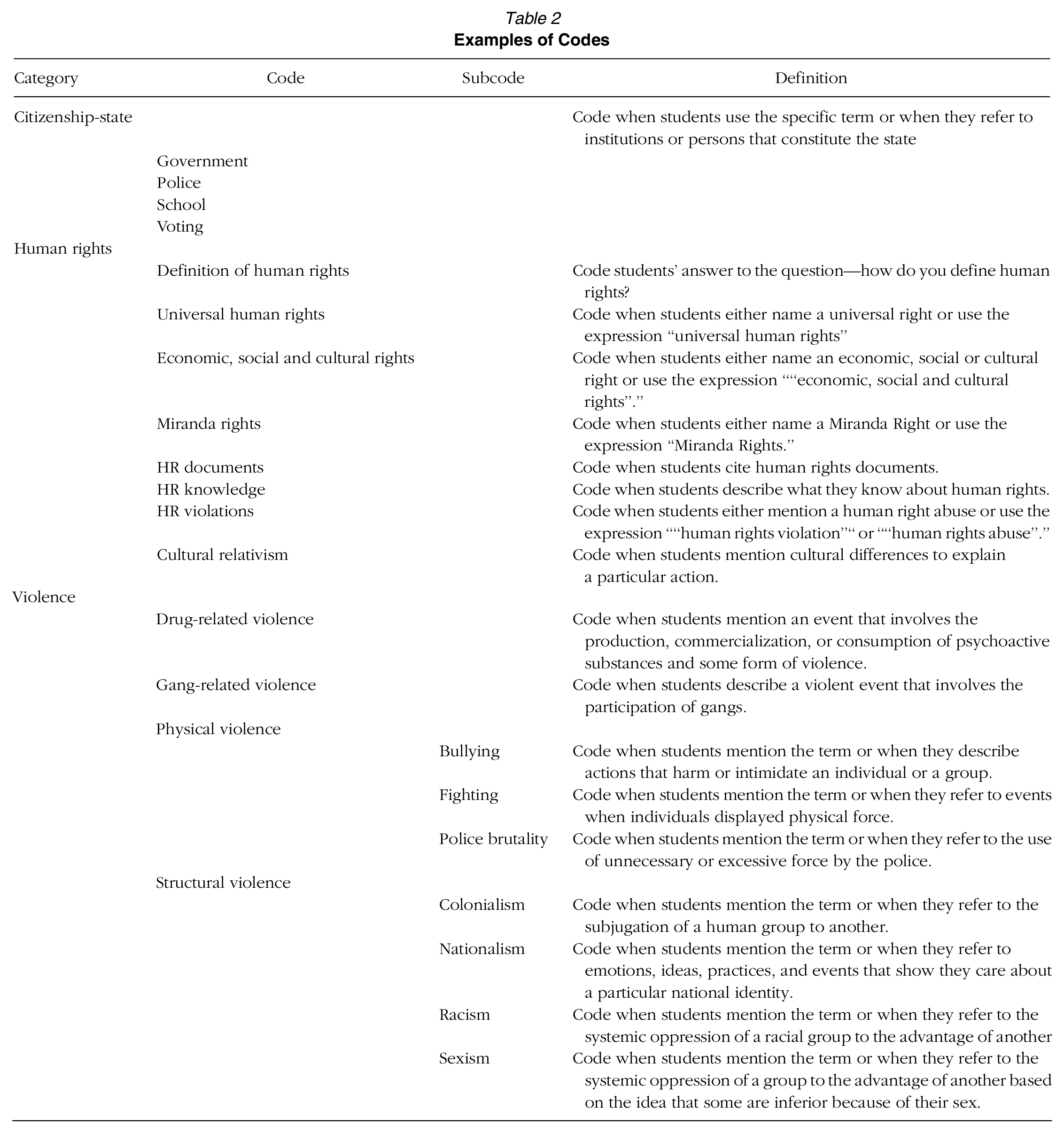
The research team recorded and transcribed the interviews verbatim. Once interviews were completed, the team met to develop the coding protocol, which emerged from initial rounds of coding. Coding entailed predetermined etic codes from the literature (e.g., human rights violations, human rights documents) as well as emerging emic codes (e.g., violence, police brutality, and racial discrimination; see Table 2, for examples of codes). We used both concept coding, aimed at representing broader ideas, and descriptive coding, which describes and summarizes the data (Saldaña, 2016). For example, we first coded the data for our main conceptual themes around human rights and human rights violations, which emerged from the initial focus of the project. We then did a second round of descriptive coding, focusing on the emic codes around direct and structural violence that emerged from the data; these included, for example, fighting, drug violence, and police brutality. The research team coded the qualitative interview and classroom observation data using NVivo software.
Examples of Codes
In biweekly meetings, the team reviewed the coding and resolved any discrepancies across coders. Additionally, at the end of the coding process, the PI merged and reviewed the final coding files. Drawing from this NVivo file, the first author wrote descriptive memos for each participant. The purpose was to trace each student’s learning path, to identify patterns and disruptions in students’ responses in the interview responses and observational data. Once the results from the interviews and the classroom observation notes were found to be consistent and trustworthy, preliminary findings were shared with the full research team. Informed by this collective feedback, the authors wrote analytic memos comparing students’ learning trajectories. In line with the research questions that guide this article, these memos answered the questions: What do students learn in a course structured around human rights violations? How does the curriculum content affect what students understand about human rights? What ideas are left behind?
While the findings are not generalizable beyond the students who participated in our study, the evidence provides insights into how students understand human rights violations as disconnected from structural violence. Moreover, since the study focused on students, we have limited data on the teachers and facilitators, aside from what we could glean from the classroom observations.
Findings
Our findings show that throughout the year, students learned about human rights often in relation to human rights violations. The way students understood human rights violations evolved over the year, from thinking of them as rules broken to identifying them more accurately as violations of rights. However, most students viewed the notion of violence as separate from human rights violations. In the rare cases where they did connect violence and human rights violations, such as in the case of police brutality, they often focused on physical violence and individualized responsibility rather than on broader notions of structural violence.
This section starts with an analysis of pedagogical practices and facilitator-student interactions that position human rights knowledge as knowledge about human rights violations. We then explain the students’ tendency to dislocate human rights from violence-related issues; in closing, we provide an analysis of the limitations embedded in teaching police brutality as removed from broader historical and social contexts.
Learning About Human Rights as Learning About Human Rights Violations
In class, students learned to recognize themselves as rights holders. To the question posed toward the end of the school year, “What do you think was the most important thing you learned?” Jerome, a quiet 16-year-old from Class A affirmed: “We learned about the rights that we have as people and that other people don’t have, and how we could help change that” (5.8.15). Tisha, a 15-year-old student from Class B, replied: “I think learning about our rights as individuals because I don’t think that even you know even basic rights that like our laws, I don’t think teenagers know about” (5.28.15). Similarly, Kahawai, age 15, from Class C, responded: “I learned my rights. I didn’t know my rights before” (5.12.15). This realization came hand in hand with more knowledge about human rights issues.
However, students generally equated human rights with human rights violations, reinforcing what we refer to as the human rights/human rights violations dichotomy, whereby human rights are juxtaposed with human rights violations. In line with the written curriculum, class content across the different classrooms introduced human rights and human rights violations as interdependent. Asking students to list human rights in conjunction with human rights violations was a recurrent practice in both class and assignments. For example, during the first month of the academic year, students played a human rights bingo to summarize the course’s introductory module. Students had to combine different statements—for example, “a clothing factory has employees under 10 years old,” “a husband hits his wife,” “you watch a movie about a woman in Africa who is HIV positive and cannot get access to the medicine that could save her life,” “you join a protest to stop torture at Guantanamo Bay Detention Center”—into six categories: “awareness,” “activism,” “advocacy,” “HumanRightsOrg,” “human rights,” and “human rights violations.” The game directed students’ attention toward the classification of human rights, human rights violations, and advocacy. Class observations revealed facilitators reading statements aloud and students providing answers while adding small paper squares to their game sheets:
The next example is about a clothing factory that has employees under the age of 10. One student says, “HR violation.” The next example is about an assembly in school on ending the death penalty. Students call out “activism” and “advocacy.” The teacher explains that the correct answer is “awareness.” (Class A Observations, 10.13.14)
Facilitator: “An employee factory has employees under 10 years old.”—”Human rights violation,” exclaims one student.—Facilitator: “You read a book about a child forced to be a soldier in Uganda.”—“Uganda,” repeated around the room.—“Human rights violation?” “Awareness. It’s awareness because you’re reading the book.” (Class B Observations, 10.16.14)
The human rights/human rights violations dichotomy was also used as a tool to analyze videos and other materials. During the second half of the academic year, students from Class A watched a video about human rights advocacy campaigns. Classroom observations show that once the video was over, one of the facilitators asked students to name human rights violations: “human trafficking,” “immigrant rights,” “child soldiers,” and “sex trafficking,” they responded (Class A Observation, 3.5.15).
To provide teachers with input for grades, the human rights class included evaluations. Quizzes and informal class check-ins were also framed through the human rights/human rights violations dichotomy:
Quiz Instructions: (a) List 3 human rights; (b) List the 4As [awareness, advocacy, allies, and activism]; (c) What is HumanRightsOrg?; (d) Define “advocacy”; (e) List 3 human rights violations; (f) What is the name of the document that lists 30 human rights? (g) Who is entitled to these 30 rights? (h) What is one thing you can do to raise awareness about a human rights violation? and (i) What is one thing you can do to advocate for the end to a human rights violation? [Italics added]
The facilitator goes over the questions on the review sheets. She asks the students to name five human rights. Jimmy says, “I know my Miranda rights.” The facilitator reviews the answers to the quiz and tells the students that they will take the quiz next time. She asks the students to name five human rights violations. Tamik mentions “no slavery, no discrimination.” . . . She asks for more. One boy mentions “violations of LGBTI rights”; another boy mentions “sex trafficking.” (Class A Observation, 10.24.14)
Data collected in the last interview round show that students equated human rights knowledge with human rights abuses. When we asked students to describe what they had learned over the academic year, all of the interviewees (18 of 18) opted to list human rights violations:
Bullying, child abuse, police brutality, sex trafficking. (Jayla, 5.7.15)
Police brutality, sex trafficking, genocide, school-to-prison pipeline. (Tisha, 5.28.15)
We learned about human rights, the violations like foster care, child labor, it was a lot. (Kiara, 6.5.15)
Racial profiling, genocide, police brutality. (Lachie, 5.6.15)
Genocide in Rwanda. We learned about refugees. Homeless teens. (David, 5.6.15)
We did something on child soldiers throughout the world. We did something about I think, something based on genocide too. Oh yeah, how the kids from Latin America are coming into this country through trains and stuff. (Makhi, 5.1.15)
Even those students who provided more detailed answers prioritized human rights violations over any other content. Mariah and Lara, for example, crafted answers that show the evolution of their thinking around the notion of human rights violations but still reduced knowledge about human rights to knowledge about human rights abuses:
We learned about child soldiers. Like I never knew children like little children could fight in war before. And even with that topic we’re focusing on, child abuse in the foster care, I would think of the foster care as like oh yes it’s like a heavenly place. You know kids get to breathe, get nice family, you know when I heard about it, I was like I, that’s not something I would expect. And even with the centers that kids are supposed to go to like fix them up or whatever but where they gettin’ abused and raped in these facilities. It’s crazy. (Mariah, 5.7.15)
The most important thing that I learned was, child abuse and foster care, the one that we’re campaigning for. Yeah I did not know that children get abused in [the] foster care system. And the runaway teens, I didn’t know that most of them, they go and some of them become prostitutes and stuff. (Lara, 5.7.15)
Throughout the academic year, students’ understanding of what constitutes a human rights violation evolved greatly. When we asked participants to define this term during the first round of interviews, the majority (11 of 18) mentioned home and classroom rules as human rights violations, while only some (7 of 18) identified actual human rights violations. The following examples show students’ willingness to connect class content with their daily experiences:
When somebody tells you to be quiet and we have the freedom to talk. (Trevon, 11.5.14)
I think the right to speak is a human right. So say someone tells me on the train to be quiet that’s basically I think he’s violating my rights ‘cause I have the right to speak so I know that’s a human right violation. (David, 10.29.14)
The right to your own opinion, freedom of speech. I think about that every day when I’m at home. Because my mother, she always be like: “I’m not talking to you” or “be quiet” when she’s speaking. I have a right to say what I have to say. (Kiara, 10.20.14)
I realized that [my human rights] get violated sometimes. For example, in a certain class, we can’t—even though it’s our stuff—we can’t share with our fellow classmates, because, you know, they see our privacy, and even though they told us we could share with them, the teacher’s not allowing it. That’s why I find it’s kind of like a human rights violation. (Makhi, 11.6.14)
Strict classroom rules that involved silence, no laughter, and not moving across the classroom were regarded as human rights violations. In the second round of interviews at the end of the year, the numbers shifted dramatically. Of the 18 students, the vast majority (17) referenced human rights violations accurately. Only one student, Lachie, age 14 from Class C, mixed rules with human rights violations: in addition to police brutality and genocide, he argued that not being able to talk in the movies was a violation of the right to freedom of opinion and expression. The rest of the group either articulated the absence of specific human rights—“freedom of religion,” “right to play,” “right to education”—or referred to incidents representing a wide array of human rights abuses such as “police brutality,” “genocide,” or “child soldiers” as manifestations of human rights violations.
This section illustrates the emphasis that the HRE class gave to human rights violations as human rights knowledge. Students’ answers at the end of the academic year revealed the centrality of naming human rights violations to their classroom experience. They also illustrate how as the academic year progressed, students’ definitions of human rights violations become more accurate. Yet a tension emerges when we note the tendency to dislocate human rights violations from the violence students personally witness and experience. In the next section, we analyze how students made sense of human rights violations in relation to violence and structural violence.
Violence as Separated From Human Rights Violations
Violence was a recurrent topic in students’ descriptions of their own communities. Yet except for the example of police brutality, human rights violations and violence appeared as two separate phenomena: human rights violations were rarely conceived of or explained in relation to the different forms of violence the students personally faced.
Violence emerged in students’ responses to requests to describe their neighborhoods and their relationships with peers and during in-class discussions about police brutality. The majority of the students interviewed (10 of 18) referred to violence as a defining feature of their communities. This included school fighting; drug-related violence, specifically gang battles and shootings; and police brutality. These were physical forms of violence they faced on a regular basis. Joe described the Bronx as a place where “there’s always murder happening” (11.14.14); Jerome portrayed the same area as “gang-controlled territory.” In Brooklyn, David claimed, “there’s a lot of stuff that happens in Brownsville, many shootings” (10.29.14), and Trevon said that he constantly hears about “people getting shot in the community” (5.6.15). Students’ testimonies also evidenced the unpredictability of the violence they were exposed to. Chloe witnessed a shooting in front of her old preschool the same day she was visiting, and David saw a shooting through his bedroom window. Disenchanted, he explained, “I kinda got used to it and it’s hard to say that I have. But it just happens all the time [. . .] It’s normal now” (5.6.15). These testimonies show how the students’ day-to-day experiences as young men and women of color in New York City are shaped by direct forms of violence.
Students’ perceptions and definitions of violence prioritized its physical and psychological dimensions over its structural ones. They tended to understand violence as intrinsic to interpersonal relations: violence is something that emerges in encounters with family members, friends, and the police and that takes place in public or private spaces. Mariah, for example, recognized violence’s multiple manifestations: “Violence to me comes in any form. It could be physical, it could come verbally, it could come mentally, and most of the violence we hear about is physical and war” (Mariah, 5.7.15). However, she did not mention its structural component. Similarly, Davon, a 16-year-old, referred to violence as a means to hurt somebody “mentally and physically” (5.15.15). Lara and Jimmy equated violence with fighting:
Fighting. Fighting in schools. Like you’re wondering who’s gonna fight today because there’s always someone with drama going on [. . .] yeah, fighting is everywhere. (Jimmy, 5.15.15)
I would see violence as in like fighting. I would see violence as in like you know people like [having] their arguments. I would see that as violence. I would see like anything that have to do with conflict like I would see that as violence [. . .] An example of violence is like aggressive force used upon someone else. I would see that as violence. (Lara, 5.7.15)
These definitions were supported by examples from their own lives. Whereas Mariah mentioned a relative who suffered the dramatic consequences of physical abuse, Lara referred to two incidents connected to physical bullying and child abuse; both Davon and Jimmy referred to police brutality.
In some cases, students expanded on these basic definitions by describing violence as an evolving process: “Crazy. Wild. Brutal. Some violence could be calm. Some could escalate to riots and stuff. It sometimes solve problems but it gets to again a problem [. . .] it just seen as actin’ crazy” (Jimmy, 5.14.15). Similarly, Davon and Lachie identified a progressive condition in violence that moved individuals from hurting to killing: “It’s not just physically hurting somebody. You can actually kill somebody taking violence too far and stuff” (5.15.15). In describing the social dynamics of her own community, Lara also echoed this notion of violence as incremental:
Because they start talking about each other and they have beef or whatever and they finally meet each other and it’s no good. And people set out like people for them and there’s just a lot of drama after that. (11.13.14)
Despite the importance that the term “violence” had for students in their efforts to understand and navigate their social world, their testimonies revealed a tendency to dislocate human rights violations from violence. In class, facilitators did not explicitly address human rights violations as manifestations of violence. Predictably, to the question “Have you ever talked about violence in your human rights class?” of 18 students, only eight recognized violence as central to the class, six agreed violence was marginally covered, and four claimed the class had not addressed violence at all. From a curriculum that constantly addressed human rights violations, students from the first group identified violence as linked to three issues: child soldiers, child abuse, and police brutality. This same group acknowledged violence as a relevant topic to learn about. In Jerome’s words: “Yeah it’s relevant, ‘cause now it’s just somethin’ that goes on a lot. It’s a part of the world right now. War and stuff like that. We have to deal with violence a lot” (5.8.15). In the second group—those who did not feel convinced that violence had been a central class topic—we found students who alluded to violence in their communities and daily lives but hesitated in identifying violence in the human rights curriculum. Kahawai, a student from Class C, confidently explained, “I don’t really talk much about violence in the human rights class, but outside in, like the streets or something, there’s violence happening and stuff” (5.12.15). Similarly, Jimmy revealed a tension between the human rights class, which according to him did not cover violence explicitly, and violence being ubiquitous in his life. The last group of students did not recognize violence as a topic addressed in class. Even though during interviews they pinpointed multiple human rights violations, they did not conceptualize these as manifestations of violence. When we asked Alisha, a top student in Class A, if she ever discussed violence-related issues, she said, “I don’t, I don’t . . . I guess genocide would be associated with violence. We didn’t really touch on violence” (5.28.15). Although she acknowledges child abuse, genocide, police brutality, and sex trafficking as human rights violations, she did not perceive these as manifestations of violence. Similarly, at the end of the academic year Kiara named child labor and child abuse as human rights violations but could not remember if the class addressed violence or not: “Violence, violence, violence. I think they did. I don’t remember” (6.5.15).
Students’ difficulties in identifying human rights violations as manifestations of violence reflected a pedagogical approach that did not build explicit links between human rights abuses and any form of violence; rather, as classroom observations show, the curriculum and pedagogy prioritized labeling events as human rights violations over explaining these within wider political structures and practices. Under this strategy, facilitators introduced human rights violations as exceptional events with no historical background and little analysis of actors’ roles, interests, and decisions. Also, except for explicit manifestations of physical violence in the topic addressed, the term “violence” was rarely mentioned.
We now focus our attention on police brutality as a case to illustrate how the absence of discussions about structural violence in the classroom limits students’ understanding of human rights violations against them and their own communities.
Untouched by Structural Violence: Students’ Understanding of Police Brutality in the United States
In contrast to the genocide in Rwanda or the deployment of child soldiers in Liberia, which students viewed as remote and irrelevant, they understood police brutality as a human rights violation that spoke directly to their lives and the lives of their families and acquaintances. Police brutality as an important concern was present in the curriculum, in the anecdotes students shared in class, and even in the designs of their T-shirts, which mocked and defied stereotypes of young men of color as criminals: “I’m just a kid from the Bronx,” one could read on Makhi’s T-shirt. As classroom observations demonstrate, students were aware of the high levels of racial violence they were facing:
The class starts at 11:21. After students find their places, Mikael [the facilitator] starts the class, saying, “It’s been a month since we last met. A lot being in the news since we last met.” Students and Mikael drop names of African American men killed by the police. Michael Brown. Eric Garner. Tamir Rice. Ella mentions the case of a black man killed in Tulsa, Oklahoma. Another student mentions an incident in North Carolina. Mikael summarizes the stories, “This is basically what is under investigation right now.” Ramala mentions the police didn’t do CPR, and then adds, “The video is on Facebook.” “That is so stupid, that’s stupid!’ (Class A Observation, 4.17.15)
Police brutality resonated with students’ daily experiences walking down the street, taking the subway, and going into their apartment buildings. Across schools, police brutality was introduced and analyzed as an interpersonal matter between police and youth. In the curriculum, police brutality included one session on personal stories related to racial profiling and one session on police encounters, which was led by a guest speaker from the New York Civil Liberties Union and aimed to provide students with concrete self-protection strategies. To begin the conversation, students received a handout featuring information about Trayvon Martin, Michel Brown, Eric Garner, and Akai Gurley. After silently reading the handout, students were asked to share personal stories and come up with ideas about current protests. Facilitators and teachers led class discussions with questions such as—“How do you feel about the protests?” “Who else feels that their rights are limited?” “How could you change the perception that African Americans are violent?” “How many of you are stopped once a week?” “What do others think about the charge or indictment [to a police officer]?” “Does anyone else feel that the police are above the law?” In the next class, students learned concrete strategies to navigate encounters with police.
The following field note is representative of classes across the three classrooms; it illustrates the facilitator’s emphasis on teaching how to avoid unjust arrest. By providing specific instructions on using speech and body language during encounters with the police, the facilitator dislocated police brutality from its historical and political conditions:
Students are attentive. The classroom is quiet. Jocelyn [facilitator] says that you never have to speak to a police officer. But there are times when you should deescalate the situation. Jocelyn shares the 5 finger rule—answer in 5 words or less. “If an officer asks, ‘What are you doing?’ answer that officer in 5 words or less.” Students respond: “Minding my business.” “Stop speaking to me please.” Jocelyn tells students to stay calm and be polite. One student responds, “They don’t be polite.” Jocelyn asks, “Do you have to show your ID?” Students say no. They are chatty. Jocelyn asks, “Should you?” Some students say yes and some say no. Jocelyn says you might want to. Jocelyn says the first thing you should ask is, “Am I free to go?” Student asks, “What if the answer is no?” Jocelyn responds that if the answer is no, they’re in a detention, no longer in an encounter. “At this point you cannot leave. But do you have to speak?” Students say no. They are quiet again. Jocelyn explains, “The police officer can stop you for running from a scene of the crime, running from a group in a high-crime neighborhood, if you fit the description of suspect, and if standing close to a reported crime.” (Guest speaker, Classroom Observations, Class B, 01.16.15)
Responding to the set of instructions the facilitator shared, the students paid attention and fully engaged: They asked and answered questions, served as models for police searches, and even corrected one student when she did not get the right answer. Through a lens that individualized the problem, the best immediate solution relied on students’ ability to navigate these encounters safely. The emphasis on individual experiences and face-to-face encounters with the police over a critical analysis of state-sponsored violence, including the mass-incarceration system was evident across classrooms.
Informal interactions between students while planning their advocacy campaigns on police brutality also demonstrate an emphasis on students’ individual attitudes and responsibilities in handling the police. For example, consider this exchange between Marcus and Zion. Marcus: “We should have like a peace treaty and like compromise with each other. For Black people that have families, talk to them about police brutality especially their sons because they are more likely . . . [to experience police brutality].” Zion asks what can be done about it. Marcus: “Try not to act suspicious like not putting our hands in our pockets. I would ask the police ‘Why am I being detained?’ ‘What crimes am I committing?’” (Class B, 4.15.15). In the same class, after David states “police brutality should be banned,” Shemar naively responds, “I believe that Black and Latino males and women having better communication with police would help” (Class B, 4.15.15). One week later, as the facilitator asks the group what they learned from the video they watched, Deondre explains: “You shouldn’t have an attitude or talk back to the police and that if you know your rights, go over them so they can’t abuse you or anything” (Class B, 4.29.15).
As the end of the academic year approached, students prepared to launch their advocacy campaigns. In both the Bronx and Brooklyn, the message was similar: through docile behavior young people of color can avoid police brutality. Makhi, a top academic performer and basketball player from Class A, opened the event with his personal remarks:
They fear a rise of us coming up. They are afraid of us. But what I mean, “us” is the minority. But we come in peace. We do not harm at all. But sometimes we portray ourselves as beasts. So in the eyes of the police we look like animals. Don’t get confused, I am not choosing a side, I am just speaking the truth. I believe the harm they are doing to us is wrong. They are killing our people in the name of self-defense. (Makhi, 05.21.2015)
He invites his peers to behave properly to avoid giving the police reasons to be violent.
This section illustrates the way that teaching about human rights violations outside of a structural violence framework limits students’ understanding of their own reality. The tendency to teach human rights violations as exceptional events disarticulated from history and broader societal arrangements prepares students to accept grave human rights violations as interpersonal matters. Even though this approach addresses students’ immediate needs for self-protection, it does not point them toward developing any critical understanding of the long-term and systemic dimensions of racism.
Discussion
In this article, we analyze the case of a HRE curriculum that emphasized knowledge about human rights as knowledge about human rights violations. Our findings reveal that through exposure to a human rights course, students understood the importance and relevance of human rights frameworks. In addition, students were able to develop a deeper understanding of the meaning of human rights violations, evolving from rules to actual violations of rights. Nonetheless, we also find that aligned with the curricular content, students generally conceptualized human rights vis-à-vis human rights violations, pointing to the tendency to dichotomize human rights rather than explore the social and historical context that gave rise to specific human rights violations.
This research sheds light on the challenges students faced linking two concepts that could complement each other: human rights violations and violence. Despite the importance of different forms of violence in shaping students’ everyday experiences, through a curriculum that approached human rights violations as a series of isolated cases, they struggled to establish connections between this concept and the different forms of violence they experienced daily. Violence was prevalent in these students’ communities and schools; however, only a subgroup of students (8 of 18) directly related violence to their understanding of human rights and human rights violations. While studies in the field of HRE have demonstrated students’ tendency to assume that human rights violations are distant or international events (see Barton, 2015; Branigan & Ramcharan, 2012; Kim, 2019), this research illustrates that the proclivity to introduce human rights violations as emblematic and ahistorical cases spread across the curriculum, directed students’ attention toward the physical violence inflicted on the human body rather than on structural issues.
Although by the end of the year almost all students were able to identify human rights violations correctly, they often viewed violence as a separate phenomenon, one unrelated to human rights violations. When linking human rights to violence in their own lives, they often framed this in terms of physical violence related to gang activity, drugs, or police violence, which is especially salient in the context of urban schools (see Astor & Meyer, 2001; Dupper & Meyer-Adams, 2002; Meyer-Adams & Conner, 2008). Students’ testimonies showed a general tendency to provide definitions of violence that prioritized the physical and psychological dimensions over the invisible forces that shape the unequal distribution of power in society.
In contrast to recent work that demonstrates the capacity of structural thinking to increase students’ ability to historicize exclusionary and violent practices (see Hope et al., 2014; Schensul & Berg; 2004) and make sense of how society is organized (see McArthur & Muhammad, 2020 Seider et al., 2016), this research shows that the curriculum offered little feedback or opportunity to expand students’ understanding of the structural and social conditions that produce human rights abuses. The curriculum did not support instruction related to the current systems of oppression—capitalism, colonialism, racism, sexism, nationalism—that connect apparently isolated events across time and space. Subsequently, students learned how to identify but not necessarily how to explain the eruption and persistence of human rights violations or understand human rights violations as manifestations of deeper societal issues. Simultaneously, it overlooked the actors and decisions that configure the conditions for human rights violations to take place. This study illustrates that teaching human rights abuses outside a historical and political context limits students’ potential to capture those indirect forms of violence that generate the inequalities they navigate daily. To teach human rights through local issues makes the curriculum more relevant to students’ everyday experiences but not necessarily more conducive to critical analyses.
In the case of police violence, which most students identified as a clear example of a human rights violation, students generally focused on the physical manifestations of violence and the individual responsibility to prevent this violence rather than on the historical and social structural conditions that gave rise to it. The facilitators’ emphasis on self-protection reduced the widespread racial inequalities across the U.S. criminal justice system to a particular version of police brutality. This pedagogical approach detaches police brutality from the long history of segregation, racial bias, and state-sponsored violence in the country (Alexander, 2012). It separates it from related phenomena such as the school-to-prison pipeline and the mass incarceration of young men of color. The historical and racialized roots of police brutality were neglected, and the focus was placed on best-practice personal responses to police brutality. Although it did not aim to place the onus of police violence onto potential victims, the curriculum did not help students render visible and denounce the violence that perpetuates institutionalized racism. Similarly to Kim’s (2019) findings in Korea where students focused on individual responsibility over an structural analysis of domestic human rights abuses, in these three classrooms, students, in general, failed to connect such instances of violence to societal arrangements linked to structural violence (Farmer, 2004a; Galtung, 1969) or connect a history of racial discrimination and injustice in the United States to the violations they identified. Although students were taught practical knowledge to help them navigate encounters with the police and help reduce the danger of those encounters, powerful knowledge, as knowledge that would help the students understand the prevalence and structural origins of police brutality, was neglected.
Conclusion
We argue that while grounding HRE in an international legal framework is foundational (Tibbitts, 2018), teaching human rights only through legal instruments decontextualized from the local historical and social context renders invisible existing structural inequalities, inequalities that continue to have grave effects on marginalized populations in the context of the United States. Although learning about human rights implies learning its legal origins, we propose that HRE and the study of human rights violations must be situated historically and connected to how society is structured in order for students to grasp how individual and collective histories intersect and influence current conditions, including social inequality. For HRE to become effective in the struggle for rights, we need to provide students with conceptual tools that help them better understand how human rights violations are produced in the first place—that is, their root causes. By integrating structural violence into the distinctive discourse of human rights, we argue that students could gain new opportunities to approach and understand human rights violations as instances where local events are connected to national and global dynamics and where concrete everyday experiences respond to wider structural arrangements.
In this context, we situate powerful knowledge as a productive avenue to strengthen HRE’s knowledge base. First, we consider it essential to structure the curriculum so that the human rights discourse and the human rights case studies commonly used as examples are historically situated. This shift implies naming and explaining the social and economic forces that incubate forms of violence in relation to the role that different actors play, their purposes, and interests. This step can create learning opportunities for students to account for those who benefit and lose in situations where human rights violations are palpable. In dialogue with Tibbitts (2002) and Kim (2019) who argue for a conceptually complex understanding of human rights, we suggest incorporating complementary concepts from different disciplinary fields. Expanding HRE’s conceptual framework can help students explore the human rights discourse’s potential and scope as it has been formulated thus far. In this case, we advocate for the use of structural violence as a means to expand students’ understanding of what constitutes a human rights violation. This strategy can also help them transcend the bare description of human rights legal instruments and shed new light on their everyday experiences. Although we recognize that incorporating a broader conceptual repertoire might imply addressing the ambiguous relationships between related concepts, this study’s findings demonstrate the importance of making connections across abstract ideas tangible and obvious for students. Based on these premises, we propose that rather than situating the notion of human rights violation as an end in itself, educators approach it as a platform of inquiry. As such, it can help reveal the social forces that shape our societies, including both the physical and the more subtle manifestations of violence. Finally, we argue that it is vital for students to engage critically with the possibilities for political action each social milieux affords. We concur with Barton (2020), that the curriculum should offer plenty of opportunities for students to acknowledge and experiment with the social mobilization strategies and institutional mechanisms that make long-term change possible.
By bringing the notions of structural violence and powerful knowledge (Parker, 2017; Young 2013) to the examination of human rights violations, we aim to expand HRE’s transformative potential, specifically the knowledge students need to engage in an active and critical analysis of their own conditions. In line with Bajaj et al. (2017) and using ’Young’s (2013) notion of powerful knowledge, we sustain that the curriculum can use everyday practical experiences as hooks to engage students and show them the relevance of the content to come. However, a powerful HRE curriculum should do more than this: it should go beyond common-sense knowledge and incorporate concepts that support students in moving beyond the specificities of their personal experiences (Young, 2012). Although human rights violations is a term normally used within the human rights global regime to index actions—abuses of power—that go against human dignity, in HRE this same term is used to define educational goals, prescribe curriculum content, and inform class didactics. Findings from this work problematize this trend. By describing human rights violations as manifestations not only of violence but of structural violence, we offer a conceptual and pedagogical alternative that not only recognizes human rights abuses as catalysts for legal and humanitarian action but also provides students with explanatory tools to produce new, critical interpretations of their surroundings. By examining the pedagogical use of human rights violations in HRE, this study shows that the equivalency between human rights and human rights violations constrains how students integrate this educational content into their lives.
To support students in developing forms of political action rooted in critical analysis of society and thus amplify ’Love’s (2019) call to embrace education as a path to radical change, we present the notions of structural violence and powerful knowledge as conceptual and pedagogical tools to support educators in moving beyond the legalistic formulations prevailing in HRE. Future research is needed on the pedagogical strategies necessary to teach about structural violence within a human rights framework in a way that spearheads students’ willingness to engage in transformative action.
Footnotes

Notes
D
S. G